
























Bethlehem, or the city behind the Wall.
 Oct 24, 2020 | 2:35 am
#16
Original Poster

Join Date: May 2014
Posts: 8,119
I lived in Israel in my younger days for about one and a half years at my longest. Two previous trips were to attend summer camp and a family trip. I have family still living there who want me to visit, but with COVID, that’s not happening now. I’m looking forward to your additional posts.
 Oct 24, 2020 | 12:43 pm
#17
Original Poster
Join Date: May 2014
Posts: 8,119
The non-Nativity tour of Bethlehem
There’s three of us today: a Flemish Belgian lady and her teenage daughter and me. Our guide is Waleed: a forty-something Palestinian with a sandpaper stubble, leather jacket and obligatory packet of cigarettes at the ready. I wanted to know more about the reality of living in Bethlehem: nothing better than Waleed, born and bred in a nearby refugee camp.
Outside the weather has, if anything, turned worse: I’ve dug out my rainproof jacket but, instead, Waleed’s lime green Corsa is pressed into service. Before we can hop in the car, though, Waleed invites us to check out his numberplate, which we do. It’s white and green, with Arab letters and numbers. It’s the start of a brief lesson on transportation in the West Bank and the biggest, at least for me, takeaway of this journey. Cars with yellow numberplates can go almost everywhere; cars with white-and-green plates can’t. Jerusalem, the Med, Gaza are out of question for Waleed and his lime Opel. But so is a long listof roads within the West Bank itself. Route 557. Route 5. Route 404. Route 413. Route 60. Route 43. And more.
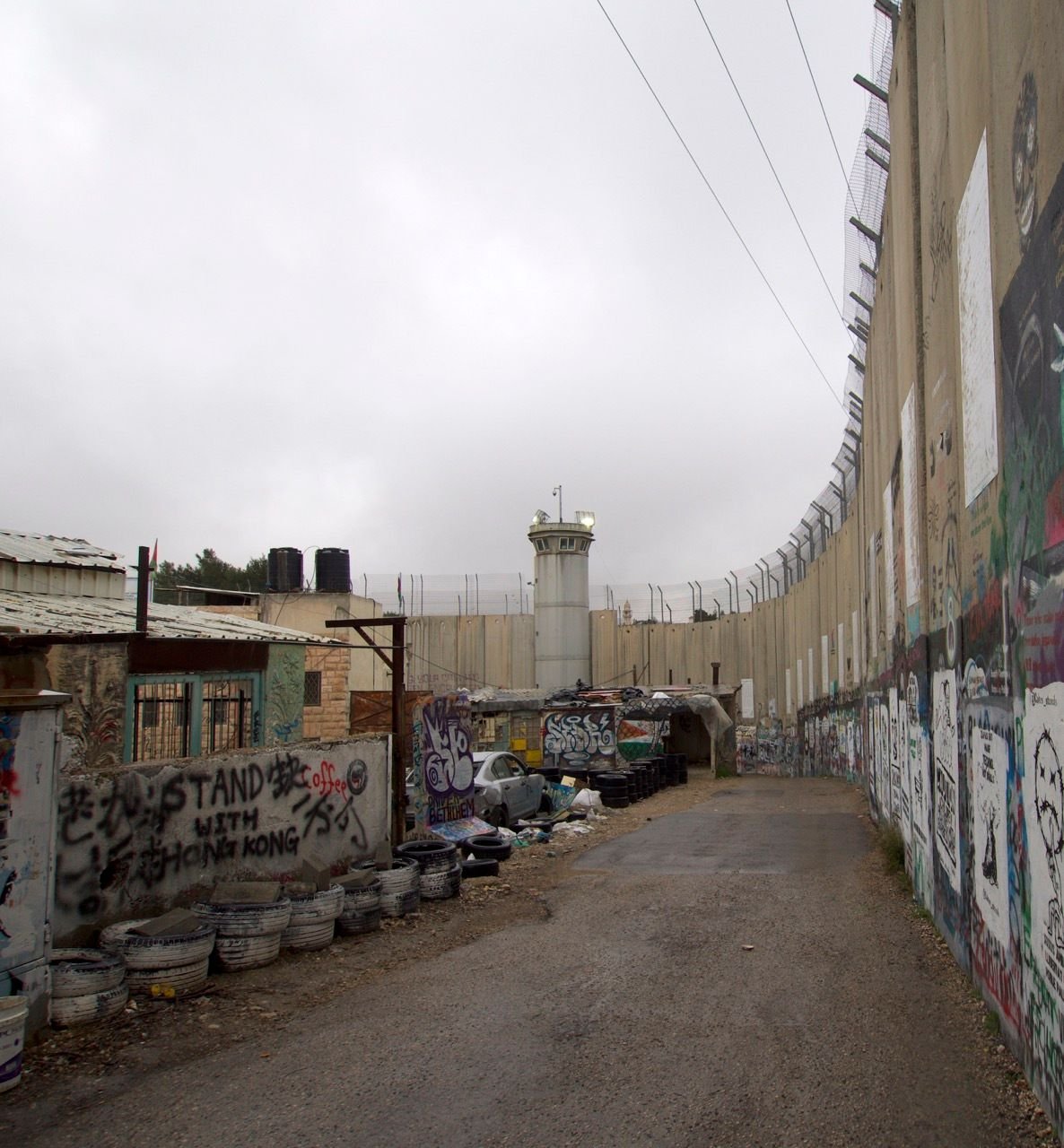
Life in Palestine, we begin to understand, is more complicated – and constrained – than we could ever imagine. I guess that the current situation (lockdowns, curfews and so on) has offered us a glimpse into it; but there’s no promise of a vaccine to open up the West Bank.
It’d be remiss of me if I were to ignore the principal purpose of the wall, which was to stop attacks. It’s perhaps not surprising if Waleed fails to mention that, though the Walled Off’s permanent exhibition is, too, silent on this aspect. The numbers, however, cannot be ignored: in the three years prior to the building of the wall there have been 70 bombings, causing 293 victims. All these were perpetrated by suicide bombers coming from the West Bank. After the wall went up, the number decreased to 12 in the same length of time and is now at zero.
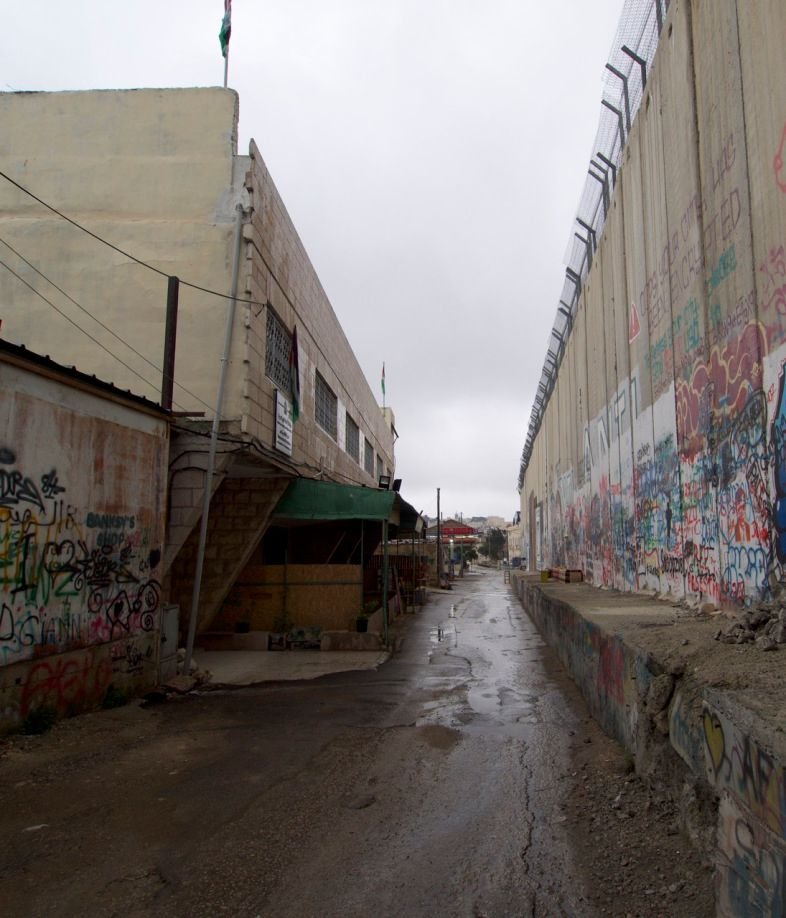
As sad as it can be I can get the reason behind the wall. What do you do when two neighbours can’t stand each other but can’t leave their homes? Build a wall and wait for time to do its magic (or for the Sun to swallow the system, whatever comes first). But… still, there’s something that doesn’t quite square with that.
The wall, as Waleed mentions, should follow the 1949 armistice line. Said line, which you can see here in the map below (from the Walled Off room I was staying in) is five km from Bethlehem.

And yet here the wall is. Crawling into the city’s urban texture, carving out an inaccessible space right in the city. Why?
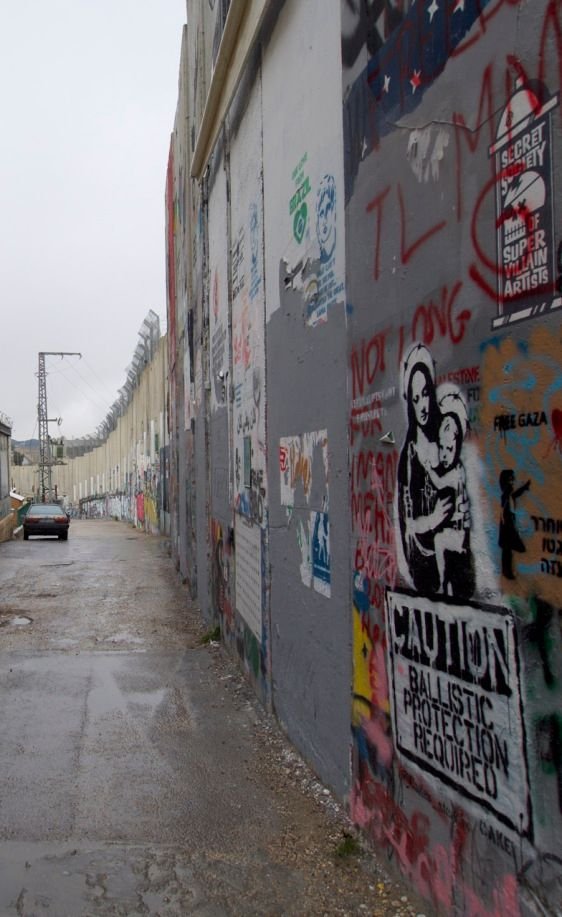
“Rachel’s tomb is behind there”, says Waleed, pointing behind the wall. “It’s a sacred place for settlers, so they can come visit”. And we can’t, he seem to imply.
This, too, is a fact. The overall length of the West Bank defence measures is longer than the actual border; a lot of it is due to orography and the challenges of a landscape unsuitable for building, but a lot is for political reasons, such as here. The UN, in a 2016 survey, found 490 obstacles to the freedom of movement of Palestinians and, try as much as I could, I struggle to reconcile all this with the legitimate desire of keeping Israelis safe.
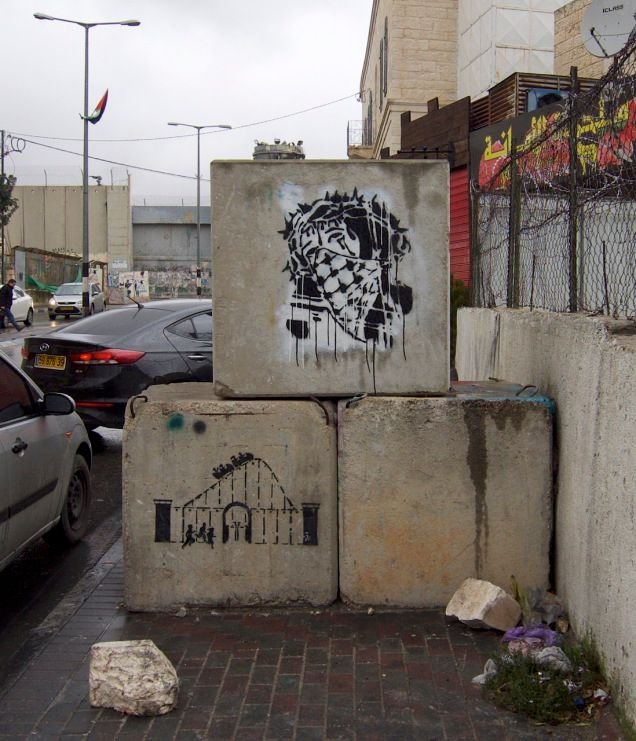
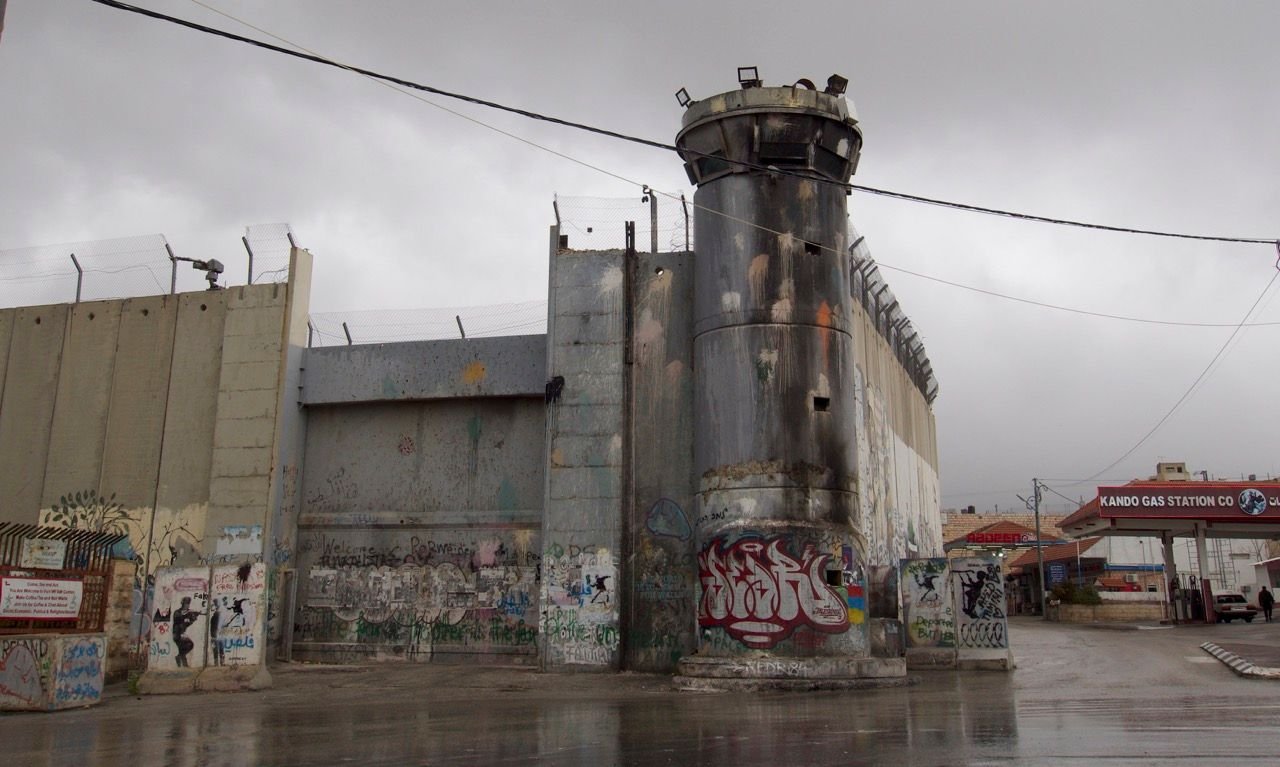
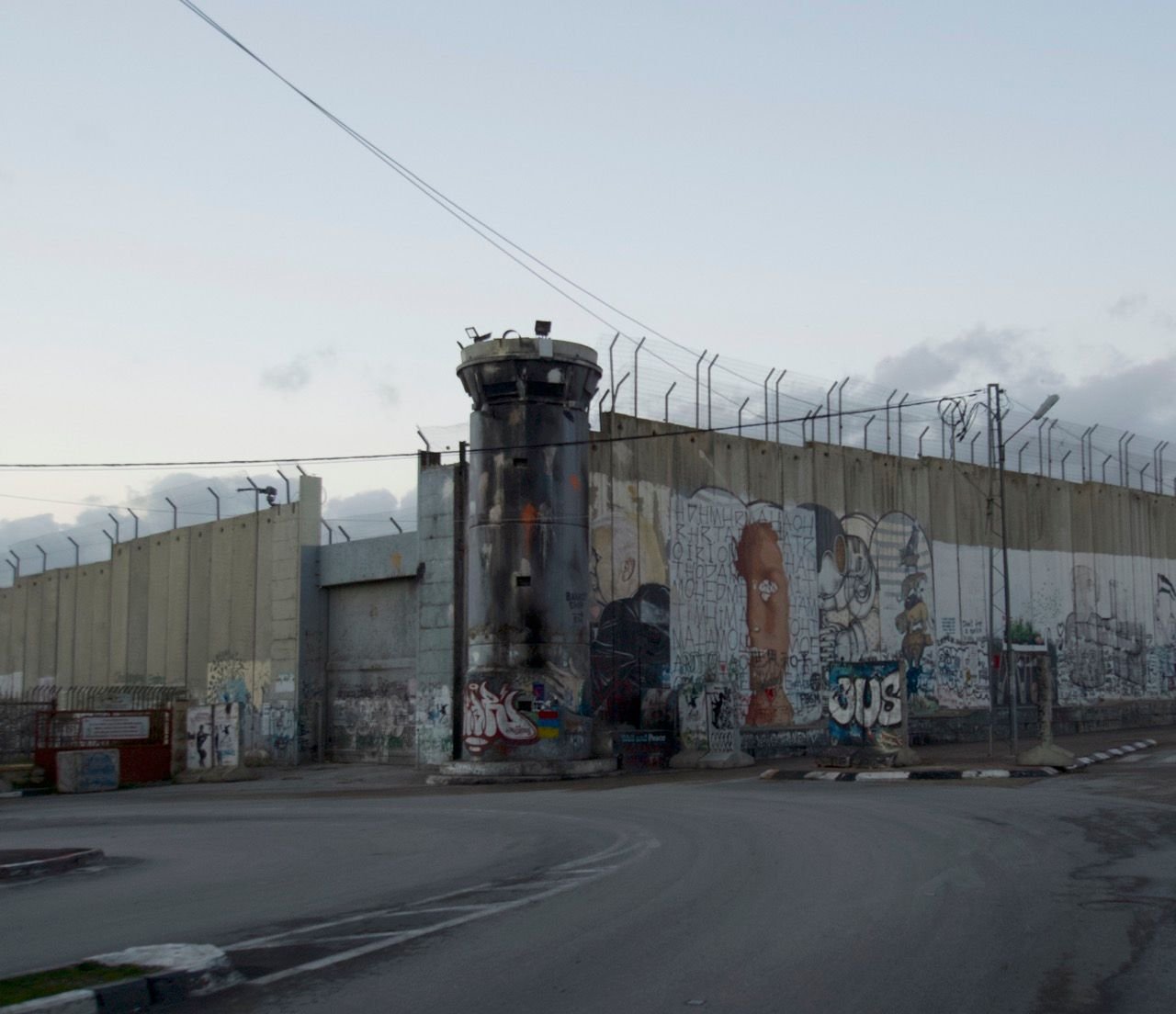
We dismount from the Corsa and walk around the tower and the gate that opens on Hebron road. Here the wall is at its ugliest, covered in graffiti, burned by petrol bombs and rubbish set on fire. Along the road are blocks of concrete placed at regular intervals: walls taller than a person and cubes with rough stairs cut behind them. “They’ve been placed by the Israelis, so that they have cover when they do raids in town. The council doesn’t dare moving them”, noted Waleed.
You’d be excused to think this wall a medieval solution, a throwback to a darker age, with men-at-arms ready to throw arrows and boiling oil from the ramparts in case of an assault. But the wall is brimming with the latest tech, a fact that becomes clear as we turn left in our journey and enter Aida refugee camp.

The camp’s no longer such: it’s become a densely packed town, multi-storey houses rising elbow-to-elbow, schools and workshops abutting the wall. Here we meet Nabil, a 22-year old student and activist. He begins rattling off an impressive array of hardware: “There’s skunk water – the cannon is above the gate on Hebron road. Then there’s tear gas, rubber bullets, sponge grenades, flash-bangs, stinger grenades, the Scream”.
Our encounter with Nabil is the low point, at least for me. Nabil has a Palestinian ID card, meaning that he is barred from entering most of Israel; as such, he’s never been to the Mediterranean. “Can you imagine”, he says, “I’m 22 and I’ve never been abroad. I’ve never seen the sea”. His passport ranks 101st out of 106 in the Henley Passport Index. “You’d expect that at least the Arab countries would allow us to travel but we can only go to Jordan. Turkey gives us visa easily, but that’s it…” he trails off. He was due to visit Italy in March, guest of a family in the north of the country. “I can’t wait to see the sea”, he smiled, oblivious to the idea of having to drive for hours to Amman to catch his flight to Milan (Ben Gurion airport is obviously off limits). Knowing what happened after, I doubt Nabil ever made it to the Med.
We finish our walk in Aida camp. Nabil takes us to his school, placed next to the wall. As a teenager, he and his friends would pelt the wall with stones and Molotovs, “the wall” retaliating with tear gas, flashbangs and stinger grenades. The violence left streets littered with spent canisters, so much so that a recycling trade sprouted up, with shops selling jewels and everyday articles made with the aluminium harvested from the ordnance.
Like the late Anthony Bourdain, I’ve always been of the opinion that the best antidote to prejudice and racism is to walk a mile in somebody’s shoes. To talk, to share a meal, to understand that, after all, we’re not that different. Has Nabil ever spoken to an Israeli? Has he ever met one, talked with one?
“How?” he laughs. “With that thing in the way?”
To be continued; feel free to check out my blog Are We There Yet? for more.
There’s three of us today: a Flemish Belgian lady and her teenage daughter and me. Our guide is Waleed: a forty-something Palestinian with a sandpaper stubble, leather jacket and obligatory packet of cigarettes at the ready. I wanted to know more about the reality of living in Bethlehem: nothing better than Waleed, born and bred in a nearby refugee camp.
Outside the weather has, if anything, turned worse: I’ve dug out my rainproof jacket but, instead, Waleed’s lime green Corsa is pressed into service. Before we can hop in the car, though, Waleed invites us to check out his numberplate, which we do. It’s white and green, with Arab letters and numbers. It’s the start of a brief lesson on transportation in the West Bank and the biggest, at least for me, takeaway of this journey. Cars with yellow numberplates can go almost everywhere; cars with white-and-green plates can’t. Jerusalem, the Med, Gaza are out of question for Waleed and his lime Opel. But so is a long listof roads within the West Bank itself. Route 557. Route 5. Route 404. Route 413. Route 60. Route 43. And more.
Life in Palestine, we begin to understand, is more complicated – and constrained – than we could ever imagine. I guess that the current situation (lockdowns, curfews and so on) has offered us a glimpse into it; but there’s no promise of a vaccine to open up the West Bank.
It’d be remiss of me if I were to ignore the principal purpose of the wall, which was to stop attacks. It’s perhaps not surprising if Waleed fails to mention that, though the Walled Off’s permanent exhibition is, too, silent on this aspect. The numbers, however, cannot be ignored: in the three years prior to the building of the wall there have been 70 bombings, causing 293 victims. All these were perpetrated by suicide bombers coming from the West Bank. After the wall went up, the number decreased to 12 in the same length of time and is now at zero.
As sad as it can be I can get the reason behind the wall. What do you do when two neighbours can’t stand each other but can’t leave their homes? Build a wall and wait for time to do its magic (or for the Sun to swallow the system, whatever comes first). But… still, there’s something that doesn’t quite square with that.
The wall, as Waleed mentions, should follow the 1949 armistice line. Said line, which you can see here in the map below (from the Walled Off room I was staying in) is five km from Bethlehem.
And yet here the wall is. Crawling into the city’s urban texture, carving out an inaccessible space right in the city. Why?
“Rachel’s tomb is behind there”, says Waleed, pointing behind the wall. “It’s a sacred place for settlers, so they can come visit”. And we can’t, he seem to imply.
This, too, is a fact. The overall length of the West Bank defence measures is longer than the actual border; a lot of it is due to orography and the challenges of a landscape unsuitable for building, but a lot is for political reasons, such as here. The UN, in a 2016 survey, found 490 obstacles to the freedom of movement of Palestinians and, try as much as I could, I struggle to reconcile all this with the legitimate desire of keeping Israelis safe.
We dismount from the Corsa and walk around the tower and the gate that opens on Hebron road. Here the wall is at its ugliest, covered in graffiti, burned by petrol bombs and rubbish set on fire. Along the road are blocks of concrete placed at regular intervals: walls taller than a person and cubes with rough stairs cut behind them. “They’ve been placed by the Israelis, so that they have cover when they do raids in town. The council doesn’t dare moving them”, noted Waleed.
You’d be excused to think this wall a medieval solution, a throwback to a darker age, with men-at-arms ready to throw arrows and boiling oil from the ramparts in case of an assault. But the wall is brimming with the latest tech, a fact that becomes clear as we turn left in our journey and enter Aida refugee camp.
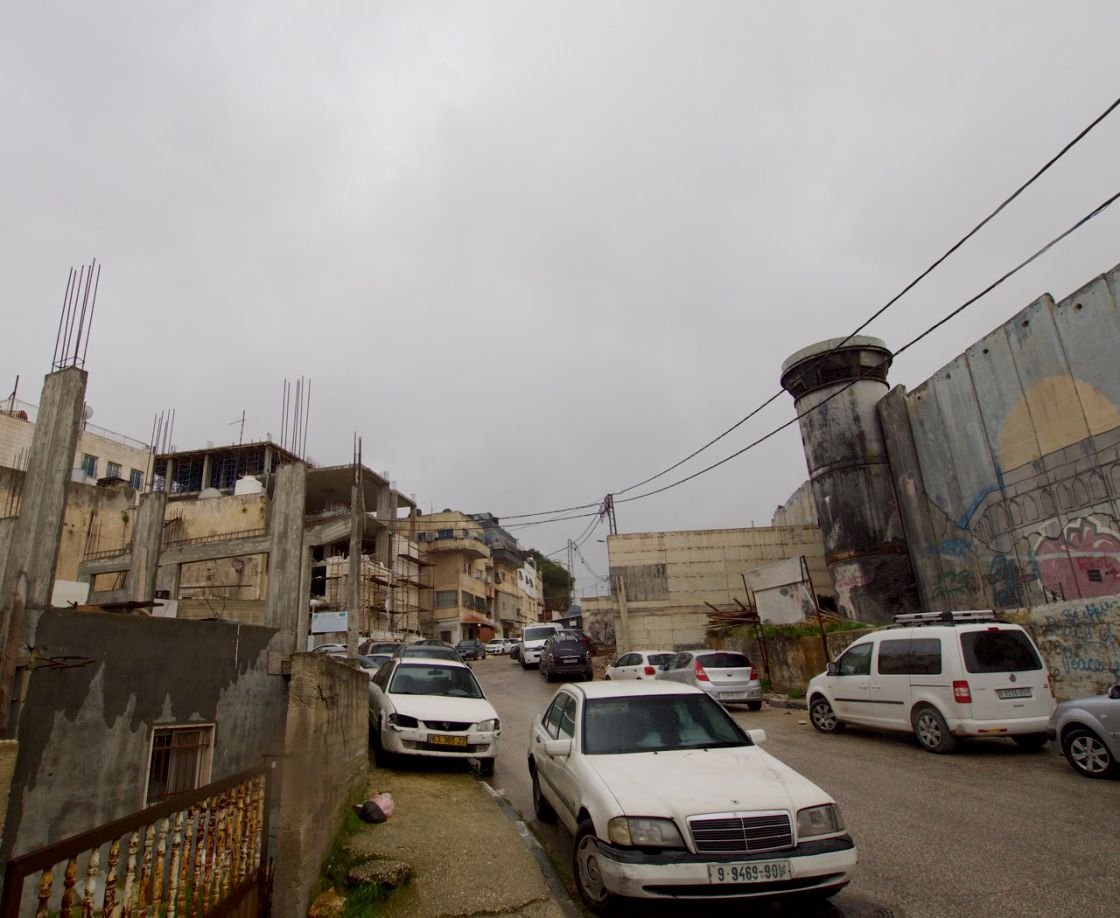
The camp’s no longer such: it’s become a densely packed town, multi-storey houses rising elbow-to-elbow, schools and workshops abutting the wall. Here we meet Nabil, a 22-year old student and activist. He begins rattling off an impressive array of hardware: “There’s skunk water – the cannon is above the gate on Hebron road. Then there’s tear gas, rubber bullets, sponge grenades, flash-bangs, stinger grenades, the Scream”.
Our encounter with Nabil is the low point, at least for me. Nabil has a Palestinian ID card, meaning that he is barred from entering most of Israel; as such, he’s never been to the Mediterranean. “Can you imagine”, he says, “I’m 22 and I’ve never been abroad. I’ve never seen the sea”. His passport ranks 101st out of 106 in the Henley Passport Index. “You’d expect that at least the Arab countries would allow us to travel but we can only go to Jordan. Turkey gives us visa easily, but that’s it…” he trails off. He was due to visit Italy in March, guest of a family in the north of the country. “I can’t wait to see the sea”, he smiled, oblivious to the idea of having to drive for hours to Amman to catch his flight to Milan (Ben Gurion airport is obviously off limits). Knowing what happened after, I doubt Nabil ever made it to the Med.
We finish our walk in Aida camp. Nabil takes us to his school, placed next to the wall. As a teenager, he and his friends would pelt the wall with stones and Molotovs, “the wall” retaliating with tear gas, flashbangs and stinger grenades. The violence left streets littered with spent canisters, so much so that a recycling trade sprouted up, with shops selling jewels and everyday articles made with the aluminium harvested from the ordnance.
Like the late Anthony Bourdain, I’ve always been of the opinion that the best antidote to prejudice and racism is to walk a mile in somebody’s shoes. To talk, to share a meal, to understand that, after all, we’re not that different. Has Nabil ever spoken to an Israeli? Has he ever met one, talked with one?
“How?” he laughs. “With that thing in the way?”
To be continued; feel free to check out my blog Are We There Yet? for more.
Oct 24, 2020 | 1:16 pm
#18
Original Poster
Join Date: May 2014
Posts: 8,119
A sunset over Bethlehem
We leave our tour with Waleed and Nabil and I return to the Walled Off. Of all the emotions I’ve been through, the most pre-eminent is of oppression. It’s a feeling I’ve re-discovered at the height of the lockdown, in March and April, though worsened by the knowledge that this situation, in the West Bank, is permanent. I try and imagine what my life would be if my horizons were shrunk to the dimensions of the space that’s available to the average Palestinian and it’s not a nice thought. It happened before; it’ll undoubtedly happen again: I’m glad that the wheel of fortune of life has given me a passport with “European Union” emblazoned in golden letter on the top.
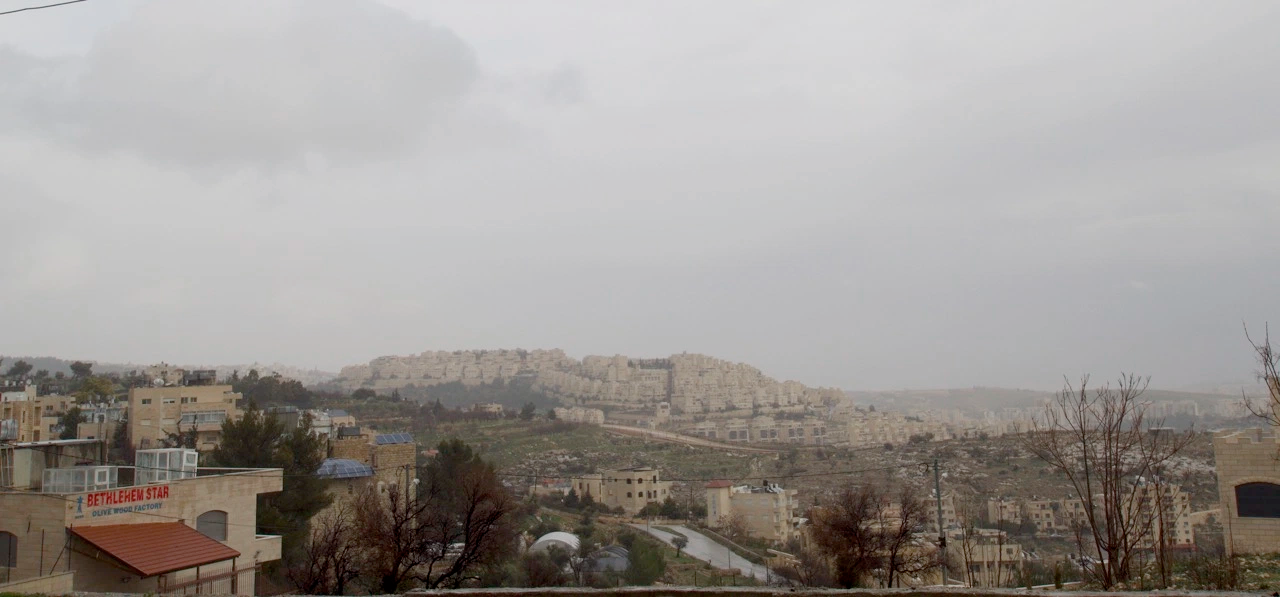
The weather has opened a little bit and I decide to go out for a late meal. Asparago restaurant is not only open, but it’s got a never-ending selection of small bites and Taybeh beer. I work my way through their entrée selection while I look over to the Jewish settlement of Har Homa. Meal done, with the skies clear, it’s time for a walk.
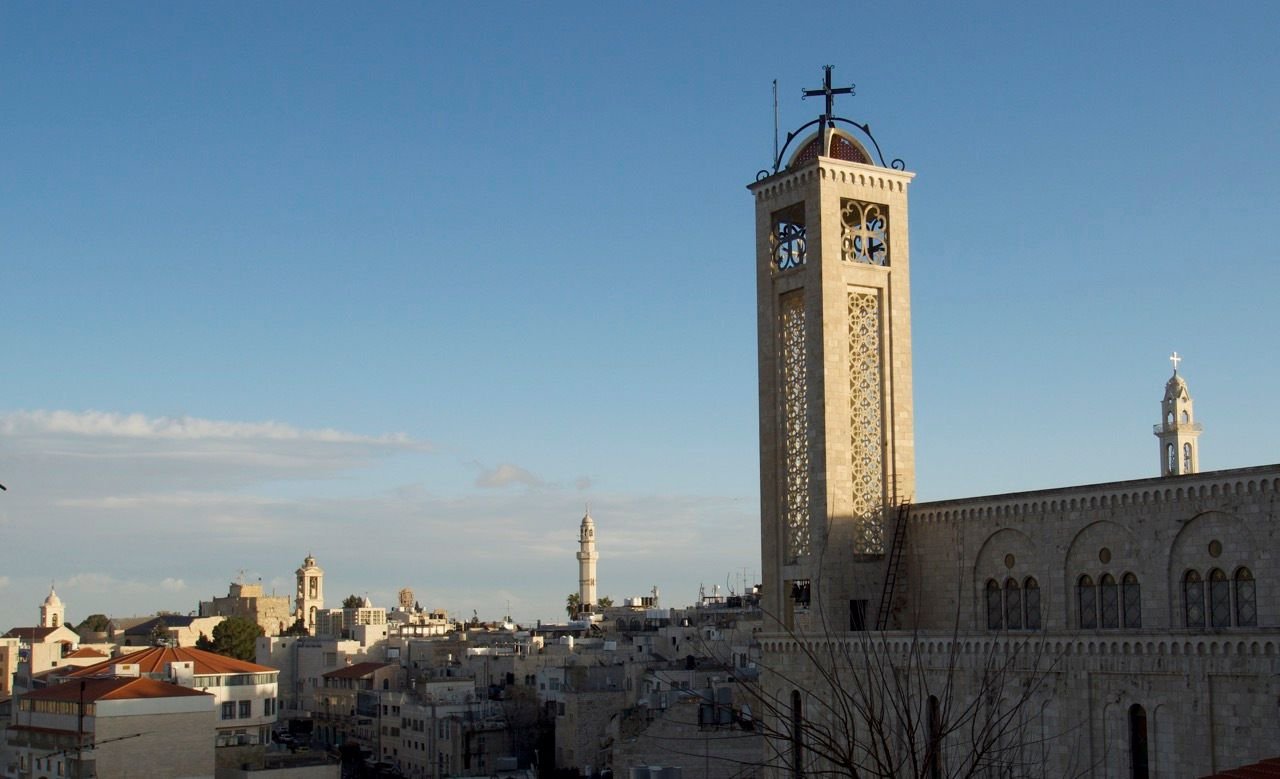
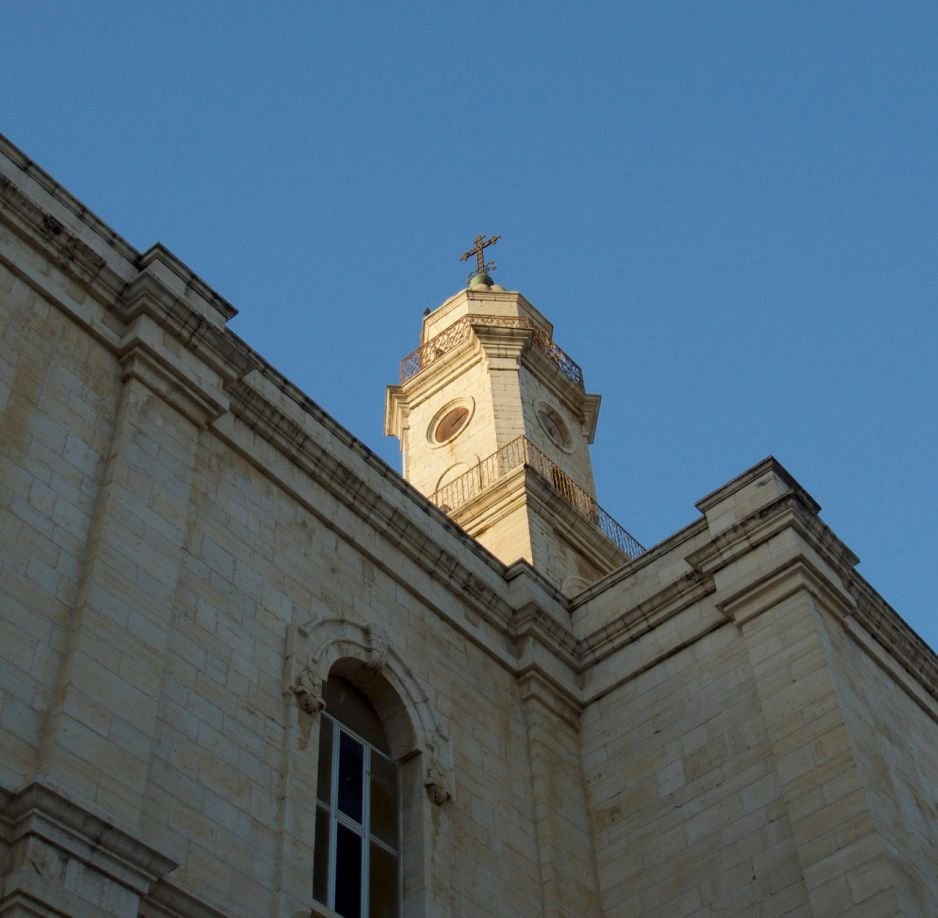
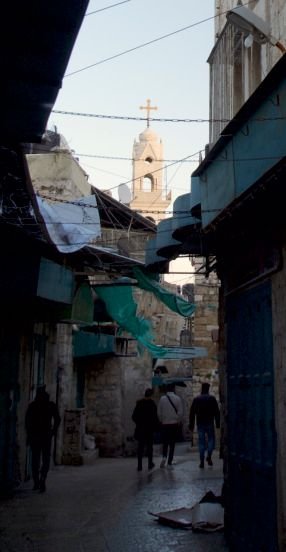
Bethlehem proper – the city of churches, of Salesian schools, with its souk and the various offices of so many different Christian NGOs – is just beyond the hill. I walk past shops brimming with clients, traffic so convulsed that the cops have given up trying to direct it and buses disgorging Russian pilgrims into souvenir outlets. The old town is quiet but for a truck stuck in a narrow lane, the backed-up traffic erupting into waves of irate horns.
.
.
.

.
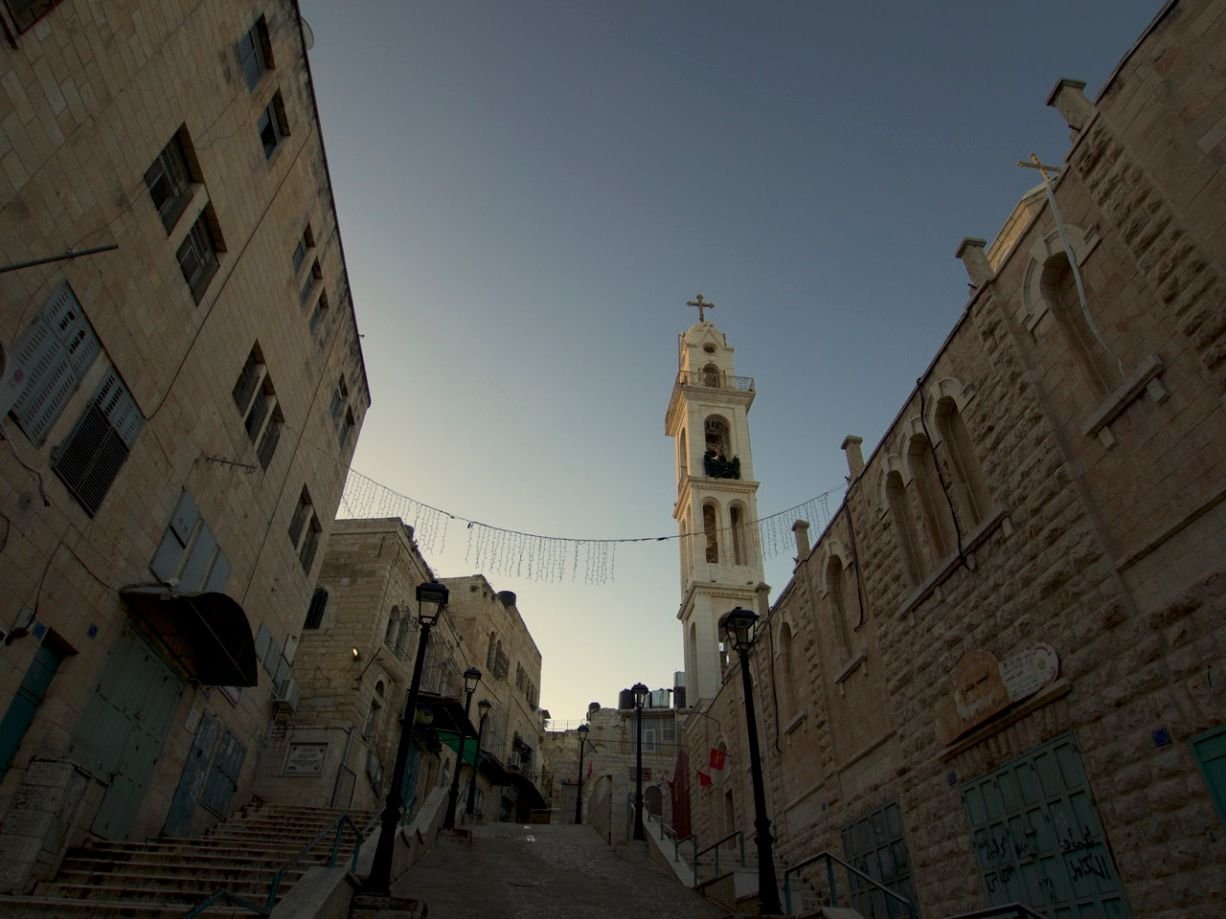
Kids play in Manger square and my spirit lifts. Lights turn on and restaurants open up for business: I’m still full from my feast at Asparago but the whiff of warm pita and the sight of bowls of hummus is enough to cause me to lapse again. It’s a good thing that I never dabbled in hard drugs I guess.
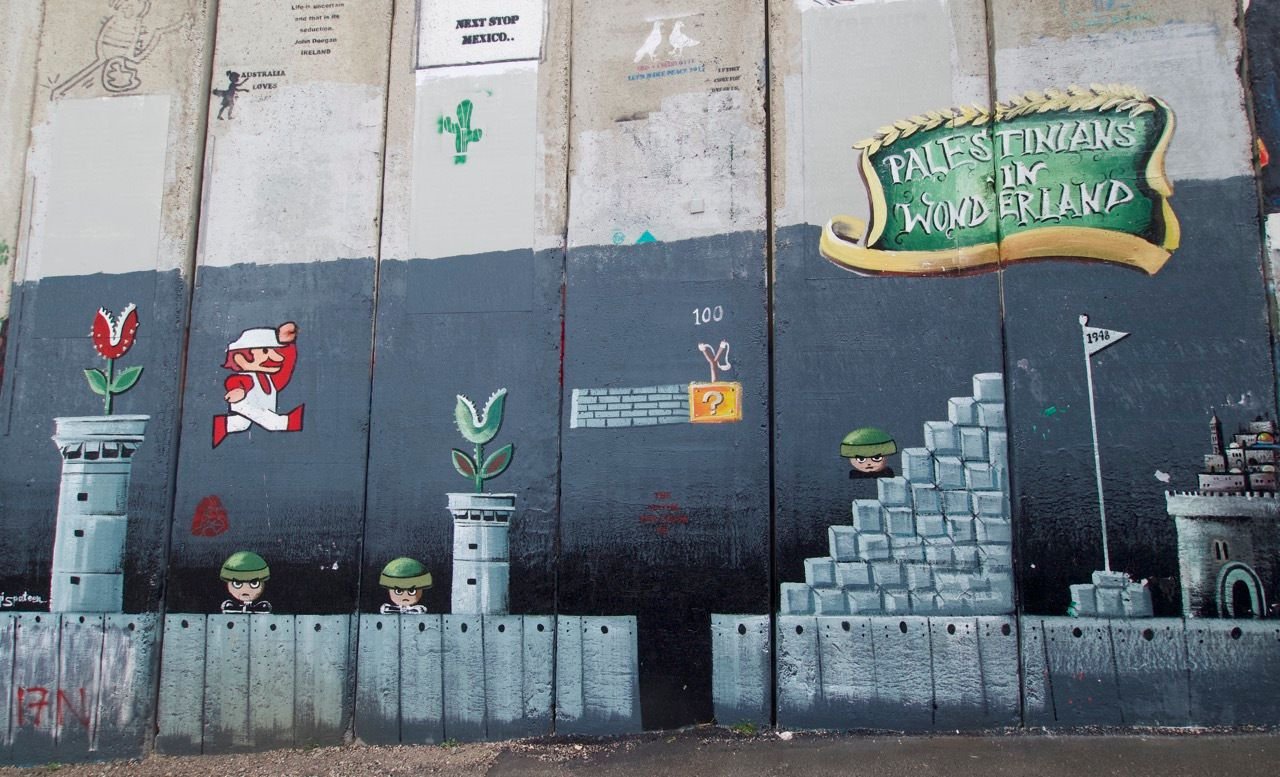
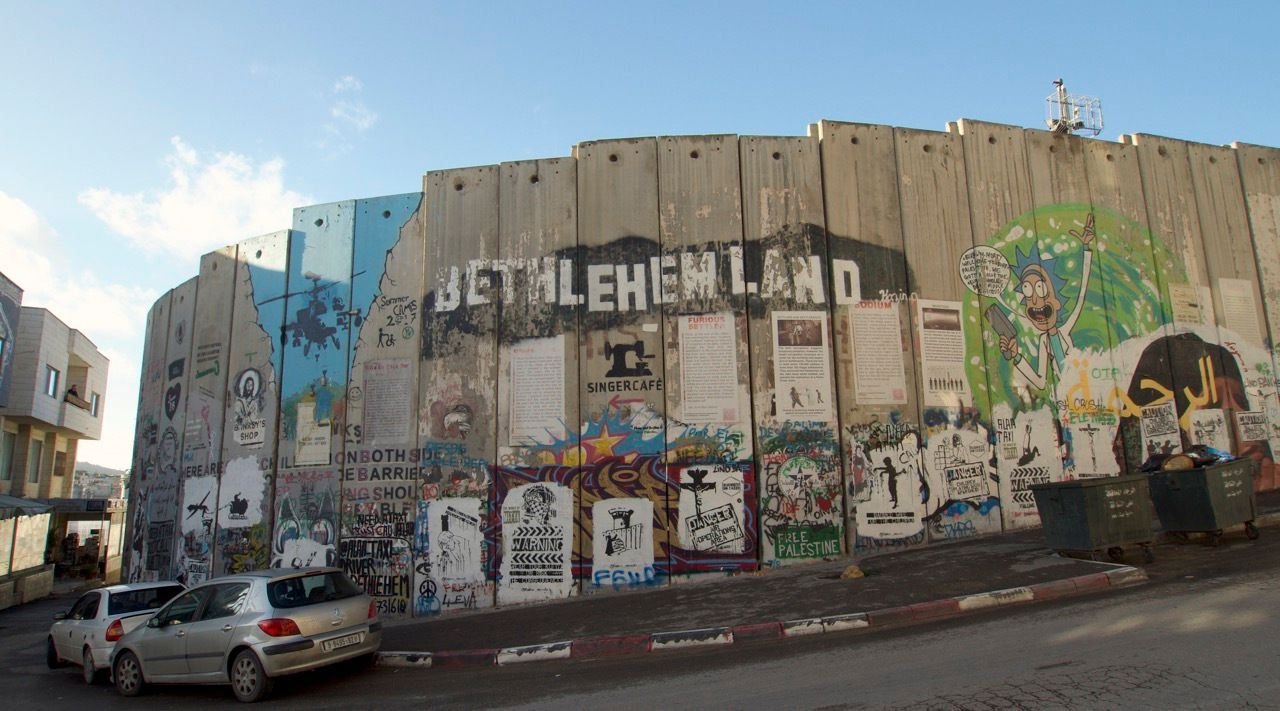
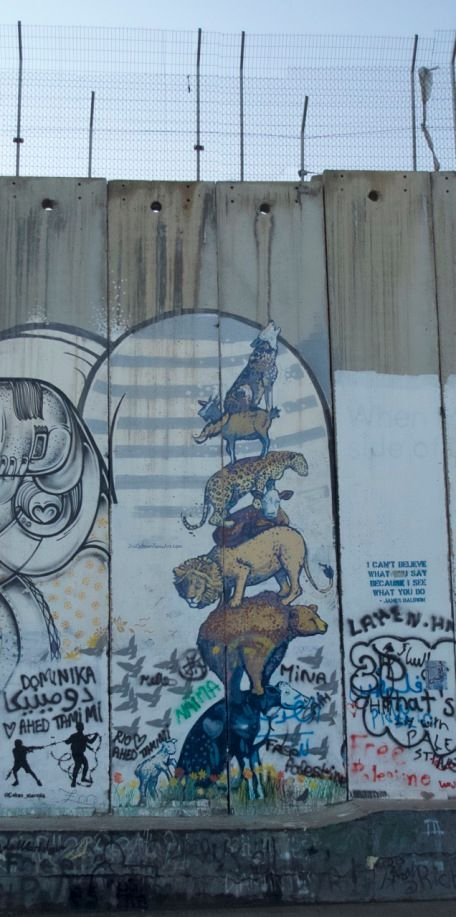
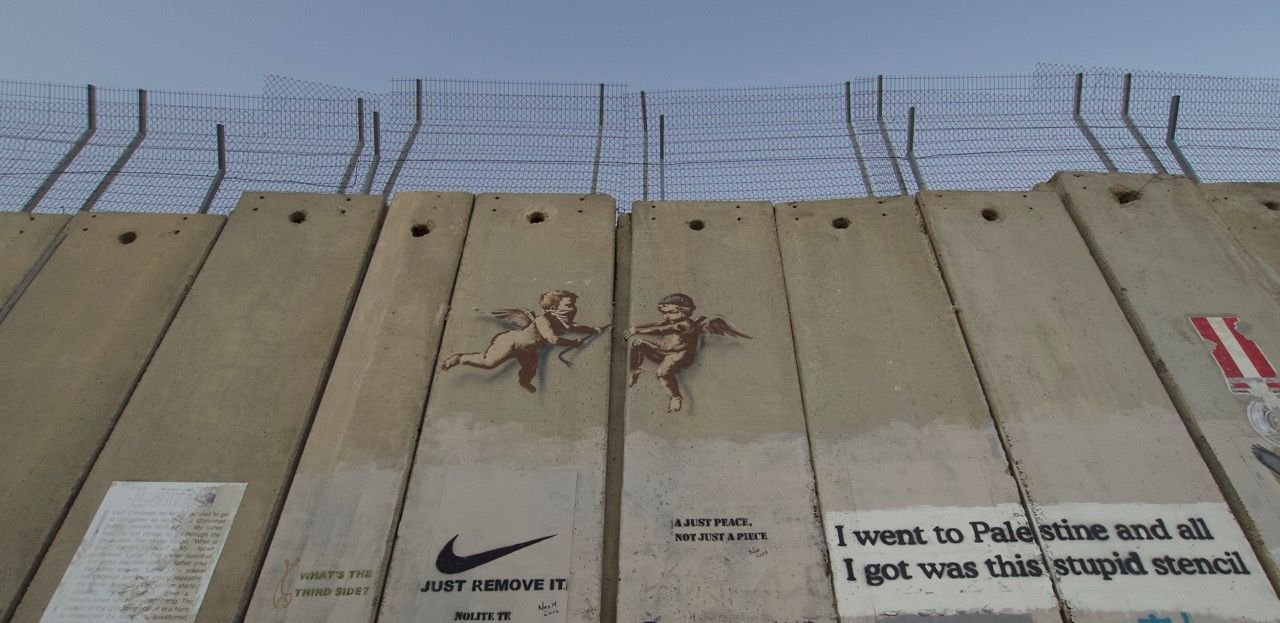
The next morning, after a sumptuous Arabic breakfast served over souvenir plates from Stratford-upon-Avon, I check out the Walled Off; before I leave the West Bank, though, I decide to do one last tour of the wall to check out the street art, which has found in this massive concrete dichotomy a ready-made canvas.
.
.
.
.

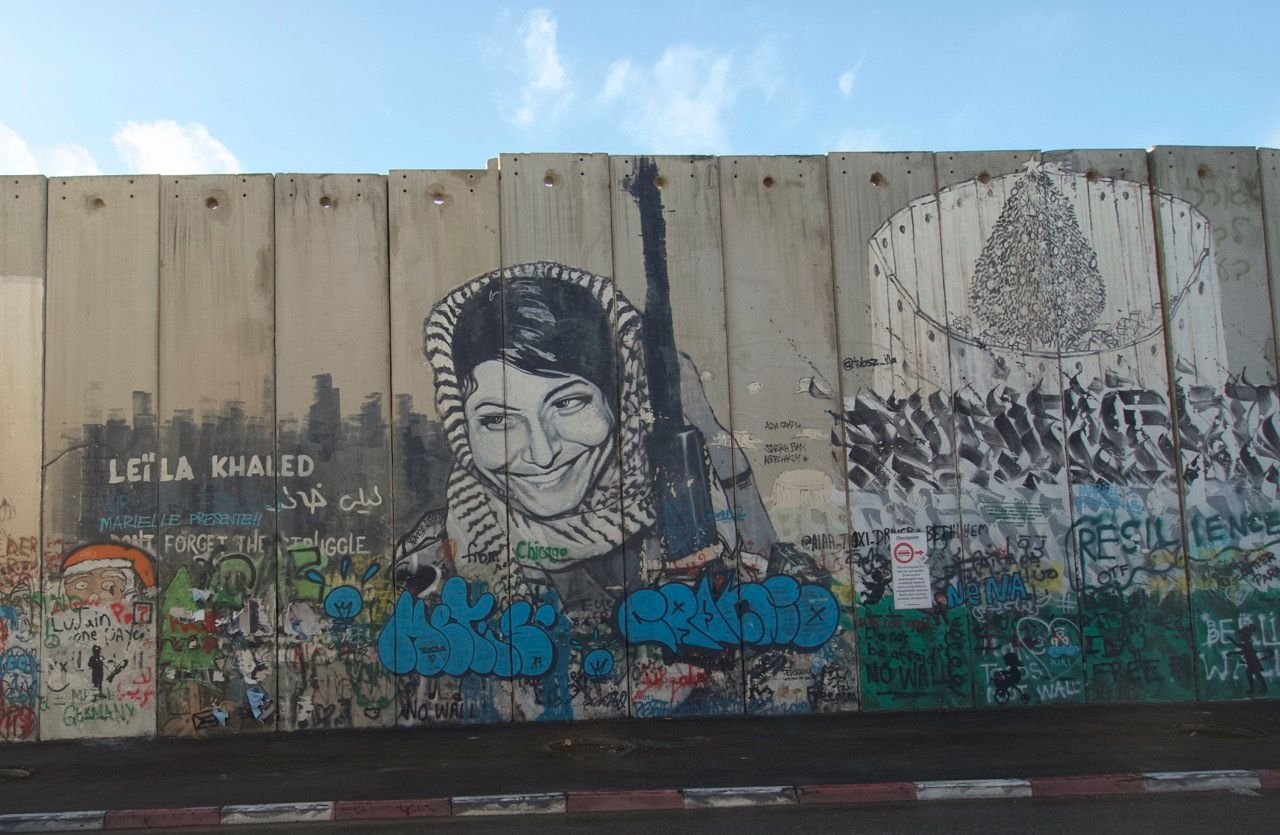
There’s everything, from Rick and Morty to Mario Bros to Donald Trump kissing a sentry tower to a beautiful portrait of Ahed Tamimi, the teenager arrested for having slapped a soldier during a raid. But it goes downhill from there. Somebody has attentively, tenderly even, painted a young Leïa Khaled holding a rifle. Her claim to fame is to have hijacked flight TWA 840 for a terrorist organisation. A few meters away, on a the wall of a shut-down pizzeria, somebody has stencilled the profiles of two of the nastiest pieces of work in this region: sheikh Yassin, founder of Hamas, and Hassan Nasrallah, current secretary of Hezbollah.
.

And with that I decided to leave, to do every time I’m ‘round here and I’ve reached my limit of stupidity. I head to Tel Aviv. To be continued.
We leave our tour with Waleed and Nabil and I return to the Walled Off. Of all the emotions I’ve been through, the most pre-eminent is of oppression. It’s a feeling I’ve re-discovered at the height of the lockdown, in March and April, though worsened by the knowledge that this situation, in the West Bank, is permanent. I try and imagine what my life would be if my horizons were shrunk to the dimensions of the space that’s available to the average Palestinian and it’s not a nice thought. It happened before; it’ll undoubtedly happen again: I’m glad that the wheel of fortune of life has given me a passport with “European Union” emblazoned in golden letter on the top.
The weather has opened a little bit and I decide to go out for a late meal. Asparago restaurant is not only open, but it’s got a never-ending selection of small bites and Taybeh beer. I work my way through their entrée selection while I look over to the Jewish settlement of Har Homa. Meal done, with the skies clear, it’s time for a walk.
Bethlehem proper – the city of churches, of Salesian schools, with its souk and the various offices of so many different Christian NGOs – is just beyond the hill. I walk past shops brimming with clients, traffic so convulsed that the cops have given up trying to direct it and buses disgorging Russian pilgrims into souvenir outlets. The old town is quiet but for a truck stuck in a narrow lane, the backed-up traffic erupting into waves of irate horns.
.
.
.
.
Kids play in Manger square and my spirit lifts. Lights turn on and restaurants open up for business: I’m still full from my feast at Asparago but the whiff of warm pita and the sight of bowls of hummus is enough to cause me to lapse again. It’s a good thing that I never dabbled in hard drugs I guess.
The next morning, after a sumptuous Arabic breakfast served over souvenir plates from Stratford-upon-Avon, I check out the Walled Off; before I leave the West Bank, though, I decide to do one last tour of the wall to check out the street art, which has found in this massive concrete dichotomy a ready-made canvas.
.
.
.
.
There’s everything, from Rick and Morty to Mario Bros to Donald Trump kissing a sentry tower to a beautiful portrait of Ahed Tamimi, the teenager arrested for having slapped a soldier during a raid. But it goes downhill from there. Somebody has attentively, tenderly even, painted a young Leïa Khaled holding a rifle. Her claim to fame is to have hijacked flight TWA 840 for a terrorist organisation. A few meters away, on a the wall of a shut-down pizzeria, somebody has stencilled the profiles of two of the nastiest pieces of work in this region: sheikh Yassin, founder of Hamas, and Hassan Nasrallah, current secretary of Hezbollah.
.
And with that I decided to leave, to do every time I’m ‘round here and I’ve reached my limit of stupidity. I head to Tel Aviv. To be continued.

 Oct 25, 2020 | 11:00 pm
#20
FlyerTalk Evangelist


Join Date: Feb 2007
Location: Los Angeles / Basel
Programs: UA 1K MM, AA EXP, Hyatt Globalist
Posts: 27,397
Very interesting trip report. Thanks for sharing.
I also visited Banksy's Walled Off Hotel - more pictures here. (disclaimer - link to my blog). It was a highlight of my trip.
I also visited Banksy's Walled Off Hotel - more pictures here. (disclaimer - link to my blog). It was a highlight of my trip.
Oct 27, 2020 | 12:01 am
#21
Original Poster
Join Date: May 2014
Posts: 8,119
Very interesting trip report. Thanks for sharing.
I also visited Banksy's Walled Off Hotel - more pictures here. (disclaimer - link to my blog). It was a highlight of my trip.
I also visited Banksy's Walled Off Hotel - more pictures here. (disclaimer - link to my blog). It was a highlight of my trip.
Oct 28, 2020 | 8:47 am
#22
Original Poster
Join Date: May 2014
Posts: 8,119
Tel Aviv
A new day breaks and the weather is as Scottish as the day before. I’m staying in the “cheap beds” at the Walled Off, i.e. the bunks. There’s six in a room decked out in a military-ish décor, with old Israeli Army bed frames and other paraphernalia. As far as dorms go it’s not cheap ($60) but it’s comfy and it comes with table-serviced breakfast. Having had another serving of hummus and falafel I leave the Walled Off, getting thoroughly drenched before I even arrive at Checkpoint 300.
Entering Israel is pretty quick: there are a few families with at least one member who’s lost their ID card, so I’m waver over by pretty much everyone and end up standing in front of the security booth as the young soldier inside is busy finishing her Candy Crush level. That done I’m through and onto a bus to Jerusalem.
It’s Saturday and, as such, no trains or buses are to be found. I walk uphill towards the corner where the sherut are known to depart and, lo and behold, here they are. We wait a little for it to fill up and then we’re on our way.
I’ve seen a fair bit of the Middle East and I’ve no doubts: Tel Aviv is my favourite city. It’s filthy, disorganised, often plain ugly: yet it’s lively, charming, easygoing and an all-rounder jewel. If the rest of the region is like Walter Sobchak, always yelling and ready to pull out the piece on the lanes, Tel Aviv is the Dude.
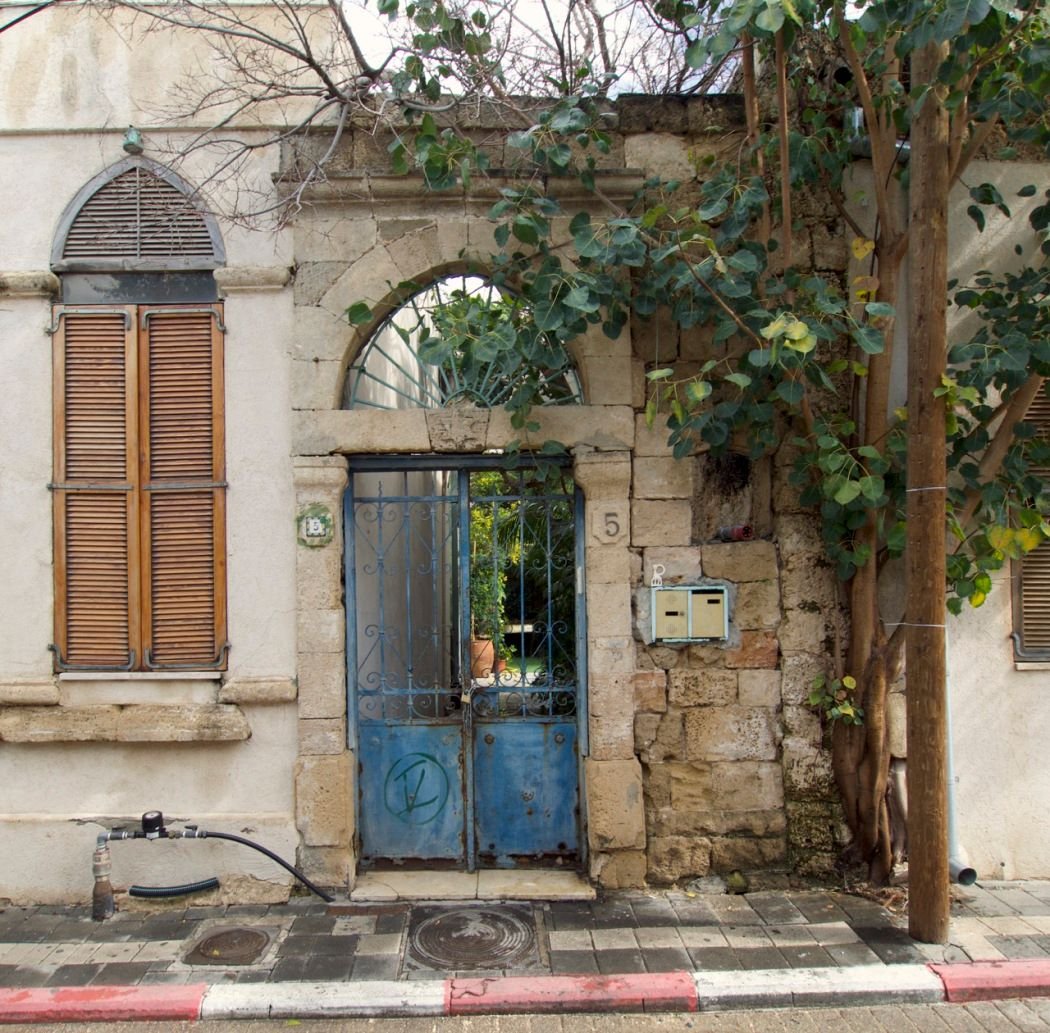
The sherut deposits us at the bus station, a locale of fascinating shabbiness. I pick up my bag and walk towards the city centre, a new spring in my step. The sun’s out, the streets aren’t as dead as they are in Jerusalem and there’s an admirable number of Alfa Romeos on the streets.

.
.
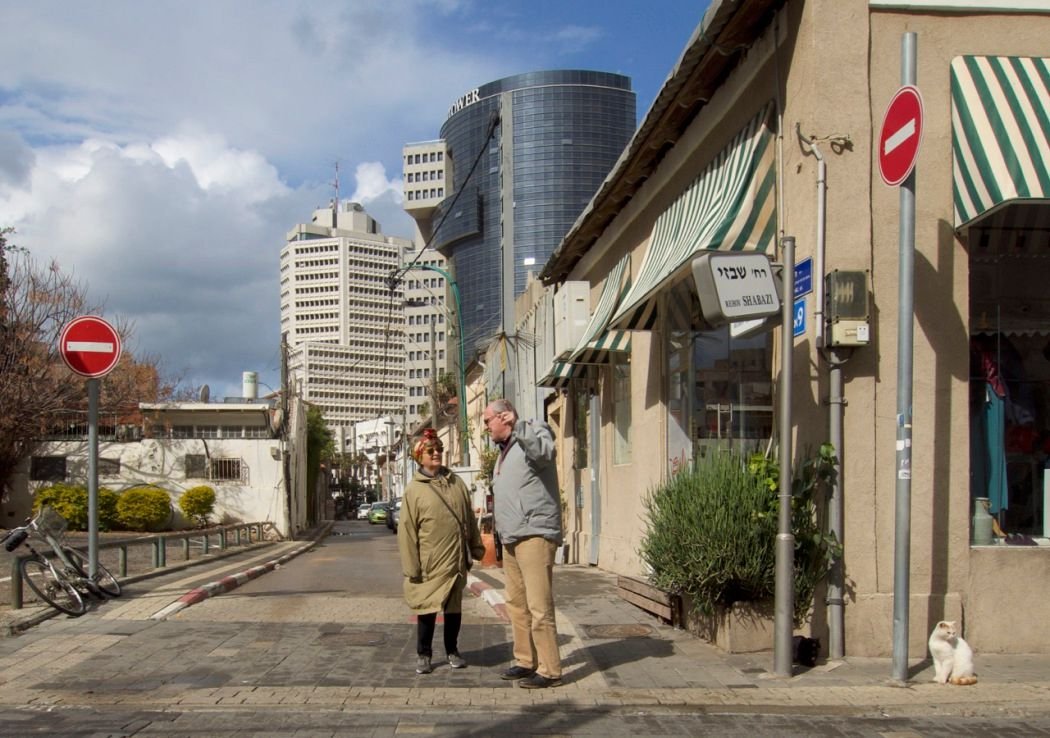
My hotel is stuffed at the end of a cul-de-sac in an area too run-down to be called shabby-chic. It feels like Shoreditch a few years ago, with the added benefit of the seaside not far away. As it’s early the room isn’t ready yet, so I dump my backpack in the care of the tattooed receptionist and head out again, sea-bound.

.
.
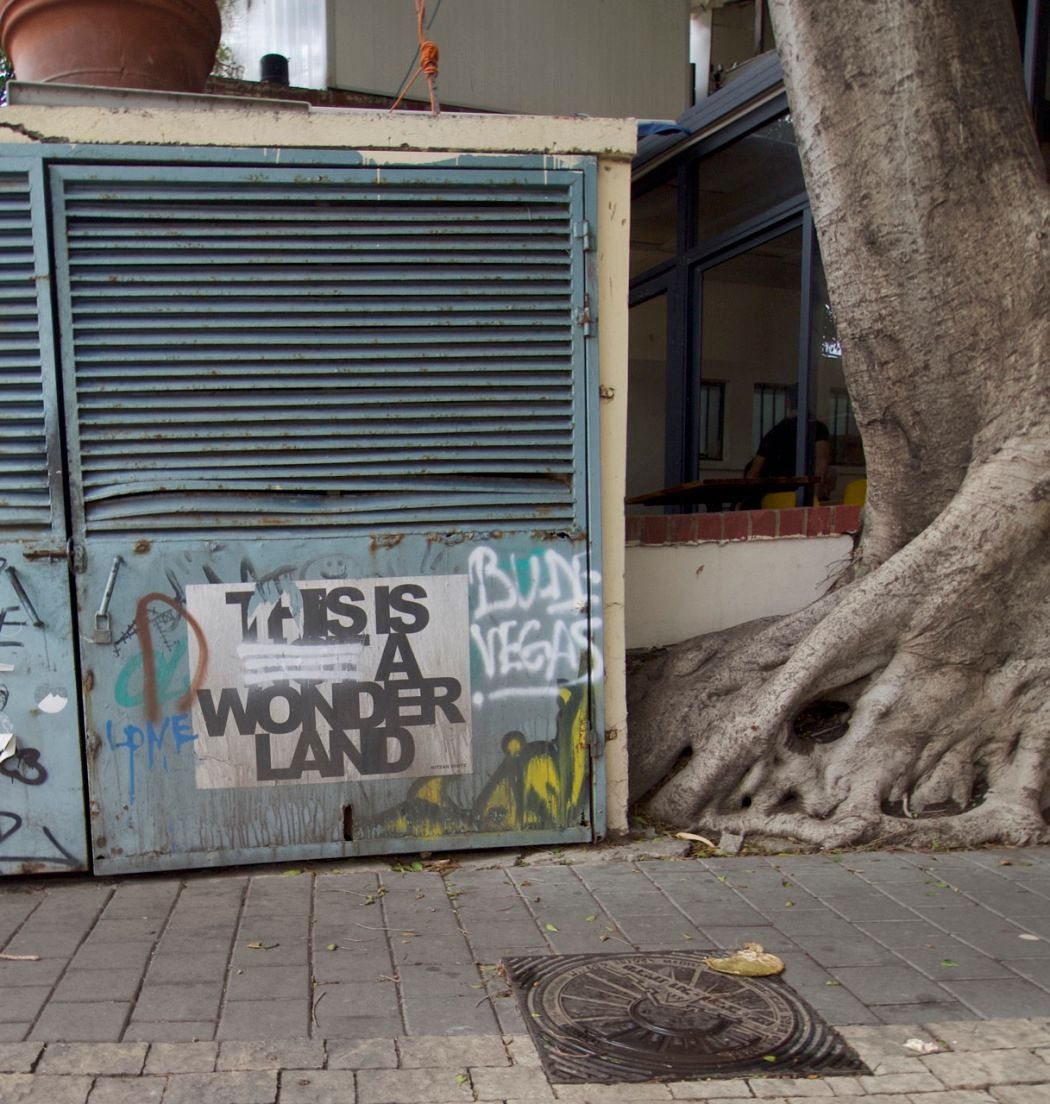
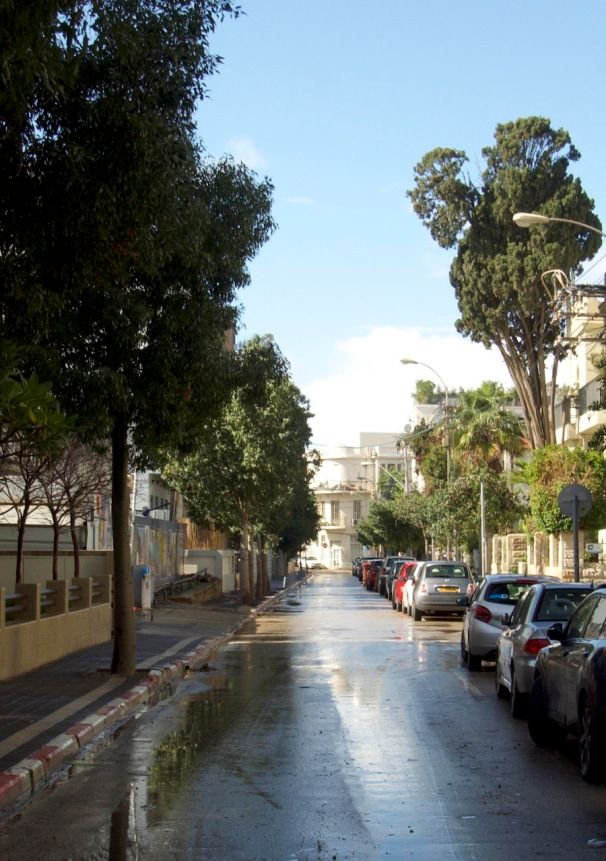
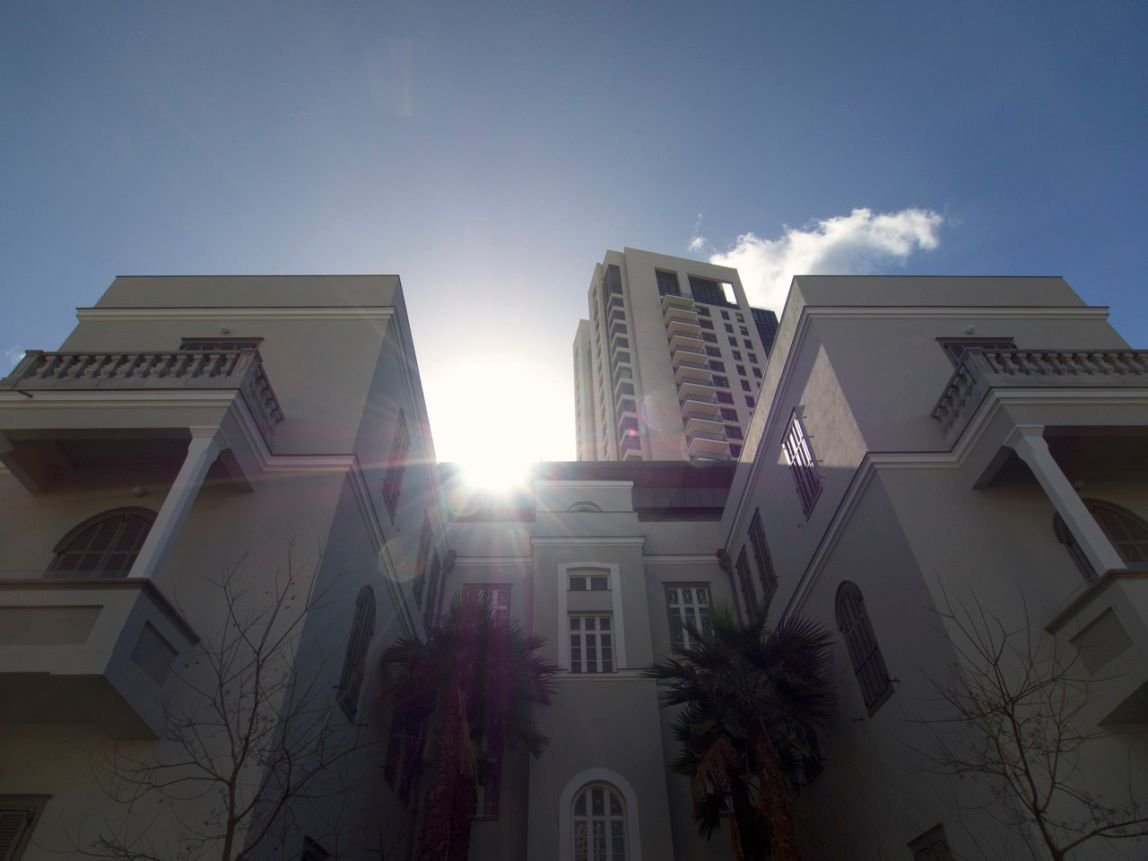
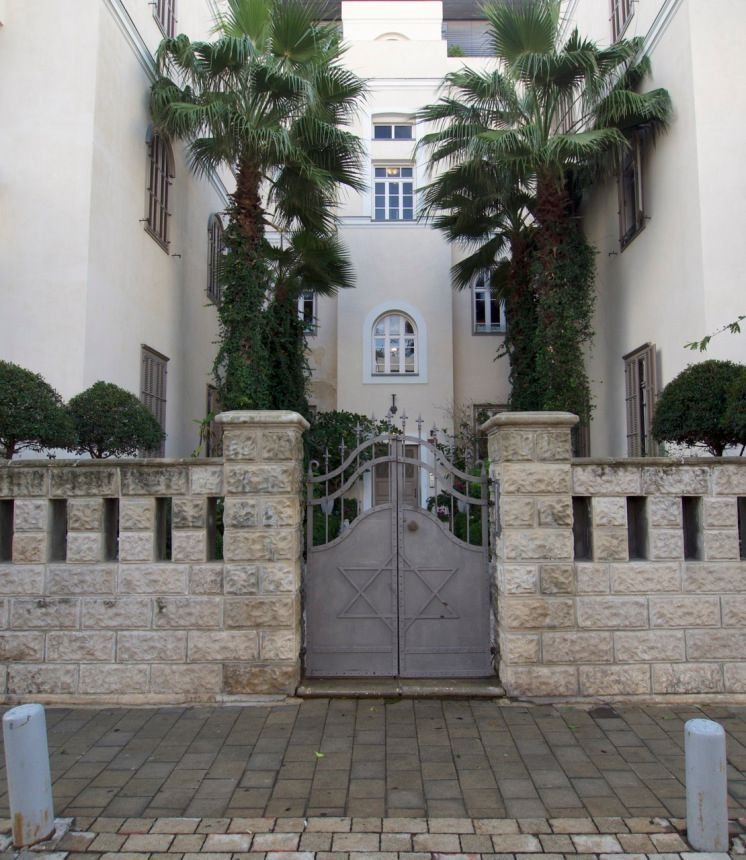
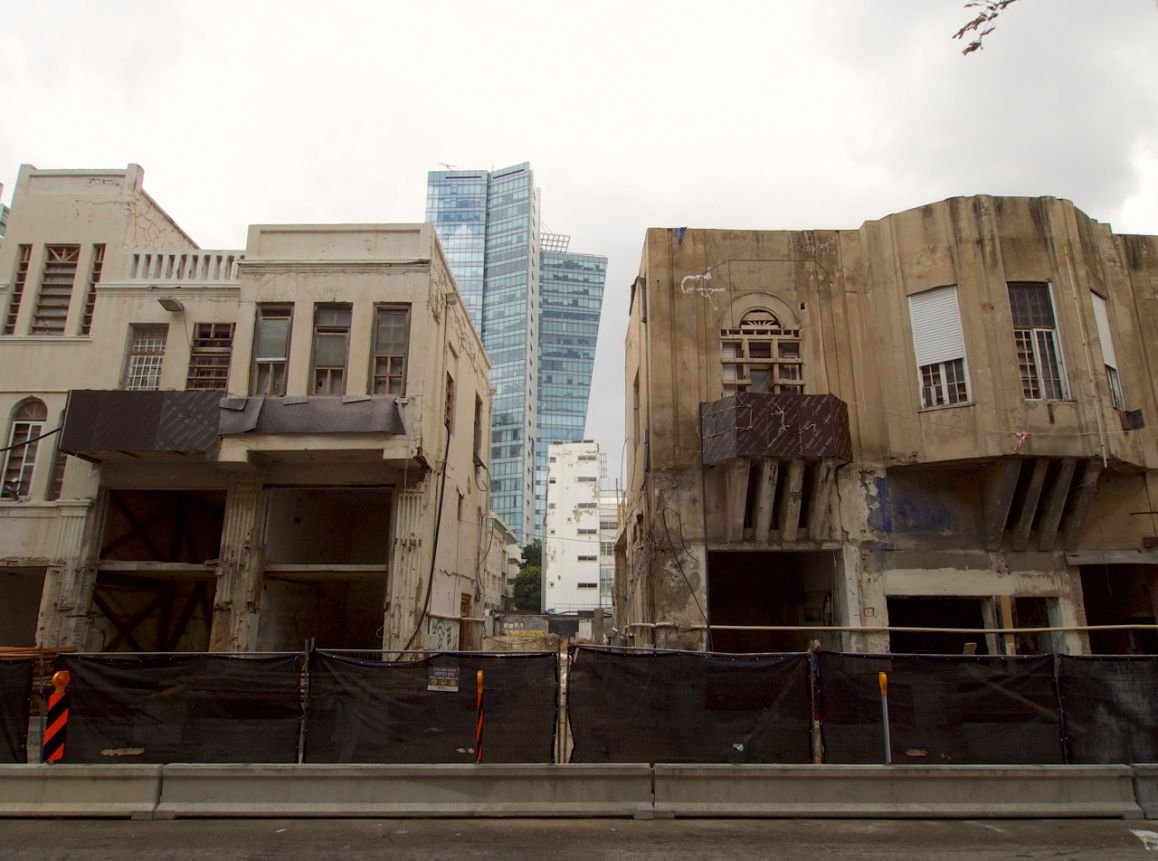
The roads between the hotel and the waterfront are a mixture of fine art/vintage boutiques (I steer well clear so not to scare the clientele), ice cream parlours (where I dive in) and early XX-century buildings where much of the history for Israel’s statehood played out. A former bomb-making facility is now a museum; the home of Akiva Aryeh Weiss, one of the city’s founders, is now a sushi bar.

.
.
.
.

.
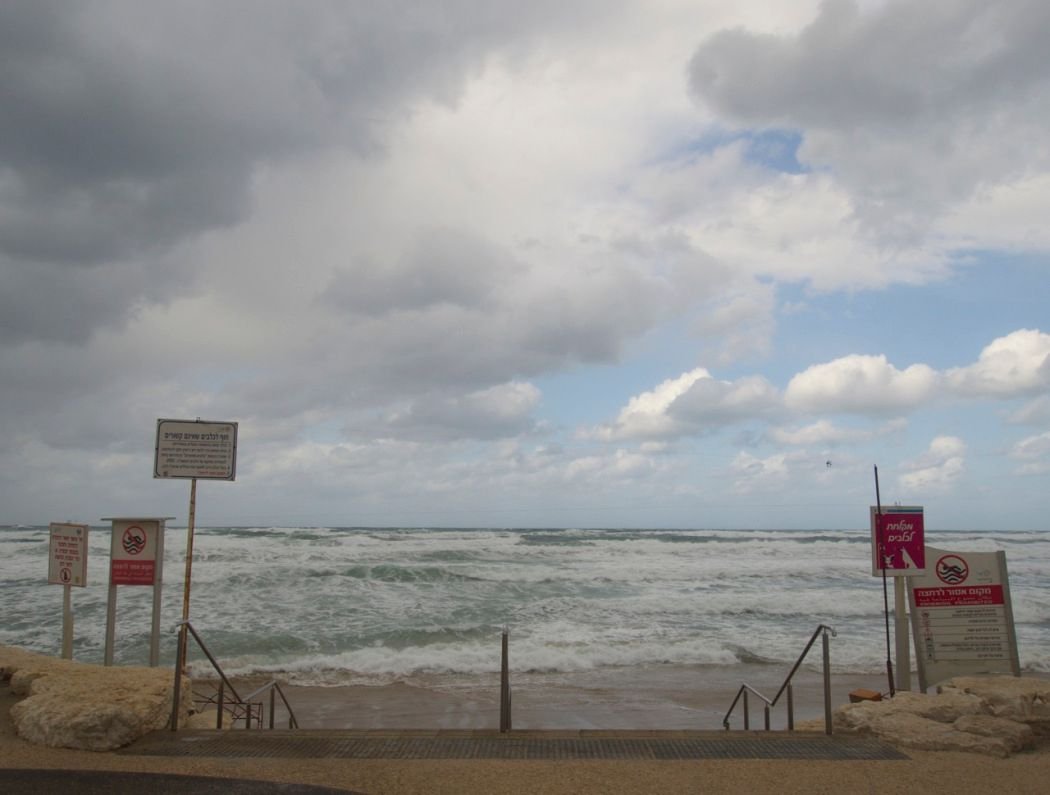
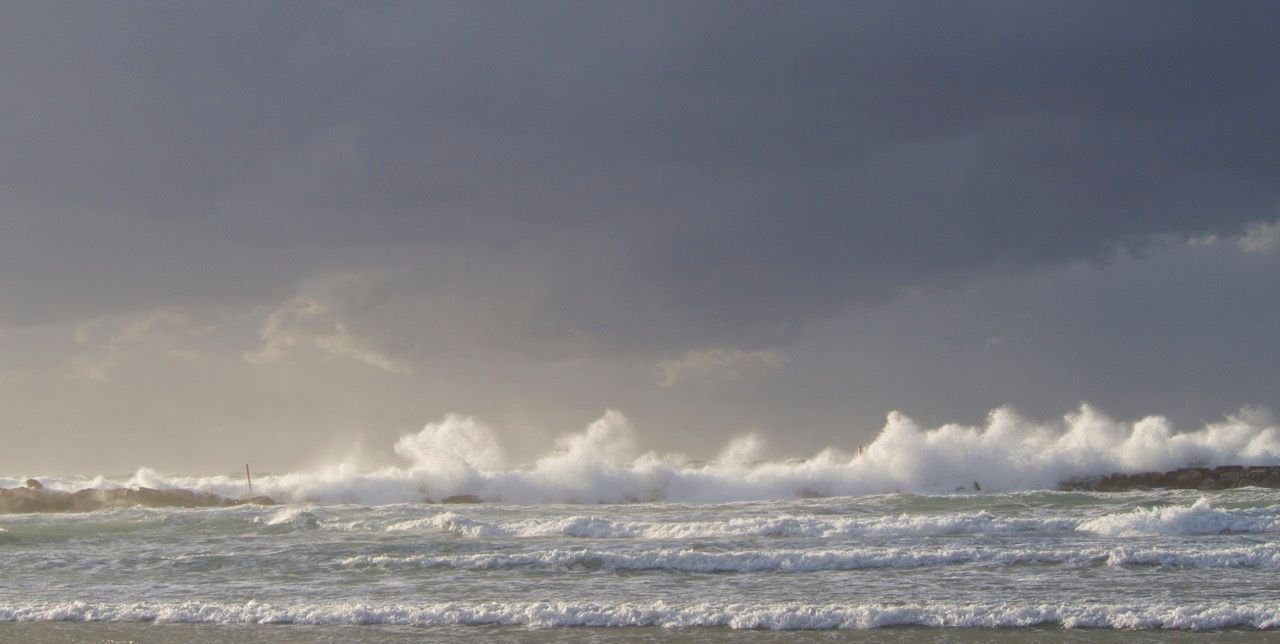
I weave in and out of the waterfront, stopping in bars and shops as I feel like. The weather is blustery and a strong, stiff wind blows the smell of the sea way inland: it’s inebriating. Or maybe it’s the third pint on an empty stomach, I’ll leave it to you to decide.
.
.
.
.

.
.
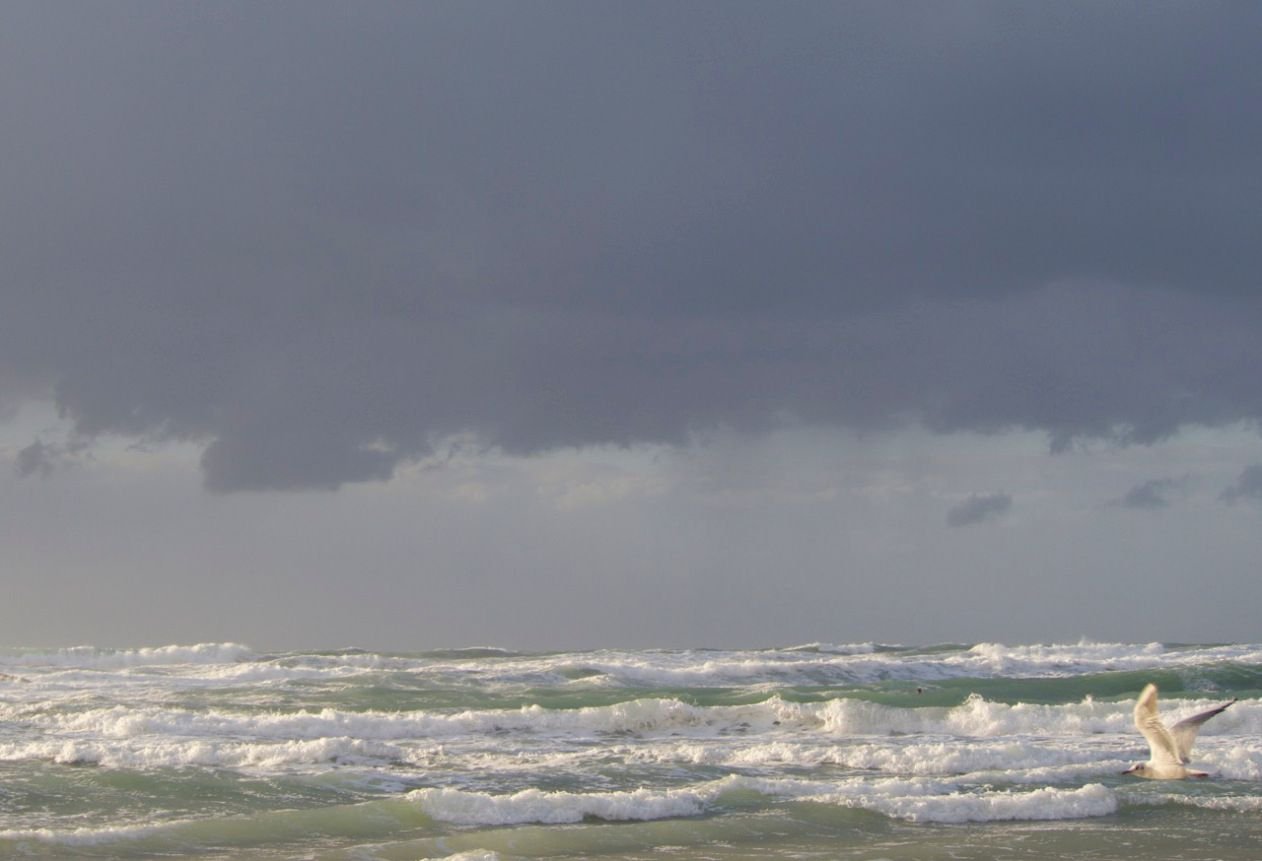
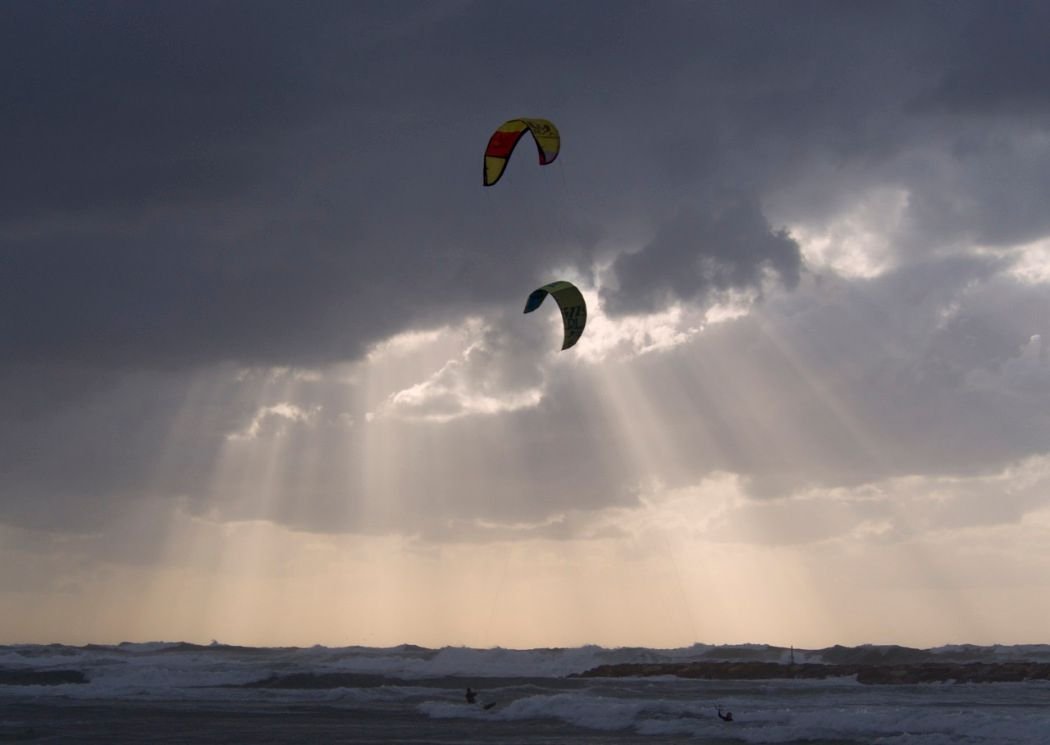
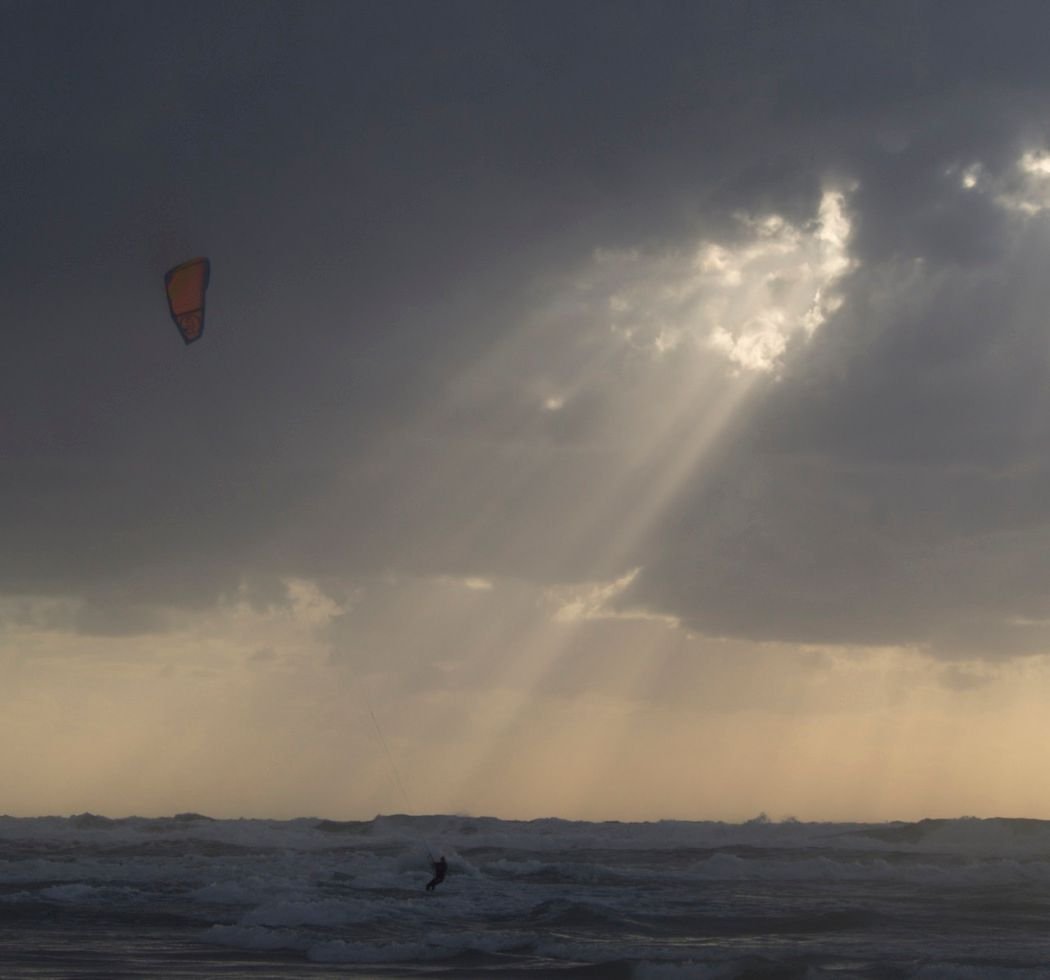
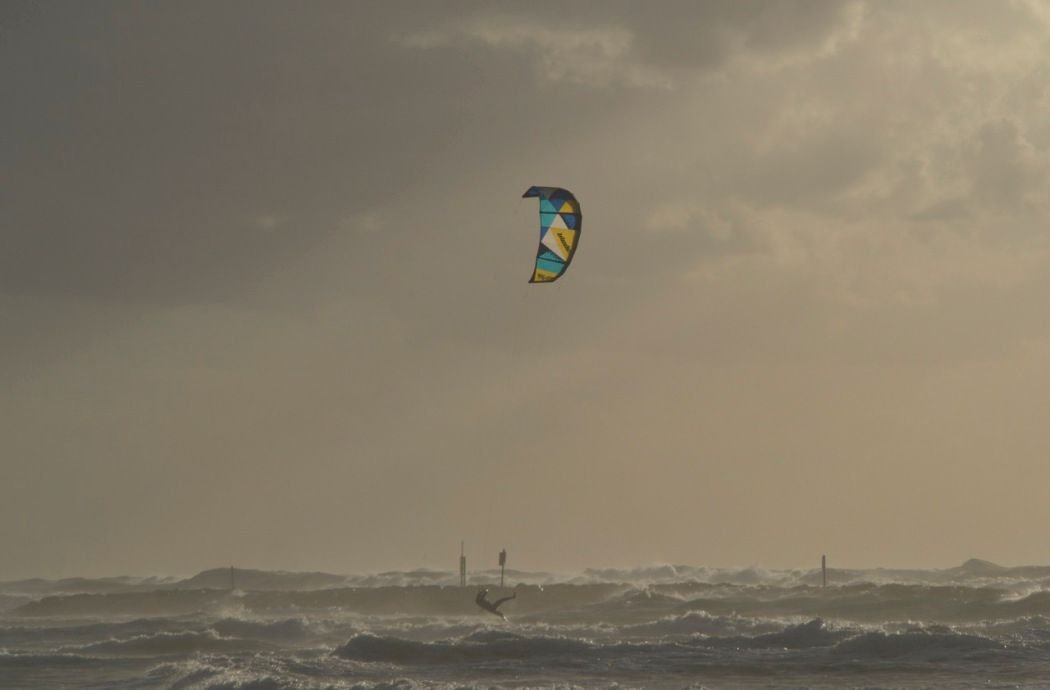
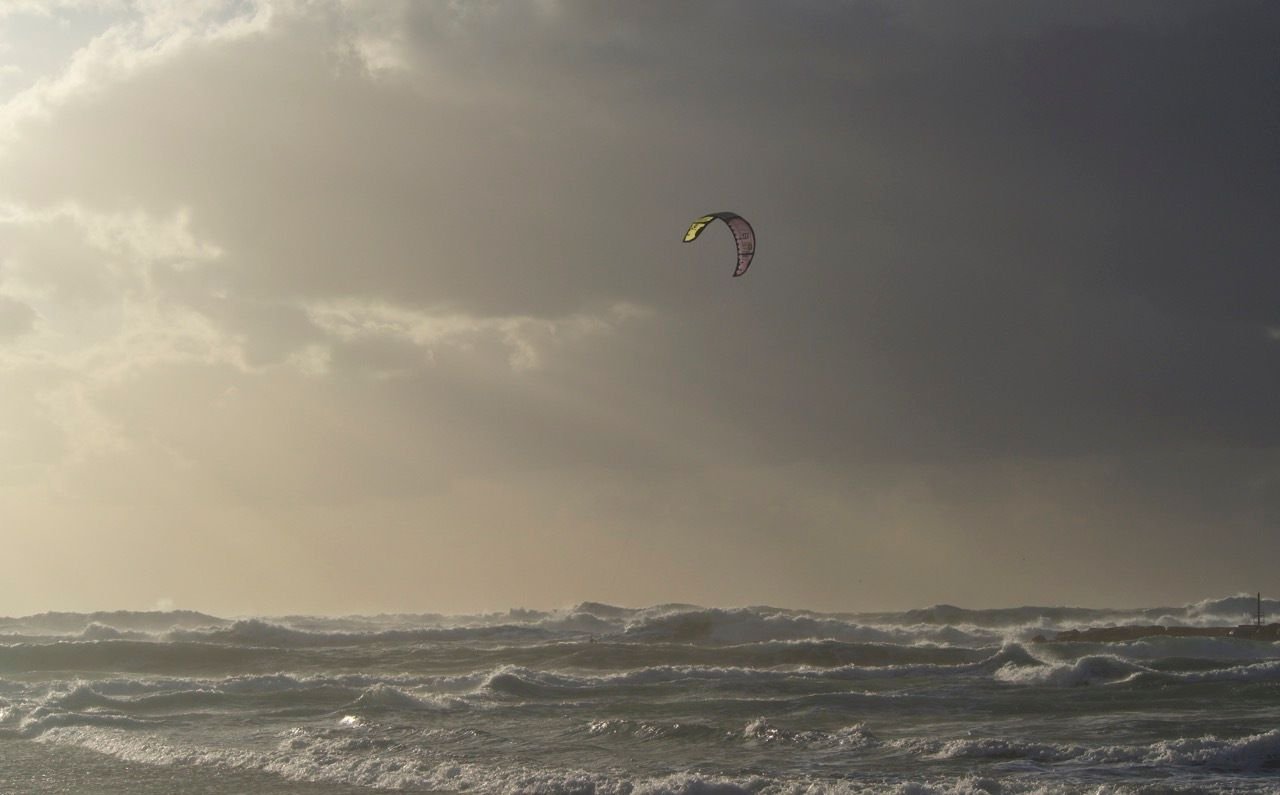
The Med looks the least Med-ish I’ve seen in a long while. The surfers are waiting for the big wave that never comes, while kite surfers are having the time of their lives.

.
.
.
.
.
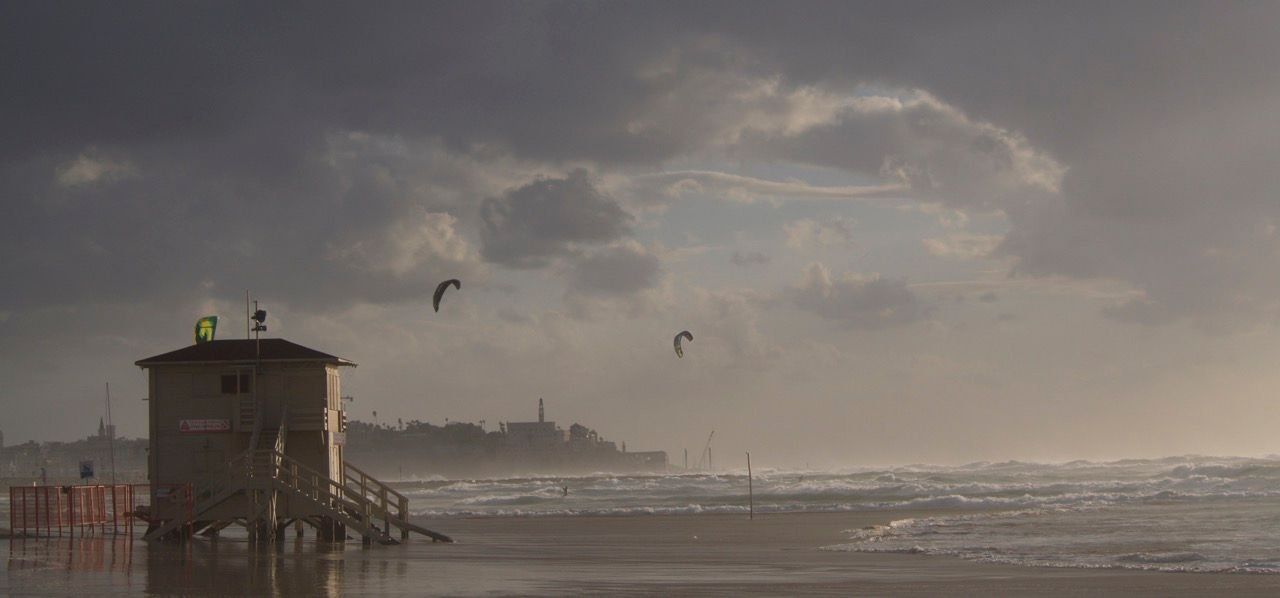
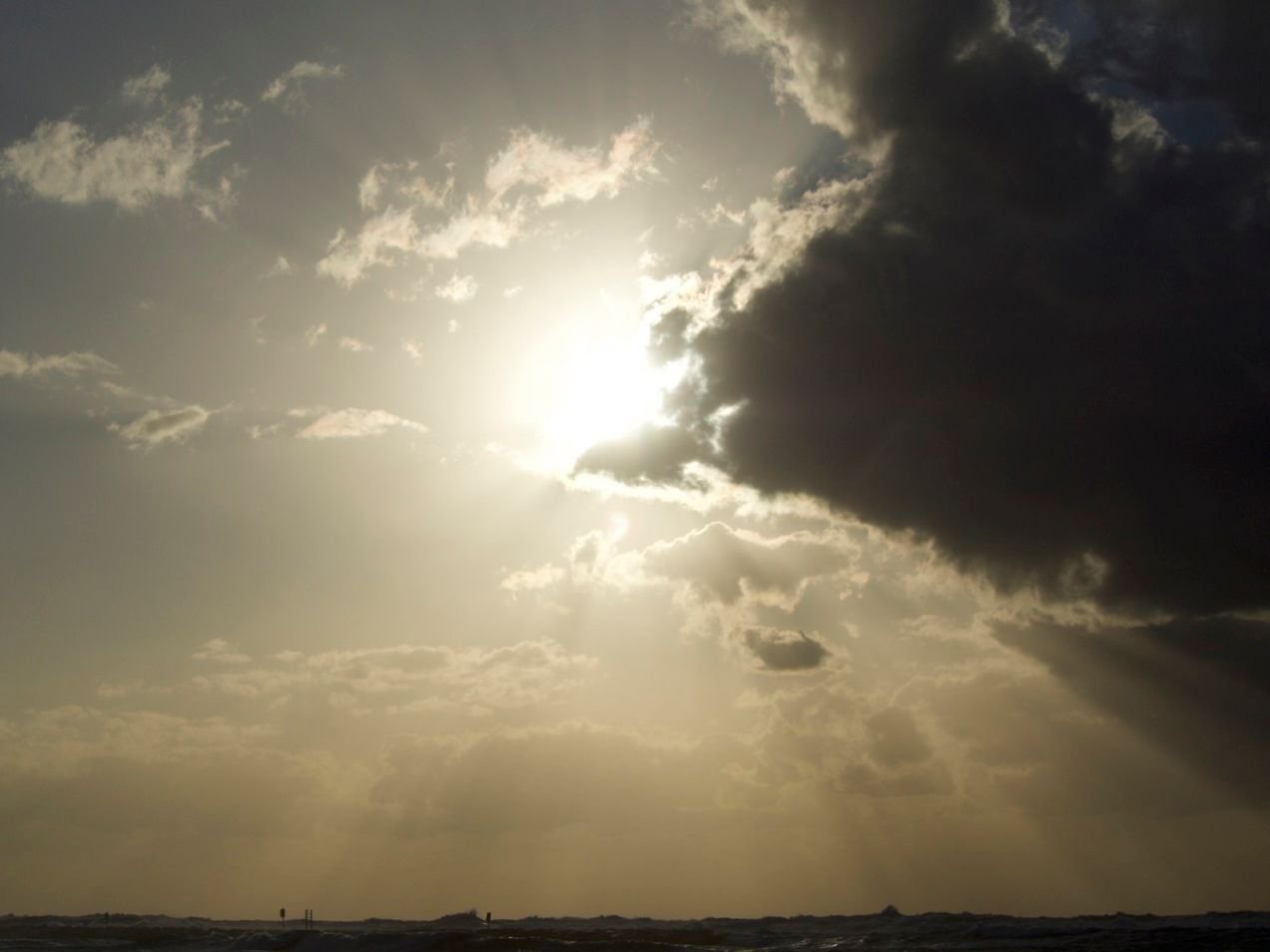
Every now and then a medusa of bad weather, rain trailing in its wake like tentacles, blows over town and we all scatter, returning as soon as it’s moved off.
.
.
Finally, I settle for the evening: there’s a bar with a sideways view of the sea, outside tables and the Supremes on the radio. Oh, there’s even hummus and pitta. This is the life, let me tell you.

.
To be continued; feel free to check out my blog Are We There Yet? for more.
A new day breaks and the weather is as Scottish as the day before. I’m staying in the “cheap beds” at the Walled Off, i.e. the bunks. There’s six in a room decked out in a military-ish décor, with old Israeli Army bed frames and other paraphernalia. As far as dorms go it’s not cheap ($60) but it’s comfy and it comes with table-serviced breakfast. Having had another serving of hummus and falafel I leave the Walled Off, getting thoroughly drenched before I even arrive at Checkpoint 300.
Entering Israel is pretty quick: there are a few families with at least one member who’s lost their ID card, so I’m waver over by pretty much everyone and end up standing in front of the security booth as the young soldier inside is busy finishing her Candy Crush level. That done I’m through and onto a bus to Jerusalem.
It’s Saturday and, as such, no trains or buses are to be found. I walk uphill towards the corner where the sherut are known to depart and, lo and behold, here they are. We wait a little for it to fill up and then we’re on our way.
I’ve seen a fair bit of the Middle East and I’ve no doubts: Tel Aviv is my favourite city. It’s filthy, disorganised, often plain ugly: yet it’s lively, charming, easygoing and an all-rounder jewel. If the rest of the region is like Walter Sobchak, always yelling and ready to pull out the piece on the lanes, Tel Aviv is the Dude.
The sherut deposits us at the bus station, a locale of fascinating shabbiness. I pick up my bag and walk towards the city centre, a new spring in my step. The sun’s out, the streets aren’t as dead as they are in Jerusalem and there’s an admirable number of Alfa Romeos on the streets.
.
.
My hotel is stuffed at the end of a cul-de-sac in an area too run-down to be called shabby-chic. It feels like Shoreditch a few years ago, with the added benefit of the seaside not far away. As it’s early the room isn’t ready yet, so I dump my backpack in the care of the tattooed receptionist and head out again, sea-bound.
.
.
The roads between the hotel and the waterfront are a mixture of fine art/vintage boutiques (I steer well clear so not to scare the clientele), ice cream parlours (where I dive in) and early XX-century buildings where much of the history for Israel’s statehood played out. A former bomb-making facility is now a museum; the home of Akiva Aryeh Weiss, one of the city’s founders, is now a sushi bar.
.
.
.
.
.
I weave in and out of the waterfront, stopping in bars and shops as I feel like. The weather is blustery and a strong, stiff wind blows the smell of the sea way inland: it’s inebriating. Or maybe it’s the third pint on an empty stomach, I’ll leave it to you to decide.
.
.
.
.
.
.
The Med looks the least Med-ish I’ve seen in a long while. The surfers are waiting for the big wave that never comes, while kite surfers are having the time of their lives.
.
.
.
.
.
Every now and then a medusa of bad weather, rain trailing in its wake like tentacles, blows over town and we all scatter, returning as soon as it’s moved off.
.
.
Finally, I settle for the evening: there’s a bar with a sideways view of the sea, outside tables and the Supremes on the radio. Oh, there’s even hummus and pitta. This is the life, let me tell you.
.
To be continued; feel free to check out my blog Are We There Yet? for more.
Oct 28, 2020 | 8:59 am
#23

Join Date: May 2009
Location: SIN (with a bit of ZRH sprinkled in)
Programs: KrisFlyer Gold
Posts: 9,606
Great story, enjoyed it alot.
Since I did something very similar early 2018 (And I managed to hit the beach as well And got Op-Uped to C both ways
  ) - including most of the places you went (Not 100% the same of course, I did walk from Jerusalem to Bethlehem, which I found a very interesting experience, and only ate at the Walled Off, not stayed there but rather at a different accomodation in Bethlehem), it was very juicy to see what changed, what didn't, and how my memory was still on the places.
Since I did something very similar early 2018 (And I managed to hit the beach as well
And got Op-Uped to C both ways ) - including most of the places you went (Not 100% the same of course, I did walk from Jerusalem to Bethlehem, which I found a very interesting experience, and only ate at the Walled Off, not stayed there but rather at a different accomodation in Bethlehem), it was very juicy to see what changed, what didn't, and how my memory was still on the places.
Last edited by YuropFlyer; Oct 28, 2020 at 9:26 am
Oct 31, 2020 | 3:53 am
#24
Original Poster
Join Date: May 2014
Posts: 8,119
Great story, enjoyed it alot.
Since I did something very similar early 2018 (And I managed to hit the beach as well And got Op-Uped to C both ways ) - including most of the places you went (Not 100% the same of course, I did walk from Jerusalem to Bethlehem, which I found a very interesting experience, and only ate at the Walled Off, not stayed there but rather at a different accomodation in Bethlehem), it was very juicy to see what changed, what didn't, and how my memory was still on the places.
Since I did something very similar early 2018 (And I managed to hit the beach as well
And got Op-Uped to C both ways ) - including most of the places you went (Not 100% the same of course, I did walk from Jerusalem to Bethlehem, which I found a very interesting experience, and only ate at the Walled Off, not stayed there but rather at a different accomodation in Bethlehem), it was very juicy to see what changed, what didn't, and how my memory was still on the places.I'm working on the last and final leg of this journey. Hopefully will upload it in a few days' time.


 Nov 1, 2020 | 4:40 am
#27
Original Poster
Join Date: May 2014
Posts: 8,119
Thank you gaobest.
Yes, indeed the weather makes a lot of a difference. I was hoping to finish this off during the weekend but unfortunately my plans have been waylaid by a funeral. It'll be next week.
Yes, indeed the weather makes a lot of a difference. I was hoping to finish this off during the weekend but unfortunately my plans have been waylaid by a funeral. It'll be next week.


 Nov 3, 2020 | 4:41 am
#30
Original Poster
Join Date: May 2014
Posts: 8,119
The A350 that wasn't.
I went to sleep excited at the prospect of the next day to come. Boarding pass - window seat at the end of the first section of Club, with great views of the engine and the wing - stored in phone's wallet, everything primed and ready to go for an early start. BA162, the one to be operated by the 350, was due to leave at 06.20 AM that following day.
As it always is with TLV, I'm through in too little time. We all know that the party line is to get there early, way earlier than for any other flight, as security is no joke and it might take a while; also, traffic can be bad. Still, when I find myself airside at Ben Gurion, having breezed through the city, gotten ripped off by the cabbie, passed all security checkpoints and immigration, the question is "What to do now?".
BA uses one of the King David lounges. A room with a few seats, a serve-yourself breakfast spread and some views on a plethora of El Al planes. It's a gusty night and, as I down weak do-it-yourself-coffee, the only distraction is the patter of rain on the windows. I might even have done my work emails. Seriously, lounges are depressing places.
I go out for a walk, do the rounds of all the piers, and return to the lounge. As I give my phone so that it can be scanned again, I notice that the seat has changed. It was an "A" seat, now it's 16G. The A350 has no G row, at least not in Club.
I text a friend from BA Engineering who not only is on shift tonight but, too, has in-depth knowledge of what's happening to the operation. There were four A350s in the fleet at that time; the one scheduled for the TLV rotation would've done it after a quick weekly check in the hangar. If only it didn't throw some weird gremlin with one of its ailerons, something got even the Airbus boffins go "Ah, je n'en ai pas la moindre idée". Long story short, out went the 350, in was a 77W.
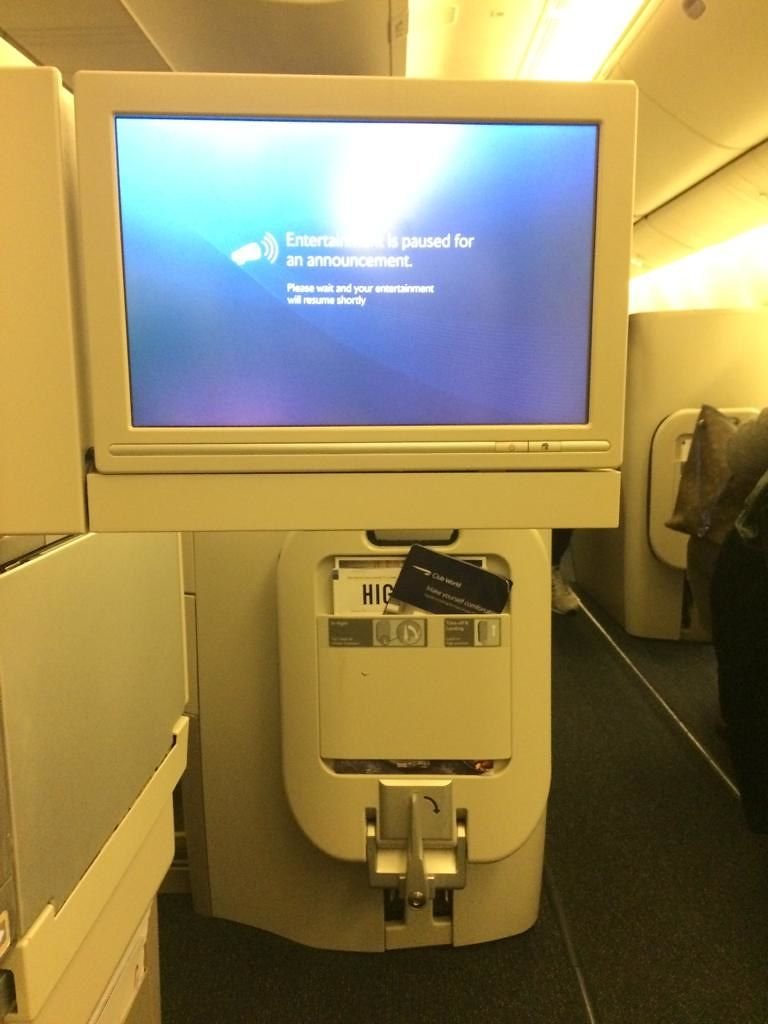
Still, some plane is better than no plane and, to be fair, I was happy to have a 77W. The UK, right at that time, was being gifted a solemn slapping by Storm Ciara: nothing better than the mighty GE90-115 to see us through it.
The crew were very much on the ball and spent an awful lot of time apologising for the delay (weather meant slot restrictions over in London) and for the lack of doors on today's Club seat. A gentleman next to me was inconsolable and just kept repeating that he wanted the seat with the doors. The do-o-o-ooo-h-rs, he yodelled for a good ten minutes to the CSM. She remained unflappable and kept on explaining what had happened. Honestly, what did he expect her to do? Do a quick run to Homebase in Tel Aviv and fashion a sliding door out of plywood for him?
Eventually we got underway and soon we were up in the air. The pilots, as ever the quintessential stiff-upper-lipped Nigels, described the approach into London as "quite breezy" which meant that everything not riveted down would be flying out into the vacuum of space. Having heard that, and not wishing to subject my seatmate with the distasteful spectacle of me projectile-vomiting the breakfast away I decided to stay light and forego the offer. Not him, though, I saw him order the full works.
Forty minutes to landing and, from the open windows, I see that we are still floating above an ocean of murk. The captain calls for the cabin to be secured and for everyone to be strapped in. We dive in the soup that hangs above London, me expecting a landing echoing of the final scenes of that George Clooney film... the one where he's the world's best groomed fisherman.
The wind is undeniable strong: we jitter, buffet and wave like a leaf caught in a draft. Improvise gusts pitch us up or down apparently at random, engines whining to counter their force. The odd scream echoes through the cabin and, from the back, come the wailing of all the infants onboard. Eventually we make it to the friendly skies of Hounslow, flapping our wings as if we were the Queen saluting a crowd. Then it's Hatton Cross, the grassy knoll where Jerry from BigJet TV is doing a six-hour special in trying to get hypothermia or a heart attack (below is the link to the best-of) and, with a bit of indecision, finally slam the big beast on the runway.
Within moments I'm in the bowels of T5, trotting along the purple walkway that I like so much, amped up after a great trip and looking forward to more. Patagonia, Ladakh, Svalbard were all on the calendar: 2020 was shaping up to be an amazing year for travel.
But then, in that moment, somewhere near a wet market in Wuhan a puny coronavirus said "Hold my beer".
I went to sleep excited at the prospect of the next day to come. Boarding pass - window seat at the end of the first section of Club, with great views of the engine and the wing - stored in phone's wallet, everything primed and ready to go for an early start. BA162, the one to be operated by the 350, was due to leave at 06.20 AM that following day.
As it always is with TLV, I'm through in too little time. We all know that the party line is to get there early, way earlier than for any other flight, as security is no joke and it might take a while; also, traffic can be bad. Still, when I find myself airside at Ben Gurion, having breezed through the city, gotten ripped off by the cabbie, passed all security checkpoints and immigration, the question is "What to do now?".
BA uses one of the King David lounges. A room with a few seats, a serve-yourself breakfast spread and some views on a plethora of El Al planes. It's a gusty night and, as I down weak do-it-yourself-coffee, the only distraction is the patter of rain on the windows. I might even have done my work emails. Seriously, lounges are depressing places.
I go out for a walk, do the rounds of all the piers, and return to the lounge. As I give my phone so that it can be scanned again, I notice that the seat has changed. It was an "A" seat, now it's 16G. The A350 has no G row, at least not in Club.
I text a friend from BA Engineering who not only is on shift tonight but, too, has in-depth knowledge of what's happening to the operation. There were four A350s in the fleet at that time; the one scheduled for the TLV rotation would've done it after a quick weekly check in the hangar. If only it didn't throw some weird gremlin with one of its ailerons, something got even the Airbus boffins go "Ah, je n'en ai pas la moindre idée". Long story short, out went the 350, in was a 77W.
Still, some plane is better than no plane and, to be fair, I was happy to have a 77W. The UK, right at that time, was being gifted a solemn slapping by Storm Ciara: nothing better than the mighty GE90-115 to see us through it.
The crew were very much on the ball and spent an awful lot of time apologising for the delay (weather meant slot restrictions over in London) and for the lack of doors on today's Club seat. A gentleman next to me was inconsolable and just kept repeating that he wanted the seat with the doors. The do-o-o-ooo-h-rs, he yodelled for a good ten minutes to the CSM. She remained unflappable and kept on explaining what had happened. Honestly, what did he expect her to do? Do a quick run to Homebase in Tel Aviv and fashion a sliding door out of plywood for him?
Eventually we got underway and soon we were up in the air. The pilots, as ever the quintessential stiff-upper-lipped Nigels, described the approach into London as "quite breezy" which meant that everything not riveted down would be flying out into the vacuum of space. Having heard that, and not wishing to subject my seatmate with the distasteful spectacle of me projectile-vomiting the breakfast away I decided to stay light and forego the offer. Not him, though, I saw him order the full works.
Forty minutes to landing and, from the open windows, I see that we are still floating above an ocean of murk. The captain calls for the cabin to be secured and for everyone to be strapped in. We dive in the soup that hangs above London, me expecting a landing echoing of the final scenes of that George Clooney film... the one where he's the world's best groomed fisherman.
The wind is undeniable strong: we jitter, buffet and wave like a leaf caught in a draft. Improvise gusts pitch us up or down apparently at random, engines whining to counter their force. The odd scream echoes through the cabin and, from the back, come the wailing of all the infants onboard. Eventually we make it to the friendly skies of Hounslow, flapping our wings as if we were the Queen saluting a crowd. Then it's Hatton Cross, the grassy knoll where Jerry from BigJet TV is doing a six-hour special in trying to get hypothermia or a heart attack (below is the link to the best-of) and, with a bit of indecision, finally slam the big beast on the runway.
Within moments I'm in the bowels of T5, trotting along the purple walkway that I like so much, amped up after a great trip and looking forward to more. Patagonia, Ladakh, Svalbard were all on the calendar: 2020 was shaping up to be an amazing year for travel.
But then, in that moment, somewhere near a wet market in Wuhan a puny coronavirus said "Hold my beer".