
























Personal File Encryption
 Jul 23, 2015 | 12:54 pm
#16


Join Date: Nov 2002
Location: LAX, SAN, ORD, MAA & COK
Programs: AA LT EXP 6+ MM, AC, DL (MM) & LT SkyClub, All Airlines 10+MM, Hilton LT Diamond, Bonvoy LT Plat
Posts: 761
 Aug 4, 2015 | 9:33 pm
#18
FlyerTalk Evangelist


Join Date: Sep 2000
Programs: BA, AA, DL, KLM, UA
Posts: 37,489
If you share in the cloud, you could consider Hitachi Credeon.
http://psg.hitachi-solutions.com/cre...ction-overview
http://psg.hitachi-solutions.com/cre...ction-overview
Aug 4, 2015 | 11:23 pm
#19
FlyerTalk Evangelist


Join Date: Jul 2000
Location: in the vicinity of SFO
Programs: AA 2MM (LT-PLT, PPro for this year)
Posts: 19,784
On Linux, the general thing is called LUKS, and the command-line tool is called "cryptsetup."
(Usually, distributions will just have a checkbox during set-up to enable encryption.)
Enterprise, or Ultimate, for Vista and 7.
Pro or Enterprise for 8/8.1
Pro, Enterprise, or Education for 10.
As a regular user would use it, and for the normal range of attacks, TPM just saves you from needing a pre-boot password; it can be used to make it more secure, but unless you're dealing with say, the PRC or FBI or some very serious industrial hackers trying to break into your machine, the extra possible security is an irrelevance. Plus, if you don't know what you're doing (or your corporate security detail does) you may actually be less secure with TPM -- or liable to locking yourself out and needing a recovery key.

(Usually, distributions will just have a checkbox during set-up to enable encryption.)
Pro or Enterprise for 8/8.1
Pro, Enterprise, or Education for 10.
As a regular user would use it, and for the normal range of attacks, TPM just saves you from needing a pre-boot password; it can be used to make it more secure, but unless you're dealing with say, the PRC or FBI or some very serious industrial hackers trying to break into your machine, the extra possible security is an irrelevance. Plus, if you don't know what you're doing (or your corporate security detail does) you may actually be less secure with TPM -- or liable to locking yourself out and needing a recovery key.
Aug 5, 2015 | 6:59 am
#20
Suspended
Join Date: Jul 2001
Location: Watchlisted by the prejudiced, en route to purgatory
Programs: Just Say No to Fleecing and Blacklisting
Posts: 102,077

http://www.theregister.co.uk/2015/08...rypted_by_fbi/
 Aug 5, 2015 | 12:54 pm
#22
Suspended
Join Date: Jun 2009
Location: YYZ
Programs: AC E50K (*G) WS Gold | SPG/Fairmont Plat Hilton/Hyatt Diamond Marriott Silver | National Exec Elite
Posts: 19,284
TPM just saves you from needing a pre-boot password; it can be used to make it more secure, but unless you're dealing with say, the PRC or FBI or some very serious industrial hackers trying to break into your machine, the extra possible security is an irrelevance. Plus, if you don't know what you're doing (or your corporate security detail does) you may actually be less secure with TPM -- or liable to locking yourself out and needing a recovery key.
And no, in a corporate environment, there are ways to ensure that people don't lock themselves out. The recovery key can be tied to Active Directory so a user can retrieve it, say by just using their alias.
Aug 5, 2015 | 2:32 pm
#23
FlyerTalk Evangelist
Join Date: Jul 2000
Location: in the vicinity of SFO
Programs: AA 2MM (LT-PLT, PPro for this year)
Posts: 19,784
TPM basically just gives you two things; pre-boot configuration verification (although this has the risk of a lot of accidental lock-outs) and being a physical token for pre-boot authentication.
Windows still caches the key, so memory-based attacks can be used to recovery the key -- given a locked machine without a BIOS password, there are some realy fun hacks involving cooling the DIMMs.

It's also still pretty easy to grab Windows passwords via trojan horse programs (or via browser hacks if the user uses Webmail, and the Outlook password is the domain password.) It's also pretty easy to beat a password out of someone, or get it via subpoena.
If you think you can break bitlocker on a totally cold environment without TPM, I tell you what -- I'll bitlocker-encrypt your choice of a cheapo USB stick or an old bootable hard drive with a strong password and then mail it to you, with a message. Post the message here, and I'll donate $100 to a US 501(c)3 charity of your choice.
And no, in a corporate environment, there are ways to ensure that people don't lock themselves out. The recovery key can be tied to Active Directory so a user can retrieve it, say by just using their alias.
The number of people I know who've either printed their recovery key and/or saved it to Google/Dropbox/Box/Onedrive is really high.
Bitlocker, with or without TPM, or LUKS, or most of these full-disk encryption programs are best for preventing casual data theft after a machine is lost or stolen, but they're hardly perfect protection (indeed, there is literally no such thing on a portable, network connected computer -- and even perfect security in an electronic sense -- air gap and faraday cage -- is only as good as the physical security guarding it.)
Aug 5, 2015 | 3:11 pm
#24
Suspended
Join Date: Jun 2009
Location: YYZ
Programs: AC E50K (*G) WS Gold | SPG/Fairmont Plat Hilton/Hyatt Diamond Marriott Silver | National Exec Elite
Posts: 19,284
Aug 5, 2015 | 4:34 pm
#25
Suspended
Join Date: Jul 2001
Location: Watchlisted by the prejudiced, en route to purgatory
Programs: Just Say No to Fleecing and Blacklisting
Posts: 102,077
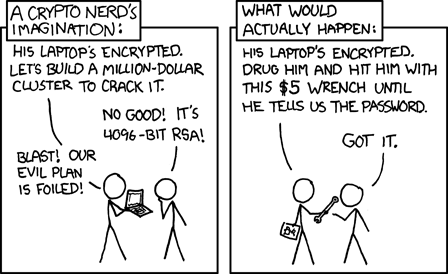
So true, as with how ATMs are used to rob people made to give up or even enter their own card PIN at the ATM; but the "wrench" may sometimes be things that don't involve direct physical violence: examples such as threat of prosecution on more charges or of worse sentencing outcomes if/when convicted; such as threats to ruin the lifestyles/opportunities of relatives/friends.
Aug 5, 2015 | 4:45 pm
#26
FlyerTalk Evangelist
Join Date: Jul 2000
Location: in the vicinity of SFO
Programs: AA 2MM (LT-PLT, PPro for this year)
Posts: 19,784
So true, as with how ATMs are used to rob people made to give up or even enter their own card PIN at the ATM; but the "wrench" may sometimes be things that don't involve direct physical violence: examples such as threat of prosecution on more charges or of worse sentencing outcomes if/when convicted; such as threats to ruin the lifestyles/opportunities of relatives/friends.
Ain't a much bigger wrench on earth than the force of the law.
Aug 5, 2015 | 5:09 pm
#27
Join Date: Aug 2014
Posts: 57
for individual files/directories, I use axcrypt (free): http://www.axantum.com/AxCrypt/
if I need to put that data in the cloud, I use tresorit (also free with paid plans as well): https://tresorit.com/
if I need to put that data in the cloud, I use tresorit (also free with paid plans as well): https://tresorit.com/
Aug 7, 2015 | 10:39 pm
#28


Join Date: Oct 2000
Location: Los Angeles
Posts: 336
Surprised no one has mentioned Jetico's BestCrypt. I know it's not open source (although they do publish their encryption and keygen routines), but their volume and container encryption is excellent, fast, and secure.
I did a lot of homework on this a year or so ago, and ultimately decided on them.
I did a lot of homework on this a year or so ago, and ultimately decided on them.
Aug 8, 2015 | 8:31 am
#29

Join Date: Mar 2013
Posts: 56
Surprised no one has mentioned Jetico's BestCrypt. I know it's not open source (although they do publish their encryption and keygen routines), but their volume and container encryption is excellent, fast, and secure.
To the OP: I could suggest separating the problems of encrypting flies on disk v. being shared. For things on local disk, use some combination of full disk encryption + BestCrypt or some other "container" encryption.
For encrypting individual files (e.g. to share), there are countless tools. One answer might be GnuPG in symmetric mode:
gpg --output doc.gpg --symmetric doc