
























 Feb 8, 2020, 1:07 am
Last edit by: danger
Oneworld Explorer is cash-only fares. One cannot buy such fares with points, regardless of the program in which one has points.
Top
Welcome to the Oneworld Explorer User Guide
Either: click on one of the icons, or
Select a Menu Option:


Menu Options
- Introduction
- Ticket Basics
- Ticket Rules
- Ticket Cost
- Ticket Purchase
- Ticket Changes
- Planning Tools
- Terminology
- Ticket Tricks
- FAQ
INTRODUCTION
This wiki describes the basics of the Oneworld Alliance’s popular RTW ticket - the Oneworld Explorer. Oneworld has another RTW ticket, the Global Explorer, and Star Alliance and Skyteam also have similar products – these tickets limit the number of flights to 16 and have maximum mileage limitations, whereas the Oneworld Explorer has the same limit of 16 flights but has no mileage limit (which is probably why it is so popular!)
The wiki is not exhaustive but does cover all the major topics that you need to know if you are thinking about going RTW on this ticket
The FAQ section at the end answers some questions that newbies often have
Top
TICKET BASICS
You must circle the globe, either westbound or eastbound, crossing both the Atlantic and Pacific oceans
You are allowed a maximum of 16 flights and can fly with any of the airlines in the Oneworld Alliance, plus their affiliate airlines
You can purchase the ticket from one of the airlines, or through a travel agent, or by using the Oneworld Explorer on-line booking tool
You can change or cancel your ticket, before or after departure (fees may apply)
From first flight to last flight, you have one year to complete the journey
The total price of a ticket depends on the number of continents, the cabin class, the starting point, and the actual flights you take (for calculating arrival/departure charges and airline surcharges)
Some ballpark prices (as at January 2020) are:
- £2,500 (USD3,300) for a 3 continent economy class ticket starting in the U.K.
- €7,000 (USD8,000) for a 4 continent business class ticket starting in a euro zone country
- ¥1,500,000 (USD14,000) for a 5 continent first class ticket starting in Japan
TICKET RULES
This section identifies the main rules of the ticket, which are those to do with how you can move from continent to continent and also within a continent
At the end of the section is a link to the full rule sheet on the Oneworld web site
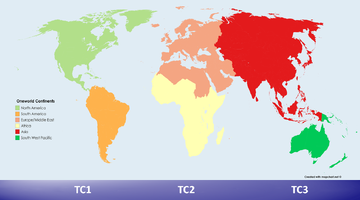
The ticket rules divide up the world into three “Tariff Conferences” (TC) each having two continents; as follows:
TC1 = North and South America
TC2 = Europe/Middle East and Africa
TC3 = Asia and South West Pacific (SWP)
Notes:
Europe/Middle East includes the countries of North Africa (Morocco, Algeria, Tunisia, Libya, Egypt, Sudan)
Russia is split between Europe/Middle East and Asia (the split is at the Ural Mountains),
Main Routing Rules:
- You must visit all three Tariff Conferences – you will of course be starting in one of them, so you must visit the other two in order (travelling either eastbound or westbound), and complete your RTW journey by returning to your starting TC; generally you must return to your starting country (there are exceptions - see More Rule Details below for more information)
- Within a TC, you can visit either or both continents
- Within a continent you can travel about in any direction you like
- You are limited to four flight segments per continent (6 for North America) – subject to an overall maximum of 16 segments in the whole itinerary
- You cannot travel via your point of origin
- You cannot return to your country of origin until the end
(exception: if you start in the U.S.A. then you are allowed to make one transit there, but without stopover) - You cannot fly directly more than once between two cities in the same direction
- There are restrictions on trans-continental flights in Australia and in North America (including to/from Alaska and Hawaii) – see More Rule Details below
- You are allowed to visit each northern hemisphere continent twice, but each southern hemisphere continent only once – see More Rule Details below
Segments
There are two types of segment – flight and surface
A flight segment is a direct flight between two airports (it may be a non-stop flight, or it may stop somewhere on the way – for example BA’s London to Sydney flight stops in Singapore)
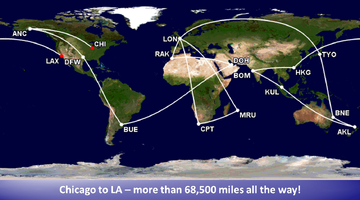
A surface segment is when you land at one airport and later depart from another airport. The airports may be close to each other (for example the 11 miles between New York's La Guardia and JFK airports) or distant (for example Chicago and LA - for someone who’s going to drive the “more than 2,000 miles all the way” of Route 66
 )
)white space
- You are allowed a maximum of 16 segments
- Within each continent, you are allowed up to 4 flight segments (6 for North America)
- You must fly across the Atlantic and Pacific oceans - surface segments are not allowed
(exception: for itineraries starting in SWP one crossing can be a surface segment) - You are allowed a surface segment between your point of origin and your final destination, which does not count toward the 16 maximum allowed – see More Rule Details below
Stopovers
You have a stopover when there is more than 24 hours between the scheduled arrival time of one flight and the scheduled departure time of the next flight (if you spend 24 hours or less between flights, that is called a Transit)
white space
- You must have at least two stopovers in your itinerary
- You are allowed only two stopovers in your continent of origin (each can be a surface segment; you can still have the maximum allowed number of flight segments in the continent )
There is no restriction on multiple stopovers at one place (other than the point of origin). It is possible to stopover in the same place up to four times (five in North America)
Ticket Validity
From first flight to last flight, you have one year to complete the journey
Also, airline general conditions of carriage allow you book up to one year in advance
So, in theory, you can book an itinerary that will start in one year’s time and end in two years’ time
BUT airline booking systems can only hold booking that are up to about one year in advance. However there is way around this problem – see the Ticket Tricks section below
More Rule Details
This section provides more detail on:
- Restrictions on trans-continental flights in Australia
- Restrictions on trans-continental flights in North America, including Alaska and Hawaii
- Surface segment between point of origin and final destination
- Second visits to northern hemisphere continents
Restrictions on trans-continental flights in Australia
The relevant rule for Australia is:
4(l) Within Australia ‐ only one nonstop/single plane service flight is permitted between the following points:
BNE/CBR/CNS/SYD/MEL ‐ PER
CBR/MEL/SYD ‐ DRW
BNE/MEL/SYD ‐ BME
BNE/MEL/SYD ‐ KTA
EXCEPTION
The online booking tool interprets this rule to mean you are allowed only one of the flights depicted on this mapBNE/CBR/CNS/SYD/MEL ‐ PER
CBR/MEL/SYD ‐ DRW
BNE/MEL/SYD ‐ BME
BNE/MEL/SYD ‐ KTA
EXCEPTION
- No restriction between SYD/MEL ‐ PER for passengers originating in PER when in conjunction with travel to/from JNB/SHA
- No restriction between SYD/MEL ‐ PER for passengers originating in New Zealand when in conjunction with travel to/from JNB
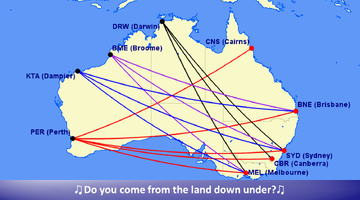
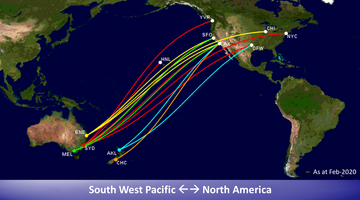
However, there have been recent (2019) reports here on FT that some airline telephone agents are allowing one flight to or from each of the west coast cities (subject to the overall limit of four flight segments for the continent)
Restrictions on trans-continental flights in North America, including Alaska and Hawaii
The relevant rules for North America are:
4(k) Within the USA/Canada only one nonstop or single plane service transcontinental flight permitted. A transcontinental flight is defined as travel between a State in column A and a State in column B.
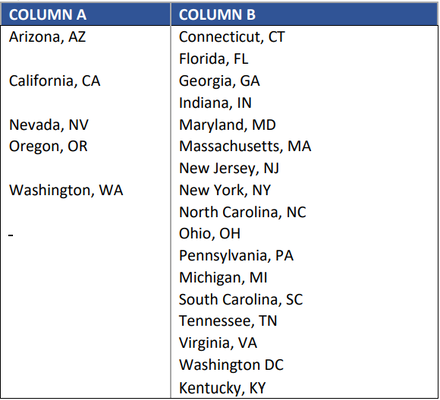
Additionally, only one flight to State of Alaska and one flight from State of Alaska permittedand:
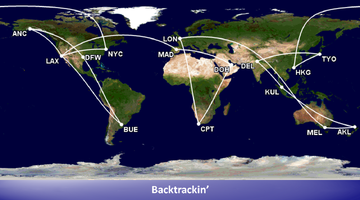
4(b) Travel must be in a continuous forward direction between TC1 ‐ TC2 ‐ TC3.
Backtracking within a continent is permitted except as follows:
Backtracking between Hawaii and other points in North America is not permitted.
white spaceBacktracking within a continent is permitted except as follows:
Backtracking between Hawaii and other points in North America is not permitted.
Surface segment between point of origin and final destination
The relevant rule is:
4(c) Travel may originate at any point for which fares are published and must terminate at the same point, except that origin‐destination surface segments are permitted as follows:
a. within the country of origin
b. within the Middle East
c. between the United States and Canada
d. between HKG and China
e. between Malaysia and SIN
f. within Africa
g. between Maldives and Sri Lanka/India
Really, it is a bit confusing to call this a surface segment; the more usual phrase is "open jaw at origin"a. within the country of origin
b. within the Middle East
c. between the United States and Canada
d. between HKG and China
e. between Malaysia and SIN
f. within Africa
g. between Maldives and Sri Lanka/India
Second visits to northern hemisphere continents
The relevant rule is:
4(e) Only one intercontinental departure and one intercontinental arrival permitted in each continent except as follows:
white space- Two permitted in North America.
- Two permitted in Asia
- Two permitted in Europe/Middle East for travel to/from/via Africa. If travel is to/from Europe in both directions, itinerary may not include Mauritius/South Africa.
Because of the requirement in Rule 4(b) (Travel must be in a continuous forward direction between TC1 ‐ TC2 ‐ TC3), the only way to have a second visit (i.e. a second intercontinental departure and a second intercontinental arrival) to a continent is to travel down to its southern hemisphere neighbour and then return
You can stopover in the northern continent both before and after you travel south
For North America and Asia there are no additional rules
For Europe/Middle East, the continent is divided into two zones – Europe Zone and Middle East Zone, as shown (Morocco, Algeria and Tunisia are in the Europe Zone; Libya, Egypt and Sudan are in the Middle East Zone)
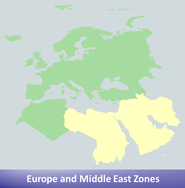
The rule is that if both your intercontinental flights are between Africa and the Europe Zone, then South Africa and Mauritius cannot be included in the itinerary
Fortunately, Qatar Airways serves many destinations in Africa from its hub in Qatar, Middle East
Further information on rules
This section has not covered every single rule in the rule sheet for the Oneworld Explorer ticket
See the full rule sheet on the Oneworld web site for more information
Go to Oneworld Around the World
Scroll down to the Frequently Asked Questions
Click on "How is my fare calculated? "
Click on the oneworld Explorer link
Top
TICKET COST
The ticket cost is made up of two components:
- the base fare, and
- the add-ons
Base Fares
As an example, here are the base fares for Canada (provided by an FTer)
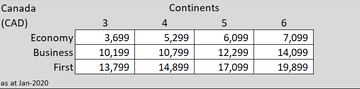
Base fares vary by cabin class, number of continents and starting country
The highest class of all the flights determines the class charged for whole journey. So if only one flight in your itinerary has first class and you want to fly that flight in first class then you must purchase a first-class ticket (and be downgraded on all the other flights on the ticket). You cannot purchase mixed cabin tickets. There are no Premium Economy fares. If you are purchasing an economy ticket, you can pay extra to fly individual flight segments in premium economy.
Each continent you visit is counted, including your continent of origin
A continent is counted even if all you do is change planes there; even if your plane merely lands there (flying London-Sydney your plane will stop at Singapore, so you pay for Asia)
And, in the case of Asia, you pay even if you fly non-stop between Europe/Middle East and South West Pacific (say on the London-Perth non-stop Qantas flight)
Oneworld does not publish the base fares
However, if you search the Oneworld forum here on FT you will find some fares posted, especially for lower cost starting points
Ask the friendly FT community if you cannot find the fares for a country you are interested in (some have access to systems that show the fares)
Add-Ons
The add-ons are the various taxes, fees and charges added on by governments and airlines
How much you will pay for your particular itinerary will depend on which airports you fly into and out of, and which airlines you use
For planning purposes, estimate 10-15% of the base fare for add-ons.
Top
TICKET PURCHASE
The ways to purchase a ticket are:
white space
- Purchase directly from a Oneworld Airline
It is best to have done your homework and be able to spoon-feed your itinerary to the agent (for each flight: date, origin, destination, flight number).
The agent will check there are seats available in your booking class and that your itinerary complies with all the rules of the ticket. The end result of this step will be that you have a booking in the airline’s system; you should receive an email confirmation of this – check this carefully: that your name is correct, and all the flights are as you wanted
The booking will be sent to the airline’s fares team which will double-check its validity and price it up
Once you have paid, a ticket will be issued and emailed to you - again, check this carefully
white space - Purchase from a Travel Agent
This process is very similar to purchasing direct from an airline. The agent will send the booking to the airline for pricing, and once you have paid the airline will issue your ticket
white space - Use the on-line booking tool
The online tool has been around for about 10 years, but it has always been ‘flaky’ and as the fare rules have changed over time, it has not kept pace
But when it works, it works, particularly for simple itineraries
Generally, the ticket will be issued by whichever airline flies your first segment.
The first carrier cannot be Qatar Airways.
Depending on airline, you either pay in the tool or you will be given a reference number to pay by phone.
Top
TICKET CHANGES
You can make changes to your ticket at any time - either before you start your journey or once you have started
If you are adding or changing flights, then there needs to be seats available in your booking class on the new flights
The airline or agent making the changes for you may charge a service fee
white space
- Ticketed point changes are changes to the list of airports in the itinerary – dropping or adding points (including adding or removing connections) or reordering the list. Depending on the airline and potentially the specific agent, changing stopovers to transits or vice versa may also be considered a re-route.
The change fee is USD125 (one fee for all changes made at the same time)
Generally, the add-on charges will be recalculated which may result in additional fees to pay or a refund of fees already paid
white space - Provided ticketed points are unchanged, there is no change fee for changes you make; however there may still be a service fee.
Examples of such changes are – changing the date of a flight, or changing from one airline to another that also flies between the two points (say from BA to AA between London Heathrow and New York JFK)
white space - If you are making the changes before departure, then changes to ticketed points or to the first segment (even just a simple date change), will result in a re-price if the fare has increased
white space - You can increase the number of continents in your itinerary and/or upgrade the class of travel – there is no change fee but you must of course pay the recalculated fare. There is no refund for downgrading (and you must pay the change fee).
white space - There is a fee to cancel the ticket, which you can do at any time
PLANNING TOOLS
The following tools have proved useful, to varying degrees for planning Oneworld Explorer journeys
white space
- Oneworld’s See Where We Fly tool allows you to see all Oneworld destinations and what flights there are to/from each, and between any two airports - it works well
white space - Oneworld’s Plan and Book Your Itinerary on-line booking tool should be the primary, and maybe only, tool needed
It is intended to allow entry of complete itineraries and take a user right through to booking and paying.
Unfortunately, it is very buggy and poorly maintained - so buggy there’s an FT Thread on it (xONEx Tool Bugs Thread)
The biggest problems are that it has not been kept up to date with rule changes, and frustratingly the tool can just hang (forever), especially when you ask it to price your itinerary
When it works, it works OK - you can enter your itinerary, it will display a picklist of flights for each segment and when you’ve chosen them all, you can request the price (it will itemise all the add-ons) and then you can pay
Just be cautious with regard to the rules; it will sometimes flag an error where there is no error; if in doubt ask for advice here on FT
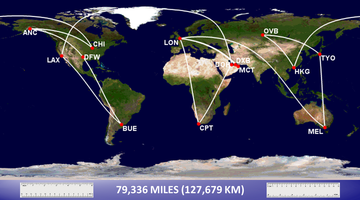
white space - The Great Circle Mapper tool is great for visualising your itinerary; and you can copy and print your final itinerary (so you can pin it up at work and make your colleagues jealous
 )
)
white space - Subscription services. If you are getting serious about planning your RTW journey you might consider two on-line tools - KVS and ExpertFlyer, which have lots of features including fare look-up, timetables, seat availability.
white space - The Matrix and Google Flights can be used to check flight schedules and to see the +++ add-on charges for individual flights.
Top
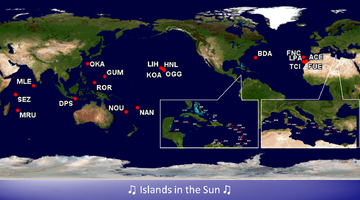
TERMINOLOGY
Oneworld Explorer Specific
- OWE – acronym for One World Explorer
white space - xONEx, LONE4, AONE6, DONE3, DONEx, xONE5 and their variants
All tickets have what is called a Fare Basis, which identifies the fare in airline computer systems. The fare basis code is a string of letters and numbers
OWE fare basis codes are all five characters long - the letters ONE in the middle, a single digit at the end (specifying the number of continents), and a single letter at the beginning (called the Booking Class) specifying the cabin class – A for First, D for Business and L for Economy)
So when someone posts about a DONE4, that is shorthand for a 4-continent Oneworld Explorer in Business Class; LONEx is referring to Economy Class Oneworld Explorers in general; xONEx refers to all Oneworld Explorers
white space - SWP is shorthand for the South West Pacific continent
General
These general terms are often used in discussing xONEx tickets
- Booking Class - tbc
- +++ and ai are used to indicate if a fare is the base fare ($500+++) or the all-in fare($650ai) (+++ meaning that the add-ons need to be added on)
TICKET TRICKS
Booking in Advance
The rules allow you to book a ticket one year in advance, for an itinerary where the last flight is one year after the first flight (so two years after booking)
But airline booking systems cannot book flights that far in advance
The trick to booking such itineraries is to make use of the fact that date changes are free
So use dummy dates for the later flights in your itinerary; you can change them later to the actual dates you want
Ways to Reduce Costs
Start Somewhere Less Expensive
Fares vary by cabin class, number of continents and starting country. So check out the fares from nearby countries. Of course, here on FT there are posts identifying the known less expensive starting countries. As at Jan-2020 these are:
Europe: Norway
Asia: Japan, Pakistan and Sri Lanka
North America: Canada
Africa: South Africa, Namibia and Mozambique
If you live in another country, then you would need to factor in the positioning costs to get to a low fare country to start the RTW and to get home from the final destination. As a concrete example - the fare differences between Canada and the U.S. vary from USD750 for a LONE3 through to USD4,000 for an AONE6Asia: Japan, Pakistan and Sri Lanka
North America: Canada
Africa: South Africa, Namibia and Mozambique
Where there are multiple carriers flying the same route – look at the surcharges for each, they can vary a bit
The total government charge to land in a country can be quite different to the total charge to leave that country. The notorious example is the U.K. – no charges at all to land there, but significant charges to leave from there, especially if flying long-haul in a premium cabin – so if you are intending to fly in and out of Europe then fly into the U.K and out from somewhere else.
Avoid Short Flight Segments
16 flights may seem like a lot, but when you start planning your trip you will likely find that 16 is not enough!
If this happens then look at your short-haul flights; places such as Europe are easy to get around by train – save your flight segments for those long-haul flights.
Low cost carriers are another option; they are good for S.E. Asia.
Also look at your first and last flights. If they are short flights, probably getting you to a major hub for its long-haul flights, then consider making your own way to and from the hub that way you will free up two segments to use elsewhere
Avoid Short Surface Segments
Sometimes when you are planning an itinerary, you end up with pesky little surface segments, such as LGA-JFK, LHR-LGW, which waste a whole segment of your allowed 16 segments.
The trick is to find somewhere in between such that the surface segment is eliminated.
For example, you want to fly from Atlanta to New York and then fly transatlantic from New York. The problem is that all the AA flights into New York are in to LGA, and none of the Oneworld transatlantic flights leave from LGA. The solution is to fly from Atlanta to somewhere that has flights into JFK – for example Chicago, Dallas or Miami. This will eliminate the surface segment and give you an extra stopover!
Break the RTW into Two (or more) Portions
You might not have the time to do a complete RTW in one go. If so, it is possible to break it into two or more separate trips. You can purchase a return ticket home from some intermediate point, or you can start somewhere other than home and have a stopover at home partway through the RTW
Use all 16 Segments
It is possible to have un-used segments at the end of your trip.
Consider someone starting a 3-continent trip from the US – 3 intercontinental flights plus 4 flights in Europe and another 4 in Asia all totals 11 flights, leaving 5 unused!
OK you might use a couple getting to and from a gateway city to leave/come back to Nth America – still leaves 3 unused.
So, you could use those spare segments as surface segments somewhere, or you could have a holiday in the US; here’s the trick:
- Remember that you can have two stopovers in your continent of origin and can fly the allowed number of flight segments (6 for Nth America – but limited to 16 segments on the entire itinerary)
- Remember also that you cannot travel via your point of origin
- Let’s say your hometown is NYC – don’t start from there! Start from say Boston or Philadelphia; that way after going around the world, you can stopover in NYC which will be the first of your two allowed stopovers in Nth America.
- Then later, but still within the one year allowed by the ticket, use the left-over segments to have the second stopover somewhere else in the US (Miami say) and to fly back to NYC at the end.
- This way, apart from the +++ for the final flights, you get a free round trip! (Note: there is no restriction on stopping over at your final destination – in the example that means you can stopover in NYC, even though it is also your final destination)
- If you have 3 segments to play with, then the west coast is reachable (remember you are allowed only one transcontinental flight, so you need three flights - say JFK-oLAX-xDFW-JFK (‘o’ means stopover, “x” means transit))
So, that can work well for someone originating in a large country such as the U.S. But what about starting in a small country such as the U.K.? The trick here is to start in a nearby country – say France, which will then be the country of origin and so after the RTW (ending with a stopover in London) the extra segments can be used for flights and a second stopover in Europe/Middle East, ending in France.
Our New Yorker can play this trick too – by starting in Canada the extra flights can be to a North American destination outside the U.S. (Bermuda say). An added benefit is that the itinerary can still end in New York
For northern hemisphere starting points, there is one more trick possible to make effective use of leftover segments – a return trip to the neighbouring southern hemisphere continent. This will add a continent to the itinerary, which is not free – but might be cost-effective compared to purchasing a completely separate ticket to go down there. So our New Yorker can start in Canada, travel around the world ending up back in New York for a stopover, and later have a trip down to Rio – returning to New York after it.
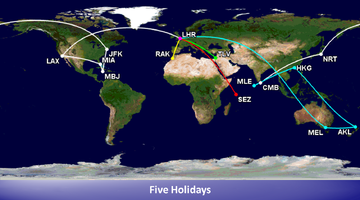
Five (or even six) holidays!
This is going over the top, but it is possible! At least for those located in the northern hemisphere (those of us located south of the equator miss out on this ☹)
- Take a positioning flight to another continent and start from there (you will get to visit this continent twice, which may drive your choice of starting continent)
- When you return to your home continent take separate trips:
- 2 return trips in your home continent using the 4 flights allowed per continent (3 return trips using 6 flights allowed in North America)
- a return trip to your southern hemisphere neighbour
- complete your RTW trip by returning to your starting point
Position to Sri Lanka (one of the low-cost starting countries); start an xONE5 from CMB
- CMB-NRT-JFK-MBJ-MIA-LAX-LHR
- LHR-TLV-LHR
- LHR-RAK-LHR
- LHR-SEZ-LHR
- LHR-MEL-AKL-HKG-MLE; then re-position home from The Maldives
Top
FREQUENTLY ASKED QUESTIONS
Ticket rule questions
Ticket cost questions
Ticket purchase questions
Ticket change questions
Terminology questions
Planning tools questions
Ticket tricks questions
Top
Change Log
Date User Handle Change Description
2021-May-10 pandaperth "one visit to ANC" etc changed to "one visit to State of Alaska" etc – see Changes to the xONEx Rule Sheet
2021-May-10 pandaperth Updated the instructions to go to the full rule sheet on the oneworld web site
2021-Jun-01 pandaperth Rule 4(k) - Inserted new table of west coast and east coast states
2023-Nov-20 anabalism - added text noting that changing stops to connections and vice versa may or may not be considered a route change.
2024-Jan-18 Mwenenzi - formatting
2025-Jan-14 SPN Lifer - Introductory sentence: inapplicability of point redemptions

The Oneworld Explorer User Guide
 Jun 8, 2025 | 9:06 pm
#917


Join Date: Dec 2019
Location: SW London UK 🇬🇧
Programs: BA GGL , * Alliance Gold, SAS Gold, Hilton Dimond IHG Platinum
Posts: 100
as long as it's booked with a AY and under D,C or J then yes credited to BA you can do it in 3 days with no hotel costs and you could be home for Sunday roast. 🤪
 Jun 10, 2025 | 3:13 am
#919


Join Date: Mar 2000
Posts: 1,030
Jun 20, 2025 | 7:02 am
#921

Join Date: Jun 2005
Location: Nowhere - Tax Free Nomad
Programs: BA GfL, UA Gold, Hilton LT Diamond, Marriott LT Titanium, IHG Plat
Posts: 1,385
A few questions/sanity check/suggestions ?
Am planning a nice long RTW and have the following itinerary planned.
OSL-LHR-JNB-DOH-PER-MEL-ZQN-AKL-JFK-CLT-JAX-ORD-BZN-DFW-MIA-LHR-OSL
So this will be 16 segments on a DONE4 with PER-MEL being a surface segment and ZQN-AKL also being surface
Questions as follows:
1) Assume the Itinerary is valid ? - I have 6 North America segments after landing in JFK and exiting in MIA so I think that is fine
2) JNB-DOH-PER is, I assume, 2 segments even though I am just in transit in DOH - I think I read somewhere that JNB-PER via SYD might only be one ?
3) When flying JNB - PER as per above, I will transit DOH so that will be "re-visiting" the Europe/Middle East zone - I assume this is ok (or otherwise I will need to book JNB-SYD-PER which would work but not be ideal as JNB-SYD does not fly every day. I don’t want to fly JNB-PER on CX as this would make it a DONE5 and even though QF are re-introducing a non-stop JNB-PER it again doesn’t fly on the day I need and has no D class at the moment - FYI - JNB - PER is my only time sensitive segment - most everything else I don’t care about and can move a week or weeks either way
4) What is the best way to book this - as BA is the first segment should I just ring them ? I did contact Trailfinders and they can do it no problem but they want 250 GBP to make any changes to the ticket after issue - and as this will start next Jan (2026) and be for a whole year I am going to have to put some dummy dates to begin with and book them as/when the booking window opens
5) Any other thoughts ? I will probably book on my BA Amex to maximise the avios return - any better ways of booking?
Am planning a nice long RTW and have the following itinerary planned.
OSL-LHR-JNB-DOH-PER-MEL-ZQN-AKL-JFK-CLT-JAX-ORD-BZN-DFW-MIA-LHR-OSL
So this will be 16 segments on a DONE4 with PER-MEL being a surface segment and ZQN-AKL also being surface
Questions as follows:
1) Assume the Itinerary is valid ? - I have 6 North America segments after landing in JFK and exiting in MIA so I think that is fine
2) JNB-DOH-PER is, I assume, 2 segments even though I am just in transit in DOH - I think I read somewhere that JNB-PER via SYD might only be one ?
3) When flying JNB - PER as per above, I will transit DOH so that will be "re-visiting" the Europe/Middle East zone - I assume this is ok (or otherwise I will need to book JNB-SYD-PER which would work but not be ideal as JNB-SYD does not fly every day. I don’t want to fly JNB-PER on CX as this would make it a DONE5 and even though QF are re-introducing a non-stop JNB-PER it again doesn’t fly on the day I need and has no D class at the moment - FYI - JNB - PER is my only time sensitive segment - most everything else I don’t care about and can move a week or weeks either way
4) What is the best way to book this - as BA is the first segment should I just ring them ? I did contact Trailfinders and they can do it no problem but they want 250 GBP to make any changes to the ticket after issue - and as this will start next Jan (2026) and be for a whole year I am going to have to put some dummy dates to begin with and book them as/when the booking window opens
5) Any other thoughts ? I will probably book on my BA Amex to maximise the avios return - any better ways of booking?
Jun 20, 2025 | 7:23 am
#922

Join Date: Nov 2021
Posts: 154
A few questions/sanity check/suggestions ?
Am planning a nice long RTW and have the following itinerary planned.
OSL-LHR-JNB-DOH-PER-MEL-ZQN-AKL-JFK-CLT-JAX-ORD-BZN-DFW-MIA-LHR-OSL
So this will be 16 segments on a DONE4 with PER-MEL being a surface segment and ZQN-AKL also being surface
Questions as follows:
1) Assume the Itinerary is valid ? - I have 6 North America segments after landing in JFK and exiting in MIA so I think that is fine
2) JNB-DOH-PER is, I assume, 2 segments even though I am just in transit in DOH - I think I read somewhere that JNB-PER via SYD might only be one ?
3) When flying JNB - PER as per above, I will transit DOH so that will be "re-visiting" the Europe/Middle East zone - I assume this is ok (or otherwise I will need to book JNB-SYD-PER which would work but not be ideal as JNB-SYD does not fly every day. I don’t want to fly JNB-PER on CX as this would make it a DONE5 and even though QF are re-introducing a non-stop JNB-PER it again doesn’t fly on the day I need and has no D class at the moment - FYI - JNB - PER is my only time sensitive segment - most everything else I don’t care about and can move a week or weeks either way
4) What is the best way to book this - as BA is the first segment should I just ring them ? I did contact Trailfinders and they can do it no problem but they want 250 GBP to make any changes to the ticket after issue - and as this will start next Jan (2026) and be for a whole year I am going to have to put some dummy dates to begin with and book them as/when the booking window opens
5) Any other thoughts ? I will probably book on my BA Amex to maximise the avios return - any better ways of booking?
Am planning a nice long RTW and have the following itinerary planned.
OSL-LHR-JNB-DOH-PER-MEL-ZQN-AKL-JFK-CLT-JAX-ORD-BZN-DFW-MIA-LHR-OSL
So this will be 16 segments on a DONE4 with PER-MEL being a surface segment and ZQN-AKL also being surface
Questions as follows:
1) Assume the Itinerary is valid ? - I have 6 North America segments after landing in JFK and exiting in MIA so I think that is fine
2) JNB-DOH-PER is, I assume, 2 segments even though I am just in transit in DOH - I think I read somewhere that JNB-PER via SYD might only be one ?
3) When flying JNB - PER as per above, I will transit DOH so that will be "re-visiting" the Europe/Middle East zone - I assume this is ok (or otherwise I will need to book JNB-SYD-PER which would work but not be ideal as JNB-SYD does not fly every day. I don’t want to fly JNB-PER on CX as this would make it a DONE5 and even though QF are re-introducing a non-stop JNB-PER it again doesn’t fly on the day I need and has no D class at the moment - FYI - JNB - PER is my only time sensitive segment - most everything else I don’t care about and can move a week or weeks either way
4) What is the best way to book this - as BA is the first segment should I just ring them ? I did contact Trailfinders and they can do it no problem but they want 250 GBP to make any changes to the ticket after issue - and as this will start next Jan (2026) and be for a whole year I am going to have to put some dummy dates to begin with and book them as/when the booking window opens
5) Any other thoughts ? I will probably book on my BA Amex to maximise the avios return - any better ways of booking?
Jun 20, 2025 | 8:45 am
#923
Join Date: Jun 2005
Location: Nowhere - Tax Free Nomad
Programs: BA GfL, UA Gold, Hilton LT Diamond, Marriott LT Titanium, IHG Plat
Posts: 1,385
True - but as I am not intending to take CX then I won't be visiting the Pacific at all and therefore a DONE4 (Europe, Africa, Australia and North America)
Jun 20, 2025 | 9:43 am
#924


Join Date: Aug 2004
Location: DCA, EGE, IAD
Programs: MR LTT, BA Gold, AA LTP, UA Silver
Posts: 6,093
Travel between South West Pacific and Europe/Middle East on a single flight number/or by surface eg LON-SYD/MEL/PER vv, DOH-ADL/AKL/CBR/MEL/PER/SYD vv, is considered travelling via Asia. Continents South West Pacific, Asia and Europe/Middle East must each be counted.
Jun 20, 2025 | 9:06 pm
#926

Join Date: Feb 2006
Location: land of aahhhhs (ICT)
Programs: EXP LTPlat 2MM
Posts: 530
I was planning to post this in the Booking and Pricing sticky, but a post there seemed to indicate this one more appropriate. I'm planning a 5th DONEx. I have a great fare to LHR in Aug with a confirmed SWU and thought about originating in OSL. Then I snagged an 80K First Class ticket to Tokyo for July 15 on JAL (it's the old 777, but still...), so I could alternatively originate TYO. If I decide on OSL I'll probably still make separate trip to TYO as there are some $2K biz fares home. Same if I purchase x TYO; I'll still go to LHR as I already have a RT ticket. My last x TYO had about 20-25% added taxes and fees, and I'd love to reduce that if possible.. Goal is maintaining EXP and accruing miles while seeing the world. I have always booked via AA RTW desk but would consider going with TA if I can find one experienced in these fares. None are listed in the tools forum.
Questions:
Is there any consensus on which origin has better fees?
There was a thread about longest xONEx but it would no longer be useful for booking to any of the carriers since there will be a mix of fare based and distance based earning. Have any of you considered maximum LP earnings (if you're an AA flier), or whatever currency you are earning? Any specific itineraries? I will be working on this and will post, but I don't think it's possible to know in advance how many status earning points or redeemable points will be awarded..
Has anyone been able to book via AA RTW without booking TATL or TPAC?
Thanks for plowing through this.
Questions:
Is there any consensus on which origin has better fees?
There was a thread about longest xONEx but it would no longer be useful for booking to any of the carriers since there will be a mix of fare based and distance based earning. Have any of you considered maximum LP earnings (if you're an AA flier), or whatever currency you are earning? Any specific itineraries? I will be working on this and will post, but I don't think it's possible to know in advance how many status earning points or redeemable points will be awarded..
Has anyone been able to book via AA RTW without booking TATL or TPAC?
Thanks for plowing through this.
Jun 20, 2025 | 11:59 pm
#928

Join Date: Apr 2007
Programs: QF, AC, Hyatt, Hilton
Posts: 4,236
... Questions:
Is there any consensus on which origin has better fees?
There was a thread about longest xONEx but it would no longer be useful for booking to any of the carriers since there will be a mix of fare based and distance based earning. Have any of you considered maximum LP earnings (if you're an AA flier), or whatever currency you are earning? Any specific itineraries? I will be working on this and will post, but I don't think it's possible to know in advance how many status earning points or redeemable points will be awarded..
Has anyone been able to book via AA RTW without booking TATL or TPAC?
Thanks for plowing through this.
Is there any consensus on which origin has better fees?
There was a thread about longest xONEx but it would no longer be useful for booking to any of the carriers since there will be a mix of fare based and distance based earning. Have any of you considered maximum LP earnings (if you're an AA flier), or whatever currency you are earning? Any specific itineraries? I will be working on this and will post, but I don't think it's possible to know in advance how many status earning points or redeemable points will be awarded..
Has anyone been able to book via AA RTW without booking TATL or TPAC?
Thanks for plowing through this.
OSL: DONE4, EUR5037; DONE5, EUR5782; DONE6, 6519.
TOK: DONE4, EUR5615; DONE5, EUR6441; DONE6, EUR7038.
It's impossible to comment on possible earnings without at least a rough indication of an itinerary.
It seems a hard and fast rule that you must have at least the TAtl or TPac as an AA code. I think there may have been a report of some who's an executive platinum getting away without the requirement, but that's rare, it seems.
 Jun 21, 2025 | 12:45 am
#929
Join Date: Feb 2006
Location: land of aahhhhs (ICT)
Programs: EXP LTPlat 2MM
Posts: 530

Also, as mentioned, there exists a thread, (to which I've contributed), giving GCM itineraries showing maximum miles various members had constructed. They were mostly 3 continent fares. Now that miles aren't the only factor if one is interested in achieving status or stockpiling miles, that thread is obsolete. Also relevant is the airline you are crediting to. For American, one would prioritize AY, QR, and JL internationally and AS for North America. That might vary for other airlines' members. Maybe the data most valuable to people planning would come from those who've completed their trips and can break down the activity.
Jun 21, 2025 | 2:12 am
#930
Join Date: Mar 2008
Location: London, UK
Programs: BA GGL, AA liftime gold
Posts: 688
Well, yes, seriously. Pretty clear: is there any preference for one or the other points of origin for lower fees and taxes and for better points and miles accrual? Yes I recognize that might be a complex question.
Also, as mentioned, there exists a thread, (to which I've contributed), giving GCM itineraries showing maximum miles various members had constructed. They were mostly 3 continent fares. Now that miles aren't the only factor if one is interested in achieving status or stockpiling miles, that thread is obsolete. Also relevant is the airline you are crediting to. For American, one would prioritize AY, QR, and JL internationally and AS for North America. That might vary for other airlines' members. Maybe the data most valuable to people planning would come from those who've completed their trips and can break down the activity.
Also, as mentioned, there exists a thread, (to which I've contributed), giving GCM itineraries showing maximum miles various members had constructed. They were mostly 3 continent fares. Now that miles aren't the only factor if one is interested in achieving status or stockpiling miles, that thread is obsolete. Also relevant is the airline you are crediting to. For American, one would prioritize AY, QR, and JL internationally and AS for North America. That might vary for other airlines' members. Maybe the data most valuable to people planning would come from those who've completed their trips and can break down the activity.