
























Bread making -- recipes, best machines, techniques, etc.
 Apr 27, 2020 | 9:20 am
#31
Original Poster
FlyerTalk Evangelist


Join Date: Nov 2002
Location: ORD
Posts: 14,773
Thanks, yes, baking it in the Dutch oven makes it crusty (it bakes in its own steam). I actually like the crust on my bread, that's not the issue.
For this bread, I followed the recipe in the book for 75% whole wheat single-day bread. I used 3 parts King Arthur whole wheat flour and 1 part grocery store-brand all purpose flour.
I let it rise for about six hours...it never tripled in size like the recipe said but it did double. Then when I shaped it and did the final proof it had shrunk again (because of the shaping). I followed the book's suggestion of poking it with a finger to determine when the proofing was done...if you poke it and the indentation springs back slowly and incompletely, it's ready.
For this bread, I followed the recipe in the book for 75% whole wheat single-day bread. I used 3 parts King Arthur whole wheat flour and 1 part grocery store-brand all purpose flour.
I let it rise for about six hours...it never tripled in size like the recipe said but it did double. Then when I shaped it and did the final proof it had shrunk again (because of the shaping). I followed the book's suggestion of poking it with a finger to determine when the proofing was done...if you poke it and the indentation springs back slowly and incompletely, it's ready.
 Apr 27, 2020 | 10:27 am
#32
FlyerTalk Evangelist


Join Date: Apr 2001
Location: Denver, CO
Programs: UA Silver, Bonvoy Gold, Hyatt Discoverist
Posts: 23,178
We use a recipe similar to this one... https://joyfoodsunshine.com/easy-no-knead-bread/
By the time you let it proof overnight, it doesn't matter how you get it into the dutch oven.
By the time you let it proof overnight, it doesn't matter how you get it into the dutch oven.
Apr 27, 2020 | 11:12 am
#33
Original Poster
FlyerTalk Evangelist
Join Date: Nov 2002
Location: ORD
Posts: 14,773
We use a recipe similar to this one... https://joyfoodsunshine.com/easy-no-knead-bread/
By the time you let it proof overnight, it doesn't matter how you get it into the dutch oven.
By the time you let it proof overnight, it doesn't matter how you get it into the dutch oven.
If I could find any flour at the store I'd try again!

 Apr 27, 2020 | 11:38 am
#35


Join Date: Dec 2012
Location: YVR, HNL
Programs: AS MVPG, UA peon, BA Bronze, Marriott Plat, HH Diamond, Fairmont Plat (RIP)
Posts: 8,438
Use Jim Lahey’s recipe/technique. This is the best recipe I have ever found. “..use lightly floured hands to gently and quickly lift the edges of the dough in toward the center, effectively folding the dough over onto itself. Nudge and tuck in the edges of the dough to make it round. That’s it. Don’t knead the dough”. Do it on parchment and then just flip it over into the pot.
https://leitesculinaria.com/99521/re...ead-bread.html
https://leitesculinaria.com/99521/re...ead-bread.html
Apr 27, 2020 | 1:50 pm
#37
FlyerTalk Evangelist

Join Date: Nov 2013
Location: Los Angeles
Posts: 15,357
I also do Jim Lahey's recipe (same as NYT 18 hour recipe). I've made a lot of loaves of it. I just ate some toast with rye bread and caraway seeds (and peanut butter after toasting) that I made yesterday.
Here's a video of Lahey doing it.
www.youtube.com/watch?v=13Ah9ES2yTU
I just slide the oven rack out and plop the dough in off the towel - I don't flip it into my hand first like he does in the video. It usually looks like a mess after the plop and the loaf comes out pretty anyway.
A few tips:
- get a couple cheap digital scales (one that does kg range for flour and water, one with mg resolution and ~100g range for yeast and salt).
- Weigh your ingredients, including water. 1 mL water = 1 gram. There's a lot of variation among measuring cups that claim to be the same size.
- experiment a bit with how much water you need, and weigh the extra you put in. There are variations in flour and humidity of where you are that will make you want more or less water. I've been doing 320 g of water lately for 300g bread flour+100g rye or whole wheat. I also like to do 250g bread/100 g whole wheat/ 50 g spelt.
- a silicone dough scraper is convenient for getting the dough out of the bowl, though not required.
- I used to have a nice setup where I had an old laptop setup as a server and I put a vented shoebox over it and I'd put the bowls of dough over it to rise. That's not running anymore, so I got a temperature controller and a and I throw the temp sensor and lamp in the oven with the temp controller set to 80F for the overnight rise. You don't have to be that extreme, but someplace warm to rise is important. I like breads that have overnight rises more than when they're sped up with sugar for the yeast.
- and I love the bon appetit videos, so here's one of claire and brad making sourdough. The BA videos are nice because they do show people cooking for real and messing things up and making things up on the fly.
www.youtube.com/watch?v=oidnwPIeqsI
- If you can't get bread flour, you can dope all purpose with about 1 tbsp vital wheat gluten flour per cup (keeping the total amount of flour the same) to get the gluten content up to bread flour levels.
Here's a video of Lahey doing it.
www.youtube.com/watch?v=13Ah9ES2yTU
I just slide the oven rack out and plop the dough in off the towel - I don't flip it into my hand first like he does in the video. It usually looks like a mess after the plop and the loaf comes out pretty anyway.
A few tips:
- get a couple cheap digital scales (one that does kg range for flour and water, one with mg resolution and ~100g range for yeast and salt).
- Weigh your ingredients, including water. 1 mL water = 1 gram. There's a lot of variation among measuring cups that claim to be the same size.
- experiment a bit with how much water you need, and weigh the extra you put in. There are variations in flour and humidity of where you are that will make you want more or less water. I've been doing 320 g of water lately for 300g bread flour+100g rye or whole wheat. I also like to do 250g bread/100 g whole wheat/ 50 g spelt.
- a silicone dough scraper is convenient for getting the dough out of the bowl, though not required.
- I used to have a nice setup where I had an old laptop setup as a server and I put a vented shoebox over it and I'd put the bowls of dough over it to rise. That's not running anymore, so I got a temperature controller and a and I throw the temp sensor and lamp in the oven with the temp controller set to 80F for the overnight rise. You don't have to be that extreme, but someplace warm to rise is important. I like breads that have overnight rises more than when they're sped up with sugar for the yeast.

- and I love the bon appetit videos, so here's one of claire and brad making sourdough. The BA videos are nice because they do show people cooking for real and messing things up and making things up on the fly.
www.youtube.com/watch?v=oidnwPIeqsI
- If you can't get bread flour, you can dope all purpose with about 1 tbsp vital wheat gluten flour per cup (keeping the total amount of flour the same) to get the gluten content up to bread flour levels.
Apr 27, 2020 | 1:56 pm
#38
Moderator, Omni, Omni/PR, Omni/Games, FlyerTalk Posting Legend


Join Date: Oct 2004
Location: Between DCA and IAD
Programs: UA 1K MM; Hilton Diamond
Posts: 72,610
This video (and others from the same gentleman) is super-useful IMHO. He's got another one post-quarantine showing baking from home without access to all the pro gear, too.
You don't have to do sourdough, either; a lot of the same concepts apply to yeast-leavened breads. For example, I have been making a poolish, or basically a 50-50 blend of water & flour with a bit of instant yeast added, which you then let ferment for a couple of hours before adding to the dough, and it's has worked out great albeit without the added flavor of the sourdough ferment.
You don't have to do sourdough, either; a lot of the same concepts apply to yeast-leavened breads. For example, I have been making a poolish, or basically a 50-50 blend of water & flour with a bit of instant yeast added, which you then let ferment for a couple of hours before adding to the dough, and it's has worked out great albeit without the added flavor of the sourdough ferment.
Apr 27, 2020 | 1:59 pm
#39
FlyerTalk Evangelist
Join Date: Nov 2013
Location: Los Angeles
Posts: 15,357
T For example, I have been making a poolish, or basically a 50-50 blend of water & flour with a bit of instant yeast added, which you then let ferment for a couple of hours before adding to the dough, and it's has worked out great albeit without the added flavor of the sourdough ferment.
Apr 27, 2020 | 2:54 pm
#40


Join Date: Apr 2007
Location: IAD
Programs: united, american, alaska
Posts: 1,845
It sounds like your flour mix is too low in gluten. Try adding gluten. And 6 hours to double is a lot. You might try letting it rise in a warmer place. I have a huge bathroom, so I sometimes put a bowl of dough on the far end of the counter while I take a bubble bath.
Apr 27, 2020 | 7:03 pm
#41
Moderator, Omni, Omni/PR, Omni/Games, FlyerTalk Posting Legend
Join Date: Oct 2004
Location: Between DCA and IAD
Programs: UA 1K MM; Hilton Diamond
Posts: 72,610
I love that our oven has a bread proofing setting. The convection half of the oven basically sits at 78-80 degrees (there's also a rapid proof cycle that I expect runs closer to 100 degrees, but we stick to the standard one). Solves a world of problems to be able to park the dough there for the bulk fermentation, for the proofing, and for the final rise. Also cool enough that we can toss plastic bowls, rattan proofing baskets, etc., in there without fire or melting risks.
Now, if only we had a steam injection oven, we'd be coming hardcore! As it is, I usually mist the oven repeatedly with water to keep the steam levels high, and of course use a Dutch oven with lid for the initial 20 minutes or so of baking to hold in steam.
Now, if only we had a steam injection oven, we'd be coming hardcore! As it is, I usually mist the oven repeatedly with water to keep the steam levels high, and of course use a Dutch oven with lid for the initial 20 minutes or so of baking to hold in steam.
Apr 27, 2020 | 7:57 pm
#42
Join Date: Dec 2012
Location: YVR, HNL
Programs: AS MVPG, UA peon, BA Bronze, Marriott Plat, HH Diamond, Fairmont Plat (RIP)
Posts: 8,438
I love that our oven has a bread proofing setting. The convection half of the oven basically sits at 78-80 degrees (there's also a rapid proof cycle that I expect runs closer to 100 degrees, but we stick to the standard one). Solves a world of problems to be able to park the dough there for the bulk fermentation, for the proofing, and for the final rise. Also cool enough that we can toss plastic bowls, rattan proofing baskets, etc., in there without fire or melting risks.
Now, if only we had a steam injection oven, we'd be coming hardcore! As it is, I usually mist the oven repeatedly with water to keep the steam levels high, and of course use a Dutch oven with lid for the initial 20 minutes or so of baking to hold in steam.
Now, if only we had a steam injection oven, we'd be coming hardcore! As it is, I usually mist the oven repeatedly with water to keep the steam levels high, and of course use a Dutch oven with lid for the initial 20 minutes or so of baking to hold in steam.
Apr 27, 2020 | 8:21 pm
#43
Moderator, Omni, Omni/PR, Omni/Games, FlyerTalk Posting Legend
Join Date: Oct 2004
Location: Between DCA and IAD
Programs: UA 1K MM; Hilton Diamond
Posts: 72,610
I have dough in the oven right now on standard proof. Using Lahey’s recipe so I will leave it overnight and bake tomorrow. Should I leave the oven on all night on the proof setting or is that overkill and I should turn it off before bed? It seems a bit above room temp in there, around 78-80F if I had to guess.
I haven't looked Lahey's recipe yet in detail, but I would be averse to using the proofing cycle for more than 6-7 hours or so of the total process (bulk rise, loaf proofing, etc., combined). I'll have to go read though his recipe now...
ETA: Read through Lahey's recipe, and I still think the standard proof cycle might be a bit warm for overnight. A 12-18 hour bulk fermentation like he suggests would be at room temperature of 68-72 IMHO, and at warmer temps would risk the yeast basically running out of food too quickly, and the final dough falling a bit. You might be okay; always worth trying. I left my dough to autolyse in the oven on the proof setting the other night, and it oxidized a bit. Still mostly worked ok, but had yeast been there, it would have been messy (I added the yeast the next morning, then let it rise for about 3 hours and proof for 1-2 more after I'd shaped it roughly; it came out pretty well). But most overnight rises I've used have indeed been either in the fridge or with ice water to start.
Last edited by exerda; Apr 27, 2020 at 8:31 pm
Apr 27, 2020 | 8:35 pm
#44
Join Date: Dec 2012
Location: YVR, HNL
Programs: AS MVPG, UA peon, BA Bronze, Marriott Plat, HH Diamond, Fairmont Plat (RIP)
Posts: 8,438
If you're going overnight, personally I would use the fridge. Definitely think the oven on proof cycle with lead to over-rising and then a poor final rise (as the yeast will have eaten everything they can too early in the process).
I haven't looked Lahey's recipe yet in detail, but I would be averse to using the proofing cycle for more than 6-7 hours or so of the total process (bulk rise, loaf proofing, etc., combined). I'll have to go read though his recipe now...
ETA: Read through Lahey's recipe, and I still think the standard proof cycle might be a bit warm for overnight. A 12-18 hour bulk fermentation like he suggests would be at room temperature of 68-72 IMHO, and at warmer temps would risk the yeast basically running out of food too quickly, and the final dough falling a bit. You might be okay; always worth trying. I left my dough to autolyse in the oven on the proof setting the other night, and it oxidized a bit. Still mostly worked ok, but had yeast been there, it would have been messy (I added the yeast the next morning, then let it rise for about 3 hours and proof for 1-2 more after I'd shaped it roughly; it came out pretty well). But most overnight rises I've used have indeed been either in the fridge or with ice water to start.
I haven't looked Lahey's recipe yet in detail, but I would be averse to using the proofing cycle for more than 6-7 hours or so of the total process (bulk rise, loaf proofing, etc., combined). I'll have to go read though his recipe now...
ETA: Read through Lahey's recipe, and I still think the standard proof cycle might be a bit warm for overnight. A 12-18 hour bulk fermentation like he suggests would be at room temperature of 68-72 IMHO, and at warmer temps would risk the yeast basically running out of food too quickly, and the final dough falling a bit. You might be okay; always worth trying. I left my dough to autolyse in the oven on the proof setting the other night, and it oxidized a bit. Still mostly worked ok, but had yeast been there, it would have been messy (I added the yeast the next morning, then let it rise for about 3 hours and proof for 1-2 more after I'd shaped it roughly; it came out pretty well). But most overnight rises I've used have indeed been either in the fridge or with ice water to start.
Apr 27, 2020 | 9:48 pm
#45
Moderator, Omni, Omni/PR, Omni/Games, FlyerTalk Posting Legend
Join Date: Oct 2004
Location: Between DCA and IAD
Programs: UA 1K MM; Hilton Diamond
Posts: 72,610
Those look delicious!
I will admit that the hardest thing to get used to in getting back into making bread is the lack of kneading. I had always had it drilled into my head that you had to knead to develop gluten, and that of course the stand mixer would save all that effort.
Then all the recipes I've used as well as those a professional baker friend of mine has recommended to me involve no traditional kneading, either by hand or by dough hook. Just an autolyse period for the ingredients, some turning & stretching of the dough during the bulk rise (far less than kneading), and loaf shaping.
With high moisture ratio doughs (75% or more water by weight), I'm happy not to try to knead. That would be a gloopy mess in the mixer and worse by hand. It's enough of a mess turning and stretching by hand as it is. But the results have been great on every batch I've tried this year.
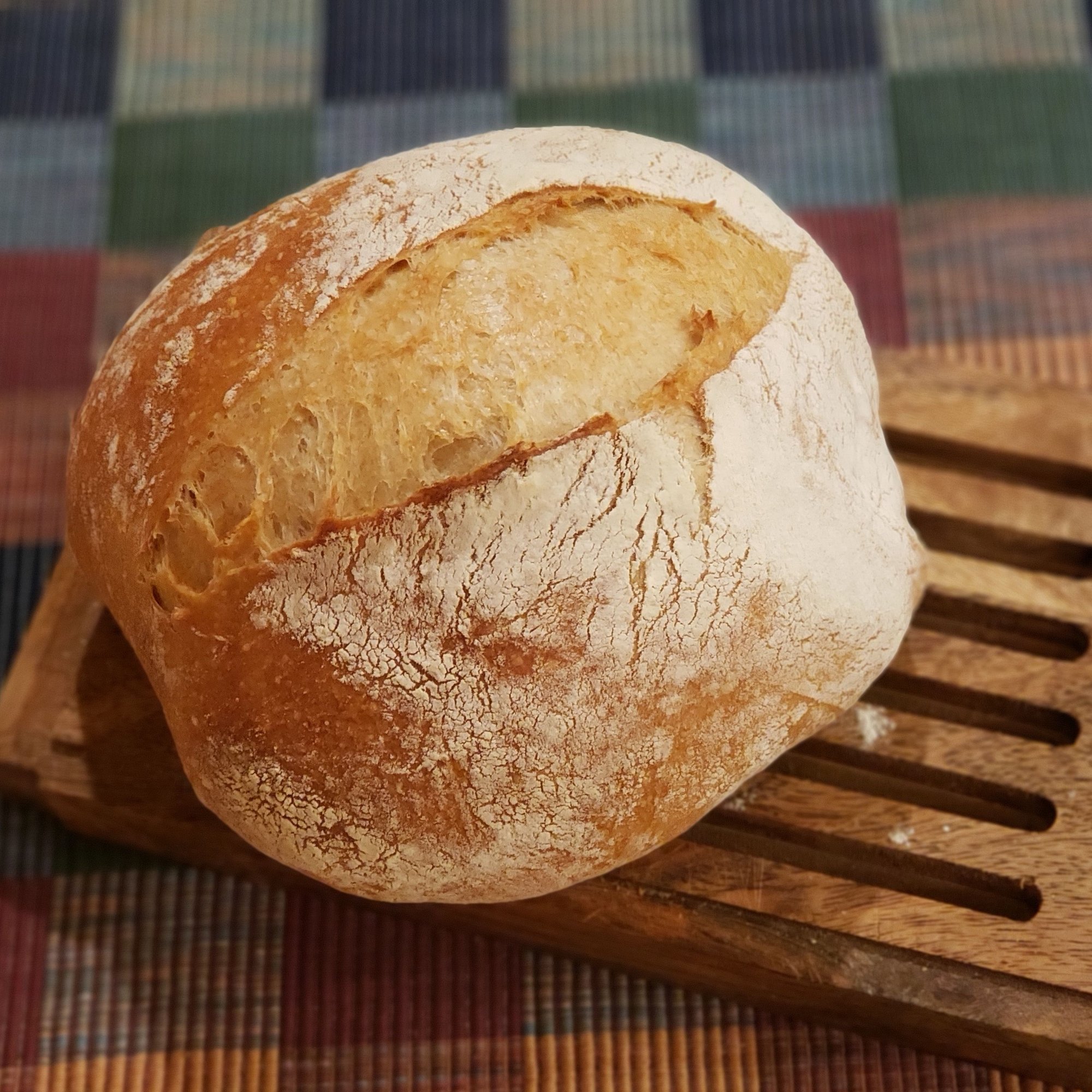
This was one of my recent results:
I will admit that the hardest thing to get used to in getting back into making bread is the lack of kneading. I had always had it drilled into my head that you had to knead to develop gluten, and that of course the stand mixer would save all that effort.
Then all the recipes I've used as well as those a professional baker friend of mine has recommended to me involve no traditional kneading, either by hand or by dough hook. Just an autolyse period for the ingredients, some turning & stretching of the dough during the bulk rise (far less than kneading), and loaf shaping.
With high moisture ratio doughs (75% or more water by weight), I'm happy not to try to knead. That would be a gloopy mess in the mixer and worse by hand. It's enough of a mess turning and stretching by hand as it is. But the results have been great on every batch I've tried this year.
This was one of my recent results: