Originally Posted by
IMOA
That wasn’t my experience in either Hong Kong or Singapore where we were checked, there wasn’t any remote suggestion that this was a health check or that we had been given the all clear. It was simply one of many things that they were doing to identify potential carriers and separate them as early as possible. Given the progression of the disease in those countries compared to others I know where I feel much safer.
It has the benefit of warning people who have mild symptoms to think twice, so they may not enter the place (e.g., hotel, store)
Originally Posted by
narvik
So NOTHING at all to do with medical treatment one might receive?
Untrue
Originally Posted by
GinFizz
I
EDIT: trueblu explained it far more accurately and politely than I could ...
No, the article also clearly states that "Sometimes people experience complications, and need extra care, such as breathing assistance, ventilators or even extracorporeal membrane oxygenation (ECMO), which pumps blood outside a patient's body". Without which the "stress" on patients would be even greater.
True
Originally Posted by
stimpy
I wrote "what matters the most to the most people". It should be obvious that most adults are healthy enough to withstand this virus or the flu. It is also correct that people who are not in good health have a rather high risk with Coronavirus and should take all precautions. For the rest of us, it should be business as usual and it will go back to just that once the panic is over.
I've been traveling a lot and while the passenger loads are down on planes and trains, I'm not the only one on board. There are plenty of others like me who aren't buying in to the panic.
I was in a uber the driver was a young lady. I asked her if she worries a passenger may be infected but does not have symptom. She replied "the viruses do not scare me, I am young and healthy, and even if I got so unlucky to be one of the very few young people killed by this virus, I am not afraid to die."
I then said: What if that passenger without symptom passes virus to you, you also have mild or no symptom and recover later, but during the interim you can pass the virus to passengers my age?
She immediately said, oh no, I don't want to do that.
Originally Posted by
narvik
China's measures helped control the spread for sure.
It's also possible the rise in temperatures helped and is helping.
Made a quick chart showing temps in Wuhan, China (taking data from weather.com from Dec 1, 2019 to Mar 9, 2020, averaging daily high and daily low, red line is added "by hand"):
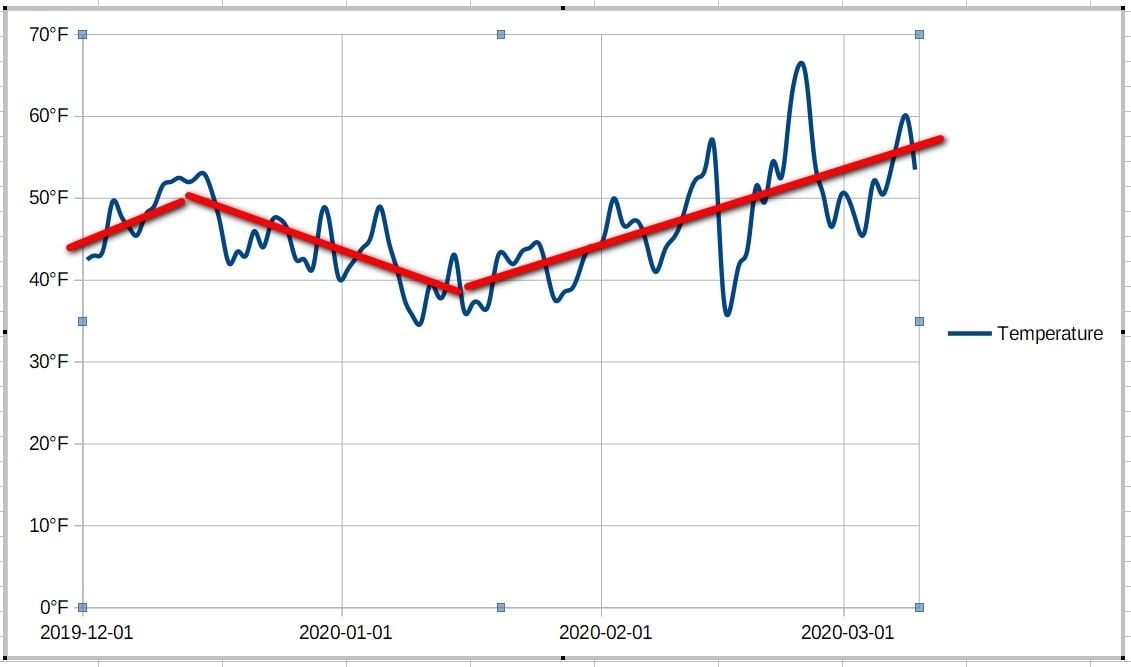
What you show is a typical seasonal cycle. We all hope the coming warm season will suppress the viruses. But one cannot use this figure to argue for a relationship. If you draw a time series of temperature of US it will show the opposite relationship with case number, To identify a temperature association one has to isolate all the non meteorological factors, including the counter measures such as healthcare infrastructure, behavior change of the masses and social distancing etc which clearly change with time.
Originally Posted by
notquiteaff
8.72 degrees, to be “precise”.
The number was mentioned in the post below by Diplomatico.
I haven’t read the article or study yet, but given that we don’t even seem to know with certainty yet what transmission mechanisms “work best”, being able to determine the perfect temperature for the virus to spread with two decimal places precision seems amazing to me.
The paper has not been published, I can only read the linked article. The authors appear to be naive in going to the second digit of temperature values. They collected data from different locations and environments where other factors are not the same. There was no mention of any effort to stratify the data to remove these other factors. I know SYSU quite well, I was there in early December, organizing a WMO conference at School of Atmospheric Sciences. They have a strong medical school. But based on the linked article if I were the journal editor I will not send it out to peer review.