
























Is this pilot lost? Unusual flight pattern?
 Feb 14, 2020 | 10:33 pm
#1
Original Poster
Join Date: Aug 2014
Location: DAL
Programs: WN
Posts: 40
Is this pilot lost? Unusual flight pattern?
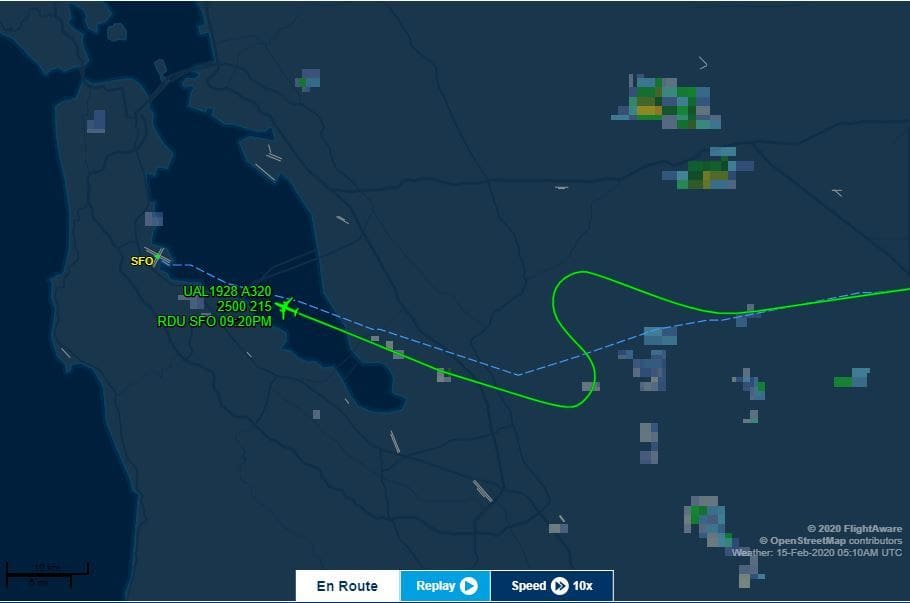
What's going on here? Am I missing something? The flight below appears to have turned early to land at OAK, then changes and ends up landing at SFO per their original flight plan.


 Feb 15, 2020 | 8:49 am
#6
Original Poster
Join Date: Aug 2014
Location: DAL
Programs: WN
Posts: 40
Gotcha. Thanks. I always assumed flights had to circle around the airport in a holding pattern to get in line to land when it is busy. Didn't know they could just zig-zag their way in.
I guess the pattern reminded me of a private flight I was on a few years ago flying from Clearwater to Key West. We were flying down the Florida coastline. As we were crossing over Fort Myers, the pilot punched in a new vector direct to Key West. The plane suddenly banked and turned 90 degrees heading directly out into the Gulf of Mexico towards Mexico. After I told him we weren't heading to Key West anymore, and after the ATC asked him what he was doing and where he was going, and after we had a near miss, he realized he punched in the wrong airport. I thought the same guy might have been flying the plane last night to SFO.
I guess the pattern reminded me of a private flight I was on a few years ago flying from Clearwater to Key West. We were flying down the Florida coastline. As we were crossing over Fort Myers, the pilot punched in a new vector direct to Key West. The plane suddenly banked and turned 90 degrees heading directly out into the Gulf of Mexico towards Mexico. After I told him we weren't heading to Key West anymore, and after the ATC asked him what he was doing and where he was going, and after we had a near miss, he realized he punched in the wrong airport. I thought the same guy might have been flying the plane last night to SFO.
Last edited by darrenpb; Feb 15, 2020 at 9:05 am
Feb 15, 2020 | 9:16 am
#7


Join Date: May 2005
Location: Dulles, VA
Programs: United Airlines 1 MM, Marriott Life Titanium
Posts: 2,777
Zig-zaging in is more normal these days than orbiting closer in. Plan A is simply slowing down, then take a few turns a few hundred miles out to kill time, then maybe orbit a while in close. Orbiting is tough to do in San Fran since there are three large commercial airports within 30 miles of each other, plus private fiels and whatever occasionally flies out of Moffett these days.
Feb 15, 2020 | 10:31 am
#9

Join Date: Feb 2015
Location: SFO
Programs: UA 1MM 1K, BA Gold
Posts: 480
How ATC handles this actually depends on the region. Europeans seems to prefer a procedure where they just put the plane in a hold. US is usually vectoring around unless there is a lot of congestion or uncertain length of delay (storm over airport)
Feb 15, 2020 | 11:50 am
#10

Join Date: Dec 2019
Posts: 261
A common San Jose take off is going north but not in a straight line. Instead, the plane takes off going north then does an almost immediate left (west turn) then goes south past San Jose airport then makes a wide turn north. In doing so it is now higher in altitude and flying over the East Bay slightly east of Oakland Airport. In contrast, SFO flight often take off to the northeast then make a slight left turn so they are going north but are flying on a trajectory west of the SJC north bound planes. They are also probably flying a little lower.
See post #1 for a map.
Feb 15, 2020 | 1:05 pm
#11
Join Date: Jul 2000
Location: Santa Clara, Calif.
Programs: AA 1MM (Back to GLD for now)
Posts: 165
Here's a sectional with overlays showing the relatively new (August 2018) Class B airspace around SFO.
Blue is the new definition and Yellow the old one.
They tweaked it mostly to allow better flow to SJC, San Carlos (SQL), Palo Alto (PAO), and Moffett Field (NUQ) without compromising SFO traffic.
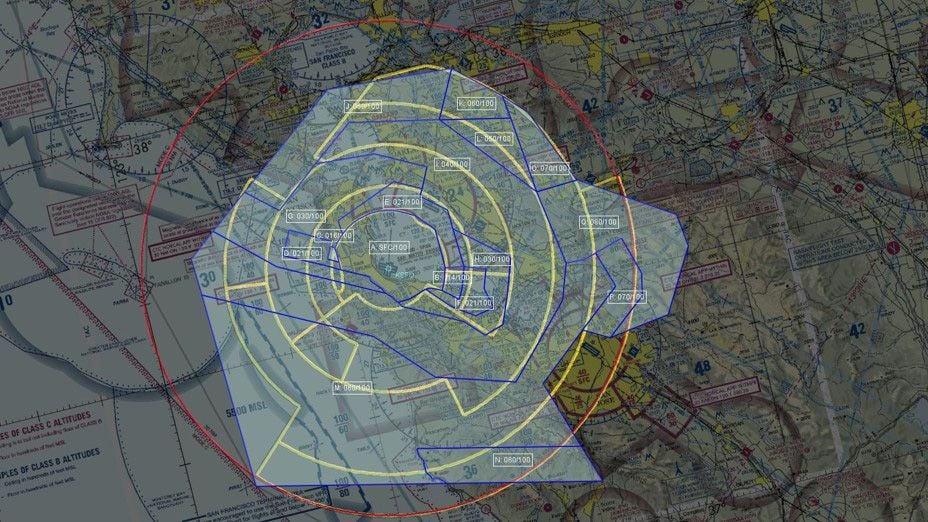
This may give you a better idea of what the airspace actually looks like, especially if you're unfamiliar with reading a sectional chart.
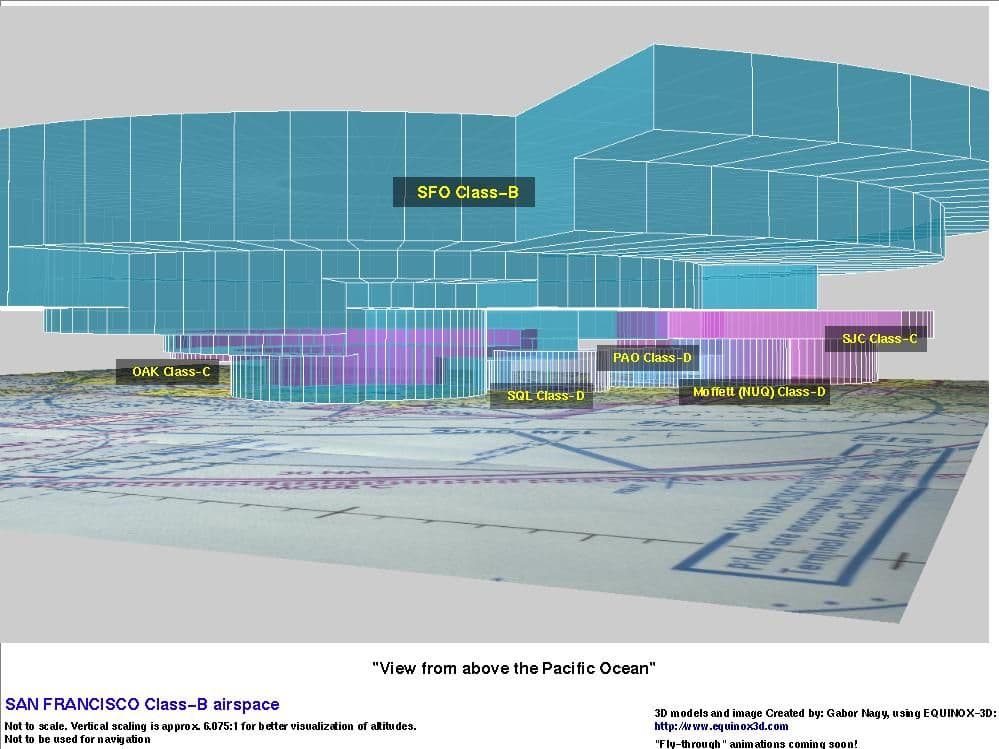
As you can see, it's a lot like an inverted wedding cake.
Hope this helps.
- Plat
Blue is the new definition and Yellow the old one.
They tweaked it mostly to allow better flow to SJC, San Carlos (SQL), Palo Alto (PAO), and Moffett Field (NUQ) without compromising SFO traffic.
This may give you a better idea of what the airspace actually looks like, especially if you're unfamiliar with reading a sectional chart.
As you can see, it's a lot like an inverted wedding cake.
Hope this helps.
- Plat
Feb 15, 2020 | 1:10 pm
#12


Join Date: Aug 2010
Location: KEWR
Programs: Marriott Platinum
Posts: 901
Gotcha. Thanks. I always assumed flights had to circle around the airport in a holding pattern to get in line to land when it is busy. Didn't know they could just zig-zag their way in.
I guess the pattern reminded me of a private flight I was on a few years ago flying from Clearwater to Key West. We were flying down the Florida coastline. As we were crossing over Fort Myers, the pilot punched in a new vector direct to Key West. The plane suddenly banked and turned 90 degrees heading directly out into the Gulf of Mexico towards Mexico. After I told him we weren't heading to Key West anymore, and after the ATC asked him what he was doing and where he was going, and after we had a near miss, he realized he punched in the wrong airport. I thought the same guy might have been flying the plane last night to SFO.
I guess the pattern reminded me of a private flight I was on a few years ago flying from Clearwater to Key West. We were flying down the Florida coastline. As we were crossing over Fort Myers, the pilot punched in a new vector direct to Key West. The plane suddenly banked and turned 90 degrees heading directly out into the Gulf of Mexico towards Mexico. After I told him we weren't heading to Key West anymore, and after the ATC asked him what he was doing and where he was going, and after we had a near miss, he realized he punched in the wrong airport. I thought the same guy might have been flying the plane last night to SFO.
Feb 15, 2020 | 1:11 pm
#13
Join Date: Jan 2005
Location: San Francisco, California
Programs: Amex Centurion, United Global Services, Hyatt Globalist, Marriott Titanium
Posts: 919
Feb 15, 2020 | 1:16 pm
#14

Join Date: Mar 2017
Programs: Does Non Rev count?
Posts: 677
Gotcha. Thanks. I always assumed flights had to circle around the airport in a holding pattern to get in line to land when it is busy. Didn't know they could just zig-zag their way in.
I guess the pattern reminded me of a private flight I was on a few years ago flying from Clearwater to Key West. We were flying down the Florida coastline. As we were crossing over Fort Myers, the pilot punched in a new vector direct to Key West. The plane suddenly banked and turned 90 degrees heading directly out into the Gulf of Mexico towards Mexico. After I told him we weren't heading to Key West anymore, and after the ATC asked him what he was doing and where he was going, and after we had a near miss, he realized he punched in the wrong airport. I thought the same guy might have been flying the plane last night to SFO.
I guess the pattern reminded me of a private flight I was on a few years ago flying from Clearwater to Key West. We were flying down the Florida coastline. As we were crossing over Fort Myers, the pilot punched in a new vector direct to Key West. The plane suddenly banked and turned 90 degrees heading directly out into the Gulf of Mexico towards Mexico. After I told him we weren't heading to Key West anymore, and after the ATC asked him what he was doing and where he was going, and after we had a near miss, he realized he punched in the wrong airport. I thought the same guy might have been flying the plane last night to SFO.
 Feb 15, 2020 | 1:26 pm
#15
Join Date: Aug 2008
Location: SF Bay Area
Programs: UA 1K, Hyatt Globalist, Virtuoso Travel Agent, Commercial Pilot
Posts: 2,167
Holds don't happen that often in the US these days, and are mostly used for unexpected events that significantly impact the airport's arrival rate. (Ground Delay Programs are used to hold planes at their origin for events that are forecasted.) Delay vectors, however, are super common for creating an extra mile or two of spacing when necessary. Often they're just not quite as dramatic as this one (e.g. a turn in a slightly less-than-optimal direction).