

















Faster vs. bigger?
 May 6, 2001 | 12:49 pm
#1
Original Poster
FlyerTalk Evangelist


Join Date: May 1998
Location: Massachusetts, USA; AA 2.996MM & Plat Pro, DL 1MM, GM & Flying Colonel
Posts: 25,037
Faster vs. bigger?
The Boston Globe's take on the battle between the Airbus A380 and Boeing's sonic cruiser: which do airlines and the traveling public really want or need? The article includes some of the business strategies behind them and the PR war, which can overshadow the real issues as each company tries to show the other in the worst possible light:
http://www.boston.com/dailyglobe2/12..._bigger+.shtml
http://www.boston.com/dailyglobe2/12..._bigger+.shtml
 May 6, 2001 | 12:58 pm
#2
Join Date: Oct 1999
Location: Third planet from the Sun
Posts: 7,024
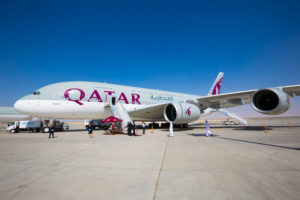
If people do not support pouring more concrete for runways (not in my back yard)--then size does matter. If you can replace several 757's /767's into one A380, then building bigger airplanes is the only way to reduce airport congestion.
May 6, 2001 | 3:30 pm
#4
Join Date: Jan 2001
Location: NYC
Programs: UA/1K, DL/PM, AA/PLT, NW/SLV; SW/PLT, HH/DIA
Posts: 1,732
Actually, I think the new runway issue is moot. I think I read that none of the major world airports have runways that could support the A380. Additionally, it's the taxiways and gates. Remember, this plane is longer, heavier, and wider than anything else out there.
If it happens, I think the sonic cruiser is a MUCH more compelling case for the airlines. I could easily see Singapore, Cathay, and JAL all offering daily flights from LAX and SFO using the sonic cruiser, configured ENTIRELY as first and business class. This would be a huge moneymaker for the airlines.
As for the new "luxury" of the A380, it isn't going to happen. When the 747's were introduced, they had lounge areas upstairs. Has anyone seen a lounge area upstairs on a 747 recently?
If it happens, I think the sonic cruiser is a MUCH more compelling case for the airlines. I could easily see Singapore, Cathay, and JAL all offering daily flights from LAX and SFO using the sonic cruiser, configured ENTIRELY as first and business class. This would be a huge moneymaker for the airlines.
As for the new "luxury" of the A380, it isn't going to happen. When the 747's were introduced, they had lounge areas upstairs. Has anyone seen a lounge area upstairs on a 747 recently?
 May 6, 2001 | 9:25 pm
#6
Join Date: Sep 2000
Location: MCI. AA Plat, UA PrmEx., Mrrtt Gold, Hz Pres.Circle, HHonors Gold
Posts: 1,070
I personally would absolutely avoid the A380 unless I was traveling in a premium class. If you are sitting in the back of the upper deck, your trip will probably be about an hour longer than that of a business class passenger - just counting the time spent in line at immigration. Loading/unloading will be brutal, considering most airports will still load this beast through one door (although I've seen drawings of a two-door configuration).
May 7, 2001 | 1:18 am
#7


Join Date: Jun 2000
Location: Syracuse, Boston, Athens
Posts: 999
Here is an article from this week's "The Economist", which offers an interesting opinion on the subject:
May 3rd 2001
A phoney war
Boeing may have shied away from a fight with Airbus’s super-jumbo. But in marketing its “sonic cruiser”, it is learning from the Europeans
Late last year Alan Mulally, boss of Boeing Commercial Airplane Group, thought he was about to land some crucial orders for the stretched 747 that he wanted to launch to compete with Airbus’s super-jumbo, the A380. As Airbus, based in Toulouse, raced towards the 50 orders it needed to launch its giant, Mr Mulally was pinning his hopes on a deal with Federal Express to buy freighter versions for its huge cargo airline. When he learned that Fedex was going to buy the all-new Airbus, it was time to face facts.
Nobody wanted the latest stretched 747, just as nobody had wanted an attempt to upgrade the ageing war-horse a few years earlier. A 32-year monopoly as the queen of the skies was coming to an end. For the Seattle company, which had already seen Airbus’s share of the civil-jet market rise from a fifth to half, losing roughly 50 to nil on the orders score was too much to bear. Boeing wisely decided to withdraw from the contest, while it thought up a different one.
That is the real story behind the fanfare at the end of March, when Boeing announced that it was switching its attention from a super-jumbo to an entirely new aircraft: a long-range jetliner, dubbed the “sonic cruiser” because it would fly at just below the speed of sound, cutting an hour off transatlantic flights and saving three hours over the Pacific. This may well be what the market wants: even Airbus agrees it might have potential. “We also have design studies for aircraft like that,” says Rainer Hertrich, co-chief executive of Airbus’s parent company, EADS. “If the market likes it, we’ll see how we react.” That is probably bombast, as Airbus would struggle to launch a second all-new aircraft, if Boeing is in the lead, just as Boeing would struggle to make money against the Airbus super-jumbo, a huge punt made possible only by soft government loans.
Boeing is still far from committed to launching its faster aircraft, however: it is merely talking it up to attract interest among the travelling public and airlines. This is exactly what Airbus did for several years before winning enough orders to launch the A380. All the guff about the A380’s on-board gyms, casinos and saunas bears little relation to airline reality. Most launch customers are determined to pack in as many seats as possible, to maximise revenues. All the same, Airbus has taught Boeing that hype is now a key part of launching aircraft.
In the early 1990s, Boeing and Airbus considered a joint venture to build super-jumbos. But their talks came to nothing, and Airbus executives suspected that it was all a ploy by Boeing to delay Airbus’s own super-jumbo. The two sides emerged from their brief liaison with starkly different views of the potential demand. Boeing estimated that, over 20 years, there was a market for only about 700 aircraft of the size of the 747 or bigger. Airbus, on the other hand, reckoned there was demand for 1,550 aircraft, worth $345 billion. After many false starts, Airbus eventually began marketing its aircraft a year ago. By last autumn, it had landed some big orders, notably from Singapore Airlines. In December, Airbus launched the programme, which now has 62 orders and 40 options from eight carriers. The first A380, destined for Singapore, should fly in late 2006. Until then, Airbus is likely to face a dearth of new orders, while airlines weigh up whether they have to follow the early customers, but without the steep discounts those first-movers enjoyed.
When it was trying to persuade airlines not to buy the Airbus super-jumbo, Boeing argued that the airline market is fragmenting, with more growth coming from direct flights between cities large and small, rather than from flights between big hub airports. There is evidence to support this: traffic growth at most hubs (with some exceptions, such as Paris Charles de Gaulle) is much slower than overall growth of 8% a year worldwide (see chart). Analysts such as John Lindquist of Boston Consulting Group, are convinced that Boeing is right about fragmentation, which is making it easier to open new routes as aviation markets liberalise.
Boeing’s new view is that more and more business passengers (who contribute most to airline profits) will opt for a fast, long-range aircraft that flies direct to their final destination, saving them a change at a hub. Boeing expects the Pacific market to fragment, rather as the Atlantic routes have done over the past 20 years. Airbus accepts much of this argument, which is why it launched its A340 long-haul aircraft to compete against Boeing’s 777. But Airbus still believes that the sheer growth of traffic between a dozen or so global hubs, at which landing slots are limited, will force airlines to choose the A380 over the 747.
Moreover, Boeing’s sonic cruiser has a big hurdle to clear: fuel efficiency. Although many American airlines reacted enthusiastically to the planned Boeing jetliner, they will need to be convinced that it can fly at just under the speed of sound without consuming too much fuel. Today’s jets fly more slowly than their predecessors did before the 1973 OPEC oil-price rise, to save fuel. Boeing is confident it can keep the fuel consumption within affordable limits, given the premium that passengers will pay for speed.
Separate niches
If Boeing gets enough support to proceed with the sonic cruiser, it will have a niche product cornering the fast end of the market, while Airbus has another at the bulk end with the A380. And, as Oz Shy, an Israeli academic and author of a new book on network economics points out, both niches are appropriate markets to be occupied by only a single company. Both manufacturers have realised this. When Airbus moved to stake out the super-jumbo niche, the old Boeing would have plodded on with its rival stretched 747. But the new, profit-minded Boeing is happy to let Airbus take a chance, while it seeks another niche.
In any case, the real action may be elsewhere. Despite some glee in Seattle about having found an “Airbus killer” in the proposed sonic cruiser, this is a sideshow. The fiercest competition will continue to be between the two companies’ single-aisle aircraft and the wide-bodied 250-380 seaters such as the Boeing 767 and 777 and the A330 and A340, where the two companies share the market roughly equally.
The duopoly’s battle could extend beyond aircraft into aviation services. Boeing appeared to steal a march on Airbus last year when it launched “Connexion by Boeing” to provide broadband communications that would deliver fast Internet access and live TV pictures in aircraft. Continental Airlines is said to be interested in America, and Ireland’s Ryanair wants live TV on every seat-back video screen, paid for by the passenger swiping a credit card.
Yet Boeing’s “Connexion” has still to land a single customer, while a simpler narrower-band service from a small Seattle company called Tenzing is already being installed by Virgin Atlantic, Cathay Pacific and Singapore Airlines. The Tenzing approach has been to start modestly, then upgrade to real broadband once enough satellites are in place to make that work. According to industry sources, quoted by Flight International, an industry magazine, Airbus is negotiating to buy a big stake in Tenzing and plans to unveil its own Internet strategy at the Paris Air Show in mid-June. Vive la concurrence, even if it does not apply to super-jumbos and sonic cruisers.
May 7, 2001 | 11:22 am
#8
Original Poster
FlyerTalk Evangelist
Join Date: May 1998
Location: Massachusetts, USA; AA 2.996MM & Plat Pro, DL 1MM, GM & Flying Colonel
Posts: 25,037
I think the sonic cruiser will rise or fall on the fuel consumption issue. Boeing says it won't use more fuel than current Mach 0.8x aircraft. If true, that presumes more fuel-efficient engines. Given such engines, they could equally be used to REDUCE fuel consumption of Mach 0.8x aircraft, so comparing it with today's jets is apples and oranges (though it may be an effective PR ploy for those who don't see through it). The point it that it would use more fuel than an otherwise comparable Mach 0.8x aircraft of the same era. That being the case, it would be more expensive to operate than other planes the airlines could buy at the same time to replace their current fleet - which Airbus is sure to point out!
I personally would not pay a premium to save, at best, 10 percent of door-to-door travel time on a 4000-mile trip. If Boeing builds it, and someone buys it, and they fly it where I'm going, and the price is no higher, and I'm still alive by the time all that happens, I'll be on board. But on balance I think it's a bad idea.
I personally would not pay a premium to save, at best, 10 percent of door-to-door travel time on a 4000-mile trip. If Boeing builds it, and someone buys it, and they fly it where I'm going, and the price is no higher, and I'm still alive by the time all that happens, I'll be on board. But on balance I think it's a bad idea.
May 7, 2001 | 11:39 am
#9
Original Member
Join Date: May 1998
Programs: AA2MM
Posts: 1,754
Providing fuel consumption is not increased, airlines will probably favor the sonic due to increased utilization and lower direct labor costs. Just finished reading a report put together by a member of an aircraft orders groups and does a side to side comparison of the SC vs. traditional aircraft based on BA's long haul schedule out of LHR. Significant cost savings due to the afore mentioned reduced direct labor cost, and better aircraft useability. (ie: no overnight in JHB required, etc).
May 7, 2001 | 12:03 pm
#10
Join Date: Oct 1999
Location: Third planet from the Sun
Posts: 7,024
It looks like Boeing is doing what Airbus did in the 1990's to build up support for the sonic cruiser even though they are a long way from making the decison to build it.
The old Boeing days of "We can build it" are over. Now that Douglas performed a stealth buyout of Boeing, the bean counter method will be used to decide when and where to build a new model aircraft.
The old Boeing days of "We can build it" are over. Now that Douglas performed a stealth buyout of Boeing, the bean counter method will be used to decide when and where to build a new model aircraft.
May 7, 2001 | 12:09 pm
#11


Join Date: Oct 1999
Location: Don't know....
Programs: BA LTG, SQ TPPS, CX DMP, AA EXP, Bonvoy LTT, ALL PLT, Hilton DM
Posts: 4,037
Personally, I would take the faster plane! I won't want to be that big A380 unless it has some cool features that the 747 doesn't. Then again, I don't see the same airline having two different types of facilities on two different planes. For example, I would expect the first class of a 747 belonging to QF to have the same facilites as their A380 planes.
May 8, 2001 | 5:37 pm
#12
Join Date: Mar 2000
Location: California
Programs: AA EXP 5 Mil, UA Global Services, BA Gold, DL Diamond, SPG Plat75, Hilton Diamond
Posts: 1,231
2 Many Miles,
Regarding configuring the plan with just Biz and F - I don't think it is going to happen in the near future. They will continue to have coach fares. THis has to do with the current thought processes at most airlines. You need the "foundation" of discounted coach fares to charge flexible/refundable full-fare/Biz/F fares. If you analyze most airline economics as run today, you will notice that they will not even break on current revenue Biz and First (and don't forget that a good chunk are upgrades/awards).
I can see a niche play such as a Concorde being all Biz or F but it will be difficult otherwise in a volatile economy. However, it is possible that they can have MRTC or other configurations that allow fewer seats for more pleasant coach experience and maybe fly at capacity.
Regarding configuring the plan with just Biz and F - I don't think it is going to happen in the near future. They will continue to have coach fares. THis has to do with the current thought processes at most airlines. You need the "foundation" of discounted coach fares to charge flexible/refundable full-fare/Biz/F fares. If you analyze most airline economics as run today, you will notice that they will not even break on current revenue Biz and First (and don't forget that a good chunk are upgrades/awards).
I can see a niche play such as a Concorde being all Biz or F but it will be difficult otherwise in a volatile economy. However, it is possible that they can have MRTC or other configurations that allow fewer seats for more pleasant coach experience and maybe fly at capacity.
May 8, 2001 | 6:20 pm
#13
Join Date: Oct 1999
Location: Don't know....
Programs: BA LTG, SQ TPPS, CX DMP, AA EXP, Bonvoy LTT, ALL PLT, Hilton DM
Posts: 4,037
Originally posted by enjoystravel:
2 Many Miles,
Regarding configuring the plan with just Biz and F - I don't think it is going to happen in the near future. They will continue to have coach fares. THis has to do with the current thought processes at most airlines. You need the "foundation" of discounted coach fares to charge flexible/refundable full-fare/Biz/F fares. If you analyze most airline economics as run today, you will notice that they will not even break on current revenue Biz and First (and don't forget that a good chunk are upgrades/awards).
I can see a niche play such as a Concorde being all Biz or F but it will be difficult otherwise in a volatile economy. However, it is possible that they can have MRTC or other configurations that allow fewer seats for more pleasant coach experience and maybe fly at capacity.
2 Many Miles,
Regarding configuring the plan with just Biz and F - I don't think it is going to happen in the near future. They will continue to have coach fares. THis has to do with the current thought processes at most airlines. You need the "foundation" of discounted coach fares to charge flexible/refundable full-fare/Biz/F fares. If you analyze most airline economics as run today, you will notice that they will not even break on current revenue Biz and First (and don't forget that a good chunk are upgrades/awards).
I can see a niche play such as a Concorde being all Biz or F but it will be difficult otherwise in a volatile economy. However, it is possible that they can have MRTC or other configurations that allow fewer seats for more pleasant coach experience and maybe fly at capacity.