
























The weight of fuel
 Dec 14, 2018 | 7:40 am
#1
Original Poster


Join Date: Aug 2015
Location: SFO
Programs: AS Titanium (OW), HA Platinum, SK Silver (ST), UA (*A), UR, MR, IHG Platinum Elite
Posts: 4,893
The weight of fuel

“An airplane on a 15- or 16-hour flight uses nearly 40 percent of all its onboard fuel just to carry the weight of the fuel it takes to go that far.”
How Air Travel Will Change in 2019
https://www.cntraveler.com/story/how...change-in-2019
 Dec 14, 2018 | 8:31 am
#2
FlyerTalk Evangelist


Join Date: May 1998
Location: Massachusetts, USA; AA 2.996MM & Plat Pro, DL 1MM, GM & Flying Colonel
Posts: 25,037
This is nothing compared to putting a satellite (or anything else) into orbit. The great majority of the fuel, especially but not only in the early stages, is needed to carry the fuel for later parts of the trip.
Dec 14, 2018 | 10:39 am
#3
A FlyerTalk Posting Legend


Join Date: Jul 2002
Location: MCI
Programs: AA Gold 1MM, AS MVP, UA Silver, WN A-List, Marriott LT Titanium, HH Diamond
Posts: 53,012
It begs the question: does it make financial sense to do a technical stop? Assume it is a route where only one carrier flies the nonstop, so there's no competitive disadvantage to 17 hours gate-to-gate vs. 16 hours. Would flying two 8-hour segments (plus reserves) burn less total fuel than a single 16-hour segment? Or do the costs associated with the 2nd take-off and climb to cruise altitude more than burn up the savings?
Airlines used to have technical stops all over the place because they were limited by aircraft range. With longer range aircraft, I assume they got rid of them for competitive reasons. But maybe they make sense on these ultra-long flights?
Some portion of passengers might actually *like* them on a 16+ hour trip.
Airlines used to have technical stops all over the place because they were limited by aircraft range. With longer range aircraft, I assume they got rid of them for competitive reasons. But maybe they make sense on these ultra-long flights?
Some portion of passengers might actually *like* them on a 16+ hour trip.
Dec 14, 2018 | 12:19 pm
#4
Suspended
Join Date: Nov 2015
Posts: 1,808
Aircraft burn a huge amount of fuel on takeoff, compared to the amount they burn in cruise, but there IS a diminishing return at a certain point where that efficiency drops. This is largely why long hauls from SYD to LHR still do stops. It's a curve, not a straight line if you graph it out.
But from physics point of view, it's the old rocket fuel problem. To get where you need to go, you need enough fuel to move you..but fuel has weight, so you need more..but when you need more you gain weight..so you need MORE fuel. A vicious circle.
This is why massive rockets are needed to put comparatively small satellites into orbit.
But the same principle applies to planes, and to your personal car. For fun, watch your MPG go up as your fuel tank gets closer to empty. The car has to haul less weight and gets more efficient.
But from physics point of view, it's the old rocket fuel problem. To get where you need to go, you need enough fuel to move you..but fuel has weight, so you need more..but when you need more you gain weight..so you need MORE fuel. A vicious circle.
This is why massive rockets are needed to put comparatively small satellites into orbit.
But the same principle applies to planes, and to your personal car. For fun, watch your MPG go up as your fuel tank gets closer to empty. The car has to haul less weight and gets more efficient.
Dec 14, 2018 | 2:52 pm
#5
A FlyerTalk Posting Legend
Join Date: Jul 2002
Location: MCI
Programs: AA Gold 1MM, AS MVP, UA Silver, WN A-List, Marriott LT Titanium, HH Diamond
Posts: 53,012
Dec 14, 2018 | 3:30 pm
#6
FlyerTalk Evangelist
Join Date: Jan 2014
Location: San Diego, CA
Programs: GE, Marriott Platinum
Posts: 15,743
I saw this video on YouTube recently that goes into the issue:
At ~3:45 into the video, there's a graph showing that the lowest pounds/mile fuel burn is around 3,000nm, which would take around 5-5.5 hours to fly at Mach 0.85. Of course, as also mentioned in the video, passengers (especially business travelers) really don't want to stop all that often if they can avoid it.
At ~3:45 into the video, there's a graph showing that the lowest pounds/mile fuel burn is around 3,000nm, which would take around 5-5.5 hours to fly at Mach 0.85. Of course, as also mentioned in the video, passengers (especially business travelers) really don't want to stop all that often if they can avoid it.
 Dec 14, 2018 | 5:30 pm
#7


Join Date: Sep 2008
Posts: 7,934
It begs the question: does it make financial sense to do a technical stop? Assume it is a route where only one carrier flies the nonstop, so there's no competitive disadvantage to 17 hours gate-to-gate vs. 16 hours. Would flying two 8-hour segments (plus reserves) burn less total fuel than a single 16-hour segment? Or do the costs associated with the 2nd take-off and climb to cruise altitude more than burn up the savings?
Airlines used to have technical stops all over the place because they were limited by aircraft range. With longer range aircraft, I assume they got rid of them for competitive reasons. But maybe they make sense on these ultra-long flights?
Some portion of passengers might actually *like* them on a 16+ hour trip.
Airlines used to have technical stops all over the place because they were limited by aircraft range. With longer range aircraft, I assume they got rid of them for competitive reasons. But maybe they make sense on these ultra-long flights?
Some portion of passengers might actually *like* them on a 16+ hour trip.
Of course it depends where you are flying to, going to Australia there isn't much point to the great circle route. But going to the Middle East you often go all the way up to the north pole, so EK cannot really do a tech stop.
Dec 14, 2018 | 6:14 pm
#8
FlyerTalk Evangelist
Join Date: Apr 2001
Location: MEL CHC
Posts: 22,923
There is a calculation possible of the minimum cost of segments, including cost for cruise, take off, landing, fuel cost (can be different around the world), crew, aircraft maintenance (based on cycles & hours), etc to determine the most cost efficient sector length for a long haul flight.
Those 2 calculations will very likley not have the same answer. Then you need at airport at those optimum sector lengths (that's unlikely).
And then politics' come in play, as some direct routes are not possible.
 Dec 14, 2018 | 9:35 pm
#10
FlyerTalk Evangelist


Join Date: May 2002
Location: Pittsburgh
Programs: MR LT Titanium, AA LT PLT, UA SLV, Avis PreferredPlus, HH Gold, Hertz PC, National Executive, etc.
Posts: 31,670
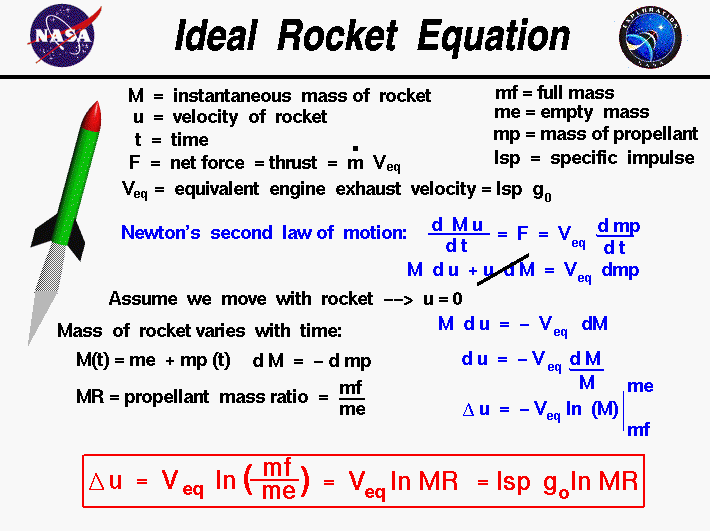
Yes, there is a system of equations to which nonlinear optimization can be applied to minimize the cost of a flight (though I don't believe calculating delta-v based on specific impulse is part of them). As noted, airport availability and marketing likely have more an effect on the decision than the physics. Singapore's direct EWR-SIN flight certainly isn't the cheapest way to get there from a fuel cost standpoint. They're selling the cost of time.
Dec 14, 2018 | 10:58 pm
#11
FlyerTalk Evangelist
Join Date: Jul 2011
Location: RNO
Programs: AA/DL/UA
Posts: 11,617
I flew to Australia one time, and I was glad that I had to stop in HNL. I guess I'm a weirdo, in that I actually like take-offs and landings. I certainly don't like sitting in one place for hours and hours and hours and hours.... 
Dec 14, 2018 | 11:17 pm
#12
Join Date: Apr 2007
Location: Australia
Programs: NZ Elite
Posts: 6,518
I enjoyed the one time I went via NAN for the same reason...
Dec 15, 2018 | 7:14 am
#13
Join Date: Feb 2002
Location: BNA
Programs: HH Silver. (Former UA PP, DL PM, PC Plat)
Posts: 9,540
Great Circle Mapper
Dec 15, 2018 | 9:16 am
#14
Join Date: Sep 2008
Posts: 7,934
Not sure what you mean by that. The great circle route is the shortest distance between any two points on Earth. Australia is no exception.
Great Circle Mapper
Great Circle Mapper
Dec 15, 2018 | 9:59 am
#15
Join Date: May 2009
Location: South Park, CO
Programs: Tegridy Elite
Posts: 5,677
I guess I mean a route that doesn't make sense on a flat versus curved world view. Like if you look at SIN to LAX vs SFO, one goes further north than the other. And if you look at SIN to JNB it is basically a straight line, not really curving. So same as if you just put a map on a table and traced the shortest distance point by point, disregarding the curvature of the earth.
https://gisgeography.com/great-circl...t-flight-path/