
























Jogging in China? (pollution)
 Jun 14, 2013 | 8:21 am
#16
Ambassador: China
Join Date: Oct 2005
Location: Malibu Inferno Ground Zero
Programs: UA AA CO
Posts: 4,836
yes, it did kill her -- after 30+ years....http://www.dailymail.co.uk/news/arti...ed-60-day.html
tb
tb
Surprising she lived to age 71. Tough woman.
 Jun 18, 2013 | 9:07 am
#17


Join Date: Jun 2009
Posts: 371
I practiced workers compensation law for 18 years and developed an informal sub-specialty dealing with lung diseases. (complex large cases just tended to come my way).Here are my basic reactions to the question of pollution and lung disease in China. First, as a general matter, I am surprised how few people I see who have outward signs of difficulty breathing. (Between the smoking and the pollution, one would think signs of this would be everywhere).
Second, my son (Mark) has had minor asthma. Over the last year it cleared up and he hasn’t needed any medication. Was afraid that Wuhan would worsen his breathing. For the past month, he has been using a peak flow meter every day, and his readings in Wuhan are the same as they were in Cincinnati. Am very surprised and pleased about this. Was always ready to bring him home if his stay in Wuhan worsened his breathing.
Third, generally, particles under 10 microns in size are very dangerous because they are so small they evade the lungs’ filters and penetrate into the lungs, which can cause fibrosis of the lungs. This can be very serious and lead to the need for lung transplants. I did a quick Google search and didn’t find anything really scary about lung fibrosis in China although apparently there is a large amount of polluting particles less than 10 microns in size. Again, this surprises me, but if I was in China for long periods of time, I would research this issue and all other lung issues very closely.
Fourth, in my experience, the quality of lung specialists in China is not great. About 2 years ago when my son was only having very minor problems, I decided to have him take a methacholine challenge test while I was in Beijing just to save money on that expensive test. It was administered in one of Beijing’s best hospitals. The conclusion was that Mark had severe asthma. I knew immediately that it was wrong. It turns out that Mark’s pulmonary specialist in the U.S. had spent time in Shanghai, and the specialist told me that the Chinese doctors made lots of mistakes in the administration of pulmonary tests. So, the bottom line here is: choose your specialist carefully, and it may make sense to use an American one.
Personally, if I was in China for an extended period of time, I would be monitoring the condition of my lungs closely.
Second, my son (Mark) has had minor asthma. Over the last year it cleared up and he hasn’t needed any medication. Was afraid that Wuhan would worsen his breathing. For the past month, he has been using a peak flow meter every day, and his readings in Wuhan are the same as they were in Cincinnati. Am very surprised and pleased about this. Was always ready to bring him home if his stay in Wuhan worsened his breathing.
Third, generally, particles under 10 microns in size are very dangerous because they are so small they evade the lungs’ filters and penetrate into the lungs, which can cause fibrosis of the lungs. This can be very serious and lead to the need for lung transplants. I did a quick Google search and didn’t find anything really scary about lung fibrosis in China although apparently there is a large amount of polluting particles less than 10 microns in size. Again, this surprises me, but if I was in China for long periods of time, I would research this issue and all other lung issues very closely.
Fourth, in my experience, the quality of lung specialists in China is not great. About 2 years ago when my son was only having very minor problems, I decided to have him take a methacholine challenge test while I was in Beijing just to save money on that expensive test. It was administered in one of Beijing’s best hospitals. The conclusion was that Mark had severe asthma. I knew immediately that it was wrong. It turns out that Mark’s pulmonary specialist in the U.S. had spent time in Shanghai, and the specialist told me that the Chinese doctors made lots of mistakes in the administration of pulmonary tests. So, the bottom line here is: choose your specialist carefully, and it may make sense to use an American one.
Personally, if I was in China for an extended period of time, I would be monitoring the condition of my lungs closely.
Jun 18, 2013 | 11:48 pm
#18

Join Date: Dec 2007
Location: Bay Area
Programs: BA - Blue
Posts: 4,721
Most of us are in China, knowing full well the risks. And what method of monitoring would you advise? Spirometry? (by the time changes detected, irreversible damage is done). High-res CT (regular monitoring radiation outweighs benefits)?
tb
 Jun 24, 2013 | 9:39 pm
#19
Join Date: Jun 2009
Posts: 371
TB "Most of us are in China, knowing full well the risks. And what method of monitoring would you advise? Spirometry? (by the time changes detected, irreversible damage is done). High-res CT (regular monitoring radiation outweighs benefits)?"
Before I posted I did a quick Google search on the rates of lung diseases in China & the U.S., and that didn't give me a good handle on what the rate of lung diseases is in China compared to the U.S. I think people definitely have the idea that they are more at risk, but I doubt that many people know how much more at risk they would be in China of contracting COPD, Asthma or pulmonary fibrosis than they would be if they lived in the U.S. If I was living long term in China, I would want to know. To begin finding out, I would contact a sophisticated pulmonary specialist and ask him what he thinks about living in China and how he would minimize risks. For instance, living in certain neighborhoods in Beijing might be safer than others because the safer neighborhoods might be farther away from dangerous factories. Any number of lifestyle modifications may or may not be helpful. However, I would be proactive rather than passive in protecting my lungs.
I would add that I have had good luck in the past in taking a proactive approach to health problems. 20 years ago a podiatrist told me I needed an operation for a bunion on my big toe. An orthopedic surgeon simply recommended minor drug treatments. I totally solved the problem (at least up to now) by changing the shoes I wore. (Certain shoes took the pressure off of my toe, and that solved the problem.) Also, about 15 years ago, I added lifting weights to aerobic exercise. This almost completely solved a substantial back problem, and by mechanisms I don't understand, reduced really nasty headaches (not quite migraines but pretty bad) by about 95%.
From my perspective, I would rather try to solve a potential problem rather than passively accept whatever comes my way.
Before I posted I did a quick Google search on the rates of lung diseases in China & the U.S., and that didn't give me a good handle on what the rate of lung diseases is in China compared to the U.S. I think people definitely have the idea that they are more at risk, but I doubt that many people know how much more at risk they would be in China of contracting COPD, Asthma or pulmonary fibrosis than they would be if they lived in the U.S. If I was living long term in China, I would want to know. To begin finding out, I would contact a sophisticated pulmonary specialist and ask him what he thinks about living in China and how he would minimize risks. For instance, living in certain neighborhoods in Beijing might be safer than others because the safer neighborhoods might be farther away from dangerous factories. Any number of lifestyle modifications may or may not be helpful. However, I would be proactive rather than passive in protecting my lungs.
I would add that I have had good luck in the past in taking a proactive approach to health problems. 20 years ago a podiatrist told me I needed an operation for a bunion on my big toe. An orthopedic surgeon simply recommended minor drug treatments. I totally solved the problem (at least up to now) by changing the shoes I wore. (Certain shoes took the pressure off of my toe, and that solved the problem.) Also, about 15 years ago, I added lifting weights to aerobic exercise. This almost completely solved a substantial back problem, and by mechanisms I don't understand, reduced really nasty headaches (not quite migraines but pretty bad) by about 95%.
From my perspective, I would rather try to solve a potential problem rather than passively accept whatever comes my way.
Jun 28, 2013 | 10:44 pm
#20
FlyerTalk Evangelist


Join Date: Feb 2003
Posts: 11,260
 Jul 3, 2013 | 8:36 pm
#21
Join Date: Jun 2009
Posts: 371
tls: "A quick glance at your fellow passengers when getting off the plane in any American airport will reveal that Americans are in much worse health than the Chinese, air quality be damned. There is nothing passive about running every day."
On my end, I would like to know what my risk is and what the consequences of certain behaviors are. For instance, when you run, you breath in more air and more particles contained in that air. I would like to know whether the obvious benefits of jogging are outweighed by the increased risk of lung disease caused by inhaling more particulates when exercising strenuously. Also, although Chinese air passengers may generally appear healthier than American passengers, the Chinese have a lower life expectancy than Americans.
My 12-year-old son has in some ways performed a perfect small experiment in that regard. His asthma symptoms went away one year ago. Just by chance he downloaded an Ipod app that has vigorous exercise programs and started using it when he arrived in Wuhan 6 weeks ago. Hasn't had any problems caused by the exercise. Obviously, this is not a rigorous scientific result, but it is an interesting first look at the issue.
I would add that jogging is not a passive physical activity, but jogging without making any effort to find out the benefits and detriments in China is passive with respect to assessing health risks. I am not judging other people who don't assess their health risks; I am simply stating what I would do. We all have limited time and each us will have his or her own way of using time wisely.
On my end, I would like to know what my risk is and what the consequences of certain behaviors are. For instance, when you run, you breath in more air and more particles contained in that air. I would like to know whether the obvious benefits of jogging are outweighed by the increased risk of lung disease caused by inhaling more particulates when exercising strenuously. Also, although Chinese air passengers may generally appear healthier than American passengers, the Chinese have a lower life expectancy than Americans.
My 12-year-old son has in some ways performed a perfect small experiment in that regard. His asthma symptoms went away one year ago. Just by chance he downloaded an Ipod app that has vigorous exercise programs and started using it when he arrived in Wuhan 6 weeks ago. Hasn't had any problems caused by the exercise. Obviously, this is not a rigorous scientific result, but it is an interesting first look at the issue.
I would add that jogging is not a passive physical activity, but jogging without making any effort to find out the benefits and detriments in China is passive with respect to assessing health risks. I am not judging other people who don't assess their health risks; I am simply stating what I would do. We all have limited time and each us will have his or her own way of using time wisely.
Jul 3, 2013 | 9:43 pm
#22
Join Date: Dec 2007
Location: Bay Area
Programs: BA - Blue
Posts: 4,721
On my end, I would like to know what my risk is and what the consequences of certain behaviors are. For instance, when you run, you breath in more air and more particles contained in that air. I would like to know whether the obvious benefits of jogging are outweighed by the increased risk of lung disease caused by inhaling more particulates when exercising strenuously. Also, although Chinese air passengers may generally appear healthier than American passengers, the Chinese have a lower life expectancy than Americans.
.
.
This is not to say pollution is a good thing, but it is one of many factors. As more affluent Chinese take on more 'bad' western lifestyle habits, the trend for year on year improvement may be reversed.
My issue with your take is that the measures you suggest, as I alluded to up-thread, are entirely pro-active, as in 'doing something', but most likely not the right thing. I'm not a pulmonary specialist, but I have previously practiced pulmonary medicine (for >4 years) with some very famous 'world experts' (if we want to 'name drop'), so I know at least a little about it.
In the end, we all do what we think is best. Do carry on being pro-active and happy. I pro-actively check the pollution levels on my phone every day...but I'm not sure it has much bearing on my health.
Safe travels!
tb
Jul 3, 2013 | 10:08 pm
#23
Ambassador: China
Join Date: Oct 2005
Location: Malibu Inferno Ground Zero
Programs: UA AA CO
Posts: 4,836
By 2018, over 85 percent of Beijing's residents will have health related knowledge, and their average life expectancy will rise from the current 80.27 years to 81 years.
What about the other 15%?
Great way to manipulate the facts, exclude those who skew the number
down to about age 65.
What about the other 15%?
Great way to manipulate the facts, exclude those who skew the number
down to about age 65.
Jul 4, 2013 | 3:17 am
#24
Join Date: Dec 2007
Location: Bay Area
Programs: BA - Blue
Posts: 4,721
By 2018, over 85 percent of Beijing's residents will have health related knowledge, and their average life expectancy will rise from the current 80.27 years to 81 years.
What about the other 15%?
Great way to manipulate the facts, exclude those who skew the number
down to about age 65.
What about the other 15%?
Great way to manipulate the facts, exclude those who skew the number
down to about age 65.
tb
Jul 4, 2013 | 10:32 am
#25
Ambassador: China
Join Date: Oct 2005
Location: Malibu Inferno Ground Zero
Programs: UA AA CO
Posts: 4,836
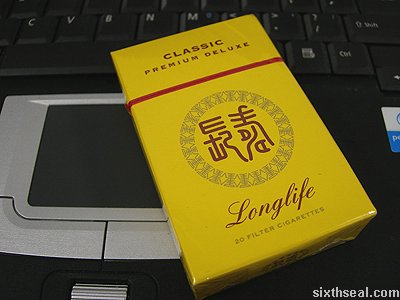
the branding for this Taiwanese tobacco company.
 Jul 8, 2013 | 4:57 pm
#26
Join Date: Apr 2009
Location: HKG
Posts: 1,397
The conclusion to draw is that the air quality probably doesn't make that big an impact, but healthcare does. Beijing residents get free health care while migrant labour has to pay upfront.
Jul 9, 2013 | 1:12 am
#27
Join Date: Dec 2007
Location: Bay Area
Programs: BA - Blue
Posts: 4,721
One caveat with respect to Beijing life expectancy is that it only counts so-called Beijing residents, which excludes about 1/3 of the population in Beijing, i.e., migrant labour.
The conclusion to draw is that the air quality probably doesn't make that big an impact, but healthcare does. Beijing residents get free health care while migrant labour has to pay upfront.
The conclusion to draw is that the air quality probably doesn't make that big an impact, but healthcare does. Beijing residents get free health care while migrant labour has to pay upfront.
tb
Sep 4, 2013 | 8:16 am
#28
Join Date: Jun 2009
Posts: 371
Just an update on my 12-year-old son Mark's experience in Wuhan. (Mark has asthma but hasn't needed flovent for 1.5 years and has been doing really well for the last 18 months.) His typical peak flow measurement before going to Wuhan was about 360-370. Except for 3 or 4 days when he went down to 340, his peak flow was a pretty constant 360-370 while he was in Wuhan. He returned from his 2 month stay in Wuhan on 7/15 in Chicago. His first peak flow was 400. He has never matched that again and has stayed in the 360-370 range. Basic conclusion is that the pollution in Wuhan didn't have a noticeable effect on his asthma.
Sep 4, 2013 | 9:35 am
#29
Join Date: Oct 2007
Location: Southeast USA
Programs: various
Posts: 6,710
Glad that he remained fine, but my basic conclusion is that he wasn't in Wuhan long enough for the pollution to start wreaking havoc. Live in a place with heavy pollution long enough and even non-asthmatic healthy lungs will begin to notice an effect.