Part 3: The Coast Part
Following our fantastic safari days we headed for the coast, with a rest stop in Damaraland. Damaraland is home to Namibia’s first (of two) UNESCO world heritage sites, the Twyfelfontein, or /Ui-//aes petroglyphs. These well-preserved rock carvings represent one of the largest sets of petroglyphs in Africa. The extensive carvings cover several thousand years and functioned both as maps and teaching tools for the people who made them as well as a means of worship, with many featuring the religiously important giraffe and rhinoceros.
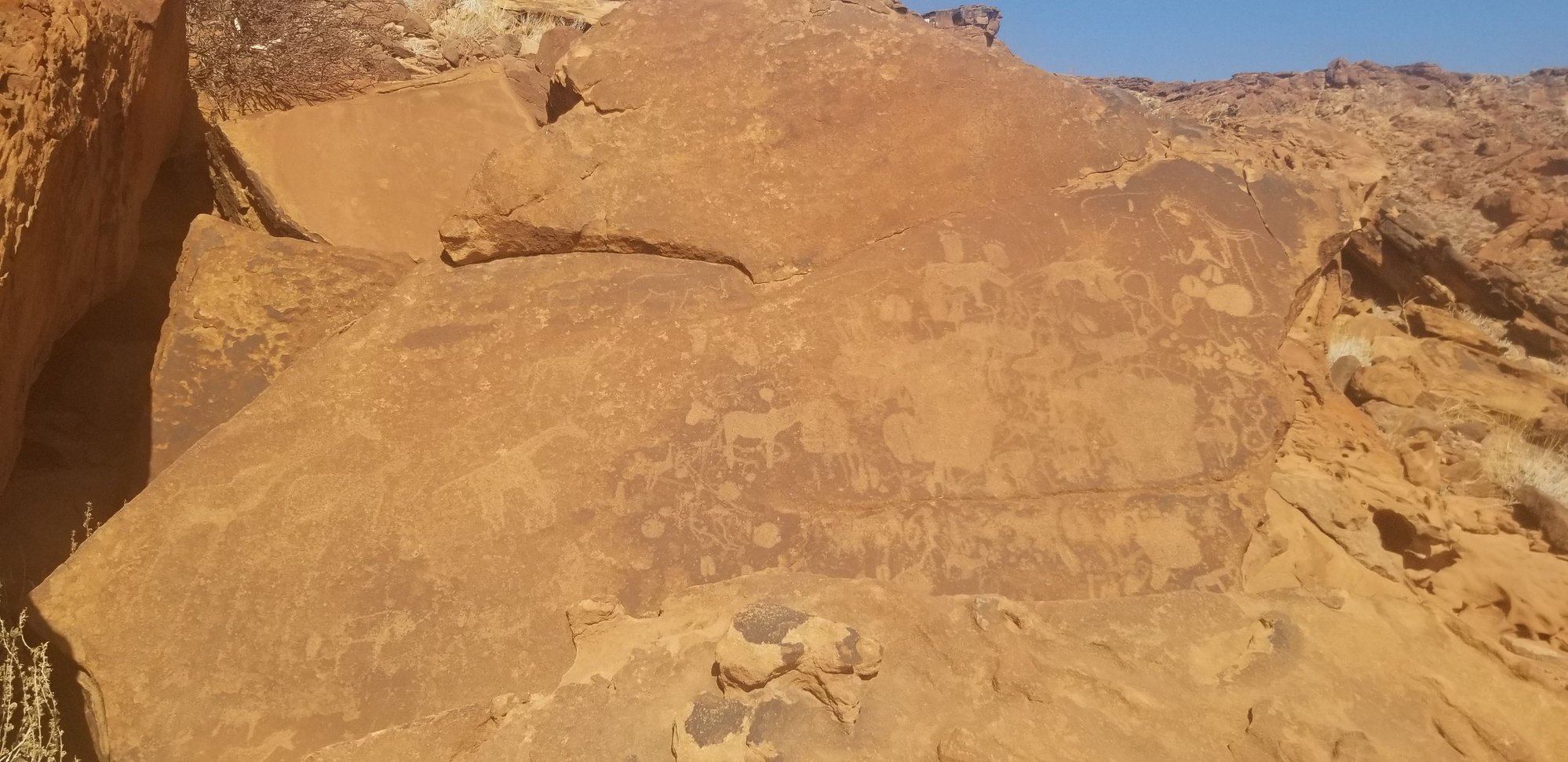 One small portion of the rock carvings
Did you catch the slashes in that name above? … Following that, we dropped by the Damaraland Living History Museum. The government of Namibia sponsors about 10 of these museums throughout the country, each focused on a different indigenous tribe. These multifunctional museums serve as repositories of native knowledge, tourist attractions, and revenue-generating opportunities for local tribes. If you’ve ever visited the Polynesian Cultural Center in Hawaii, it’s basically the Namibian version of that. Members of the local tribe, the Damara in this case, dress in traditional outfits and give demonstrations of various cultural traditions. These include dances, fire making, clothing production, arts and crafts, hunting, medicine, etc. It’s a bit cheesy and too tourist-centric for me, but I do appreciate the effort to preserve and showcase cultures that are at risk of extinction in our hyper-global modern society. Plus, the kids loved it. The most fascinating part for me, by far, was listening to them speak to each other. Those slashes in the name of the area are a (rather poor) representation in English of the clicking sounds for which the Khoisan languages of southern Africa are so famous. Listening to native speakers talk to each other (probably about us, but whatevs) was amazing. I caught at least a half dozen different types of click sounds; there were probably tons more that my ear couldn’t distinguish.
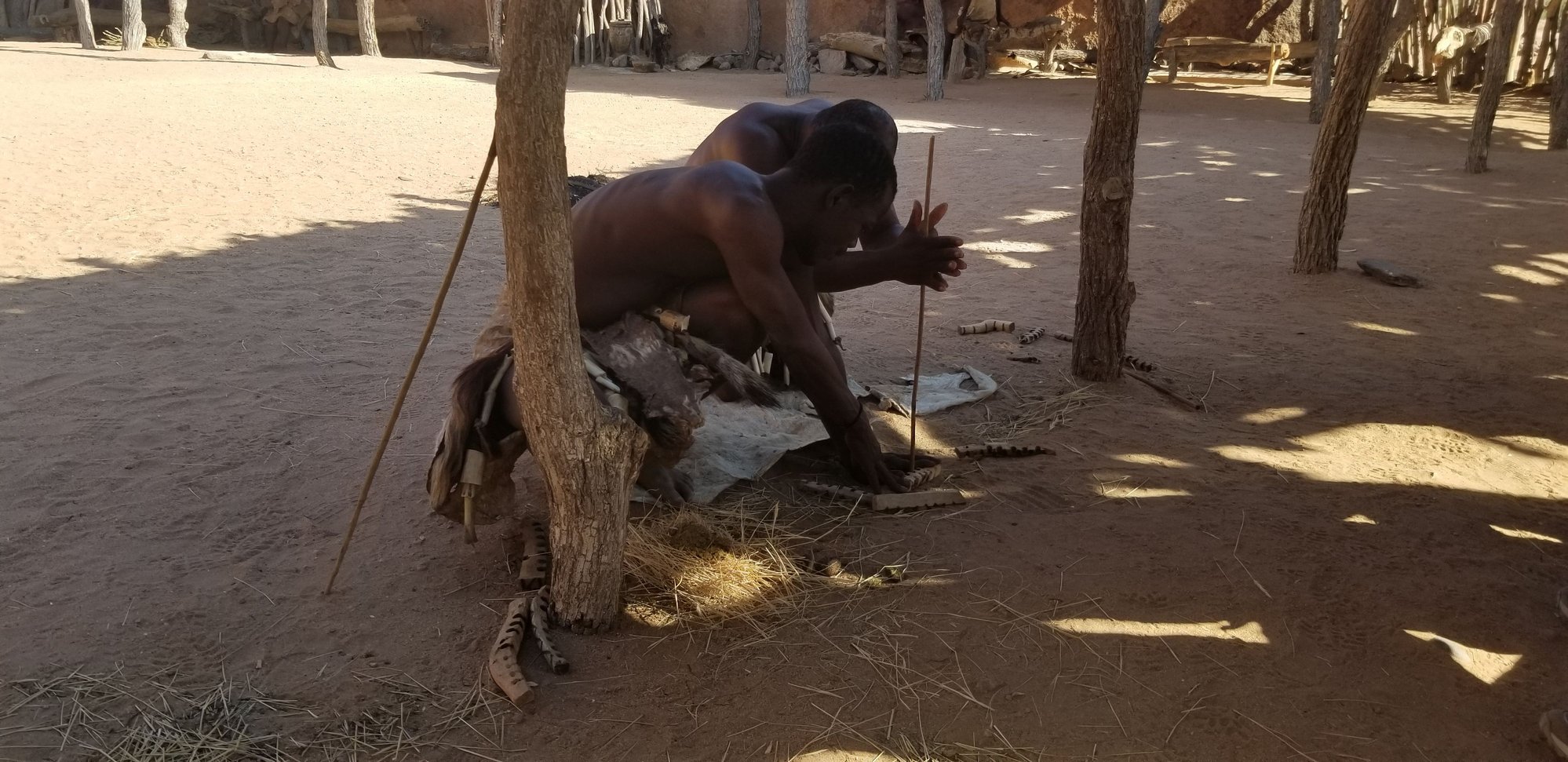 A couple of locals showing us how to make fire
 The inside of the Living History Museum. No one actually lives here these days.
We spent that night in a campsite that wasn’t yet finished, which I realize is an odd thing to say, especially since Flyertalkers love ultra-luxury hotels. It was a campsite, after all, so many would argue that it cannot possibly be finished as it will forever lack walls and a roof. But even as campsites go, it wasn’t yet finished. They were still in the process of building the bathrooms so in the meantime they had strung some curtains on some poles behind a massive boulder, forming two “stalls”, one for a toilet and one for a shower, and called it good. They were even so kind as to light the fire underneath the hot water heater, as in, literally light some wood on fire to heat up the big black boiler-type thing that functioned as a hot water heater, so we could clean a layer of dirt off the kids. The water never actually got warmer than ambient temperature, but it’s the thought that counts.
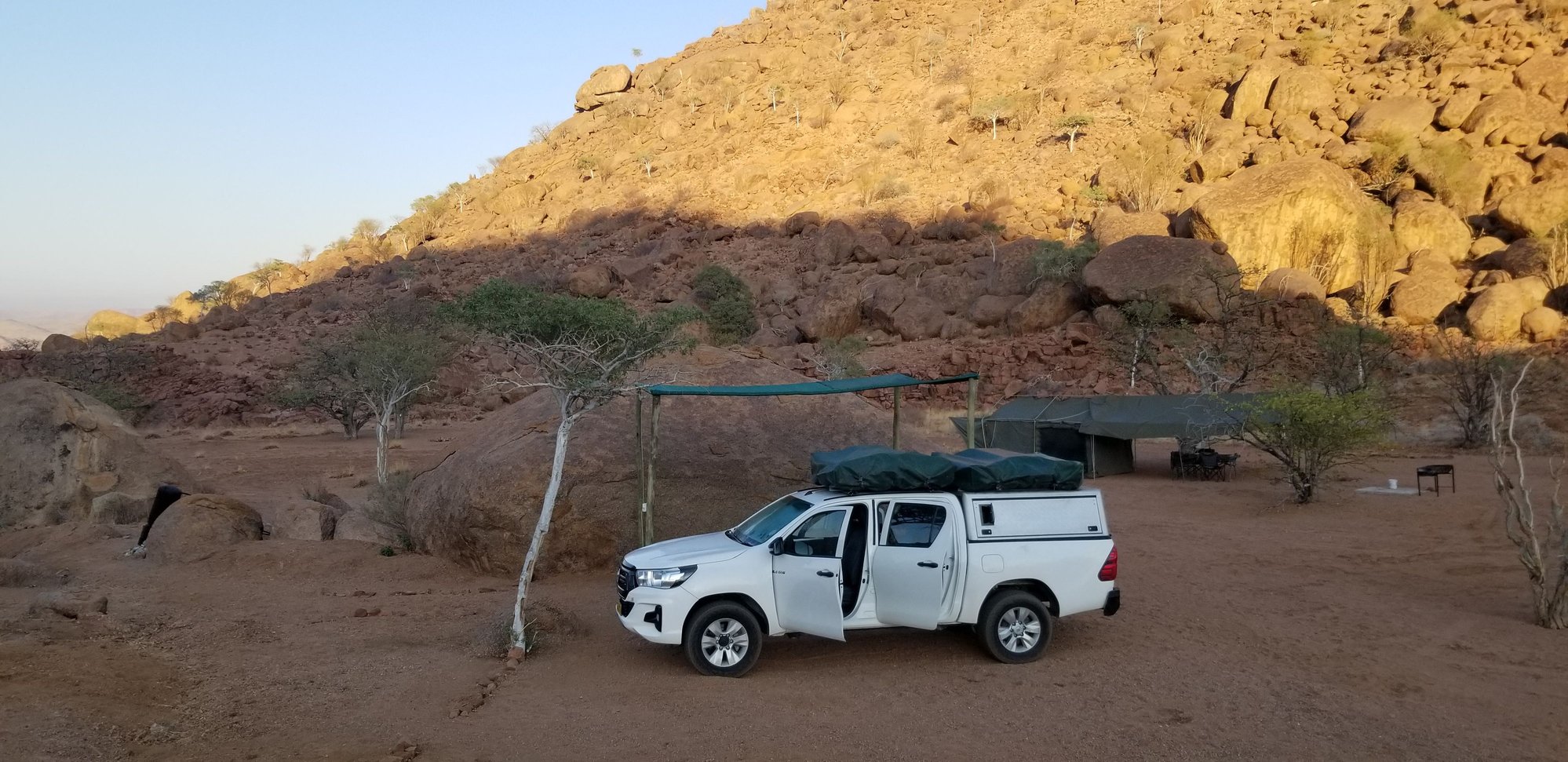 An unfinished campground...
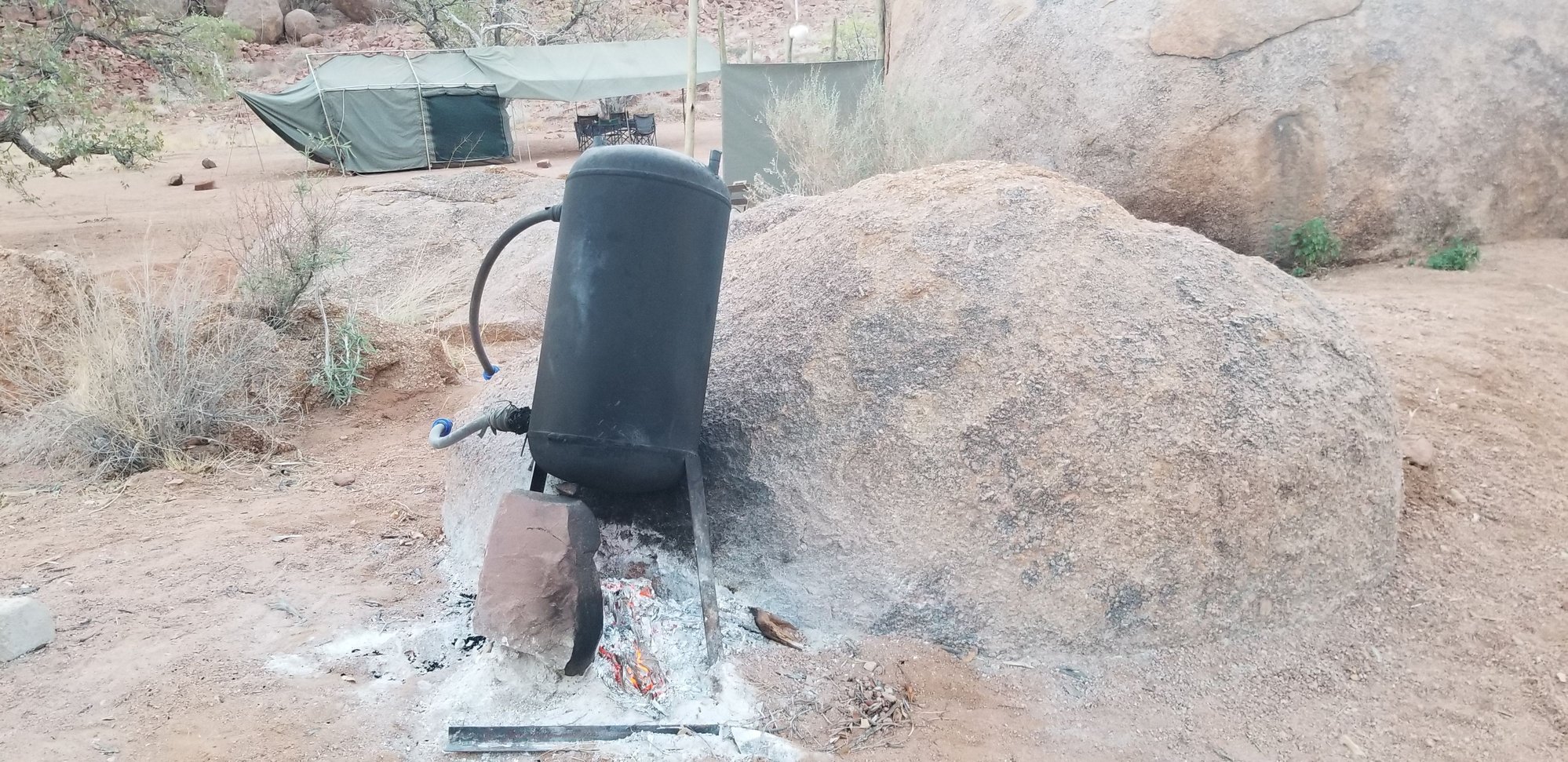 ... and its fire-warmed hot water heater.
The next morning, we set out for the stretch of coast known as the Skeleton Coast. At least, today it's called the Skeleton Coast. Fortunately, unless you're a cetacean, that name refers not to human bones but to the whale bones that litter this 600-mile stretch of largely forgotten, barely inhabited coastline from the Angolan border south through much of Namibia. Before gaining its English name, The Portuguese called the area "as areias do inferno" - the sands of Hell. During the great age of exploration, following the lead of Prince Henry the Navigator, the Portuguese explored and mapped huge swathes of the earth's surface. As they journeyed around the Horn of Africa their ships wound up grounded on this coast with shocking regularity. The winds, waves, fog, and currents seemed to pull ships in, closer and closer to shore, and refused to let them go once within their grip. Once shipwrecked, the Portuguese sailors knew their days were numbered as rescue was next to impossible. Today, hundreds of shipwrecks litter these beaches, some hundreds of years old, others more recent. Many of the most famous are nearly impossible to reach today and would have been even more impossible in previous decades. Before the Portuguese, the traditional Damara people called this area "the land God made in anger" in reference to the stark inhospitable conditions. Even those hardy desert-dwellers found the land too desolate to spend much time here. For centuries, at least, humans have been terrified by this stretch of coastline.
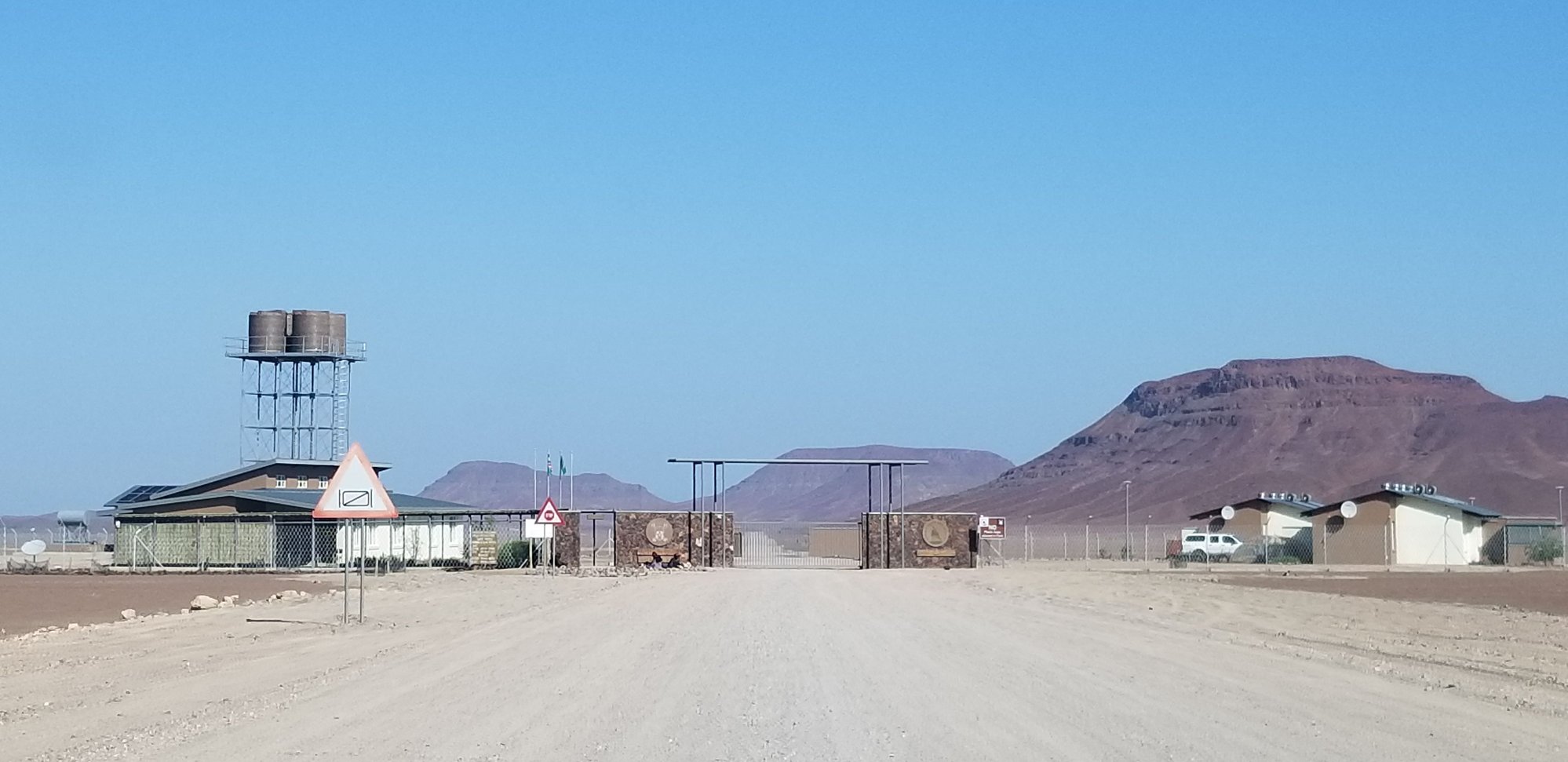 Before you can even drive here you have to fill out some paperwork acknowledging the risks and telling them where you're going in case they need to rescue you.
I have no idea why such a place has fascinated me for so long. Ever since I heard about it, many years ago, I'd wanted to come. Indeed, the impetus for this trip was this part of the drive. There are shorter drives through the stunning wasteland, but we took the long road on purpose. It is stark. It is desolate. It is inhospitable. And it is hauntingly beautiful. I loved every minute of the long drive, from the mountain pass that wound down from Twyfelfontein to the salt road stretching for hundreds of kilometers along the coast. For most of the day we had the blue crashing breakers on our right and a mix of sandy flatland, rolling sandy hills, and steep cliffs on our left, with the red mountains in the distance. It was breathtaking.
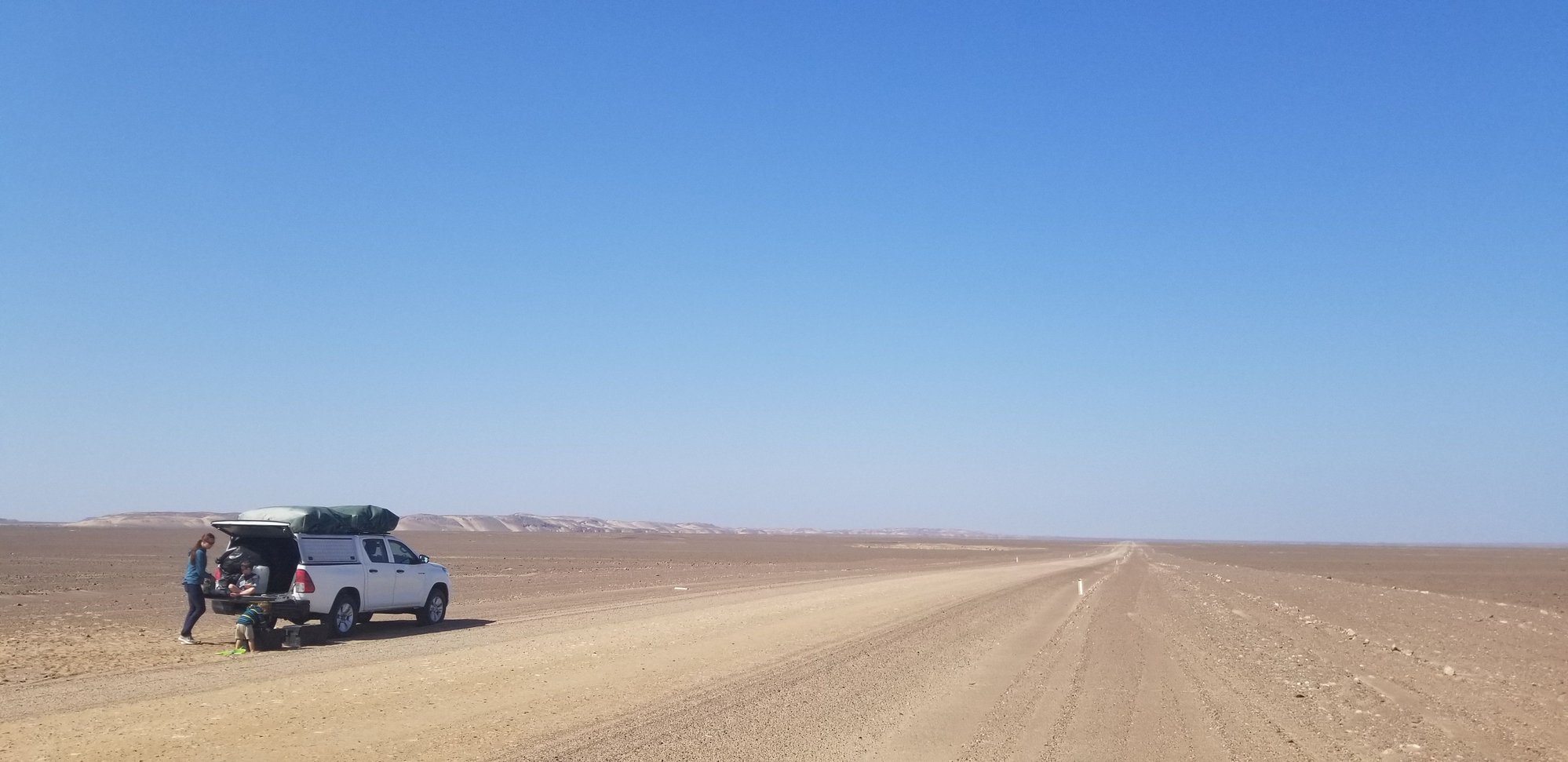 Nothing for miles around
We made several stops along the way, all of which the kids loved. We stopped at an abandoned diamond processing facility, with supports for a long-gone pier stretching from the remnants of a cluster of buildings out to the edge of the water. We also stopped at an abandoned oil rig, now, thanks to the shifting sands, located 200 meters inland, its once tall derrick toppled and rusting in the sand. Our final stop was the wreck of the Banguela Eagle, a wooden ship, wrecked on the shore decades ago, its 12 cylinder engine block and wooden ribs left sticking out of the sand. Nearby, through some slightly-macabre, yet poetic, coincidence, was a massive whale skull, washed up on shore, staring ruefully at the wreck through empty eye sockets.
 The piers of the old diamond mining facility
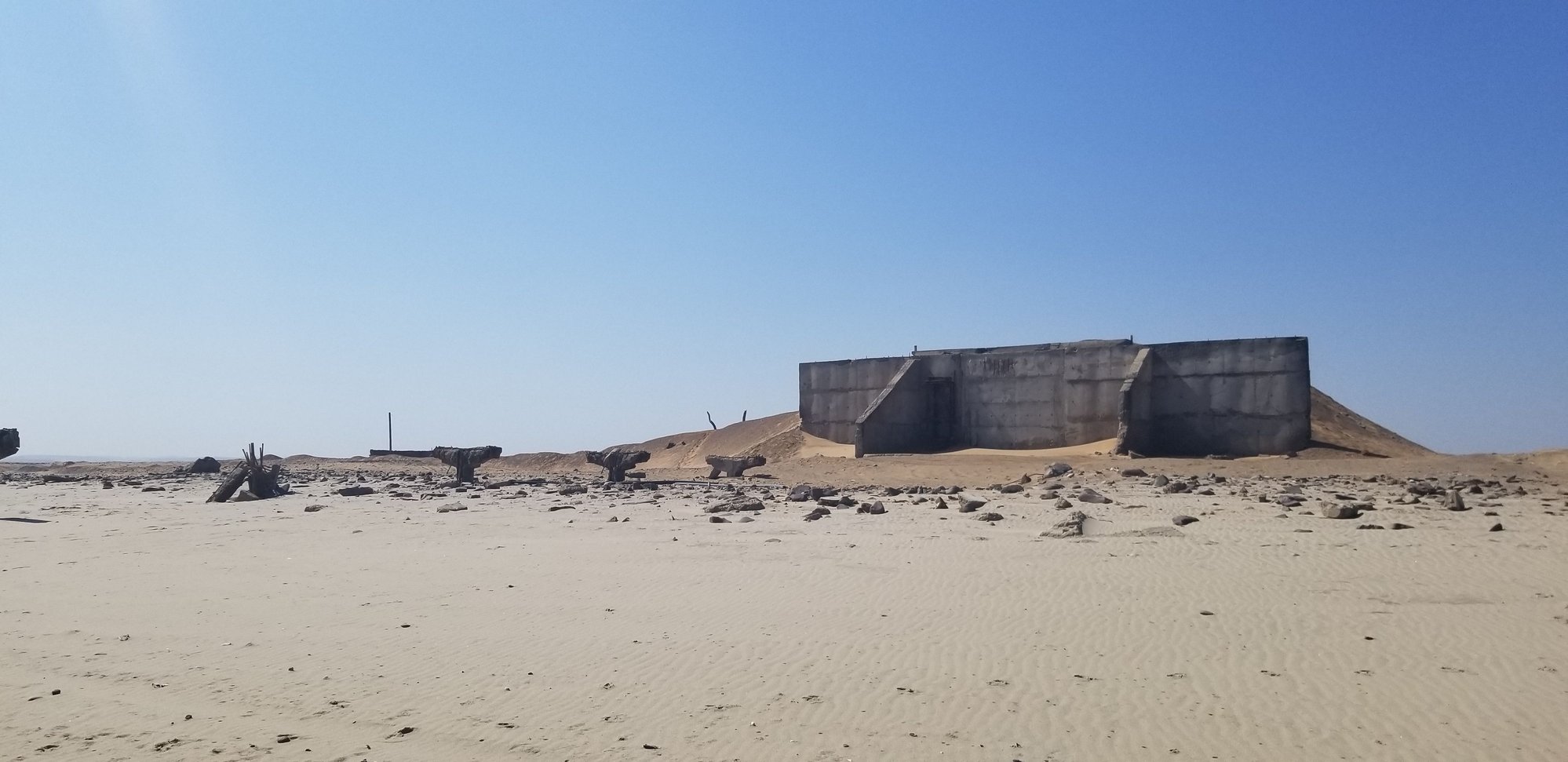 The old diamond facility itself
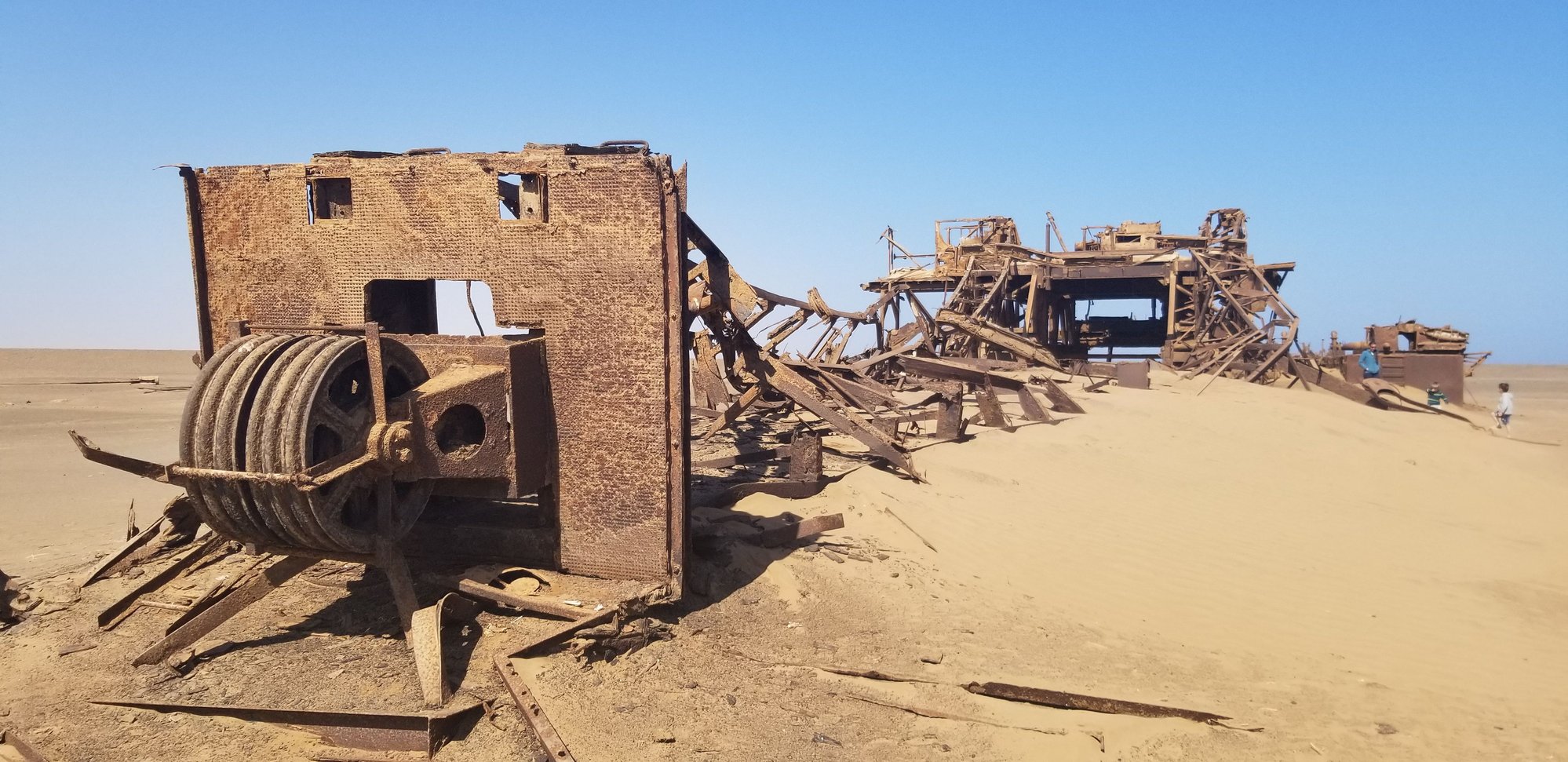 The collapsed oil derrick
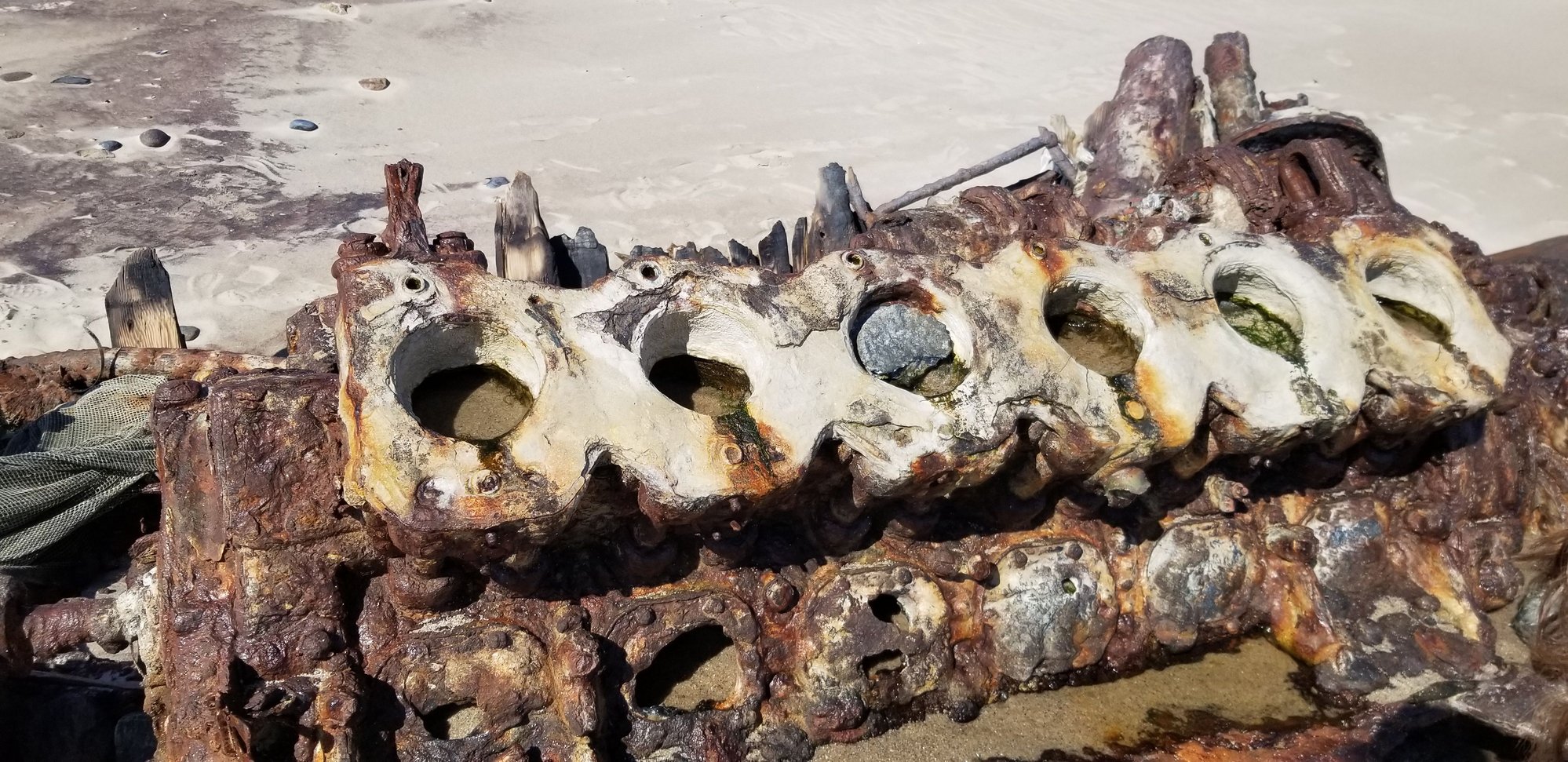 The rusting engine of the Benguela Eagle
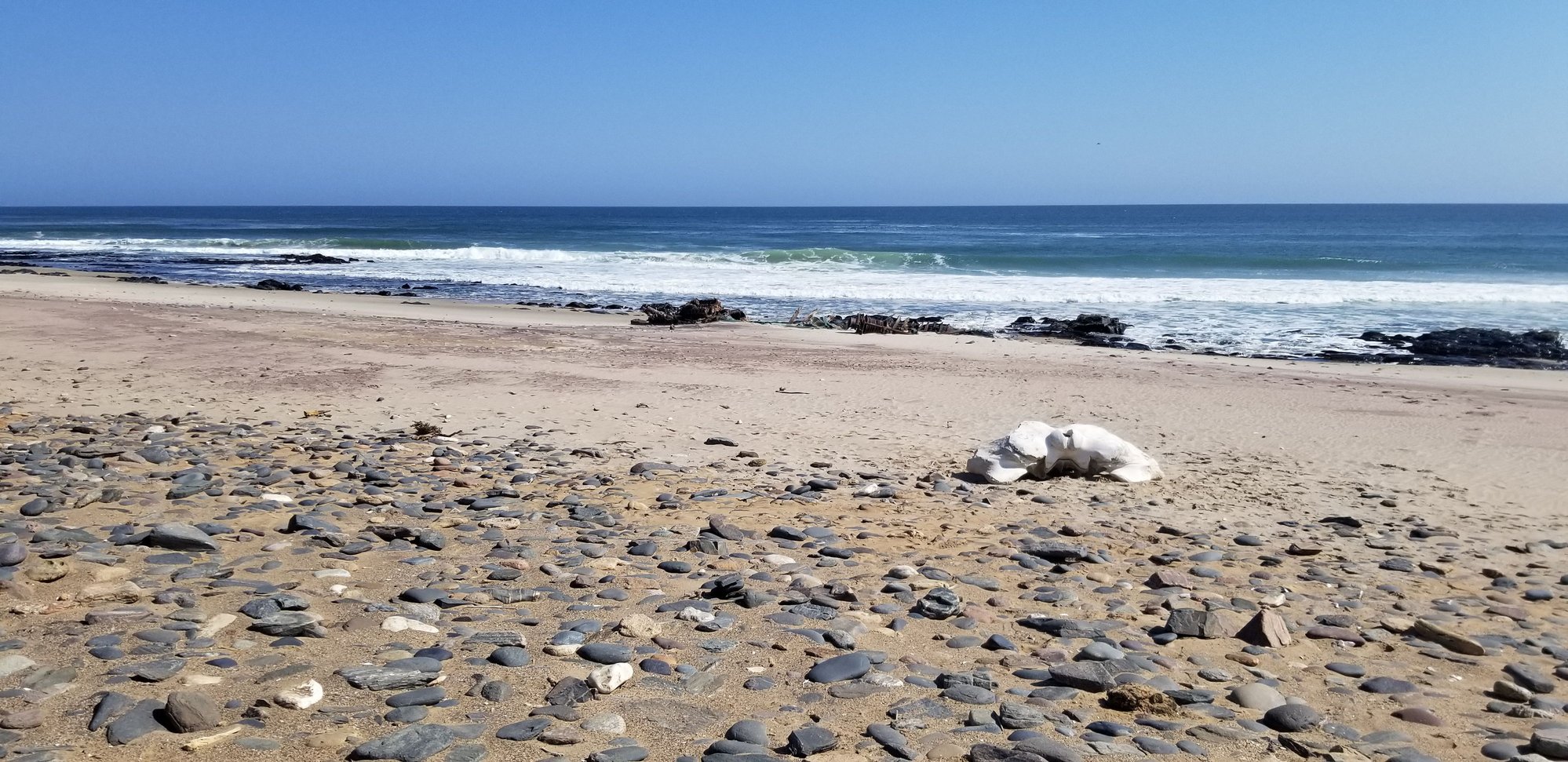 The wreck of the Benguela Eagle, from a distance, with a whale skull for good measure.
We slept that night at Cape Cross. Originally put on the map by the Portuguese, who landed, intentionally this time, several hundred years ago and placed a cross on this spit of land jutting into the South Atlantic, today it’s known to Skeleton Coast travelers for two things: the only accommodations for a hundred miles in any direction and seals. Just down the road from our campsite was the famous Cape Cross Nature Reserve seal colony. Supported by the ocean which, in contrast to the barren land, is fertile and full of life, this colony of seals is easily several thousand strong. From the boardwalk, which was even hard to get to because seals were blocking most of its entrances, the beach and waves were teeming with black bodies and the air was full of a cacophony of sounds, from playful barks and chirps to angry bellows and hisses. There were dozens of pups, likely born just a few months before, drinking milk and playing, all while the adults constantly rotated out of the surf to laze on the rocks and dry off. We loved it.
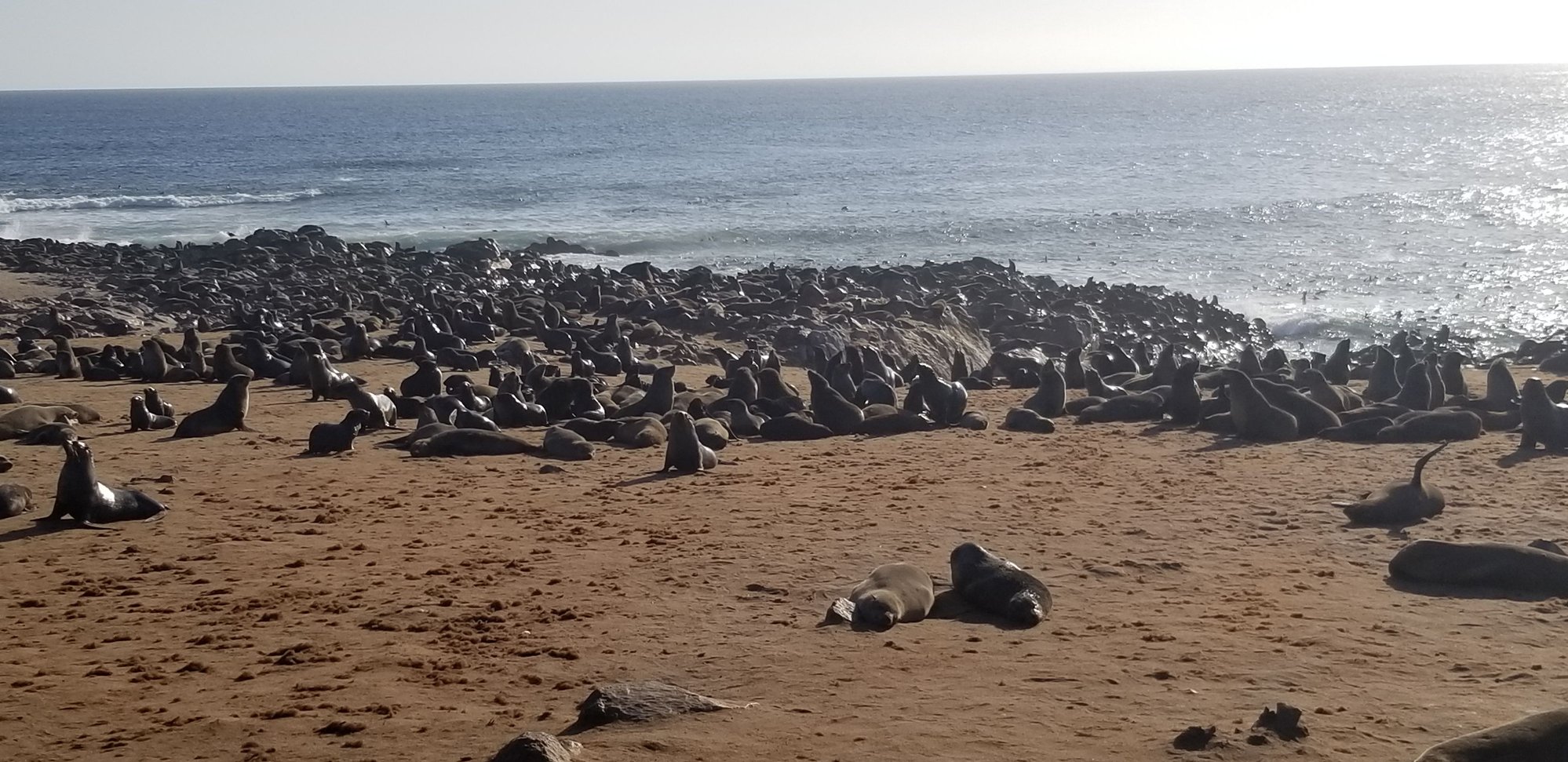 Thousands of seals
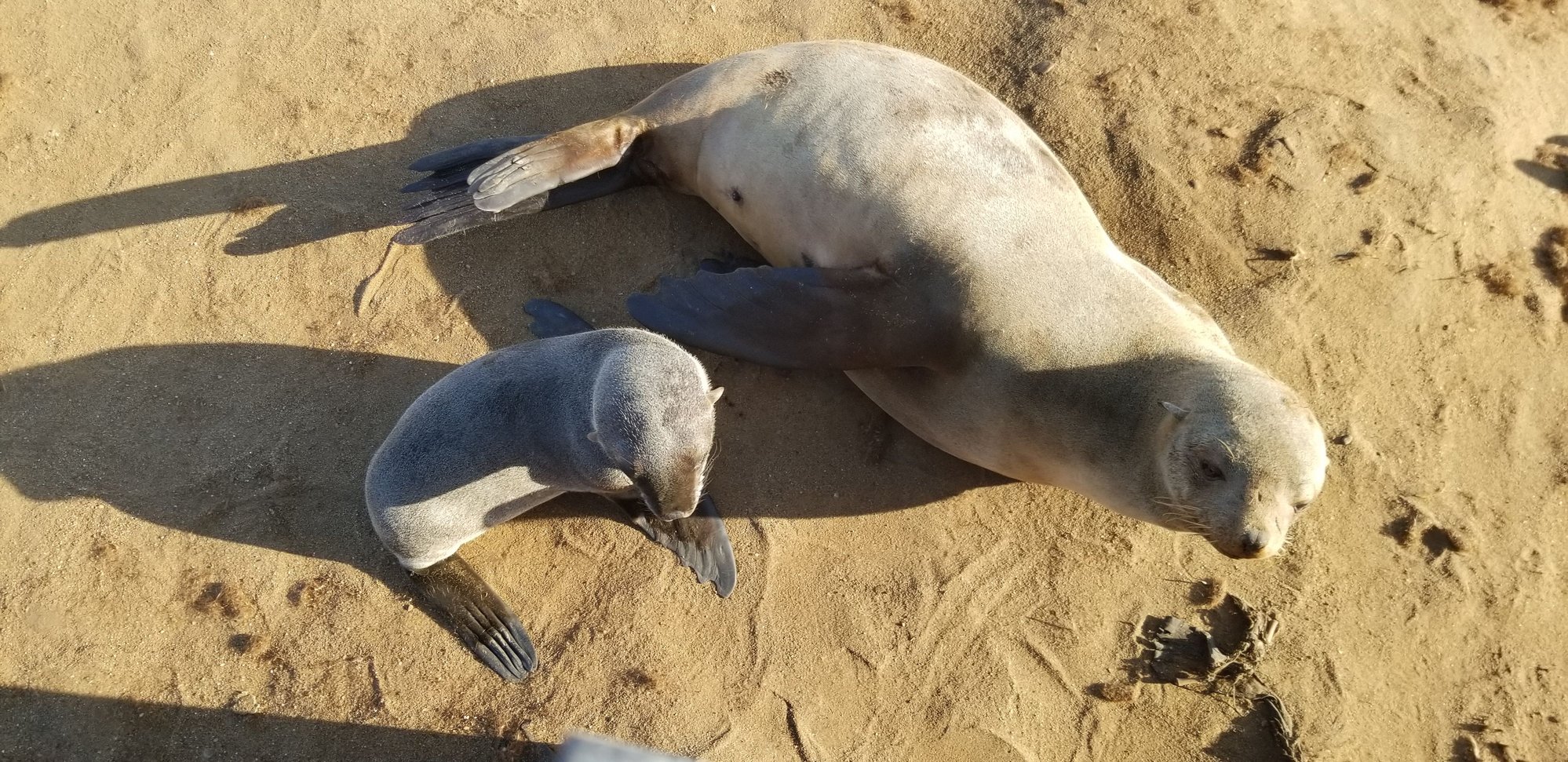 A few seals up close
Finally, we made it to our campsite at the Cape Cross Lodge, a semi-circular cluster of buildings with a campground in the middle. On the way back from letting the kids burn off some energy at the playground, Mrs. dfw88 noticed a posting on the bathroom door warning everyone about a young hyena that had been spotted (get it? The hyena was spotted?) around the lodge recently and providing some safety tips. The boys, not fully sure of what a hyena is, began asking lots of questions. Can it climb the ladders to our tents? Can it break down the bathroom door? And so on. After helping the boys shower, I carried them back to camp one at a time so they wouldn't get their feet dirty all over again. I took the Anarchist first, left him with Mrs. dfw88, and went back for the Observer. As I arrived back at camp the second time, I heard Mrs. dfw88, whose Master’s degree in biology undoubtedly came in handy here, respond to an unheard-by-me question from the Anarchist by saying: "they don't have lightsabers... they're hyenas". That’s kids for you.
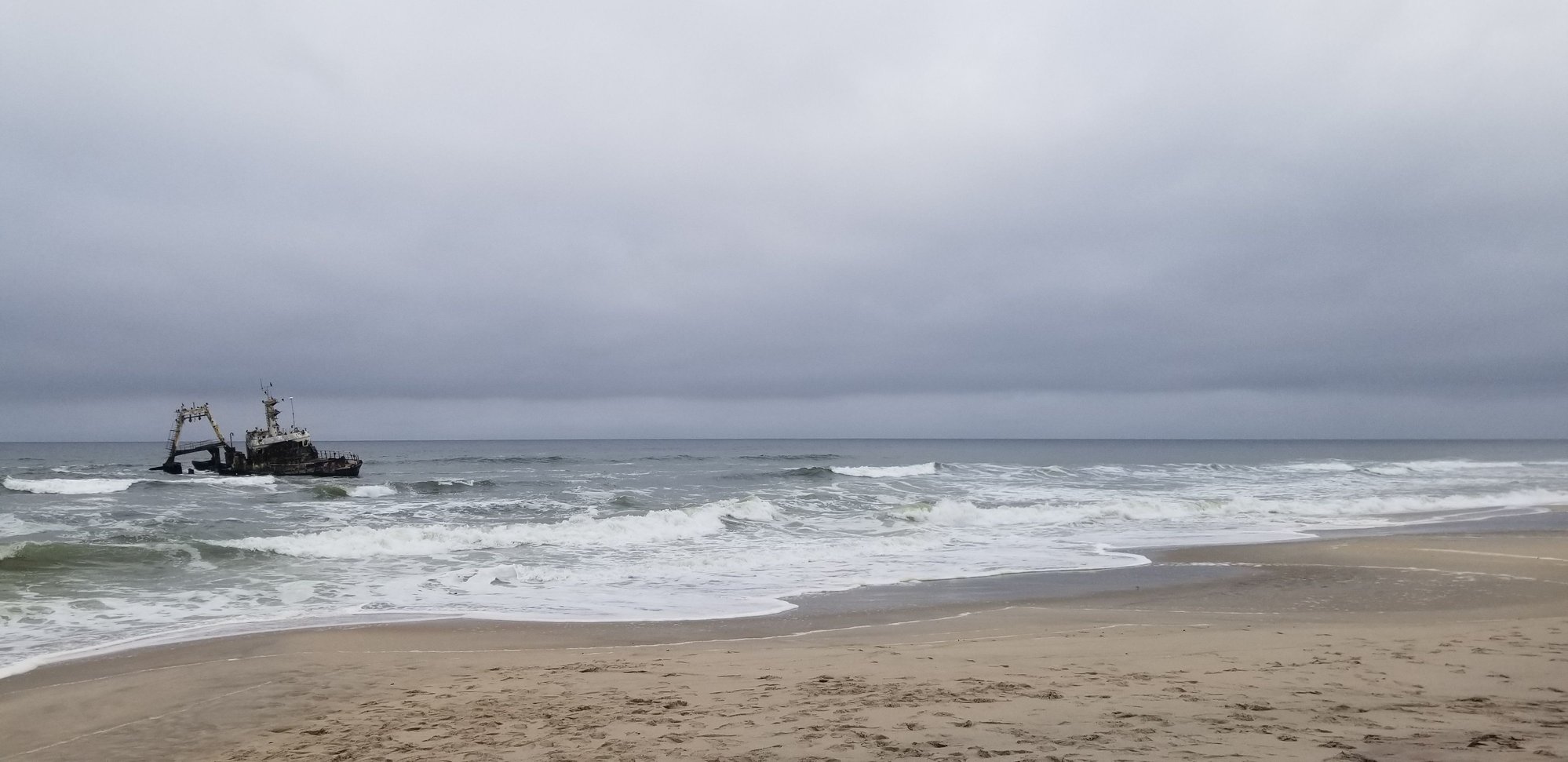 The very photogenic wreck of the Zeila
 A closer look