Part 1: The Getting There Part
Namibia isn’t the easiest place to get to from the US. Frankly, it isn’t easy to get to from anywhere, including other parts of Namibia, but we’ll get to that later. Namibia is the 139th most populous country on earth (putting it about 70% of the way down the list, depending on what you count as a country) and the second-least-densely populated country (only Mongolia has fewer people per square mile/kilometer), meaning that there just isn’t a whole lot of demand for air travel and what does exist is spread out over a relatively large land area, meaning it’s impractical to capture for most airlines. To get there from the US you have basically three options:
- Discover flies from FRA (and has recently added MUC flights) and is owned by and codeshares with Lufthansa
- Ethiopian flies from ADD, which it also links with a handful of cities in the US
- South African and Airlink fly from JNB, so you can get yourself to South Africa and pop over
Pre-COVID, Comair was an option and a good way for oneworld passengers to get there from South Africa, but, alas, they are no more.
We decided to take Ethiopian Airlines on the way over. Due to bad weather back home, we ended up needing to leave a day early and do an odd connection, involving a one-way rental car and an overnight stay with family, but eventually we ended up at Washington Dulles Airport on the correct morning. The line was long at the check-in counter, which we needed to wait in for reasons, but we enjoyed the people watching. The number of bags checked per person was surely higher than any other flight we’ve ever boarded, except for maybe Miami to Havana, which slowed the line down to a crawl. Fortunately, the kids could enjoy the Lego model of the airport on display while I waited. The staff were friendly and relatively efficient and eventually we were on our way to the gate, after a brief stop at the Capital One lounge, which was rather annoying to find and more than slightly labyrinthine once inside. That said, the breakfast was solid and much appreciated. Once at the gate, boarding was by row numbers, which I like, though Flyertalk assures me that I only like it because I’m an unimportant plebe with no status, and Flyertalk is never wrong.
Our team of five was positioned across two rows in the back middle section of ET’s 787-9 Dreamliner, right in front of the three rows that were reserved for flight attendant rest. Also occupying the rear of the plane were 100 other small children (plus or minus) who spent the duration of the flight performing a high-pitched screaming opera, probably loosely based on Aida, but I admit I had trouble following the lyrics. As a parent of perfectly behaved children (this is a joke, to be clear) I was grateful for some good earplugs so I could get some sleep. Ethiopian provides a tiny amenity kit in economy, notable only because my children immediately put on, then refused to remove, the formless, mustard-yellow tube socks that were far too big for them. The pillow was typical for economy class, though the blanket seemed bigger than usual, which was appreciated. The flight left in the late morning, so we stayed awake for the first half and tried to sleep the second half to do some jetlag pre-adjustment. The food was fairly tasty for economy class, there was a good selection of entertainment, and we arrived in one piece and on time, so really, we didn’t have anything to complain about.
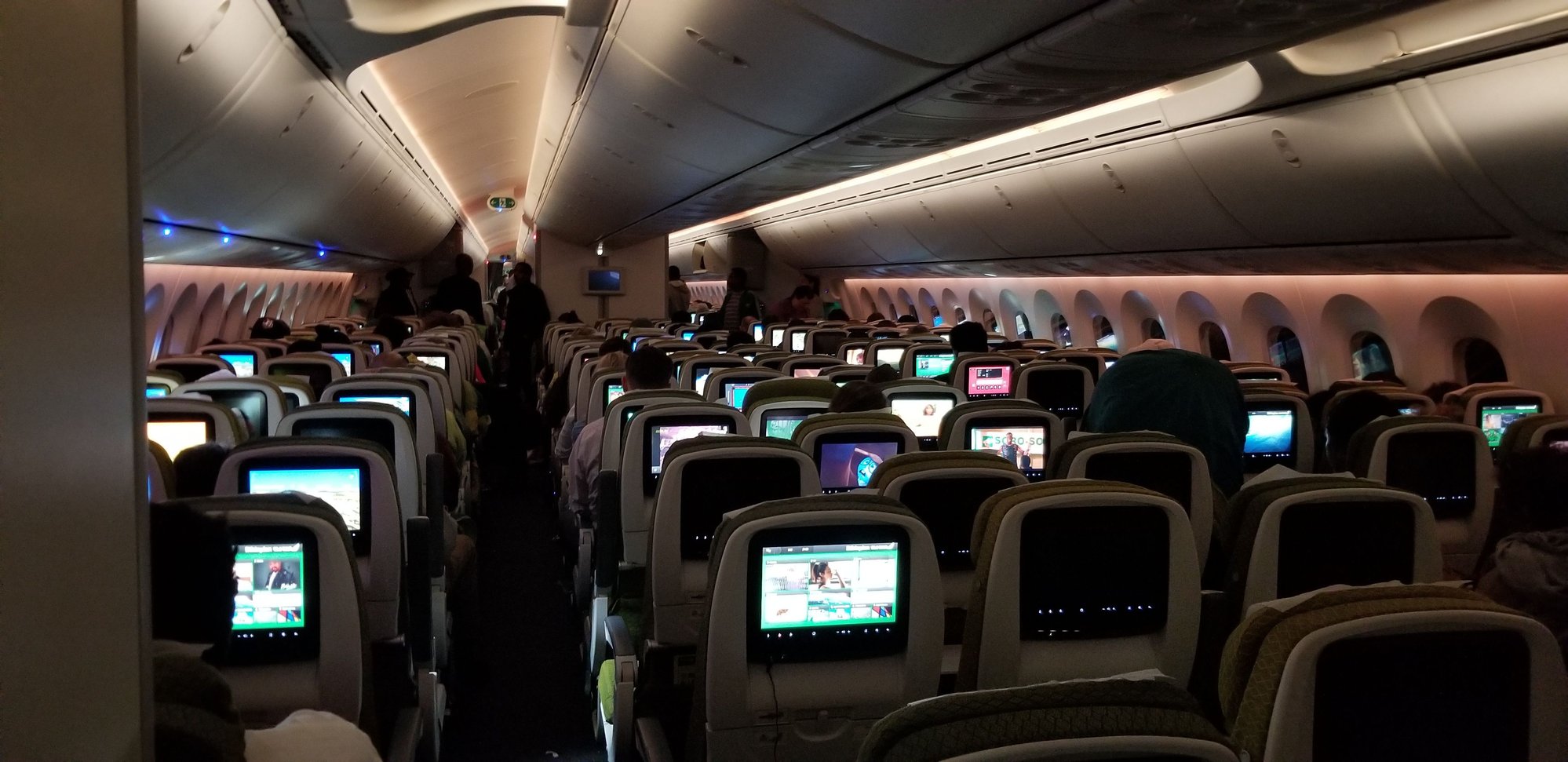 The view from the back.
On arrival at ADD we parked at a remote stand. It seems like they could’ve deplaned from both the back and front without too much trouble, but decided to use only the front doors, which took twice as long to get everyone off and onto a conga line of buses. The transit experience at ADD is a bit of a mess, but it’s an efficient mess, which I realize is an oxymoron, but it’s also true, so we easily found our way to the gate for our flight to Windhoek (WDH) during our 1.5-hour layover. We had the boarding passes for our second flight, which are technically required to transit without entering the country, but no one, not even at the quick security checkpoint, asked to see them.
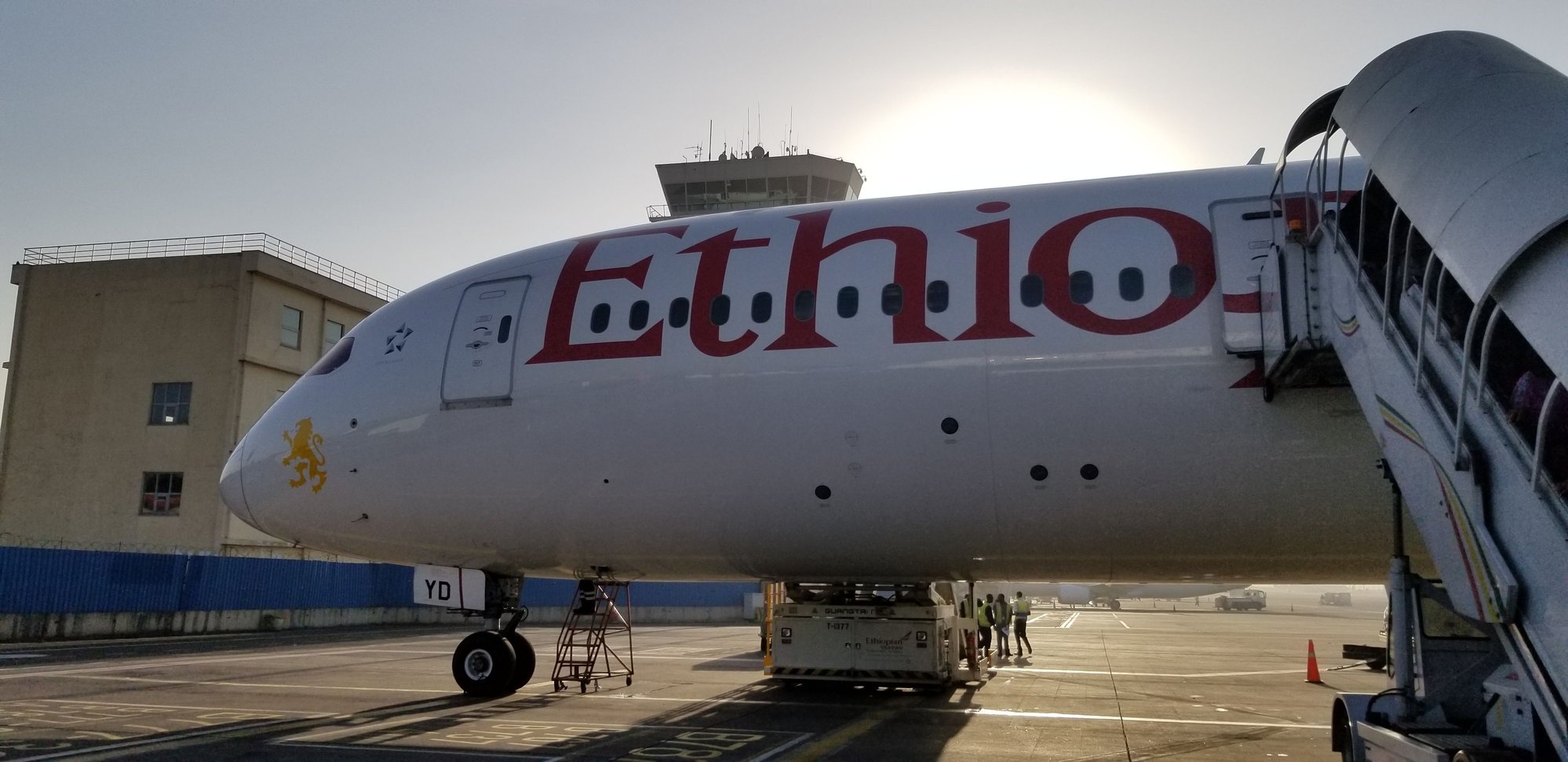 Loading onto the bus at ADD
The clientele on this second flight was rather different: primarily European and no other children. We had an actual jet bridge to board our 787-8, which made things easy and efficient. The flight was about 6 hours long, but the flight attendants handed out children’s entertainment pouches during boarding, which kept the kids busy playing the whole time and me busy fishing small puzzle pieces out of the cracks between the seats. While I appreciated the gesture and most of the contents, who thought a jigsaw puzzle was the right thing to include on a potentially bumpy plane ride? I tried my hardest to see Kilimanjaro out the window, but it was either too cloudy or we didn’t pass quite close enough. The flight was largely empty and was actually pretty empty the entire week we traveled. It seems like this would be a great 737 route for ET, but the elevation at ADD means that the narrowbody wouldn’t have the range so they use their smallest widebody instead.
 WDH, definitely a new airport for me
After an easy flight we were finally on the ground in Namibia. We waited in line for about an hour at immigration, before being lectured by a border guard for travelling without our children’s birth certificates. The conversation went something like this:
Her: “You always need birth certificates to travel internationally with your children.”
Me (in my mind): “Really? Because I’ve never ever brought them with me once and my kids have 30 passport stamps apiece, so I don’t think so.”
Me (out loud): “Yes ma’am”
Her: “You better get a copy while you’re here or else you won’t be able to leave.”
Me (in my mind): “Sure, like you wouldn’t let us leave.”
Me (out loud): “Yes ma’am”
Spoiler alert: No one even mentioned them when we left.
Finally, we met up with our rental car company’s representative and started our vacation. We picked up a local SIM card, which proved very useful for the data alone, then drove into town to the rental car office. The airport is quite far from town, which doesn’t really make sense when looking at the map, unless you’re looking at a topo map. The airport is in one of the only flat spots big enough for it within a reasonable drive, so the thirty minutes to town is understandable.
 Friendly reminder from the rental car company not to drive at night. If you do that in the eastern US you may hit a deer. If you do that in Namibia you may hit something much bigger. (Note: this was not our car. This was one they were working on while we were signing the paperwork)