
























Methodology: seat avalibility
 Nov 6, 2018 | 12:10 pm
#1
Original Poster
Join Date: May 2018
Location: London/ Oxford
Programs: BAEC Bronze; LoungeKey
Posts: 53
Methodology: seat avalibility
I saw this being discussed before and was intrigued. I thought I'd pass on this discussion to those most knowledgeable on this  . Mods, please feel free to move this - I couldn't really find anywhere else that was more appropriate for this.
So in this paper, "DYNAMIC AIRLINE PRICING AND SEAT AVAILABILITY", which can be found here, Expertflyer fare bucket data and airline seat maps are used to gauge availability and determine daily bookings.
Obviously, using seat maps can be hugely problematic for this, which is acknowledged in section 2.2 by the author. He concludes, however, that "the measurement error associated with seat maps is likely to be small" upon "perform[ing] two analyses". Do you think this is correct?
Additionally, isn't there also a potential issue with fare bucket data in that airlines often restrict and release fare buckets over time, and there being overlap between different fare buckets?
And could these issues with the data significantly impact the statistical inferences which the author draws?
. Mods, please feel free to move this - I couldn't really find anywhere else that was more appropriate for this. So in this paper, "DYNAMIC AIRLINE PRICING AND SEAT AVAILABILITY", which can be found here, Expertflyer fare bucket data and airline seat maps are used to gauge availability and determine daily bookings.
Obviously, using seat maps can be hugely problematic for this, which is acknowledged in section 2.2 by the author. He concludes, however, that "the measurement error associated with seat maps is likely to be small" upon "perform[ing] two analyses". Do you think this is correct?
Additionally, isn't there also a potential issue with fare bucket data in that airlines often restrict and release fare buckets over time, and there being overlap between different fare buckets?
And could these issues with the data significantly impact the statistical inferences which the author draws?
 Nov 6, 2018 | 12:40 pm
#2


Join Date: Sep 2014
Location: Cumbria
Programs: BAEC GGL/CCR, Hilton Diamond, Starbucks Gold
Posts: 4,513
Apart from the fact that BA charges for all seats for non-status passengers with the exception of F, what has this to do with BA specifically? There may be a better home for this on another forum.
Nov 6, 2018 | 12:50 pm
#3
Moderator: Iberia Club, Airport Lounges and Ambassador: The British Airways Club


Join Date: Feb 2010
Programs: BA Lifetime Gold; Flying Blue Life Platinum; LH Sen.; Hilton Diamond; Kemal Kebabs Prized Customer
Posts: 70,998
I should have stopped when I got the start of the second paragraph heading:
"easyJet (2003) on dynamic adjustment to stochastic demand"
but I persisted to section 3:
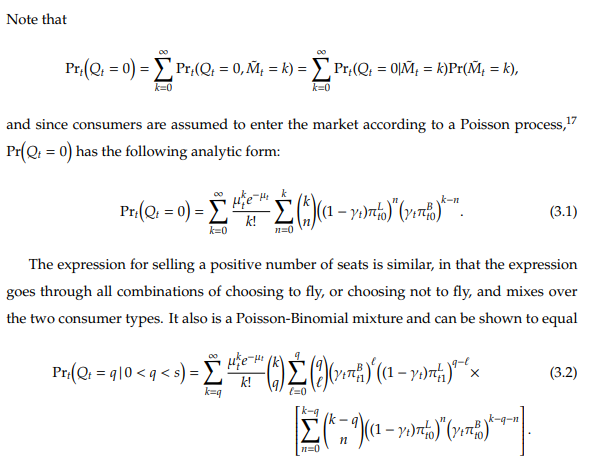
At which point I would have run for the hills, except I'm already 700 feet up one of them.
But yes, the writer is clearly using the USA model where seating normally comes upon purchase, and most of the airlines walk you through the seating module as part of the payment process. BA only gives free seating to discrete groups of their passengers and so that whole section, and the basis drawn from it, won't work for BA. In economy, in Europe, BA isn't alone either, and not Basic fares have started to creep into the US system too, since the paper was written. However I'm generally able to estimate how full a flight is by looking at the bare bones seat plan and the fare buckets, but it's more magic than the formula above.
I'll keep looking out for more mistakes. If this is my final FT post, you will all know why.
"easyJet (2003) on dynamic adjustment to stochastic demand"
but I persisted to section 3:
At which point I would have run for the hills, except I'm already 700 feet up one of them.
But yes, the writer is clearly using the USA model where seating normally comes upon purchase, and most of the airlines walk you through the seating module as part of the payment process. BA only gives free seating to discrete groups of their passengers and so that whole section, and the basis drawn from it, won't work for BA. In economy, in Europe, BA isn't alone either, and not Basic fares have started to creep into the US system too, since the paper was written. However I'm generally able to estimate how full a flight is by looking at the bare bones seat plan and the fare buckets, but it's more magic than the formula above.
I'll keep looking out for more mistakes. If this is my final FT post, you will all know why.
Nov 6, 2018 | 1:34 pm
#4
Original Poster
Join Date: May 2018
Location: London/ Oxford
Programs: BAEC Bronze; LoungeKey
Posts: 53
I should have stopped when I got the start of the second paragraph heading:
"easyJet (2003) on dynamic adjustment to stochastic demand"
but I persisted to section 3:
At which point I would have run for the hills, except I'm already 700 feet up one of them.
But yes, the writer is clearly using the USA model where seating normally comes upon purchase, and most of the airlines walk you through the seating module as part of the payment process. BA only gives free seating to discrete groups of their passengers and so that whole section, and the basis drawn from it, won't work for BA. In economy, in Europe, BA isn't alone either, and not Basic fares have started to creep into the US system too, since the paper was written. However I'm generally able to estimate how full a flight is by looking at the bare bones seat plan and the fare buckets, but it's more magic than the formula above.
I'll keep looking out for more mistakes. If this is my final FT post, you will all know why.
"easyJet (2003) on dynamic adjustment to stochastic demand"
but I persisted to section 3:
At which point I would have run for the hills, except I'm already 700 feet up one of them.
But yes, the writer is clearly using the USA model where seating normally comes upon purchase, and most of the airlines walk you through the seating module as part of the payment process. BA only gives free seating to discrete groups of their passengers and so that whole section, and the basis drawn from it, won't work for BA. In economy, in Europe, BA isn't alone either, and not Basic fares have started to creep into the US system too, since the paper was written. However I'm generally able to estimate how full a flight is by looking at the bare bones seat plan and the fare buckets, but it's more magic than the formula above.
I'll keep looking out for more mistakes. If this is my final FT post, you will all know why.
And yes, I doubt this formula could match your ability to predict! Please don't spend too long looking, not sure how this forum would be if this was your last post!
Thanks again for the help - its good to hear the data, whilst not perfect, is good. Would be interesting to see how it would turn out if European airline markets were analysed instead.
Nov 6, 2018 | 1:54 pm
#5
Original Poster
Join Date: May 2018
Location: London/ Oxford
Programs: BAEC Bronze; LoungeKey
Posts: 53
Thought its just generally quite an interesting topic anyway - sorry if it's not to you!
Nov 7, 2018 | 1:05 pm
#7
Join Date: Oct 2008
Posts: 802
How the heck does e and pi get involved in the formula to predict how many seats will be used on a flight? I should have paid more attention in math class!
I should have stopped when I got the start of the second paragraph heading:
"easyJet (2003) on dynamic adjustment to stochastic demand"
but I persisted to section 3:
At which point I would have run for the hills, except I'm already 700 feet up one of them.
But yes, the writer is clearly using the USA model where seating normally comes upon purchase, and most of the airlines walk you through the seating module as part of the payment process. BA only gives free seating to discrete groups of their passengers and so that whole section, and the basis drawn from it, won't work for BA. In economy, in Europe, BA isn't alone either, and not Basic fares have started to creep into the US system too, since the paper was written. However I'm generally able to estimate how full a flight is by looking at the bare bones seat plan and the fare buckets, but it's more magic than the formula above.
I'll keep looking out for more mistakes. If this is my final FT post, you will all know why.
"easyJet (2003) on dynamic adjustment to stochastic demand"
but I persisted to section 3:
At which point I would have run for the hills, except I'm already 700 feet up one of them.
But yes, the writer is clearly using the USA model where seating normally comes upon purchase, and most of the airlines walk you through the seating module as part of the payment process. BA only gives free seating to discrete groups of their passengers and so that whole section, and the basis drawn from it, won't work for BA. In economy, in Europe, BA isn't alone either, and not Basic fares have started to creep into the US system too, since the paper was written. However I'm generally able to estimate how full a flight is by looking at the bare bones seat plan and the fare buckets, but it's more magic than the formula above.
I'll keep looking out for more mistakes. If this is my final FT post, you will all know why.
Nov 9, 2018 | 1:27 pm
#8
A FlyerTalk Posting Legend

Join Date: Apr 2001
Location: PSM
Posts: 69,232
Obviously, using seat maps can be hugely problematic for this, which is acknowledged in section 2.2 by the author. He concludes, however, that "the measurement error associated with seat maps is likely to be small" upon "perform[ing] two analyses". Do you think this is correct?
Not to mention airlines tweak availability based on connecting bookings, not just direct sales on a single flight. The Inventory and Revenue management systems are incredibly complex. Reducing them to seat maps and published inventory is not going to lead to great results.