Pets or Food
The last time I visited a street fair in Borneo was in the middle of January, when I roamed around the Sunday market on
Gaya Street in
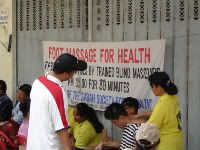
Kota Kinabalu. Without a doubt, they certainly offered an interesting and varied array of goods and services, including foot massages by blind masseurs and an extensive variety of exotic foods, both cooked and live.
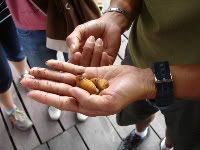
As I wandered around the open air market, I came across a vendor selling live birds and yet another hawking plump and juicy
sago worms, at one time an important dietary staple amongst the indigenous tribes of
Sarawak and
Sabah. I am told that the proper way to eat one is to hold it by its head, insert the wriggling body into one’s mouth and then bite the head off, which is discarded. I am not ashamed to admit that I didn’t try any and neither did any of the worm vendors, despite my repeated teasing and cajoling. If you prefer your sago worms cooked, here is a recipe for
Sago Delight.

Well, at least now I know what to do if I want to get some good grub.

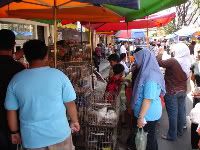
Continuing my stroll through the market, I arrived at a vendor selling numerous varieties of live tropical fish and I marveled at the fact that the fish were all still very much alive despite the oppressive heat. Given the
inverse relationship between temperature and the dissolved oxygen content of water, I would have figured that any water held at such a high ambient temperature would have been virtually anoxic.
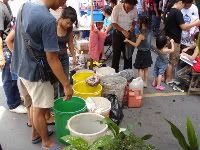
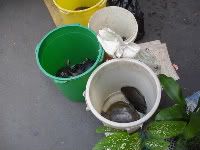
Situated next to the tropical fish stall, another vendor was hawking somewhat larger fish, many dead but others still alive, confined in a varied assemblage of diminutive aquaria. Whether they were pets or food was not as clear but I am guessing that they were intended to be food, even though the size of some of the fish was quite similar to the ones intended to be pets. In front of the very same stall, I observed a number of shoppers peering into several large plastic garbage cans. When I peeked inside the containers, I found a dozen or so sea turtles, constituting several different species, all clearly destined for the cooking pot.

Next to that stall, another merchant was displaying several dozen puppies, some confined within cages barely larger than their bodies.
In
Kuching,
Pasar Minggu, the
Sunday market is significantly larger than the one in
Kota Kinabalu so I figured it would be a very interesting place to explore. Given that it was a fair distance west of the Hilton and I have a tendency to get lost quite easily, I decided to take a taxi to get there and would then work my way back to the Hilton by foot.
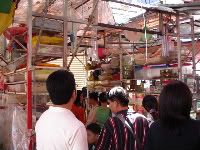
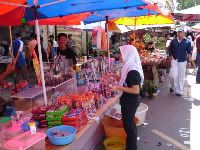
The Sunday market, which actually opens on Saturday afternoon, was indeed quite expansive. I arrived at about 10:30 on Sunday morning, considerably later than I had intended, so the ambient temperature was intensely scorching by the time I got there. It was so hot that I have no doubt that one could literally
fry eggs on the sidewalk. Although I couldn’t find any eggs sizzling on the cement, there were certainly plenty of other goodies being squeezed, fried, grilled, brewed and baked, albeit not on the ground.
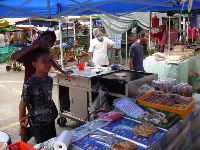
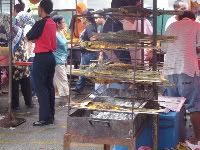

The market would be shutting down by 1:00 PM or so but even at that late hour, it was packed with people, most of whom appeared to be local rather than tourists. The hawkers themselves appeared to be an equal mix of Chinese, Malay and
Bidayuh ethnicities, the latter group having journeyed into town from various longhouses situated on the outskirts of
Kuching. Aisle after aisle of vendors hawked a myriad bounty of vegetables and fruits, all gathered from the farmland and jungles surrounding
Kuching.
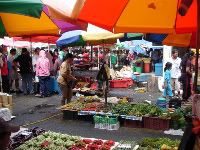
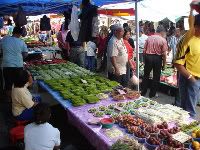
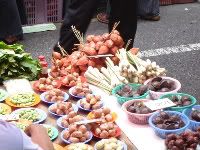
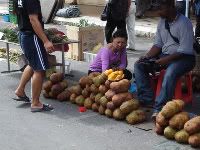
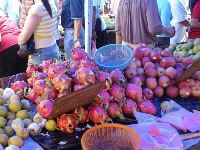
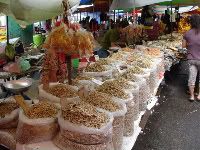
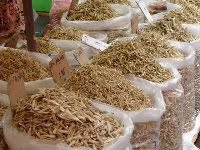
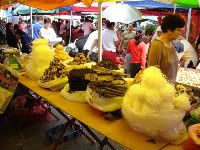
In one area of the market, hawkers were selling a wide variety of live plants and flowers. In other sections, stall after stall contained large tables laden with heaping mounds of coffee, dried fish, herbs, spices and mushrooms.
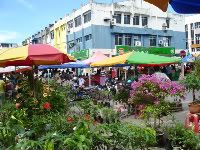
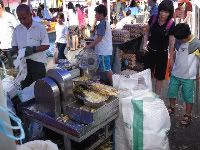
Several vendors could be seen squeezing out fresh sugar cane juice, almost certainly much healthier than the
sugar "can" juice that had been offered at the
Hilton breakfast buffet.
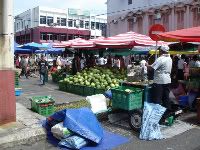
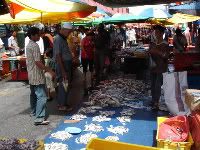
Fish and sea creatures of all shapes and sizes were available for purchase, some of them clearly for pets:
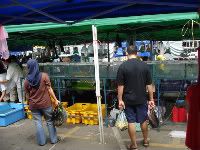
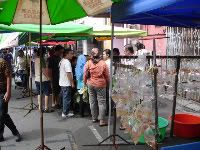
And some probably not:
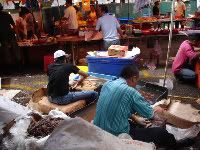
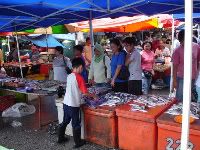
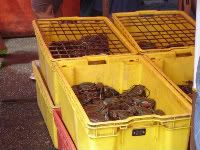
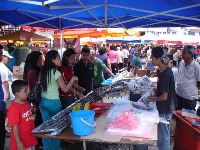
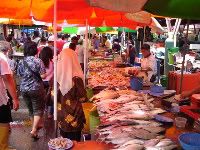
I did not encounter any fat, juicy squirming grubs like I had seen earlier in
Kota Kinabalu so I guess they must have already sold out. There were some live
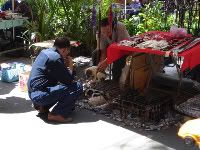
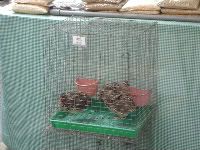
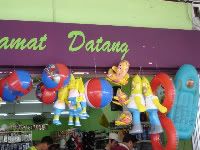
partridges for sale, as well as some small live snakes, though I am not at all sure whether the latter were intended as pets or food. And amongst the complex variety of native crafts for sale, by far the most exotic had to be the large inflatable free range Homers that could be seen hanging from the eaves of a nearby building.
By the time I left the Sunday Market, it was nearly 1:00 PM. As I strolled slowly back towards the
Hilton in the heat, I stopped briefly at the
Sarawak Museum, where I enjoyed their comprehensive exhibits of local flora, fauna and native crafts. As is the case for
all museums in Kuching, the cost of admission was free. And the value of the air conditioning was priceless.
My Village Skull House
On my last night in
Kuching, I decided to invite
Idzuan and
Azman over to the
Hilton club lounge to relax and enjoy some munchies and beverages on the 12th floor. We chatted for a bit and then watched as the cloudy sky grew dark and the light rain that had been threatening periodically throughout the day had finally seemed to come to an end. Although the lounge appetizers took the edge off of our appetites a bit, all three of us were hankering for something a bit more substantial so we decided to seek out some good seafood in a small village across the river.
After crossing the busy
Jalan Tunku Abdul Rahman, we trundled over to a small dock and waited for one of the many
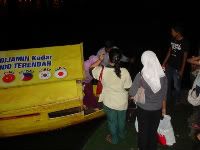
sampans to make its way across the river and pick us up. The long wooden boats can accommodate about 12 passengers or so and we were the last ones to clamber on board and into the darkness by the edge of the river. The operator used a pair of scissor-like oars mounted on the bow of the boat to make his way a bit off shore and then started a small motor to finish the trip somewhat noisily towards the opposing pier on the other side of the river. As we exited the boat,
Azman paid the driver about
30 sen each for our passage.
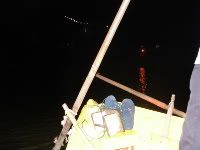
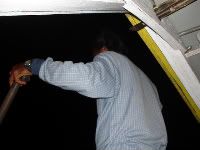
Once safely deposited on the opposing shore, we strode along the streets of a small
kampung, where Moslem prayers filled the air over loudspeakers. A few minutes later, we wandered into yet another small Kampung, also well equipped with its own set of religious broadcast capabilities. In short order, we entered a small house, where we all took off our shoes and then wandered into a moderately sized living room. In one corner of the room was a large aquarium housing a hungry looking
Arowana and some very nervous looking smaller fish. A coffee table in the center of the room held a pair of large intricately adorned wooden boxes comprised of six individual compartments. Within each compartment were strips of cake sporting a wide variety of colors and tastes.
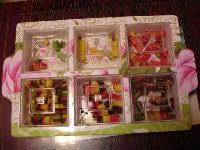
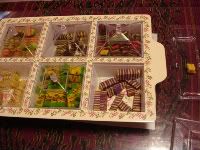 Azman
Azman and
Idzuan dug right in so I was obliged to do so as well. Besides, free food is clearly the universal icon for hungry guys throughout the world. After gorging on as many of the free cake samples as I could, I followed the guys into the next room, which was evidently a sales area. Shelf after shelf held stacks of the colorful cakes, all clearly marked with both flavor and price. I confess to still being somewhat bewildered and confused by all of the goodies so I asked my companions what exactly I was looking at. "
Kek Lapis," they quickly replied, figuring that this short response would provide me with all of the answers I would need.
Correctly sensing a continuing spark of confusion and uncertainty from me, they added, "that’s the world famous Sarawak Layer Cake!" The two of them walked gleefully amongst the shelves, stacking their arms high with layer cakes representing a veritable rainbow of flavors and colors. World famous the cakes may have been but I am not ashamed to admit that their renown had not quite made it across to my side of the Pacific, let alone to the distant land of New York City, where I grew up. Or if it had been famous in the states, I guess I wasn’t paying sufficient attention. No matter, it certainly tasted decent enough and, whereas I had no immediate plans to make a purchase (preferring to travel as light as possible), I was happy enough to enjoy their interest and enthusiasm vicariously.
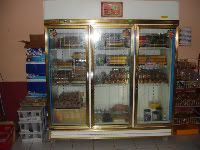
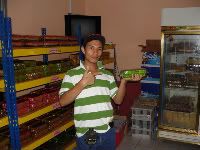
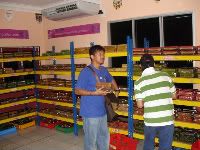
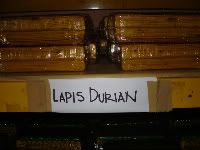
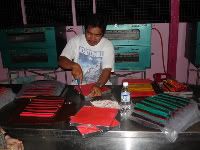
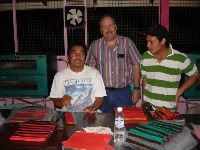
Some discussions in Malay ensued between the guys and the proprietor and, in short order, all three of us where invited into the "factory," situated just behind the main sales room. We all watched as a craftsman sliced and weaved the cakes together into numerous and varied attractive designs, his dexterous fingers swiftly manipulating the multihued layers and evidencing many years of skill and experience. As he worked on the cakes, I teased him a bit by asking why a man who was so artistically fashioning the famous
Sarawak Layer Cake was wearing a sweatshirt emblazoned with
Mount Kinabalu, a blatant symbol of
Sabah tourism.
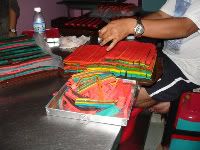
As the guys were paying for their mountain of
Kek Lapis, the proprietor insisted I take one of the cakes with me as both a souvenir and a symbol of his hospitality. After exiting the factory and retrieving our shoes, I figured we would be heading back to the dock given that I was fairly full of
Kek Lapis by then.
But we continued walking through the village and soon arrived within the domain of a sprawling outdoor seafood restaurant called,
My Village Barok. As we settled into a private circular table off to the side, I was told it was built to resemble a
baruk, the structure in which the original
Iban denizens of
Borneo traditionally stored
head trophies.
After taking our seats and placing a drink order, we descended the simple wooden steps of our
baruk and walked towards a counter that had been erected in front of the open air kitchen. The counter displayed a wide selection of fresh fish, live crabs and jungle vegetation, all eagerly clamoring for our inspection and purchase.
Though we had gorged ourselves on abundant helpings of
Hilton snacks and Sarawak
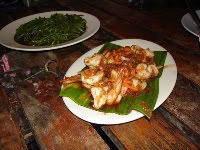
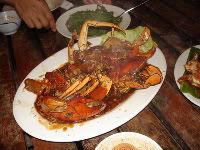
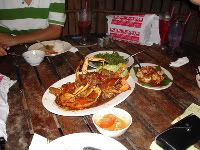
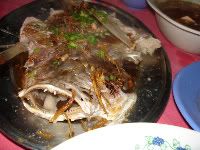
Kek Lapis, we ordered two chilli crabs, one whole fish, some specially prepared prawns, stir fried
jungle fern, rice and a big portion of
tom yum soup. Knowing my lack of enthusiasm for
belacan,
Azman and
Idzuan kindly made quite sure that the smelly ingredient was used in generous abundance in as many dishes as possible.
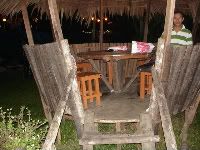
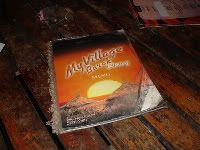
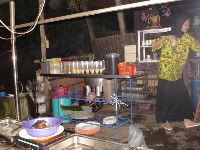
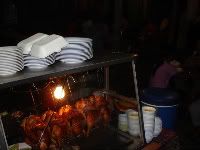
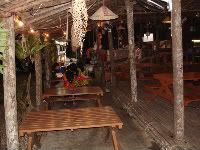
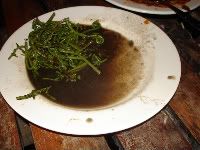
After all of our dishes had arrived, I began to chew on some
belacan infused
jungle fern and noticed that copious amounts of dirty-looking black liquid oozed out every time I look a bite. Soon enough, there was nothing edible left on our table, it was just a mass of prawn tails, fish bones, crab shells and dirty black
jungle fern slime. The total cost for this huge seafood repast was approximately
60 ringgits. ^
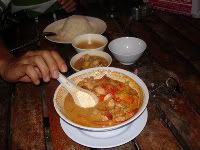
It was not until 10:30 PM before we arrived back at the dock to await our
sampan journey back towards the
Hilton side of the river. We were somewhat disappointed to arrive back at the dock so late because the tariff for
sampan transportation triples at that time of night so it would now cost us a hefty
90 sen per person.
As we waited for the boat to pick us up, several fisherman stood on the side of the dock holding lanterns. "Fishing for squid," they told us, as our small boat pulled in and we gingerly climbed on board and drifted into the darkness of the
Sungai Sarawak.
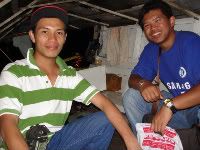
While we were plodding noisily across the river in our
sampan,
Angela called to say that she would like to have breakfast with me the next morning at the
Hilton. I also learned that
Idzuan and
Azman were both on my
Air Asia flight back to
Kuala Lumpur the following afternoon and they kindly offered to give me a ride to the airport. Our flight was scheduled to depart at 3:05 PM and they explained that they planned to arrive about 45 minutes before departure.
Keeping in mind that they needed to return their rental car and also knowing that I liked to board early so I could snag a roomy seat in row one, I figured it might behoove me to make my own way to the airport on Tuesday. Besides, I explained, if there is one thing I have learned after flying nearly 2,000,000 million miles on
UA and a smattering of miles on a variety of other airlines, it nearly
always pays to arrive at the airport somewhat early. There is typically a great deal of uncertainty when flying and one can
never be sure what the travel gods have in store. Little did I know at the time that this simple statement would turn out to be profoundly and sadly omniscient.
Final Chapter:
Fight or Flight …