Nosing Around the Jungle With Proboscis Monkeys
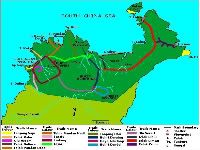
Bako National Park spans an area of 27 sq km and is situated at the tip of the
Muara Tebas peninsula that juts out into the
South China Sea. The park is an ecological treasure trove, comprised of seven unique ecosystems and 25 distinct vegetation types, representing nearly every species of plant found within
Borneo. It is also an area of great natural beauty, its massive steep cliffs weathered over millions of years into a striking assortment of beautiful sea stacks, rugged arches and precipitous promontories.
From
Kuching, one can take the
Petrajaya bus No.6, a minibus or a taxi to
Kampung Bako and then sign in at the registration counter. The park is accessible only via water, so a boat needs to be chartered for the 25 minute trip over to the park headquarters. From there, private guides can be hired to facilitate a variety of possible treks.
I opted for a tour package that included pickup at the
Crowne Plaza, land transport to the Bako fishing village, boat transportation to the park entrance, all admission fees, guided walks along various jungle trails, lunch and return transport to the
Hilton. After a 37 km ride by van from
Kuching, we arrived at the stilt village situated near the mouth of the
Sungai Bako. From there, I climbed aboard a small boat along with three other passengers, a fellow from Phoenix and a couple from the UK.
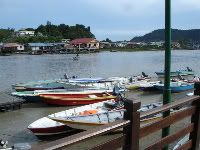
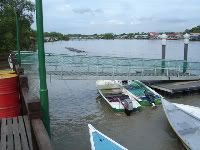
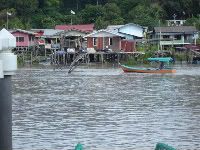
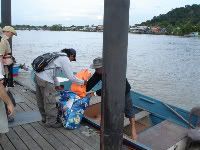
The boat ride took us from the swift currents of the turbid
Sungai Bako out into the
South China Sea, a coastal area frequently punctuated with permanently anchored fishing nets and populated by quite a few fishing boats.

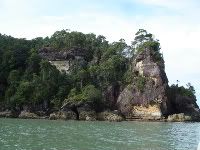
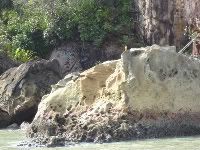
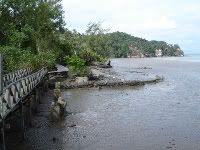
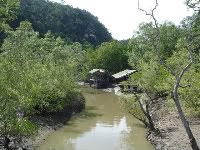
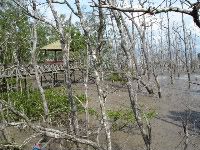
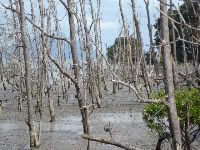
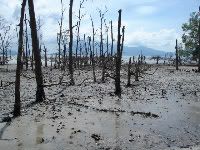
The boat pulled into an area dominated by a vast mangrove swamp, nestled within the rugged rocky coastline. After pulling up to the dock, we strolled along an elevated boardwalk for the 15 minute trek to the park headquarters. The mud flat below us was populated by thousands of
mudskippers, an amphibious fish that uses its
pectoral fins for propulsion and can stay out of the water for several days at a time.
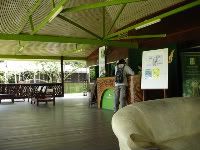
After checking in, our guide escorted the four of us up a very steep trail where grand vistas and spectacular views would await us. After a half hour of continuously inching our way over very large rocks and slippery tree roots, we stopped for a rest and were then informed that we were only a quarter of the way to the viewpoint. One of the other members of our group already had a wounded leg so after a brief powwow, we unanimously decided to branch off to a different trail whose vertical inclinations promised to be somewhat less extreme. By this point, so much sweat was poring off of me in the dense tropical humidity that my glasses kept slipping off my face and I finally opted to put them away. I figured that stumbling around with limited visibility in the jungle still beats losing my glasses permanently.
For the next hour and a half, we slogged along our new routing on the
Telok Pandan Besar trail. As we proceeded on our journey, we frequently passed by large
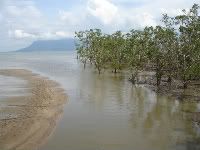
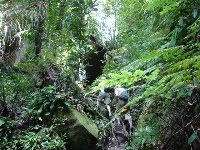
rattan trees, every surface of which was covered with fierce spines, designed to assist their growth over other plants and to deter herbivores. Our trail provided us with frequent glimpses of cliffs that descended steeply to secluded coves and beaches and to large rocky sea stacks poised imposingly along the shoreline. We rounded one sharp twist in the trail to find ourselves confronted with a very long procession of millions of ants, an immense formicid convoy with no clear beginning or end.
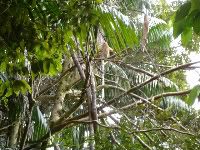
As we continued walking along the jungle trail, we heard some rustling in the leaves high above us in the
canopy. We all stopped and peered upwards into the dense foliage and eventually discerned a small group of
proboscis monkeys feeding amongst the tree tops.
The
proboscis monkeys can attain weights over 50 pounds and are endemic to the mangrove swamps and wetlands of
Borneo. They are well known for their stereotypically immense nose that sometimes grows to exceed seven inches in length for males. The huge nose acts like a resonating chamber that can be used to intensify warning calls. When they become upset, they quite literally get their noses out of joint as the nose engorges with blood, thereby intensifying their warning calls.
When the Dutch began infiltrating Indonesia in the 16th century some of the locals could not help but notice the obvious similarity between their big bellies and noses with those of the
proboscis monkeys. The Indonesian word for "Dutch" is
belanda so, it should come as no surprise that a popular nickname for this monkey was
monyet belanda, which literally means, "Dutch monkey."

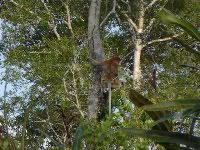
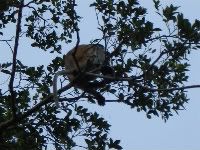
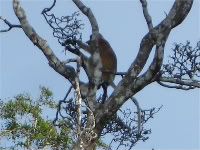
My attempts to get a decent photograph of the monkeys were thwarted every time I tried. Not only were the monkeys quite high up in the treetops and partially obscured by vegetation, they kept turning away every time I snapped a picture. This was my second effort to view
proboscis monkeys; the first was a couple of months ago while I was exploring the
Klias river in
Sabah. Those monkeys proved to be equally shy when it came to turning in my direction. So, the best that I can do under the circumstances is to offer this close-up of the secretive proboscis that I managed to dig up from deep within the zoological archives.


We continued on the trail for a while longer and then descended a steep incline through a cliff teaming with vegetation. The
Telok Pandan Besar trail ended at a broad beach where we gathered under the roof of a small wooden hut to spend a little time relaxing, rehydrating and escaping from the relentless sun for a while. A boat was scheduled to pick us up and cart us off to our next destination and it seemed like a perfectly pleasant place to await its arrival.
When we arrived at the hut, I met an American fellow who had just flown in from Dubai with his two young sons. The boys spent much of the time scampering along the beach, clearly immune and impervious to the baking rays of the sun. Also foraging along the beach were several troops of
long-tailed macaques, which, under the current circumstances, helps to explain why the animals are also often referred to as
crab eating macaques in many parts of the world.
Given that I have had more than my fill of monkeys when I
visited Bali the previous month, I opted to rest in the hut and stay as far away from the monkeys as I could. Besides, under the present oppressive weather conditions, the last thing I needed at this point was yet another
monkey hat.
Nevertheless, none of my personal reticence precluded me from trying to coerce others to interact with the macaques. I tried everything I could think of to encourage the boys to play with the monkeys and even volunteered to donate a variety of gifts that the boys could use to lure the mischievous primates a little closer. Unfortunately, the boys ignored me completely, thus proving that they, and the monkeys, were all much smarter than I was.
After waiting for a half hour, a boat finally appeared on the distant horizon and we walked out towards it along the beach under the blazing
Borneo sun. However, when we arrived at the edge of the water, it was so shallow that the boat was unable to come in close enough to pick us up. Our only possible choice was to wade out into the muddy water, nearly as hot as bath water, and then climb on board a short distance from shore.
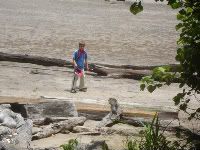
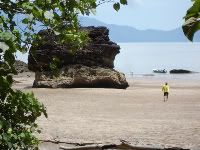
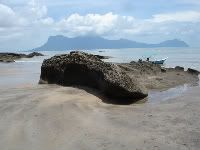
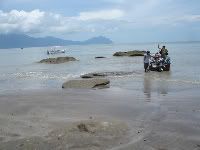
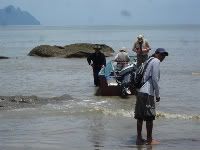
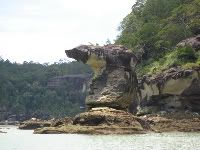
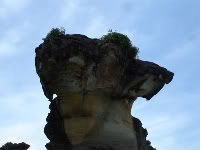
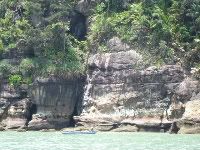
Once we were all safely aboard, the motor started right up and we soon found ourselves cruising along the coast of the peninsula. From time to time, we slowed down to inspect secluded coves and isolated beaches or came in for closer looks at rocky cliffs dripping with lush tropical vegetation. We spotted a yellow kingfisher poised on a rocky precipice and eased up to several dramatic rocky pillars, such as the famous
cobra head sea stack that resides just off the shore of
Teluk Pandan Kecil.
We eventually wound up back in the vicinity of the Bako park headquarters, where we endured a very long wade ashore through warm and murky mud flats. Our guide sternly warned us to watch where we were walking because catfish liked to embed themselves in the mud, exposing only their sharp dorsal spines to those unlucky enough to step on them. Given that none of us could see anything at all through the intense turbidity of the water, I am not at all sure what we could have done to avoid them. As we trundled ashore, I noticed the phrase "1492 miles" inscribed on the guide’s sweatshirt and asked him what it meant. He responded that he didn’t know; he just liked the shirt.
We finally ascended to the boardwalk and all of us were, fortunately, catfish free. Within the administrative complex at
Teluk Assam, we were led to a small canteen where we were invited to partake in a lunch buffet. The rule was that we could make only one visit to the buffet but we could take as much as we wanted. As a result of the enormous breakfast buffet that I had enjoyed several hours ago in
Kuching, I as not especially hungry.
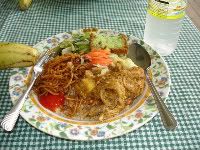
But I recall reading about of group of Taiwanese engineering students who came up with a clever way to
maximize their return on investment when faced with similar restrictions at a buffet in Taipei.
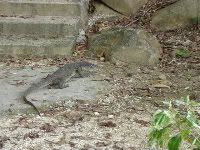
When I stepped outside after lunch, I encountered a large
monitor lizard resting in a wet area near the corner of the building.
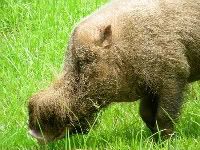
A few feet away from the giant lizard, I was confronted by a huge
bearded pig who had just come sauntering by to see what he could scavenge. By the time I grabbed my camera, only his rump was still in the frame. So, for educational purposes, I have provided some stock photos so you can see what he looked like:
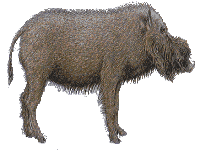
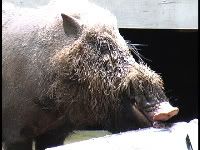

As the wild boar slogged off into the trees, we walked along a small trail that brought us alongside a variety of snakes, including a
painted bronzeback and the highly venomous
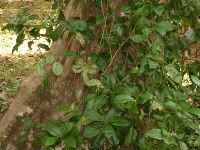
green pit viper, who was using its prehensile tail to coil tightly against a large tree.
As we continued our walk, we ran into a pair of French visitors, who reported that they had seen a troop of
silver leaf monkeys about 20 minutes further down the trail. Quiet and docile creatures, the
silver leaf monkeys resemble the evil
long-tailed macaques in all but temperament so I asked the French couple if they were absolutely sure that the silver leafs they had spotted were not really
long-tailed macaques.
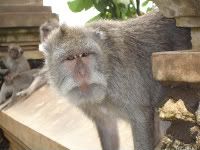
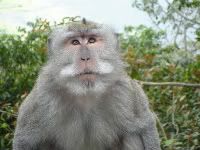
The couple were quite adamant about the identity of the primates so our group opted for a 20 minute detour so we could get a closer look. As we began to ascend a steep hill, the fellow from Phoenix decided to stay behind because his bandaged leg was beginning to hurt. After mulling it over a bit, I chose to keep him company because my gut instinct told me that the monkeys were probably just macaques and I had already surpassed my quota of
long-tailed macaque interactions for the year. So I asked the other members of our group to send one of the monkeys back with a signed note saying that they were not macaques, sort of like a carrier monkey. As I had suspected, no monkeys returned with a note; my instincts that the whole thing was all a wild monkey chase turned out to be correct.
As we continued along on our originally planned itinerary, we walked along the
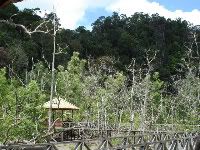
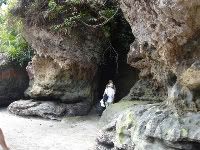
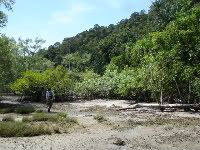
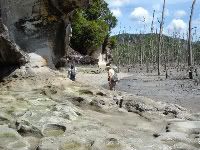
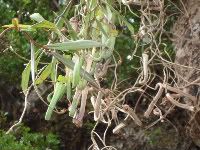
Telok Paku trail and eventually arrived at another elevated boardwalk. At the terminus of this very long walkway, we finally descended onto the ground below, which had not yet made up its mind whether it wanted to be a sandy beach or a mud flat. Our guide led us along the edge of some very steep cliffs where the ground was a little more solid and we then found ourselves in a very narrow cave. Squeezing through the cave was a very tight fit but we eventually emerged into a secluded cove on the other side. In this area, the rocks of the cliff face were carpeted with dense clusters of carnivorous
pitcher plants, some of which cascaded down from very long vines anchored much higher up on the cliff.
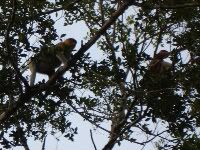
Soon enough, the ground began to morph into more mud than sand. Just as we were about to turn back, we discerned considerable movement at the tops of some nearby trees situated at the edge of the jungle. As we slowly inched our way closer, a small troop of
proboscis monkeys could be seen clustered near the tops of the
canopy, occasionally leaping from one tree to the next. Our guide explained that the monkeys normally would have descended from the trees and be grazing closer to the beach this time of day but it was just too hot for them. I, for one, certainly agreed with the monkeys' assessment of the weather conditions; the sudorific heat was absolutely brutal. As with all of my prior
proboscis monkey encounters, I failed to get a good photograph of their unusual visage; it almost seemed like they were thumbing their noses at me.
We eventually turned away from the monkeys to start on our long trek back to the beach where a boat would pick us up for our return trip to the Bako stilt village. We walked for well over a mile under the relentlessly blazing sun until we finally reached the edge of the
South China Sea. Once again, the water was so shallow that we needed to wade quite far out from shore in order for the boat to pick us up.
From that point, our trip back should have been smooth sailing but I quickly observed that we were drifting ever closer to a rocky outcropping. I turned around to see the driver frantically manipulating the outboard motor and repeatedly yanking on the starter chord. After many such attempts, the engine remained resolutely unresponsive. As we began to drift dangerously close to the rocky shore, the driver frantically grabbed an oar and paddled us out for a while so he could have another go at the engine.
Notwithstanding the possibility of being smashed against the rocks, I was not relishing the thought of spending the night in the jungle. We were all fully exposed to the blistering sun at that point and I was feeling profoundly drained from the heat and all of the day’s activities.
Courtesy of
Angela, I had met two visitors from
peninsular Malaysia,
Azman and
Idzuan, and was planning to hook up with them for dinner later that evening. Getting smashed with some cool beverage on the rocks in the comfortable Hilton
club lounge was considerably more appealing then getting smashed against the rocks of Bako. And the idea of enjoying a nice dinner in a pleasant riverside seafood restaurant in
Kuching was infinitely more palatable than scrounging with the monkeys on the local mud flats. Finally, just as we had all pretty much given up hope, the engine suddenly sputtered to a hesitant start and we hightailed it back to the Bako fishing village.
Once we arrived safely back at the dock, we ascended a few steps and then walked over to a shaded area to await our van ride back into
Kuching.
As we mounted the steps, we were overpowered by an overwhelming stench, an odor so powerful that it smelled as if something had died, come back to life and then died again from its own smell. My fellow travelers asked about the awful smell and I replied, truthfully, "dinner." Nearby, a mass of festering shrimp was fermenting odiferously in the tropical sunshine, eventually morphing from rotting seafood into the quintessential ingredient of much Malaysian cuisine,
belacan.
Getting A Head in the Longhouse
When I visited the
Sarawak Cultural Village a few months ago, I booked a ride on the
10 ringgit shuttle that operated from either the
Holiday Inn or
Crowne Plaza in downtown
Kuching and then terminated at the
Damai Beach Resort, about 35 km away. On the way to Damai, the shuttle dropped off passengers at the cultural village and then picked them up later for the return trip to
Kuching.
The cultural village was designed and conceived to depict all of the major indigenous racial groups of
Sarawak, portraying both their dwellings and lifestyle. From what I could determine, life must have been very harsh in those days and the youngsters matured at a very early age.

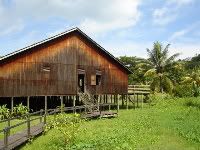
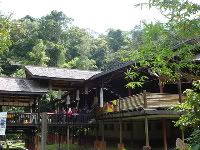
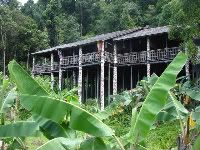
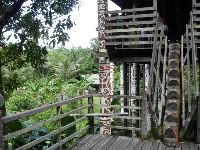
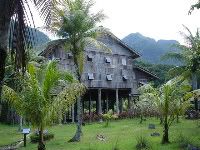
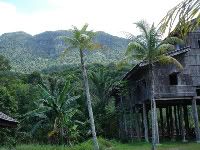
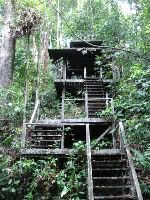
Seven ethnic houses represent the
Malay, the
Chinese, the
Penan and the longhouses of the
Bidayuh,
Iban,
Orang Ulu and the
Melanau.
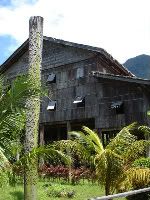
The 14 acre village is nestled in the foothills of 2658 foot
Mount Santubong, which, according to legend, formed when two beautiful princesses exchanged blows and were turned into mountains by the King of Heaven. One of these mountains,
Santubong, is said to resemble a woman lying on her back.
Surrounded by semi-landscaped jungle, an artificial lake situated in the middle of village was built to symbolize the proclivity of
Sarawak denizens to build their abodes near bodies of water.
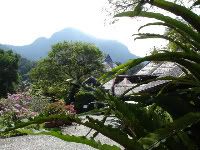
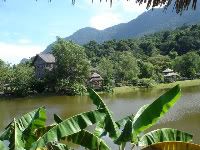
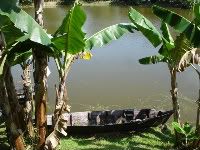
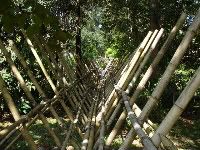
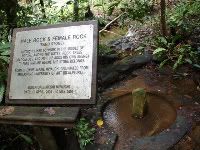
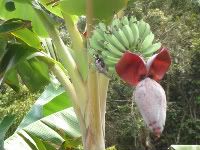
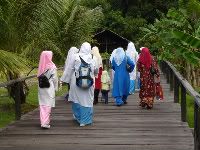
Visitors can meander around the circumference of the village and inspect all of the longhouses, chatting with each of its respective inhabitants to learn about the life, beliefs, crafts and customs of their forebears.
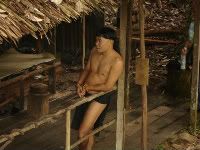
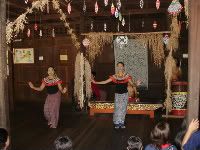
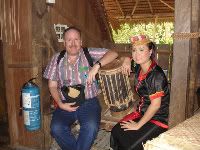
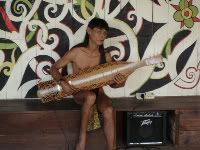
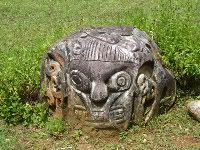
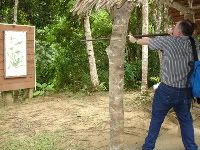
I observed most of the craft demonstrations but blew off the blow pipe exhibition because I had already successfully managed to use a blow pipe to hit a monkey on the leg. I had accomplished this feet while visiting the
Monsopiad village, a 25 minute drive from
Kota Kinabalu in
Sabah so I figured I should quit while I was ahead. And, in the interest of full disclosure, I must confess that it was only a
picture of a monkey whose leg I hit -- though, after my recent experiences in
Bali, hitting the real thing would have felt mighty tempting.
 Monsopiad
 was a legendary
Kadazan warrior whose people inhabited a region of
Sabah several hundred years ago. According to local legend, when Monospiad’s mother became pregnant, a sacred bird called a
Bugang made a nest in the roof of the home. When Monospiad was born, so were the bird’s hatchlings. This was interpreted as an omen and Monospiad’s parents believed that this engendered great superpowers in their son and took special care to hone his skills.
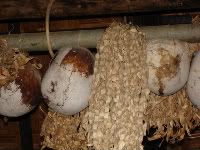
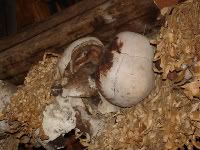
At the time, Monospiad’s village was frequently at the mercy of robbers so when Monospiad got a little bit older, he vowed to rid the village of this recurring scourge. He set about to hunt down the robbers and then returned to the village victorious, exhibiting a robber’s head as proof of his conquest. Figuring that two heads were better than one, he ventured out once again and returned to the village bearing the requisite trophy of his victory. Before proudly displaying these heads in his home, he took them out into the jungle, where he hung them from trees for a while so they could dry out.
Now that their safety was ensured, the village people were ecstatic and I suppose one can forgive the young Monospiad for being just a little headstrong.
The warrior soon set out upon other conquests, vowing to rid the area of all robbers and foreign "aggressors." As his collection of skulls grew ever larger, he quickly ran out of victims from whom to collect new head trophies. His pent up aggression not fully assuaged, he started dueling and provoking quarrels with everyone around him, motivated mainly by his desire to add heads to his collection.
At that point, the only tragic choice for the village was to rid themselves of their most respected denizen. So they summoned all of their remaining warriors who then snuck in at night and killed Monospiad after a huge and bloody battle. The power and strength originally bestowed on him by the sacred
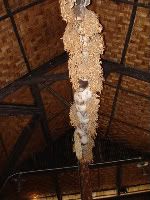
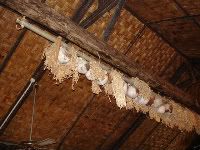
Bugang had been rescinded once he abused his gift and let his power go to his head. Although that was the end of Monospiad, his people honored his prior years of dedication by erecting a monument to him and then renamed the village in his name. To this day, one can still see 42 skulls hanging from the rafters of Monospiad’s house, all "gazing" up towards the heavens.
 Going Ape at Semenggoh
The day after I journeyed to the
Sarawak Cultural Village I ventured over to the
Semenggoh Wildlife Rehabilation Centre, located 20 km from
Kuching. To get there, I negotiated long and hard with one of the numerous professional "drivers" who linger outside the downtown
Kuching hotels, waiting anxiously to take visitors for a ride.
At
Semenggoh, one can observe
orang utans in the wild, inasmuch as apes waiting to be fed at a dedicated feeding platform can be considered "wild." But, in truth, these
people of the forest really are free to come and go as they please and they are, in reality, living in their natural habitat. This is not where many of these
orang utans originally came from, though.
The origin of many of these apes is quite sad; many were orphaned or illegally captured, and then subsequently recovered and confiscated from their "owners." Quite a few of them had been terribly abused before finally ending up within the relatively safe realm of the sanctuary. Although these animals are free to forage on their own, food is always available twice a day on the feeding platform, just in case the
orang utans are unable to gather enough of their own munchies.
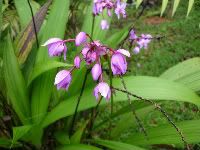
A short walk along a well built plank pathway is required for humans to access the feeding platform. Buses disgorge their payload of passengers a fair distance away from the trailhead but private cars can sneak in considerably closer. The entrance itself is surrounded by an interesting assemblage of native vegetation, including
pitcher plants,
Sarawak pepper, wild orchids and a variety of other tropical flowers and fruits.
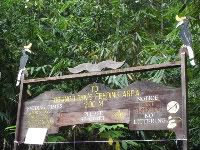
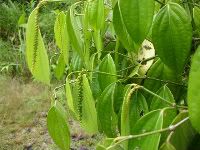
Prior to entering the inner reaches of the sanctuary, a ranger lectures visitors on what behaviors and actions should be avoided, such as flash photography and cell phone conversations, in fact, any loud conversations whatsoever. Nevertheless, I observed that these admonitions did very little to preclude such behaviors. In fact, the greatest disturbers of the peace were the very same drivers who had transported the busloads of visitors to the sanctuary.

Once assembled in front of the feeding platform, visitors are obliged to wait in the steamy jungle patiently and sweatily. Sometimes the
orang utans don’t show up at all, especially if they have been successful in harvesting ripe fruit on their own. After we had waited for a while, an attendant materialized bearing overflowing buckets of
orang utan chow, mostly fruits, veggies, seeds and coconuts.
For quite some time, no
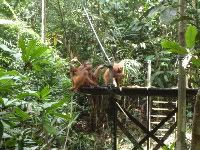
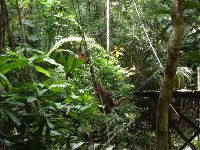
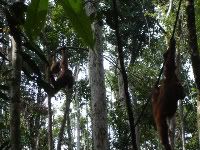
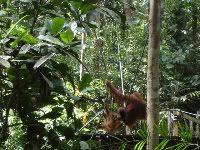
orang utans could be seen, despite repeated loud, melodic and plaintive calls from the human caretaker. Then, slowly and surely, they began to swing in on vines from the tops of the trees, like so many furry, red Tarzans scurrying through the upper reaches of the
canopy, rarely, if ever touching the ground. First one, then another, then a mother with her youngster, all accompanied by much whispering, finger pointing and camera clicking amongst the human audience.
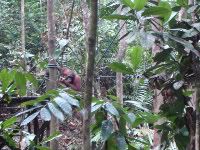
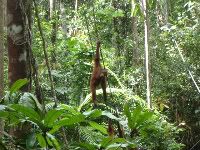
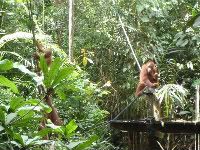
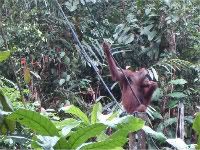
As many as seven
orang utans showed up while I was there. Eventually, having had their fill of brunch, all of them disappeared back into the dense and steamy jungle, completely invisible for a while, at least until they reemerged later in the afternoon for their dinner feeding.
Next Chapter:
The Hilton Batang Ai ai ai Longhouse Resort …