VANCOUVER TO CAMPBELL RIVER
Bus, Car and Ferry
Today’s plan called for getting from Vancouver over to the city of Nanaimo, located across the Strait of Georgia on Vancouver Island. Once there, I’d find a place to stay and catch a bus the next morning up to Port Hardy, located on the northern end of the island.
Getting from the Vancouver Airport across to Vancouver Island is easy. A company called
Pacific Coach Lines operates a bus service direct to Victoria via the BC Ferry out of Tsawwassen. They sell thru-tickets to Nanaimo as well, but the bus will only take you as far as the mainland ferry terminal at Tsawwassen. From there you take the ferry across to Nanaimo. This sounded just fine to me, and so I shelled out $27.00 CAD for the trip to Nanaimo.
There was just one problem. The ferry didn’t actually dock in Nanaimo. It docked at Duke Point, about ten miles from Nanaimo. This was kind of like landing out in Virginia at Dulles Airport when your ultimate destination was downtown Washington DC. The ticket agent told me the only way into Nanaimo was via taxi. Is there any city bus, I asked. She didn’t know. Oh well. I’d figure it all out once I got there.
BC Ferries does a brisk business between the mainland and Vancouver Island. The most heavily traveled crossings are between the Vancouver ports of Tsawassen or the more northerly Horseshoe Bay across to Victoria and Nanaimo. However, there are many other crossing points as well.
My boat today was named the
Queen of New Westminster. Aside from this ferry, I wasn’t aware that New Westminster – much less Old Westminster – had ever had a Queen. Ah well, they’ve got one now in the form of this ferry, and quite a large and spacious Queen she is. Built in Victoria, BC in 1964, the Queen offered spacious passenger seating areas, a snack bar, a restaurant serving full, plated hot meals and even a children’s area. Crossing time was about an hour and a half, during which I enjoyed a tuna sandwich and that morning’s Globe and Mail.
At Duke Point, I quickly discovered that the only way into Nanaimo was via taxi. I approached an available cab and asked how much it cost to get into Nanaimo. $35.00 to $40.00 was the reply. Oh my God! That’s highway robbery! Five minutes later I was standing alongside the road into town where I quickly got a ride from a nice couple who took me directly to the city bus station.
My ultimate destination on Vancouver Island was Port Hardy, located on the northern end of Vancouver Island, about 250 miles up the East Coast highway from Nanaimo. From Port Hardy, I’d be boarding another BC ferry the following evening for the twenty-two hour passage up to Prince Rupert, BC. There’s one bus a day from Nanaimo to Port Hardy. It leaves Nanaimo at 8:30am, arriving in Port Hardy at 3:40pm, allowing plenty of time to connect to the ferry which departs at 6:00pm. My original plan had been to spend the night in Nanaimo, but right now it was 1:00pm and there was a 2:45pm bus heading up to Campbell River, about a third of the way up to Port Hardy. The Port Hardy bus would pass through Campbell River tomorrow at a little after noon. After so many early morning wake up calls, it was an easy choice to go to Campbell River today so I could sleep in tomorrow morning.
So far, everything was working out quite nicely. The only thing that wasn’t was the weather. It had returned to its usual winter pattern of cloudy days with occasional wind and rain. Tomorrow’s forecast called for intensified wind and rain. As if on cue, the rain started falling in earnest that night in Campbell River. The wind woke me up the next morning.
March 26, 2005
Port Hardy to Prince Rupert
B.C. Ferries
M.V. Queen of Prince Rupert
600p-430p Travel Time: 22 Hours
To say that it was merely windy would be quite an understatement. Gusts were approaching 40-50 mph and the rain was falling in sheets. It was an impressive, if somewhat disheartening display. Only three days ago from the vantage point of my window seat some 30,000 feet overhead, it had looked so calm, sunny and beautiful down here. Now I was faced with riding a ferry through this. Good thing I didn’t throw out that Chilean sea sickness medication I thought as I listed to port and caught another hour of sleep.
Thankfully, by noon the worst of the weather had passed and when I boarded the bus to Port Hardy, it was merely cloudy with occasional light rain. As we rolled through the suburbs of Campbell River and finally turned north on the main road up to Port Hardy, it occurred to me that exactly a week ago at this time I was down on the other side of the planet, choogling along through Tierra del Fuego on a steam train. What a difference a week makes! A week from today I’d be comfortably sat up in the First Class cabin of a Cathay Pacific 747-400, flying between Vancouver and Hong Kong. A week after that I’d be tossin’ back a cold one in Alice Springs after a long day in the Alice Springs Desert Park. Daydreaming sure is fun, especially when it’s reality based!
The bus dropped us off at the ferry terminal right on time. The town of Port Hardy itself is located about a mile away. I had hoped that there’d be a store nearby the terminal, but there was nothing. Oh well. Hopefully the food on board the boat would be affordably priced.
When I made these reservations three months ago, I’d requested a cabin since it cost only $45.00 USD more per night than a mere seat. At that time no cabins were available, but I was put on a waiting list. Having heard nothing by email from BC Ferries, I assumed that nothing had cleared and so I was prepared to make the best of it in the passenger lounge with my Thermarest pad and sleeping bag. Imagine then my surprise and delight upon checking in to discover that my accommodation request had cleared off the waitlist and I did indeed have a cabin assigned to me.
Is it my own or will I be sharing it? I asked. It’s all yours, was the reply. Yippeee!
Just before boarding was announced, a chartered bus arrived and disgorged a large group of
Royal Canadian Sea Cadets. They were all boys and girls who looked to be between the ages twelve and sixteen or thereabouts. All of them were decked out in their black dress uniforms, complete with black wool Captain’s hats. Three or four similarly bedecked chaperones maintained order amongst the group. All of them toted a full sized duffel bag. It was quite a group.
Boarding began at about 4:30pm. Foot passengers were allowed to board first, followed by cars and trucks. As with my experience two weeks earlier on the Navimag ferry in Chile, it was raining as we walked the one hundred or so yards from the ferry terminal down to the boat, named the “
Queen of Prince Rupert”. Thankfully it wasn’t as heavy a rain, nor did we have to walk as far.
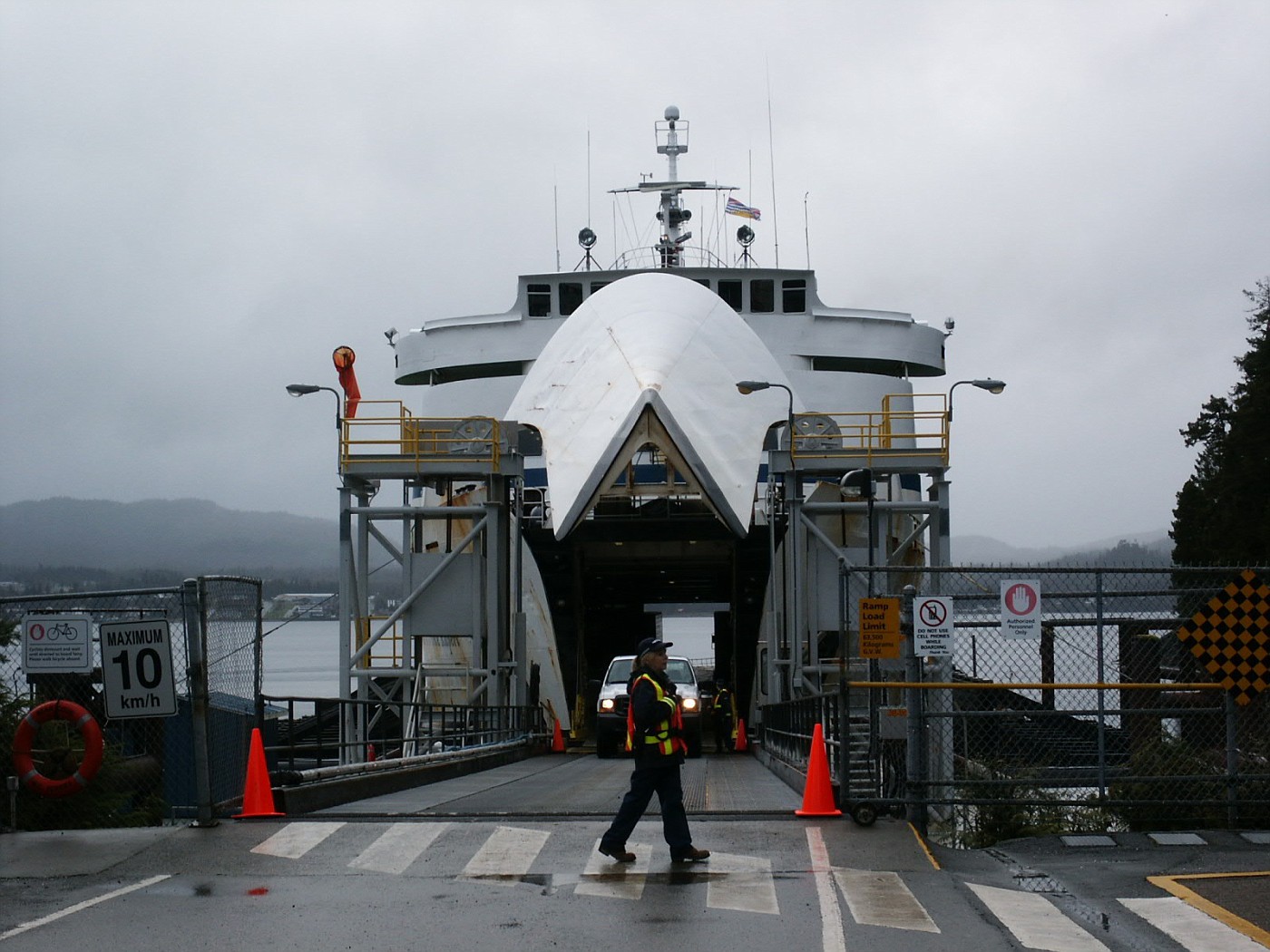 Boarding The Queen
We entered through the vehicle deck and climbed a couple flights of stairs to get up to the lounge deck where passenger seating and the Purser’s Office were located. At the Purser’s desk, I paid the additional $55.00 CAD for my cabin and was handed a key to room L-8. The L stood for Lounge Deck, so no more narrow stairways for me – at least not while wearing my big backpack. As I walked down the hallway and counted off the room numbers, I took note of how much space there was between doors. Either I’ve been upgraded to a suite or they’ve put me in another four-bunk room, I thought. Finally I reached L-8, the last cabin at the end of the hall, and opened the door.
Oh My God! What a room! It wasn’t a suite but it might as well have been after some of the accommodations I’d stayed in of late. I would guess the cabin measured 8’ by 10’, not including the ensuite toilet. Along one wall was a set of comfortable looking curtained bunk beds. I lay down on the bottom one and was thrilled to discover that there was room to spare for my nearly 6’ frame. Each bunk had a reading light and a small shelf for books or personal items.
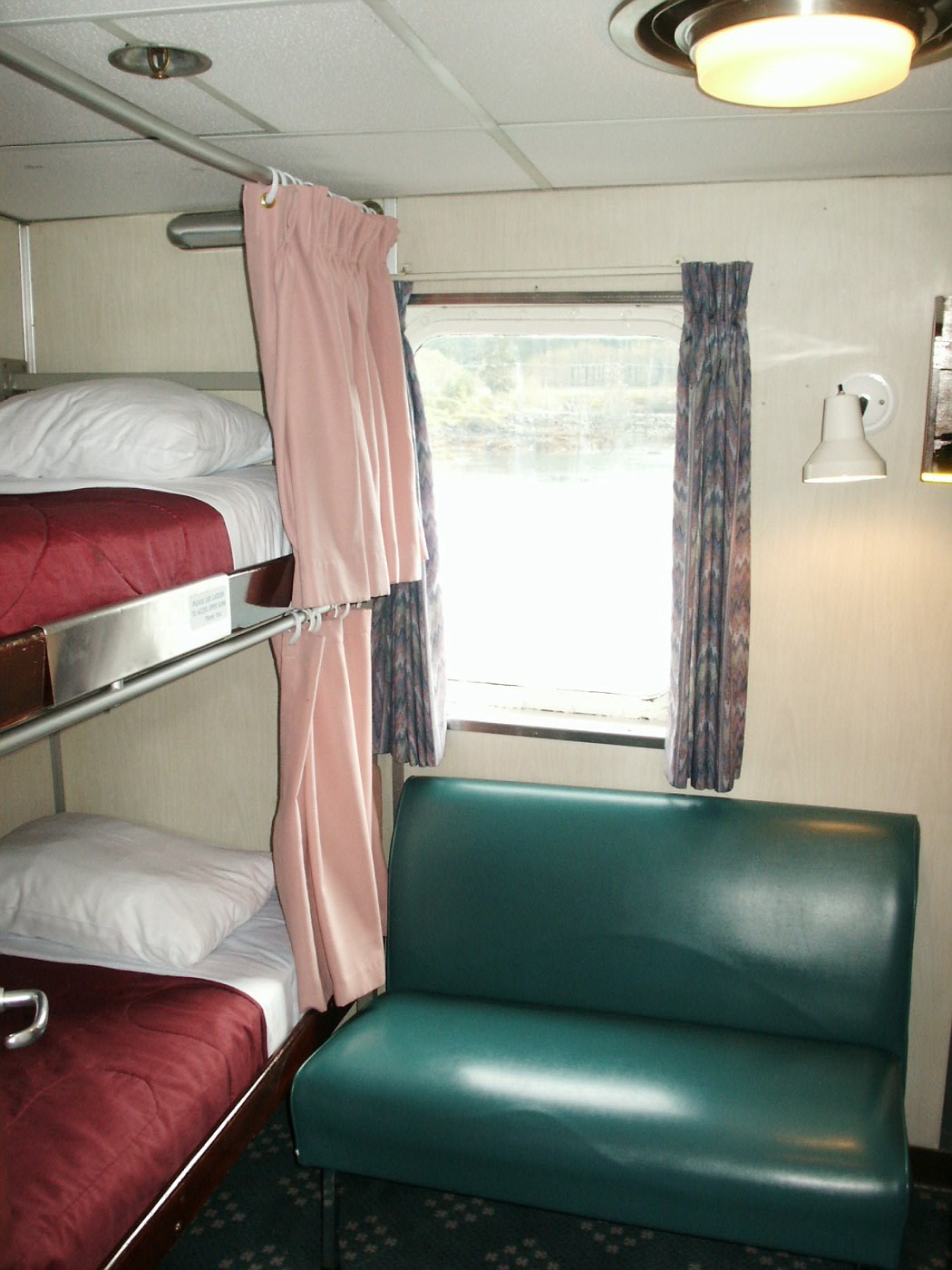 Spacious Accommodations Aboard The Queen
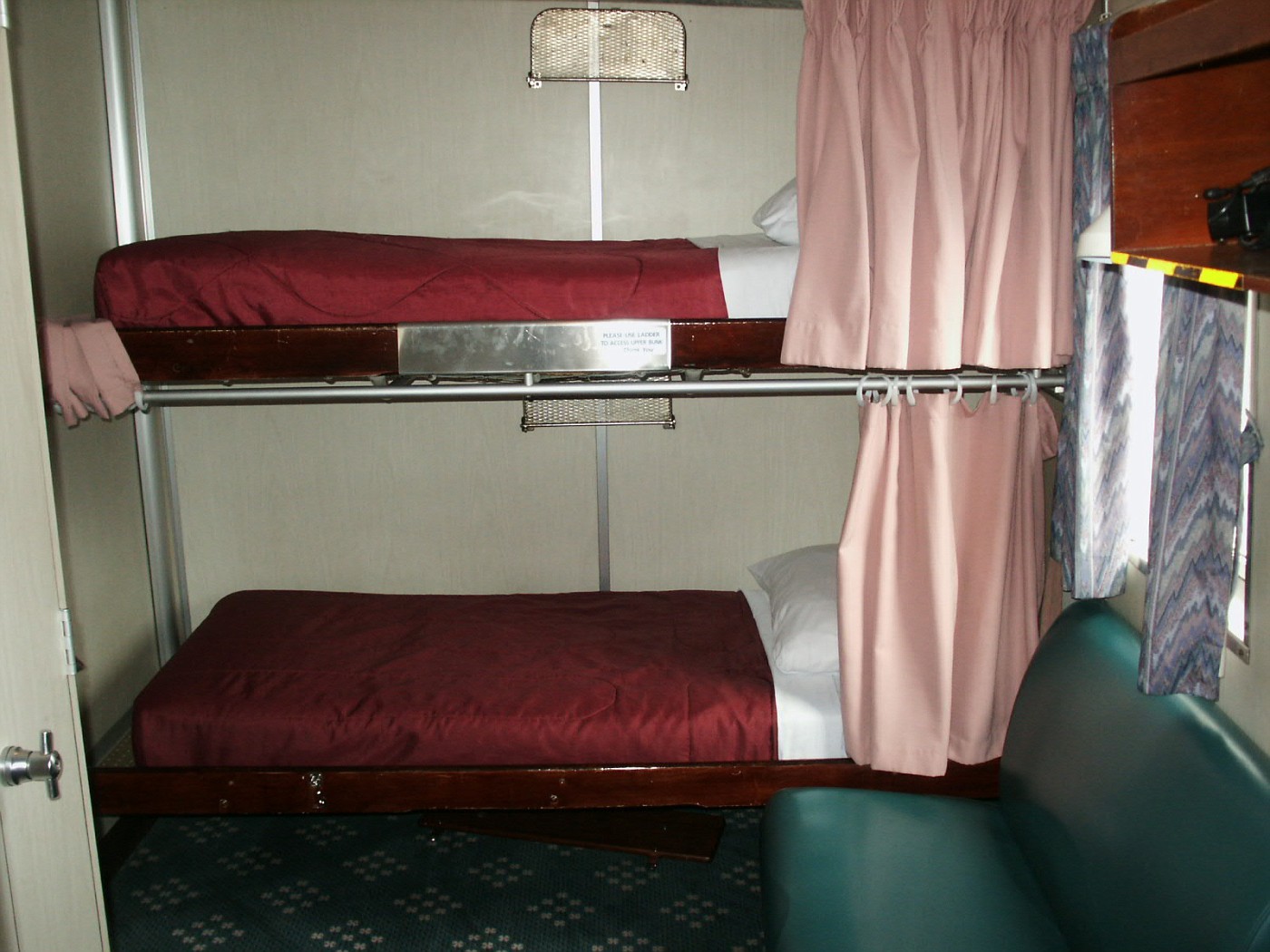 These Bunk Beds Were Really Comfortable
A small couch sat alongside a table built into the wall. An electrical outlet was conveniently located alongside the table. Good! I’d be able to recharge my laptop. I even had a window between my bed and the table. This was no porthole, either. It was a big curtained window that let in lots of natural light. The bathroom had a full size flush toilet and a sink with hot and cold running water. Hand towels and washcloths were hung on a nearby rack.
Needless to say, I was positively thrilled with my accommodations. This was going to be a nice ride, regardless of the weather!
Once I’d gotten everything in my cabin squared away, I headed out to take a look around my new home for the next twenty-two hours. The Queen of Prince Rupert was built in Victoria, BC and entered service in 1966. At that time, she was considered the flagship of the BC Ferries fleet, and with good cause. Measuring 310 feet long and weighing in at 5,860 tonnes, she was the first ocean going ship in the fleet and the only one to offer staterooms.
My cabin was on the Lounge Deck, the largest on the ship. The cabins were located at the rear of the ship. My cabin was one of thirty-two cabins on the deck, twelve of them outside cabins with windows. All of the inside cabins had been allocated to the young Sea Cadets, most of whom were now out of their uniforms and conducting a localized ship inspection of their own – namely each other’s cabins. Every cabin, regardless of location, included its own ensuite toilet facilities. Showers were located across from the Purser’s office. Between the cabins and the Purser’s area was the Theater Lounge. Movies were shown here as well as the occasional documentary. At the forward end of the Lounge Deck was the main passenger seating area. This was the largest room on the ship and had reclining seats for about 125. People were spread out all over the place – both in the seats and on the floors. Makeshift camps comprised of floor blankets, sleeping bags and coolers had sprung up in most every open space. There was all manner of humanity spread about, from families with young children to retirees to backpackers. I was happy to have my cabin because this room was a noisy place.
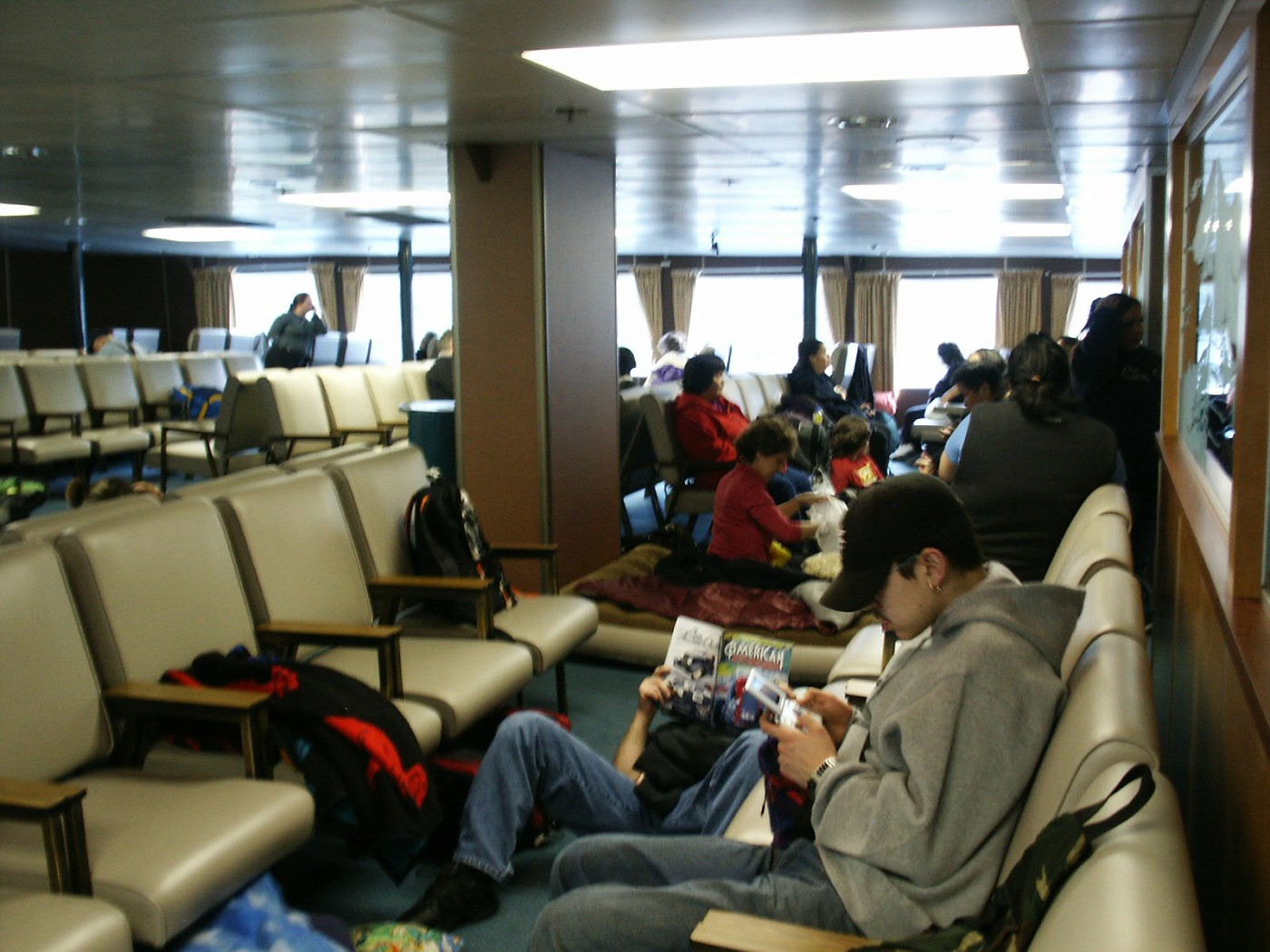 The Scene In Steerage
Up a wide stairway from the Purser’s Office was the Promenade Deck. It featured the restaurant and gift shop. The restaurant was set up cafeteria style and looked very inviting. Not in a pretentious kind of way but rather a comfortable, homey kind of way, much like a rustic roadside café. I found myself looking forward to dinner and I wasn’t even hungry.
I took a quick look at the deck above, only to find it contained more passengers cabins. Apparently nothing else. Above that was the ship’s bridge and officer’s quarters. Everything I needed was on my deck and the one above. Satisfied, I returned to my cabin and put in some work on this report.
The deep bass bellow of the ship’s horn announced that departure was imminent. Soon, I felt as much as heard the big engines power up as the boat shuddered and slowly backed away from the loading dock. Port Hardy sits in a pretty little cove surrounded by spruce covered mountains, so all my attention was directed towards the scenery for the next half-hour.
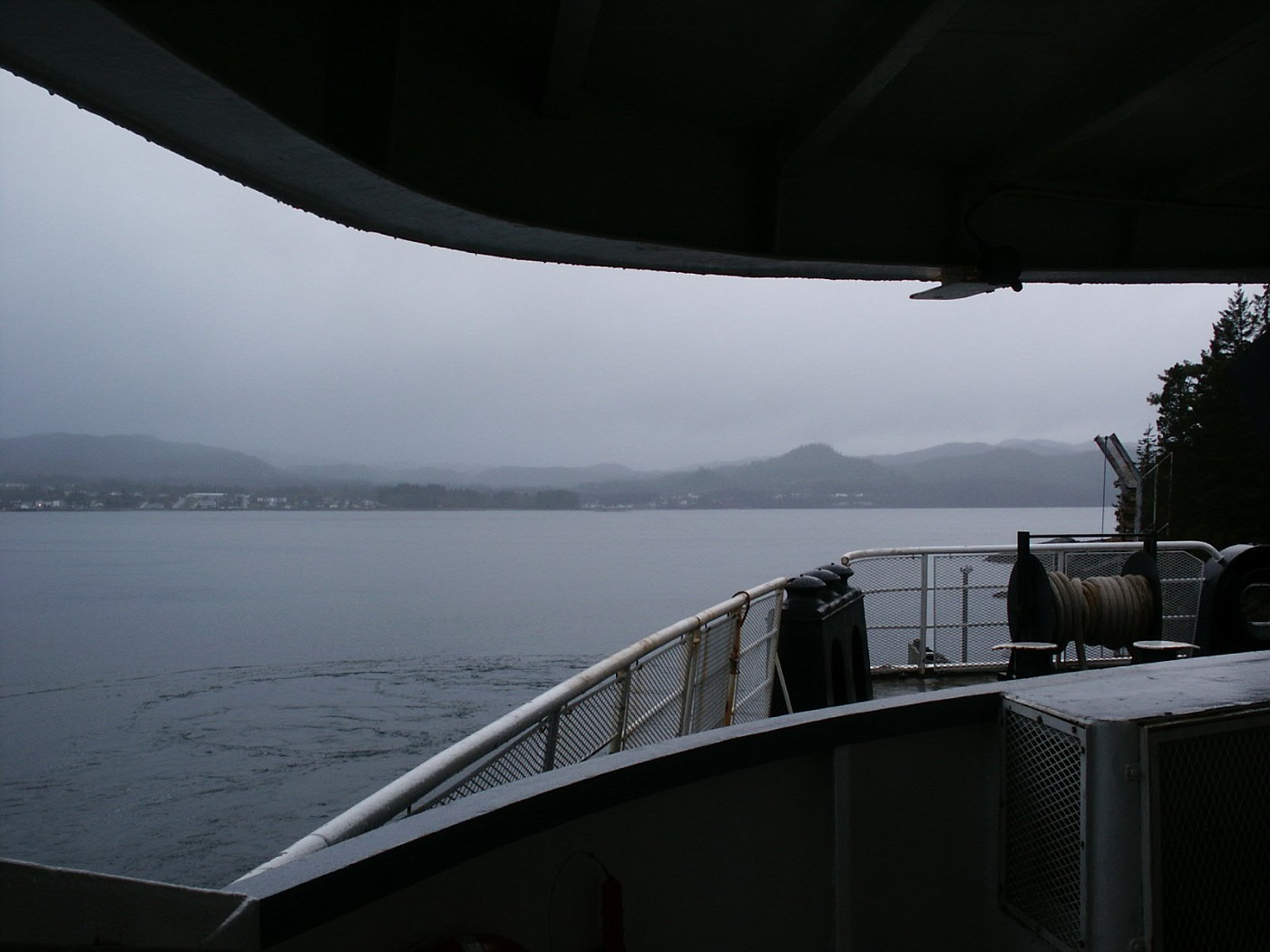 Leaving Port Hardy
The coastline of British Columbia is dotted with hundreds of islands and pierced by numerous fiords. I’ve flown over it hundreds of times and often wished I could be down there on the ocean blue sailing amongst those green spruce covered islands. Seventeen years ago I rode the summer day trip between Prince Rupert and Port Hardy. The sailing took fifteen hours and it rained the entire way. The current winter schedule takes twenty-two hours and makes stops in some communities not visited on the expedited summer schedule. Hopefully the weather will be a bit nicer enroute.
Alas, low clouds and rain were the order of the day. Still, given the heavy winds and rain I experienced earlier this morning, things could have been a lot worse. I found out later that we were on the northern edge of a substantial weather system that had dumped over three feet of snow in parts of the Cascade Mountains down in Washington State. The storm was a most welcome development because the winter of 2005 had thus far been one of the driest ever in the Cascades. Most ski areas were closed – some had never even opened. I flew through Seattle numerous times during February and was amazed at how pleasant and sunny it always was.
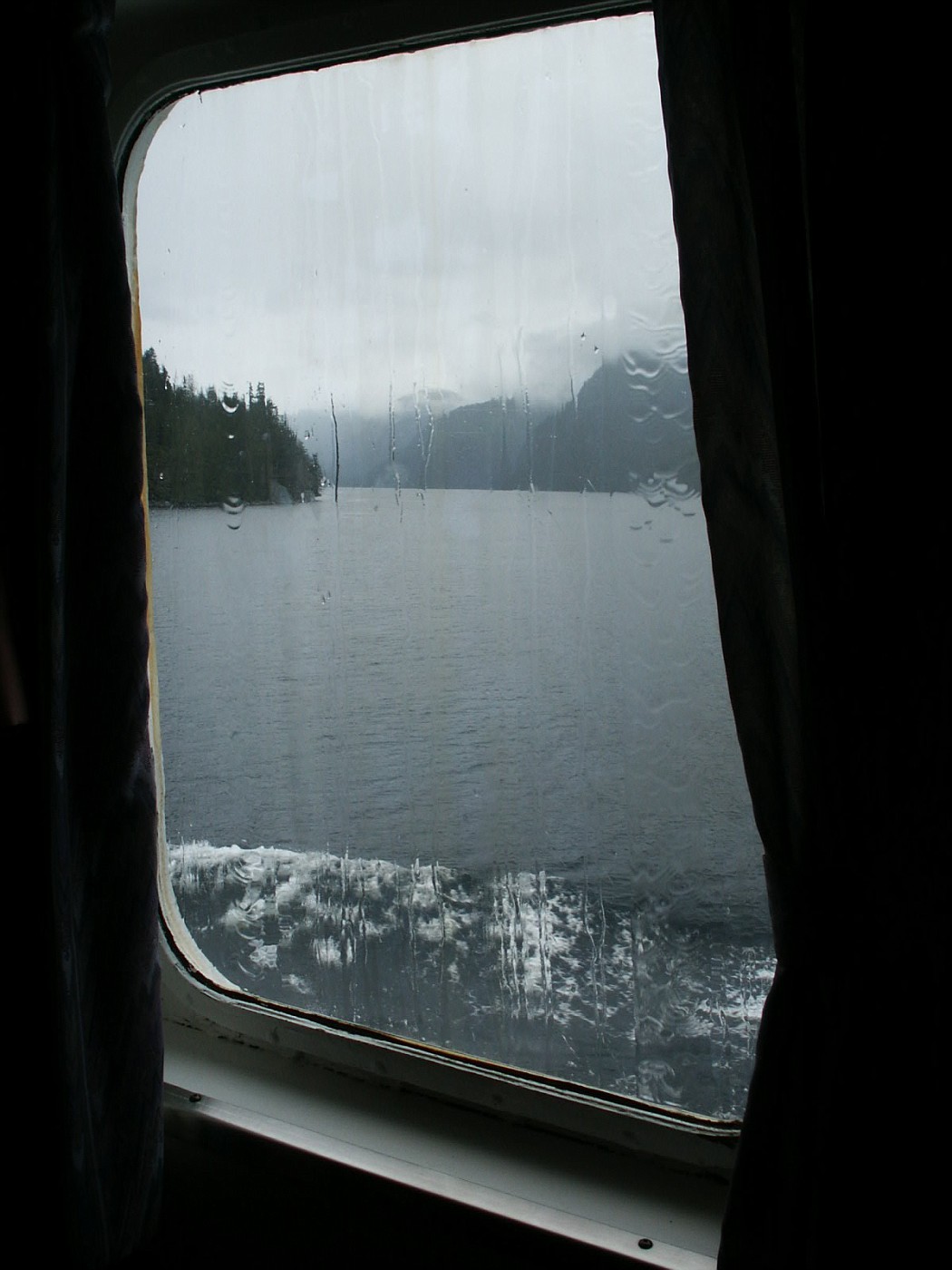 Beautiful BC Coastline ~ Lousy Weather
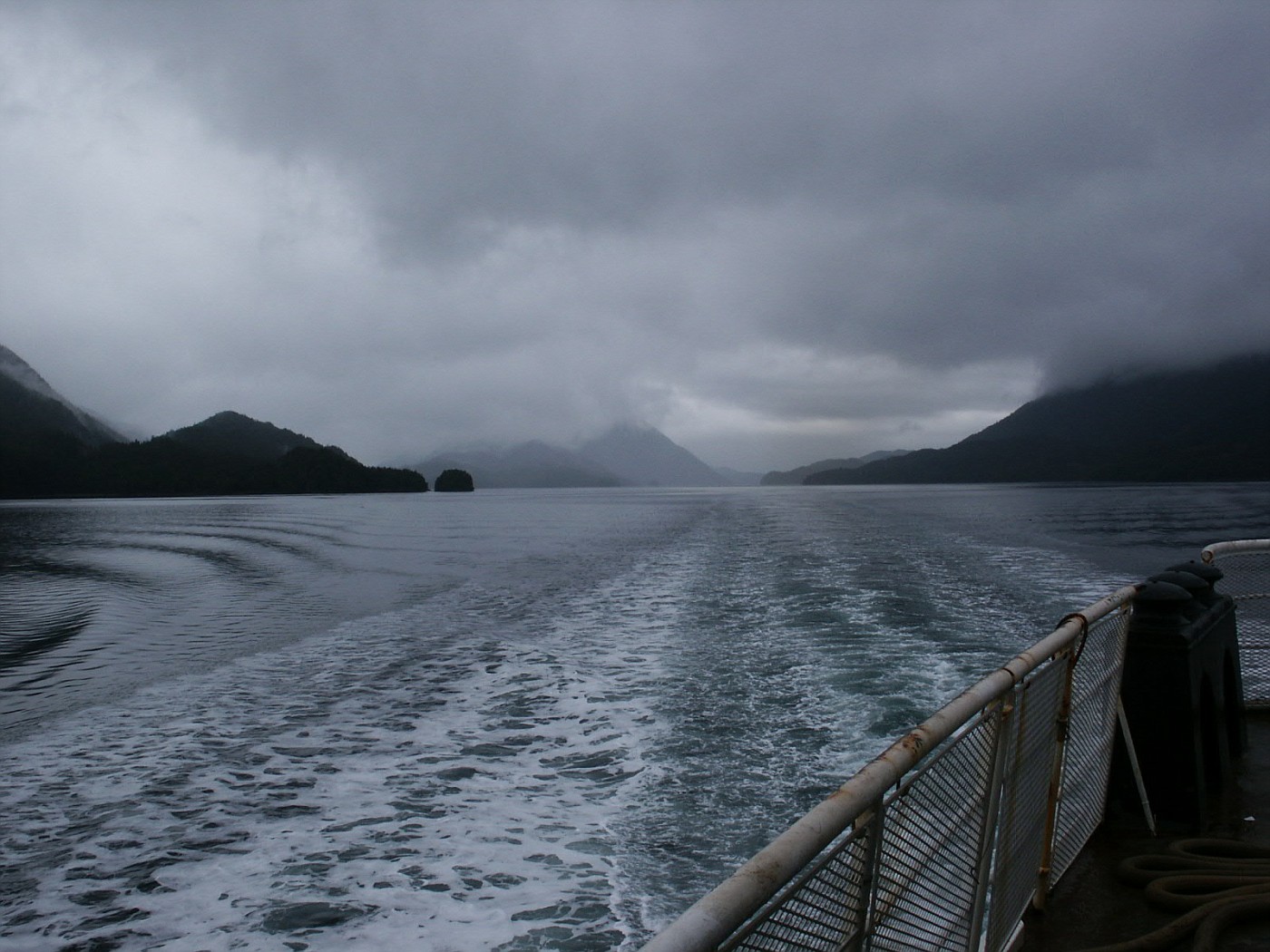 Beautiful BC Coastline ~ Lousy Weather
At 7:45pm, the last call for dinner was announced on the ship’s PA system. Thankfully, these announcements didn’t blast into the cabins but I could easily hear them from the speaker out in the hallway. Unfortunately, I could also hear screams and laughter from the rambunctious sea cadets. Occasionally a stern adult voice could be heard admonishing them to keep it down, after which they’d be good for about twenty minutes. While I would have preferred a quieter ride, I remember how excited we were as kids to go anywhere and I doubt we were any quieter. As long as it was quiet by about 10:00pm, I could live with it.
Up in the dining room, the specials were listed as breaded pork chops, barbecued spare ribs and roast beef. These were served with the usual accompaniments like a green salad, rice, mixed vegetables and/or potatoes. There was even a horseradish sauce for the roast beef. Also available were everyday standbys from the grill like a cheeseburger, grilled chicken sandwich, fried chicken tenders or fish and chips. Prices in Canadian currency ranged from $5.99 for the burger to $9.99 for the roast beef or pork chops. A self-serve cooler was stocked with a variety of desserts as well as pre-made sandwiches and beer. I had the breaded pork chops and was not disappointed.
I considered buying a beer but at $5.75 per bottle, I thought the price was a bit steep. Later, I asked the cashier about the lack of a bar on board and was told that there used to be one years ago but drunks had caused more trouble than not and so it was removed. Beer and wine were still available, but only during mealtimes. That meant alcohol sales ended at 8:00pm.
I like a couple of cold ones and the camaraderie of a good pub as much as anyone, but I’ve also been on boats and trains where alcohol has been a problem before and it’s generally not a pretty scene. While I think it’s a shame we couldn’t have a nice pub on board, under the circumstances I’m totally supportive of the decision to remove the pub. Few things irritate me as much as losers who can’t drink peaceably.
Tonight’s movie was announced as Ocean’s Eleven. I’ve seen this film a couple of times now so I decided to head back down to my cabin and enjoy the sanctuary it provided. Honestly, I was so impressed with that cabin that I quite enjoyed the comfort and solitude that it offered. I was very fortunate that I cleared the waitlist, particularly in light of how nice my cabin turned out to be. And, at only $55.00 CAD more per trip than a seat, my cabin was one of the best travel bargains going.
As I looked out my window at the rainy evening outside, I thought there’s something quite nice about having a warm room and a comfortable bed aboard a big boat on a night such as this. Because our route up to Prince Rupert took us primarily through the Inside Passage, the waters were calm and the ride smooth. Even the sea cadets were quiet after 9:00pm, having been ordered to bed by their commanding officers. By 11:00pm, I was also sound asleep.
During the night I slept through the stop in McLoughlin Bay. When I awoke at about 7:00am, we were just getting ready to depart Ocean Falls on our way to Klemta, our final stop before Prince Rupert. After taking advantage of the shower facilities – good and hot with decent water pressure – I headed upstairs for a ham and cheese omelette with coffee. As with the passenger lounge below it, the dining room was surrounded by windows on three sides. I took a table at the front of the room and enjoyed the view. The narrow, misty channels and spruce covered shoreline actually looked rather nice against a backdrop of twenty shades of gray. I was reminded of my trip through New Zealand’s Doubtful Sound many years ago. Even so, I would hope to someday see both areas under sunshine and blue skies. Given the normal weather patterns in both locales however, some might say I have a better chance of winning the lottery.
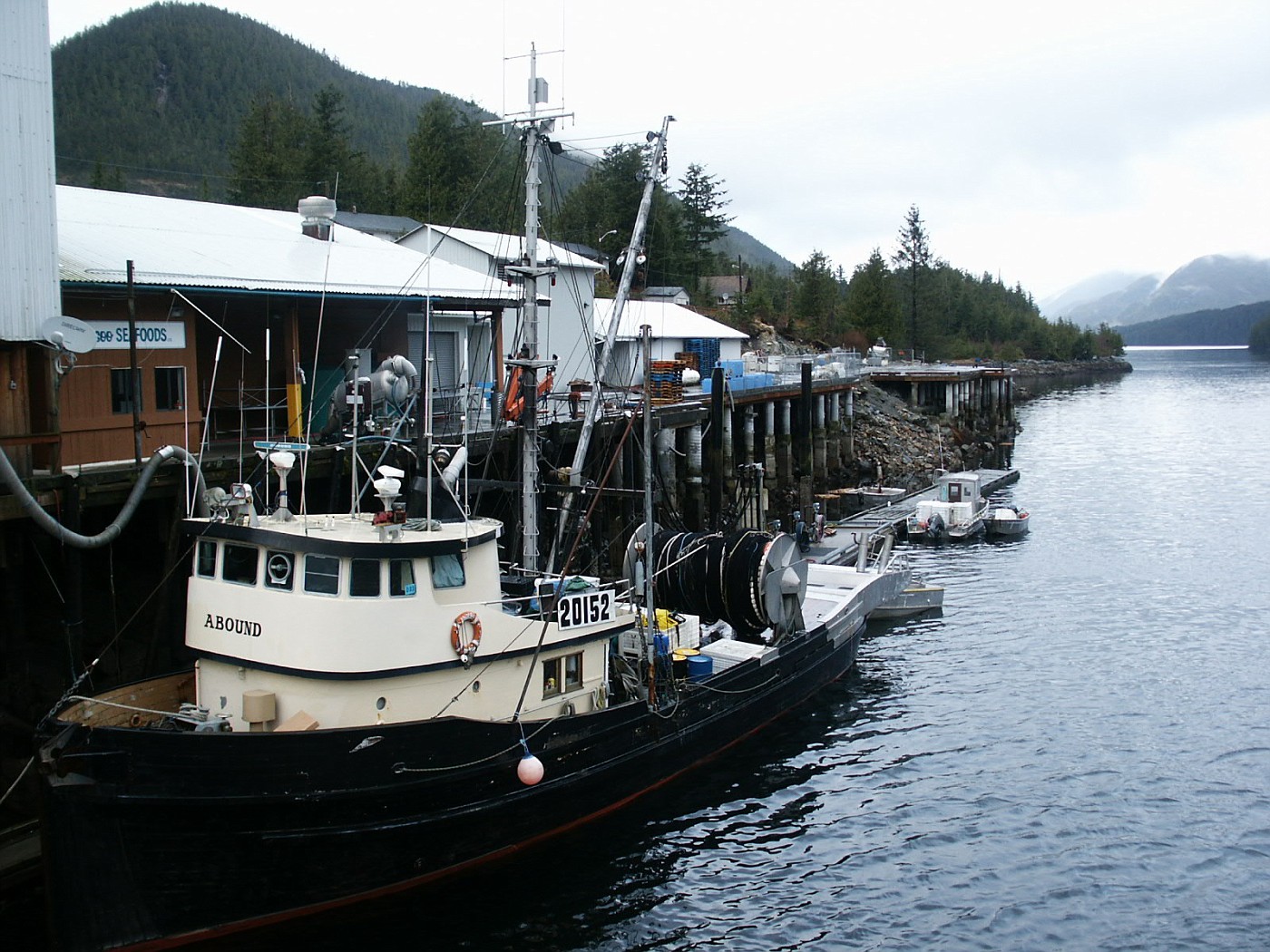 Docked at Ocean Falls
 The Town Hall at Ocean Falls
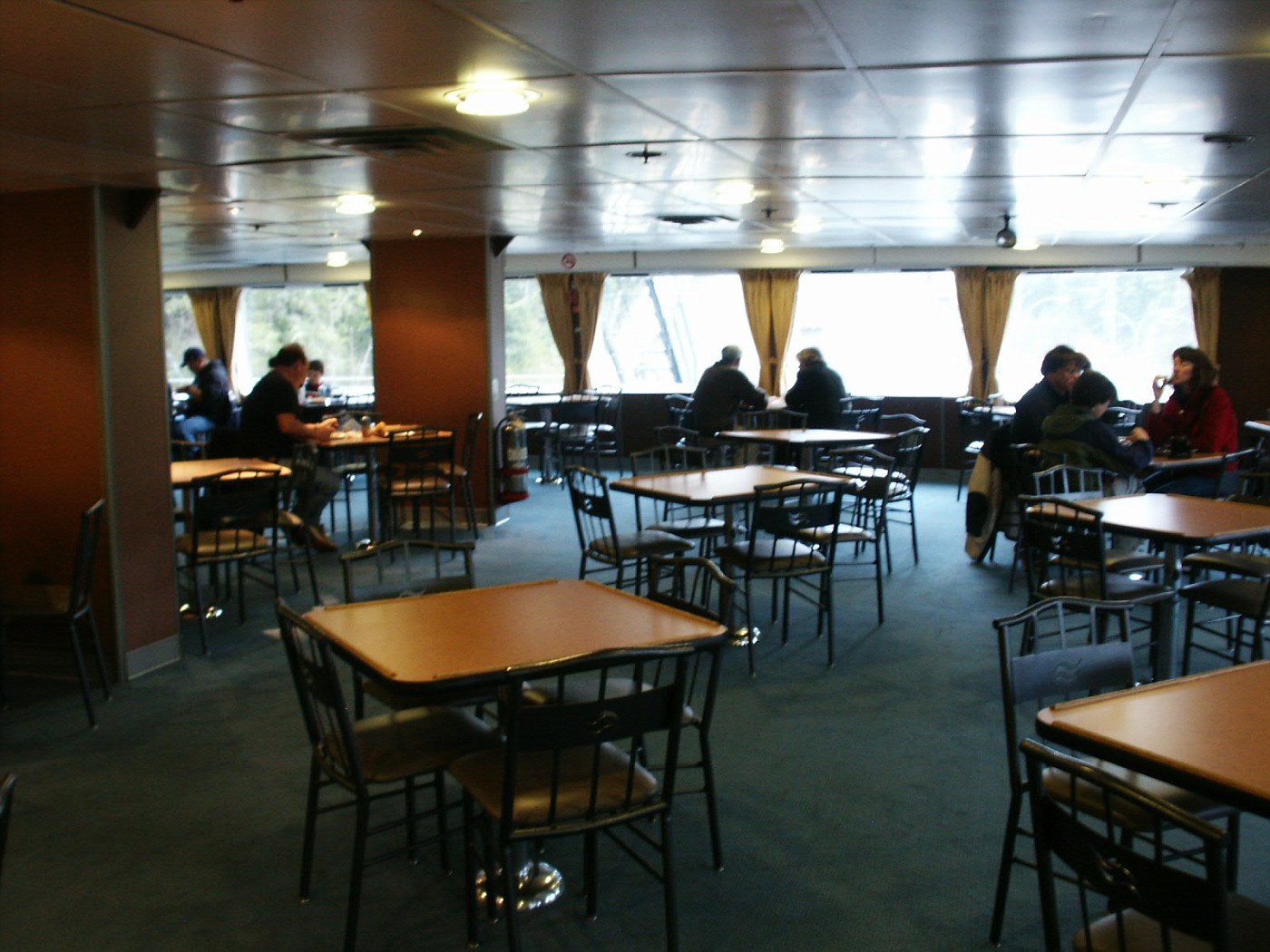 The Restaurant Aboard The Queen
The view from the tables by the windows is fantastic!
The Restaurant Aboard The Queen
The view from the tables by the windows is fantastic!
Our arrival into Prince Rupert was about an hour and a half late, not that I was complaining however. This was one of the most enjoyable boat rides I’ve ever had and if any of you visiting the Pacific Northwest or British Columbia should have the time to visit coastal B.C., I highly recommend making a trip up the Inside Passage as part of your adventure. It’s worth noting that the ferry from Port Hardy generally has good connections with the Alaska Marine Highway. You may have to overnight in Prince Rupert for a night but if you’re in too much of a hurry to do that, you’ll probably be flying anyway.
PRINCE RUPERT, BC
Prince Rupert is known as “
The City of Rainbows”. It is a name well earned, for Prince Rupert is also the rainiest city in Canada. It receives an average of about 100 inches of rain per year. The city has a population of 17,000 and is supported primarily by forestry, fishing and tourism. I paid a visit to the Museum of Northern BC and discovered that this area has seen substantial human activity for over ten thousand years.
Just 80 miles north of Prince Rupert is Ketchikan, Alaska. It is said to be the rainiest city in North America, receiving over 150” of rainfall annually. There’s a funny postcard out of Ketchikan that shows people cowering in the street as a stray ray of sun breaks through the clouds and illuminates them. The caption reads “Sunshine terrorizes Southeast Alaskans”. The only relief is to quickly run inside and jump into a cold shower. I wanted to cruise up the on the Alaska Marine Highway but the schedule wouldn’t accommodate my limited time in Prince Rupert.
My two full days in Prince Rupert were spent at my usual leisurely pace. I’ve never been one to arrive somewhere and immediately rush out and try to see this or do that. I’ll get around to it when I get around to it. And if I don’t get around to it, then I don’t. It’s a poor approach to work but a laid back approach to travel that suits me well. As such, I woke up each morning at around 8:00am, showered and wandered into town in search of a good coffee shop. I found a couple of very nice places and in one got caught up in a conversation on travel around the South Pacific and Australia. Australia? Why it so happens I’ll be heading there in just a few days. And on it went from there.
I spent one entire afternoon in the Museum of Northern BC and another walking a coastal trail out towards the ferry terminal. Given the amount of rainfall that the area gets, its forests are quite spectacular indeed and I was quite fortunate to get one afternoon that was merely blustery. Rainy weather not withstanding, I wouldn’t mind returning to Prince Rupert for another couple of days. It’s a nice place.
March 30, 2005
Prince Rupert to Prince George
ViaRail Comfort Class
“The Skeena”
800a–830p
I’ve driven to Prince Rupert many times in order to catch the Alaska Marine Highway ferry up to Skagway, Alaska. During the final forty miles of the drive, the highway enters the spectacular Skeena River canyon where it parallels not only the river but also the Canadian National Railroad tracks. On one trip, I happened to share the canyon with ViaRail’s westbound “
Skeena” as we both sped towards an early evening arrival in Prince Rupert. While I had to pay attention to the narrow roadway alongside the tracks, passengers on board the train were relaxing and enjoying the view. I love riding trains and knew then that I’d have to someday ride the train through this beautiful canyon. Now, thirteen years later, my dream has become reality.
The Skeena is not a glamour train. Starting from Jasper, Alberta, the Skeena travels 813 miles across the middle of British Columbia to Prince Rupert. Unlike it’s celebrated cousin, ViaRail’s world famous
Canadian,
The Skeena doesn’t have a long and storied history. As well, its
route through western British Columbia, while very pretty, is not nearly as dramatic as that enjoyed by passengers on
The Canadian during its journey through the heart of the Canadian Rockies.
All that aside,
The Skeena is one of the few remaining trains anywhere on the planet to be equipped with classic 1950s era dome cars. Collectors own most surviving examples and only ViaRail still offers scheduled service aboard trains equipped with them. Amongst rail fans and anyone who appreciates the glamour of post WWII rail travel in North America, domeliners like
The Skeena and
The Canadian will always be special trains.
ViaRail’s dome cars are old Canadian Pacific Railroad stock, built in 1955 especially for the CP’s brand new
Canadian. There are dome coaches and dome lounges in addition to the beautiful
dome observation lounges that bring up the rear of the train. These are called “Park Cars” because they are named after various National and Provincial Parks in Canada. They are normally reserved for the exclusive use of First Class passengers, meaning those passengers holding sleeping accommodations.
*** ***** ***
I thought I’d be able to walk to the ViaRail station in Prince Rupert, but it has relocated to the ferry terminal outside of town. Though inconvenient for me, the move allows ferry passengers arriving in the morning from Alaska or the Queen Charlotte Islands to more easily connect to the 8:00am train to points east. Interestingly, a new containership terminal to be completed next year will mean the relocation of both the ferry and railroad terminals to a location closer to the city.
The taxi dropped me off at the station in a driving rain. It was raining so hard that in the short time it took me to step out of the cab, remove my pack from the trunk and step into the station, I actually got pretty wet. Wet enough that I decided to change my shirt.
Inside the station were about a half a dozen people. Where is everybody? The ViaRail ticket agent exchanged my electronic ticket for a paper one and told me that the load was pretty light today. I’d say so. Ultimately, only fourteen of us boarded in Prince Rupert.
The train pulled into the station just ten minutes prior to departure. Headed up by a single F40PH engine, the remainder of the train consisted of just two cars - a flat top coach and the dome observation lounge “Kootenay Park”. That was it. I do believe this is the shortest train I’ve ever ridden upon.
During the off-season, the Skeena is operated as an all-economy class train. As such, the inclusion of the dome observation lounge was a real treat because these cars are normally reserved for First Class passengers.
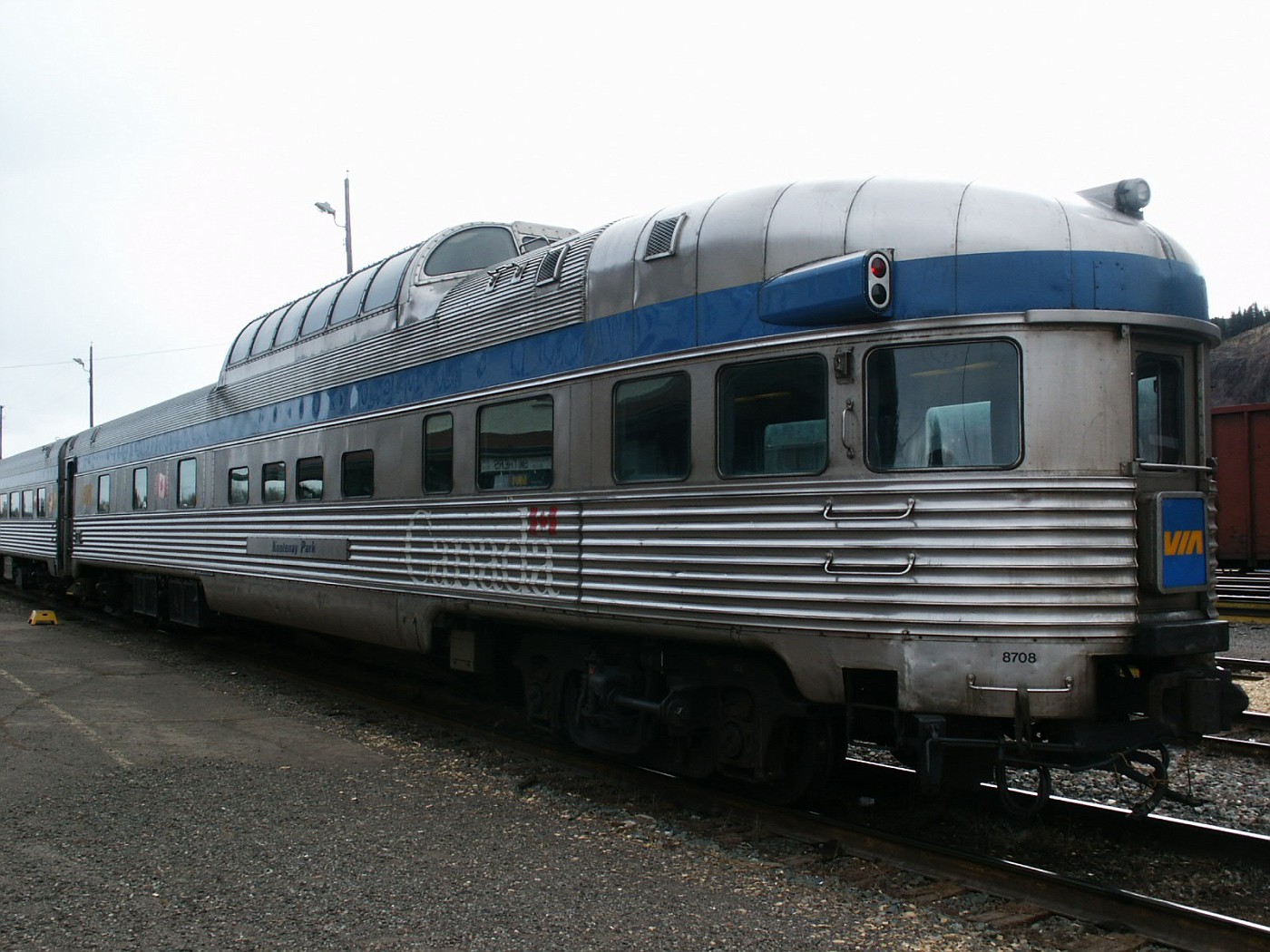 The Skeena Awaits at Prince Rupert Station
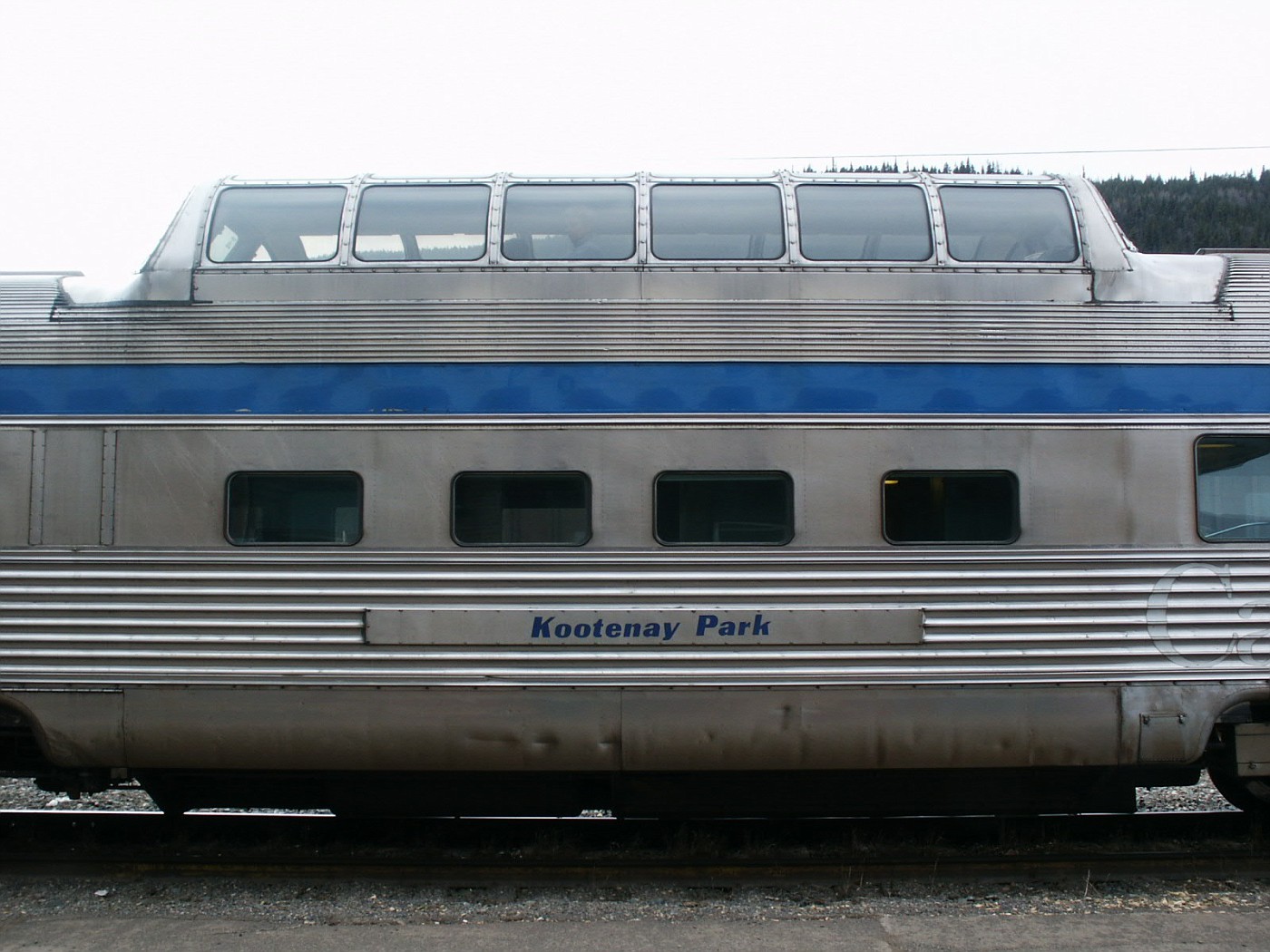 The Domecar "Kootenay Park"
 All Aboard at Prince Rupert
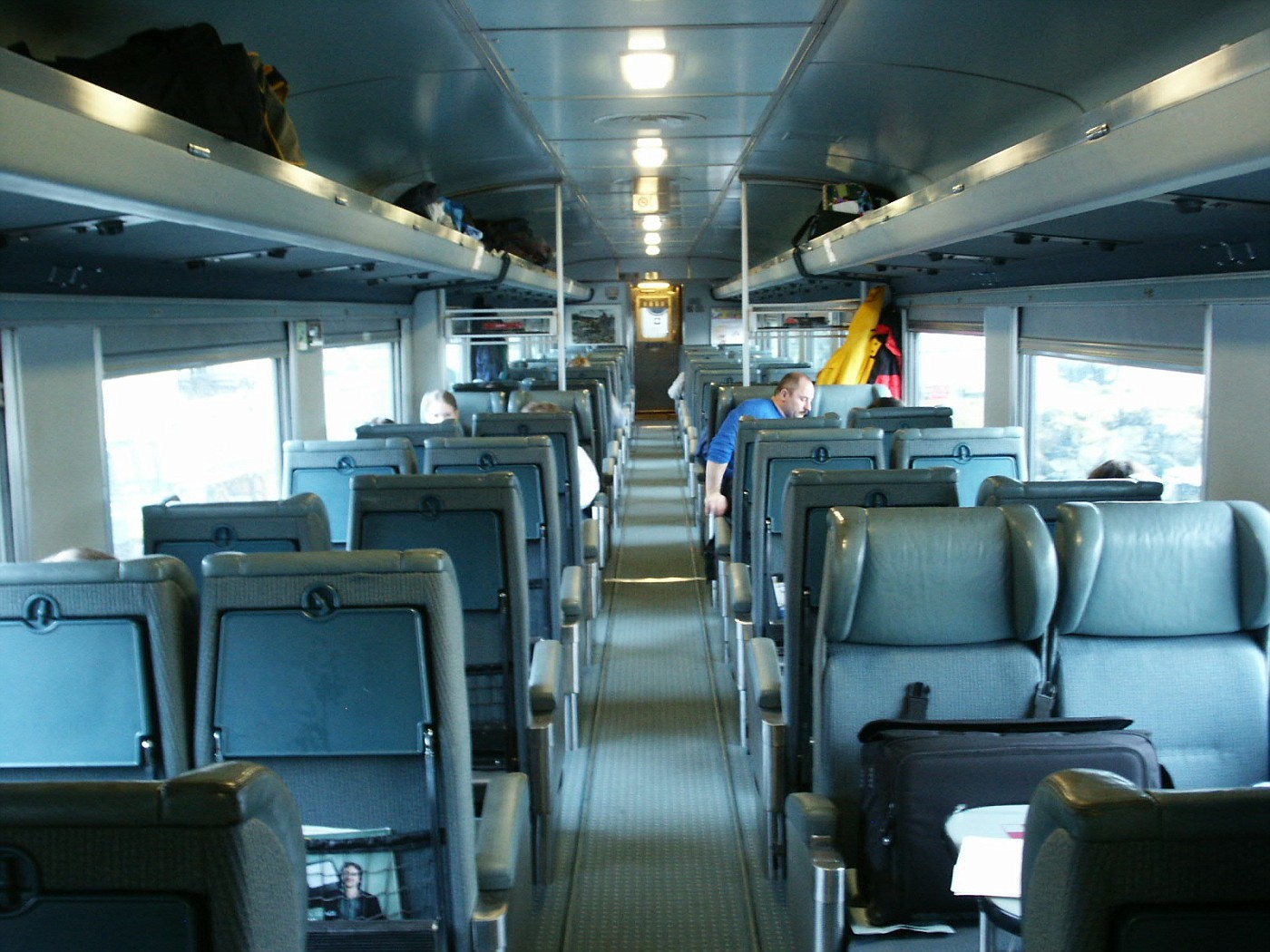 Economy Class Seating on The Skeena
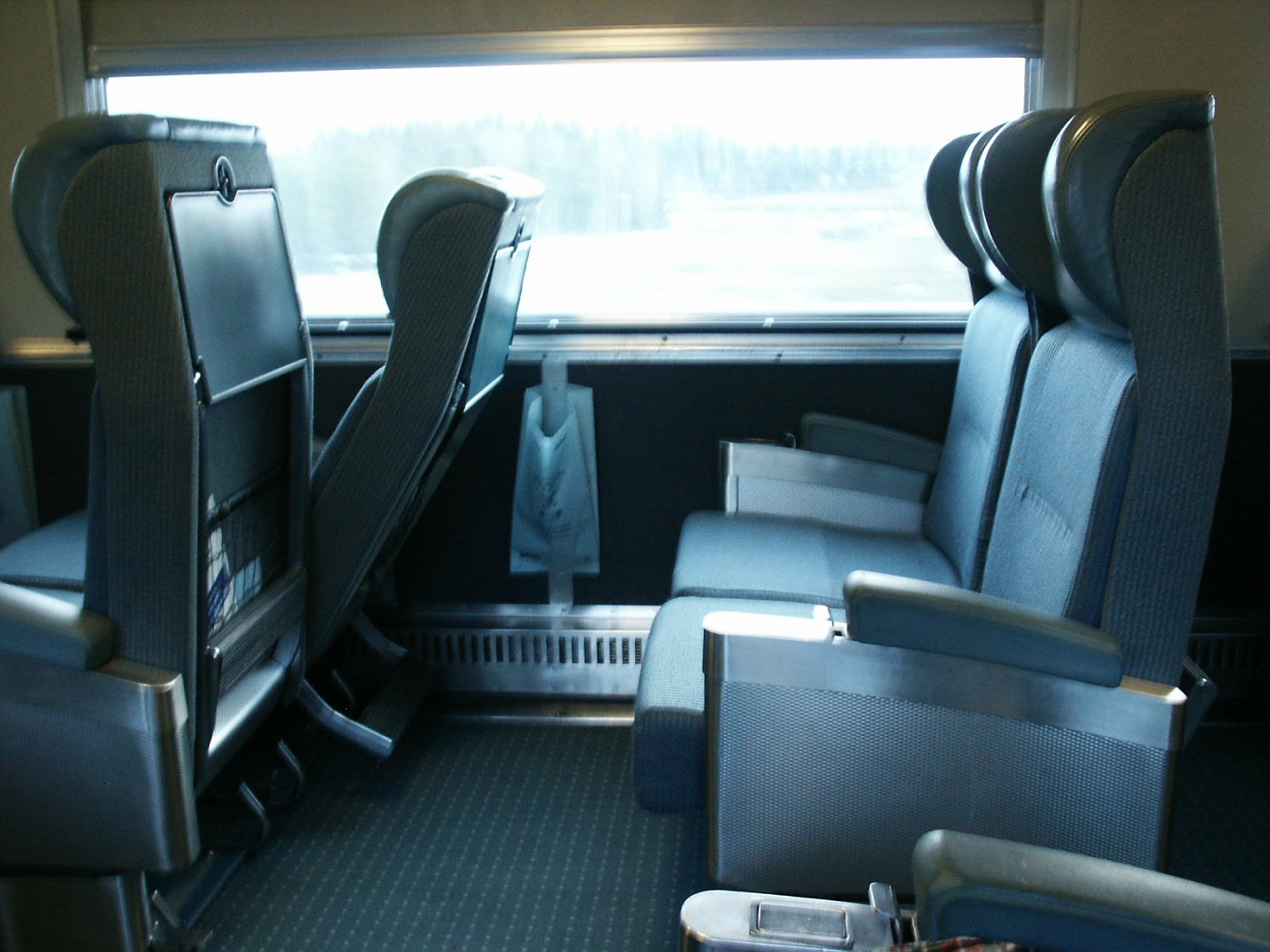 Economy Class Seating on The Skeena
Decent Legroom
Economy Class Seating on The Skeena
Decent Legroom
With only fourteen passengers to board, we were loaded and ready to go within five minutes of boarding. There was no baggage car since the coach had baggage storage shelves at each end. Tickets were collected by the conductor, some last minute paperwork was exchanged through the vestibule window and we were on our way, smoothly gliding through the Prince Rupert suburbs and out into the rainforest south of the city.
I didn’t spend but five minutes in my seat before gathering my gear and relocating to a seat upstairs in the dome car. The dome is accessed via a small stairway and offers
24 seats under the glass, six rows of 2-2. The views is forward and above as well as to the sides, perfect for viewing the mountains above and the river beside us as we rolled out of Prince Rupert and into the Skeena River Canyon. Now if only the rain would stop.
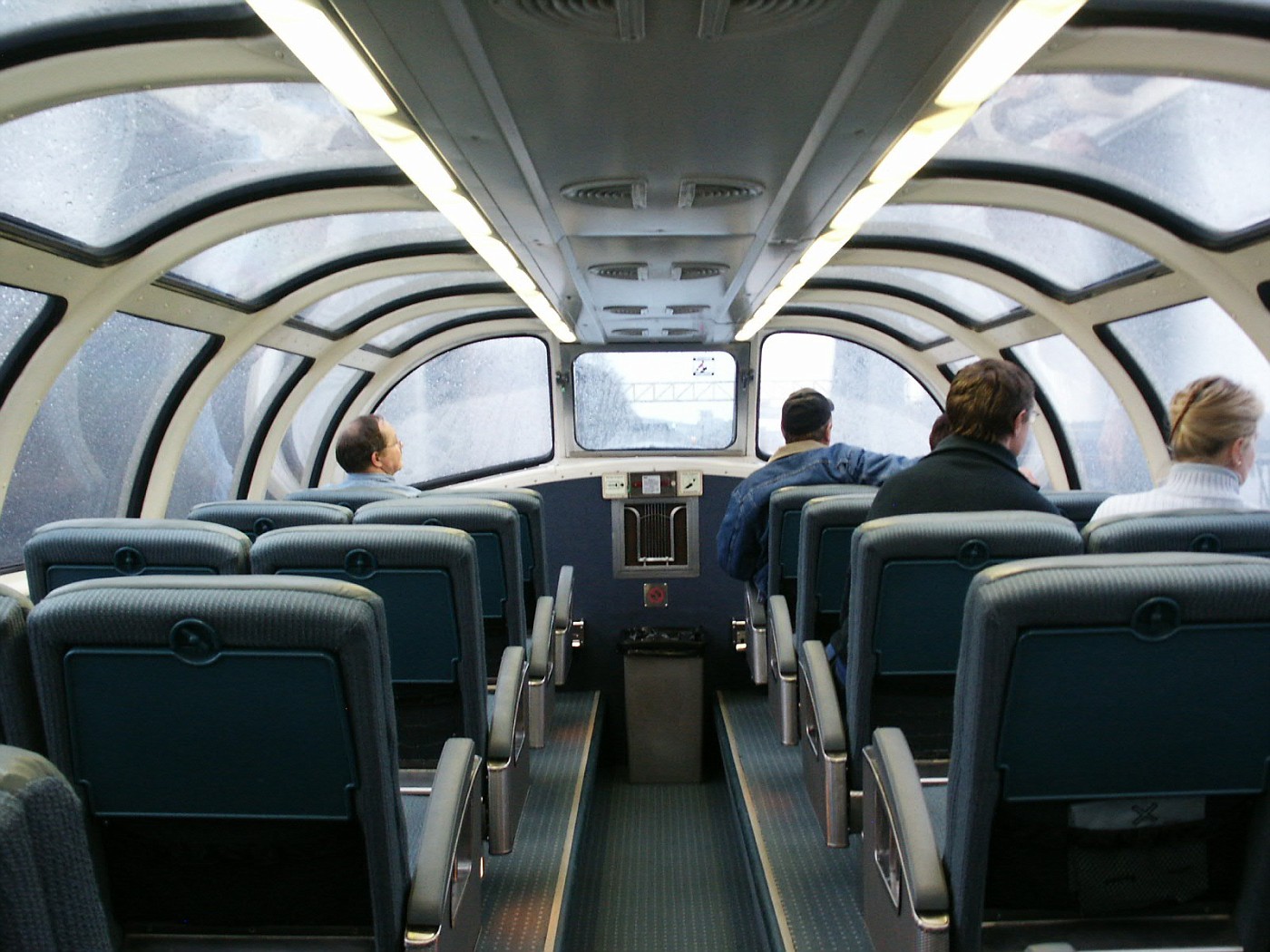 Upstairs Seating Under The Dome
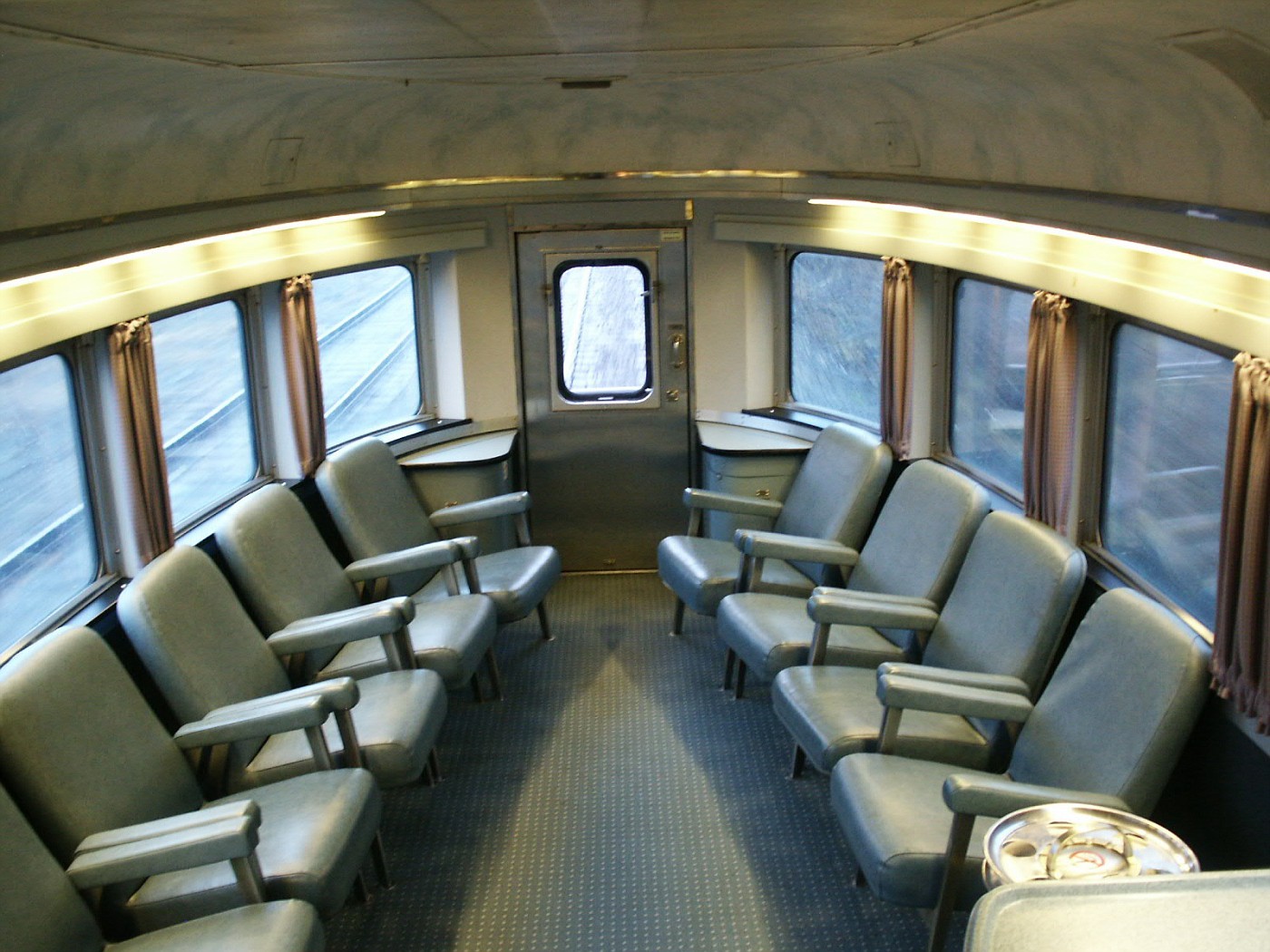 Looking Downstairs From The Dome Into The Bullet Lounge
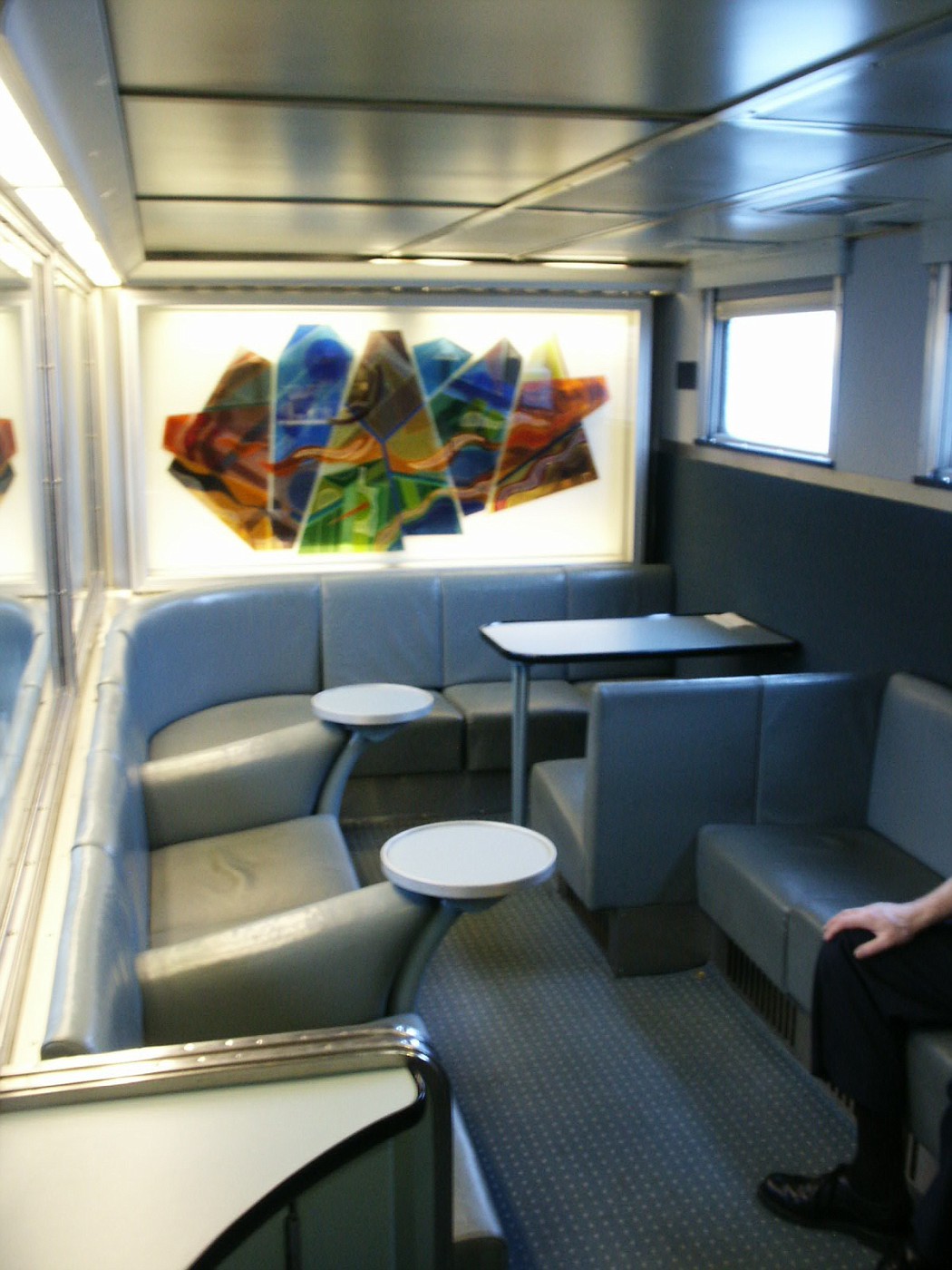 The Mural Lounge Located Under The Dome
In the language of the Gitksan people, Skeena translates into River of the Mists. The river has been a trading route and fish source for thousands of years. Over its last forty miles, the Skeena is as wide or wider than many of the channels that I’d recently sailed through in both Chile and British Columbia.
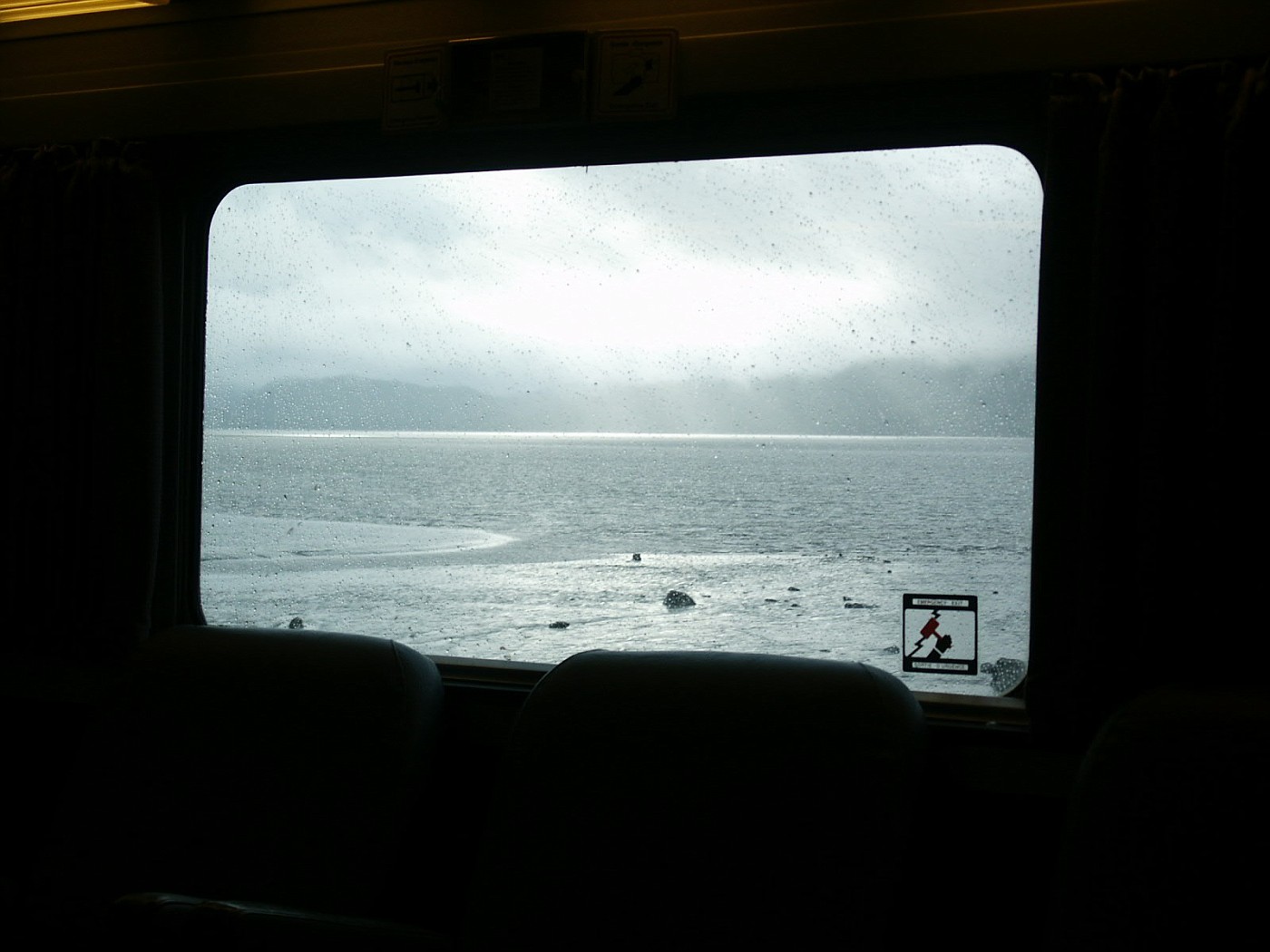 Rolling Along The Skeena
At one point, we stopped briefly as the train crew pointed out a two hundred year old native rock painting. The painting depicted an eagle, of which there are many along the Skeena River.
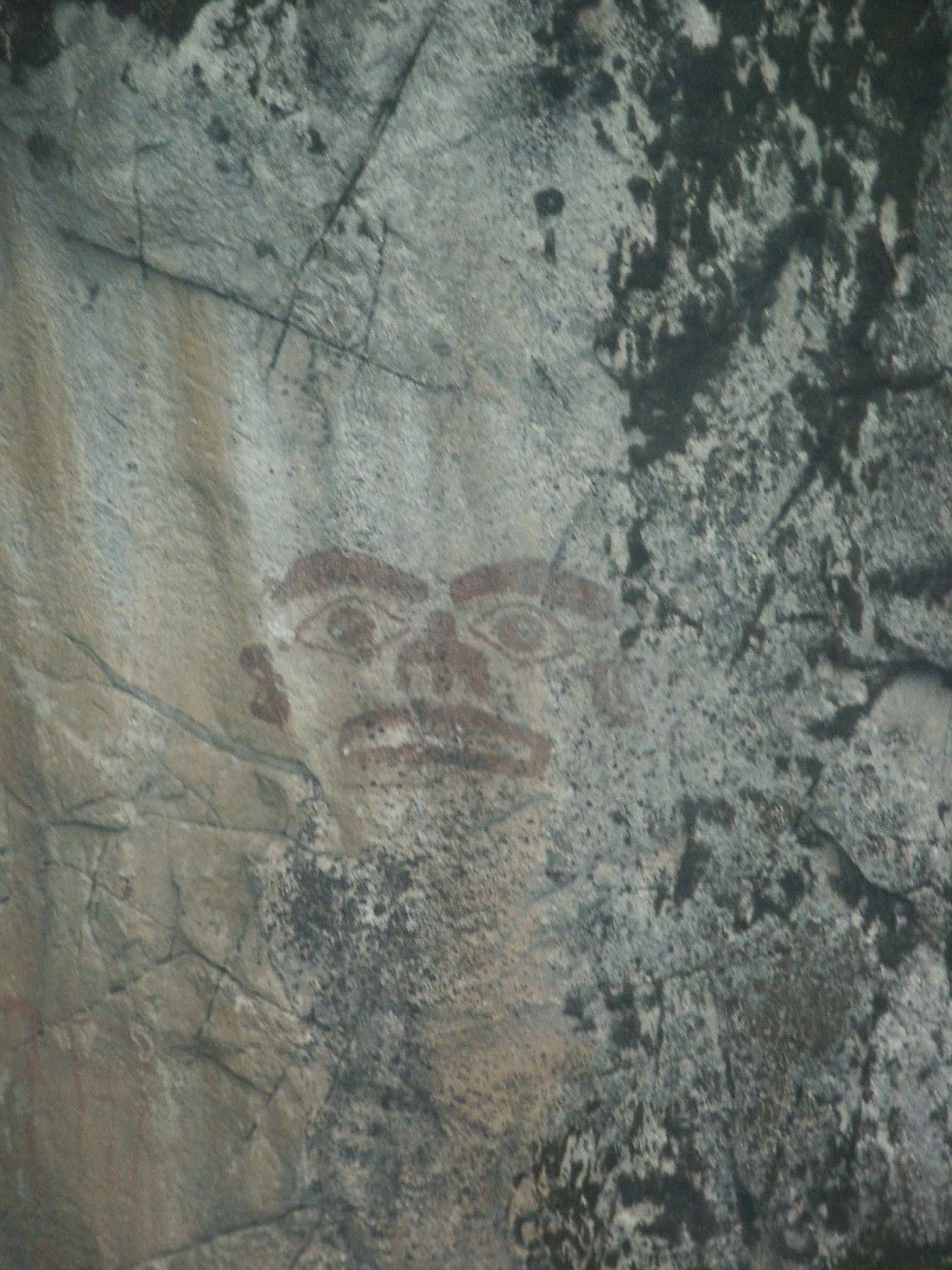 Rock Painting Alongside The Tracks
Our speed through the
Skeena River Canyon was about 50 mph. I thought the pace was perfect for enjoying the scenery enroute. By contrast, trains like the French TGV and Japanese Bullet Train rip along the tracks at speeds three to four times faster. I’ve never been all that impressed with ultra high-speed travel. This includes the Concorde. I’m into the experience of travel, of getting there. Super fast planes and trains are for people who are more interested in the destination. The less time they have to spend getting there, the better.
To be sure, we all face situations where time is of the essence and travel needs to be accomplished as quickly as possible. In general though, if the time and price are right I’d much rather drive or take the train than fly. The pace is slower and more relaxed, I get to see and enjoy the country I’m traveling through rather than over, and there’s often a diner or lounge car in which to enjoy a meal or mingle with fellow travelers.
Leaving the Skeena River canyon, the train passed through pretty valleys and small towns surrounded by high mountains. Approaching the town of Smithers, we passed by Hudson Bay Mountain. I’ve seen this mountain many times under sunny skies and its quite impressive. The view of the Kathlyn Glacier upon its upper reaches is said to be the best view of a Glacier from any train in North America. Unfortunately, low clouds obscured any chance of seeing the glacier, much less the top of the mountain. Later, big fluffy snowflakes started falling as we paralleled the Bulkley River. High mountains gave way to rolling hills as we entered B.C.'s Lake District. As we slowly rolled into Burns Lake, a popular fishing and vacation area, one of the train attendants took time to check a nearby eagle’s nest for sign of chicks. I commented that it seemed a bit early for chicks but she replied that she’d seen some last week out at Fraser Lake. No doubt the unusually warm winter has jump-started some of the natural processes.
Food on today’s train was nothing to write home about. The menu was strictly take away and was highlighted by pre-fab sandwiches and instant noodle soups. There were a couple of microwaveable entrée dishes but neither of them looked particularly appealing. During the summer months, the selection is considerably better.
About an hour out of Prince George, we passed through the town of Fort Fraser. It was announced that this was where the final spike was driven in to complete the Grand Trunk and Pacific transcontinental railway in April of 1914. That railway went on to become today’s Canadian National.
At a little after 8:00pm, we saw the first lights of Prince George, the largest city in Northern BC with a population of about 75,000. Approaching the city from the west, those first lights turned out to be about the only lights because there really wasn’t much of a western suburb. We passed by lumber mills and old warehouses and when we finally did enter an area of bright lights and city streets we were just a few blocks from the train station.
Alighting from the train, I headed over to the National Hotel located just across the street from the station. I’d discovered this hotel via the Internet when searching for budget accommodations in Prince Rupert. While I couldn’t argue with the hotel’s convenient location, the place had a rough look about it that wasn’t captured in the glossy photos posted on the website. The lobby was open but there was nobody working the front desk. A sign directed potential guests to register with the bar next door. Hmm… My doubts about this place were confirmed when I watched three of the hotel guests lurch into the hotel. One of them asked me for some spare change.
I headed back across the street to the train station where I booked a clean, quiet room at the Downtown Motor Inn for just $45.00 CAD per night.
March 31, 2005
Prince George to Vancouver
Air Canada Jazz 2825 Economy Class
DHC-8-300 C-GKTA Seat 1B
1230p-200p Flight Time: 1:24
My flight down to Vancouver didn’t depart until 12:30pm so I enjoyed a late breakfast and a leisurely morning in Prince George before catching a shuttle out to the airport. The terminal was nearly empty when I arrived, so check-in was accomplished quickly.
Prince George is served by Air Canada Jazz, WestJet and a couple of smaller regional airlines. Until just recently, it was also served by Fokker 100s from low cost carrier JetsGo. Two or three months ago when I’d made my reservations for this segment, I gave serious consideration to booking my flight aboard JetsGo. Not only was it an airline that I’d never flown before but it also operated the Fokker 100, an aircraft fast disappearing from North American skies. Ultimately, I chose Air Canada’s Jazz because its Tango fare was substantially lower than anything offered by JetsGo or WestJet at the time. JetsGo recently filed for bankruptcy and ceased all flight operations, so today I was doubly thankful to be booked aboard Air Canada.
The aircraft for today’s flight was a DeHavilland Canada DHC-8-300, one of the most popular regional propjets ever built. It was painted in Jazz’s green livery, which features a simple green maple leaf on the tail and the stylized “Jazz” title across the forward part of the fuselage. Other colors for this livery include red, orange and yellow. Autumn colors. Green was an appropriate color for today, the 10th day of spring.
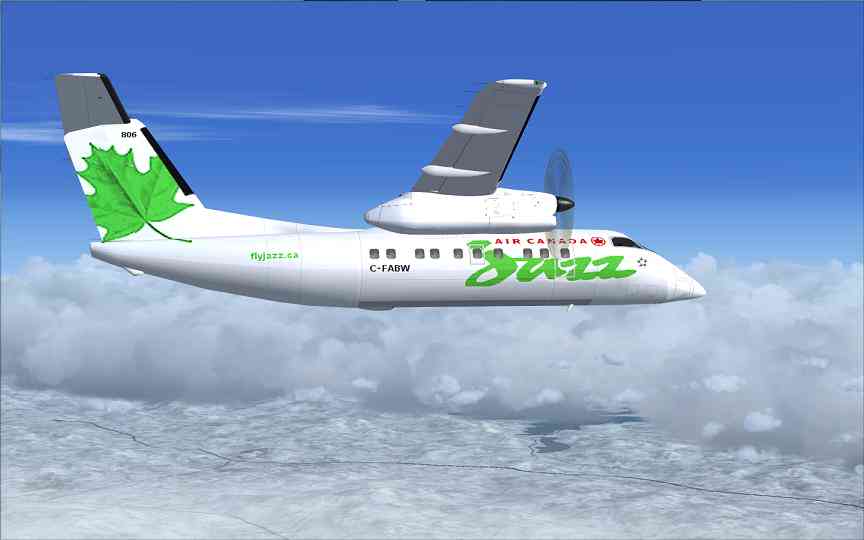 Air Canada Jazz Dash 8 enroute to YVR
This one hour flight down to Vancouver didn’t offer much in the way of service, but then not much was expected from an airline teetering on the brink of bankruptcy just one year ago. I had a Coke and a bag of surprisingly tasty sesame sticks. Unfortunately, the cloudy skies deprived us of viewing some of the pretty scenery between Prince George and Vancouver. After last week’s sunshine, it seems I’m travelling through this region just a few days too late.
Upon landing in Vancouver, I collected my pack and headed off to pick up a rental car for a weekend down in Seattle.