March 21, 2005
Punta Arenas to Puerto Montt
LAN Express 80 Economy Class * Lunch
A319-100 CC-CPE Seat 11J
1240p-250p Flight Time: 1:44
Punta Arenas is the southernmost city in Chile. It is home to about 130,000 people and is the Chilean gateway to Tierra del Fuego and Antarctica. I had a pretty fair walk around the downtown district last night and I liked what I saw – lots of old colonial buildings and, in the heart of the city, a beautiful tree lined plaza dominated by a statue of Magellan.
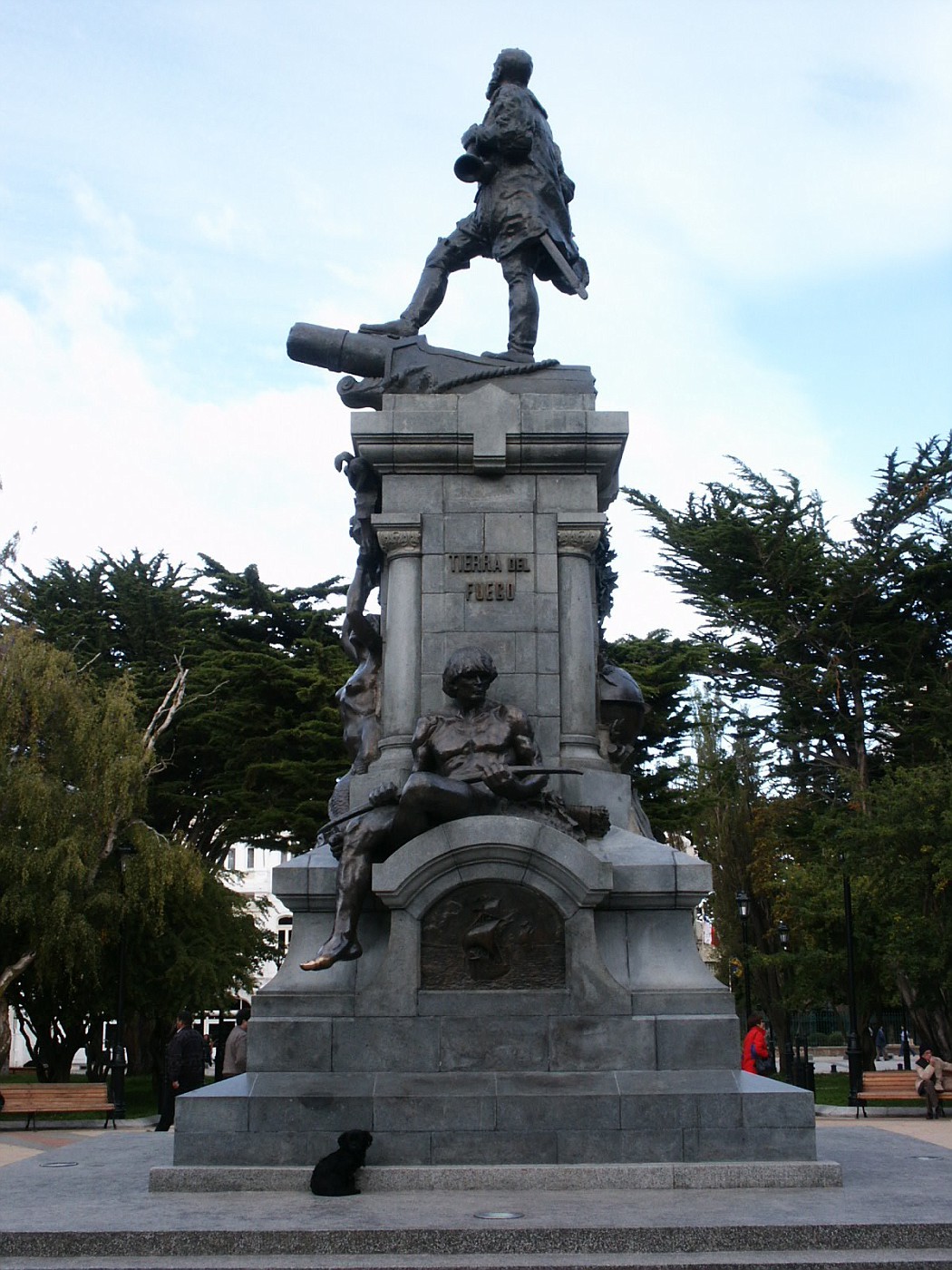 Statue of Magellan in Punta Arenas
Today was the 75th anniversary of the Chilean Air Force. The downtown district was filled with men in uniform and a number of streets were closed for a big parade. I was sorry that I couldn’t spend a couple more days here.
Punta Arenas’ Ibanez International Airport is located 22km from town. For $3.50, you can catch the local airport shuttle service or splurge and pay twice as much for the taxi. Was that a collective moan I heard coming out of the New York metropolitan area…?
The government of Chile appears to have invested a fair amount of money into its airports over the past ten years. This is especially evident in smaller cities such as Punta Arenas, Puerto Montt and Concepcion – all of which sported nice new terminals with jetways. The primary beneficiary of these jetways appears to be LAN Chile. The competition, namely startups Sky Airlines and Aerolineas del Sur, are generally relegated to ramp space in front of the older terminals. Only in Santiago do they have a chance at a jetway.
LAN Chile’s domestic operations are handled by LAN Express, which does not offer First or Business Class. When I arrived at the counter, there was a good sized crowd waiting to check in for the flight to Puerto Montt and on to Santiago. The five agents working the counter along with the one expediter working the line did an impressive job of keeping the line moving and getting people smoothly on their way. My backpack was checked through to Santiago and I was issued an exit row seat for the flight up to Puerto Montt. I asked for an exit row on the milk run between Puerto Montt and Santiago as well but was informed that exit row and bulkhead seats could only be allocated at the airport of origin. Hmm…
Another new and welcome addition to LAN’s product is a collection of airport lounges called Pacific Clubs. Though my Economy Class ticket would not by itself gain me entrance to any of these clubs, my
Priority Pass membership would.
In smaller airports like Punta Arenas, the Pacific Clubs are also small. Very small. How small are they? I’ve been in living rooms that were larger. Even so, the lounge was a welcome respite from the noisy crowd out in the gate area. In one corner was a small bar offering the usual non-alcoholic drinks. The bar also served as the reception area. I was checked in by an attractive young lady who also prepared me a café con leche and a plate of cookies. Interestingly, the only alcohol available was wine. Across from the bar was a pair of Internet ready computers. In addition to computer terminals, most Pacific Clubs now offer Wi-Fi wireless access as well. A TV and a couple of couches completed the furnishings.
 Beverages Service in The Pacific Club
The only downside to this lounge visit was a man sitting at one of the computer terminals who spent the entire time yakking loudly on his cell phone. He was a couple of spots ahead of me in the check-in line and talked all the way through that, too. Talk, talk, talk, talk, talk! If any airline should someday allow people to use their cell phones while inflight, they’ll see the last of my patronage. I’m not anti-cell phone, but for many travelers flights can great places to finally relax, sleep or catch up on some work after a long day of whatever. Having one or more people sitting within a row of your seat yakking away, loudly or not, would be nerve wracking in the extreme.
No boarding announcement was made in the lounge but I could hear the announcement outside in the gate area. At the gate awaited a gleaming Airbus A319, resplendent in the dark blue, silver and white livery of LAN Express. The aircraft was outfitted with 136 dark blue seats and as I walked back to my exit row seat, I wondered how many airlines sport cabin interiors in any color other than dark blue. I’m sure there are still a few but dark blue is far and away the most popular choice.
Back in the colorful 1970s, most US airlines employed all manner of bright colors and intricate patterns in their seat fabrics.
Braniff’s seats were multi-hued yellow, orange and red, National’s DC-10 cabins were a mix of tropical lemon yellow, orange and melon. Eastern’s seats were upholstered in an attractive pattern of multi-hued blues and purples. As we became more conservative through the eighties and nineties, darker and more somber colors began to proliferate.
That said, I thought the cabin in LAN’s A319 looked very nice. Clean and uncluttered. That is until all those colorfully clad passengers started filing in and ruined the effect. As for the outside of the airplane, I think
LAN has one of the more attractive liveries out there.
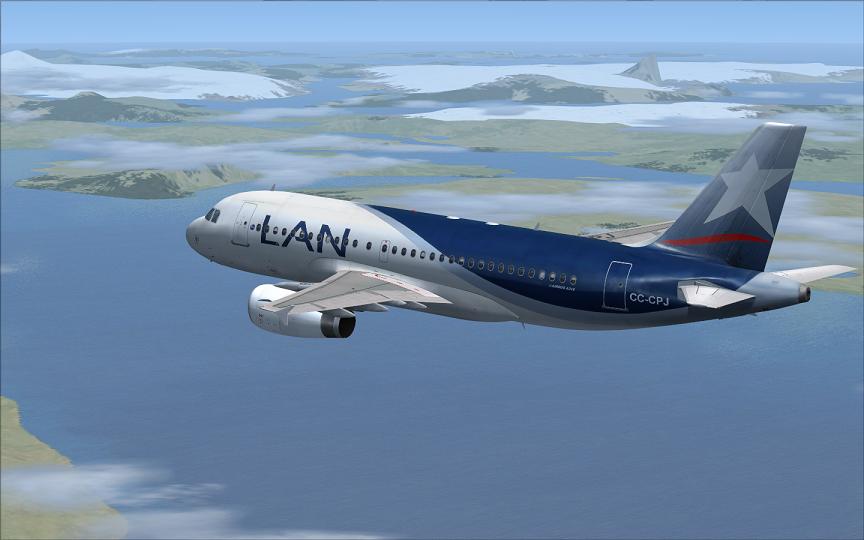 Flying north up the Patagonian coast to Puerto Montt
Service started with a basket of hard candies passed around just before pushback. A flight attendant stopped by my seat in the exit row to ask me if I spoke Spanish. Verifying that everyone in the exit row speaks the predominant language of the country is an excellent idea, I think. I assured the FA, in Spanish, that I could speak well enough to be of assistance in the exit row should the need arise.
The Captain welcomed us aboard and gave the usual flight details; first in Spanish, then English and finally French. French? I don’t believe I’ve heard French spoken even once in Chile though I did hear plenty of German. Still, if there were any French speaking passengers on board, I’m sure they would have been positively exultant because if there’s anything a Frenchman loves to hear, it’s his own language!
Our 12:40pm departure coupled with a scheduled flight time of almost two hours meant that luncheon would be served on this flight. Today’s offering was slices of baked chicken breast presented with peas, potatoes, a dinner roll and a custard dessert. I thought it was all quite good, especially in these times of diminished quantity and quality of inflight meals.
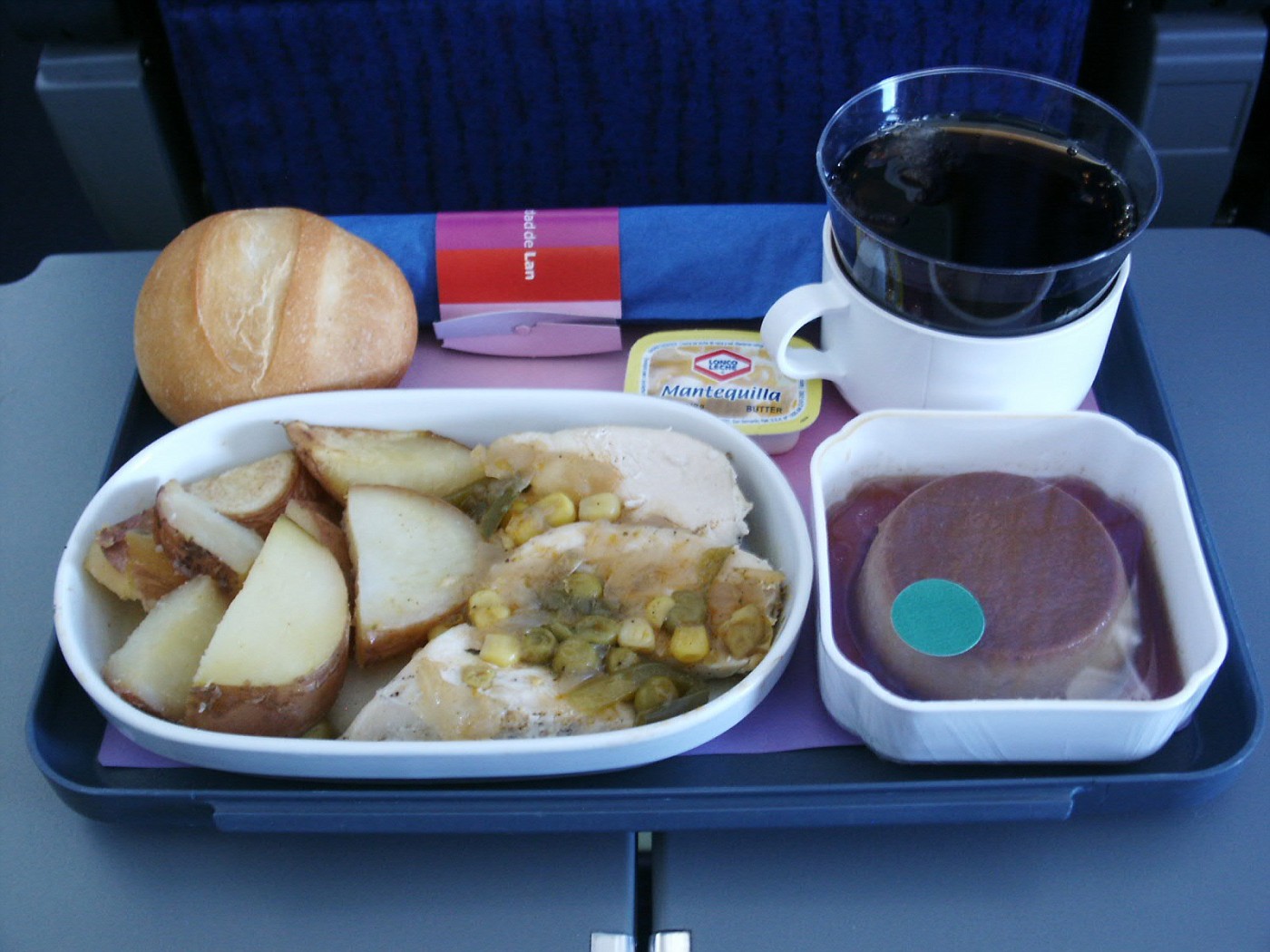 Luncheon on LAN's Flight from Punta Arenas to Puerto Montt
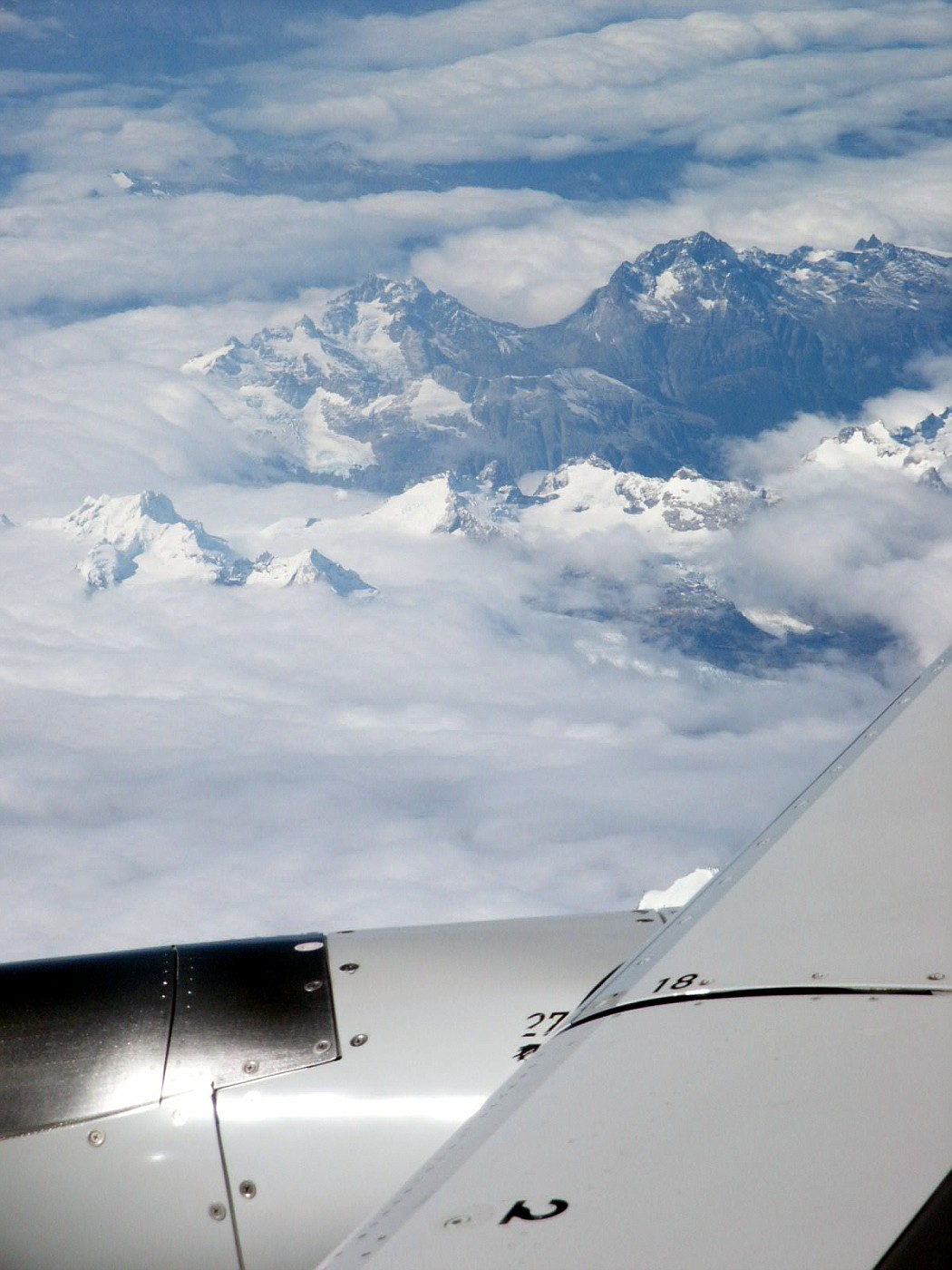 Patagonian Peaks Poke Above The Clouds
The far south of Chile is a land of rugged mountains, massive glaciers and azure blue lakes. On a clear day, a window seat is a must when flying between Punta Arenas and Puerto Montt. Unfortunately, localized cloudiness obscured what is otherwise one of the more scenic flights on the planet. Thankfully, the clouds cleared somewhat later in the flight and as we descended into Puerto Montt’s Tepual Airport, I got a nice view of Osorno volcano to the north of the city.
In Puerto Montt, I had a three hour layover until the departure of my connecting flight up to Santiago. It was time well spent in the Pacific Club while bringing my Alaska to Ushuaia report up to date. I was well over a week behind on that so the long layover was doubly appreciated.
Puerto Montt to Santiago (via Temuco and Concepcion)
LAN Chile 565 Economy Class * Snack
737-200 CC-CSP Seat 1L
455p-900p Flight Times: :29 / :24 / :44
Speaking of getting behind, you might be interested to know that I’m writing the portion you’re now reading from the back row of a Greyhound bus. At present, we’re winding through the spruce forested mountains of Vancouver Island enroute to Port Hardy. Where will I be when I get around to writing about today’s travels… Hong Kong?
LAN Express offers plenty of daily flights between Puerto Montt and Santiago. A three hour layover was not necessary, but since I wanted to fly LA 264, the two-stop milkrun up to the capitol city, that’s the way things worked out. Adding to my layover was a slight delay in boarding while the mechanics changed out a tire on the 737-200 slated to operate today’s flight.
Nonstop flights between Puerto Montt and Santiago take only an hour and twenty minutes, so as you might imagine this flight making two stops enroute offered some pretty short flight times. It was a nice sunny evening as we climbed out of Puerto Montt and made a big sweeping turn to the north.
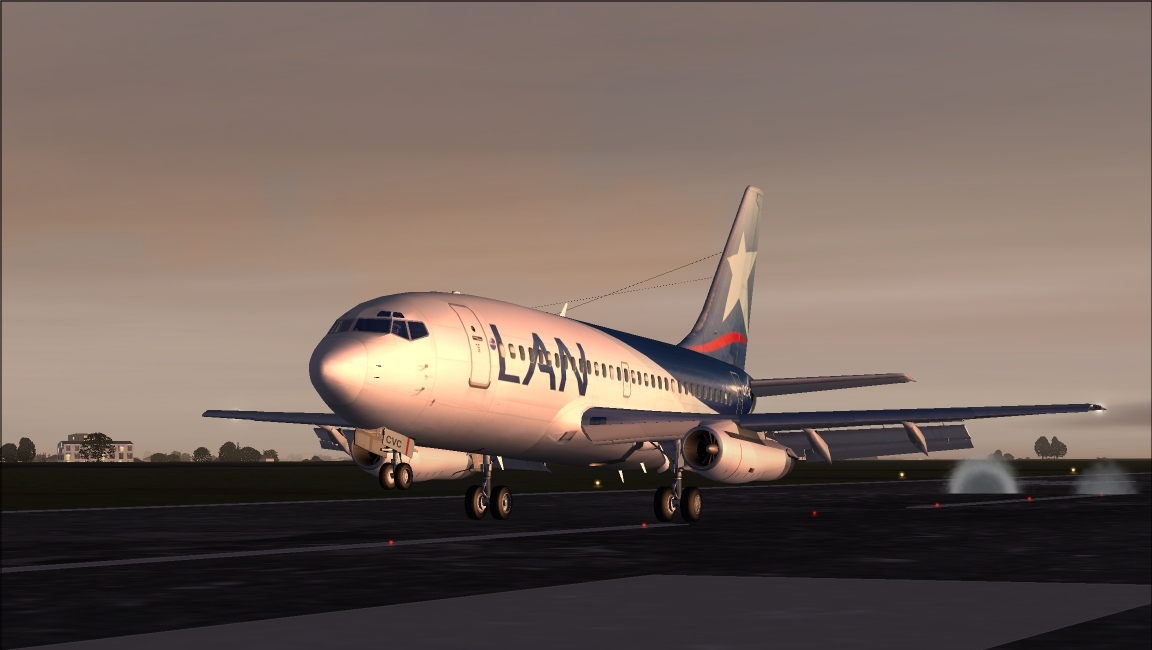 Take off from Puerto Montt
Our first destination was ZCO, otherwise known as Maquehue Airport serving Temuco, Chile. Temuco’s a large agricultural and forestry center, attractively set in verdant farmlands surrounded by equally verdant rolling hills. Flight time was twenty-nine minutes so thre was no service of any kind enroute. Not even beverages. Up in bulkhead window seat 1L, I had the entire row to myself and spent the entire flight admiring first the volcanos north of Puerto Montt and then the setting sun as we descended into Temuco.
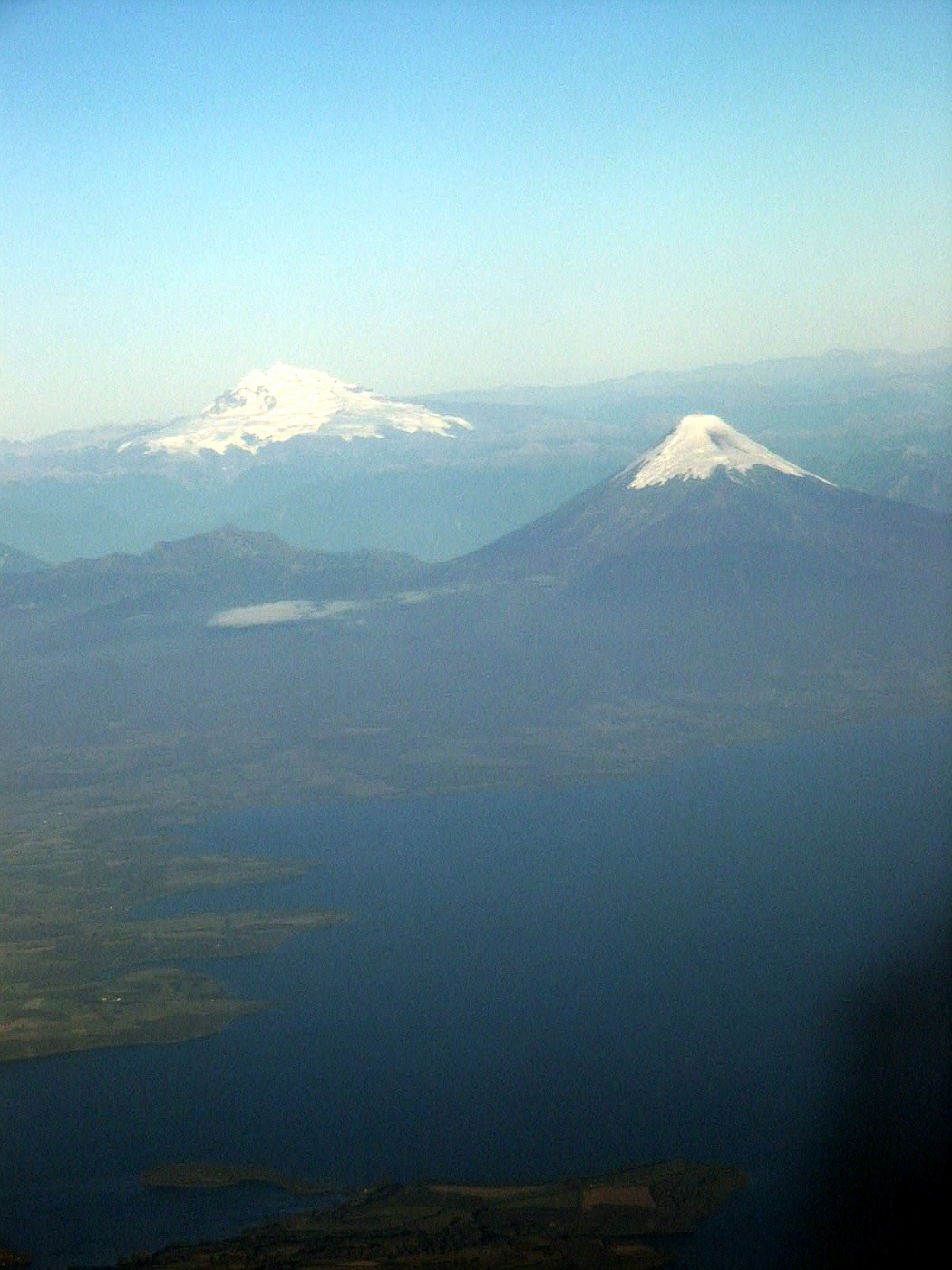 Volcanoes North of Puerto Montt
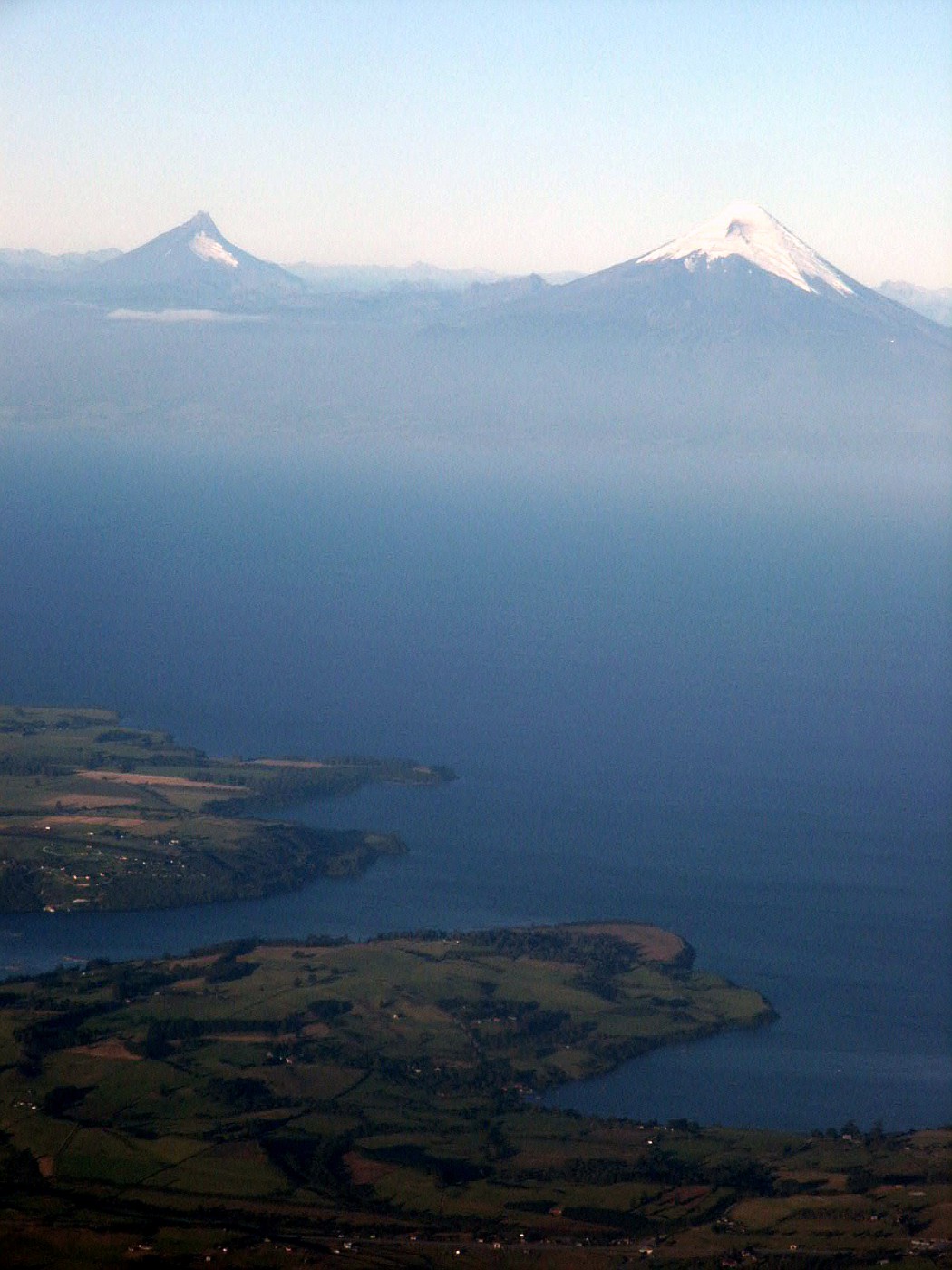 More Volcanoes North of Puerto Montt
Twenty-five minutes later, we were airborne again, this time for only twenty-four minutes as we winged our way further north to the city of Concepcion. Our landing at Carriel Sur Airport was textbook smooth and as we parked in front of the old terminal building we were joined by a 737-200 from Sky Airlines.
The Flight Attendant informed me that we had a full load from Concepcion up to Santiago so I quickly gathered up my well spread out belongings before my seatmates arrived. Flight time up to Santiago was announced as fifty minutes and once we’d leveled out, a snack would be offered. Oh boy! I was more thirsty than hungry but as one who generally views airline meal service as a form of inflight entertainment, I anxiously awaited the meal offering as well. Small trays were distributed, each bearing a cream cheese and tomato relish filled roll, a mysterious white pastry dessert and a coffee cup. To this day I’m not sure what that dessert was supposed to be. It tasted like something that had once been moist but was left out in the sun for a few days. One small bite was enough of that.
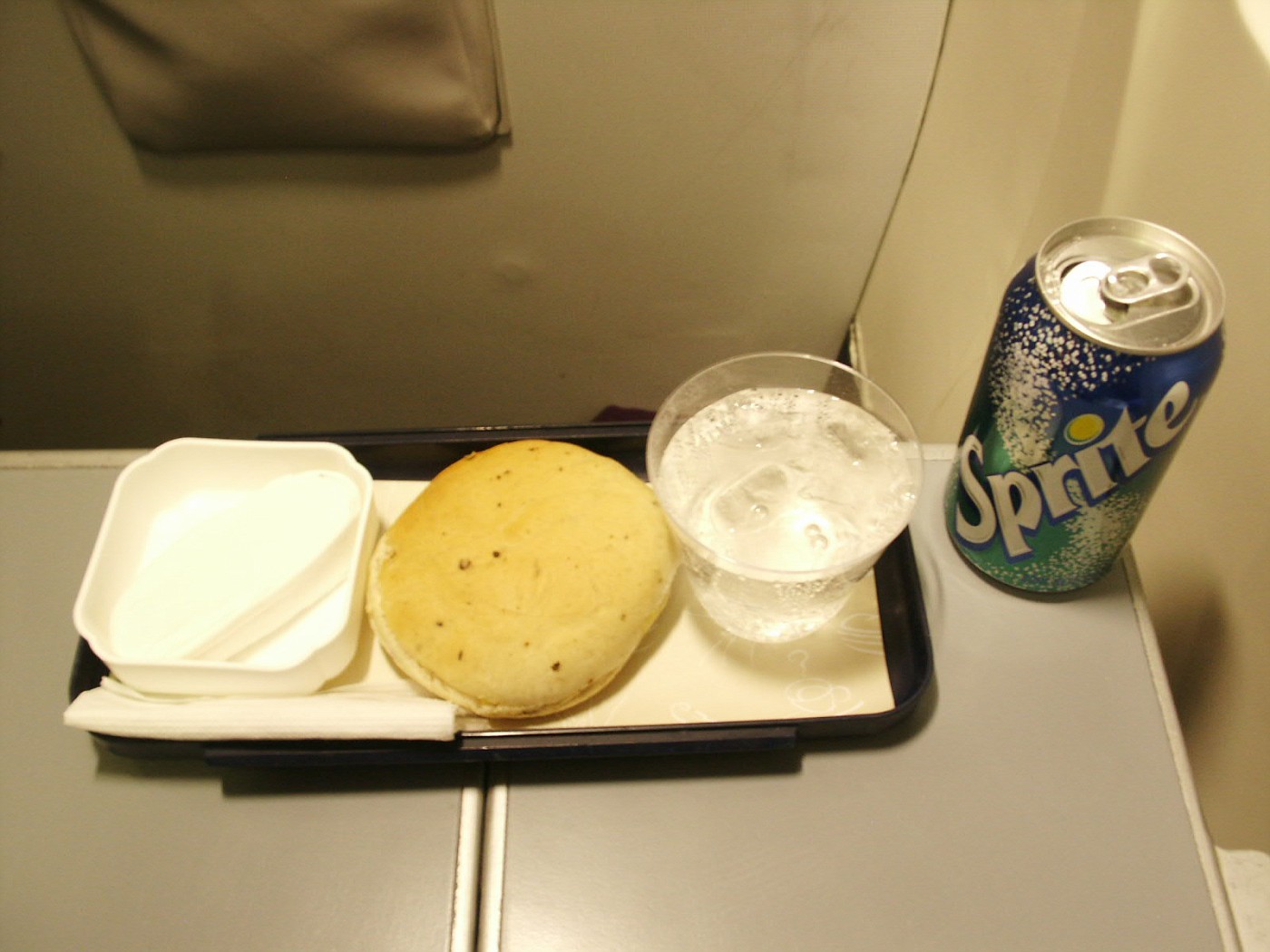 Sustenance on LAN Chile
Baggage delivery in Santiago was surprisingly fast and soon I was on my way into the city center where an air-conditioned room at the Ciudad de Vitoria Hotel awaited me. Total mileage flown today came to 1,680 miles. Only 8,810 more miles to go until I get back home to Fairbanks.
March 22, 2005
Santiago to Miami (via Guayaquil and Bogota)
LAN Chile 565 Business Class * Breakfast, Lunch, Snack
767-300 CC-CEN Seat 5A
915a-830p Flight Time: 4:35 / 1:26 / 3:06
In arranging a pick-up time for my ride out to Santiago’s Benitez International Airport, I was offered a choice of 6:00am or 9:00am. Since my flight didn’t leave until 9:15am, I was hoping for something a little later. Alas, it was a busy morning so a 6:00am pick up it was.
On a positive note, my early arrival and check-in left me that much more time to enjoy LAN Chile’s
Neruda Lounge. Interestingly, as I was walking down to this lounge, I passed by LAN’s Mistral Lounge and decided to stop in there and check it out. The attendant took one look at my Business Class boarding pass and did her best to convince me that I’d really be better off at the Neruda Lounge. Apparently, the Neruda Lounge is a dedicated First and Business Class lounge with all the attendant amenities whereas the Mistral Lounge is somewhat more basic by comparison. Anyone can buy a visit to the Mistral Lounge whereas only Business and First Class passengers may access the Neruda Lounge. From what I could see of the Mistral Lounge, it looked comfortable and pleasant enough but I nonetheless thanked the receptionist and continued on down the concourse to the Neruda Lounge.
The Neruda Lounge supplied two things that I really needed at the time. Breakfast and an Internet connection. A buffet area offered peach, orange and raspberry juice along with sliced fruits, a tray of ham and cheese sandwiches and a plate of sweet rolls and cookies. The All Chilean Breakfast if ever there was one. I put together a plate with a bit of everything and relocated to one of the empty workstations. An hour later, having successfully communicated my imminent arrival to interested parties up north, I gathered my gear together and headed up to the gate.
Boarding was well underway when I arrived and a fairly long line had formed. Usually in cases like this I just take a seat and wait for the crowd to thin out but this group seemed to be boarding at a decent pace so I took my place at the end of the line. Moments later, a uniformed LAN agent approached and asked to see my boarding pass. Ah, Business Class, she said. Come with me. Still not quite sure how she’d managed to identify me as a Business Class passenger, I nonetheless followed her straight to the podium where my boarding pass was pulled, my stub was returned and I was subsequently welcomed to board. Yeah! Now that’s the kind of service I like!
The 767-300 operating today’s flight up to Miami was painted in LAN’s old livery, the one with the curved red line below the windows. I like the new livery much better. Still, I’ve never refused to board an aircraft because I didn’t like the livery and I wasn’t going to start today. This was especially true for this flight, one I’d really been looking forward to because it made stops at Guayaquil, Ecuador and Bogota, Colombia. I’d never landed at Bogota’s Eldorado International Airport and was looking forward to seeing the Colombian countryside during our approach as well as some of the many vintage jetliners I knew were parked there. As well, I’d never flown these routes, so I was looking forward to adding them to my over 650,000 miles of unduplicated route mileage around the world.
The First Class cabin was full for the first leg of this flight up to Guayaquil. All of the passengers were men between the ages of fifty and sixty-five. All of them were dressed in business suits. It was like a flashback to the 1960s.
Back in the Business Class cabin, pre-packaged pillow and blanket sets had been placed atop each seat. Seating is 2-2-2 and out of the twenty-eight seats available, only six were occupied. A Flight Attendant soon appeared, relieved me of my jacket and returned three minutes later with an amenity kit. Perhaps because this is not an overnight flight, the amenity kit I received contained only a pair of socks, some earplugs and an eyeshade.
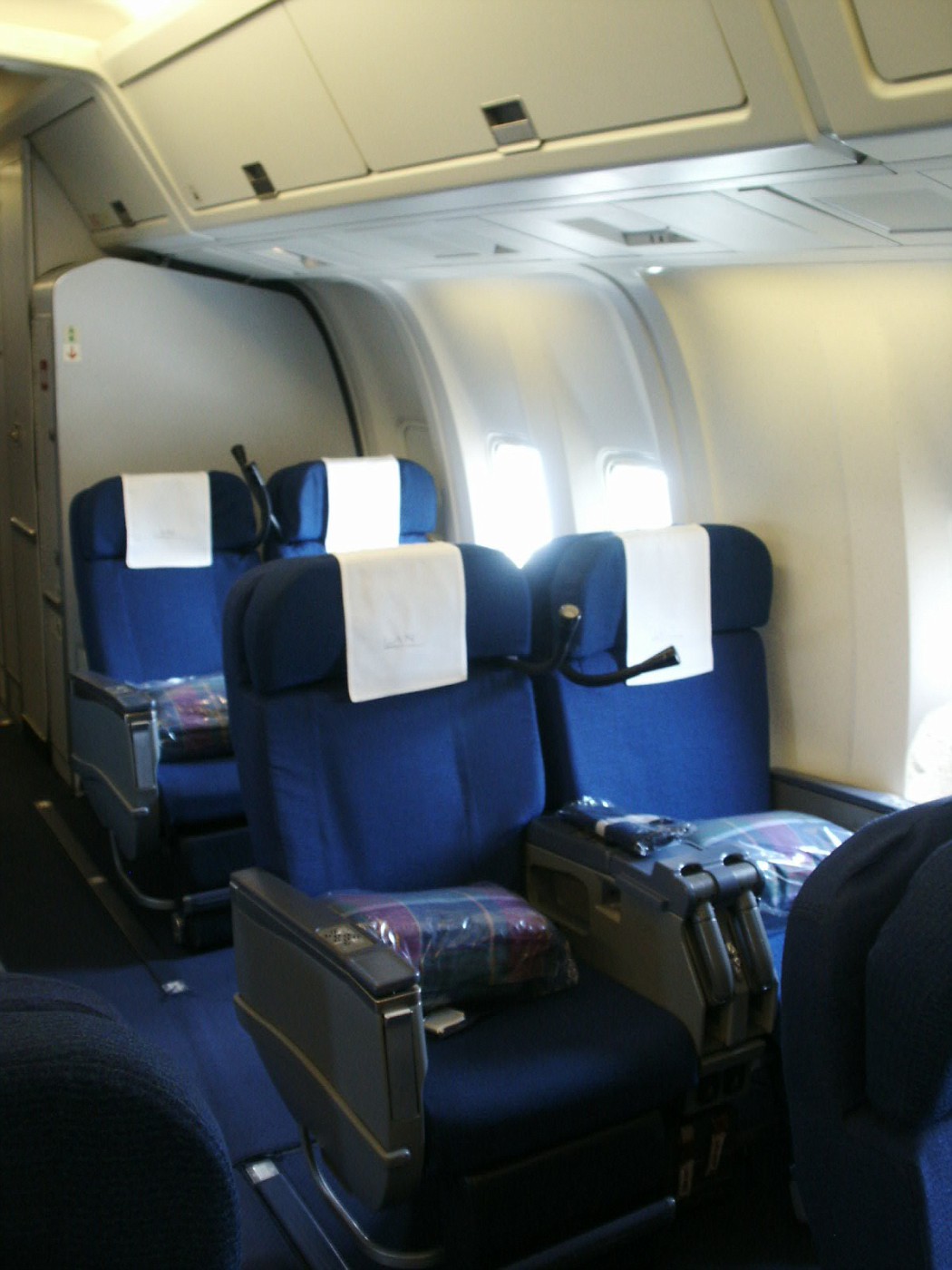 Business Class Seating on LAN's 767-300
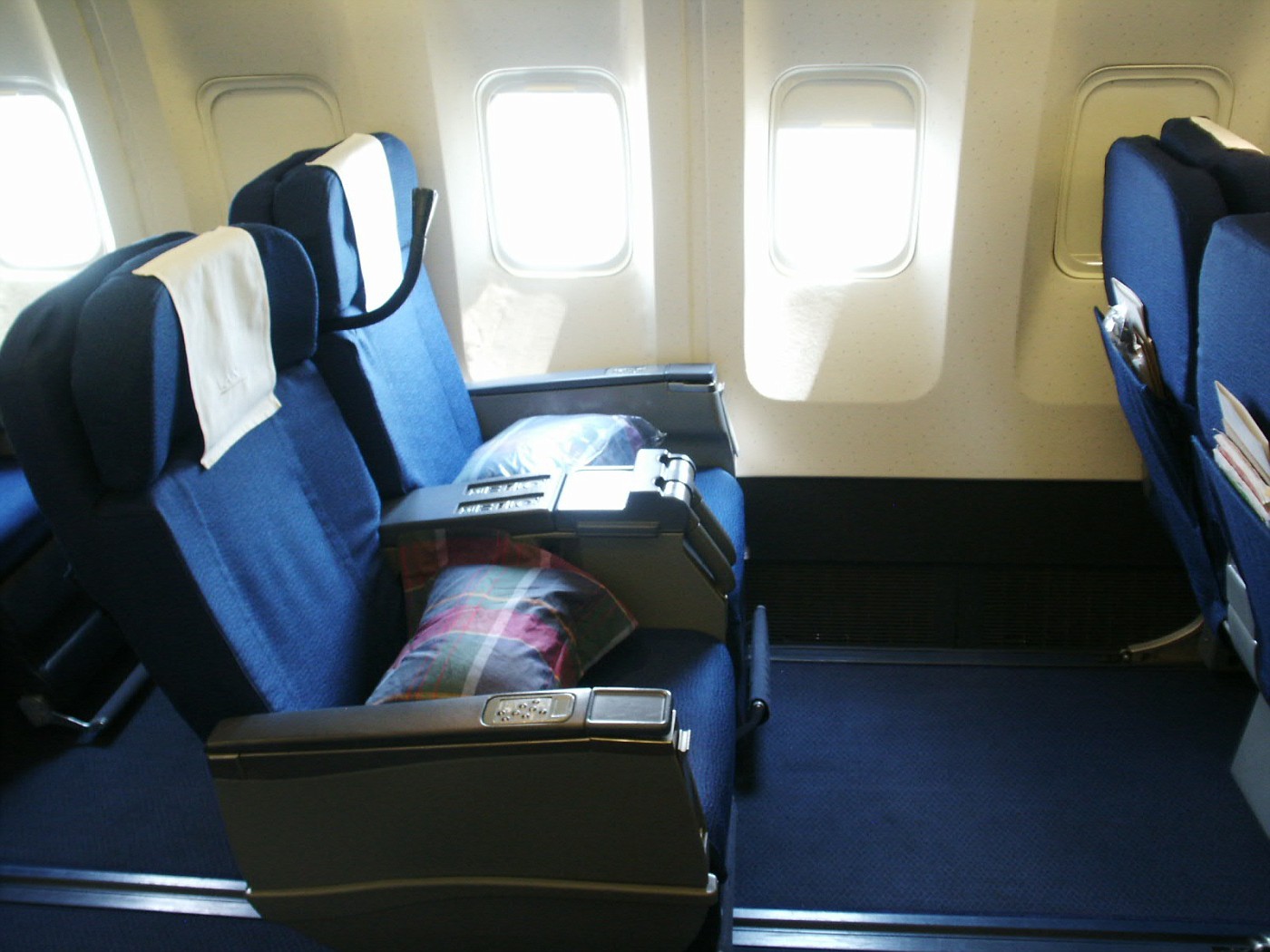 Business Class Seating on LAN's 767-300
As I began to get settled into my new home for the next twelve hours, I reflected on how vastly different the boarding process is when flying First Class on a Boeing 747 as opposed to flying First or Business Class on a 767. Upon entering the 747, you make a left hand turn and are almost immediately cocooned in the peaceful tranquility of the First Class cabin. It’s just you, your fellow passengers and two or three ever-helpful Flight Attendants. Coats are taken, cocktails and canapés are delivered and the overall transition from the harried environment of the crowded airport concourse to the serene world of International First Class begins the moment you enter the airplane.
Unfortunately, the same cannot be said for the boarding process on the 767. Today’s flight offered an excellent example of why. As I was getting my carry-on baggage stowed away and the Flight Attendant was attempting to relieve me of my jacket, the aisles were filled with people trying to make their way back into the Economy Class cabin. A mother with not one but two screaming infants in tow trundled by, followed shortly thereafter by a middle-aged couple hauling a number of bags and boxes well in excess of the one carry-on (plus a small personal item) per passenger limit. A Wide Load sign should have preceded them. During a stall in the Stampede to Economy, two guys decided to take a seat in the Business Class cabin, perhaps to sample the seating comfort. When the line resumed its procession, they remained in the seats. At first I thought they were fellow Business Class passengers until a Flight Attendant stopped by, asked to see their boarding passes and subsequently shooed them off behind the curtain like errant cattle that had strayed from the drive. G’wan, now… The advertised peace and serenity of First or Business Class would not begin until well after takeoff.
Takeoff took 42 seconds by my watch. I time all my flights starting with the takeoff. This is not done so much to provide you all with stirring minutiae of the flight (Oh my God! Honey, come quick! Look at this! This guy was flying on a 767 out of Santiago and it took 42 seconds to take off! Isn’t that just the most unbelievable thing you’ve ever heard?!!) but rather to give me a sense of where we are when I look out the window during the flight. I started this practice on domestic flights within America where AirShow maps are rarely seen. I have
driven, ridden trains and hitchhiked through all fifty American states many times over. In the western third of the nation, there are only
nine counties that I’ve not yet set foot in. From the course of its rivers to the location of its cities, I know the geography of America better than most. Because I’ve been there. To me at least, it’s fascinating to look at the country from a vantage point 35,000 feet above it, and know what you’re looking at. As for flights outside of North America, well, old habits die hard. Even if I’ve never been through the lands below me, that doesn’t mean I don’t have some sense of where I’m at. I love to look at maps like most people like to eat. They inspire me to go see more of the world.
This morning’s inflight service started with hot towels that were neither hot nor scented. Does any airline do a consistently good job of presenting this Japanese treat known as Oshibori Towels? Maybe Japan Air Lines. It really seems to be hit or miss with most airlines, and I mention it simply because a properly presented hot towel is truly as refreshing as it is relaxing.
A menu along with the wine list had been placed in our seatback pockets prior to boarding. The menu covered each segment of today’s 4,380 mile journey to Miami. On the flight up to Guayaquil, we’d be served a hot breakfast. Here is a transcript from the menu:
Santiago to Guayaquil
BREAKFAST
TO START
Orange Juice
Coffee or Tea
OUR COLD DISHES
Fresh Seasonal Fruit
Yogurt or Cereal
WARM ENTREES
Cheese Omelette
Served with crisp bacon and steamed asparagus
Ham and Edam Cheese Sandwich
Served on country bread with fresh butter
FROM THE BAKERY
Choose your selection from our variety of bread served with butter and preserves
Although many hotels and hospedajes throughout Chile and Argentina include a complimentary breakfast in their rates, I never once saw eggs offered. The national breakfast of both countries seems to be juice, coffee and sweet breakfast breads or pastries. A larger version of that breakfast would include fruit, cereal and yogurt. I hadn’t had an egg breakfast since my flight down from Miami. As such, a ham and cheese sandwich for breakfast was out of the question.
The omelette was fairly decent as airline omelettes go. That is to say it wasn’t greasy. The crisp bacon was not quite what I expected, however. Where I come from, bacon is served in strips. What I received with my eggs was a pile of crispy pieces of bacon. These were little tiny pieces of bacon, like Bacon Bits. Not that I’m complaining, however. The bacon tasted fine but the presentation was … interesting. I really liked the cereal. It was kind of a mixture of crunchy granola and puffed rice. Overall, this was a savory and satisfying meal.
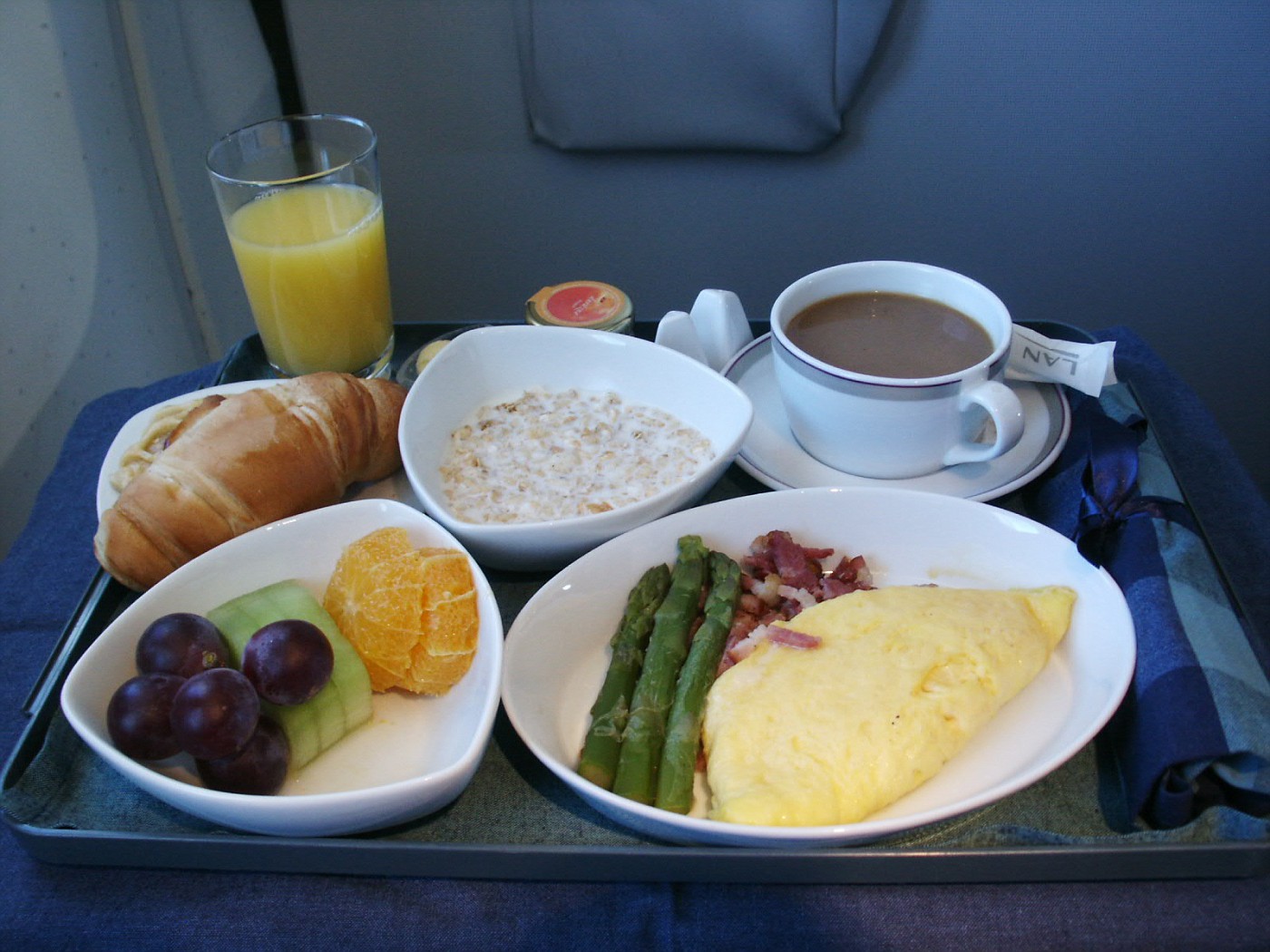 Breakfast Over Northern Chile
Guayaquil sits 2,250 miles to the north of Santiago. Flying time was just over four and a half hours, so after breakfast I had plenty of time for a short nap. I needed it. I didn’t get to the hotel in Santiago last night until 10:00pm, didn’t fall asleep until about midnight and was up and at ‘em at 5:30 this morning. Thankfully, LAN’s Business Class seats have excellent recline. As well, the pillows are large and the blankets are thick. I slept quite comfortably.
When I awoke some two hours later, I fired up my tiny 6” PTV and tried to bring up the AirShow. It hadn’t been on earlier in the flight and it still wasn’t on now. A quick consultation with the Flight Attendant confirmed that unfortunately the AirShow was not working on this aircraft. Outside my window high clouds obscured everything below, so I ordered a cup of coffee with Baileys and read for awhile.
Our approach into Guayaquil took us past the eastern edge of the city before then making a big turn and landing to the south. Below us a huge river wound through the outskirts of Guayaquil before emptying into the nearby Pacific Ocean. What river is that, I wondered. I’ve always had a fascination with rivers. All that water - dark, silent inexorable energy flowing somewhere far away. Where does it go? When I was about nine years old, I mapped out every river in my home state of Colorado. Where did those rivers start from and where did they end up? As I got older, I started rafting them. The Green, the Colorado, the Yampa, the San Juan… the list goes on but I digress. In any event, I later found out that the river below us was the Guayas.
The last time I flew into Guayaquil was in 1983 aboard a brightly colored
Ecuatoriana 720B. Sadly, Ecuatoriana and its wildly colored aircraft have been relegated to the dustbin of history, as has Boeing’s high performance 720B. This shorter version of Boeing’s 707 was originally introduced with pure jet engines rated at just over 13,000 pounds of thrust each. The “B” variant was outfitted with the much more powerful Pratt & Whitney JT3D-3B turbofans, each generating 18,000 pounds of thrust. It was a real sportster, going from zero to over 600 mph in mere minutes! Cruising speed was listed at a swift 615 mph. Unfortunately, the smaller size of the 720 combined with four of those ever thirsty JT3Ds resulted in unacceptably high seat mile costs and the airplane was retired from most US airline fleets by 1975. US operators of the 720B included American, Braniff, Continental, Northwest, Pan Am, Pacific Northern, TWA, Western and United. The last 720B in scheduled passenger service was operated by Middle East Airlines until the early nineties. The dimensions of Qantas’ 707-138 were very similar to the 720B, though Qantas’ little 707 had much greater fuel capacity for longer international flights.
As we taxied in to our gate, we passed a venerable
Bristol Britannia, also known as the “Whispering Giant”. What a museum piece! The Britannia formed the backbone of BOAC’s trans-Atlantic fleet until the onset of the jet age. Throughout the 1960s and into the early 1970s, Loftleidir Britannias flew budget minded vacationers back and forth between America and Europe via Iceland. This aircraft parked in Guayaquil looked as if it hadn’t flown anywhere in quite some time.
As we approached the terminal, it was obvious that since my last visit Guayaquil’s Simon Bolivar International Airport had seen some improvements with the addition of a somewhat more modern looking terminal building that included three jetways. We parked at one of them, next to LAN’s southbound 767-300, inbound from Miami.
Guayaquil is located only about 100 miles south of the equator, so the climate is very much like Singapore’s. Hot and humid. As such, oppressive heat and humidity invaded the aircraft cabin the moment the doors were opened. Thankfully, air-conditioning was restored once we’d been hooked up to a ground based Auxiliary Power Unit. Apparently, the one on board our 767 was not functioning.
 TAME 727-100 Parked at Guayaquil
During the time we sat parked at the gate, the ramp filled with an eclectic assortment of South American jetliners that included a TAME F-28, a TAME 727-100, an Aero Gal 737-200 and a COPA 737-700. Very few airlines around the world still operate the 727-100 in revenue passenger service, so it was quite a treat to see that TAME (Transportes Aereos Militares Ecuatorians) aircraft. If it’s still flying next time I’m down here, I’ll have to book a flight for old time’s sake. That 737 from COPA operates one of the longest scheduled 737 flights in the world, the 3007 mile flight between Panama City and Los Angeles. So far as I know, there are only two longer flights operated by 737s ~ Air Pacific’s 3,163 mile flight between Nandi and Honolulu and the 4,058 mile flight between Munich and Newark operated by Lufthansa via PrivateAir. That’s a long time to sit in a narrow-bodied aircraft though to be fair, Lufthansa’s aircraft is operated in an all Business Class configuration.
Out of Guayaquil we boarded maybe a dozen people, if that many. As we taxied out to the runway, the captain welcomed us aboard and estimated our flight time to Bogota at one hour and twenty-five minutes. We took off to the south, circled around the downtown district and accelerated north up to Colombia.
The menu indicated that we’d be served a Hot Snack on this sector. What we received would be called a hot lunch anywhere else. Here’s the menu transcript, and now that we’ve arrived at an appropriate time of day, I’ll also include the wine list.
Guayaquil to Bogota
HOT SNACK
TO START OUR SNACK
Champagne Henriot, Brut Souverain
FROM THE BAKERY
Choose your selection from our variety of warm breads
AS THE MAIN ENTRÉE, WE OFFER
Grilled Loin with Mushroom and Cabernet Sauce
Accompanied by Tomato Provenzal and Lyonnaise Mashed Potatoes
A FRESH SALAD
Assortment of fresh greens with seasonal garnishes
OUR DESSERT
“Alfajor” filled with dulce de leche and banana, served cold atop vanilla sauce
Freshly brewed gourmet, instant coffee, decaffeinated coffee, tea or herbal teas
Liqueurs
WINE LIST
Champagne
Brut Souverain, Champagne Henriot, Reims, France
Red Wines
Anakena Cabernet Sauvignon Reserva 2003 – Valle del Rapel
Ramirana Gran Reserva Syrah 2003 – Valle del Maipo
Bodega Salentein Roble Malbec – Alto Valle de Uco Mendoza
Porta Carmenere Reserve 2004 – Valle del Maipo
White Wines
Concha y Toro Trio Chardonnay–Pinot Grigio–Pinot Blanc 2004 – Valle Casablanca
La Fortuna Sauvignon Blanc 2004 – Valle de Curico
Port
Graham’s Late Bottled Vintage Port 1997
Once again, there was no pre-meal offering of Champagne. The steak was fine, especially the sauce, but the “Green Salad” never did happen. What we received instead was a wedge of some lightly flavored cheese, a scoop of cream cheese with some brown flaky stuff sprinkled atop it that looked suspiciously like fish food and lastly, a piece of asparagus sitting atop what might best be described as a mass of indefinable protoplasm. It was brown and mushy and didn’t have a lot of flavor. I ate everything but the mystery mush.
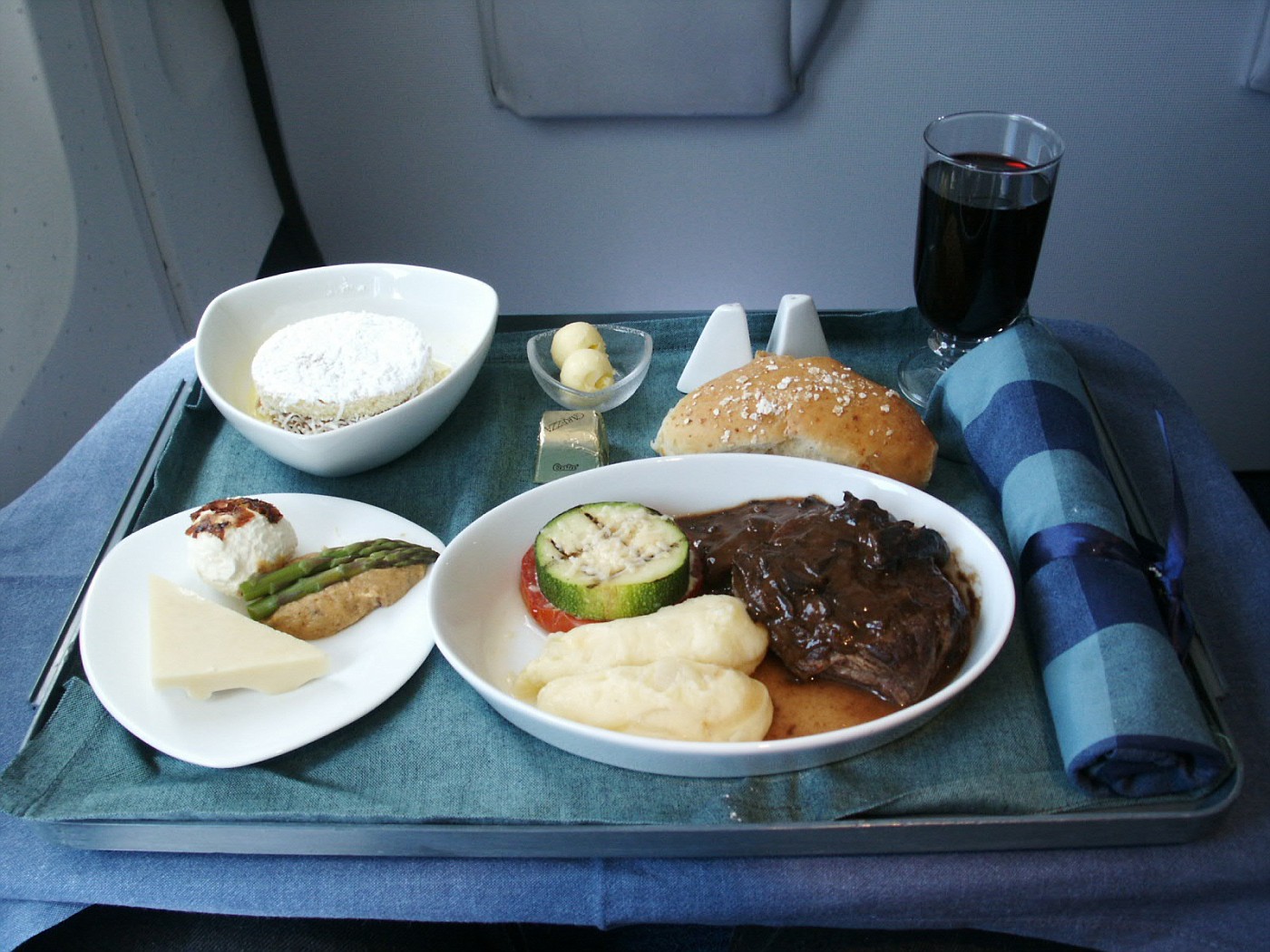 Grilled Loin with Mushroom and Cabernet Sauce
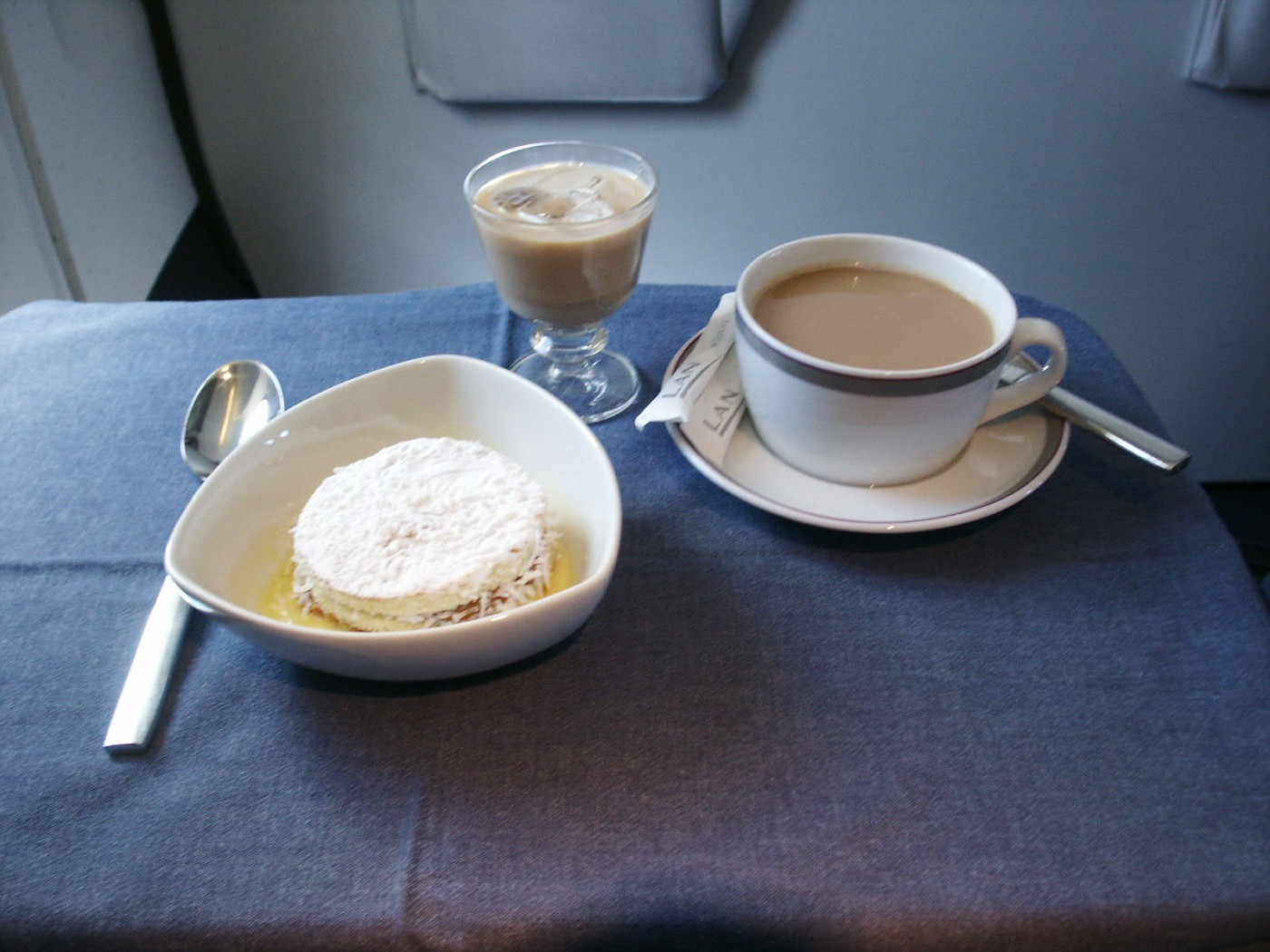 Dessert with Coffee and Baileys
By the way, the Cabernet Sauvignon from Anakena was magnificent! I’ll be looking for a bottle of that when I get back home. Hopefully I’ll have more success than I did during my search for the delicious Warre’s 1986 Reserve Tawny Port that BA used to serve its First Class clientele.
As we began our descent into Bogota’s Eldorado International Airport, I gazed out my window at the lush green mountains and valleys below. I took particular note of some villages perched high upon some fairly steep mountainsides, their only access apparently by foot or horseback. And, like Caracas, a large number of people lived within three hundred meters of the runway. In Bogota, that number would be several thousand, given the size and depth of the barrio that had grown up parallel to the runway.
 The Edge of the World?
Like many South American airports, Bogota’s Eldorado is a veritable museum for classic airliners. Many people are surprised to learn that Colombia was one of the very first countries to provide commercial air transport to its citizenry. Avianca is one of the world’s oldest airlines. In fact, passengers were being flown around Colombia seven years before anyone ever purchased an air travel ticket in the United States.
Many people think KLM Dutch Airlines is the world’s oldest. However, that distinction must go to Chalk’s Ocean Airways, which commenced service in February of 1919 from downtown Miami to Alicetown, on the island of Bimini, Bahamas. KLM wasn’t even founded until October of 1919 and didn’t begin service until May of 1920. The third oldest airline is Avianca, followed by Australia’s Qantas. Mexicana is the oldest airline in North America and Northwest is the oldest of the US majors, commencing service in July of 1927.
Chalk's still operates between Miami and Bimini as well as providing service to Ft. Lauderdale-Hollywood International Airport and the only scheduled service to Paradise Island and downtown Nassau.
Eldorado International is fairly large airport, about the same size as Helsinki’s Vantaa International or Auckland’s International Airport. As we made our way from the runway to our gate, we passed by all manner of vintage propeller and jet powered aircraft. There were lots of DC-6s, a couple of DC-3s, a Convair and even an old Curtiss C-46. More than a few of these aircraft were still operational, especially the DC-6s, arguably the finest propeller driven transport aircraft ever built. Certainly it is one of the most durable. Back home in Fairbanks, we regularly hear the distinctive drone of the DC-6’s four big 18 cylinder piston engines since the DC-6 is the backbone of Northern Air Cargo’s fleet.
Of particular interest to me was a small herd of 727-100s basking in the late afternoon sun over at the air freight area. As a child of the jet age, I was quite a fan of the 727and I wasn’t the only one. Commercial jetliners were still novelty when 727s were introduced in 1963. Back then, people would actually go out to the airport to look at the new jets and the 727 was a real crowd pleaser with its distinctive T tail and steep takeoff climbs. Because of the 727’s ability to land or takeoff from shorter runways, it was often the first jet ever to serve many small to midsize airports. My first flight aboard a 727 occurred in 1964 when we flew from Denver to New York (via Chicago) to see the World’s Fair. In the years since then, I’ve logged over seven hundred flights and more than a half million miles aboard 727s.
Throughout the 1960s and 1970s, Colombian airlines were strong supporters of Boeing jetliners. Avianca, SAM, AeroCondor and ACES all flew predominantly Boeing fleets. During those years, if you ever saw a McDonnell-Douglas jetliner in Bogota, it was being operated by a foreign airline. Speaking of foreign, does anyone out there remember the French built Caravelle? The little twinjet with the triangular windows? It was hugely popular in Colombia and amongst the world’s nations, only France had more Caravelle operators than Colombia.
On the subject of DC-9s and their variants, I should note here that Colombian domestic operator Aero Republica operates a large fleet of DC-9-30s and MD-80s. Avianca now operate some MD-80s as well. Overall however, McDonnell Douglas did not sell a lot of DC-9s to South American airlines.
At the gate, we parked next to an Avianca 767-200 that looked quite nice in its new Summa Alliance livery. Once the Bogota bound passengers had disembarked, those of us in transit to Miami were informed that we would have to gather our gear and exit the aircraft as well. We received transit cards at the door and then had to walk all the way down to immigration. There, we made a U-turn and headed up the escalators where we went through a security checkpoint, complete with wanding for all. We then walked all the way back down the concourse back to Gate 8 where a huge line had formed for yet another security check. This time, boarding passes and passports were being inspected, after which we were subjected to yet another walk through the metal detector followed by another round of wanding. Okay then, are we safe yet? No! Our carry-ons were then X-rayed, followed by a personal inspection. All the while, well armed soldiers from the Colombian military looked on. I wonder how this compares to flights out of Tel Aviv?
Given the size of the crowd being re-inspected at the gate area, I expected we’d have a pretty full flight over to Miami. This would turn out to be true back in Economy Class. Up in Business Class, only about half the seats were occupied and thankfully none of them were next to me.
Following a lengthy take off roll to the east, we climbed into the late afternoon sky and headed off across the Caribbean to Miami. During the first half-hour of the flight there were some really pretty cloud formations but unfortunately the angle of the sun sitting low in the Western sky prevented me from getting any lasting impressions with my camera.
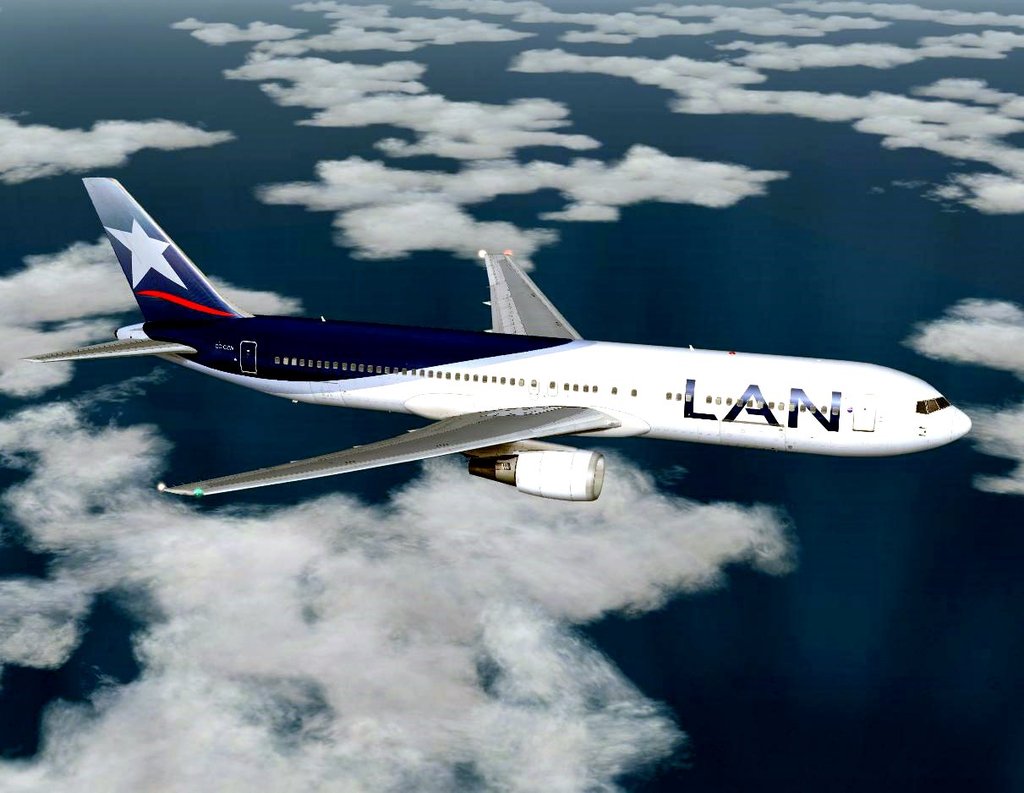 Westbound across the Caribbean
Flight time to Miami was announced at three hours and ten minutes. The menu indicated that we’d be served only a sandwich on this sector. Had I boarded this flight in Bogota where we were scheduled to depart at 4:55pm, I’d have been a bit disappointed that we weren’t offered something a bit more substantial. As it were however, I’d been well fed with a full breakfast and lunch on the way up from Santiago so I wasn’t all that hungry anyway. For any of you that are, here’s the menu transcript:
Bogota to Miami
SNACK SANDWICH
TO START
Fresh fruit juice, tea, coffee and milk
Toast served with butter and preserves
GOURMET SANDWICH SELECTION
Seared Canadian Loin and Mozzarella Cheese Sandwich
Served on baguette bread with pesto
Canadian Ham and Dutch Cheese Sandwich
Served warm on a whole wheat bread loaf with parslied butter
SWEET OFFERING
Layered cake filled with prune preserves, topped with Dulce de Leche sauce
For this, my final flight of the day aboard LAN Chile, I decided to start with a Pisco Sour. Then I had two more. They are the one cocktail that LAN Chile does a nice job with. On the flight down to Santiago, I ordered a Bloody Mary. Ay Carramba! What a bloody disaster! It tasted as if it had been made with tomato drink rather than tomato juice. It brought back memories of a backpacking trip some years ago when we brought along a fifth of Vodka and a baggie of Tang, the orange flavored fruit drink that astronauts were rumored to enjoy. I always enjoyed Tang on its own but mixed with the vodka as a Tang Driver, it was revolting! Needless to say, I’ve never touched a drop of Tang since.
As for the meal service, the description of the sandwiches was much more appetizing that what was ultimately presented. I would definitely not use the term “Gourmet” to describe the sandwiches I was served. I’ve eaten a lot of sandwiches over the years and I know the difference between a good one and a mediocre one. When it comes to your basic everyday sandwiches sold in most restaurants and take away places, Chile and Argentina may well have the world’s worst cold sandwiches. If you like a lot of bread and only tiny portions meat and cheese that have been sliced with a razor blade, you’ll like sandwiches from these countries. At least by my standards, which are easily met in most any American deli, supermarket or sandwich shop except for Subway.
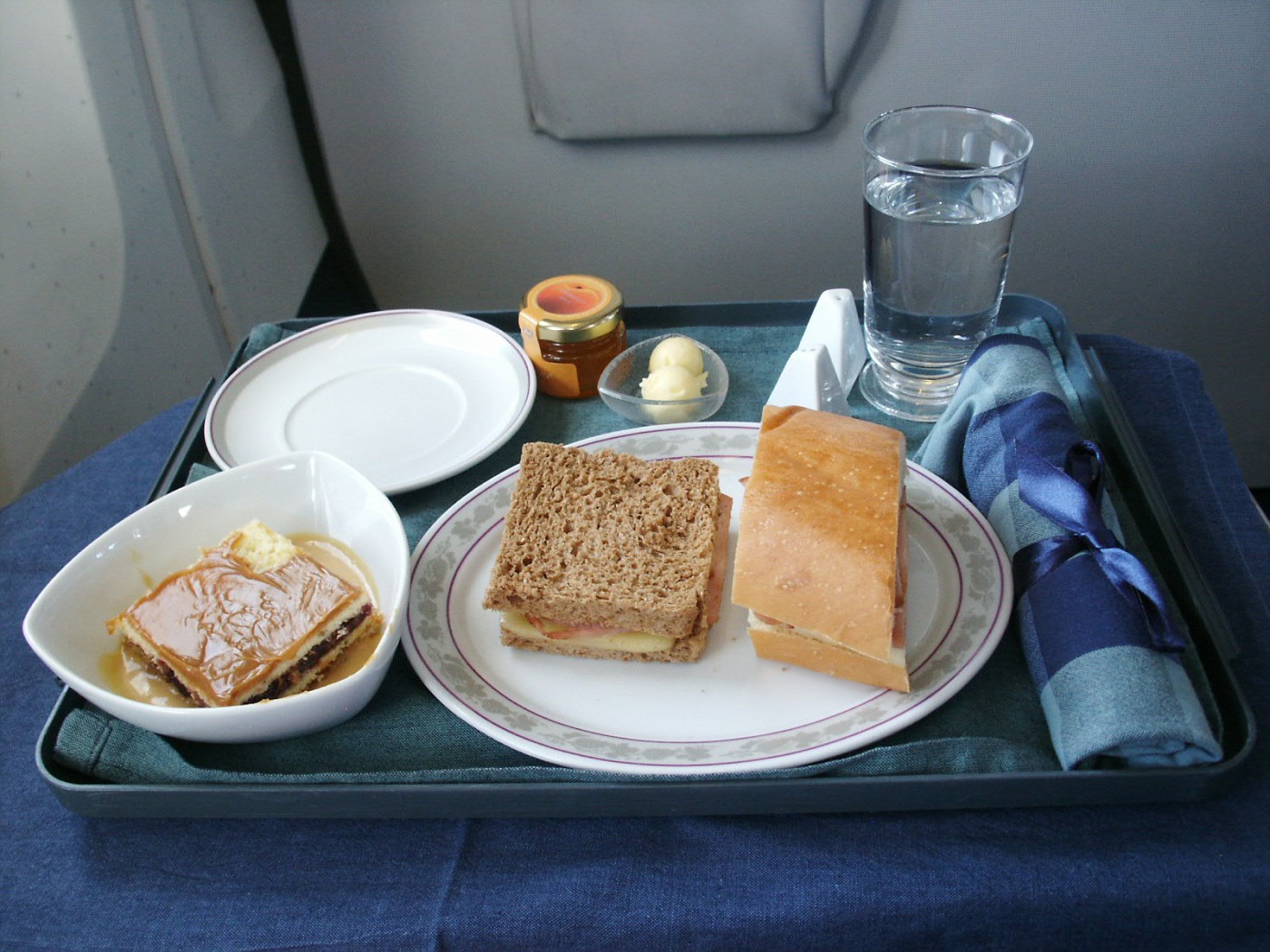 Gourmet Sandwiches on LAN
Not to digress too far from the main Trip Report but remember I’m talking about cold sandwiches here. The Barros Luco or hot beef sandwich widely served throughout Chile is excellent. Some Argentinean restaurants make a pretty fair steak or Milanesa sandwich as well.
Finally, we started our descent into Miami. From the time I boarded this morning, I’d been on this aircraft for almost twelve hours. From the time I’d left Ushuaia two days ago, I’d traveled 6,300 miles to get up to Miami. For so many Americans, Florida is considered to be way down there. Indeed, the southernmost point in the contiguous United States is at the bottom of the Florida Keys at Key West. For me at least, the idea of having been over 5500 miles in a straight line south of Key West is pretty neat. I’m already looking forward to my next trip!
*** ***** ***
Overall, I thought LAN Chile did a pretty nice job. Although their First Class product is highly regarded, I certainly wouldn’t rank their Business Class amongst the top ten or fifteen in the world. Even so, it was more than adequate and a far cry better than what lie beyond the curtain back in Economy Class. Also worth noting, the 75,000 mile Business Class award via Alaska Airlines’ Mileage Plan is one of the all time great values out there. I encourage all of you to make a visit to Chile and Argentina someday soon, while the getting’s good.
*** ***** ***
By the time I’d cleared customs, it was about 9:30pm. The arrivals hall was hot and humid and I felt like I had some sort of cold coming on so despite the 8:00am departure time of my Seattle flight I decided to look into getting a hotel. I’m $226.00 ahead of budget, so why not?
Alas, it seemed that every hotel in the area was sold out. I called about a dozen of them and only one said they had a room. Then they put me on hold and didn’t come back. I called them again. Again, they put me on hold and didn’t return. I imagined that it must be bedlam at that hotel and moved on to check others.
Finally, I asked a couple of hotels why they were so full. Is there a convention in town? It’s the season and it’s Spring Break were the answers. Huh?! Spring Break? Why would you want to come all the way down to Florida with its beautiful white beaches and sparkling blue waters and then stay in an airport hotel, miles from the beach? Spring break? So is it kinda crazy at the hotel? I asked. A little bit, was the reply. It’ll get a lot worse this weekend.
A little bit crazy… that’s all I needed with an early wake-up call and a cold coming on. Rowdy, noisy college students liquored up to excess and stumbling around the hotel, puking in the hallways and falling off of balconies. No thank you. I’ll stay in the airport and get a peaceful night’s sleep. And – that’s exactly what I did. I’ll spend the savings later in the week on a hotel in Canada.