[TLDR] Get 240W Thunderbolt 4 or USB4 (or TB5/USB4-80Gbps) cables, though they will be thicker. USB-C cables should now come with logos explaining the capabilities at a glance, as per the below picture.
More in-depth:
I would go with the 240W/100W - or, rather 5A (read below for clarity on this) - cables, though they will be a bit thicker than the 60W (3A) rated cables, to handle the higher current. Or better yet, certified Thunderbolt 4 or USB4 (which are essentially uncertified TB4) cables, since they will have the most compatibility.
New USB-C cables will likely (but not mandatorily) have new logos on them, this should help with identifying their capabilities going forward:
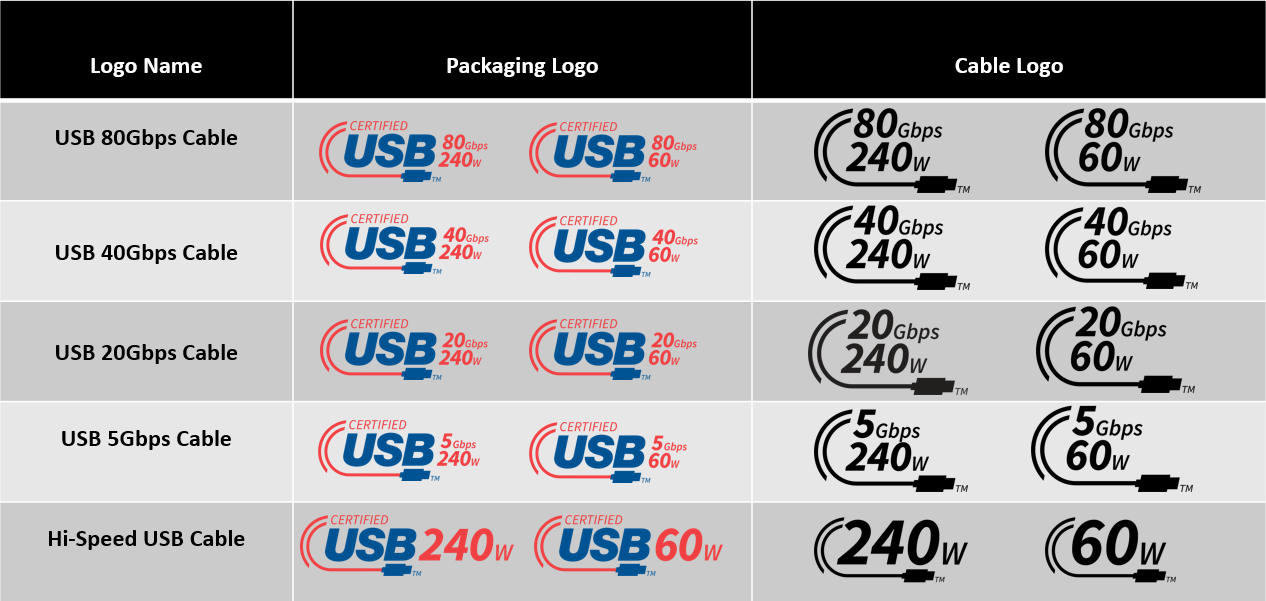
The cables rating is not truly by the specified wattage, however, but rather by the max amperes allowed. (Though, read below on why ‘active’ USB-C cables may be limited.)
An E-Marker chip which notes the 5A capability of the cable is required in each cable (both active and passive) to tell the host & device in a connection that 5A (and voltage >20V) is allowed; without an E-Marker or with an E-Marker stating 3A only in the cable, the connection will be negotiated to only offer a max of 3A, at up to 20V.
So, no, a 60W cable will not enable more than 60W; else, it would have the necessary e-Marker and be marketed with the higher capabilities at a higher price.
The 240W actually refers to the cable allowing 5A, @ 48V in this case. 48V is a new USB-PD EPR voltage, in addition to 36V and 28V. More on EPR here:
https://arstechnica.com/gadgets/2021...ower-delivery/
IIRC, all
passive cables at least can do all voltages between 5V and the new EPR 48V maximum. Older ‘100W’ passive cables should all support 240W charging as well. I believe old active cables had the voltages defined on their controller chips, and so only allow between 5V and 20V, so only up to 100W / 20V@5A, and newer active cables have updated controllers which allow EPR voltages to go to 48V.
(Anything ~1m or under is almost certainly a passive cable, though that limit was ~0.8m before; anything above that is supposed to be an active cable. Also note: TB4 active cables, longer than 1m, appear limited to 100W, I am guessing because the Intel-certified controller chip not being updated yet; some USB4 2m cables already offer 240W capabilities.)
Now, current MacBook Pro 16s enable EPR 140W/28V@5A charging
only using their non-standard MagSafe cable. You
cannot charge a MBP16 via the USB-C port at 140W; it is limited to 20V (100W) charging only. Perhaps that will change this year; other laptops are coming out which offer EPR charging via standardised USB-C cables - e.g. the Framework 16 can do the full 240W / 48V@5A (though,
its bundled charger is a 180W / 36V@5A one for now; on the other hand that is the first 36V-capable charger).
Not certain, but it looks like your iPhone cable is a 60W (or, 3A) rated cable:
https://www.apple.com/shop/product/M...arge-cable-1-m
Having said all that… this only addresses power negotiation. Data transfer is a whole ’nother ball-game. (e.g. That iPhone ‘charge cable’ is a USB 2.0 cable, maxes out at 480Mbps vs USB4’s 40Gbps limits, or the announced-but-yet-to-be-implemented
TB5’s &
USB4 Version 2.0’s 80Gbps maximums.)
*Note: I am a lay person; above could be wrong, but is my best understanding. Always happy to learn from others!