 Myoken Ishiharaso outside front entrance - reception building to the right, "Ishikura" (stone warhouse) building to the left. The main wing is to the right of the reception area, while the bathing facilities are via a walkway starts just to the left of the Ishikura building.
Based on our otherworldly stay in December of 2021, in my original post I had Myoken Ishiharaso among my personal top 10 favorite ryokans. After our second visit there last week, nothing has changed my sentiment - in fact, we had an even more phenomenal experience last week, and now it is highly unlikely that it will ever be dislodged from my list. And depending on what people are looking for, it might be the ryokan we'd recommend to many inquirers. While I did previously provide a brief overview of Ishiharaso, I'd like to do this property more justice by diving deeper into the aspects that make this such a remarkable and unique place, particularly when it comes to the Onsen and dining experience.
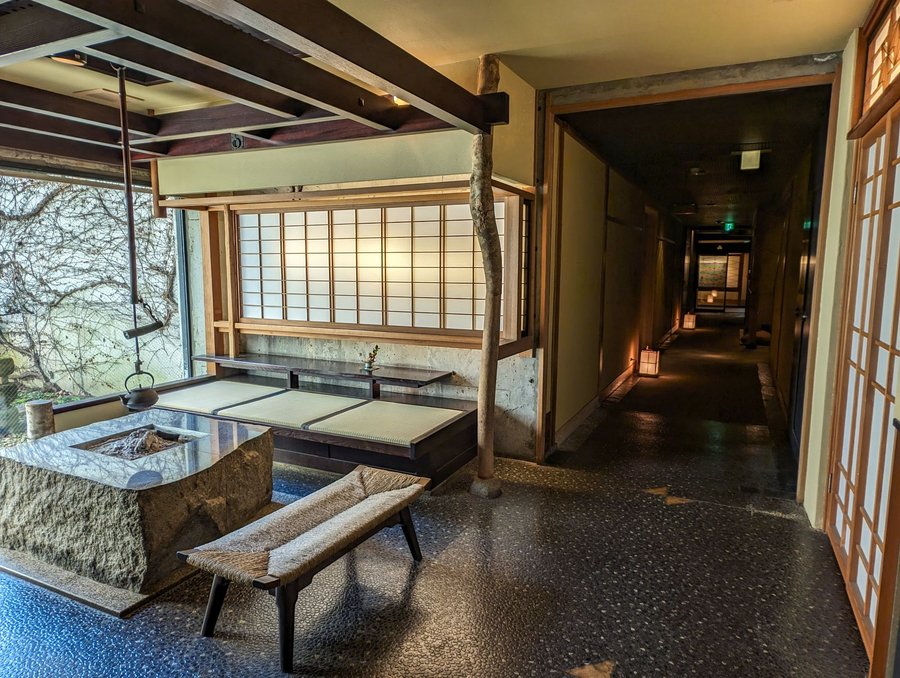
 Myoken Ishiharaso main reception area
While the ryokan is not located in a charming Onsen town like Kinosaki, Yufuin or Kurokawa Onsen, hot springs gush out in abundance in Myoken Onsen which is located in the Shinkawa Valley Hot Springs Village, so much so that onsen continually fills tubs, which are then drained and never recirculated, even in midrange accommodations in the area. The other advantage of its location: Ishiharaso is 15 minutes by taxi (which can be arranged through the property) from Kagoshima Airport, which is served by four domestic carriers and is a mere 2-hour flight from Tokyo Haneda or an even shorter 75 minute flight from Osaka Itami. Yes, you can easily do an overnight trip to Ishiharaso - just make sure to get there by 2PM (check-in time is an hour earlier than most ryokans), as you'll definitely want to maximize your time there.
 View of the Amori River from an Onsen footbath, with a view of the gushing hot springs from a hallow orange rock as well as Wasure no Sato Gajoen ryokan in the distance
The thing we learned on our second trip had to do with the Onsen quality. At least on paper and in practice, it exceeds anything we've experienced before. For some reason, on our last visit I did not recall Ishiharaso having a metallic aroma, nor did I notice bubbles floating in the bath or the thin layer at the top that looked like oil - perhaps I am just more attuned to such subtle nuances nowadays. This led me to seek out Clement (our room attendant and dinner server during our previous stay) to get an explanation of what it was, and how it came to be. What I learned from the hour-long discussion was a very interesting education on the fine art of onsen.
 Myoken Ishiharaso public bathing area lounge with free drinks and snacks
As a general rule of thumb, there are different ways in which Onsen can be delivered on site:
1) Onsen that is trucked in from elsewhere, and then added to the bath. Many ryokans in Kyoto get their onsen this way, as the majority of the area does not have the type of onsen suitable for bathing.
2) Onsen that is piped in directly from the source ("gensen onsen.") This is by far the higher quality method.
After that, the question then becomes, is the onsen diluted? And is it recirculated or drained as it overflows? If it's recirculated, how often is the bath renewed with new onsen? And are chemicals like chlorine added? In non-luxury ryokans, as well as ryokans in areas that don't produce a ton of onsen, the vast majority of them do not have onsen that comes straight from the source, where the bath is continually overflowing with the onsen never being recirculated, and with no additives added. And, even in places where they get onsen directly from the source, if the onsen is too hot, many places simply add normal tap water as a way to adjust the onsen temperature, which obviously serves to thin out the mineral property of the onsen itself. I thought the "gensen kakenagashi onsen" (straight from the source, constantly flowing into the bath, never recirculated) was the end-all, be-all of the onsen experience, but from the conversation with Ishiharaso, I learned there is so much more to it than that, at least at Ishiharaso itself.
High-level summary: The Kirishima Volcanic Zone blesses the area with amazing Onsen quality, but on top of that.... Ishiharaso gets its onsen from seven different sources directly around/below the property (some within a few dozen feet from some of the rooms), the onsen is drawn to the bathtub without being exposed to air, adds no tap water, and don't keep reserve onsen in a storage tank.
Furthermore, Ishiharaso does everything it can to preserve 100% "freshness" from the onsen which comes from the source. The hot spring is excavated from up to 200 meters below ground, and averages 55 degrees Celsius (way too hot for bathing.)
 Private rental open-air onsen "Mutsumi no Yu"
Onsen freshness preservation and bath size philosophy
Private rental open-air onsen "Mutsumi no Yu"
Onsen freshness preservation and bath size philosophy
Source name: Amoriden source
Spring quality: Sodium, calcium, magnesium bicarbonate spring
Component total: 2,264 (mg/kg)
It was explained to me that hot springs are "living things". Its composition can change over time due to factors such as temperature and pressure, as well as exposure to air. If you pull it from the source with a long pipe, it will deteriorate. For this reason, Myoken Ishiharaso has created a bathtub in the immediate vicinity of the source. By doing so, the nutrients of the source are conveyed without alteration into the bathhouse without losing the carbonic acid contained in Myoken no Yu.
The size of the bathtub suitable for the amount of hot springs flowing: Experts in Japan advise the principle of one turn per hour in order to meet hygiene standards for bathtubs. In other words, a bathtub that fills up in an hour is ideal. If you make a bathtub bigger than that, you will need to dilute it with water, circulate the water, and chlorinate it. Therefore, the size of the each of the onsen baths at Ishiharaso was decided according to the amount of onsen it can pipe into each bath.
 Private rental open-air Onsen "Nanami no Yu"
Temperature management: The hot springs at the source at Myoken Ishiharaso is as high as 55C - if regular water is added to reduce the temperature, the precious nutrients will be ruined. Therefore, Ishiharaso uses Alfa Laval heat exchangers (a French company) to control the temperature. It is a system that takes only thermal energy using mountain water. Thanks to this, the onsen is distributed as it is from the source without being in contact with the air or adding a single drop of water to the hot springs.
Amount of spring water / time to fill the tub:
- Communal, gender-segregated bath "Amoriden": 300 liters/minute; 60 minutes
- Private rental open-air bath "Nanami no Yu" and "Mutsumi no Yu": 185 liters/minute; 20 minutes
- Mixed-gender ourdoor bath (swim suits required) "Mukunoki": 180 liters/minute.; 30 minutes
Onsen composition
Myoken Ishiharaso's hot springs are called "Bijin no Yu" (spring of beauty) thanks to bicarbonate spring (hydrogen carbonate and carbon dioxide) and metasilicic acid (a form of silicon dioxide, aka silica.) Hot springs with hydrogen carbinate are also composed of sodium, calcium and magnesium. Bicarbonate springs are relatively rare in Japan, and is known to have a sedative and relaxing effect. It also works like soap to soften dead skin cells and emulsify sebum to make it easier to remove dirt. This spring water is abundant in alkaline, thus helps to make skin really smooth. The inclusion of carbon dioxide explains the bubbles that formed in our in-room onsen - the hot spring is effectively carbonated just like soda.
Metasilicic acid is contained in most hot springs, and is said to be a natural moisturizing ingredient that promotes skin metabolism and makes the skin smooth. In addition, it has the effect of adjusting the ceramide that maintains the moisture balance of the skin, and can be expected to have a high moisturizing effect. This ingredient, which is also found in cosmetics, promotes skin metabolism and rejuvenates the skin; it also helps to adjust the ceramide of one's skin. Clement claimed that women need not apply moisturizer after taking a long soak in one of their onsen baths.
Further on Metasilicic acid: Most onsen contain beetween 50 to 100 milligrams per 1 kilogram of hot springs. Anything more than 50 is known throughout Japan as "Bijin no Yu" (spring of beauty.) At Ishiharaso, each and every bath on site has a minimum of 200mg of metasilicic acid per 1 KG of hot springs. Clement explained that there are hot springs in Japan that contain more than 500mg of metasilicic acid, but hot springs that contain such a large amount are extremely hot, so water is usually added or the amount of hot springs extracted from the source is gradually released to cool it down. Depending on how it's taken out, the ingredients in the hot water may become thin or damaged due to dilution or exposure to oxygen, hence the reason Ishiharaso uses the Alfa Laval heat exchanger. Using the pressure of the hot spring that flows out, the temperature of the onsen is lowered from about 56C to 42C without being exposed to air, so the metasilicic acid and carbon dioxide gas remain as they are without changing or diluting the ingredients in the bath.
Main benefits:
- Natural moisturizing ingredients
- Strengthens hair and nails
- Aids in the production of collagen
- Inhibition of skin aging
- Promotes skin metabolism
- Antioxidant effect that helps in cell repair
The final unique aspect of the onsen is that it contains an abundance of dissolved iron. When we scooped up some onsen and brought it close to our face, we were easily able to smell the metallic composition of the onsen.
 Onsen drinking station at Myoken Ishiharaso
If that wasn't enough, drinking the Onsen at Ishiharaso is also known to have health benefits. One of the advantages of metasilicic acid is its impact on regulating the stomach and intestines. It has the effect of repairing damaged gastric mucosa and of activating intestinal bacteria. It is also used as a stomach medicine. In addition, it has an antioxidant effect; it helps to reduce the active oxygen that causes the body to decay. By drinking the hot spring, you supposedly can get the benefit of your stomach and intestines to be properly regulated in this way. It also aids in effectively managing lifestyle-related diseases such as diabetes, gout, and liver disease. There is a drinking station along the walkway from the ryokan to the communal and rental onsen baths; I think we all drank about a liter of it during our stay.
 Myoken Ishiharaso Japanese-Western Tokubetsu Shitsu (special room) - Rurimurasaki - Onsen area with seating lounge
After my discussion with Clement, we found a new appreciation for the subtle yet substantial differences in approach that is taken by a ryokan such as Myoken Ishiharaso. Did we notice a dramatic difference in our skin and health? For a one-night stay, it's highly doubtful that it'll be noticeable, even if we did a back-to-back blind test between two onsens that were tended to differently. With that said, I would argue that it's not unlike wine or some fine cuisine - part of the fun is the story behind the story, right? And if you're going to go out of your way to have an Onsen experience, why wouldn't you want to go for a place that's super legit? By the way, Clement is an Ishiharaso treasure. He's been there for 10 years, speaks fluent English/French/Japanese, knows everything about Kagoshima (and Japan), the ryokan, the food as well as the ryokan operations, and is intellectually extremely curious. He ought to be made a part-owner of the ryokan, IMO. In any case, I strongly recommend that you specifically ask for him, in advance, if you choose to stay here.
 Myoken Ishiharaso Japanese-Western Tokubetsu Shitsu (special room) - Rurimurasaki
Another legit aspect of Myoken Ishiharaso are the rooms. Last time we stayed at "Kirara" in the Ishikura ("Stone storage house") wing, which is the building adjacent to the main building. This time, we brought along Mrs. KI-NRT's mother, so we booked two rooms - they stayed in Rurimurasaki, the top suite at the ryokan, while I was alone in Hanezu, one of four rooms in the main building that were completely rebuilt earlier this year. Rurimurasaki was recently renovated so a complete overhaul was unnecessary. Rurimurasaki is a Japanese-Western Style Tokubetsu Shitsu ("Special Room") with 120m² of indoor space, faces the Amori River and has a massive wet room with a lounge area next to the large semi-open-air onsen bath. It was modern in design but still distinctly Japanese, although I do feel that the seating area in the wet room was overkill - I would have preferred they allocate more of the space to the actual indoor living area. The other minor drawback - and something that applies to all river view rooms in the main bldg. - is that it's just across the river from another luxury ryokan (Wasure no Sato Gajoen), meaning you probably want the curtains to be lowered at night if the lights are on in the room. The bath shouldn't be a problem, since the window in front of the onsen is covered with a straw matted partition outside of the window. This was not a problem with Kirara - Ishikura is further (slightly) up the river so the only thing on the opposite side of the river is the forest.
 Myoken Ishiharaso Japanese-Western Tokubetsu Shitsu (special room) - Rurimurasaki
My Hanezu room was 80m² in size (132m² incl. terrace), beautifully designed and had an outdoor open-air onsen in a hinoki cedar bathtub. It featured a tatami-matted living room with a table and chairs, and a wood-floored bedroom with two Western-style beds. I was told that the sand/rock art on the bedroom wall was specifically designed by a master craftsman that they brought in just to make it for the four rebuilt rooms in the main bldg. With the yellow lights pointed to the wall, it gave out a hauntingly beautiful vibe to the environment, even though the room was otherwise simplistic Japanese in muted hues. I was told that Hanezu was extremely popular for having a Hammam (A Turkish type of steam bath/sauna, but fed by Onsen steam in this case) in the shower area. Press a button, set the temperature, and you're ready to enjoy it.
 Myoken Ishiharaso Japanese-Western suite with open-air bath - Hanezu
The drawback of Hanezu has to do with its location and view. It's at the far end of of the building (farthest away from the Ishikura building), which allows it to have a vast, L-shaped balcony. The problem is, the area of the balcony where the Onsen bath is located faces the street. It's on the 3rd floor, so there is ample privacy, but you can hear the vehicles whizz by - not super loud, but it's noticeable. There are also power lines that are visible between the trees; we were there when all of the foliage had fallen. If you go during a time when leaves are still on the branches, you probably wouldn't see the power lines. Regardless, it's not a river view, so if that's something that is important to you, make sure you choose a different room.
 Myoken Ishiharaso Japanese-Western suite with open-air bath - Hanezu
We availed ourselves to one of the two private rental baths at the ryokan. During our last stay we tried "Mutsumi no Yu," while this time we decided to check out "Nanami no Yu." If you only have time for one, I'd recommend Mutsumi no Yu. It's a larger bath, wraps around a tree and has a nicer, more unobstructed view of the river. Nanami no Yu, however, is no slouch. It's still in a gorgeous setting and in a different environment - it's sort of treehouse-style, with another tree piercing through the deck, with the square-shaped bath overlooking the river. Note that Mutsumi no Yu can be rented for 30 minutes at a cost of 1000 yen per group, while Nanami no Yu is free of charge. Both should be reserved well in advance to guarantee a time that works best for your stay.
 Myoken Ishiharaso Japanese-Western Suite with open-air bath - Hanezu. Notice the thin oil-like layer on top as well as the bubbles in the bath. They are due to the sheer amount of minerals that float to the top, as well as carbonation from the abundance of carbon dioxide, respectively
We were wowed by the food at Myoken Ishiharaso two years ago, but our experience this time topped it. Meals can be had in either one's own room or in the main restaurant. The restaurant contains semi-private "koshitsu" (private dining rooms), which we chose to have for breakfast during our last stay to enjoy the slightly different view (vs. the view from our Kirara room.) Each of the dining areas in the restaurant are decorated in completely different ways - some have a variety of clocks, some have floor-to-ceiling windows with views of the river, while another koshitsu looked like the dining room of a farmhouse during the Meiji era (late 19th Century period.) This time, we oped to have both meals in Rurimurasaki, and were ably served by Mr. Kaminishi for dinner and Ms. Nakamura for breakfast. Clement was not available to serve us - he apologetically told us that he had foreign guests to tend to.. fair enough!
 Myoken Ishiharaso kaiseki dinner - "Tokinomono" (seasonal appetizers)
First off, not a single dish was a repeat of anything we had last time. Even the welcome tea and confectionaries served during check-in were different. Most places have a signature dish, right? At Ishiharaso, they don't have one, because every serving seems to qualify as a signature dish. It was a delight to the senses; every small serving of every course was meticulously prepared, creatively flavored and gorgeously presented. One awesome part of high-end kaiseki cuisine is the ceramics, lacquerware, clay pots (for rice), wooden baskets for each meal are carefully selected based on local artistic sensibilities, seasonality and the type of food offering that is intended to be served. Just like in many top ryokans, it's as much of a feast for the eyes (and not just the food) as it is for the nose and mouth.
 Myoken Ishiharaso kaiseki dinner - Hakusai Sumashi Jitate (clear soup made from the broth of Chinese cabbage and dried bonito flakes)
A particularly noteworthy serving was Hakusai Sumashi Jitate (clear soup made from the broth of Chinese cabbage and dried bonito flakes) that contained Tai (Japanese Red Sea Bream), a Chinese cabbage "ball" with fish inside that was then covered in a thin sheet of Mochi (pounded sticky rice), and peppered on top with Yuzu (a type of citrus) flakes. Despite what some would consider an odd mixture of ingredients, the variety of flavors, texture and aromas were absolutely intoxicating and complemented one another in perfect harmony.
Kyushu is famous for the bounty for the ocean, and Kagoshima is no exception. The lightly-seared (only on the skin) Buri (Japanese Amberjack) was awe-inspiring; we were told they are raised by being fed black vinegar(?!) Regardless of whether that's the reason or not, it was quite possibly the best Buri we've ever had. Similarly, the Takaebi sashimi (a shrimp indigenous to the waters off Kyushu) was plump like fresh Amaebi (sweet shrimp) and was magically basted with a special soy sauce formula.
 Myoken Ishiharaso dinner dessert - Homemade Monaka with Azuki sweet red bean Ice Cream, Azuki sweet red bean paste and as Gyuhi (a type of Mochi.) Upper left: Soba Mochi (そば餅 - Cake made from dough made with roasted buckwheat flour) - it was pretty darned good, too.
A special mention goes to the humble Monaka that was served for dessert. Monaka is a common confectionery - it consists of two slim wafers produced using mochi and filled with cream inside (usually Azuki sweet red beans.) You may have seen a variety of this in Japanese supermarkets in the U.S., sold as Monaka Ice Cream. At Ishiharaso they make everything by hand, and the Monaka wafter itself was unlike any Monaka we've ever had. We never would've thought there would be a difference in a Monaka wafer - it's that good here. Then, they added Azuki sweet red bean Ice Cream, Azuki sweet red bean paste as well as Gyuhi, which is a mochi made of mochiko (glutinous rice powder rather than rice itself in Mochi.) All I can say is that words don't do justice how incredible each and every bite was at Ishiharaso.
 Myoken Ishiharaso
We're still basking in the glow of our captivating Myoken Ishiharaso stay - it left us bedazzled. It truly lives up to its billing as the "pride of Kagoshima."