 Kagaya Bettei Matsunomidori - View from inside the Tokuryoan tea room
It's been seven years since our first (and only) stay at Kagaya Bettei Matsunomidori - we have fond memories of the wonderful time we spent there with Mrs. KI-NRT's mother. We were always intending to return, but there were so many other places to visit and properties to try out that it wasn't the top priority for us at any given time. Last week, the moment came for us to find out whether time has been kind to the top hot springs ryokan in the area. Wakura Onsen is an onsen town in Ishikawa Prefecture,
located along the Sea of Japan coast in the Chubu Region and best known for Kanazawa (its capital city), Kaga Onsen as well as the massive (by Japan's standards) Noto Peninsula, its most prominent geographic feature. This entire region was once ruled by the Maeda family, a rich and powerful clan that made its fortune from the bountiful rice harvests that the area is able to produce. This is the reason why Kanazawa is known as "Little Kyoto" - its one of the few cities outside of the ancient capital that featured a geisha district at its center due to the prosperity of the Kaga Domain for many centuries.
 Kagaya Bettei Matsunomidori common area
Wakura Onsen is part way up the peninsula, and is about an hour train ride from Kanazawa. We took the JR Thunderbird train, which typically terminates before Wakura Onsen, but there are several lines a day that do go all the way there - It's a 3:45 hr. direct ride from Osaka (or 3:25 hrs. from Kyoto.) From Wakuraonsen Station, the ryokan will take you to its property via its own shuttle bus - it's a short, 5 minute ride there. Yes, it's a bit of a haul, and most people will prefer to visit Kanazawa and move onto other parts of Japan, or go instead to Kaga Onsen (2:20 hr. direct line on the JR Thunderbird and only 25 minutes from Kanazawa) or Awara Onsen in Fukui (where Bouyourou is located, and is 2:10 hrs. away via JR Thunderbird.) As a general rule, the further up the Peninsula you go, the more rural it becomes, with a corresponding reduction in the number of tourists. FYI - Lamp No Yado, a ryokan reviewed towards the top of this thread, is located at the far tip of the peninsula and is another 2 hr. drive from Wakura Onsen - and no, there is no direct line to Suzu (the nearby city.) You either have to take a train part way, then go on a local bus. Or, rent a car and enjoy the scenery along the way.
Kagaya Bettei Matsunomidori common area
Wakura Onsen is part way up the peninsula, and is about an hour train ride from Kanazawa. We took the JR Thunderbird train, which typically terminates before Wakura Onsen, but there are several lines a day that do go all the way there - It's a 3:45 hr. direct ride from Osaka (or 3:25 hrs. from Kyoto.) From Wakuraonsen Station, the ryokan will take you to its property via its own shuttle bus - it's a short, 5 minute ride there. Yes, it's a bit of a haul, and most people will prefer to visit Kanazawa and move onto other parts of Japan, or go instead to Kaga Onsen (2:20 hr. direct line on the JR Thunderbird and only 25 minutes from Kanazawa) or Awara Onsen in Fukui (where Bouyourou is located, and is 2:10 hrs. away via JR Thunderbird.) As a general rule, the further up the Peninsula you go, the more rural it becomes, with a corresponding reduction in the number of tourists. FYI - Lamp No Yado, a ryokan reviewed towards the top of this thread, is located at the far tip of the peninsula and is another 2 hr. drive from Wakura Onsen - and no, there is no direct line to Suzu (the nearby city.) You either have to take a train part way, then go on a local bus. Or, rent a car and enjoy the scenery along the way.
 Kagaya Bettei Matsunomidori - Kado Isaburo Wajima-nuri lacquerware exhibit
Kagaya Bettei Matsunomidori was established in 2015 as an annex to the famous and respected Kagaya. The Kagaya group owns and operates several massive properties in the Wakura Onsen area, including Kagaya, Aenokaze and Niji to Umi, all of which are massive, big box properties with a wide array of facilities and activities that is perfect for families and large tour groups. For more discerning travelers, however, the 31-room Matsunomidori stands apart as the luxury option among Kagaya group's portfolio, along with a price to match. Partly as a result of the large, self-contained ryokans, Wakura Onsen never really developed into a walkable Onsen town with cute shops and guests hanging out on the streets wearing yukata robes. Everything from bars, karaoke, ping pong, live performances, huge public onsen bathhouses, coffee shops and massive gift shops are contained within these properties. There are pockets of cute streets lined with traditional homes and shops, but they are not located just outside of the main ryokan strip.
Kagaya Bettei Matsunomidori - Kado Isaburo Wajima-nuri lacquerware exhibit
Kagaya Bettei Matsunomidori was established in 2015 as an annex to the famous and respected Kagaya. The Kagaya group owns and operates several massive properties in the Wakura Onsen area, including Kagaya, Aenokaze and Niji to Umi, all of which are massive, big box properties with a wide array of facilities and activities that is perfect for families and large tour groups. For more discerning travelers, however, the 31-room Matsunomidori stands apart as the luxury option among Kagaya group's portfolio, along with a price to match. Partly as a result of the large, self-contained ryokans, Wakura Onsen never really developed into a walkable Onsen town with cute shops and guests hanging out on the streets wearing yukata robes. Everything from bars, karaoke, ping pong, live performances, huge public onsen bathhouses, coffee shops and massive gift shops are contained within these properties. There are pockets of cute streets lined with traditional homes and shops, but they are not located just outside of the main ryokan strip.
 Kagaya Bettei Matsunomidori - Daiyokujo communal (gender segregated) open-air onsen bath
We first stayed in 2016, so Matsunomidori was new, fresh and stylish, and we were enamored with the design, refined cuisine, polished service, the massive and interesting public areas and the enchanting view of the garden and ocean. Most of what we remember still hold true, although we were more acutely aware of some of the shortcomings that our younger selves probably overlooked the first time around. For better or for worse, Matsunomidori is a fair bit larger (in both property size and room count) than the typical high-end ryokan. Its public areas are comparatively massive, which is a good thing in this case. The ryokan is literally an indoor museum - most of the common areas have incredible displays and exhibits of traditional and modern art, focused on ceramics and the famous Wajima Nuri lacquerware. Most notably, the displays of famed craftsman Kado Isaburo is impressive, and several of his works are on sale in the gift shop. Matsunomidori's garden containing manicured pine trees is renowned, and is fronted by historic tea house called Tokuryoan, which was originally built by the Maeda Clan and was relocated to its present location when Matsunomidori opened eight years ago. Book early if you'd like to partake in the tea ceremony experience in Tokuryoan. From the tea house there are stupendous views of the ocean as well as Noto Island. In the lounge area, Matsunomidori offers coffee, tea and snacks throughout the day, free of charge, including a delicious Japanese sweet called Manju (among other offerings.) Overall, the scale and quality of the facilities (including the gift shop) is expansive and top notch.
Kagaya Bettei Matsunomidori - Daiyokujo communal (gender segregated) open-air onsen bath
We first stayed in 2016, so Matsunomidori was new, fresh and stylish, and we were enamored with the design, refined cuisine, polished service, the massive and interesting public areas and the enchanting view of the garden and ocean. Most of what we remember still hold true, although we were more acutely aware of some of the shortcomings that our younger selves probably overlooked the first time around. For better or for worse, Matsunomidori is a fair bit larger (in both property size and room count) than the typical high-end ryokan. Its public areas are comparatively massive, which is a good thing in this case. The ryokan is literally an indoor museum - most of the common areas have incredible displays and exhibits of traditional and modern art, focused on ceramics and the famous Wajima Nuri lacquerware. Most notably, the displays of famed craftsman Kado Isaburo is impressive, and several of his works are on sale in the gift shop. Matsunomidori's garden containing manicured pine trees is renowned, and is fronted by historic tea house called Tokuryoan, which was originally built by the Maeda Clan and was relocated to its present location when Matsunomidori opened eight years ago. Book early if you'd like to partake in the tea ceremony experience in Tokuryoan. From the tea house there are stupendous views of the ocean as well as Noto Island. In the lounge area, Matsunomidori offers coffee, tea and snacks throughout the day, free of charge, including a delicious Japanese sweet called Manju (among other offerings.) Overall, the scale and quality of the facilities (including the gift shop) is expansive and top notch.
 Kagaya Bettei Matsunomidori Special Room with Open-Air Bath, 140m²
 Kagaya Bettei Matsunomidori Special Room with Open-Air Bath, 140m²
We stayed in the top category accommodation at the ryokan, a "Special Room with Open-Air Bath," which is an expansive 140m² in size, has a living room, a Japanese tatami-matted room as well as a separate bedroom, which also has its own sitting area. Aside from the tatami room, the suite was unusual in being carpeted and having Western-style furnishings (couch, table/chairs and beds rather than futons.) While everything was in tip top shape and it was a great place to pass the time, we did feel that the room felt a tad dated - since this is not a traditional ryokan, some of the design elements have not stood the test of time, including the tiles in the shower area. Previously, we stayed in a non-special room and everything was tatami floored in checkerboard design fashion (which is the iconic design element of Matsunomidori, by the way.)
Kagaya Bettei Matsunomidori Special Room with Open-Air Bath, 140m²
We stayed in the top category accommodation at the ryokan, a "Special Room with Open-Air Bath," which is an expansive 140m² in size, has a living room, a Japanese tatami-matted room as well as a separate bedroom, which also has its own sitting area. Aside from the tatami room, the suite was unusual in being carpeted and having Western-style furnishings (couch, table/chairs and beds rather than futons.) While everything was in tip top shape and it was a great place to pass the time, we did feel that the room felt a tad dated - since this is not a traditional ryokan, some of the design elements have not stood the test of time, including the tiles in the shower area. Previously, we stayed in a non-special room and everything was tatami floored in checkerboard design fashion (which is the iconic design element of Matsunomidori, by the way.)
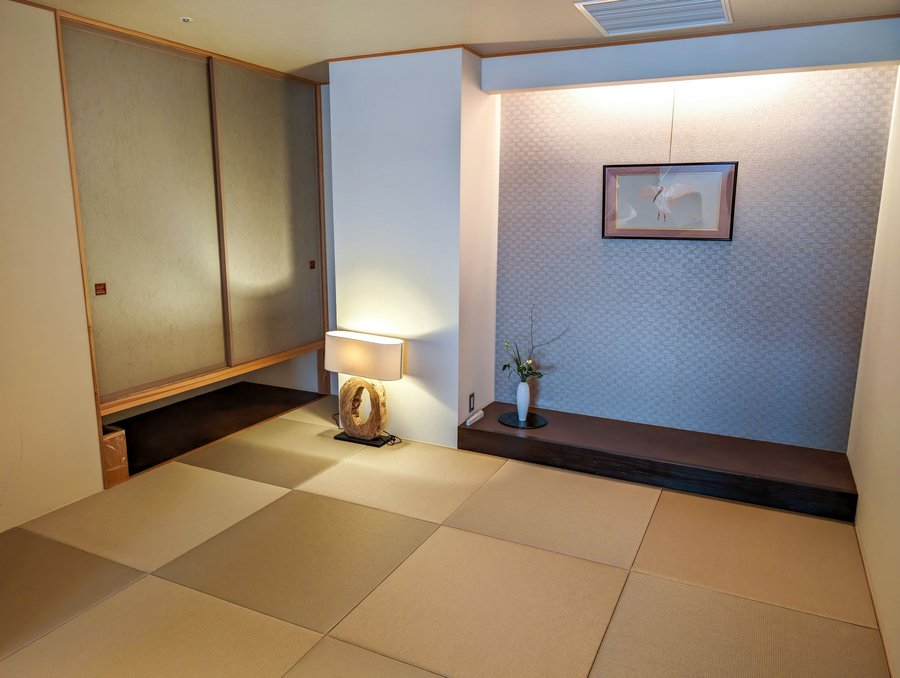 Kagaya Bettei Matsunomidori Special Room with Open-Air Bath, 140m² - Japanese tatami room
The biggest shortcoming, in my opinion, was the in-room Onsen experience. We were surprised to find the bath not being filled with hot springs, with no Onsen continually flowing into the tub - in order to fill the bath with Onsen, you need to push a button near the shower for the hot springs to be unleashed. There are problems with this approach: Because the temperature of the Onsen itself is not regulated and maintained at a predefined amount of warmth, as soon as the tub fills up you need to get in right away before the bath becomes to lukewarm to enjoy it. Once the temperature drops, you're best advised to drain the bath and start the process all over again. It's a real hassle, and something that we feel is unacceptable at a luxury Onsen ryokan that charges such high room rates. This issue can be circumvented by paying a visit to the communal bath, but if that's all you need, it sort of defeats the purpose of staying in a high-end ryokan. We had completely forgotten about this shortcoming during our last stay - we were probably less refined in our tastes back then. Be aware also that not all rooms have an Onsen bath. On the plus side, everything in the minibar is available free of charge, and the bathroom amenities are of high quality (although not unique.) Travel sized containers of lotion, shampoo, conditioner, body soap, moisturizer and other necessities are supplied by Omnisens (a Japanese brand), which seems to be what is offered by almost a third of the luxury ryokans in the country.
Kagaya Bettei Matsunomidori Special Room with Open-Air Bath, 140m² - Japanese tatami room
The biggest shortcoming, in my opinion, was the in-room Onsen experience. We were surprised to find the bath not being filled with hot springs, with no Onsen continually flowing into the tub - in order to fill the bath with Onsen, you need to push a button near the shower for the hot springs to be unleashed. There are problems with this approach: Because the temperature of the Onsen itself is not regulated and maintained at a predefined amount of warmth, as soon as the tub fills up you need to get in right away before the bath becomes to lukewarm to enjoy it. Once the temperature drops, you're best advised to drain the bath and start the process all over again. It's a real hassle, and something that we feel is unacceptable at a luxury Onsen ryokan that charges such high room rates. This issue can be circumvented by paying a visit to the communal bath, but if that's all you need, it sort of defeats the purpose of staying in a high-end ryokan. We had completely forgotten about this shortcoming during our last stay - we were probably less refined in our tastes back then. Be aware also that not all rooms have an Onsen bath. On the plus side, everything in the minibar is available free of charge, and the bathroom amenities are of high quality (although not unique.) Travel sized containers of lotion, shampoo, conditioner, body soap, moisturizer and other necessities are supplied by Omnisens (a Japanese brand), which seems to be what is offered by almost a third of the luxury ryokans in the country.
 Kagaya Bettei Matsunomidori Special Room with Open-Air Bath, 140m²
We enjoyed the kaiseki meals at Matsunomidori. Both dinner and breakfast are served in a koshitsu (private room.) The Noto Peninsula, where Wakura Onsen is located, is renowned for nature's bounty from both the sea and land, and the ryokan does a good job in getting the most out of the local ingredients (especially the seafood.) The sashimi, including the Amaebi Sweet Shrimp, was simply sublime, as was the boiled Snow Crab (the local variety in the area is called "Kano-gani.") While not every single dish was exceptional, overall we were satisfied with the high-quality and wonderfully presented servings. The same also applied to the Japanese breakfast - very good overall, although the food portions were a bit on the small side.
Kagaya Bettei Matsunomidori Special Room with Open-Air Bath, 140m²
We enjoyed the kaiseki meals at Matsunomidori. Both dinner and breakfast are served in a koshitsu (private room.) The Noto Peninsula, where Wakura Onsen is located, is renowned for nature's bounty from both the sea and land, and the ryokan does a good job in getting the most out of the local ingredients (especially the seafood.) The sashimi, including the Amaebi Sweet Shrimp, was simply sublime, as was the boiled Snow Crab (the local variety in the area is called "Kano-gani.") While not every single dish was exceptional, overall we were satisfied with the high-quality and wonderfully presented servings. The same also applied to the Japanese breakfast - very good overall, although the food portions were a bit on the small side.
 Kagaya Bettei Matsunomidori kaiseki dinner - Hassun (Seasonal Assortment Platter): Steamed lotus root cake with unagi (eel) in ankake sauce, Vinegared Japanese Ginger, Hyuganatsu Citrus with boiled citrus honey, Cheese mixed with Pacific Cod, Matsukaze (Chicken Savory Cake), Japanese Turnip Sushi with Japanese Amberjack, Kuromame Sweet Black Soybeans, Salted and dried Herring Roe, Aosa Nori Seawood-seasoned Japanese Rolled Omelette
Although we had a great second stay at Matsunomidori and are glad that we returned, it didn't quite live up to the fond memories and sky-high expectations that resulted from our amazing first visit many years ago. There is no shame in that, and it's still definitely a bona-fide luxury ryokan. But the inconvenient in-room onsen bathing process brings this property down a notch relative to some of the other top luxury ryokan stays that we've recently experienced.
Kagaya Bettei Matsunomidori kaiseki dinner - Hassun (Seasonal Assortment Platter): Steamed lotus root cake with unagi (eel) in ankake sauce, Vinegared Japanese Ginger, Hyuganatsu Citrus with boiled citrus honey, Cheese mixed with Pacific Cod, Matsukaze (Chicken Savory Cake), Japanese Turnip Sushi with Japanese Amberjack, Kuromame Sweet Black Soybeans, Salted and dried Herring Roe, Aosa Nori Seawood-seasoned Japanese Rolled Omelette
Although we had a great second stay at Matsunomidori and are glad that we returned, it didn't quite live up to the fond memories and sky-high expectations that resulted from our amazing first visit many years ago. There is no shame in that, and it's still definitely a bona-fide luxury ryokan. But the inconvenient in-room onsen bathing process brings this property down a notch relative to some of the other top luxury ryokan stays that we've recently experienced.
One thing to note - yes, we visited during Snow Crab season, but we had just gone to Nishimuraya Honkan a few weeks prior so we elected to go with a standard kaiseki course at Matsunomidori. It's nice that they offer a non-crab option, since some ryokans only serve crab courses during this time of year, making it difficult for travelers that want to stay at multiple ryokans in the Hokuriku region. More than one (maximum two) crab dinners and you'll definitely get crabbed out! Matsunomidori did, however, start by offering a small boiled crab dish. Yes, it was awesome. No, I don't think their crab course will exceed the quality on offer at Nishimuraya Honkan or Bouyourou, although I only have one reference point: when I asked the server which port the crab was delivered to, she didn't know the answer. This probably means that Matsunomidori is not as focused on crab as some of the other famed crab cuisine ryokans. I could be wrong, though - Ishikawa is known for having great Kano-gani (the name of the Snow Crab in the prefecture.)
One more thing to add - There is a special train that runs between Kanazawa and Wakuraonsen called "Hanayome Noren" ("Bridal Curtain") - I believe it only runs twice per day in each direction (although it might depend on the season.) The train has three cars and is beautifully painted and decorated in a way that pays homage to the regional tradition where brides walk through a special "Noren" (curtain) and into a room with an altar in the groom's house. This is where the groom and his family awaits, and where the actual ceremony takes place. Back in the day, once a bride marries into the groom's family, it was not uncommon for the bride to never see her own family ever again. Hanayome Noren is prepared by the bride's mother for use in the ceremony and was a symbol of affection of the bride's family and the threshold to her new life. The bride’s family crest is featured at the top of the curtain; the last time she would use it. The bride’s mother designs the curtain with her daughter in mind. This one-of-a-kind curtain served as a tangible expression of her mother’s love and hopes for her daughter’s future happiness. It would be displayed for visitors to the groom’s home for a few days after the wedding, then carefully packed away in a drawer, never to be used again. Aside from the unique design and layout (both outside and inside), there really isn't a major difference from a normal regional train. You can, however, order a special Hanayome Noren bento lunch, but you need to order it at least 4 days in advance. On our return, we decided to ride the Hanayome Noren train to Kanazawa, have a 2 hour layover to do some shopping in Kanazawa Station (it's awesome), the hop onto the JR Thunderbird to head back home. Worth a try if you're into this sort of thing.
 Hanayome Noren train from Wakuraonsen Station to Kanazawa Station
 Hanayome Noren train from Wakuraonsen Station to Kanazawa Station
 Hanayome Noren train from Wakuraonsen Station to Kanazawa Station
And... if you want to really get into the Hanayome Noren thing, there's a Hanayome Noren Museum near Nanao Station (about a 15 minute cab ride from Matsunomidori) that has an exhibit of the Hanayome Noren curtains from the Edo Period to modern times (although such ceremonies are exceedingly rare these days), as well as a display of traditional bridal outfits. You can even be dressed up and do the bridal curtain experience yourself. And that's exactly what Mrs. KI-NRT did

.
 Hanayome Noren-kan Museum (花嫁のれん館) - Bridal Curtain Experience (花嫁のれんくぐり体験)
 Hanayome Noren-kan Museum (花嫁のれん館) - Bridal Curtain Experience (花嫁のれんくぐり体験)
And after visiting the Hanayome Noren Museum, you can walk over (just one block away) and explore Ipponsugi-dori Street, a charming, old-fashioned main street lined with many old, historical shops that have been registered as tangible cultural properties of Japan. There are around 50 shops, some of the stores have allow you to take part in workshops such tea grinding at a tea shop or soy sauce making at a shoyu brewery.