We took our mothers on a 3-day/2-night trip to Nagano - they had yet to see Matsumoto Castle and that was the primary purpose of our visit to the area. For our first night, we stayed for a third time at Sui Suwako... it was just as solid as our previous visits, with polished service, great food, comfortable accommodations and the incredible rooftop communal Onsen that allows mixed-gender access (they offer complimentary Onsen "clothing" for all bathers) and panoramic views of Lake Suwa and the Japan Alps in the distance.

For our second night, we decided to take a drive to Yamada Onsen, a small town about 20 minutes away from Nagano City. Fujiiso is the historic property in the area - it has a 240-year history and has many repeat guests. The main attraction of this part of Nagano is Matsukawa Keikoku, a gorge/ravine that is considered among the most beautiful in the country. But it's only worth seeing during the green and fall foliage months - we were greeted with leafless trees, but we knew that going in. Otherwise, Yamada Onsen is a very sleepy hot springs town with not much else to keep a person preoccupied, and you're probably best served by getting around via rental car (it's easy to drive in Japan, by the way.)
 Fuji Balcony Suite inside entrance walkway
Given that it's a bit "old," I would not have given Fujiiso much thought, except that two new rooms (Fuji Balcony Suite and Yamazakura Balcony Suite) were newly built and were spacious and fresh, but with still the traditional Japanese decor and furnishings. Upon first arriving and being ushered into the lobby lounge area, I was struck at how large it was... it seemed more befitting of a property with 100+ rooms (Fujiiso only has 24), as there were chairs and tables everywhere and an expansive viewing area that should be picturesque during the Summer and Fall (and perhaps Winter) months. Downstairs, there were some elaborate
Byobu (folding screens with traditional artwork) as well as
Ohina-sama dolls, which are often exhibited in establishments throughout Japan during the month of March (Girl's Day), and has been a tradition since the Heian period, dating back almost a thousand years ago.
 Fuji Balcony Suite
The two new rooms at Fujiiso are the
Tokubetsu Shitsu (i.e. "special") rooms. They're newer (built in October 2022) and more spacious than the others, and also have free-flowing Onsen baths that come straight from the source (some other rooms have this feature as well.) The Fuji Suite has a granite Onsen bath whereas Yamazakura's is of the hinoki (cedar) variety. Otherwise, while both rooms tick similar boxes, the pick of the two is definitely Fuji. It's larger overall (158m² vs. 110m²) and has a very nice entrance hallway that Yamazakura lacks. Both suites have a Western-style living room, a Japanese tatami room, a bedroom with Western beds, two sinks in the wash basin as well as a shower/bathing area that allows the guest to open up the large windows to turn it into a half open-air Onsen bath.
 Fuji Balcony Suite's Onsen bath
We were assigned a
Nakai-san (butlers) to each of our rooms, and both were elegant and charming. While both Mariko and Chie (Chie speaks good English and is usually assigned to foreign guests) were stellar, Mariko was solely responsible for serving both dinner and breakfast, given that the four of us dined together. Meals are served in a private room (although not in one's own room) and the cuisine focuses on
the local produce, seasonal vegetables, and sansai (wild plants), for which Nagano is renowned for. White Asparagus, Bamboo Shoots, Nozawana (Japanese Mustard Leaves) and Nanohana (Young Ferns of a Rapeseed Plant) were all in peak season, and Head Chef Atsushi Fujimoto does a wonderful job introducing the best that Nagano has to offer in his unique and creative way.
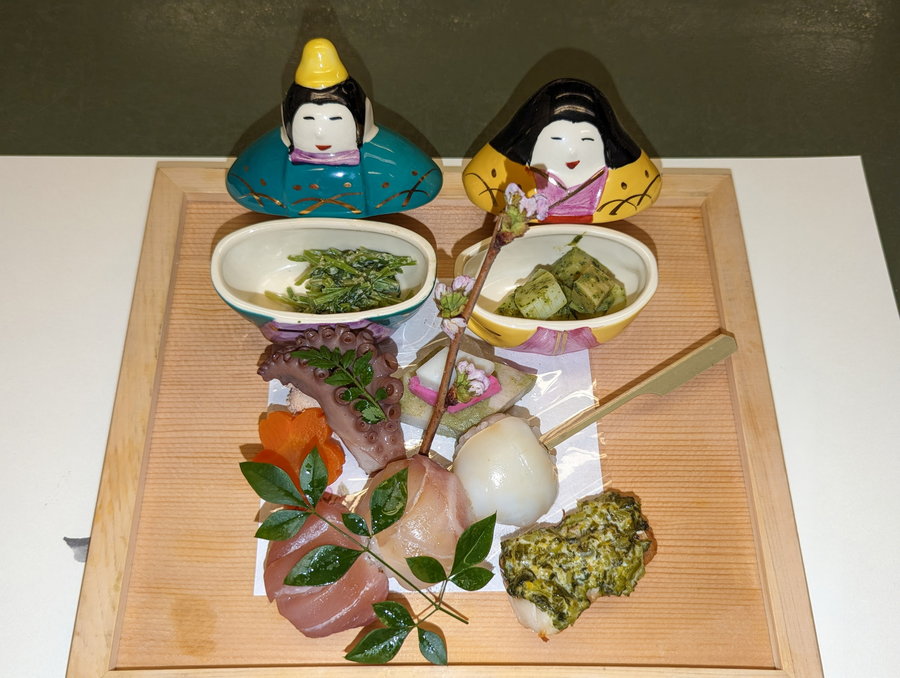 Zensai appetizers with Ohina-sama decorations
A few examples: the Grated White Asparagus soup with Uni (Sea Urchin) and Shiso flowers on top was light but filled with Umami and the soup and Uni combined very nicely, both in terms of texture as well as flavor. The Shinshu Soba (Shinshu was the name of Nagano prefecture before the Meiji Restoration) which, rather than prepared as the typical buckwheat Soba noodles, was served as Age Soba Gaki, which is the buckwheat flour that has been fried, and served with Spring onions, toasted and crumbled Nori seaweed and Momiji Oroshi (grated daikon radish with togarashi red chili peppers.) Another excellent offering was the dashi-based clear soup dish that came with Red Sea Bream wrapped over mochi, along with bamboo shoots, Nanohana, daikon radish and gold flakes.
Zensai appetizers with Ohina-sama decorations
A few examples: the Grated White Asparagus soup with Uni (Sea Urchin) and Shiso flowers on top was light but filled with Umami and the soup and Uni combined very nicely, both in terms of texture as well as flavor. The Shinshu Soba (Shinshu was the name of Nagano prefecture before the Meiji Restoration) which, rather than prepared as the typical buckwheat Soba noodles, was served as Age Soba Gaki, which is the buckwheat flour that has been fried, and served with Spring onions, toasted and crumbled Nori seaweed and Momiji Oroshi (grated daikon radish with togarashi red chili peppers.) Another excellent offering was the dashi-based clear soup dish that came with Red Sea Bream wrapped over mochi, along with bamboo shoots, Nanohana, daikon radish and gold flakes.
 Grated White Asparagus soup with Uni and Shiso flowers
The signature dish at Fujiiso is an original creation that's known as Ponpon Nabe, a fondue-type cuisine where skewers are deep-fried in a hot pot filled with Olive Oil. There were a variety of skewers such as Sweet Potatoes stuffed with Apple bits, Shrimp with burdock roots, Mochi filled with Nozawana and Butter Burstalk wrapped with Shinshu Pork. Upon first glance, there seemed to be way too many skewers, and looked quite heavy and filling. However, we wound up devouring every single one - they were all tasty, relatively light and not very oily.
Grated White Asparagus soup with Uni and Shiso flowers
The signature dish at Fujiiso is an original creation that's known as Ponpon Nabe, a fondue-type cuisine where skewers are deep-fried in a hot pot filled with Olive Oil. There were a variety of skewers such as Sweet Potatoes stuffed with Apple bits, Shrimp with burdock roots, Mochi filled with Nozawana and Butter Burstalk wrapped with Shinshu Pork. Upon first glance, there seemed to be way too many skewers, and looked quite heavy and filling. However, we wound up devouring every single one - they were all tasty, relatively light and not very oily.
 Age Soba Gaki (Fried Soba Buckwheat flour dough)
Overall, we really enjoyed our stay at Fujiiso. It was a nice opportunity to stay at a historic and famous ryokan without having to compromise on comfort and amenities. While Yamada Onsen itself has very little to offer (especially when it's not green or autumn leaves season), I would much rather go an extra 30 minutes to an hour away for the opportunity of a unique ryokan experience. That's what we were after, and that's exactly what we got.
Age Soba Gaki (Fried Soba Buckwheat flour dough)
Overall, we really enjoyed our stay at Fujiiso. It was a nice opportunity to stay at a historic and famous ryokan without having to compromise on comfort and amenities. While Yamada Onsen itself has very little to offer (especially when it's not green or autumn leaves season), I would much rather go an extra 30 minutes to an hour away for the opportunity of a unique ryokan experience. That's what we were after, and that's exactly what we got.