Last week we took a quick road (+ ferry) trip to two of the better known islands in the Seto Inland Sea ("Setonaikai" in Japanese) - Shodoshima and Naoshima. We drive to Himeji and then took a two hour ferry to Shodoshima. It's the second largest island in the Seto Inland Sea (after Awajishima in Hyogo Prefecture), and is primarily known for Olives (it's the birthplace of Olive cultivation in Japan) and Soy Sauce production. There are several places to check out, although nothing on the island are bucket list-type spots. Still, it's a peaceful place to laze away and do some light sightseeing.
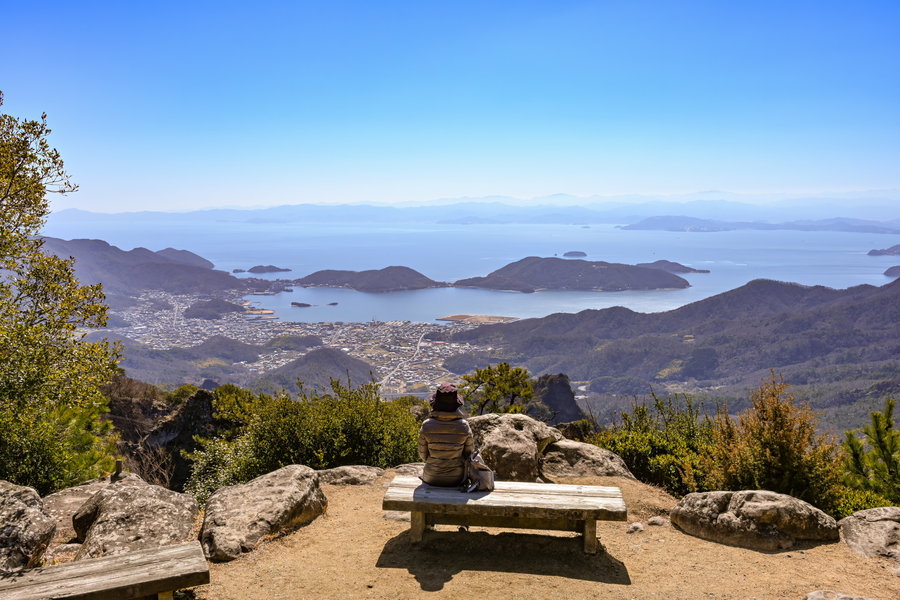 View from the top of Kankakei Gorge
Kankakei Gorge is picturesque, particularly during the autumn leaves season. It's at its worst when there is no snow or no foliage at all, which was the case when we visited. There is a short ropeway that takes you to the top of the gorge, where you are treated to panoramic views of the Seto Inland Sea as well as the surrounding islands. Shodoshima also has an "Olive Park," a working olive garden that has some walking paths, a souvenir shop and a re-creation of a Greek windmill which was the setting for the movie
'Kiki's Delivery Service." The other notable place to visit is an outdoor set for the filming of “Nijushi no Hitomi (Twenty-Four Eyes),” a classic movie based on the book by Tsuboi Sakae.
 Twenty-Four Eyes movie studio set (Nijushi no Hitomi Eigamura)
We chose to stay at Umioto Mari, a new-ish ryokan (opened in April 2019) that is the sister property of Shimoyado Mari, which is about 10 minutes away by car/bus. We were torn as to which ryokan to choose, as each has its pros and cons. Ultimately, we settled on Umioto Mari because of its newness (Shimoyado is slightly more traditional in build and furnishings) as well as views of the Ocean from the guest rooms. It features 6 rooms total, with two of them being "Hanare" (separate Villas) that are each 73m² in size - adequate but with a few minor shortcomings and one major one. For such a new property, we were surprised at the room having only one sink/vanity, and the fact that the top category room did not have separate bedroom and living rooms. Minor annoyances, yes, but the major one had to do with the bath - it's not Onsen, nor is there one anywhere on site (there is no communal bath here, either.) I should have done my research in advance (the website does not confirm or deny the existence of Onsen), but I assumed that Umioto Mari would have it since Shimoyado Mari definitely does. Oh, and you have to fill up the bath by yourself (it's not constant, free-flowing and temperature-regulated - yes, first world problems, but remember, this is Japan.) From speaking to the manager, he said the owner drilled deep underground, but did not hit the jackpot. As a result, they carry Onsen from Shimoyado Mari and then mix it with ground water. In other words, it's technically half Onsen. Nice, but if Onsen is something you're really after, this isn't going to cut it.
 Umioto Mari hanare Villa "To" No Oto, 73m²
The rest of the property is charming, if a bit small. There is no Japanese garden, but that's compensated by the wonderful view of the Ocean. By contrast, Shimoyado Mari is in the center of town, which is a plus or minus, depending on what you're after. We had our car with us, so getting around was easy; therefore, the ability to unwind in a more tranquil setting fit the bill for us.
 Umioto Mari hanare Villa "To" No Oto, 73m²
 View from room
The star attraction at Umioto Mari is the wonderful "Olive Kaiseki" dinner. Basically, just about every dish (there were 12 total courses served when we stayed) has an Olive component to it - mainly Olive Oil. Going in, we were somewhat curious and concerned that we'd be "olived-out" by the time we were halfway through dinner, but this couldn't have been further from reality - the executive chef did an incredible job in presenting Shodoshima's bounty from the land and sea, and infusing it with Olive flavors that were an enhancement rather than a gimmick.... in no way did the Olive additions overpower the other ingredients. Examples included Celery juice with Yuzu Olive Oil (Yuzu is a small Japanese citrus), Miso-marinated Olive-fed Hamachi (Yellowtail), Olive oil-steamed/Olive-fed Chicken, and grilled Olive-fed Sanuki Kuroge Wagyu beef shank. And as a palate cleanser, there was a Milk and Rosemary Sorbet that had Olive Oil poured over it and then frozen, creating a hard, Magic Shell-like texture to the outer surface.
 "Olive Kaiseki" dinner - Course 3 of 12
While most top gourmet ryokans take pride in training their waiters to be experts at every dish and every ingredient, but Umioto Mari seemed to take it to another level. We love the stories behind how things are selected and carefully crafted, but even for us, they went a tad overboard in explaining the type of Olive Oil that was used for every dish, and how they were farmed and how each one was different. I felt it was a bit over the top when hearing about Olive Oil in the same way that a Sommelier explains fine wine. Regardless, I appreciated their ability to explain everything in detail, and have answers to any and all questions that I had. Kudos to them.
 Sashimi and Vegetables - course 5 of 12
The only drawback has to do with the meal times - for dinner, it's either 17:30 or 19:30, and that's it... no other options. While there are other ryokans that have similar policies, we wished that they showed more flexibility when we were there, given that only 3 of the 6 rooms were occupied and we wished to have our dinner pushed out by 30 minutes to 18:00 - we spent more time than we anticipated in touring Shodoshima and checked in somewhat late. Nope, they say. Not sure why not; there is enough seating for 4 groups of guests in the restaurant at any given time (2 tables, and 4 available counter seats.)
Sashimi and Vegetables - course 5 of 12
The only drawback has to do with the meal times - for dinner, it's either 17:30 or 19:30, and that's it... no other options. While there are other ryokans that have similar policies, we wished that they showed more flexibility when we were there, given that only 3 of the 6 rooms were occupied and we wished to have our dinner pushed out by 30 minutes to 18:00 - we spent more time than we anticipated in touring Shodoshima and checked in somewhat late. Nope, they say. Not sure why not; there is enough seating for 4 groups of guests in the restaurant at any given time (2 tables, and 4 available counter seats.)
Overall, we enjoyed our stay here. One of the great pleasures of exploring rural Japan is in experiencing regional cuisine, and Umioto Mari did a wonderful job in representing this aspect of Shodoshima.