November 15th, 2022
Amtrak Chicago to Emeryville * California Zephyr * 200p – 410p +2 * First Class Roomette * Car 531-Room 12
A friend asked me once “Why do you like to ride the
California Zephyr so often?” From this person’s logical and reasonable perspective, a train – even one traveling through such scenic lands as the
California Zephyr - was just a means to an end, seen only as a means of transport – no more, no less. I get it, but I think it really depends upon your perspective.
I really enjoy the natural beauty of this planet – in particular the American West. I also really like riding trains. And I especially like riding the
California Zephyr because in my estimation it offers the best scenery of any of the long distance American trains.
Here is a map of the Zephyr’s route:
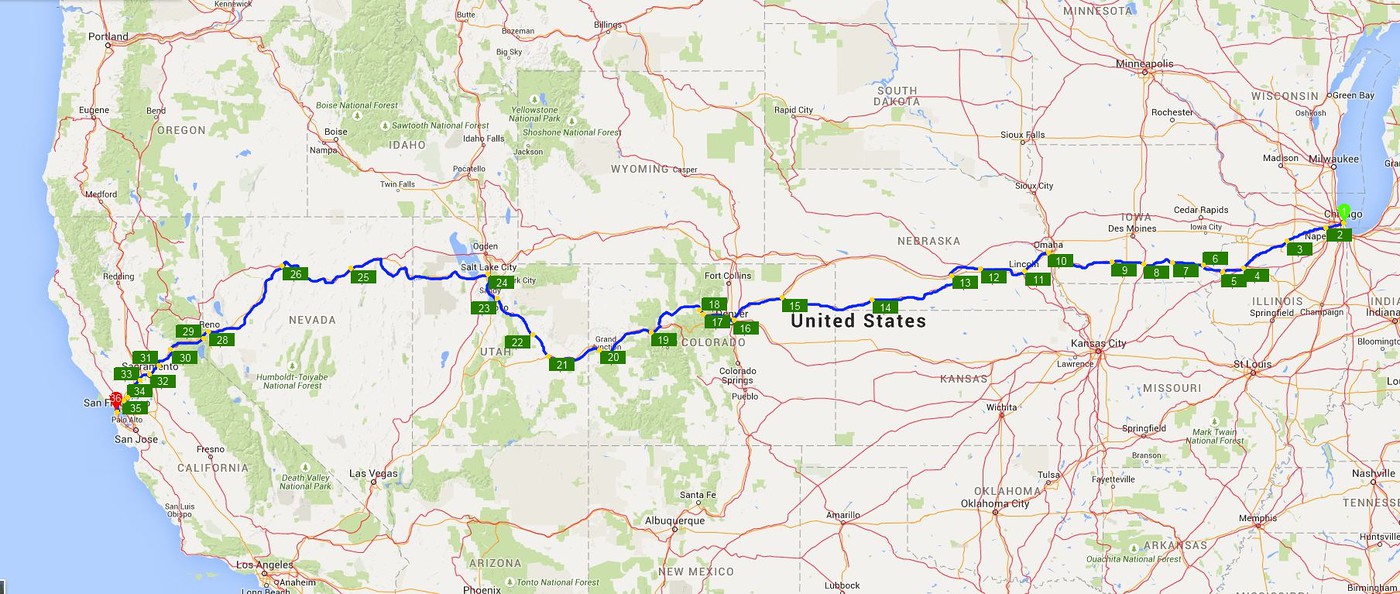 The route of the California Zephyr
As to perspectives - I didn’t get a driver’s license until I was 23. I hitchhiked everywhere, including all over the country. So when I finally did get a car, I was totally happy with good reliable transportation – with an emphasis on reliable. My last vehicle was a Mazda B-2200 4-cylinder truck that I drove for 21 years, through three engines and 493000 miles. My current vehicle is a 2001 Toyota Tacoma. I bought it used in 2009 and it’s still going strong today. Above all, it’s reliable. I could care less about speed or handling. If I won the Mega-Jackpot tomorrow I would not go out and buy a new truck. My 21 year old Toyota works just fine.
The person who asked the question about me and the
California Zephyr just happens to own a BMW sedan. He really appreciates the responsiveness in acceleration and cornering found in a fine German automobile and is willing to spend considerably more to purchase such a fine driving machine. He also likes to drive it. A lot. So I could just as easily have asked him “How come you like to take so many weekend roadtrips?”
Anyway, whatever floats your boat. Fly your freak flag and fly it proud! Just as I log my flights, I also log my train rides. This upcoming trip aboard the
California Zephyr will be my 33rd, for a total of 51960 miles. For me at least, the experience of riding this train never gets old!
* * * ~ X ~ * * *
After spending the night at an O’Hare area hotel, I caught the Blue Line train from O’Hare into the Clinton St. station. This station is only a three block walk from Chicago’s Union Station, but it is also one of the few downtown stations that don’t have an elevator or escalator up to street level. Though this was never an issue in years past, it’s become more of one these days. It was a long haul with my bag up the long narrow stairway to the street but it just took longer was all. I think from now on I’ll get off a station or two earlier and then grab a cab to Union Station.
New York’s Grand Central Station is my favorite train station in the world. Kansas City and Denver’s Union Stations would probably be my second and third favorites, then Washington DC and Chicago’s Union Stations would round out the top five.
Chicago’s Union Station is massive, taking up approximately nine and a half city blocks. Built in the popular Beaux-Arts style seen in stations at Kansas City, St. Louis and Denver to name just a few, Chicago’s Union Station is known for its distinctive Corinthian columns and magnificent Great Hall. The station was designated as one of America’s “Great Places” by the American Planning Association. For those that have an hour or two between trains, it’s worth having a look around this great station.
Passengers traveling in First Class sleeper accommodations have access to Amtrak’s Metropolitan Lounge. This lounge was rebuilt and refurbished about five years ago. It’s an okay lounge – which is to say it beats hanging out in a station waiting room – but compared to the best airline lounges (including U.S. airline lounges), it still leaves much to be desired. It’s got some comfortable seating areas but food and drink are limited to a mini-bar and a food service island offering hot and cold non-alcoholic drinks along with bags of pretzels, cookies and packaged muffins in the morning. You can see more pictures and information about this lounge as well as Chicago Union Station
HERE.
I didn’t even walk into the station until about an hour before train time, so rather than hang out in the lounge I headed straight upstairs to the food court where a McDonald’s Quarter Pounder and fries would have to tide me over until dinner later this evening onboard the train.
Amtrak offers a complimentary electric cart service from the Metropolitan Lounge to the trains for those desiring of it – mainly older or disabled folks. Depending upon the track assigned, it can sometimes be a bit of a walk to the departure gate, and then – since the westbound trains are often backed onto the platform – you’re also looking at a long walk down the length of the train to your car. So yes, a ride on the cart all the way to my car was at this stage well worth a $5.00 tip for the driver.
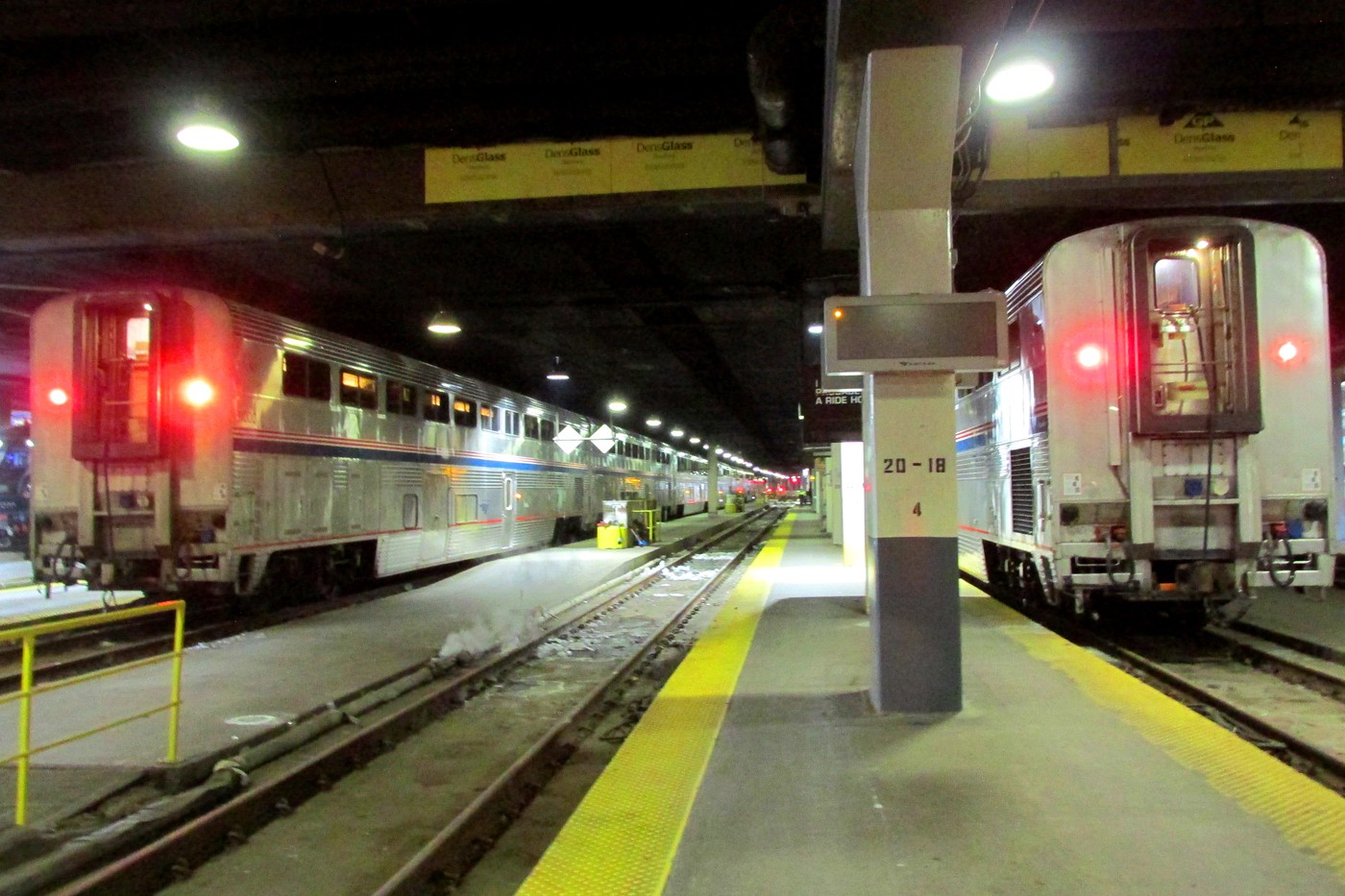 Train time at Chicago Union Station
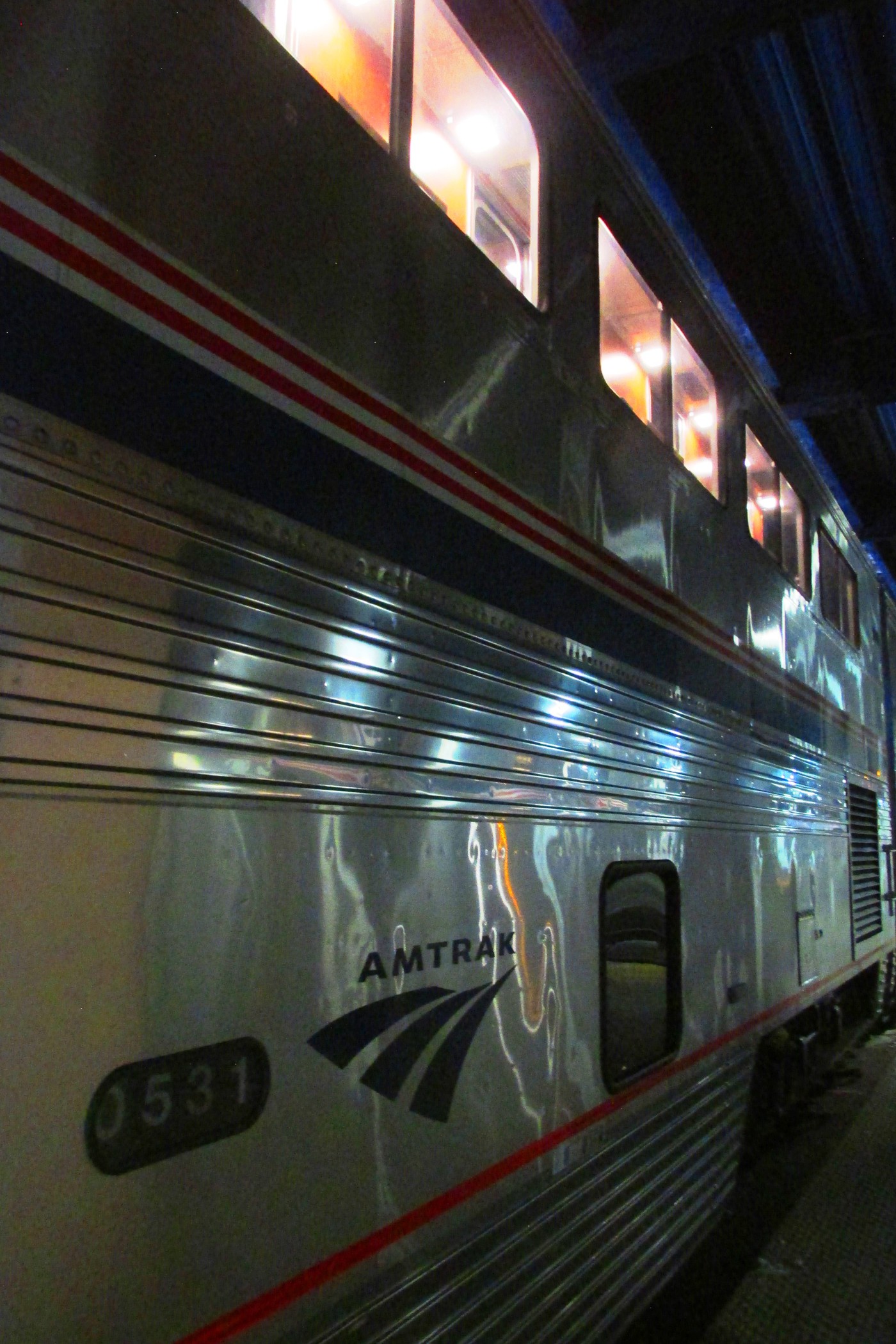 My Sleeper awaits
By this time, you’ve all read plenty in this report and others about the boarding procedure, the Superliner car and roomette descriptions and the rationale behind my usual choice of rooms downstairs versus upstairs. Let’s fast forward to the scenic part of this trip which begins on the second day as we depart Denver Union Station and commence what I consider to be the most scenic day you can have as an Amtrak passenger – the westbound passage of the
California Zephyr between Denver and Salt Lake City.
It was snowing lightly as we departed the Denver yards and slowly picked up speed until eventually we were rolling through Denver’s northwestern suburbs at about 50 mph. The whistle off the lead locomotive blew loud and often as we sped through crossings at Sheridan, Wadsworth and Kipling Streets – black and white striped gates down, bells clanging and red lights flashing. Soon we began the gradual climb into the foothills of the Rockies, starting with the Big Ten Curve, so named because the radius of the track’s curve is ten degrees, based on the method railways uses to measure curves. In the middle of the curve is a row of about two dozen hopper rail cars filled with cement. In the early 1970s they were permanently parked on a separate track inside the curve, and welded to the track, to serve as a wind block in this notoriously windy and snowy stretch of track.
Climbing ever higher, we then entered the first of 29 tunnels that would assist us in our journey through the Rockies along the old Denver & Rio Grande Western tracks once dubbed “
The Mainline Through The Rockies”.
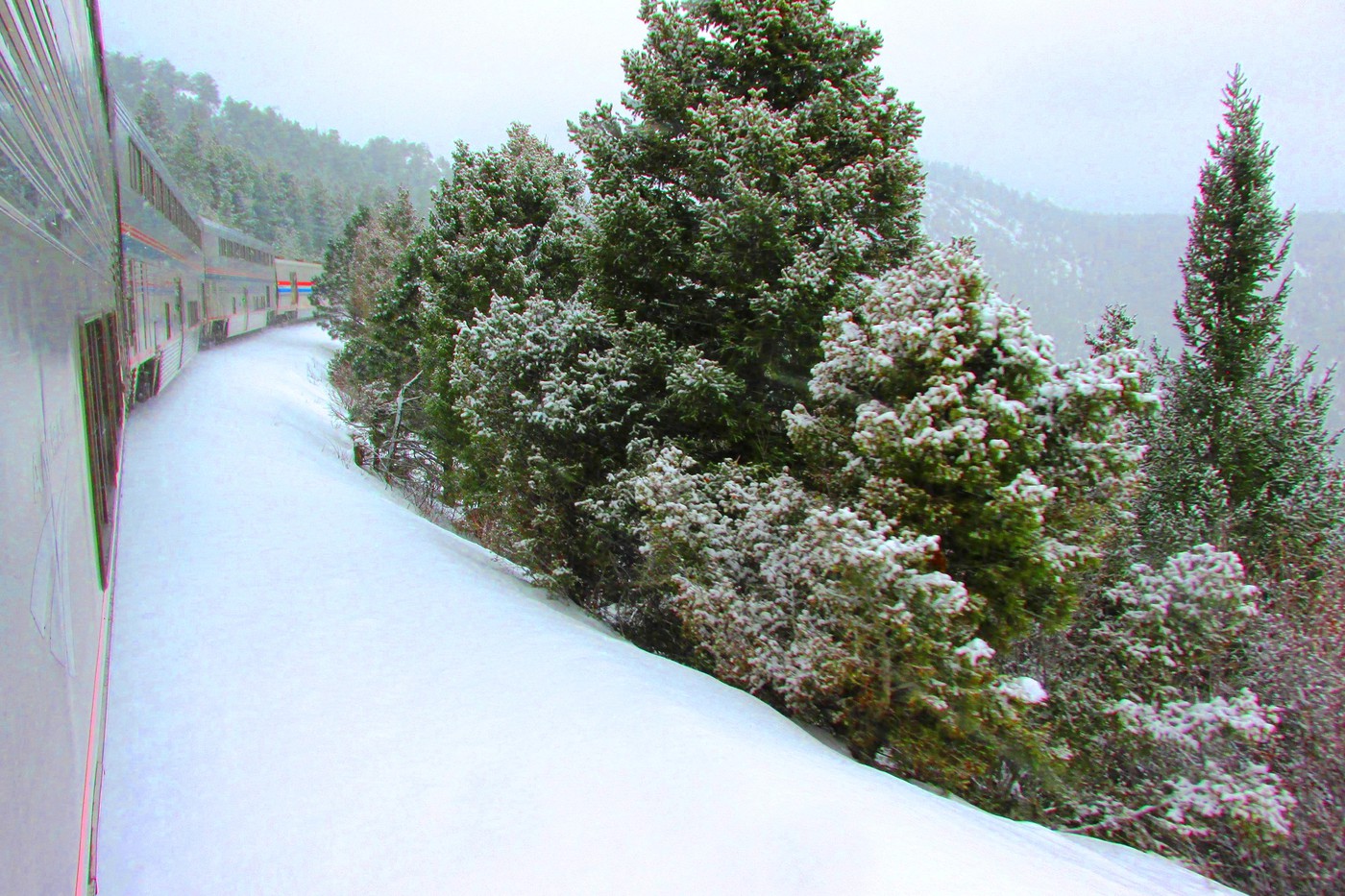 Climbing up into the snowy Rockies
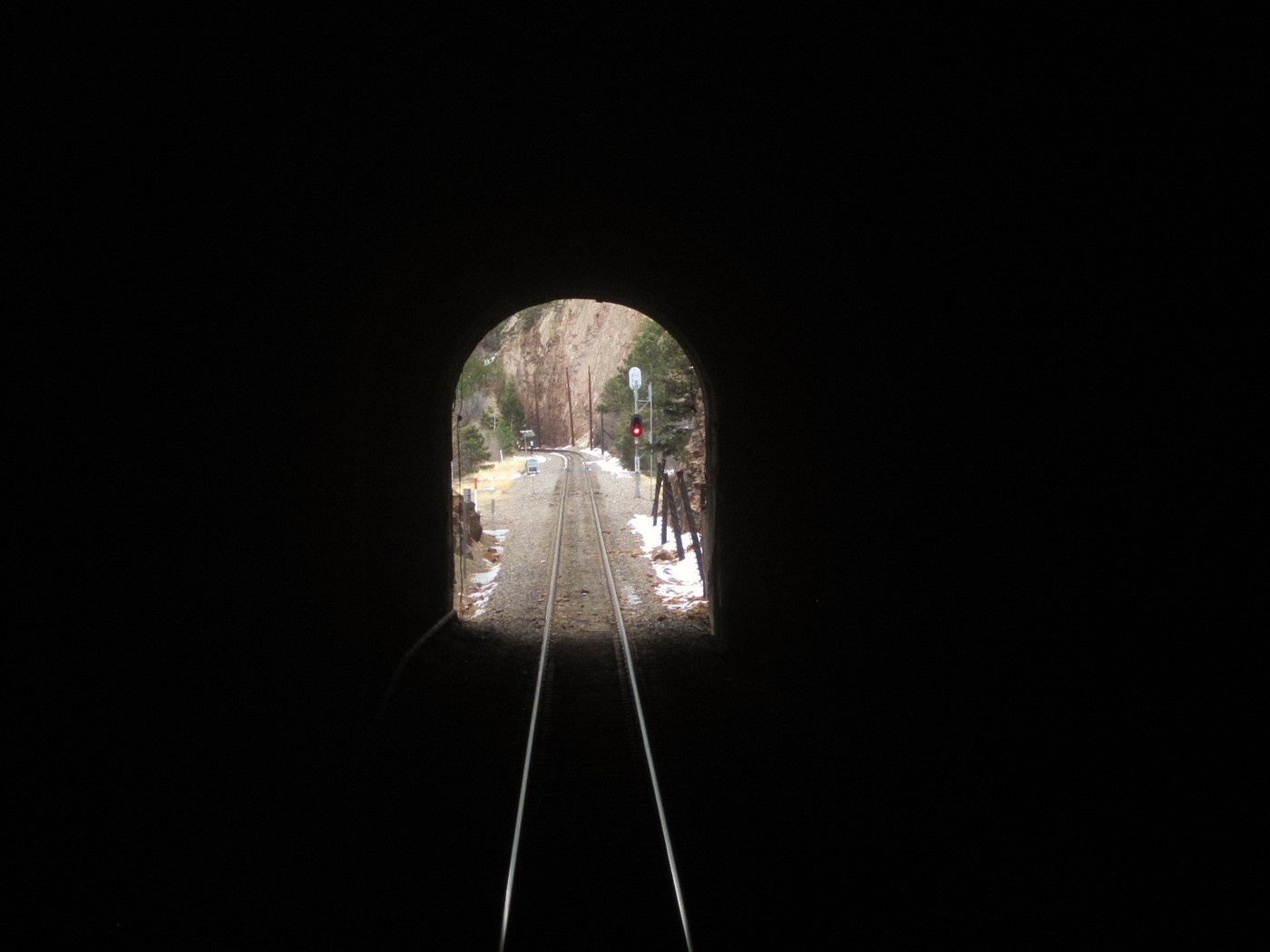 Tunnel Vision
Though cold and snowy outside, inside the Zephyr it was warm and comfy. This was especially true while stretched out on the lower bunk, two pillows providing comfortable support while out my window I watched as skies slowly began to clear allowing the sun to shine on the beauty of the Western Slope.
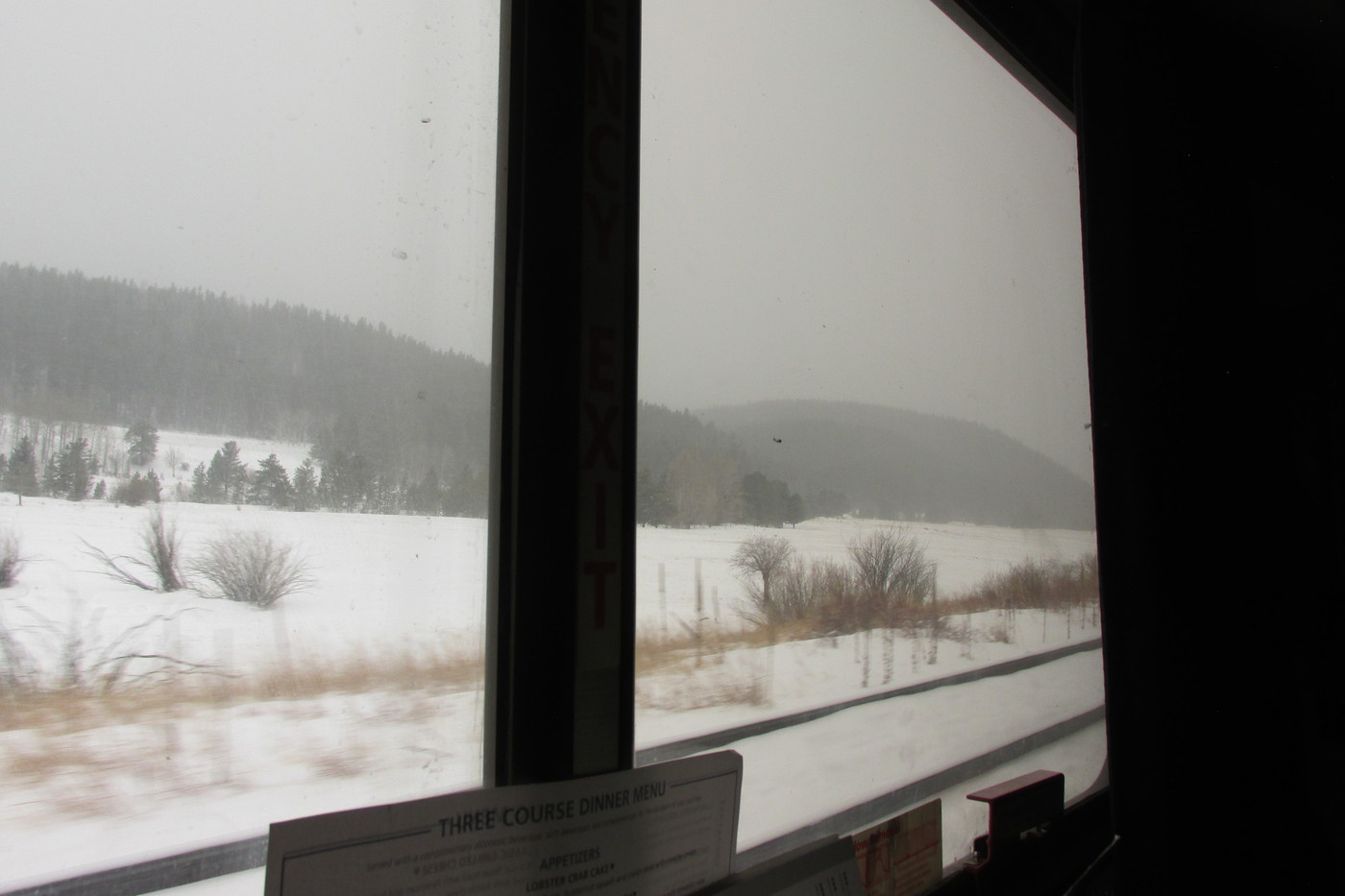 Wintry weather along US 40 outside Granby, CO
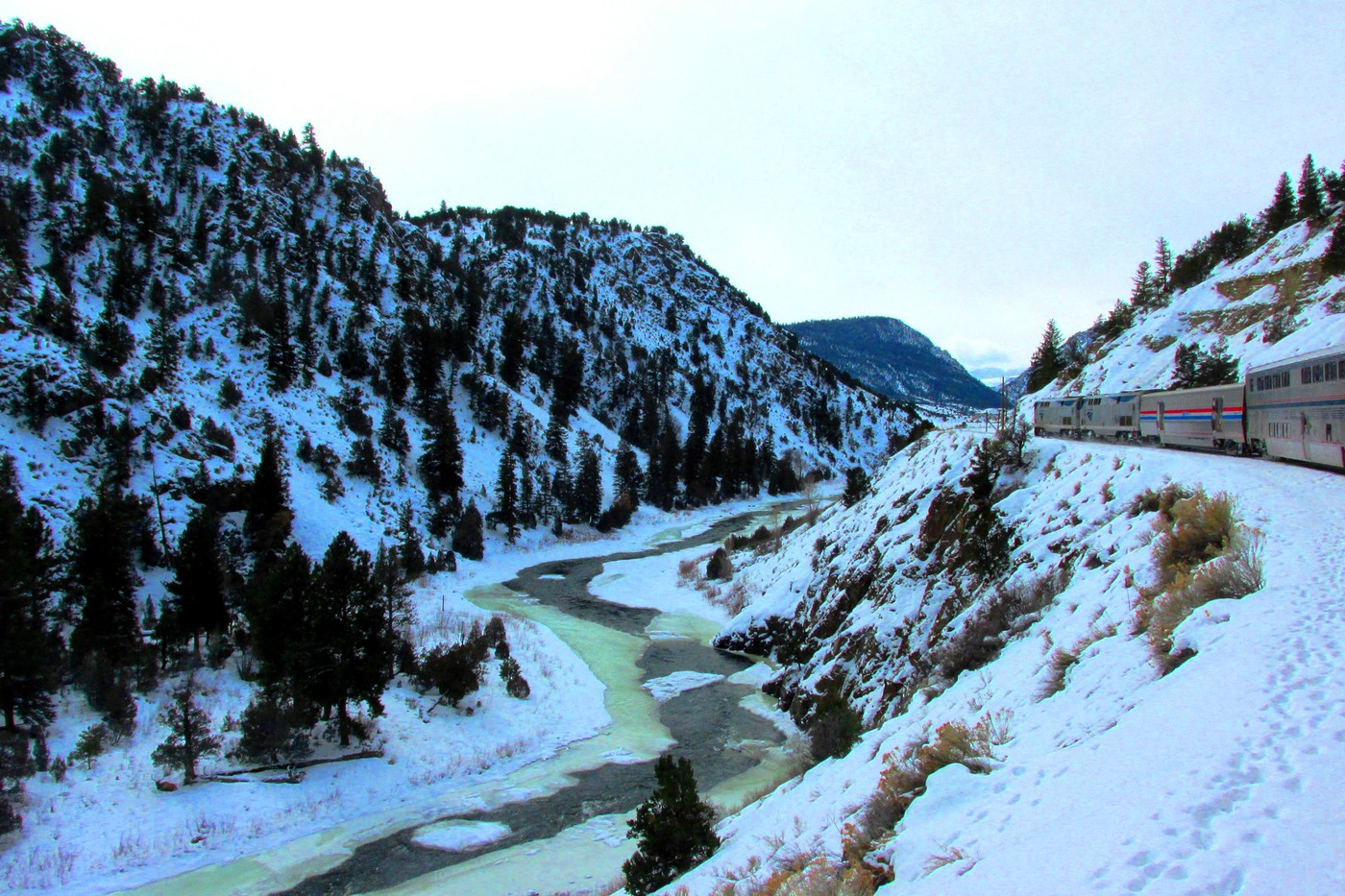 Clearing skies
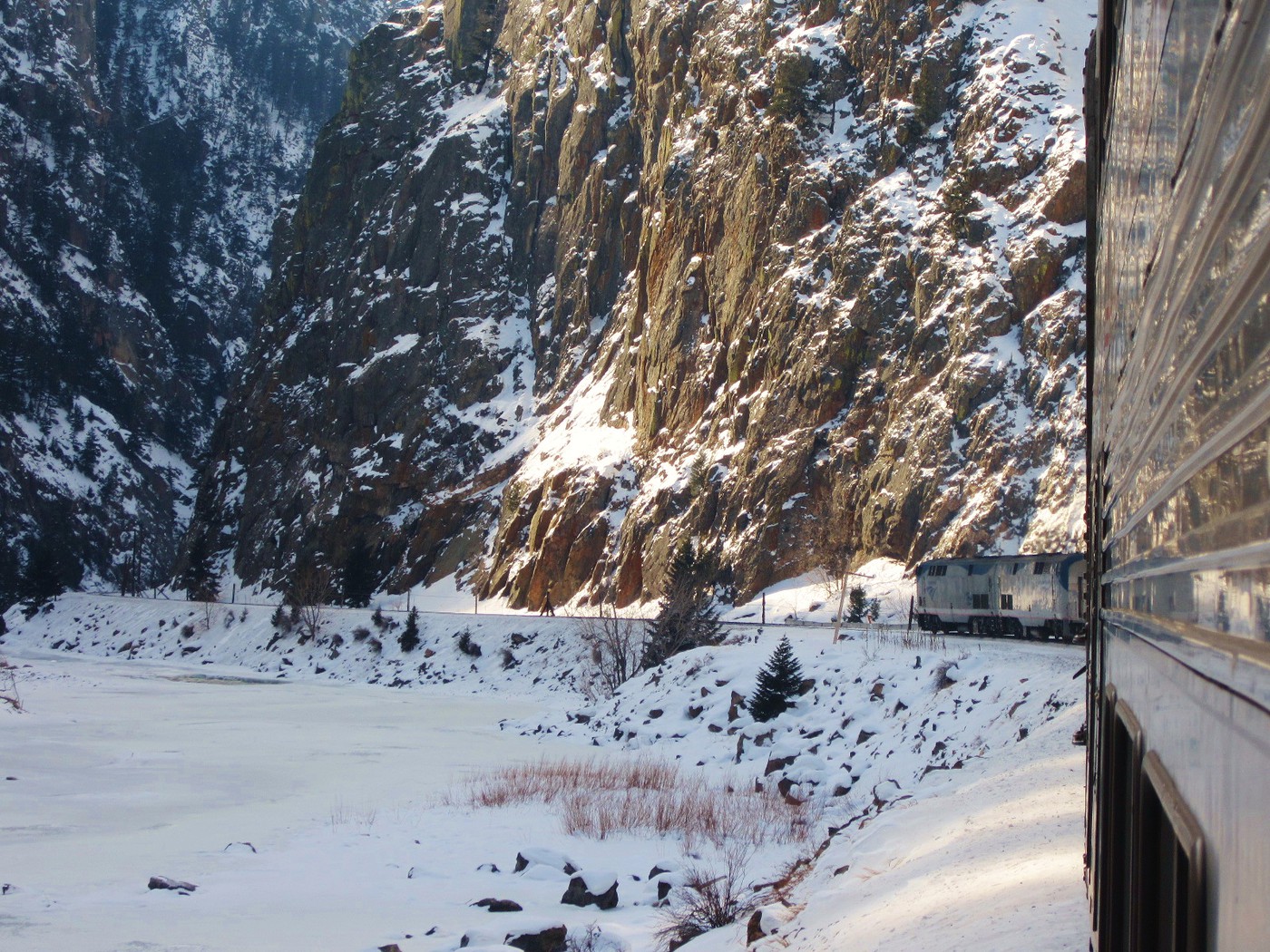 Spectacular canyon country
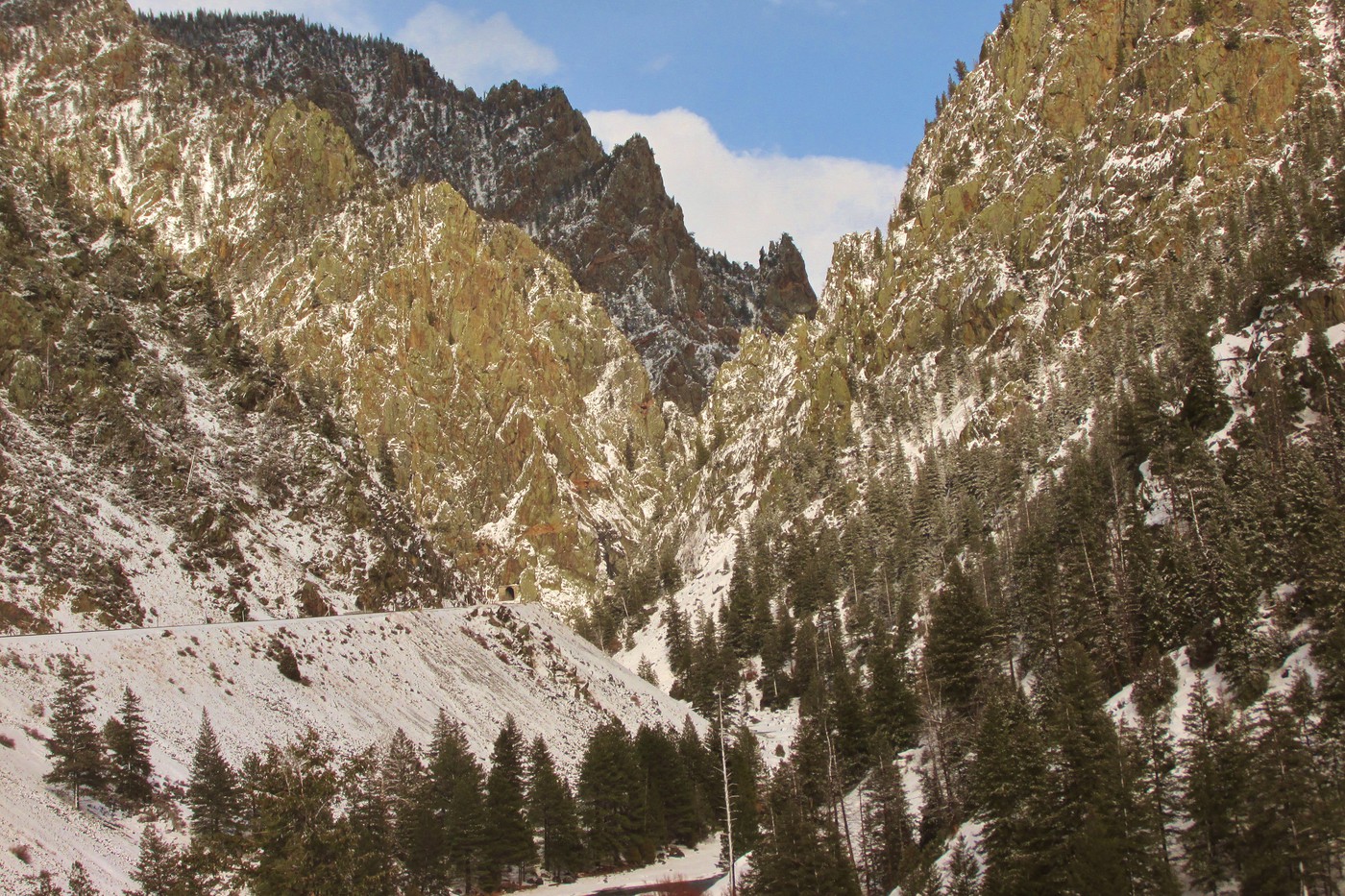 Spectacular canyon country
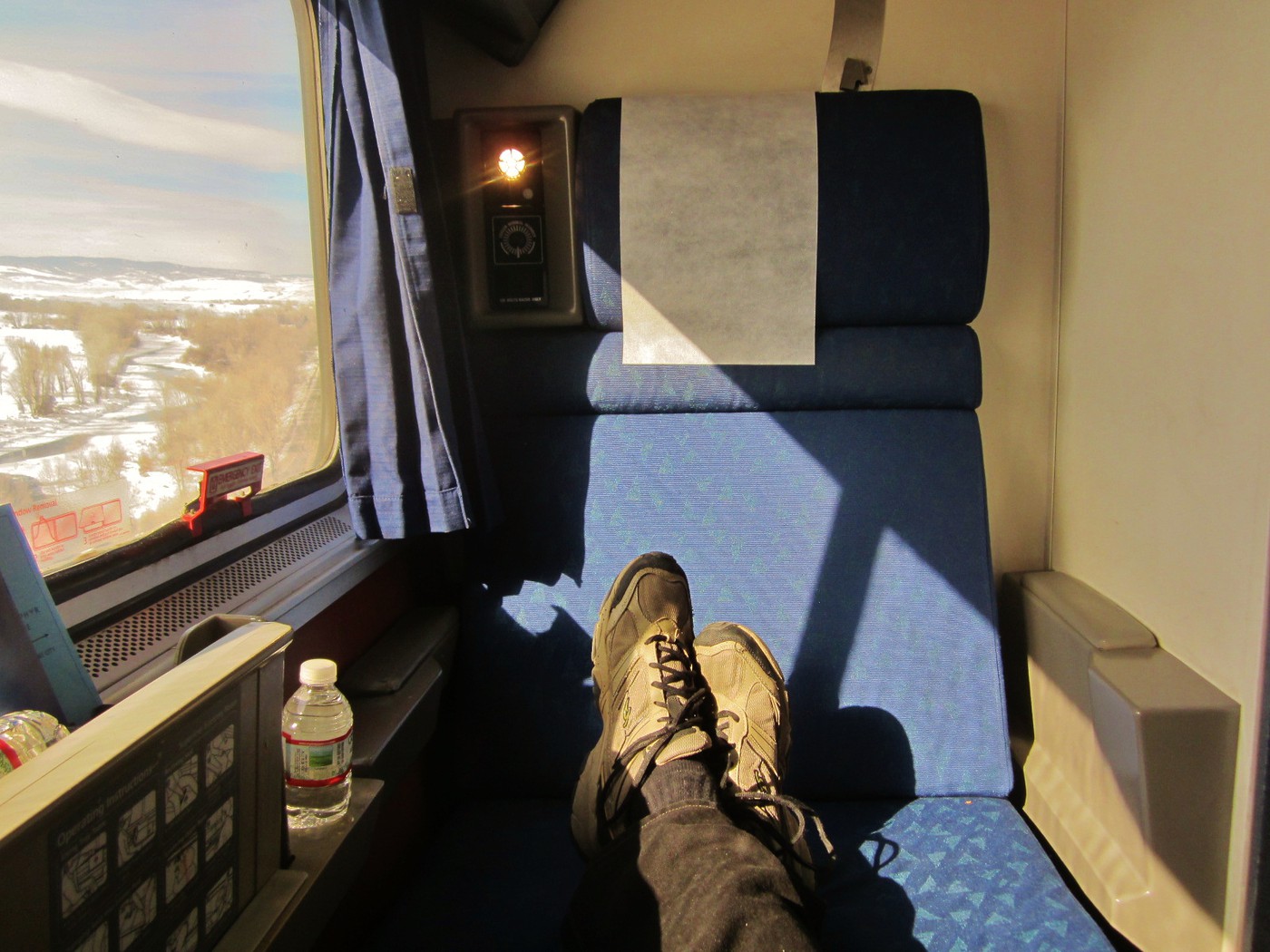 Ah… what a great way to travel…
The
California Zephyr travels alongside the Colorado River for 235 miles through a variety of canyons - some spectacular, others merely beautiful. By the time we passed under State Bridge and what of it there is of Bond, Colorado, the skies had cleared significantly – all the better to highlight the beauty of the red rock canyons from which Colorado derives its name. A visit to the Sightseer Lounge was in order…
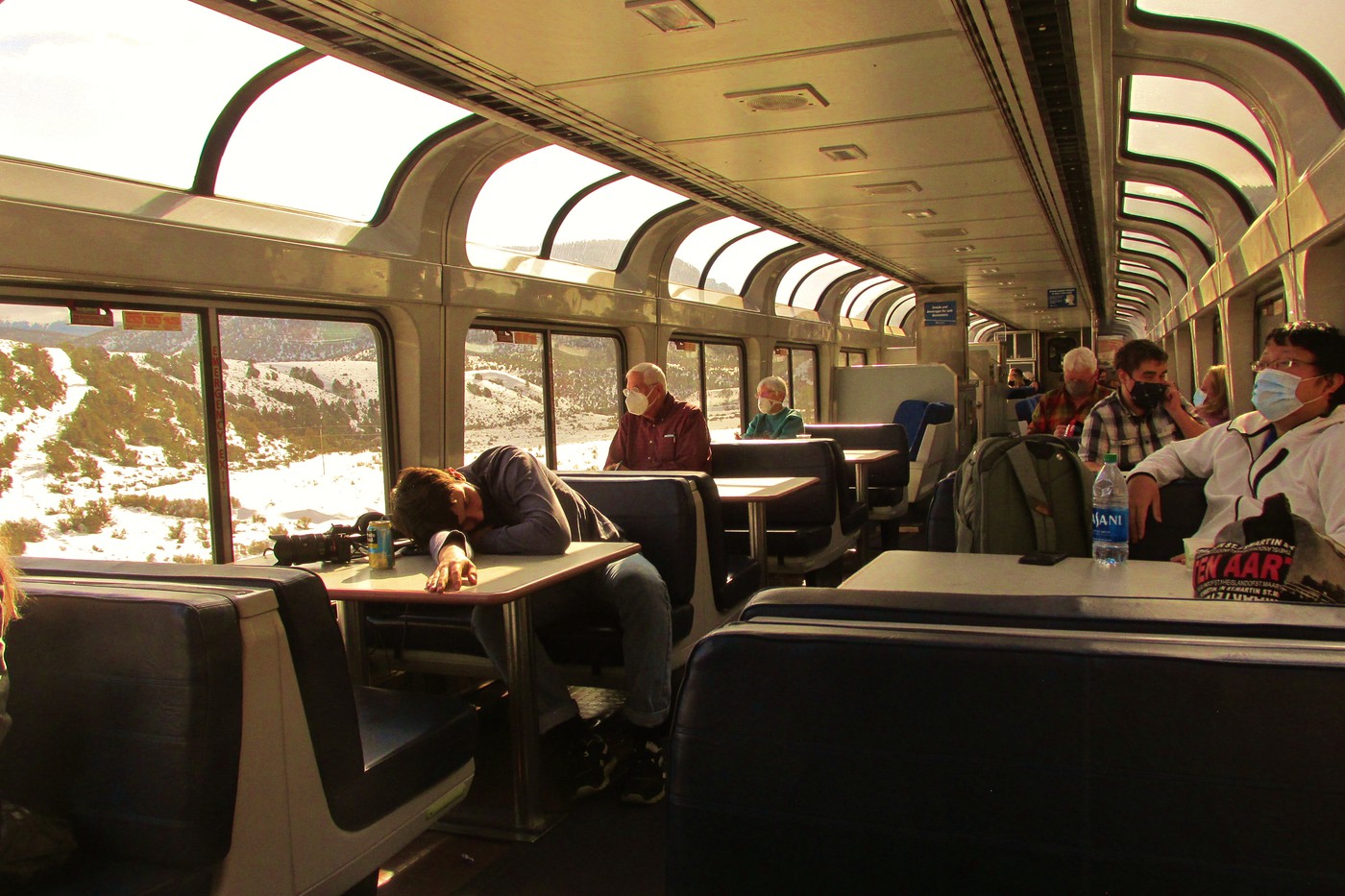 The scene in Amtrak’s Sightseer Lounge
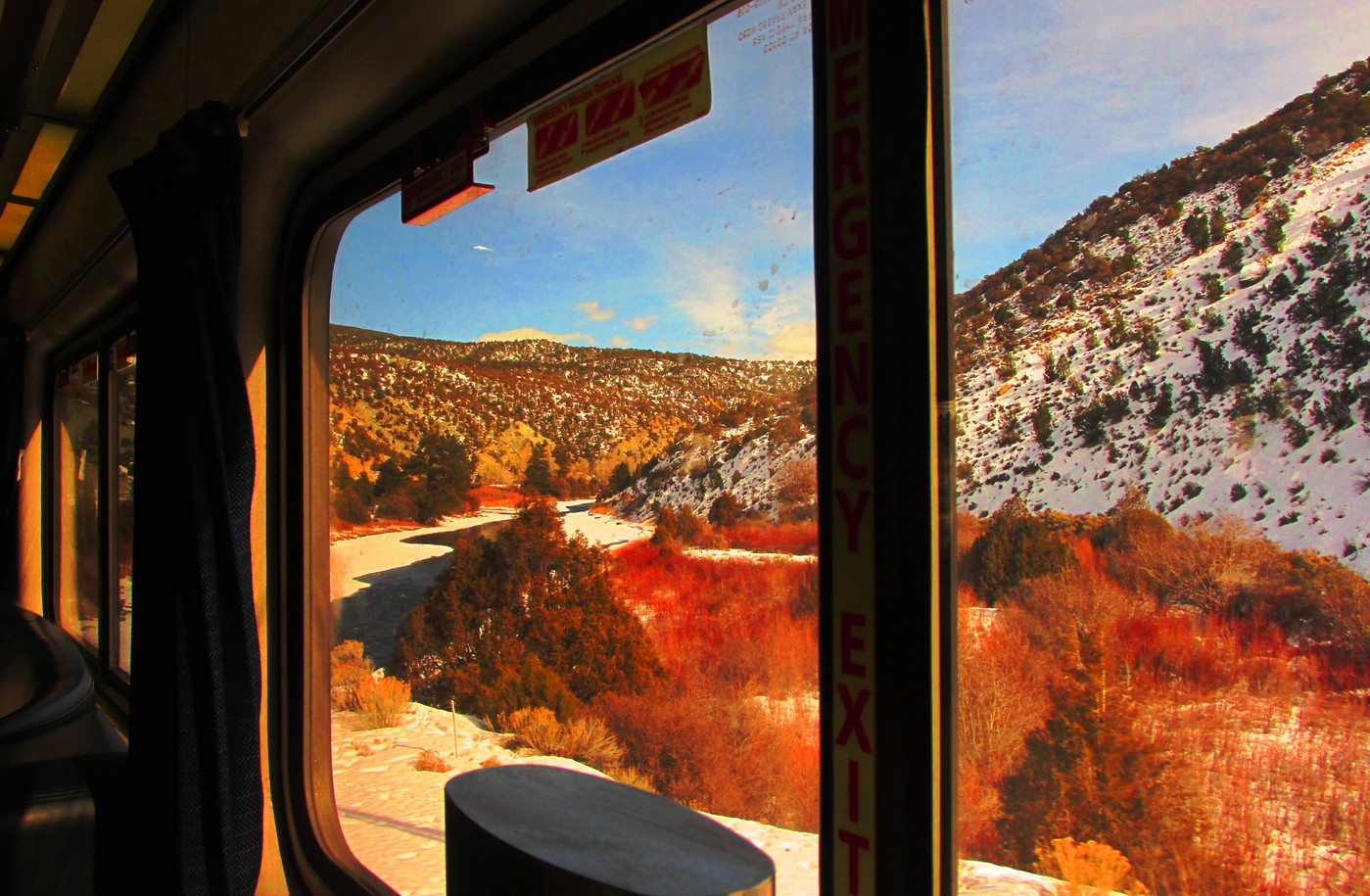 Sunshine makes everything nicer
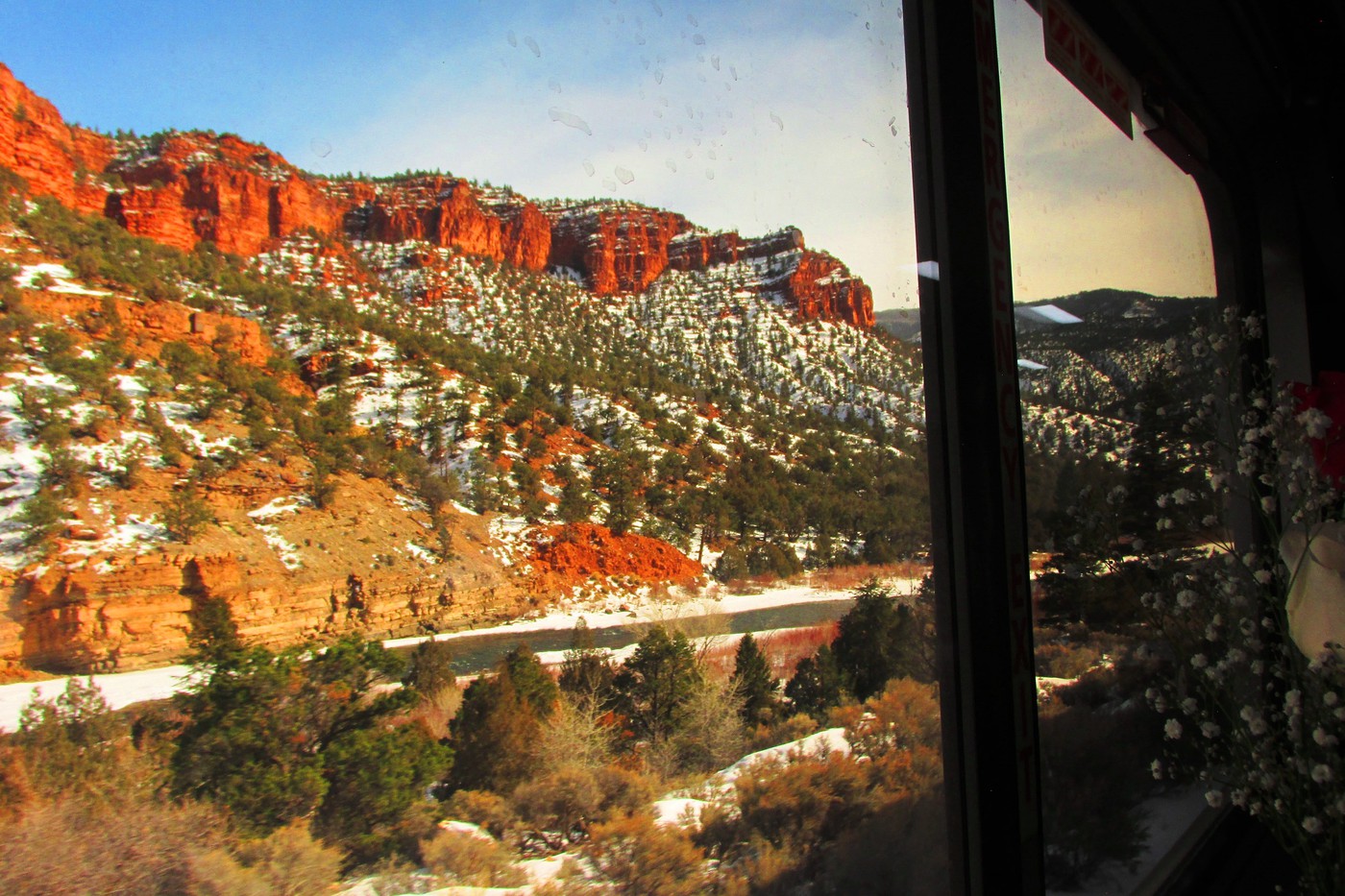 Beautiful Red Rock formations
With the promise of Glenwood Canyon just an hour away, I decided now was a good time for lunch. There are no reservations taken for lunch – the crew will generally make a first and last call and in between it’s first come, first served. Given that the dining car is First Class only these days – coach passengers eat from the café in the Sightseer Lounge – there was plenty of space available. I was shown to an empty table – river side, please – and handed a menu. There was really no need. I knew I wanted a hamburger since I boarded the train in Chicago yesterday afternoon. It was worth the wait. So was dessert – a tasty carrot cake that I’ve taken quite a liking to. This may be the twentieth carrot cake I’ve eaten over the years on Amtrak.
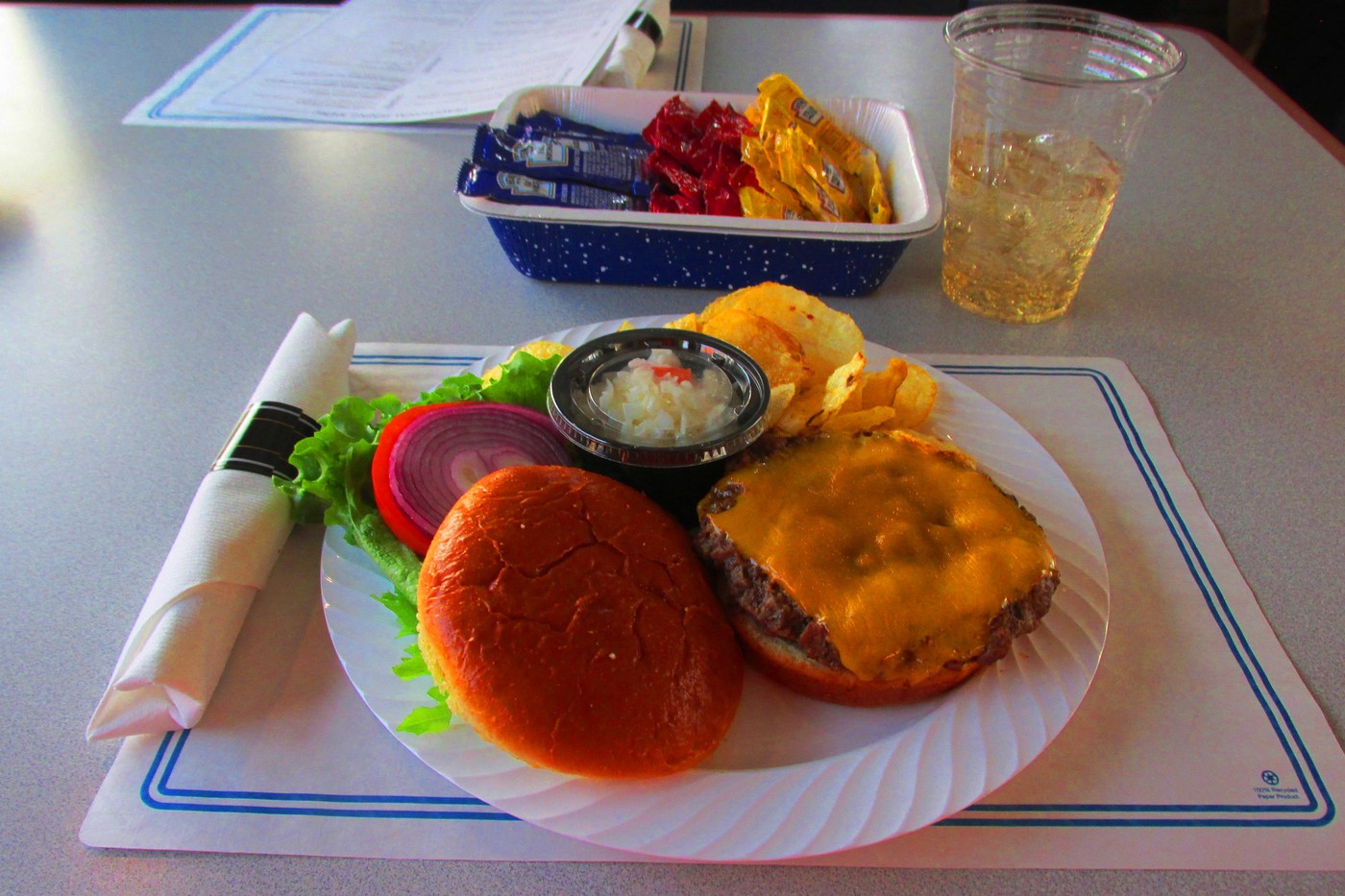 My favorite lunch
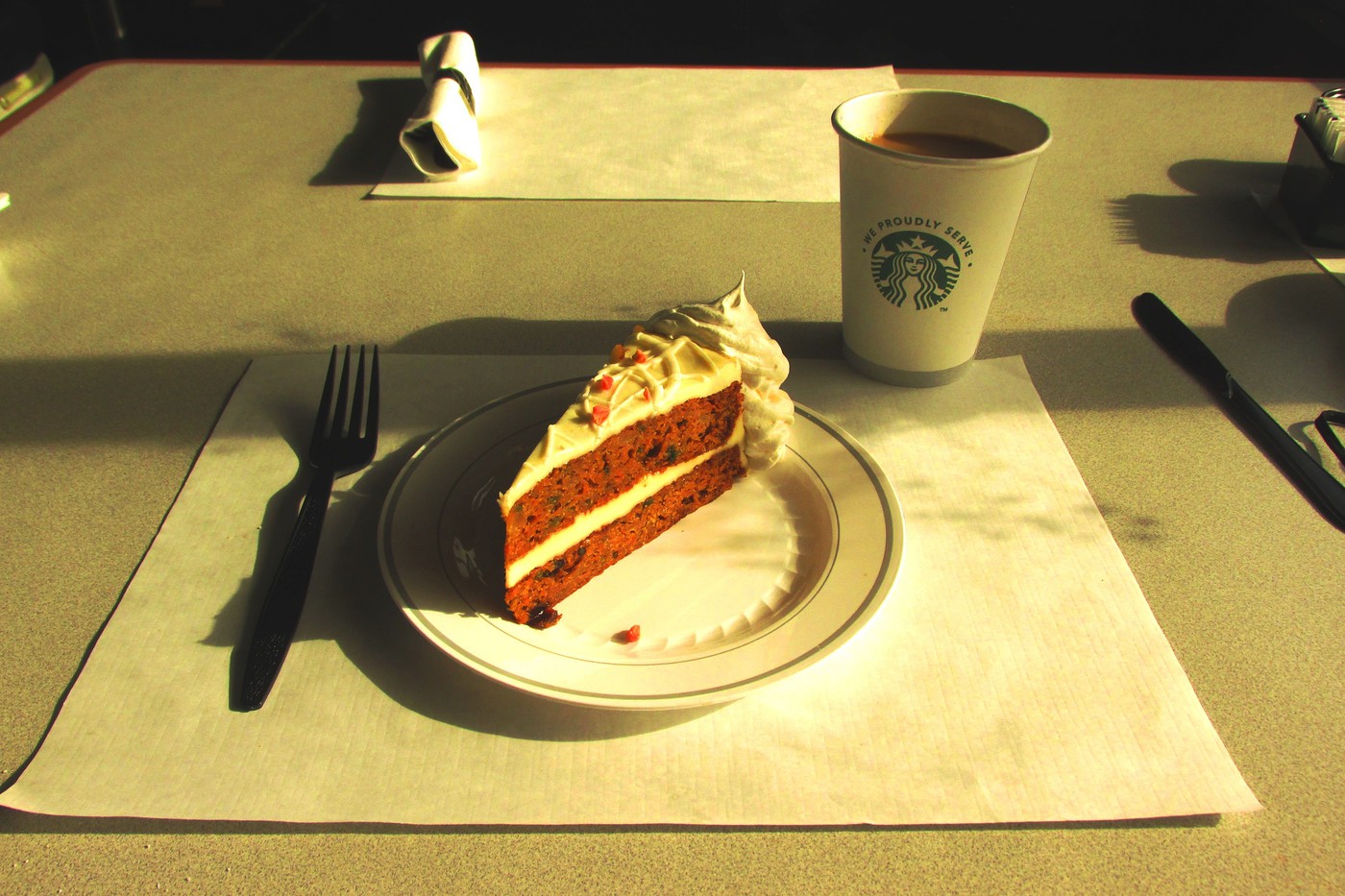 A Delicious Carrot Cake
Glenwood Canyon has been a highlight for passengers aboard the
California Zephyr since the train’s inception in 1949. Indeed, it was a ride through Glenwood Canyon back in the early 1940s that provided the impetus for the creation of the dome car. The canyon runs twelve and a half miles from the confluence of the Colorado and Eagle Rivers all the way down to the town of Glenwood Springs. The canyon walls climb as high as 1,300 feet above the bottom of the canyon which hosts the river, the railroad and Interstate 70.
When I was a kid, it wasn’t yet I-70 but rather was US 6 – a pretty 2-lane road that complimented the canyon well. When it was determined that Interstate 70 – with a minimum of four lanes – had no choice but to run through Glenwood Canyon, there was much concern about how such a large road would fit into the canyon without disrupting its scenic beauty. Well, it took twelve years and $490 million but the consensus amongst most is that the highway is an engineering marvel. You’ll find a bit more information on the project right
HERE
As for those of us on the train, well, kick back and enjoy the view…
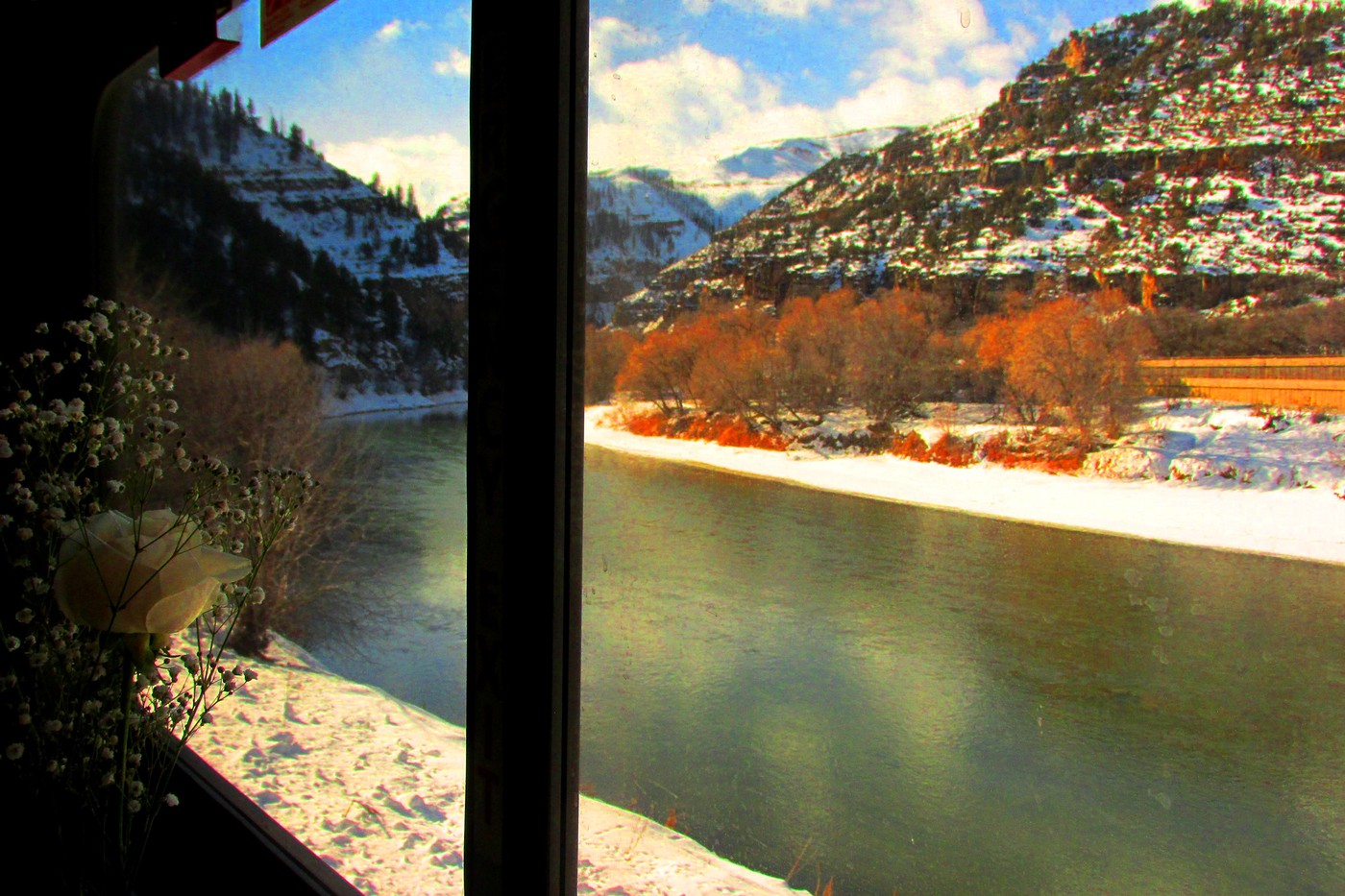 Entering Glenwood Canyon
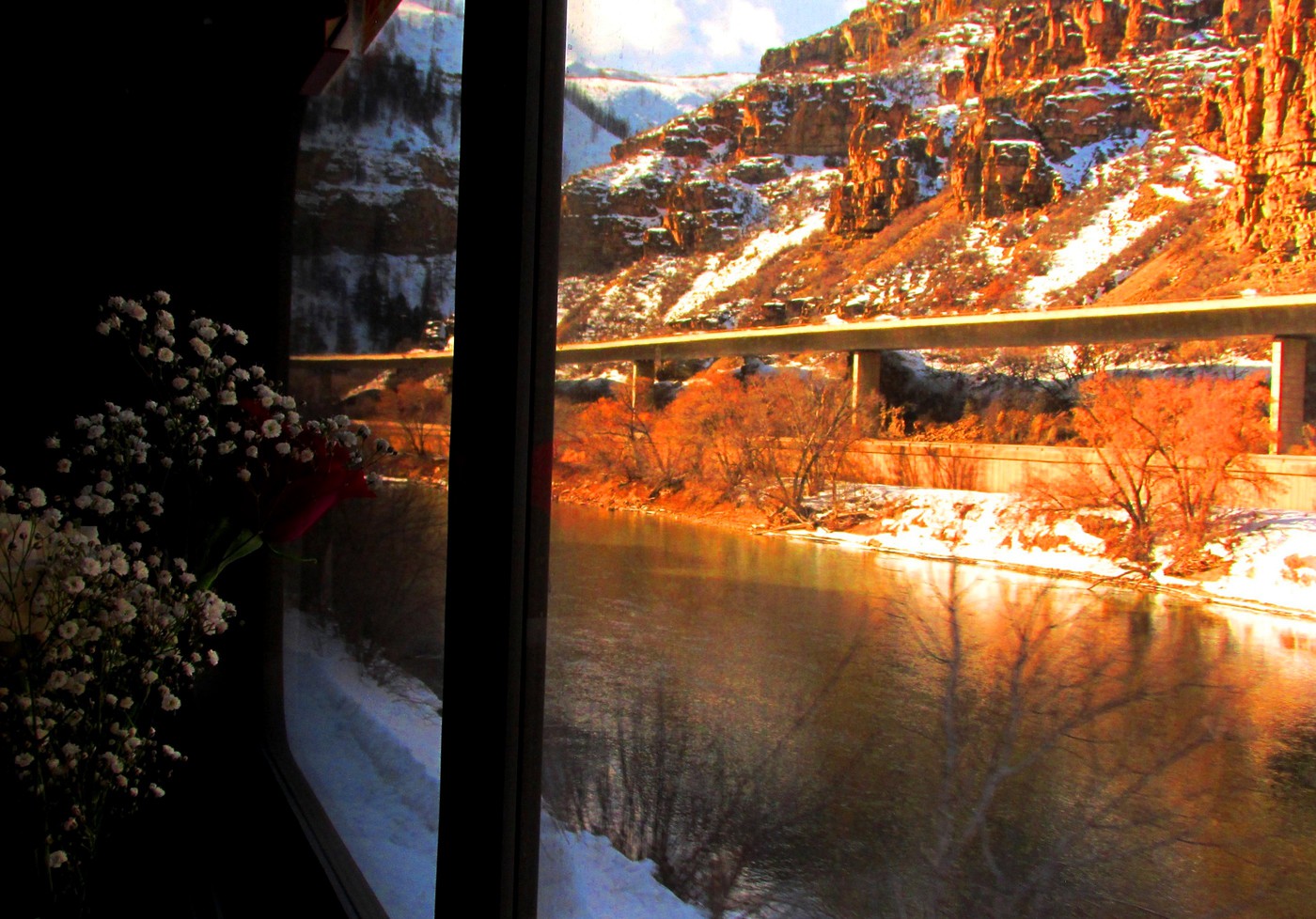 I-70 through Glenwood Canyon
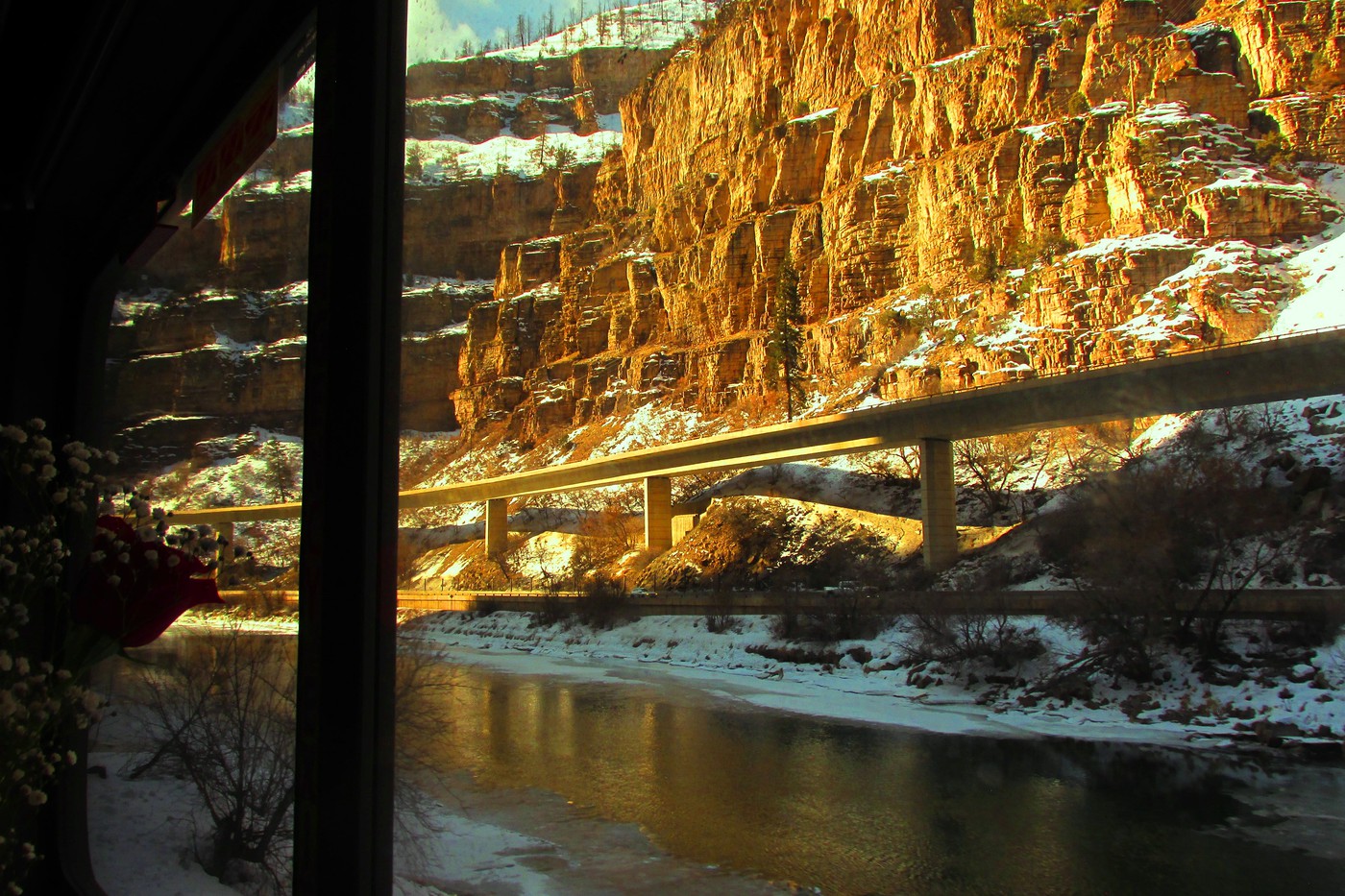 I-70 through Glenwood Canyon
Glenwood Springs is a resort town famous for its hot springs resort featuring the world’s largest mineral hot springs pool. The famous ski town of Aspen is just a 45 mile drive south of Glenwood. It’s quite a pretty setting and the
California Zephyr is a great way to get there.
It’s all downhill as the Zephyr departs Glenwood and continues to follow the Colorado River through the western slope city of Grand Junction and on into the high desert of east central Utah. Ruby Canyon – situated well off the highway along the Colorado / Utah border – doesn’t get much mention as a scenic attraction aboard the
California Zephyr, but I think it’s one of the prettiest canyons that any train anywhere runs through, especially during the summer months when the longer days illuminate the orange and pink sandstone walls beautifully.
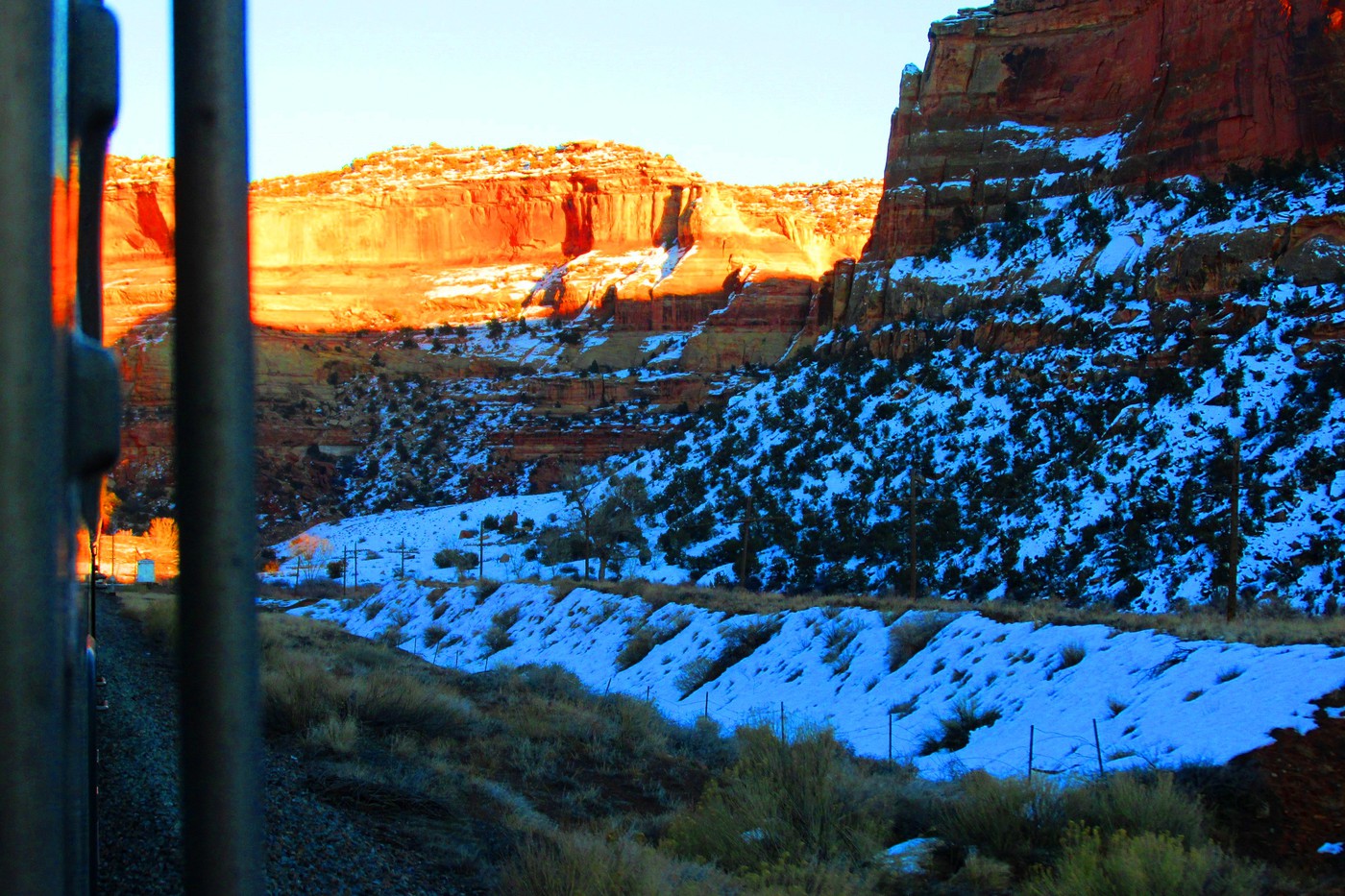 Entering Ruby Canyon
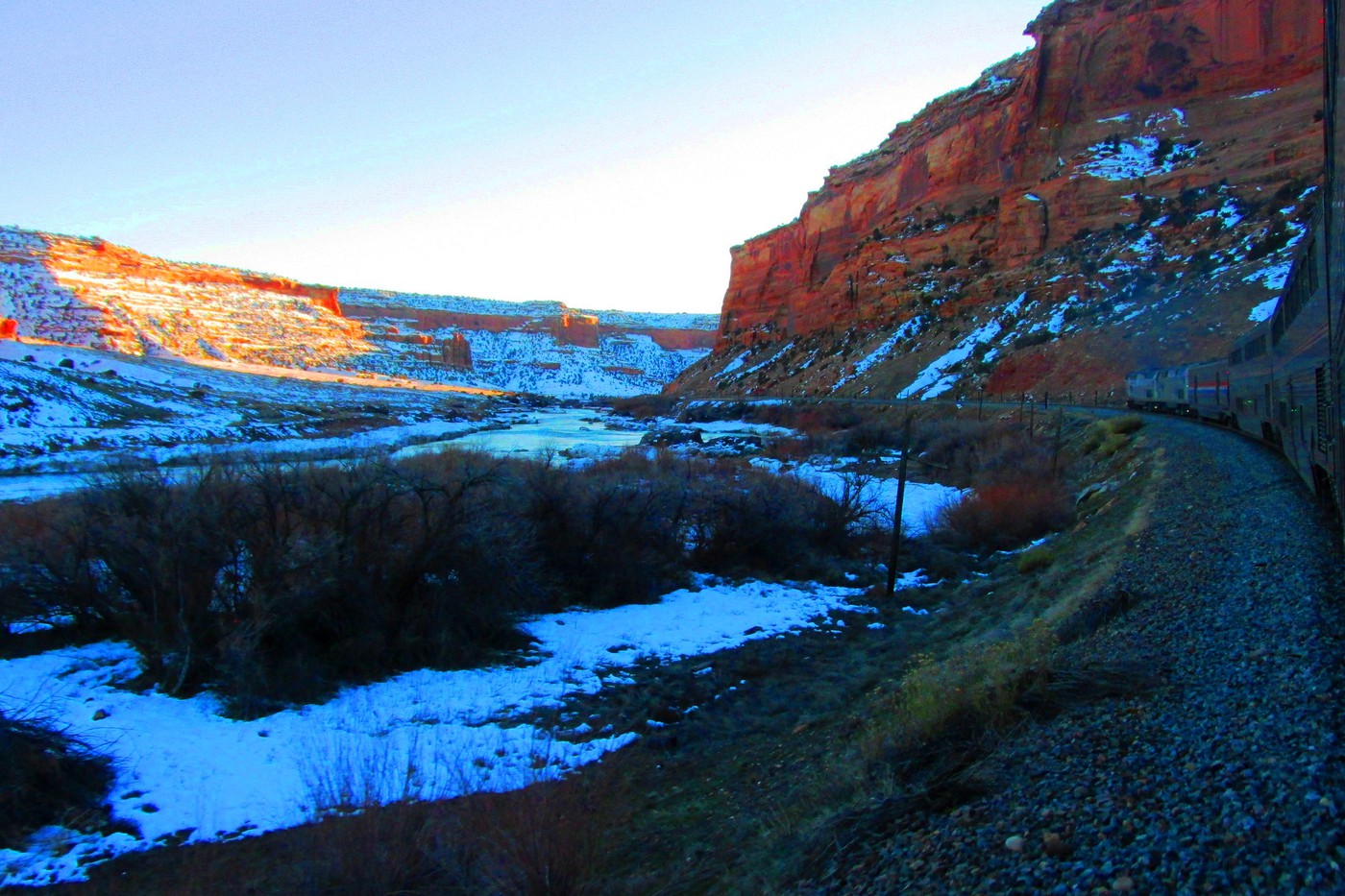 Late afternoon shadows
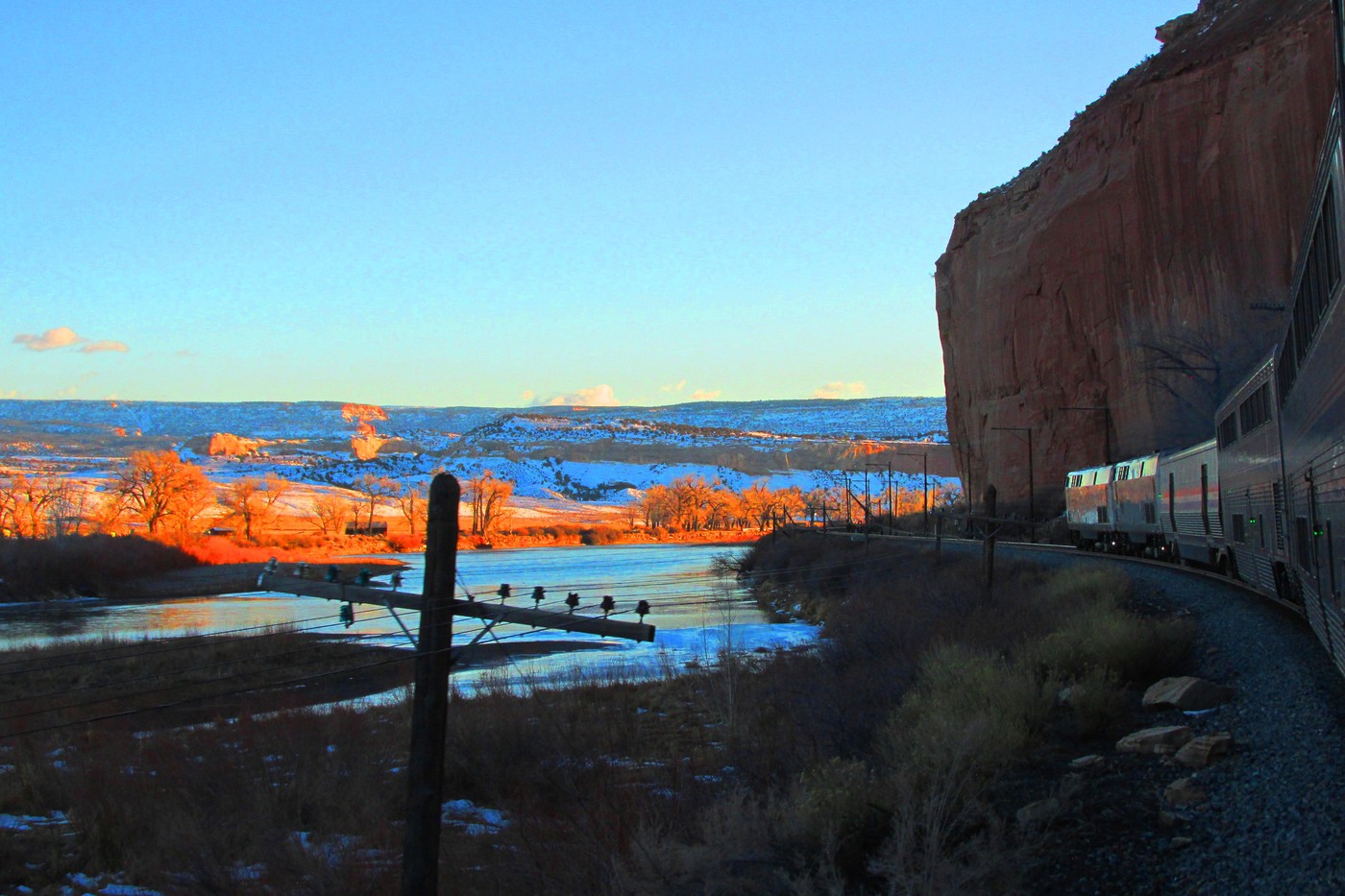 Back into sunshine
As we exited Ruby Canyon, we also ended our companionship with the Colorado River. Just ahead of us was what’s left of the town of Cisco, Utah where parts of the 1970s cult classic “Vanishing Point” were filmed. We used to put in the Colorado River there and do the 30 mile trip down to Moab. This is spectacular country and it’s worth noting that Canada’s Rocky Mountaineer is now running a seasonal train from Denver to Moab. It follows the old D&RGW mainline (Now Union Pacific) to Thompson, Utah and then heads south down to Moab and Arches National Park.
The sun was low in the sky as we exited Ruby, and I was able to get an okay shot of the Book Cliffs - the thousand plus-foot-high wall of cliffs that parallel the highway and our tracks just a few miles to the north. Winding for 250 miles across Utah and Colorado, the Book Cliffs represent the longest continuous escarpment in the world. Shortly thereafter, I caught a pretty sunset as we sped across the high desert at maximum speed of 79 mph.
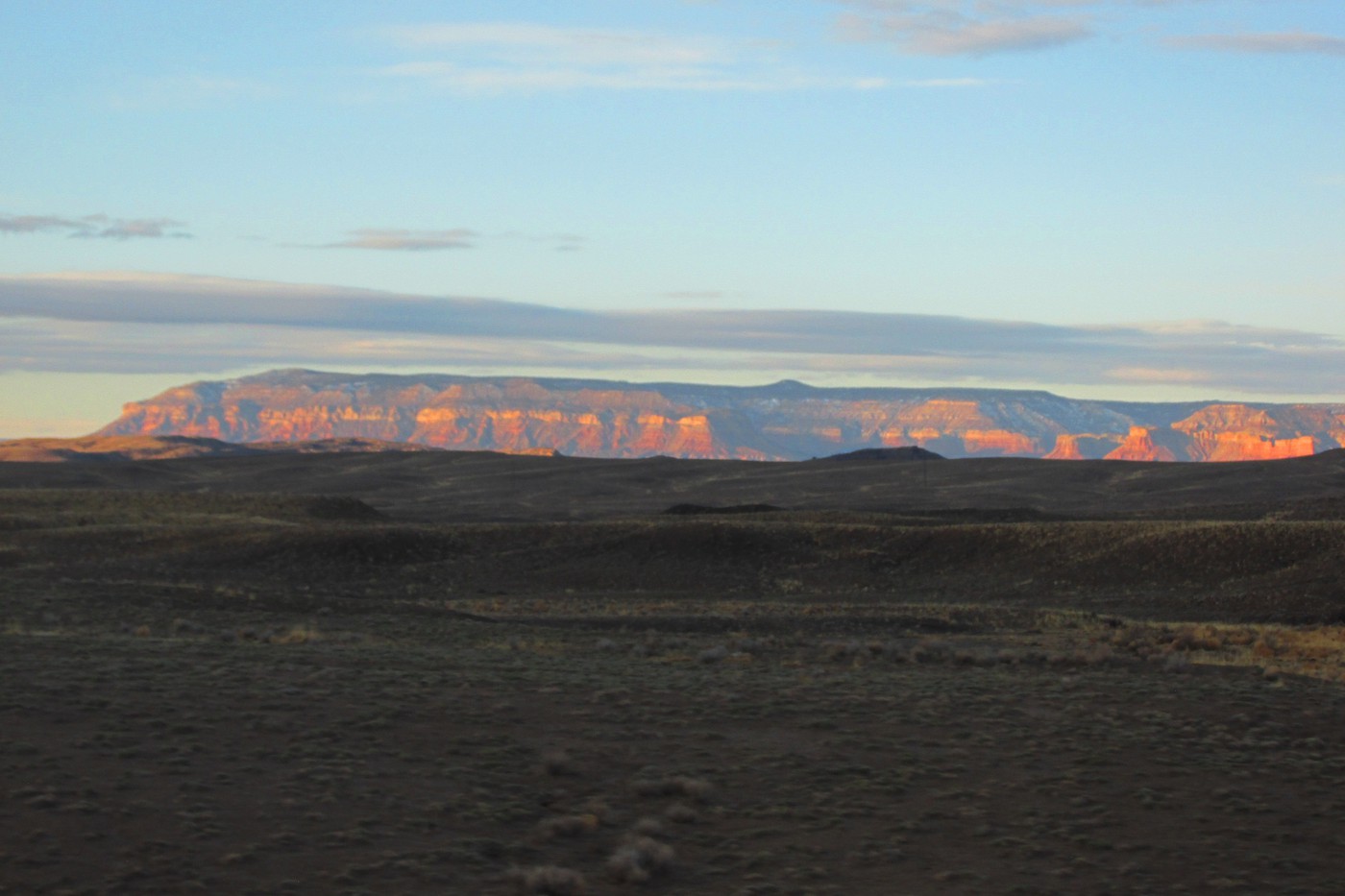 Late afternoon sun illuminates Utah’s Book Cliffs
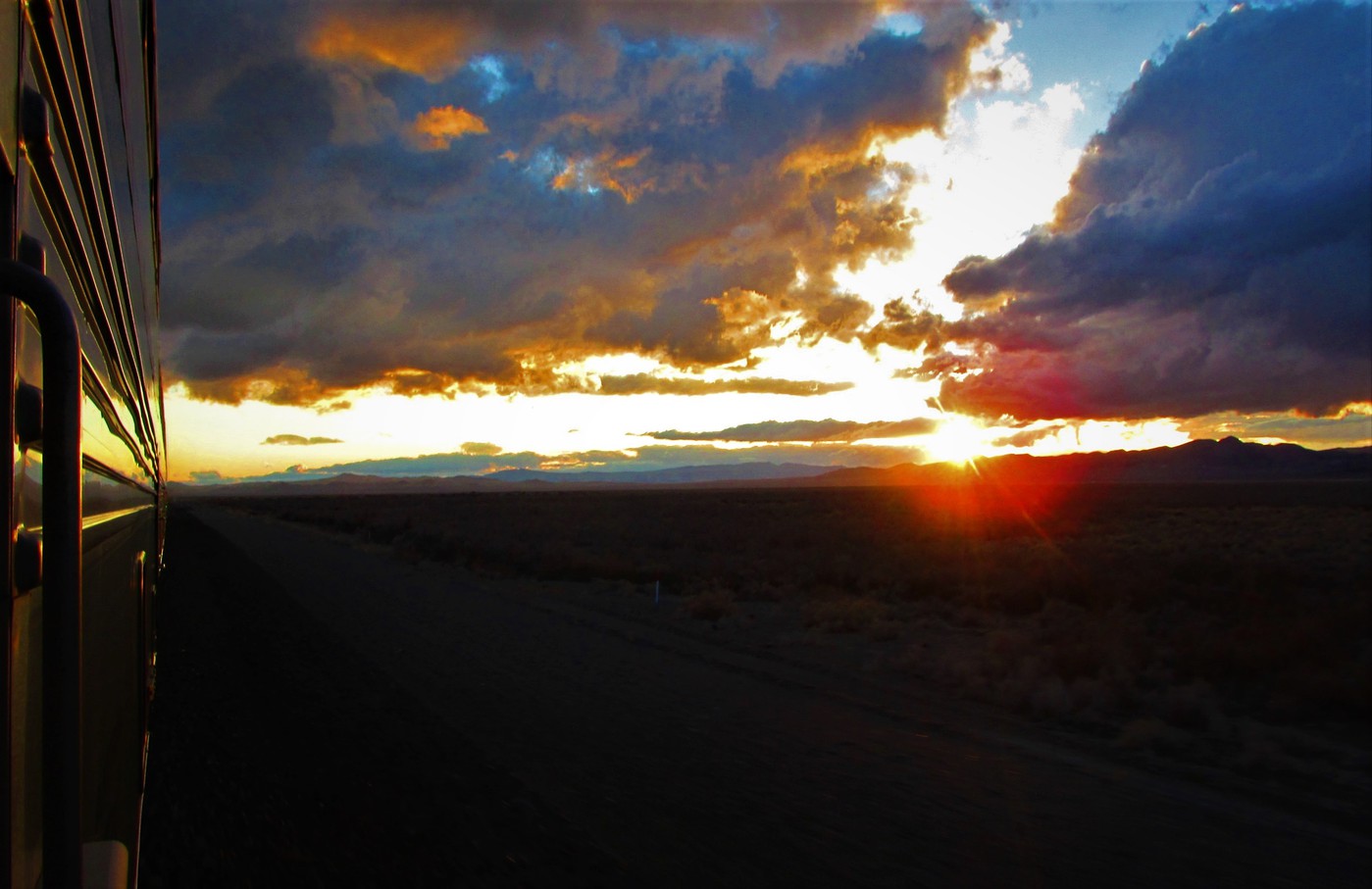 Sunset on the high desert
We were just entering the town of Green River, Utah when I made my way back to the diner for my 6:00pm dinner reservation. We were running right on time, which I take pleasure in noting since it seems so often Amtrak is remembered for not running on time. To be sure it’s had its share of delays – many of them caused by hostile host railroads that used to routinely shunt Amtrak trains off to the side to allow more profitable freight traffic the right of way. Speaking as one who’s logged well over 200000 miles aboard Amtrak since its inception in the seventies, its trains also run on time – more often today than they ever have. The article linked below details the long struggle between Amtrak and the freight railroads.
https://elpc.org/blog/amtrak-on-time-performance/
Back in the seventies we used to put out at Green River after six days on the river for which the town is named. Hungry and dirty after six days on the river, I always looked at Green River as an oasis. In many ways it still is, sitting 104 miles west of Grand Junction on I-70 with another 107 miles of desert sprawl to go until you hit the next town of any size, Salina, Utah. It remains home to one of the finest Mexican restaurants I have ever eaten at – El Veracruzano – which is located in another old favorite of mine from almost 50 years ago – Ben’s Café. Onboard the Zephyr though, I settled for a plate of delicious Atlantic Salmon and a double Maker’s Mark.
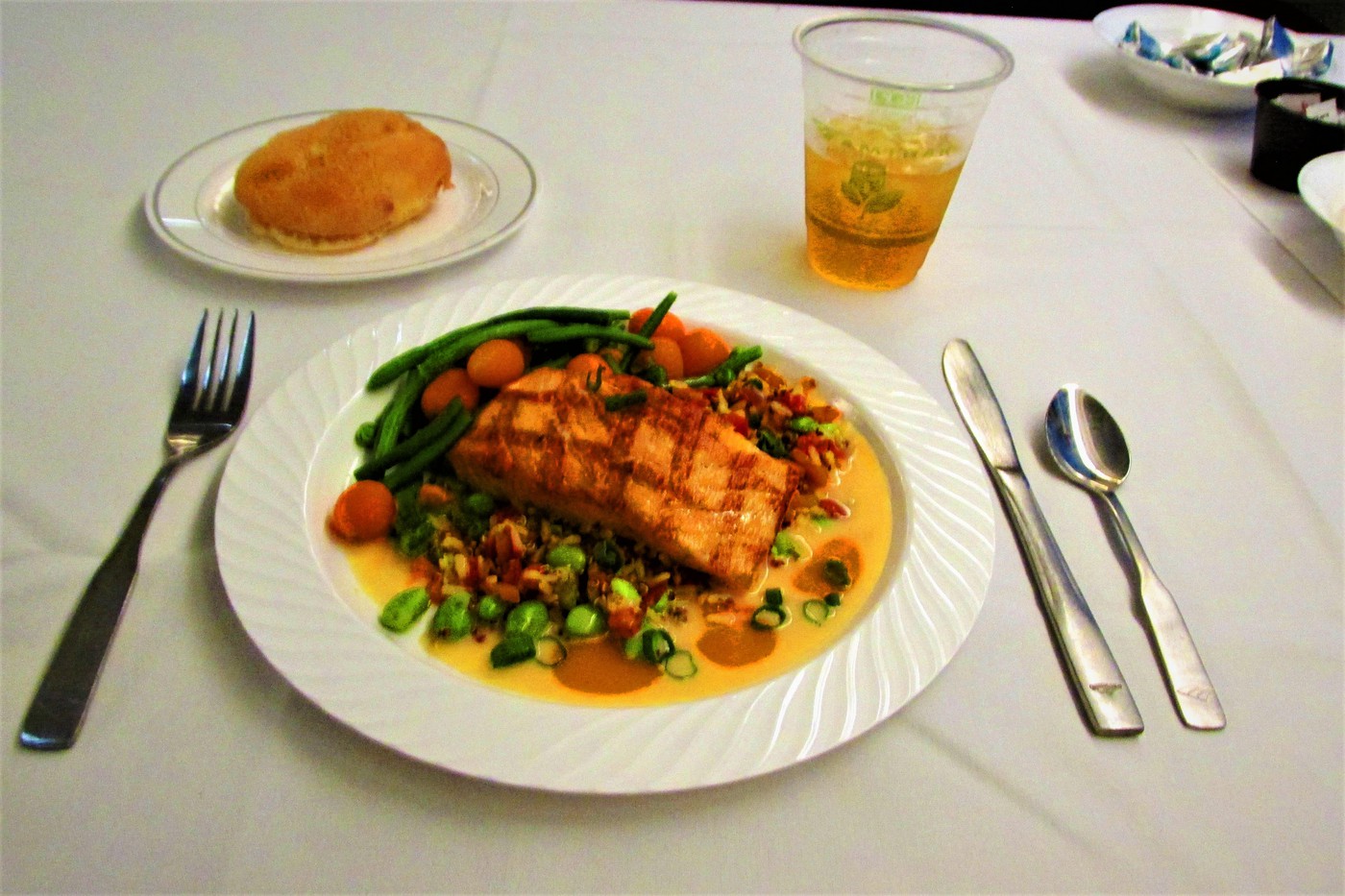 Atlantic Salmon Dinner
Shortly after departing Green River the Zephyr heads northwest toward Salt Lake City. With darkness obscuring the scenery, I headed back down to my room and stretched out with one of two books I’d brought along for this trip. Before long, the gentle motion of the train and the soothing melodic rhythm of the rails had me sleeping comfortably all the way through our 40 minute stop in Salt Lake and out across the Bonneville Salt Flats west of SLC. I didn’t wake up until we were out past Winnemucca at a little after 6am.
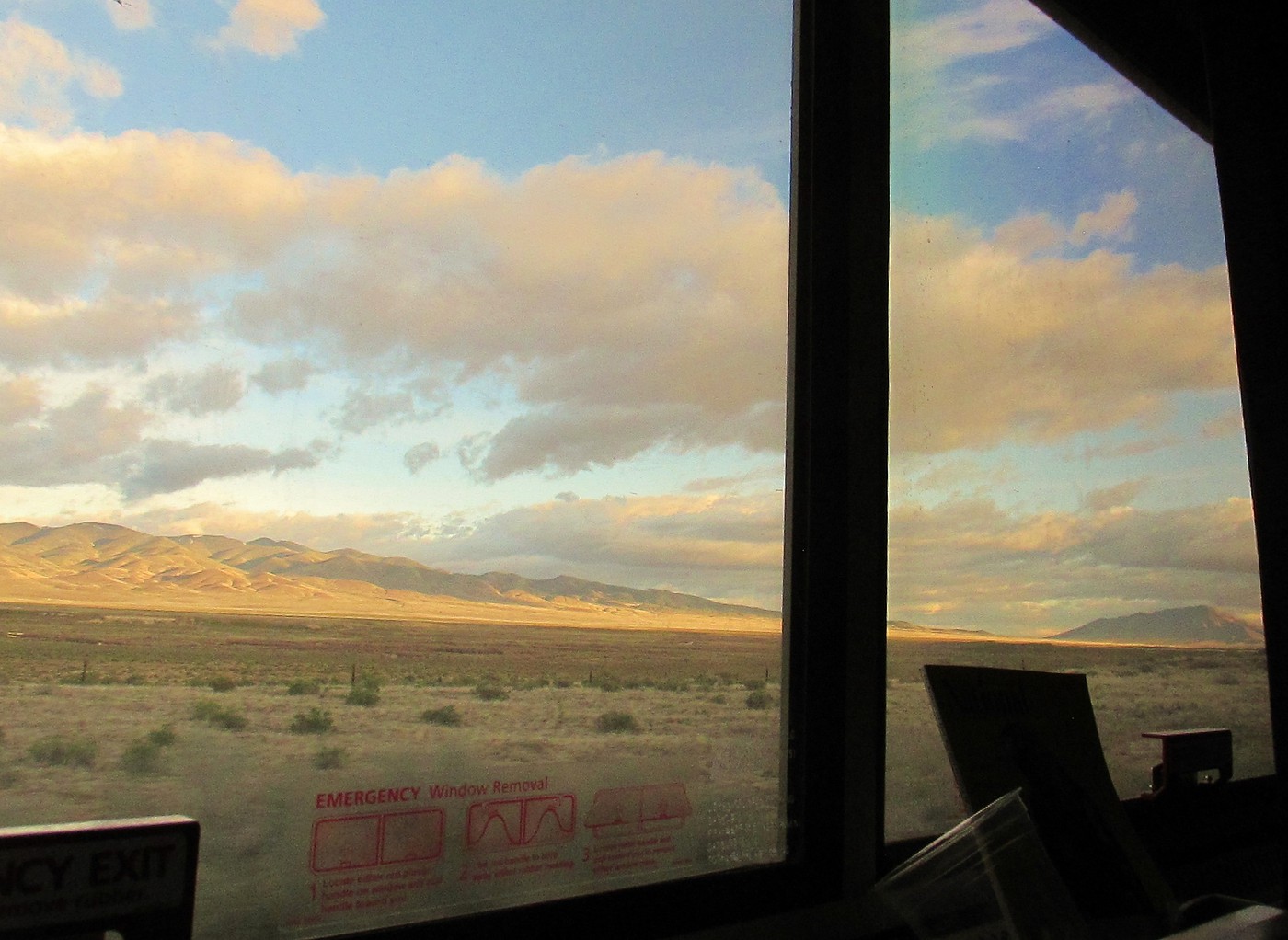 The view from my bed
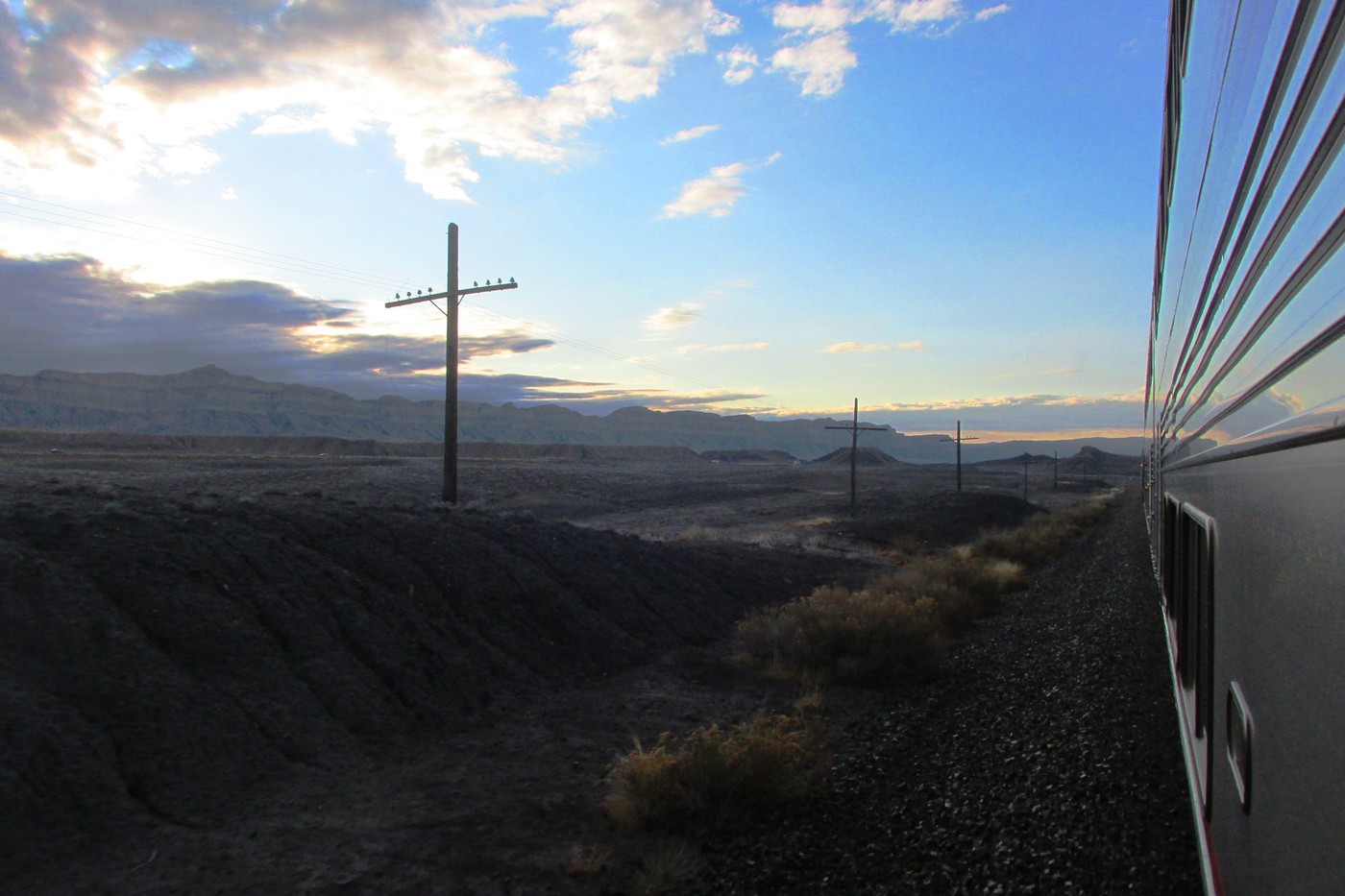 Early morning rails
At the top of the stairs to the upper level, Amtrak’s Superliners have a service area which houses a good sized coffee urn with everything you need to enjoy a nice hot cup of coffee in the morning. The car attendants usually have it up and running by 6:30 at the latest. I had brought along a box of Noni’s Chocolate Almond Biscotti in anticipation of this. Coffee and flavorful carbs – always a delicious start to the day!
The high desert of northern Nevada – really the top end of North America’s largest desert, the Great Basin – is not generally regarded as being amongst the scenic high points of a ride aboard the
California Zephyr. Ah, but beauty is in the eye of the beholder, n’est ce pas? Perhaps because I was born and raised in the western U.S. – especially back in a time when it was seemingly a lot larger and wilder – I find a stark beauty in these desert landscapes. Dawn and sunrise only serve to enhance that beauty in my mind.
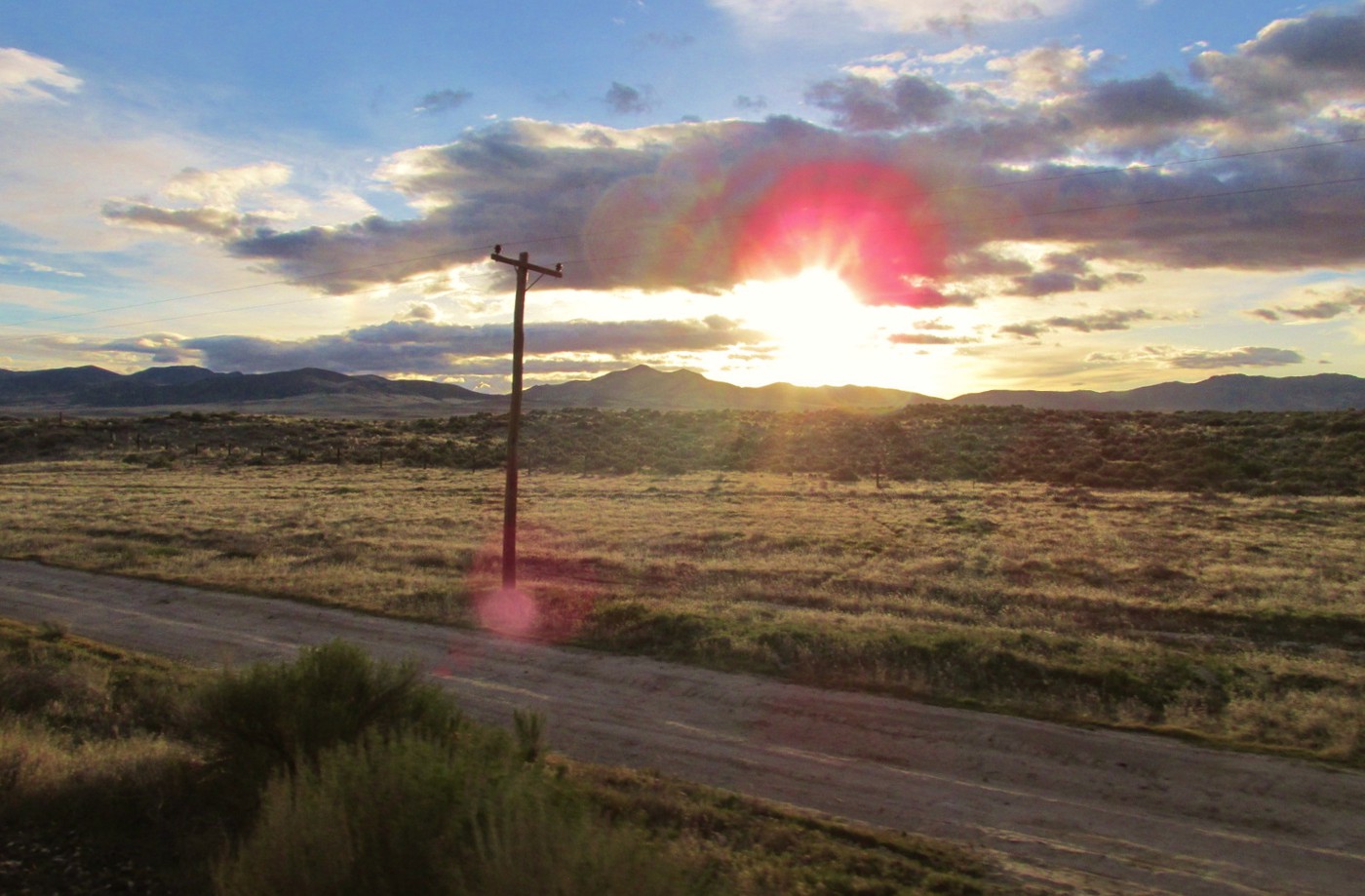 Good Morning, Nevada!
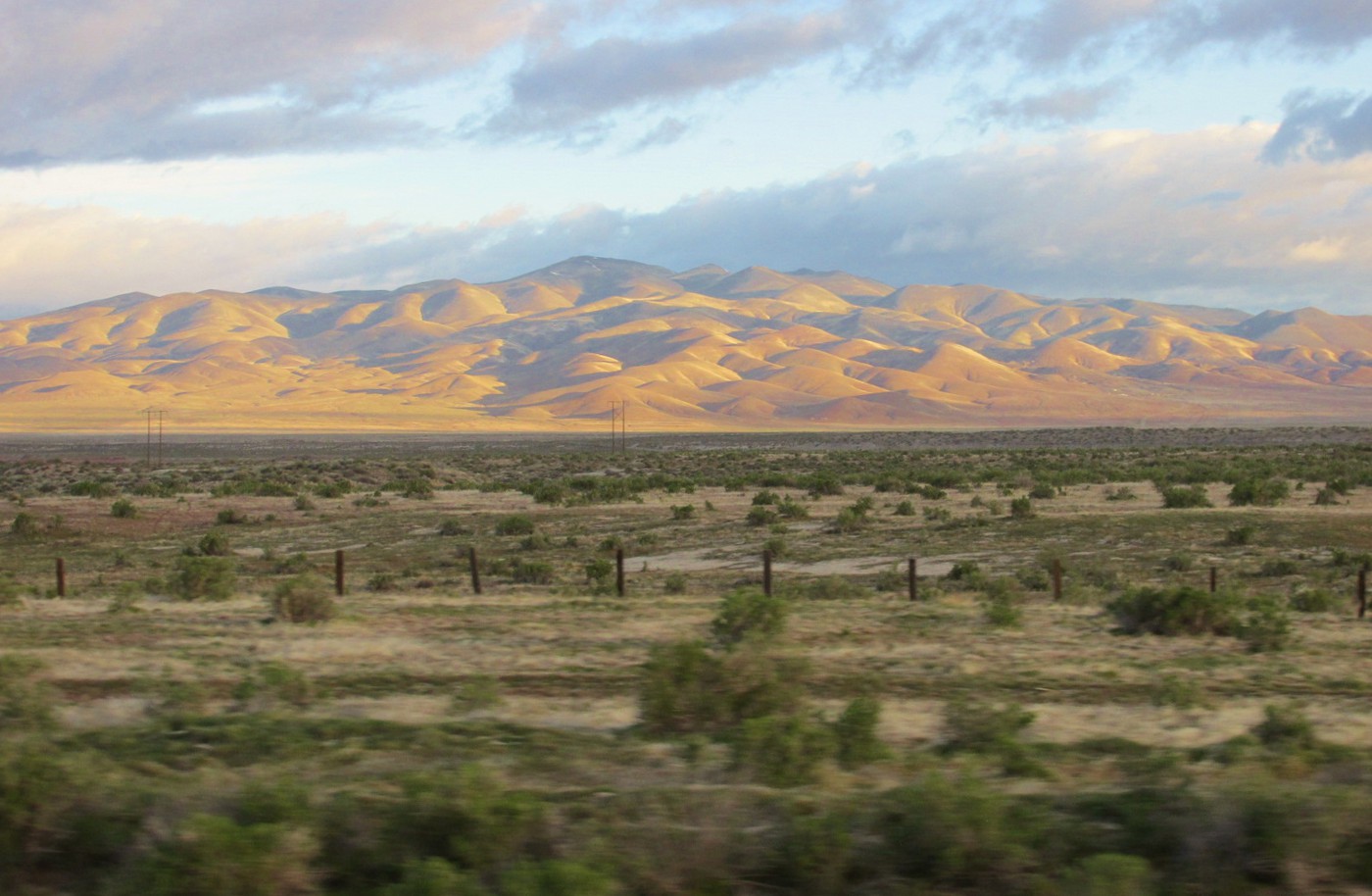 Dune-like mountains to the north
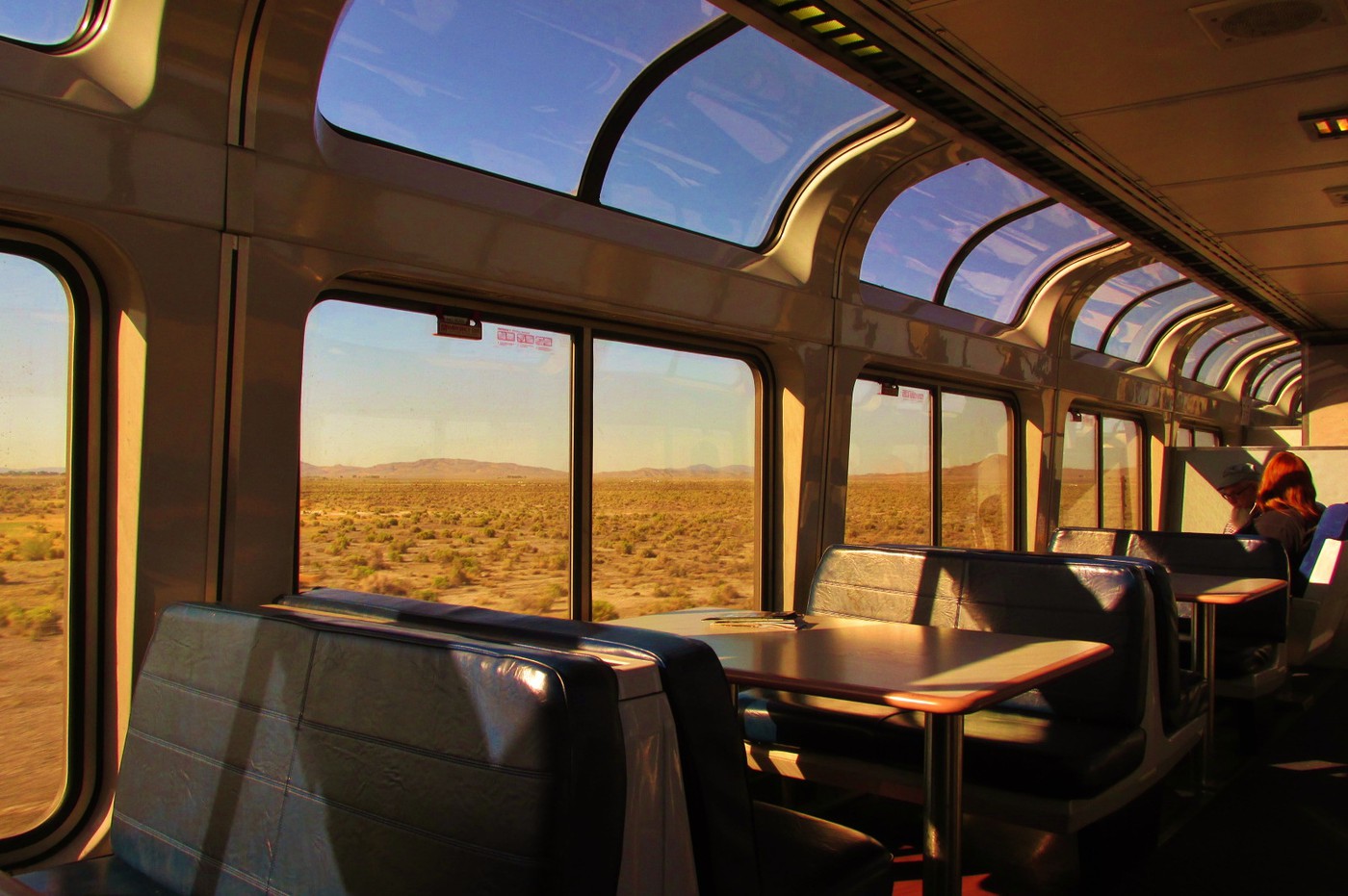 Quiet morning in the lounge car
Breakfast was my usual Veggie Omelet with potatoes, chicken sausage and a biscuit. Not the healthiest perhaps, but again I live by the maxim “Thou shalt not worry about diet whilst enjoying travels” There’ll be plenty of time for muesli and fresh fruit when I return home.
Arrival in Reno was ten minutes early. This was hardly a surprise. Out in the open desert terrain to the east of Reno, the engineers can really let ‘er rip, which means a maximum speed of 79 mph. The Reno train station is a bit different from most in that while the station itself is at street level, where the train stops, loads and unloads is down in a concrete trench thirty feet below the station. As we entered the trench, I couldn’t help but notice a lone foamer down at one end of the trench, intently filming our approach as we arrived.
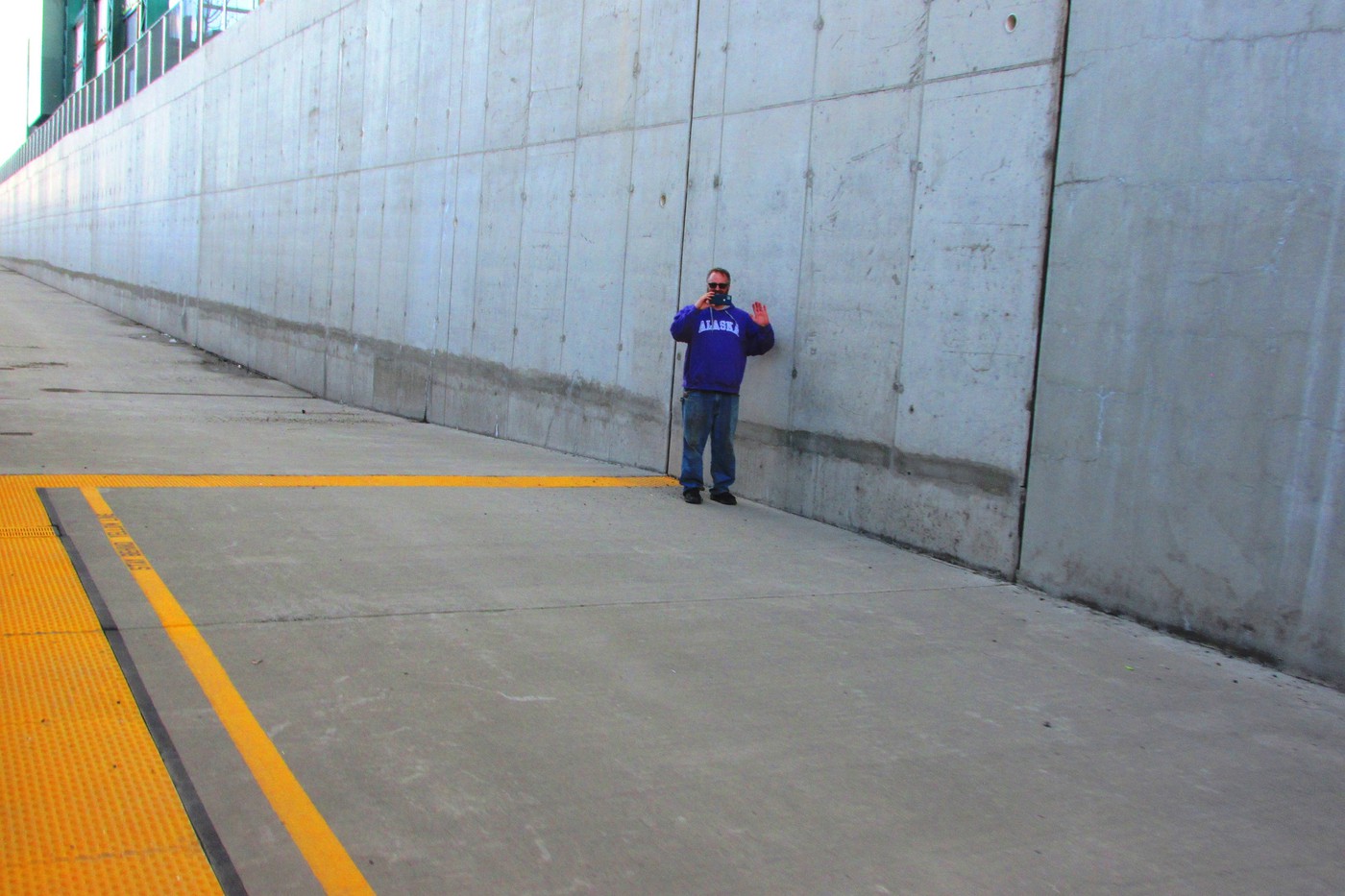 A lone Foamer awaits down the tracks
For those of you unfamiliar with the term “Foamer”, it’s railroad industry speak for rail fans who are so passionate about all things railroad that they practically foam at the mouth. While I’ve met a couple “foamers” for whom that description might be apt, this particular foamer was known to me. It was my friend Ryan who is also a fellow driver up in Denali National Park, Alaska. Ryan’s not a foamer in the classic sense, but he does enjoy railroad photography and has occasionally nailed some really nice shots. I doubt that’ll be the case today down in the trench, but you never know. Ryan knew I was coming because I called him in advance, and our early arrival allowed me time to step off and say hello.
Leaving Reno, the Zephyr begins a long climb up through the Truckee River canyon. It’s more of a narrow valley really, but quite pretty today under blue skies and patchy snow. I took up my usual position downstairs in the vestibule where open-able windows on each side offer good opportunities to capture excellent “in motion” shots from the train.
It should be noted that these windows are clearly marked with signs prohibiting their opening. Danger! Danger! In big red letters. The signs couldn’t be clearer. As I mentioned earlier in this report, Amtrak seems to feel that even though the body of the cars overhang the rails by almost a foot on each side and there are no wheels anywhere near the doors (which are located in the middle of the cars while the wheels are at each end), a rock could possibly shoot out, spin back and around in a tight arc and hit someone looking out an open window. The likelihood of a tree or branch hitting you – particularly out west – is so remote as to be commensurate with two like snowflakes.
Call me an outlaw or any number of other desultory terms if you like, but the truth of it is that based upon many train rides in the U.S. and abroad where lots of passengers use the Dutch doors in most cars for photography, I think Amtrak’s full of it and I’m willing to take my chances breaking “the law”. Truth be told, I don’t think it’s an actual law but it is an Amtrak directive and I fully accept that if I were to get caught, I could be removed from the train. And I’m totally on board with that. It’s Amtrak’s train, so they get to set the rules, regardless of how illogical they may seem to me. I’ve yet to ever be caught, but if I were I’d accept the consequences as is because it’s not my place to argue policy as I think it should be with Amtrak. Like I say - their train, their rules.
So – the abiding principle here is
Don’t Get Caught. It’s not that hard. Discretion is the key. Keep a low profile. Opening the window is against the rules, so don’t hang out the window inviting someone to see you and don’t just stand there with the window open for long periods of time. When I see a good potential shot coming up, I get ready, I open the window, I put as little of me out the window as necessary to get the shot (usually no more than a bit of my head), then duck back in and close the window. Simple. I’ve gotten a lot of great shots in this way over the years with no one being the wiser. Or injured.
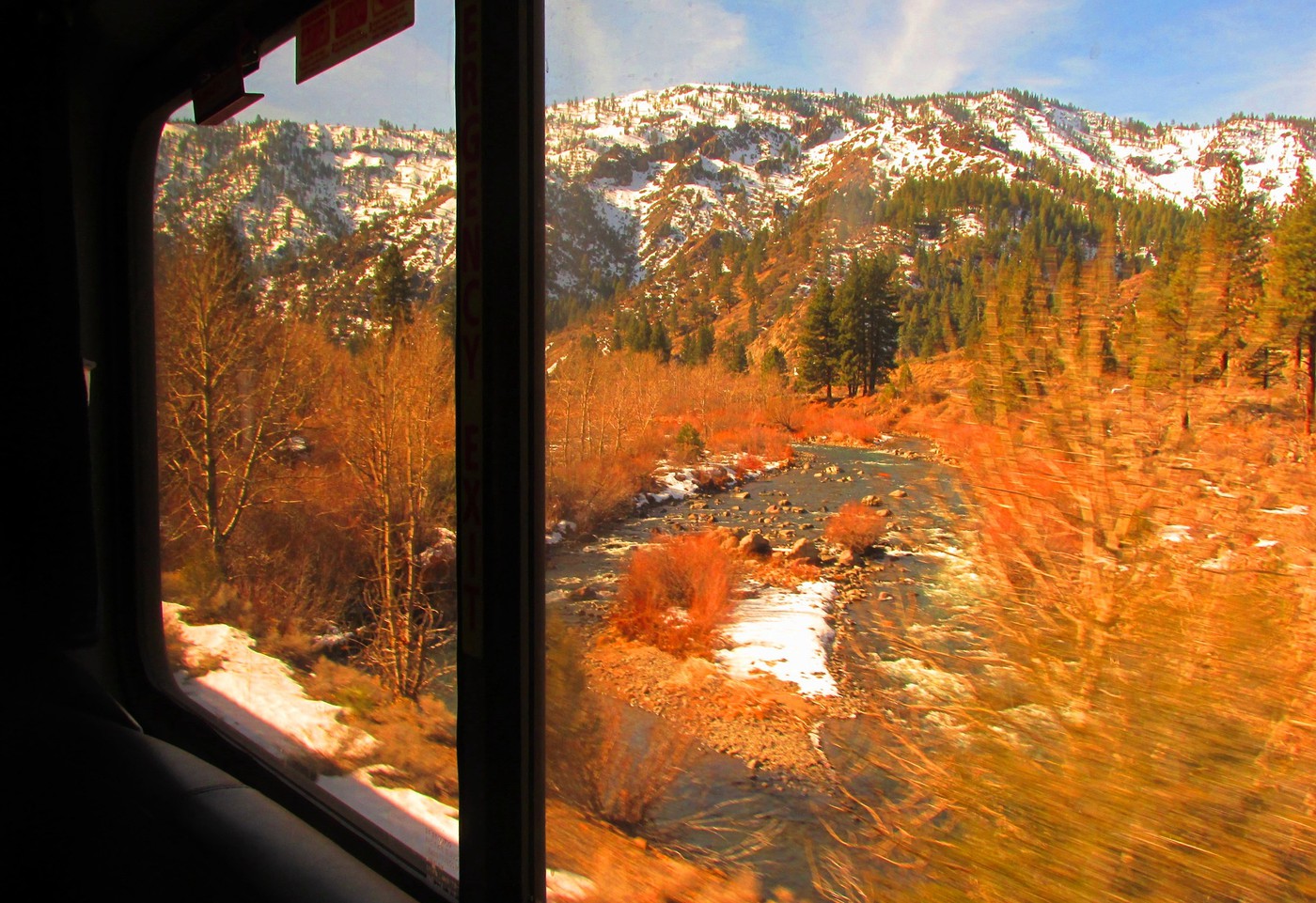 Heading up the Truckee River
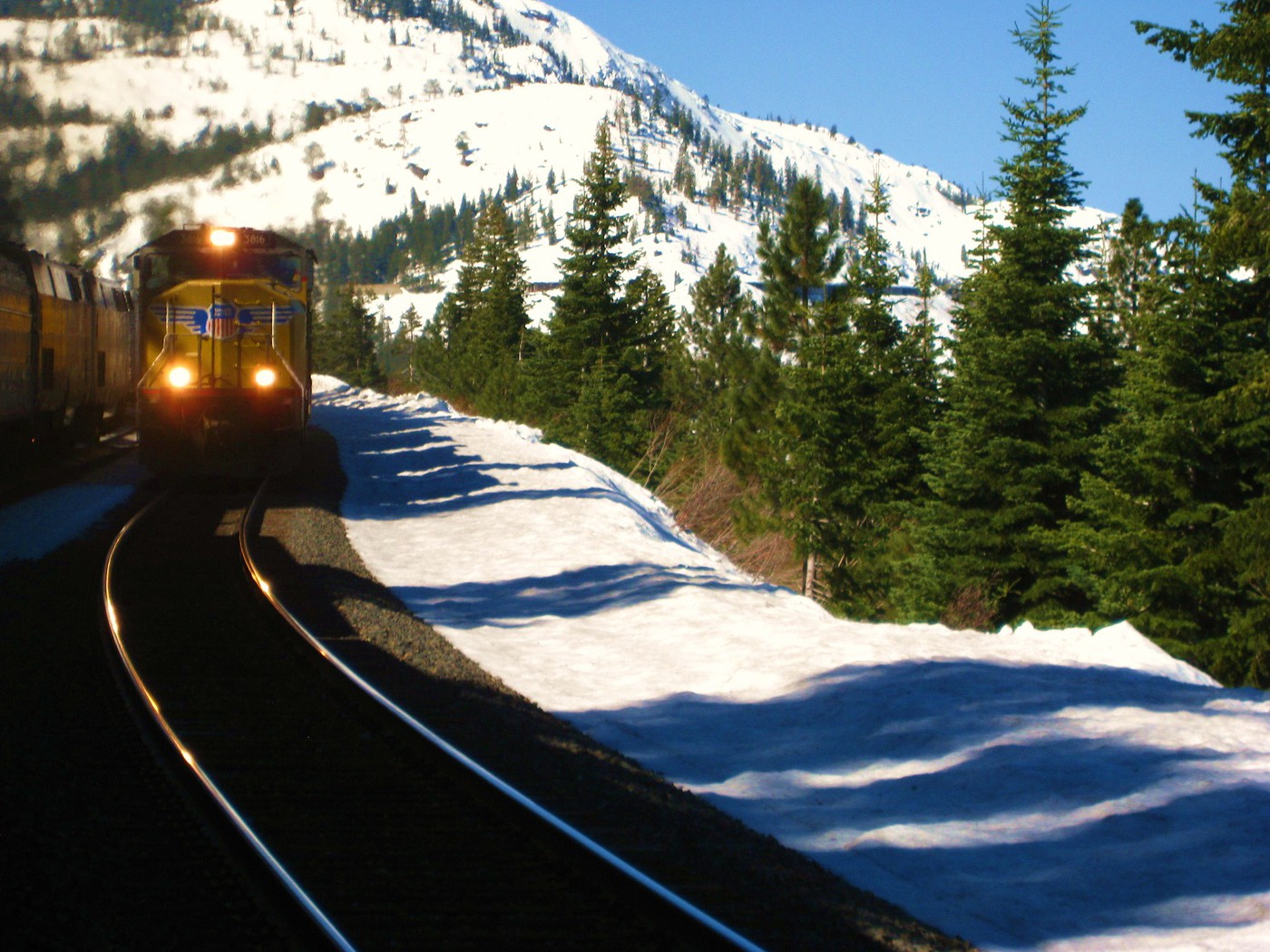 Meeting a freight on the way up Donner Pass
We were well on our way down the western side of Donner Pass when I grabbed a couple last shots and then headed back to the diner for lunch.
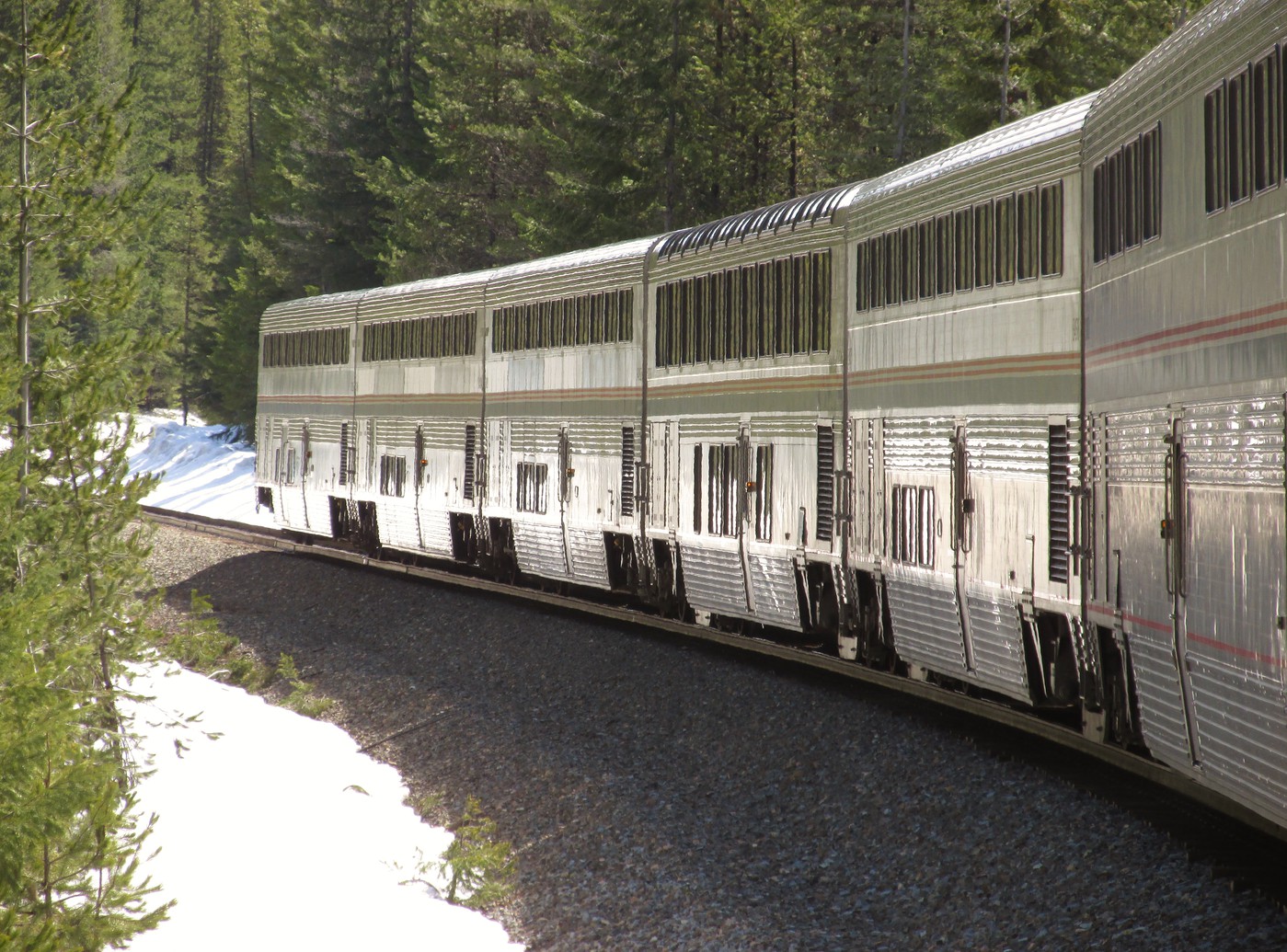 It’s all downhill from here
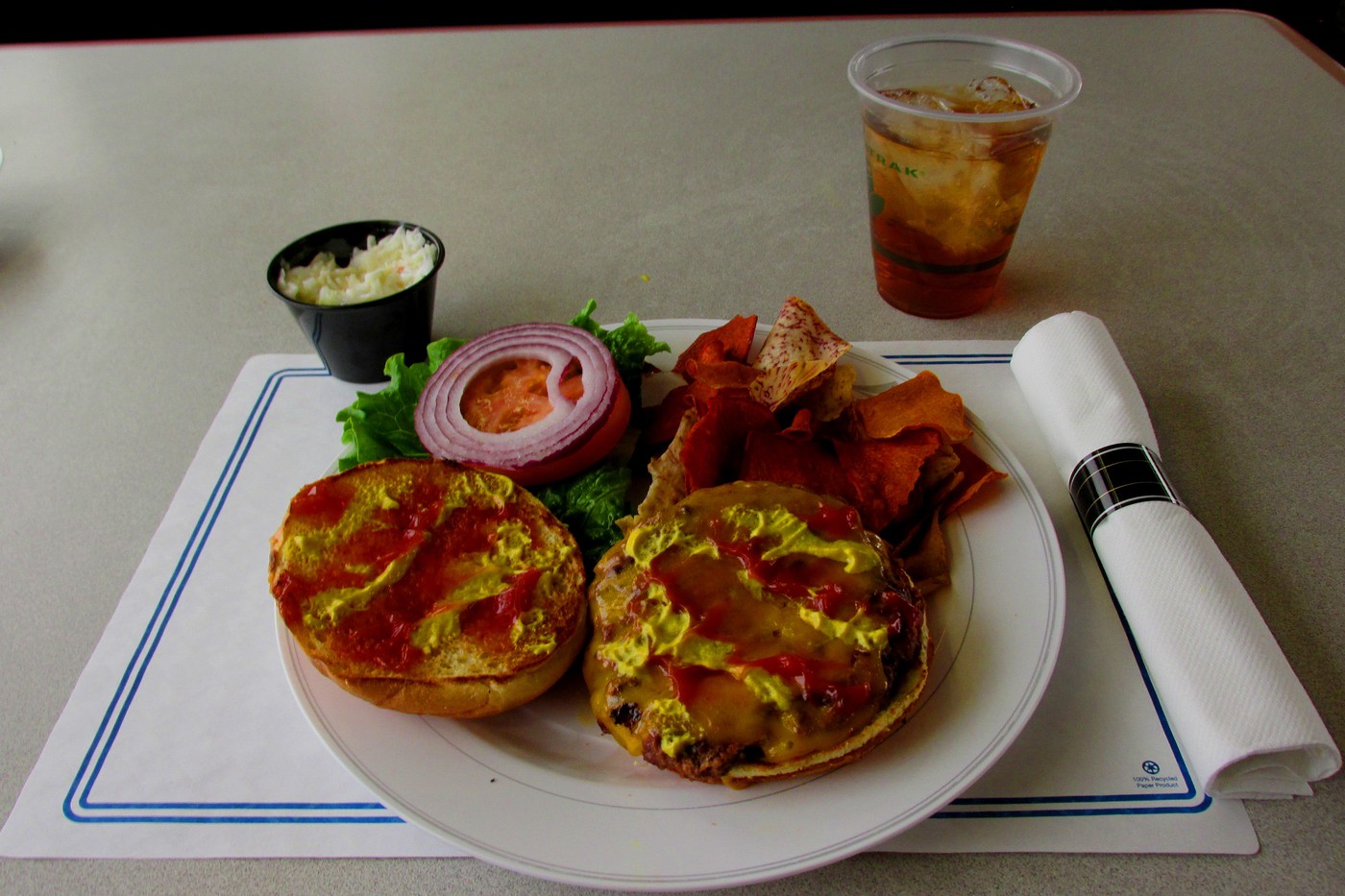 Colorful Hamburger Lunch
After lunch I headed back to the lounge car where I had a nice time trading stories and information with a gentleman named Aaron who, like me, had logged a few rides himself aboard the Zephyr. He’d also ridden aboard a couple of western excursion trains that I’d long had an interest in, particularly the Eagle Cap train operating in the mountains of northeastern Oregon. From the town of Elgin, Oregon the Eagle Cap train follows the Grande Ronde River and then travels up the Wallowa River to Minam, Oregon before reversing course and returning on the same tracks. The ride covers 38 miles over three and a half hours – my kind of trip in both distance and duration. I will definitely book a ride on this train next fall.
Our arrival at Emeryville was – by my watch – just three minutes late. For those of you unfamiliar with Emeryville, it is a suburb of Oakland – it’s closer to Berkeley, really – and is the terminus of the
California Zephyr. Trains from the east do not travel across the bay to San Francisco, and so far as I know they never have. For passengers desiring onward transportation into San Francisco, Amtrak has dedicated buses waiting at the station to take people into the city. Additionally, Amtrak’s Capitol Corridor trains stop at Emeryville and provide transport to a variety of Bay Area destinations. You can check out the schedule
HERE
As for me, I needed to get to Oakland International Airport. This was easily accomplished because directly across the street from the Emeryville Station is a stop for a free shuttle called the Emery Go-Round. That shuttle delivered me to the MacArthur BART Station where I caught a train to the Oakland Coliseum and then on to the Oakland Airport.
Three hours later I was in the Las Vegas Car Rental Center picking out another Nissan Rogue for my upcoming drive around the southwest.