A LOW VISIBILITY DAY
We are going to break this down into two distinct parts, the departure and take-off and the approach and landing. Hopefully this section will answer some of those frequently asked questions that occur on foggy days.
Departure and Take-off
We’ve arrived at Terminal 5 Heathrow on a foggy day with low visibility procedures in force, we have a morning departure and the airfield commenced safeguarding early on as radiation fog set in during the early morning.
The flight briefing pack is downloaded and start we going through a normal briefing but due to our knowledge of the required procedures and regulations, we brief a little more in depth.
Firstly, do we have an operation out of Heathrow? Heathrow and every other airport publish their approved take-off minima in terms of cloud base and visibility. For Heathrow it is 0ft cloud base and 75m of runway visual range. The current visibility today is 150m but has been fluctuating down to 100m.
Now any take-off below 400m of RVR is classed as a low visibility take-off and is a Captain’s only manoeuvre. Some operators use a higher value for the cut off and at BA this value is 600m for the First or Senior First Officer to handle the take-off.
Is our aircraft capable of doing this? Well with an operator’s approval to conduct low visibility operations, comes the training that allows us to take-off down to 125m RVR. With some specialist equipment that gives immediate information of the lateral deviation over the runway, and what to do to correct it, we can be approved down to 75m.
Our aircraft today is equipped with a head up display or HUD that contains a mode and display specific to this task of low visibility take-off or LVTO.
We check the operational defects and find nothing listed to prevent us from using this but we will double check with the aircraft’s tech log once onboard.
In these conditions ATC at LHR will only allow us to start-up and push back once the RVR is at or above a certain value based on our capability. This is handily added to the summited ATC flightplan that was filled by the airline’s flight planners.
The next question we need to ask is do we need to nominate a take-off alternate? We need a take-off alternate if we were to be unable to return and land at the departure airfield having suffered, for example, and engine failure on departure. Each state has its own prescribed ‘planning minima’ for this purpose. For us today we can use the minima we are capable of assuming a limiting failure such as losing an engine. Thankfully for us we have approval to land single engine to CAT IIIB limits and that requires 75m visibility. The weather is better than that today with between 150-100m so we do not need to nominate a take-off alternate. To save time the flight planners do this for us, we just check it complies with the rules, but should we need one it needs to be within an hours still air flying time at the one engine out diversion speed. Typically this works out at around 300-400 nautical miles based on aircraft type. For an ETOPS approved aircraft, it is two hours, or 800 nautical miles give the rule distance that is approved for the operator by the state.
So we’ve got an operation out of Heathrow, but we know things will be slower paced than normal so we elect to carry some extra fuel for the extended taxi time.
Once at the aircraft we check the aircraft’s tech log and prepare as we would normally until we get to the briefing. Some operators provide their crews with a handy aide memoir of the specific requirements and suggested areas to brief with regards to LVTOs and also approaches and landings. We will be discussing in depth the procedures Heathrow uses and the taxi routing expected, we concentrate on the HOWs of what we will be doing, how will we know we are on the correct taxi way, how will we identify the correct holding point? Who will do and say what for the LVTO, what will we expect to see and how will we know its all working as expected and how will we handle any failure? All of this is discussed until we are both happy of each other’s expectations and the plan.
The rest of our preparations are as normal and when we finally get clearance to start and push, we duly comply. Dependant on the actual visibility we will be taxing at a slower pace than normal. This is to ensure we don’t get lost and the hardest part of operating an aircraft is indeed the navigation on the ground. On arrival at our nominated holding point we are looking for the maker boards, the wig-wams or inset amber flashers and the CAT II holding point ground markers along with an expected red stop bar that we absolute not cross until it is extinguished and we have a line-up clearance.
Heathrow will allow the CAT I holding point to be used down to 1100m and 300ft cloud base. As we are below this today CAT II holds are used and our set further back. We check that we have the ILS tuned for the lateral guidance we will use during the take-off roll. We will already have discussed the number of lights we will expect to see once lined up, and this will define the visual segment to confirm that along with the RVR given by ATC, we do indeed have the visibility required to commence take-off.
There is a regulatory ‘take-off ban’ that exists until all of the following are satisfied;
· The RVR as assessed by the commander is at or above the applicable minima (75m)
· The reported touchdown zone RVR and/of met visibility are above this value
· The mid-point RVR
· The stop-end RVR is relevant (relevant meaning if entered at a speed of >60 kts should we reject the take-off at high speed)
· The cloud base if relevant for the airfield in question (not relevant today)
· Or is the runway and its markings are indistinguishable
We can only satisfy some of these once sat on the runway itself.
We are duly given line-up clearance, the red stop bar is extinguished and the alternating yellow and green taxi-way lighting illuminates, guiding out path onto the runway as we enter the ILS sensitive and critical areas.
From our briefing we reminded ourselves that Heathrow has centreline lights spaced just 15m apart, so to ensure a 75m visual segment, I must be capable of seeing 5 lights. As we passed through 45 degree to the runway centreline the HUD starts to come into its own, indicating where the centreline of the runway (according to the ILS localiser beam) is. We ensure we are lined up properly and that we have the relevant visual segment available. As clearance is received we are passed the three relevant RVRs and having confirmed they are at or above what we require, we commence our take-off roll. Should we have to reject our take off the lateral guidance prided by the HUD or the para visual display or PVD become very useful. The rate of deceleration on the 787 HUD is also displayed. It is also prudent for us to let ATC know that we are “stopping”. The ground movement and tower (runway) controllers sit in a visual control room, visual being the emphasis. In low visibility the visual part of that title is somewhat limited and so radar and transponder outputs become invaluable to know where the aircraft are. The back up to this are the standard RT or radio calls to ATC in these conditions. Whilst it is no longer mandatory to call “airborne” to ATC, we often still do this out of habit.
Once we are in the air and with having suffered no failures, that’s that. We continue the flight as we would any other.
Whilst that covers a general overview of departing a foggy UK airfield, other stars such as the USA, Canada, Saudi Arabia and Australia have slightly more restrictive requirements and minima. Regardless all are in effect achieving the same end goal of a safe operation in conditions where our primary references are obscured, always remember that a take-off is a visual manoeuvre!
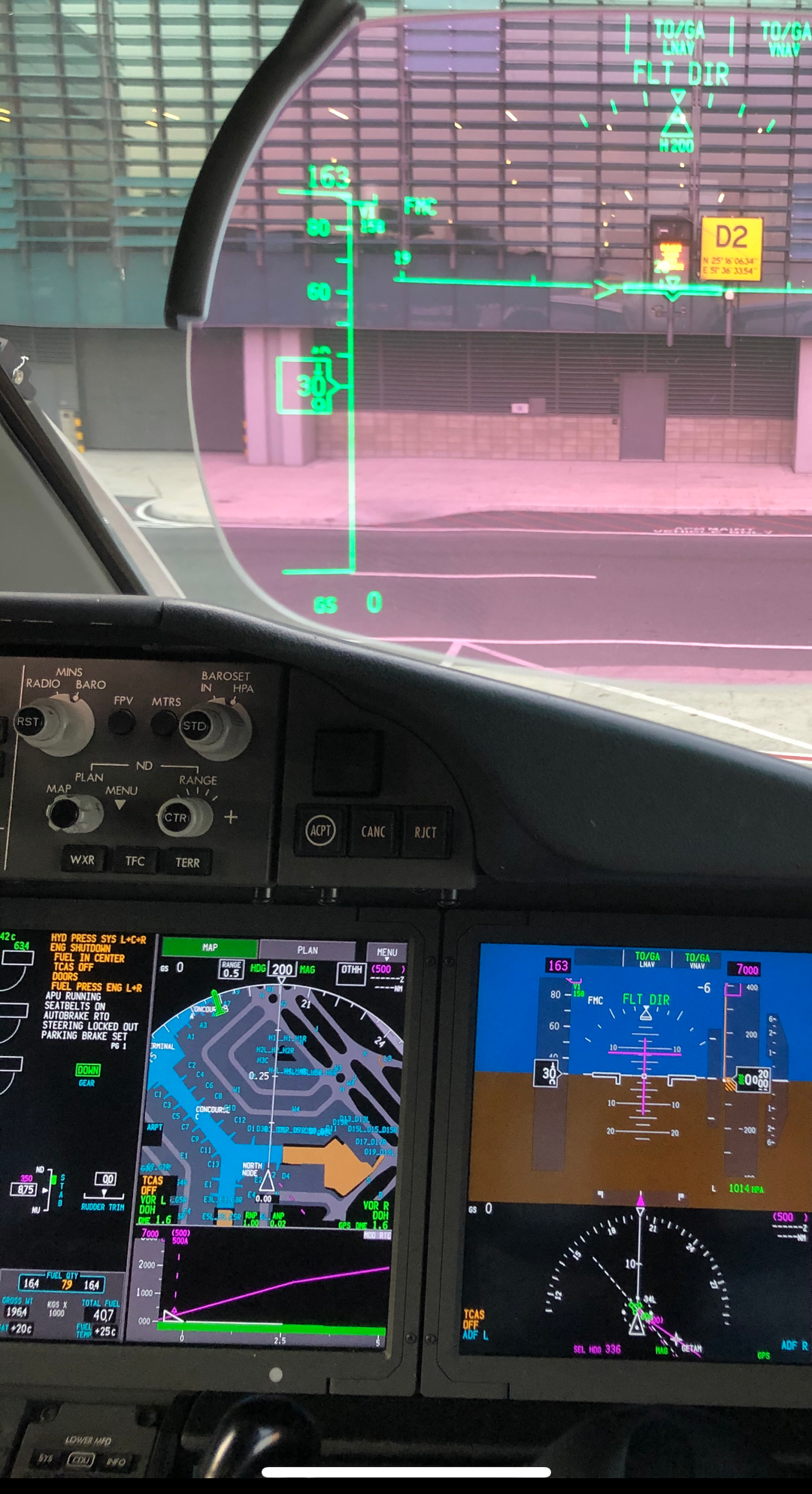 Nav Display with Airport Map Function and view of HUD on a standard day during preflight cockpit prep.
Approach and landing
Nav Display with Airport Map Function and view of HUD on a standard day during preflight cockpit prep.
Approach and landing
Having noticed at the briefing stage that our destination is forecasting low visibility conditions, we have checked out NOTAMS to look for any unserviceable equipment on the airfield that might affect our approach and therefore the minima we are allowed to use.
With a fully serviceable aircraft we are consulting the page in the aerodrome booklet of charts that lays out the minima we have at our disposal. We can start to formulate a plan for landing. We consult the latest weather reports from the airport (ATIS) to see what we are capable of today and see that the visibility is around 250m.
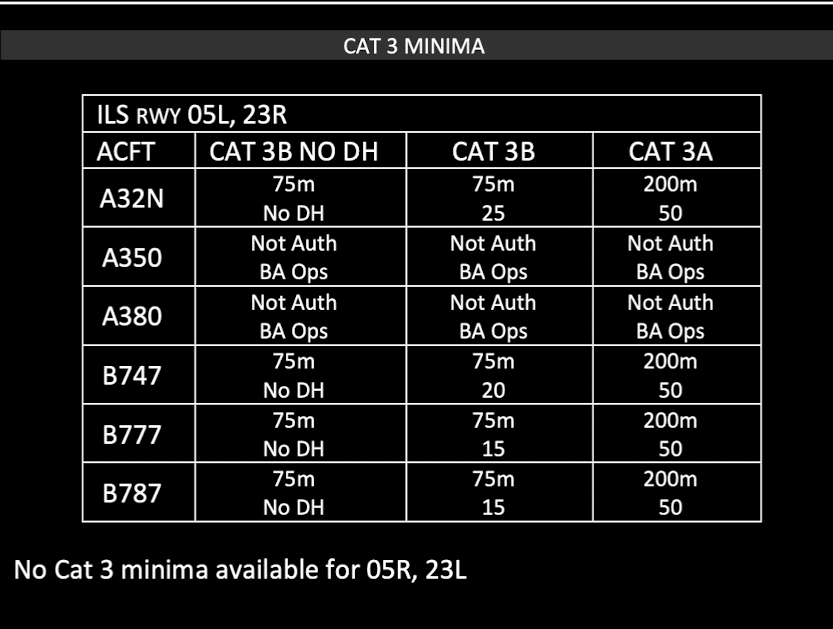
From the table we can see that CAT II is not available to us, but we can do a CAT IIIB with no decision height (DH), a CAT IIIB with a 15ft DH or a CAT IIIA approach with a 50ft DH. The 200 in that box refers to 200m RVR, and 75 for the CAT IIIB and CAT IIIB no DH.
So to prepare for our approach we refer to our aide memoir and set up the aircraft for a CAT IIIB no DH as we default to the best available performance the aircraft can achieve to get the greatest chance of success on the first attempt.
Going briefly back to the aircraft and it’s capability, we need to be prepared for what is known as a reversion should a failure downgrade the aircraft to LAND 2 status. This will still enable us to operate to CAT IIIA limits. In this case then we can set up the radio altimeter to be able to make automatic call outs for a minima of 50ft. As we are planning on operating to CAT IIIB no DH we ‘blank’ this display, but at the briefing we will discuss which single button to push in order to generate the calls outs should we need to revert and the weather still permits that.
The briefing is slightly more in depth than a normal briefing and again we refer to the aide memoir to keep it simple. We check we are both qualified to conduct this operation, that the aircraft is capable of CAT IIIB ops or plan on a lower minima. If we were to have an aircraft with a NO AUTOLAND message, wed need to find an airfield with CAT I weather or better as anything blow CAT I limits requires an Autoland. This is a company limitation and some airlines train for CAT II manual landings. We also make sure the runway is capable and discus any reversions that are available based on the actual weather and the minima available for that runway. We discuss the handling of various failures both above and below the alert height and how we will handle them. Some failures allow us to reconfigure and continue, some require a go around. As an example, if we were to suffer an engine failure below the alert height, we will continue with the landing, if the autopilot or auto throttle disconnects, we will go-around. We also discuss the runway exit and taxi route and any airfield specific procedures and what we will do with aircraft lights. To aid the visual requirements it is often prudent not to have the landing lights on in low visibility to reduce glare.
We now discuss the regulatory requirements for lighting we need to see in order to let the aircraft land itself. The reason for this is that we will need to disconnect the autopilot at some point on the runway and be prepared for it to disconnect itself in the event of a failure after touchdown. For a CAT II landing down to 300m visibility we need to see 3 consecutive approach or runway lights including a lateral element such as a touch down zone barrette. For CAT IIIA we just need 3 lights with no requirement for a lateral element and then for CAT IIIB it is at least 1 centreline light and for Cat IIIB with no DH we don’t have to see anything at all.
So if we can land ‘blind’ why the 75m requirement? We will need to taxi the aircraft with the human eye and therefore 75m has been established as the lowest visibility that can be safely conducted with the Mk.1 eyeball.
We’ve now briefed and discussed the HOWs with regards to executing the brief and it is time to commence descent the approach. Autolands are the preserve of Captain’s as the ‘pilot flying’ for the landing itself. Most airlines adopt a concept known as ‘monitored approaches’ for low visibility operations. This means that the First Officer flies the descent and approach down to the minima for that approach at which point the captain will call ‘”LAND” (or words to that effect) and assume control from the automatic or manual (if permitted) landing. The First Officer is at all times on the approach planning to do one thing only, go-around. They will deliver the aircraft in the correct landing configuration and in a stable condition by the prescribed point specified by the airline for the captain to land. The captain will however wait until the required visual reference (the number of lights required) has been achieved.
To commence the ILS approach we check the correct code for identing the system is displayed and that the lateral and vertical deviation pointers are working in the correct sense. As we are cleared to ‘intercept’ we select the LOC or localizer mode of the Auto Flight Function suite. The VOR antenna in the tail will ‘lock onto’ the localiser beam an align the aircraft to track the signal to the runway, as alignment finishes the LOC mode switches to the antenna in the radome for ‘tracking’. We arm the glide slope mode via the ‘APP’ or Approach button and the glideslope antenna, also around the radome will intercept and track the glideslope beam. At 1500ft off the ground the autopilot engages all available channels, separates power sources and conducts a BITE check. At this point we see either LAND 3 or LAND 2 and we can now confirm the weather and minima we are able to use and any reversions that still remain. We are now approaching a critical regulatory moment for a few reasons, 1000ft above ground. The approach bad is now relevant. The regulations permit us to commence an approach more of less regardless of the reported RVR, but we are not permitted to go below 1000ft unless the RVRs provided by ATC in the tower are at or above the minima we require to land. Assuming we have values above this figure we can continue right down to our decision height. 1000ft also marks a critical point in the stable approach policy. We must now be in the correct landing configuration of flaps and gear and be in the correct vertical and lateral ‘slot’ in the sky and at the correct stable final approach speed. If we are not we go-around. With everything in order the call of “Stable, Autoland, I have control” comes from the left hand seat. The Captain is now the pilot flying for their autoland. This role reversal is known as the monitored approach, and means one pilot is always go-around minded and ready to react if needed.
We are hoping there will be no system downgrades, but we are briefed on what to do for a variety of scenarios. The RVRs are behaving and its now prudent we know the that the touch-down zone RVR is always controlling, the mid-point value is controlling if reported at relevant and needs to be at least 75m, the same as the touch-down zone value today. Otherwise it would be 125m required there. The stop-end value will be a minimum of 75m and is only controlling if reported and relevant. For relevant, it is relevant if we’d be in that segment of runway at or above 60 kts.
ATC have by now cleared us to land and we are given RVRs of 150/150/125, so we should actually see some runway today. We approach 100’ and the “100 ABOVE” call from the GPWS system tied to the radio altimeter.
With the LED lighting installed these days and the visibility better than required, a “visual” call is made by the Captain above the “minimums” call-out. Implicit in this call by the Capatain is the hand over of control and the controls are now guarded by the captain as the aircraft continues down. The ‘FLARE’ auto pilot/flight director function activated and the thrust levers roll back to idle. The aircraft settles down. On 777s the para visual display (where installed) provides roll out guidance and the HUD on the 787 continues to show the localiser centreline. With the patchy nature of fog the visibility goes up and down as we roll and decelerate along the runway and at around 60 kts the captain squeezes on the top of the rudder peddle to take over from the auto brake and disconnects the auto pilot with its distinctive alarm.
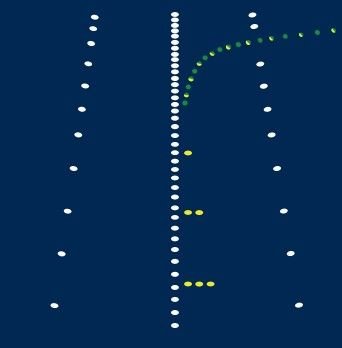
The 3/2/1 count down lights of the rapid exit taxiway are seen and we can pick out the alternative green and yellow centre line lights. We follow these off of the runway and use ATC instruction, viewable taxiway signage and our charts backed up by the airport map function of the navigation display (where installed) to navigate to our parking position. A concept of ‘follow the greens’ comes into its own here with clear red stop bars that help us to navigate correctly in what is the most difficult part of the flight.
So there you have it, what you don't know now isn't worth knowing. Along with
Heathrow Tower's great post on the ATC side, you can hopefully begin to see exactly why we don't mess about with Low Visibility and why not all aircraft, runways or Pilots are capable of performing auto lands and low visibility take-offs, and just why extra spacing is required and the amount off effort that goes into maintaining an operation, albeit reduced compared to a lovely sunny day.
* For the Mods - As per
HeathrowTower 's suggestion on the Cold weather thread, perhaps these could all be merged? *