Segment 5: Vientiane to Boten
Since it was too early to check in, I decided to search on Google maps for a breakfast place and it led me to
Phở & Bún Chả Hà Nội, a Vietnamese restaurant a block away from Central Bus Station.

I ordered a small bowl of beef pho for 20,000 LAK and it was delicious.

The cuter of the two dogs which kept me company while I was there.

Next up was to settle the money issue. I was debating between withdrawing from ATM or exchanging USD at a moneychanger; in the end decided to go for the latter. It turned out to be a better decision because the moneychanger was offering 17,200 LAK for 1 USD as opposed to the official exchange rate of around 14,000 LAK for 1 USD. It meant that the locals don't have any confidence in the outlook of Lao Kip and are willing to pay higher than market rate to purchase USD in order to preserve their wealth.

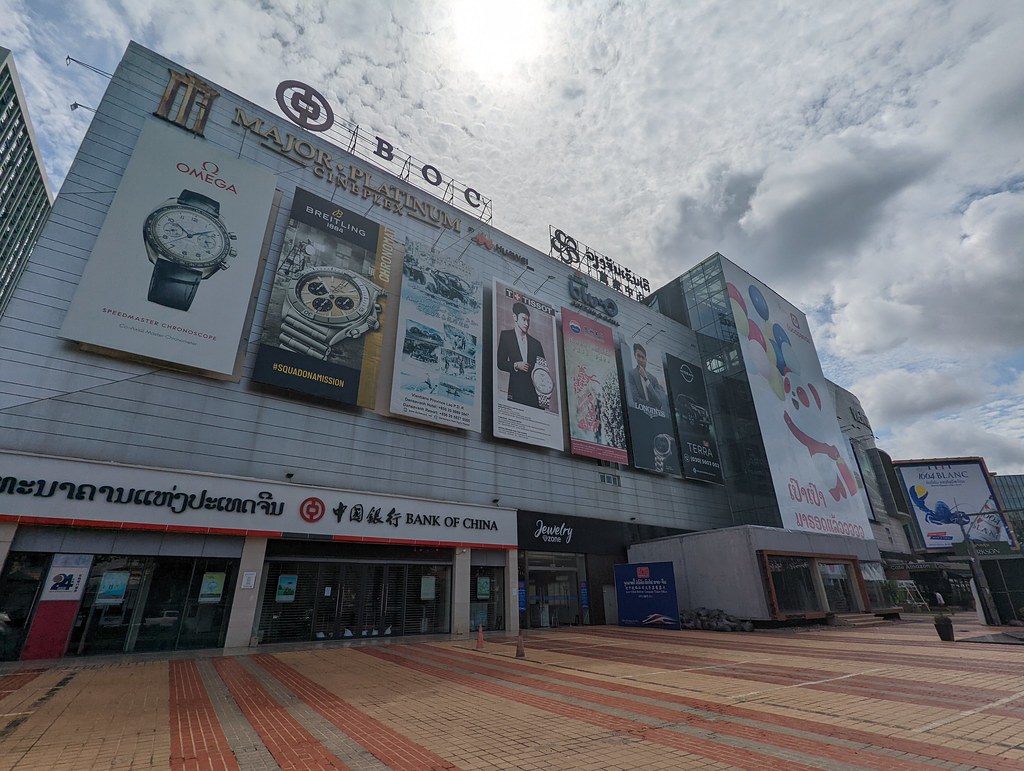
Finally 10am rolled around and I headed to Vientiane Centre Lao to purchase the train tickets.
 Lao-China Railway
 started its operation on 3 December 2021, linking Vientiane with Boten at Lao border with China
(and onwards to Kunming). In the initial stage, passengers could only purchase tickets at the stations and it was only in February 2022 when a ticket office opened in downtown Vientiane.

However, the downtown office doesn't accept any cash and only allow transfers through the local bank BCEL OnePay app. The booking system is also very restrictive; I could only buy tickets originating in Vientiane but not from other cities. Passengers could only buy tickets for the next three days and not beyond that. There was also an additional 20,000 LAK admin fee per ticket.

Despite having no BCEL OnePay app, I still queued up in the hope that I could secure a ticket. The lady at the counter could speak Lao and Mandarin and she told me that while there was ticket available for the following day's train, she wasn't able to accept cash. Most of the people in the queue in front of me were foreigners as well and had the same problem.

I approached locals who were purchasing tickets for themselves to help but they didn't have sufficient balance in the account.
Eventually the kind Chinese owner of a nearby shop assisted and even declined my offer to pay her extra for the trouble. Otherwise I would need to go to the train station to buy the ticket with cash.

There seemed to be an event going on outside Vientiane Center Lao in the evening; the area should be pretty nice after sunset.


Adjacent to Vientiane Center Lao was another shopping mall Parkson Laos. I reckon that it's probably the most fancy mall in the entire country.

After getting some foodstuff from the supermarket inside the mall, I took a tuktuk to
One Vientiane Hotel for 30,000 LAK. The driver wasn't willing to go lower despite the relatively short distance of 2km.

Although it was before noon, the friendly staff still let me check in. I had booked the room two nights ago on Agoda, paying 48.53 SGD (~35 USD) for a night.

I got a nice big room with a King bed.

If there was a real complaint, it had to be the placement of the plugs. They were all under the table.


As I woke up really early on the train, I showered and rested until I felt hungry enough to go out for lunch.
Wat Inpeng was the nearest landmark to the hotel.

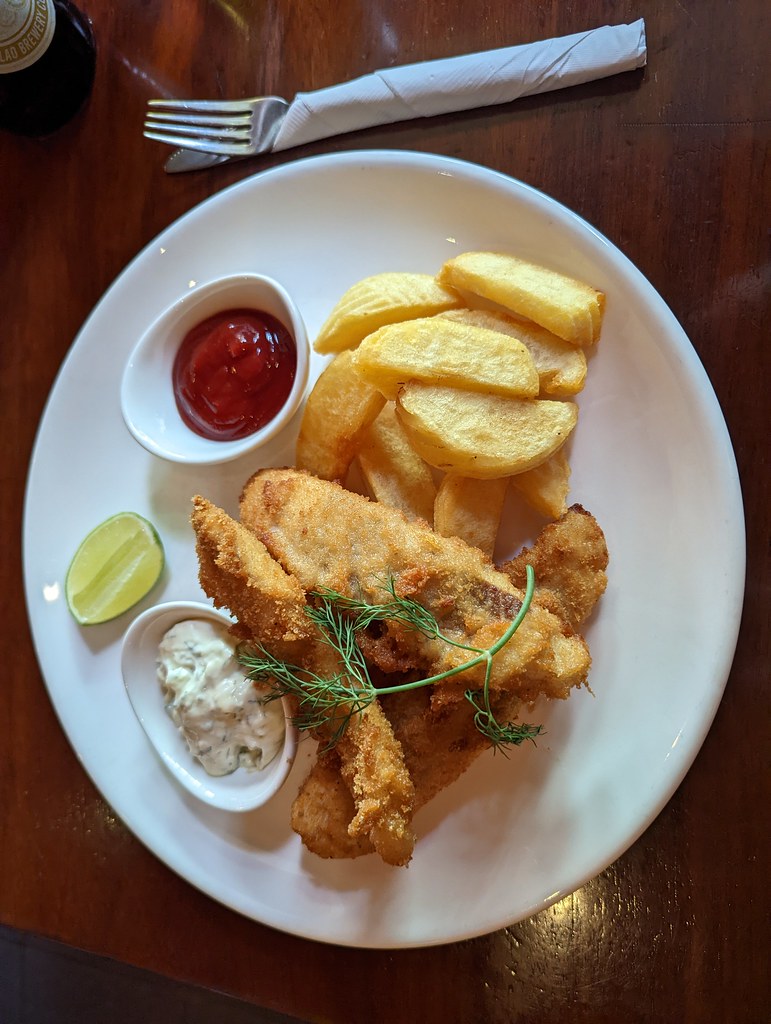
Lunch was fish and chips with
Beer Lao at
Sticky Fingers. The cost was a very reasonable 75,000 LAK (~4.30 USD).

On the way back, I walked past
Wat Ong Teu. That would be all of my sightseeing that afternoon.

I did more thinking when I got back and decided that the easiest option for me was to do a day trip from Vientiane to Boten the next day. Hence, I extended one more night at the hotel and paid 400,000 LAK (~23 USD) directly.
I ventured out again in the evening and headed in the direction of the night market. While it didn't seem much at first,
I was impressed with its size and scale after wondering around.

There were a lot of stalls, selling both food and merchandise.


There was an amusement park for kids by the river and it seemed that the locals were all out having fun on a Sunday evening.


There were also several open-air restaurants by the river and they seemed popular.

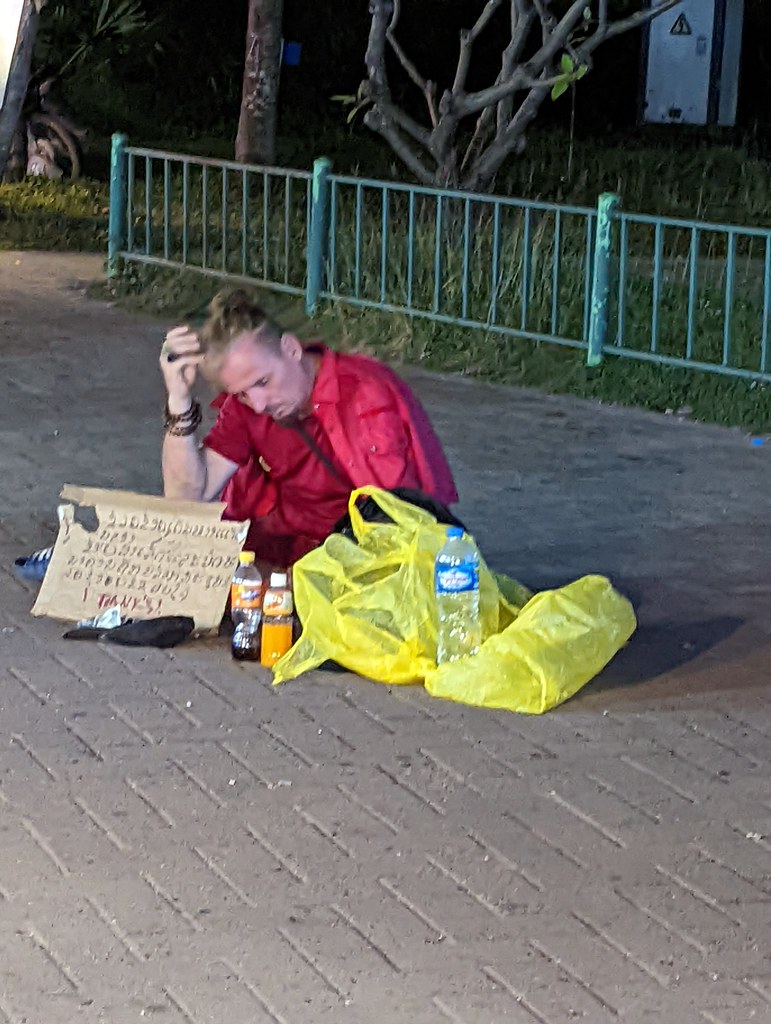
One of the things that I couldn't accept or understand was the presence of
begpackers. The sense of self-entitlement was beyond belief.
 Reckoning that my stomach might not be up for the street food, my dinner was fried kweytiau and watermelon smoothie at Papao (50,000 LAK or ~2.90 USD) before I retired for the night.

It was another day of early start and I left the hotel at 6am to walk to Central Bus Station. I had seen the public bus schedule the day before; bus 28 to the train station would depart at 6.30am.
While walking past the Presidential Palace, I could see
Patuxai in the far horizon.

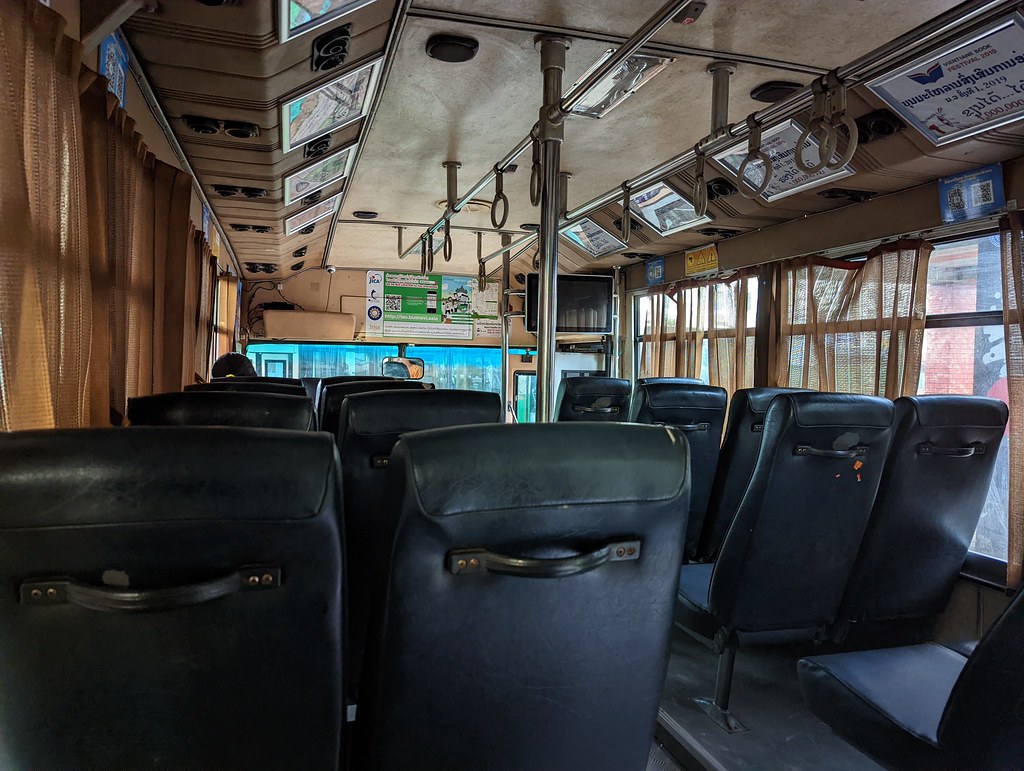
I arrived at the station around 10 minutes before departure time. The bus taking us to the railway station was an older Isuzu model. It used to be a city bus in Kyoto and was donated to Vientiane after its retirement in Japan. The fare was 15,000 LAK (~0.87 USD)

There were two things that I didn't like about the bus - firstly, there were a lot of mosquitos inside and secondly, its window film was so opaque that it was impossible to take any photographs out of the windows.
Vientiane Station is 15km away from downtown and the bus arrived there half an hour later as per scheduled. My first thought was: was I in China now?

There was a long queue to buy tickets by then. I wasn't sure if they were looking to travel on the same day.

The entire project was constructed and operated by
China Railways and thus the service followed Chinese SOP entirely. There was a first queue which checked for tickets and a second queue to go through the security. There is only one entrance with two X-ray machines, creating a bottleneck every time when there's a departure. I cannot imagine the situation if either of these machines break down.
The waiting hall wouldn't look out of place in a third-tier Chinese city.

There was no food and drinks inside the waiting hall beside a vending machine which doesn't give back any change. There were vendors selling local food outside the station so travellers would be better off getting food before entering.

Third and final queue was the ticket check before entering the platform. The train north would be quite full on this Monday morning.

As of June 2022, there are two trains between Vientiane and Boten daily. The faster C82 departs at 7.50am and takes 3h35m while the slower K12 departs at 9am and takes 5h20m. There is an afternoon fast train C84 departing Vientiane at 4.05pm but it goes to only until Luang Prabang.

Service: Lao China Railway C82 Car 1 Seat 14A
Depart: Vientiane 7.50am
Arrive: Boten 11.25am
Duration: 3h35m
Distance: ~406km
Equipment: CR200J
Cost: 430,000 LAK (~25 USD)
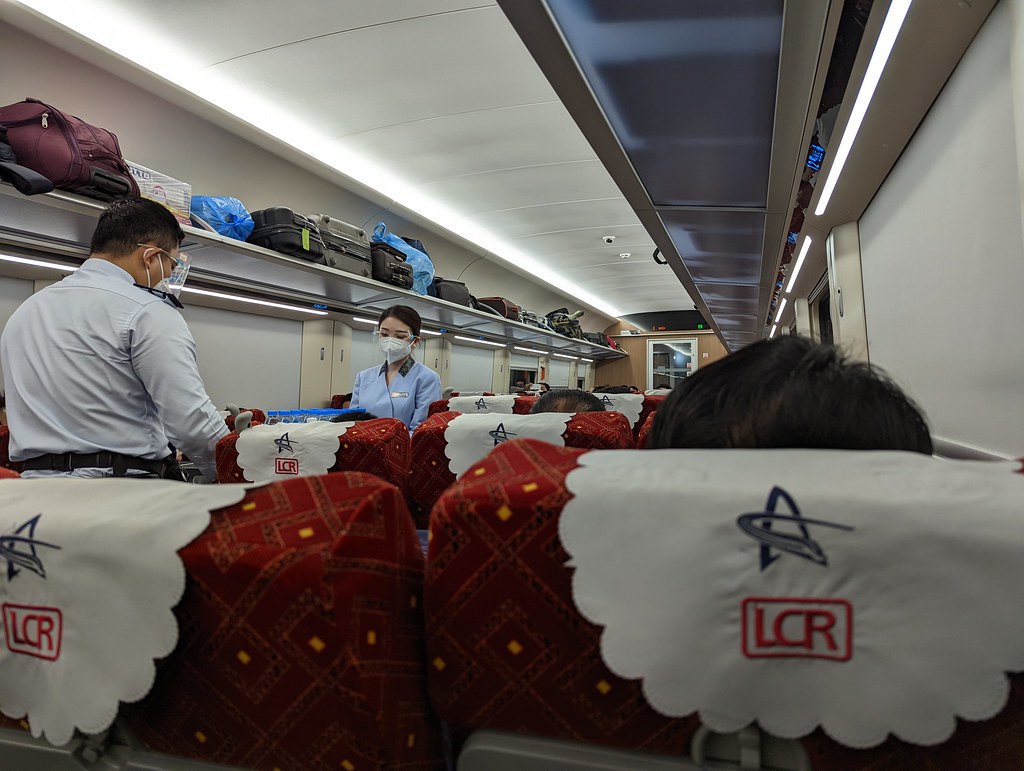
I found myself transported to "China" again when I boarded the carriage. The CR200J trains could travel at the top speed of 160km/h, cutting the travel time from more than 12 hours by road to merely 3.5 hours.

The seat pitch was more than decent and I was happy to get the window seat.

Train C82 departed on time at 7.50am sharp. While traveling northwards, rows 1 to 10 will be facing the direction of travel and rows 11 to 20 are facing the opposite.
The female attendant could speak both Lao and Mandarin Chinese and she went around checking tickets soon after departure. She would also strictly enforce that the passengers sit in their assigned seats.
The terrain was pretty flat getting out of Vientiane and I noticed that the railway was running adjacent to the
new expressway between Vientiane and Vang Vieng for some distance.
An hour later, we arrived into the first stop
Vang Vieng. The station staff would stand at attention when the train rolled in and out of the station.

From the train, Vang Vieng did look like a good place to chill for a couple of days.

The terrain got more hilly as we headed northwards from Vang Vieng.

We actually spent more time inside tunnels than out of it once we were north of Vang Vieng but the scenery was fantastic whenever we were out of it.

There was no food for sale on the train but the crew did go around selling bottled water for 12,000 LAK (~0.70 USD) each.
The next stop was the royal city of
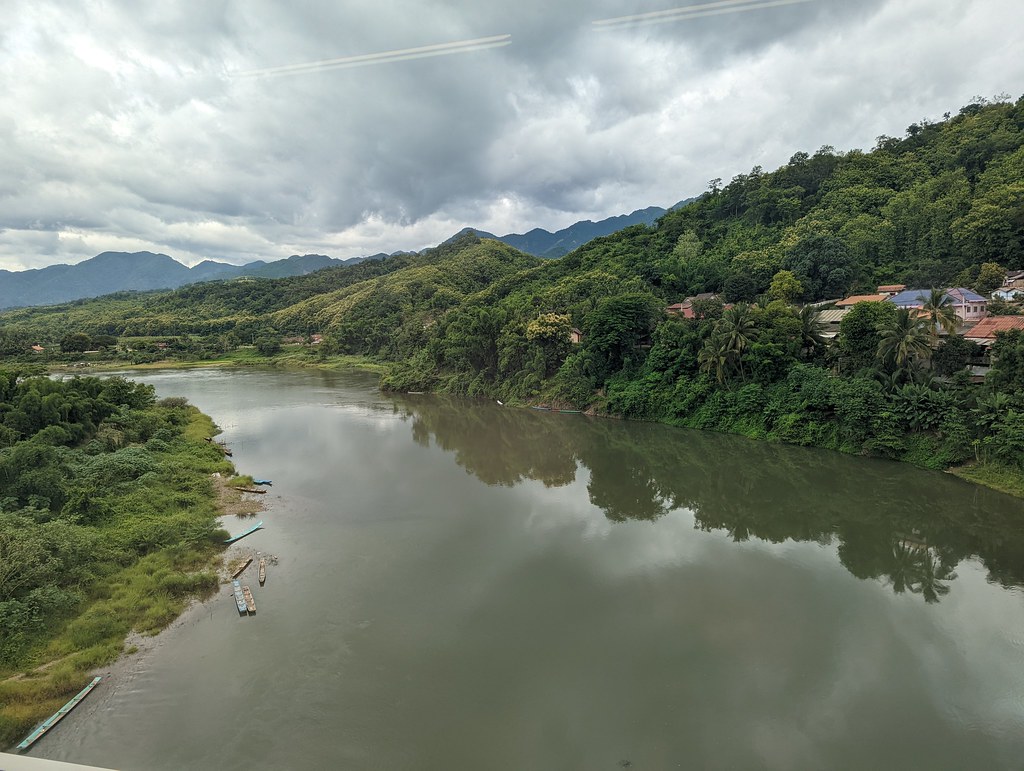
Luang Prabang at around 9.40am. We would travel across Nam Khan River just prior to arriving there.

I noticed that the train was usually slightly early arriving at the stations. Beside passengers, the railway was constructed to also carry freight which are mostly manufactured goods from China.

More than half of the passengers in my carriage were disembarking in Luang Prabang and they were replaced by new passengers traveling north.
After leaving Luang Prabang, we went across Nam Khan river again.

The next stop was
Muang Xai, around an hour away. At the station, I noticed that the brick was imprinted with the Lao-China Railway logo - Chinese characters representing Laos and China.

Another thing that I noticed was that the English on the train's scrolling text screen was just direct translation from Chinese. For instance, the Chinese version was
孟赛站到了 and the English one would be
Muang Xay Station is arrived.
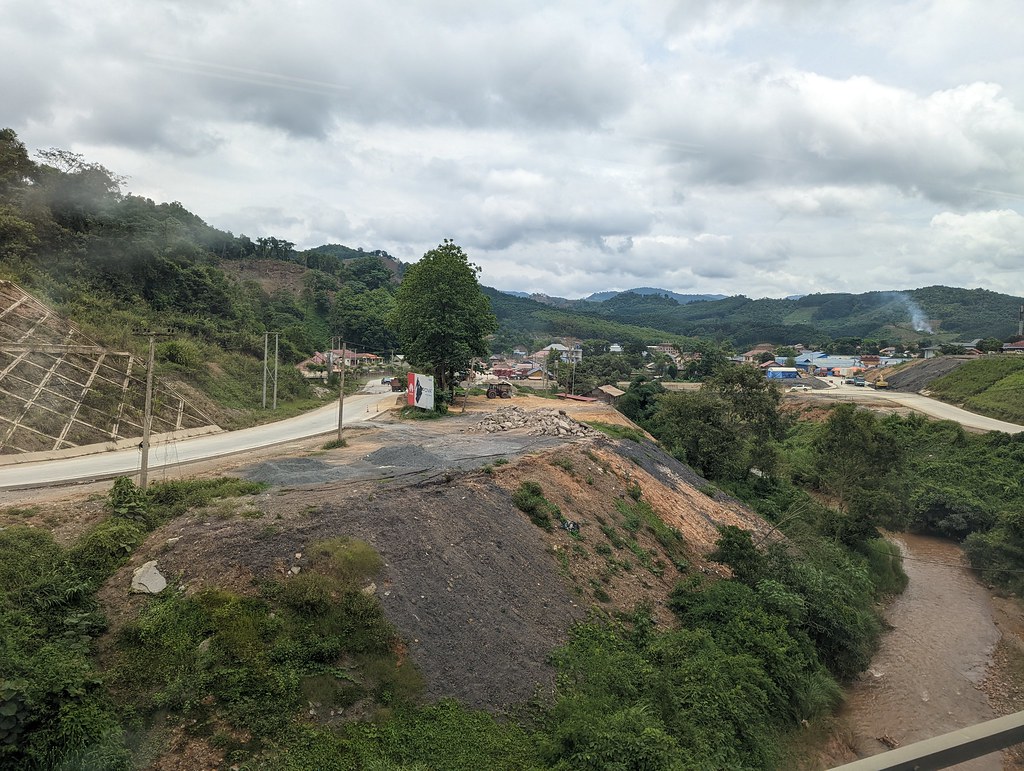
There were some projects while on the way to Nateuy and they should be Chinese-funded investments. Couldn't help but wonder how Laos could pay off all these debts in the future.


Towards the end of the journey I went to check out the bathroom. There were more squat toilets than seat toilets, which was probably in line with the locals' preference.


It was only short 12 minutes ride to from Nateuy to
Boten station and from what I could see, it's a big logistics hub for Lao-China trade and there were many Chinese in
Boten. I also overheard a phone call where a Chinese guy was asking his friend to fetch him from the train station. However, his friend said that he wasn't able to because his vehicle had ran out of fuel due to the ongoing crisis.

Arrival was on time and I followed the crowd out of the station.

And here I was, just five kilometres away from China.
I could probably get a little closer but James from
Nomadic Notes was in the area a week earlier and he shared that people entering Boten are required to have negative PCR test result. He was nice enough to reply my questions on Lao-China Railways in DM too.

Complete.

After six days and almost 3,000 km on the road, I would turn around from here and start my journey home.
Distance travelled so far: ~2,985km