Originally Posted by
SarahWest
Arrivals for direct bags is
not automated. In fact, for arriving bags, the process is as follows:
- Plane arrives on stand
- Doors are open and baggage bins are taken out
- Drivers are pre-allocated (or, sometimes, allocated on the spot by the team leader/IRS) specific bins. They receive their bins and then drive to
- If the bins are transfers, the nearest (in theory) input point, where they'll offload the bins onto a conveyor belt which will feed the bags into the handling system and there the highly automated work will start
- If the bins are direct, the driver will go to T5A, get to the conveyor belt for the specific flight and then will offload the bags onto the belt. The conveyor belts you see in T5A arrivals continue on the other side of the wall, where there is a parking stand and space for one or two workers to offload the bags. There are automated scanners on the "arches", i.e. the gap in the wall between the passenger side and the workers. These will scan the barcodes so that HAL (and thusly the airline and baggage handler) know which bag has been offloaded at which time. If memory doesn't deceive me, the workers need to do nothing but to drive to the "tip" and offload the bags.
With my armchair detective hat on, I believe that what must've happened is one giant SNAFU. Let's assume that the boxes o' fish were on the Cyprus flight. These would most definitely not travel as "baggage", but as cargo. Since the fish boxes seem to be insulated, I'm assuming that they weren't inside a constant climate AKE or AKH, as these "look" different. So they're still likely to be in a normal bin, an AKE or AKH depending on the aircraft type, but they'll be labelled as "cargo" on the manifest and will be visible as such on the team leader's iPad and on the laptop. So, for instance, here is what ANA shows for a 787:
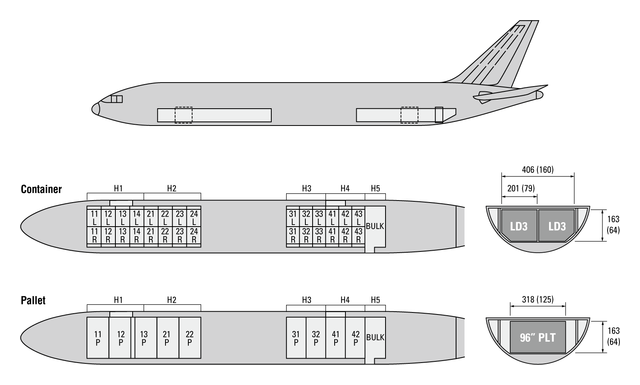
As a ramp handler you will see the picture of the hold and you'll see, for instance: 13L, position right by the door, you'll have your T5 short transfer bags as these are the most important and so they can get out of there fast. Then 12L you'll have First class bags, so an F-Bin. Then a J-class bin, then further behind the Y class bin and finally the T5Long transfer... or stuff like that. Cargo travels either at the very back (so 24L, for instance, or in the back hold.
If all of the above is correct, then there's two possible (kind of correlated) scenarios at play. No. 1, somebody in Cyprus did a cock up. Bin X is full of passengers bags, Bin Y is full of fish. Bin X is prepared and handled by the passenger side and needs to go to T5A, Bin Y needs to be picked up by a Cargo driver with a Terberg tractor and hauled to, well, Cargo!. Cyprus does a mistake and swaps Y for X. Heathrow opens the hold, gets Bin Y, thinks it's a passenger bin, somehow manages to ignore the tell-tales (like the fact that there is an A4 piece of paper that says "Hey, I'm cargo" on the outside), drives the fish to T5 and the offloads an ENTIRE BIN of blue boxes without connecting the dots. Bin X goes to cargo where I'm hoping that somebody realised what its contents were before they fed them to the machine.
Scenario No. 2, Cyprus' not at fault, but Heathrow is fully responsible. They offload the plane with the same finesse used in a WWII carpet bombing, manage to offload cargo bins and passenger bins in a gigantic ensemble, offload the fish on arrivals and the actual bags... somewhere. Maybe in the transfer tip.
From the outside looking in it seems incredible that somebody could offload 20/30 boxes of fish without batting an eyelid but... Believe me, I've seen stupider. There are brilliant baggage loaders and drivers and there are people who could be replaced by penguins, let alone robots, and the penguins would do a better job.