March 21, 2017
Russian Railways Moscow to Beijing 1155p – 1140a Train 4: The Trans-Mongolian First Class Sleeper
With five long hours to hang out before the departure of this train, let’s take a moment to examine just what the Trans-Siberian Railway is. Most people – including myself – are unaware that it comprises three different routes and each route has a differently named train. All three trains travel along the same main line between Moscow and Irkutsk, a distance of 3,200 miles or 5152 kilometers. At Irkutsk, the Trans-Siberian routes divide three ways:
The Trans-Siberian Route: Moscow – Irkutsk – Vladivostok: This is the original Trans-Siberian railway. Starting in Moscow, the route goes through Yaroslavl, Kirov and Perm to Ekaterinburg and continues through Siberia to Irkutsk and on to Vladivostok on the Pacific coast.
Actually, I stand corrected on my above statement about all three trains using the main line between Moscow and Irkutsk because on certain days of the week there is another train – also branded the “Trans-Siberian” that takes a southern route through Kazan and onwards to Ekaterinburg where it then joins the main route on to Irkutsk and beyond to Vladivostok.
The Trans-Mongolian Route: Moscow – Irkutsk - Ulan-Bataar – Beijing: This train passes through the Siberian plains and forests along the main line between Moscow and Irkutsk, after which it heads southeast through the Mongolian steppe and part of the Gobi desert as it journeys through Mongolia to China.
The Trans-Manchurian Route: Moscow – Irkutsk – Beijing: The difference between this route and that of the “Trans-Mongolian” is that it goes around the Eastern border of Mongolia rather than crossing through it. From Irkutsk, the Trans-Manchurian Line continues along the Trans-Siberian line as far as Tarskaya, which is a few hundred miles east of Baikal. From Tarskaya, the line heads southeast into China near Zabaikalsk and makes its way down to Beijing. This is the long way to Beijing, checking in at 5590 miles (9001 km) long.
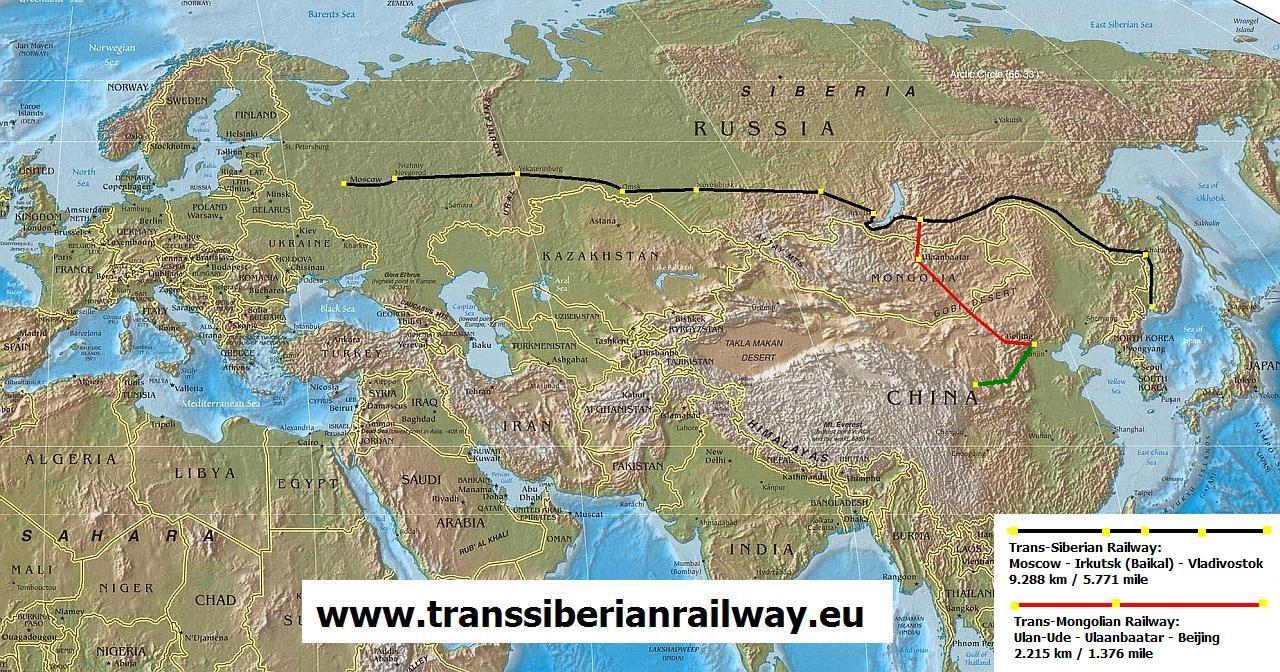 Map of the Trans-Siberian and Trans-Mongolian Routes
For most people, the classic Trans-Siberian train is the 5,767 mile (9288 km) run between Moscow and Vladivostok. The train I am riding and reporting upon is the
Trans—Mongolian, a bit shorter at
only 4,735 miles (7621 km), but arguably the most interesting of the three Trans-Siberian routes to take, given the potential to see and/or visit Mongolia along the way.
Regardless of their name, each of these trains is a trans-Siberian train as they all cross a major portion of Siberia on the 3,200 mile stretch between Moscow and Irkutsk.
* * * :-: * * * :-: * * *
Well that didn’t take long! How ‘bout a bit of history? Both the railroad’s and mine, if you will…
The construction of the Trans-Siberian Railway is one of the world’s more remarkable engineering feats, especially given the times during which it was built. The route had been in the planning stages for 25 years with many foreign companies ready to bid on and begin construction earlier, but Emperor Alexander III wanted full ownership of the railroad with no foreign influence - thus the quarter of a century delay in getting started. The railroad was completely funded and built by Russians.
Construction on what was then called "
The Great Siberian Way" began in February 1891, starting simultaneously from Chelyabinsk and Vladivostok. The thousands of common workers who took part in the construction came mostly from the ranks of exiled prisoners and soldiers. With no modern equipment, the majority of the work was carried out by hand using shovels, axes, crowbars and saws. As on who’s lived and worked in Alaska for many years, I can appreciate some of the difficulties faced by those folks in building this railroad. Alaska and Siberia have similar landforms and climates and there’s little doubt that the harsh conditions made the job that much more difficult. Most of the tracks were built through thinly-populated areas where permafrost and large rivers presented major challenges. In the Baikal region mountains had to be blasted or tunneled through while bridges had to be built to cross the canyons of the many large rivers that flowed from the mountains down into Lake Baikal – the world’s largest fresh water lake.
Despite all of the difficulties described above, an average of 430 miles or 700 km. of tracks were laid each year. That’s a remarkable figure even by modern construction standards.
One of the most impressive aspects of this railroad’s completion was the construction of its bridges over the many large Siberian rivers it encountered. The Khabarovsk Bridge across the Amur River is the largest bridge on the railroad and was the last to be completed. It was built between 1913 and 1916 and measures 200 feet high (64 meters) by 1.6 miles (2.6km) long. Its completion also marked the completion of the railroad.
These days the entire length of the main line between Moscow and Vladivostok is double tracked and electrified. It remains the world's longest railway providing access on its eastern end to the rail networks of North Korea, China and Mongolia while in the West it connects through Russian ports and border crossings with a host of European countries.
The Trans-Mongolian Line was built from 1940 to 1956 between Ulan-Ude at Lake Baikal's eastern shore on through to Beijing. From Ulan-Ude the tracks go southeast through Mongolia, crossing the Gobi desert until finally arriving in Beijing.
* * * :-: * * * :-: * * *
Prior to this trip, the longest single train ride I’d ever taken was back in 1994 aboard Amtrak’s
Sunset Limited between Miami and Los Angeles – a three day 71 hour journey covering 3,160 miles. Just last spring I took a five night, six day rail journey traveling 5,700 miles from Lafayette, Indiana to Lafayette, Louisiana along the following routing:
DAY 1: Depart Lafayette, IN for Chicago at 730am. Arrive Chicago at 1015a and depart for Portland, OR at 300pm
DAY 2: Enroute through North Dakota, Montana and Idaho
DAY 3: Arrive Portland at 1025am and depart for Los Angeles, CA at 230pm
DAY 4: Arrive Los Angeles at 845pm and depart for Lafayette, LA at 1000pm
DAY 5: Enroute through Arizona, New Mexico and Texas
DAY 6: Arrive Lafayette, LA at 515pm
So, clearly I’m no stranger to long distance train travel. Even so, this ride aboard the Trans-Mongolian will be an entirely different type of train trip. Here’s why:
This journey covers six nights and seven days aboard the same train, all the way through. There are no connections along the way that allow for a few hours off the train.
• There is no lounge car aboard this train, so a great source of mingling with my fellow travelers is not available.
• Many of my fellow travelers will not speak English. Many of the train’s onboard staff will also not speak English.
• To me, all of the above factors combine to make this trip all the more alluring.
So the question I seem to have gotten most often from friends and acquaintances who are at least vaguely aware that there is a train across Russia is this: Why aren’t you riding the long one? The actual Trans-Siberian. It’s a good question, given my passion for trains and long train rides. I have two answers.
First, given my overall itinerary and the availability of certain award flights, riding the Trans-Mongolian from Moscow to Beijing made the most sense from the perspective of both time and money.
Second, I can always come back and ride the classic Trans-Siberian another time. Indeed, what I’d really like to do is complete the trifecta and ride both the Trans-Siberian and the Trans-Manchurian.
There is one other factor as well. The Chinese train that operates the Trans-Mongolian is said to have better First Class accommodations than its Russian counterpart. Additionally, it benefits from better and more varied dining in the form of Mongolian and Chinese dining cars that travel with it through their respective countries.
* * * :-: * * * :-: * * *
So then, let’s return to the present where I’ve recently arrived at Yaroslavsky Station with five hours until train time. If I had it to do all over, I’d have booked myself a half-day Moscow City tour and checked out some of the sights in this fascinating city. Then again, I am thankful for all the extra sleep I got last night as I’ve got a long day ahead of me today.
As I mentioned earlier, Moscow’s served by an incredible five different railroad stations. As Yaroslavsky’s the only one I’ve been in, I can’t compare it to the others. However, based upon stations that I have been in, I would call Yaroslavsky a mid-sized station, about the size of London’s Euston.
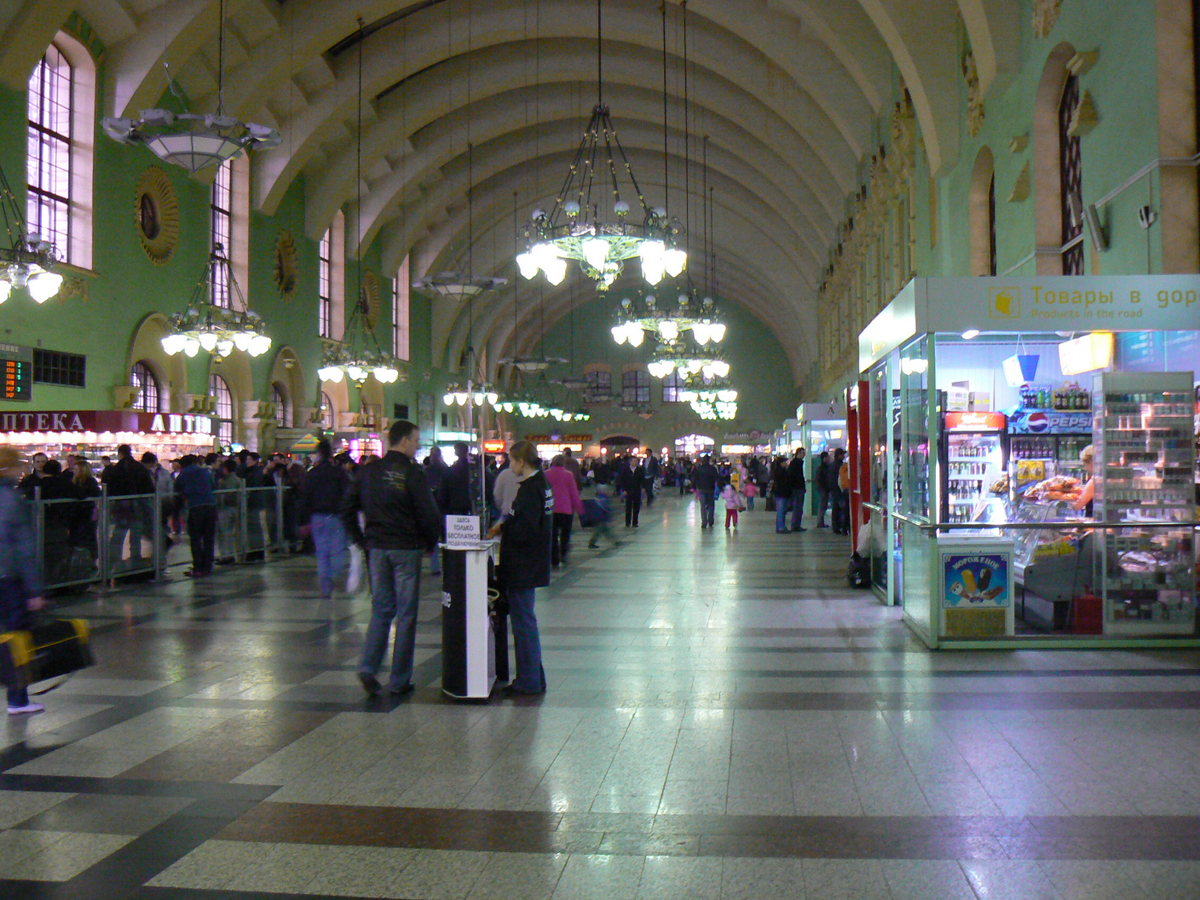 Moscow’s Yaroslavsky Railway Terminal
The main hall is ringed by shops – most of them selling cheesy souvenirs and snack foods. I did however notice a nice looking book store and a large stand that sold “Crap Dogs”. I’m assuming – indeed hoping – that “crap” has a different meaning in Russian. On two corners of the station were Kentucky Fried Chicken outlets. One of their best features was that they had plenty of tables with nearby electrical outlets. I resolved to visit one before the night was over.
In the center of the main hall are a set of escalators – one up, one down. Heading upstairs I found a large number of seats (150-200) and more shops similar to their competitors downstairs. The Crap Dog’s competitor was a nice looking sandwich shop with a nice looking variety of meats, cheeses and breads all out on display.
Continuing along on my tour, I sauntered over to the far corner where a sign above a set of double doors indicated V.I.P. Lounge. Hmm. I like lounges. Let’s go check it out.
In retrospect, it was perhaps a bit naïve of me to expect anything along the lines of say… the Virgin Trains lounges operated at various stations across the U.K. For the uninitiated, those Virgin lounges are – from my experience with the one in Euston at least - similar to a basic U.S. airline lounge offering light snacks, a few complimentary beverages and a cash bar. It would be really great if Virgin could operate one at Moscow’s Yaroslavsky Station because the facility that was billed as a V.I.P. Lounge here was nothing more than a large room with five rows of large, comfortable looking black leather loungers. On the wall facing the chairs was an approximately 50” flat screen television tuned into what appeared to be a Russian news talk show. I looked over when I heard the word “Trump” and lo and behold there he was – our leader - (key the harp glissando and the chorus from the heavens) scowling magnificently if not a tad petulantly into the camera. Aside from the television, the only other amenity was separate men’s and women’s toilets. There was no water or coffee, no tables, no newspapers or magazines. There was however a lounge receptionist who informed me by writing it down that the entry fee to this V.I.P. lounge was $200.00 Rubles – or about $3.50 USD. Yes ma’am! Sign me up!
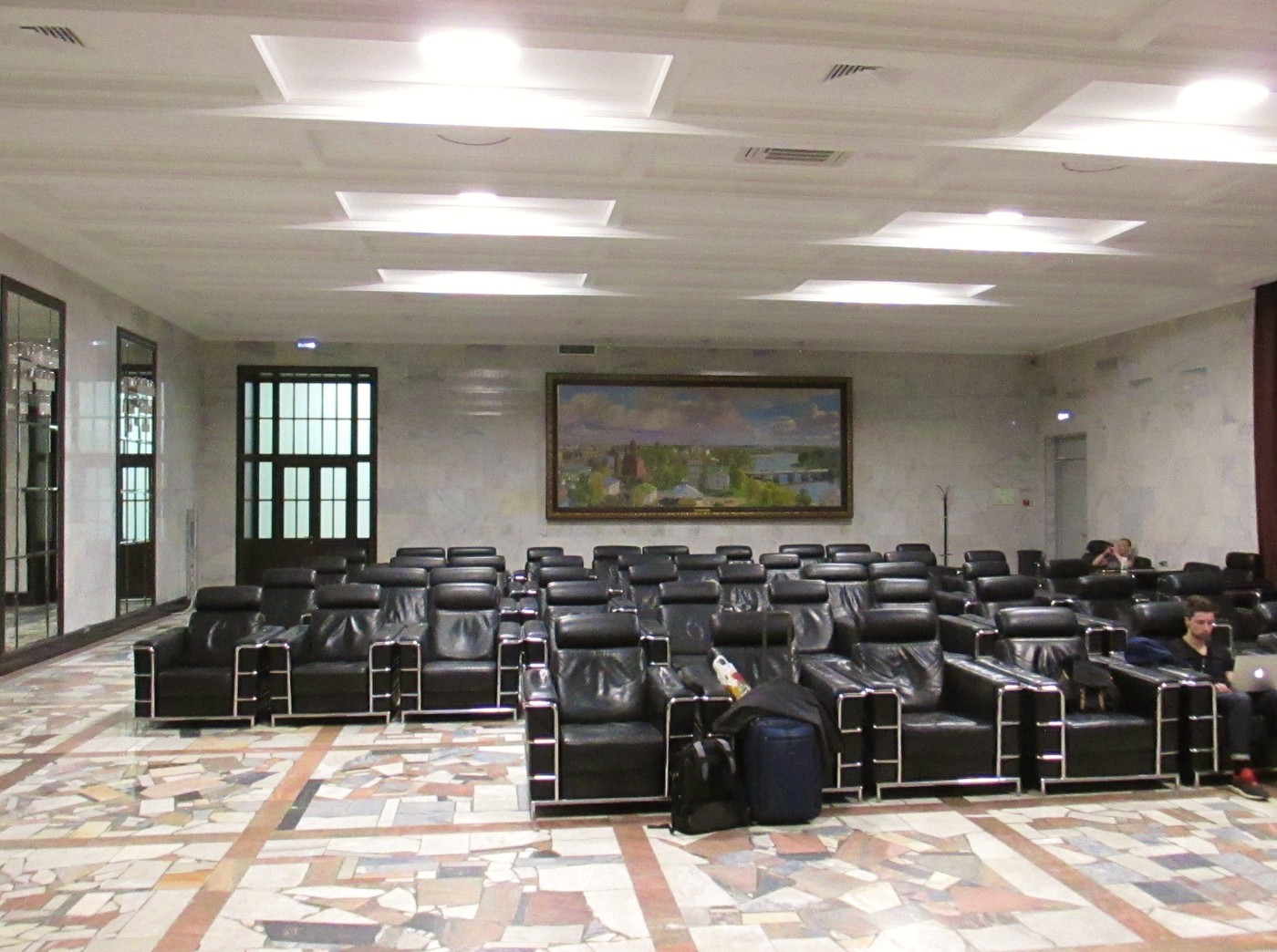 V.I.P. Lounge at Moscow’s Yaroslavsky Railway Terminal
Over the next five hours I plugged in and got some work done on this report, purchased a few bottles of drinking water and a sleeve of cookies to have with my coffee in the morning. I then paid a visit to the Kentucky Fried Chicken outlet downstairs while the lounge receptionist was kind enough to keep an eye on my gear upstairs.
With two exceptions, all of the employees at KFC appeared to be from far eastern Russia, perhaps somewhere near the Mongolia or China border. They were all very polite and efficient at taking orders, even mine which involved me pointing to one of the many items pictured in a group on the menu board and then writing down the price of it.
Out in the main hall there is a departures board that showed about 7 or 8 trains departing Yaroslavski. All of the writing was Cyrillic but it was easy enough to locate my train by its number (4) and its departure time (2355). Tracks are not posted until about 40 minutes prior to departure and I assume that once that happens, you are free to board. I was up in the lounge at the time when the receptionist alerted me to the track update.
Train 4, track 4. Keep it simple. I like it. Getting out to the train was simple, too. No need to first stop and check with a guard or conductor. Just walk out through the door marked “To Tracks”, locate track 4 (easily done – just follow the numbers) and walk down to your car. Each car has its number posted in large numbers in the window by the door. The first car I came to – the one at the end of the train – was #3. Only seven more cars to go!
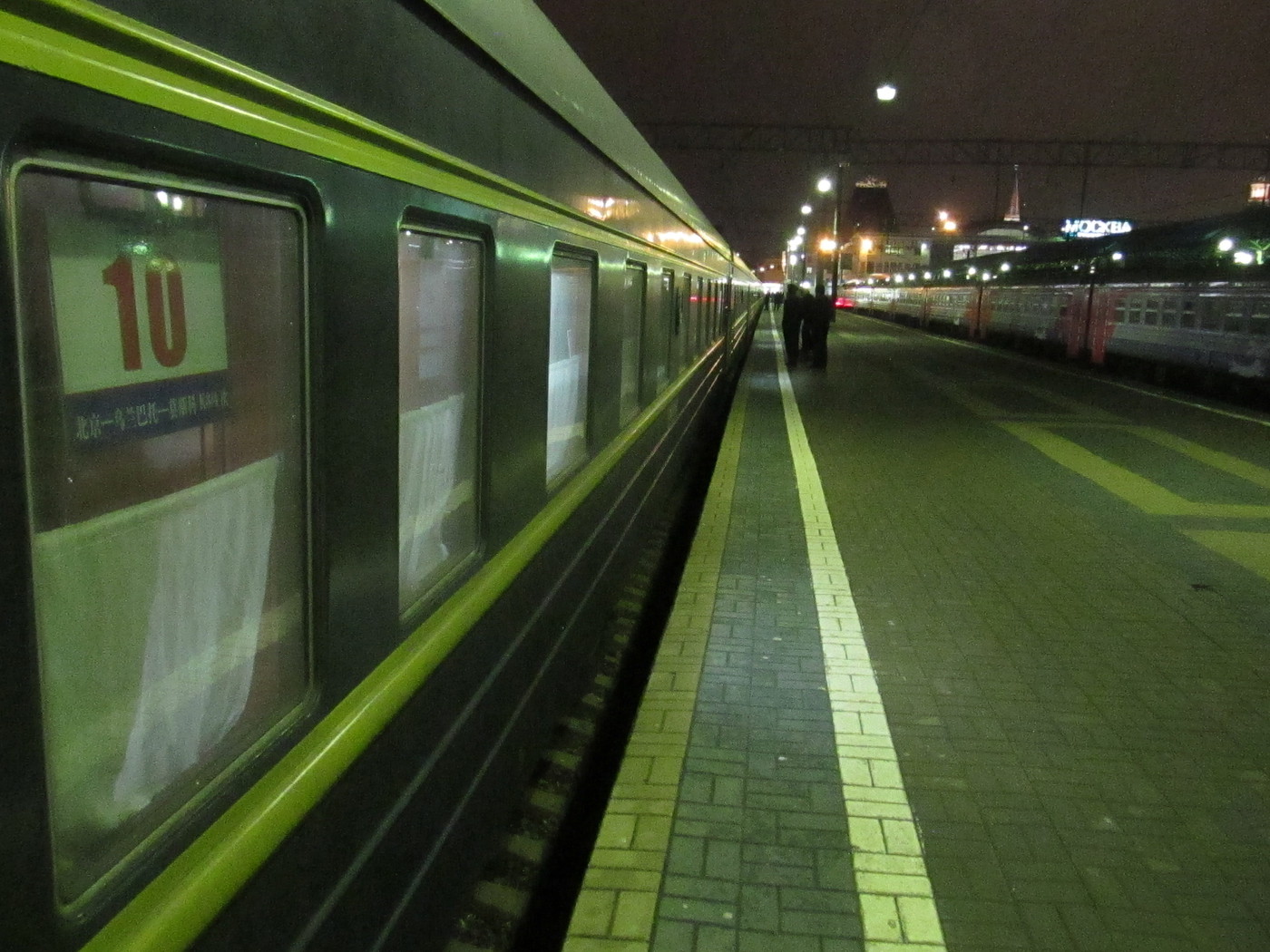 Ah… Car 10!
Car attendants and/or conductors were positioned at the entrance to each car. This is a Chinese train and with the exception of the Russian dining car staff, all of the crew are Chinese. I must say they all looked quite smart in their navy blue airline pilot style uniforms, complete with the peaked pilot’s style hat.
Li was my car attendant and thank goodness he spoke at least basic English. Seeing that I walk with a bit of a limp, he was very helpful in assisting me aboard the train by taking both my bag and my day pack and delivering them and me to my room. Upon boarding, I was at once impressed by the wooden paneled hallway and the deep pile carpet. It’s a well-known fact that neither the Chinese nor Russian trains comprise a classic luxury experience but these small touches definitely made for a good first impression.
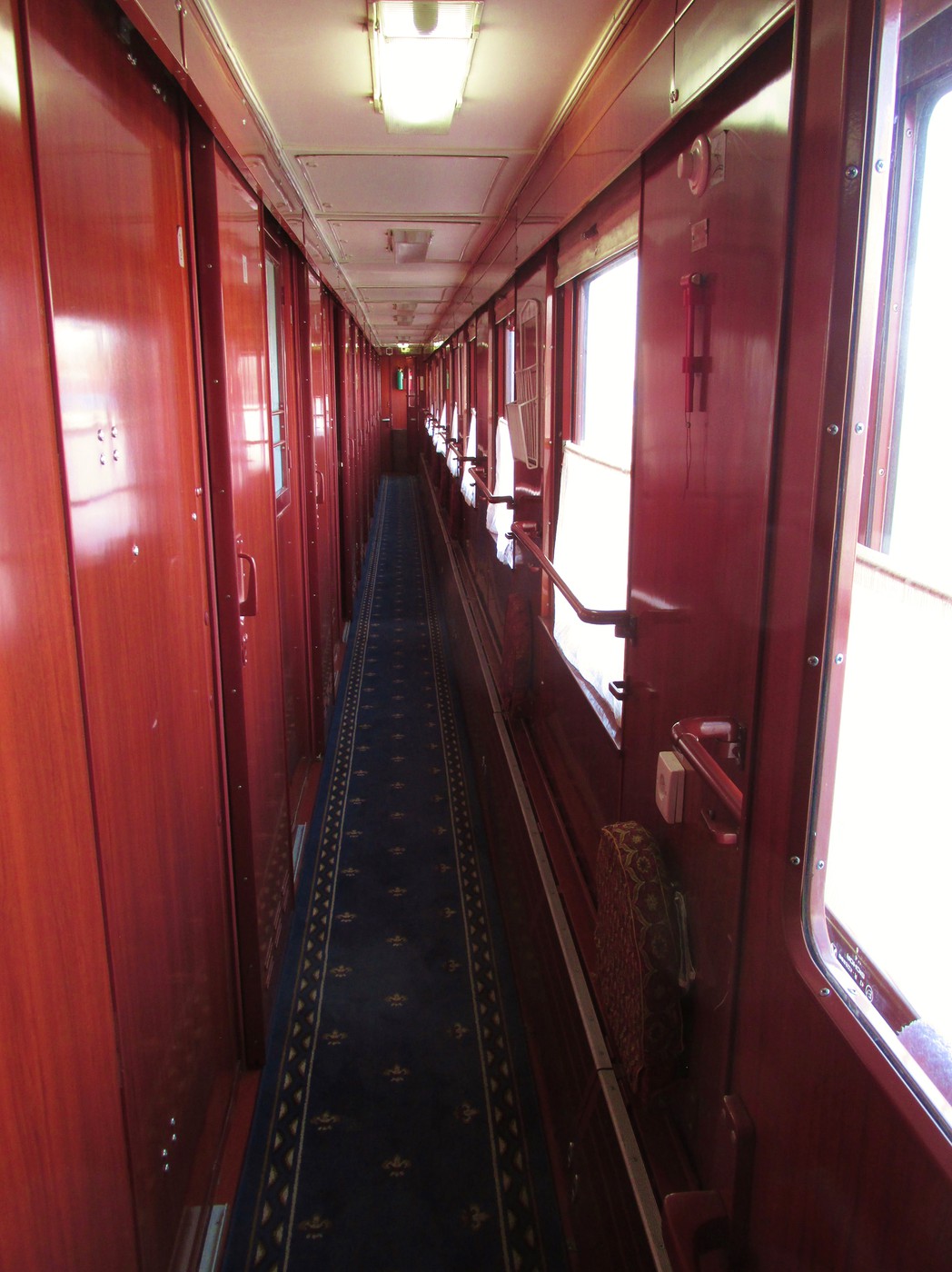 The wood paneled hallways are much nicer than the ones in the First Class cars
I am booked into suite 3 on car 10. My accommodation is what is known in Chinese railroad terminology as a Deluxe Soft Sleeper. Suite 3 comes with an upper and lower berth, a table, a separate seat across from the table and a shower and wash basin which are shared with the suite next door. It’s a fairly sizeable compartment by railroad standards, measuring about 9 feet deep by 7 feet wide (2.75 x 2.15 meters) with the ceiling close to 9 feet above. It’s well-lit with a single large fluorescent light and a couple of smaller wall mounted reading lights beside the bed and chair. In the center is a large window measuring about 3 ½ feet square. The table is decently sized with more than enough space for working and/or meals. All of the walls are wood paneled against which the beds and chair are upholstered in red and gold patterned fabric. It’s an attractive combination and in terms of overall ambience looks like a compartment I’ll be happy to inhabit for the next six days.
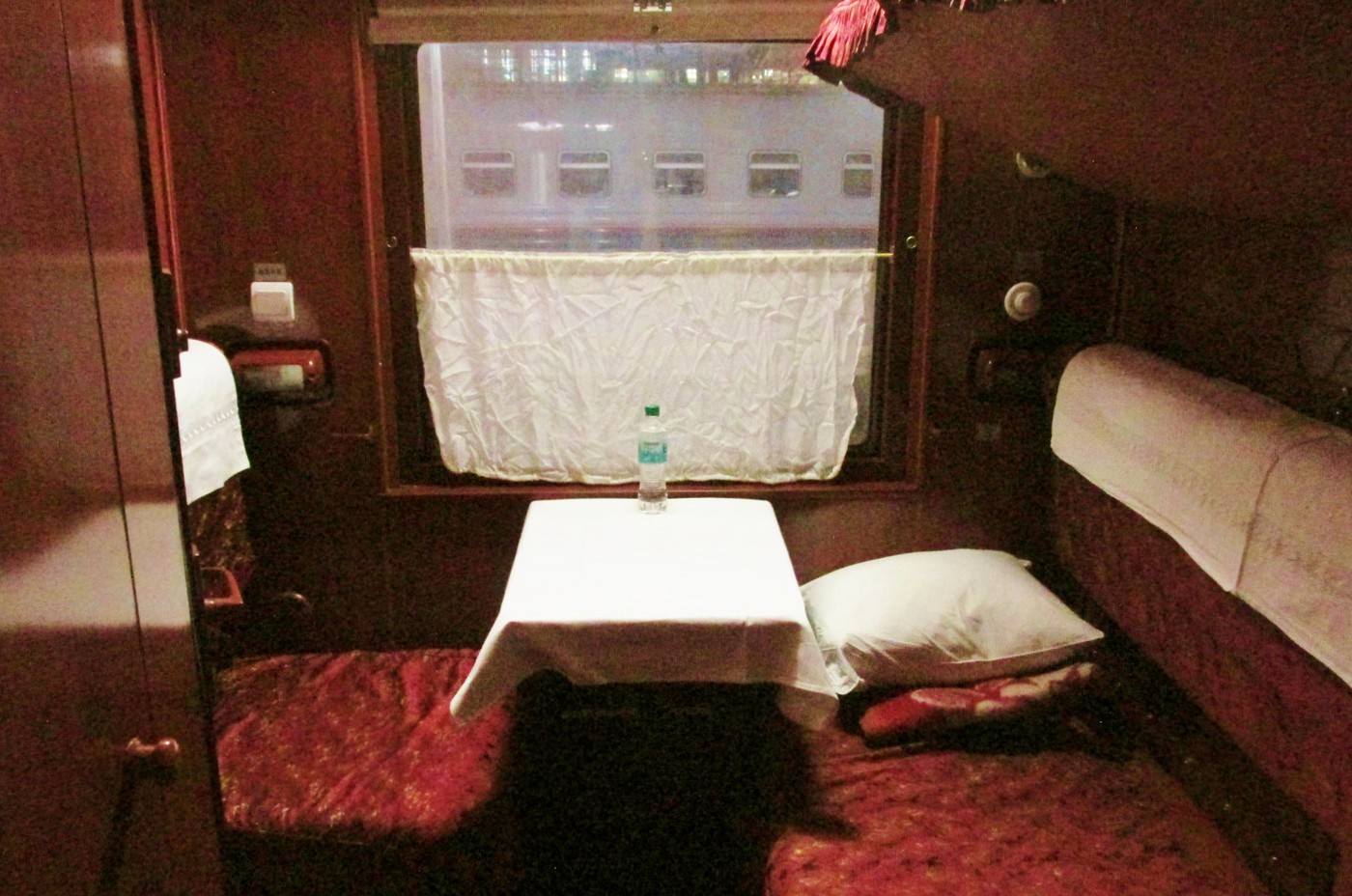 Deluxe Soft Sleeper Compartment
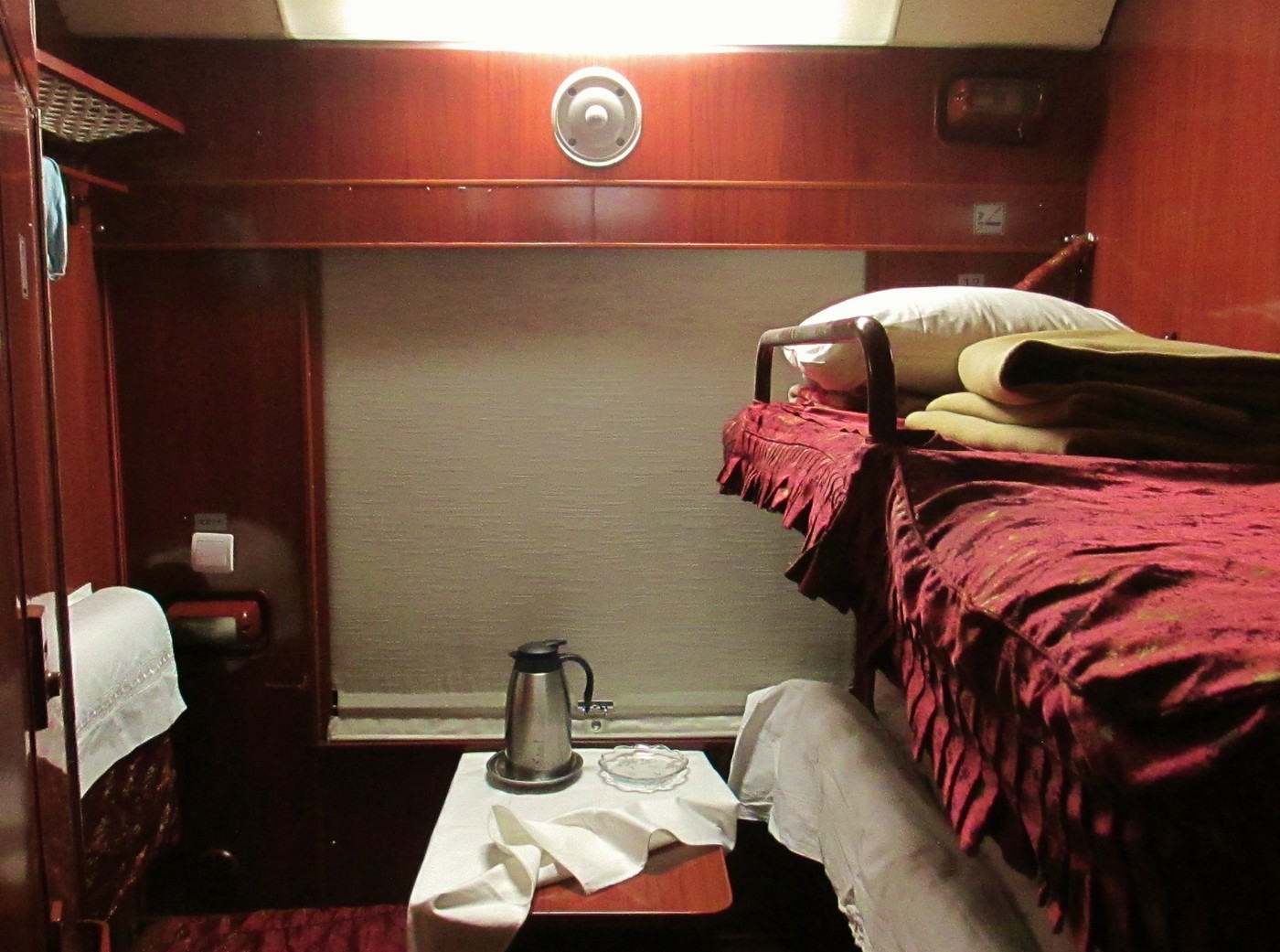 Deluxe Soft Sleeper Compartment
Not everything was perfect however. Sitting down on the bed, I was surprised at how hard it was. If this is a deluxe “soft” sleeper, I’d hate to see what the second class “hard” sleepers are like! I can only imagine they must be bare metal! The mattress on the bed as well as the padding on the chair had the consistency of the hard thin padding you’d find transit bus seats. Indeed, I’ve sat on a few transit busses that were more comfortable. These beds need some memory foam in the worst way! In the interim, I’ll have to make do with using most of the four blankets provided to fashion a little softer sleeping surface.
As for the ensuite wash room, it contains only a small sink along with a shower head attached to a 3 foot long metal hose. Any visions of luxuriant showers a la the Emirates A380 were quickly dashed. The water pressure is minimal, as is truly hot water. It does make it to the warm side of tepid, but no warmer. But hey – at least it isn’t cold.
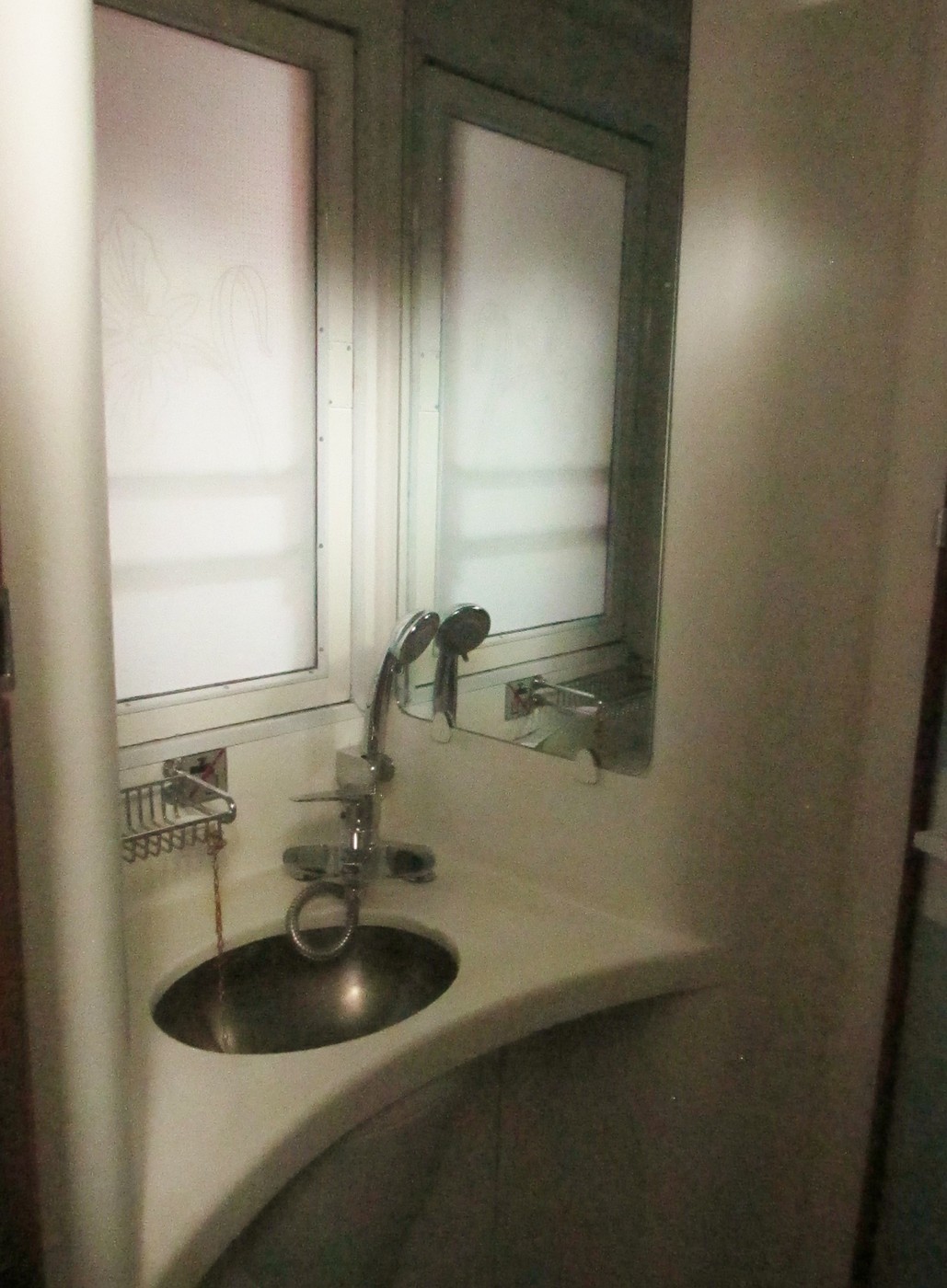 Washroom with Shower Head
When purchasing this ticket, I had paid extra to ensure that I would have the suite to myself for the entire trip. Based upon tonight’s load, I probably could have gotten away with rolling the dice on a suite for two and taken my chances with whether or not I’d have a roommate. When we pulled out of the station, I was the only passenger in this car. As I type this now five days later, sitting here at the Russian border checkpoint at Naushki, I remain the only person in this car. There is one more Deluxe First Class car just behind me and as of tonight there is just one man in that car as well. Indeed, there’s hardly anybody on this train! More on that later though.
Right now I’m just excited to finally be aboard the train! No more concerns about having any paperwork hassles along the way or finding my way from the airport to the station or even wondering what I’m going to do for five hours in the station. Now I can just sit back, relax and get into the groove of watching Asia roll past my window on this six day, 4,740 mile train trip.
First things first though. We were fifteen minutes away from departure, so there was still plenty of time to get some platform photos of my car and train against a backdrop of the Yaroslavsky Station. In the distance you can make out the big neon lighted “MOCKBA” (MOSCOW in Cyrillic) sign on the backside of the station. The red and grey passenger train next to us is Train #002, [b]The Rossiya[/i], also known as the “Trans-Siberian Express”. It’s bound for Vladivostok and leaves 10 minutes before we do. We’ll be shadowing this train for much of the journey.
 The Trans-Mongolian alongside the Trans-Siberian in Moscow
As much as I would like to have heard the Chinese version of it, there was no call for “All Aboard!” Li simply indicated to me that we were ready to go and that was that. I stepped back aboard, not knowing at the time that this would be the last time on this trip that I’d be able to do this. At all future stops I’d have to clamber up of down a steep and narrow set of metal steps.
Departure from Moscow commenced with a loud jolt and a screech of protesting metal as we lurched into motion and slowly accelerated out of the station. I watched for a while as the lights of Moscow glided past my window. Moscow is a huge city (population 12 million) and it took a good long while to get out of the city. Add to this the fact that it was dark and the city lights began to lose their entertainment value pretty quickly.
Even though it was past midnight, I was up and excited to be underway so I decided to take a walk back through the train. Li informed me that the diner was six cars back, but he wasn’t sure if they’d be open. In fact, he relayed an interesting story to me.
At one time, the dining car, which you’ll recall is Russian owned and operated - used to be staffed by men. Unfortunately a significant number of the men had a bit of a problem with drinking during their off hours. This occasionally resulted in the dining car being closed and out of service when it should have been open. Additionally, when it was open, some of the staff – still hungover – did not provide the best of service in either food preparation or presentation. The solution to this problem was that the dining car is now staffed exclusively by women.
Making my way back toward the diner, I discovered some interesting things about this train. First, all of the cars are heated with coal. In the vestibule of each car is a pile of coal and, behind a medium sized door a coal burning stove. During the trip it is each car attendant’s duty to keep the fires stoked lest we freeze while rumbling across the frigid expanses of Siberia. The smell of burning coal can be prominent in some cars (though thankfully not mine) so even though a diesel electric engine pulls this 11-car train, it smells like a coal-fired steam engine is up front.
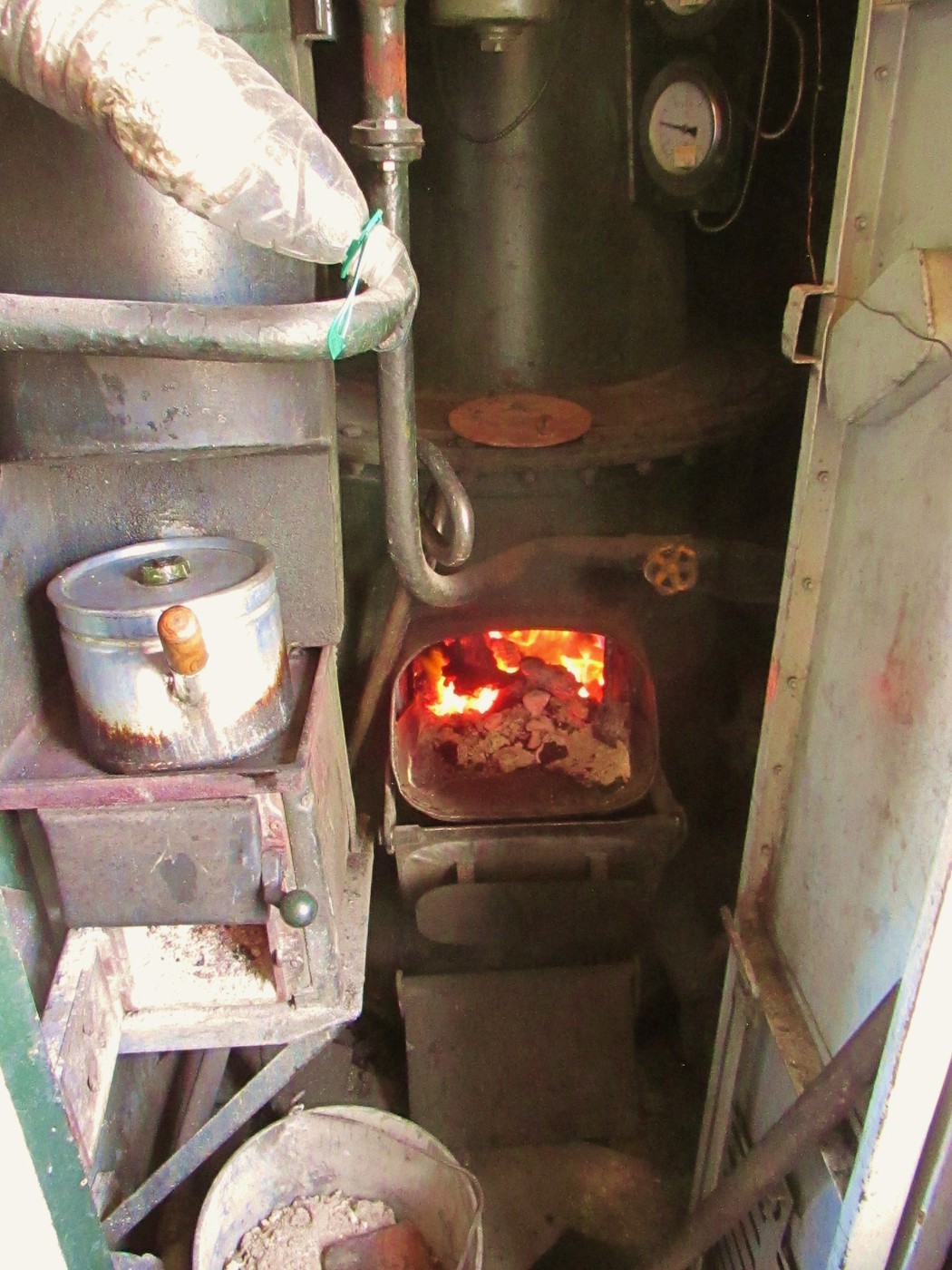 The coal-fired stove heating my car
Unisex toilets are located at the end of each car. These are very basic affairs – essentially a toilet and a sink. There are no lady’s powder rooms or men’s dressing rooms.
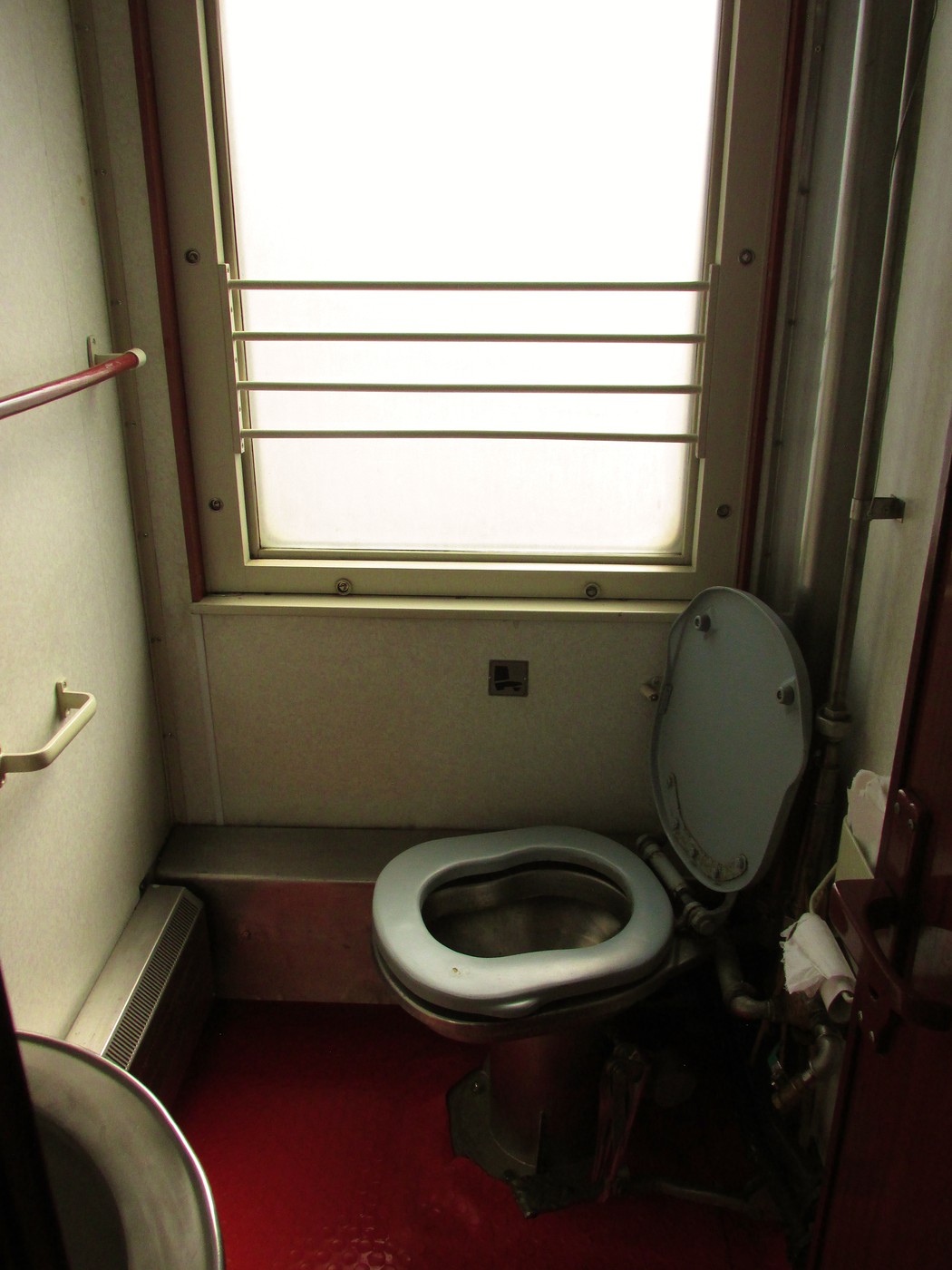 The Toilet
Each car has two doors at each end. Upon stepping out of the passenger compartment or hallway, you’ll go through a door that leads to a vestibule. From there another door opens into the space between cars. It is dark, dirty and noisy in there. There are no pneumatic doors as found on Amtrak or most decent European trains. Continuing on, you’ll open a door into the vestibule of the next car, then another into its passenger hallway and so on and so on. Over the course of passing through five cars and into the diner I had to open and close 22 separate doors!
Directly behind me was another Deluxe “Soft” Sleeper, followed by four First Class “Soft” Sleepers. The difference between Deluxe and First Class was immediately apparent upon entering the unadorned hallways with their off white metal walls.
 First Class 4-Berth Soft Sleeper Hallway
This one was very smoky from the coal burning stove
First Class 4-Berth Soft Sleeper Hallway
This one was very smoky from the coal burning stove
Each compartment in these cars comprised four berths, an upper and lower arranged two to a side. The décor was similarly Spartan to the hallway. Plain white walls, dark blue mattresses and a stack of bedding. These compartments appeared to be similar dimensions to mine but with no ensuite washroom and no separate chair. The lighting was stark, fluorescent white. As with the two Deluxe Soft Sleepers, these cars appeared similarly sparsely populated.
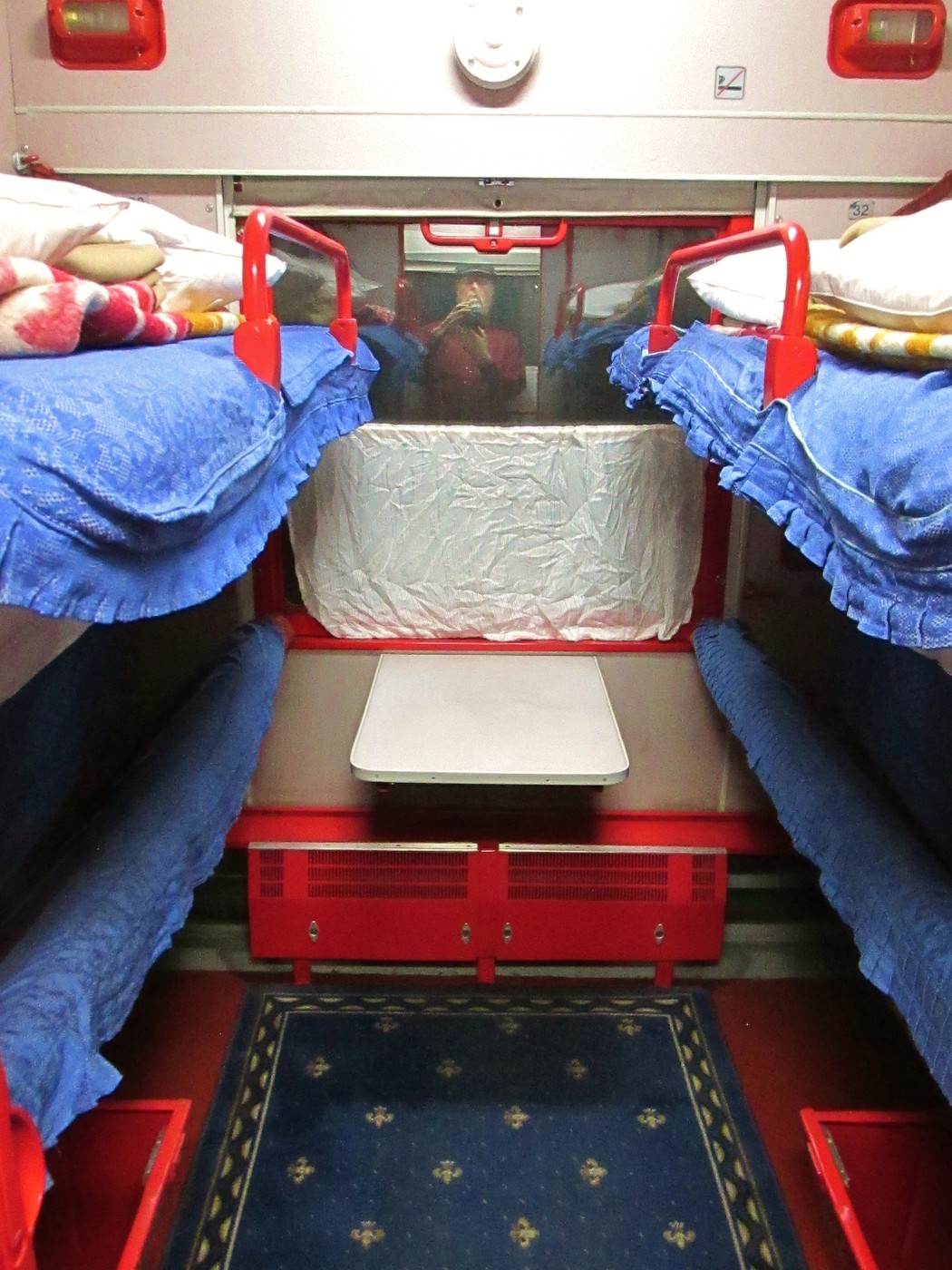 First Class 4-Berth Soft Sleeper
I’ve heard that Second Class Hard Sleeper accommodations are also available on this train though my journey back to the dining car didn’t take me through any sections that looked overtly Second Class. There is another car behind the diner but its livery is clearly Russian and I’m thinking it may serve as accommodations for the Russian dining car staff.
After having passed through five cars, the process of opening and shutting all of those doors plus grabbing onto the handrails mounted in the dark coupling passage between cars resulted in my hands getting really dirty. Over time those coal burning stoves put out a lot of soot and it accumulates on all the handles in the vicinity as well as in the passageway between vestibules. I would recommend bringing a pair of gloves.
On the door leading into the dining car was a sign indicating that its operating hours were from 900am to 1100pm, Moscow time. Therein lays another interesting aspect of riding this train. While traveling through Russia, all service aboard the train is operated on Moscow time. This extends to the stations along the route where all timetables including station clocks – regardless of their local time zone - remain in Moscow time. So - even though on day 4 you may be traveling through a region that’s four or five time zones later, you’ll need to be aware of the time in Moscow. In Mongolia and China everything reverts to local time.
In any event, given that the time was about 12:30am, I didn’t expect the diner to be open. Even so, I thought I’d give the door a try just to see what it looked like. The door was open and – surprise, surprise! – so was the diner! A waitress beckoned me in and motioned for me to take a seat at a table across from two other diners. She handed me a menu and – in Russian – probably indicated that she’d be right back. She did not speak any English and I did not speak any Russian but by now I had gotten pretty good at making my basic needs and desires understood.
The menu looked nothing like the pictures of menus I’d seen on the Seat61 website. Those menus were modern, colorful affairs with pictures of the food printed on glossy plastic. This menu was printed entirely on weathered olive green pages. Thankfully descriptions of the foods offered were provided in Russian, English and Chinese. There were quite a variety of items listed ranging from hot and cold appetizers to salads to sandwiches to full plated main courses and desserts. As I would soon learn however, not everything on the menu was available. In fact, quite a lot of it wasn’t.
At this hour of night I wasn’t particularly hungry but since the dining car was open and the waitress - a middle aged woman clad in a classic 1950s era yellow and green waitress uniform – seemed so eager to serve, I thought “Why not?”
I don’t remember the first two items I attempted to order. It doesn’t matter – they weren’t available anyway. At some point in our communications the waitress determined that I’d probably like a beer even though I’d never pointed to anything of the kind. She left and soon returned with a thankfully unopened 16oz can of local lager that from its feel was at room temperature. I might have drunk it if it were cold but as it was not I sent it back.
I could sense that the waitress was beginning to get a bit frustrated but then we finally managed to connect when she pointed at the sandwich section of the menu. I pointed at a sausage sandwich and she responded positively so we were good to go. What she brought out however was unlike any sandwich I’ve ever seen. Unlike the menu description it contained no tomato or cucumber, and it included only one small piece of bread. I had always thought the concept of a sandwich included two slices of bread but – after all we’d gone through to arrive at this point – now did not seem like a good time to quibble. I did however manage to successfully get across that I’d like that “sandwich” to take away, which was accomplished by wrapping it in a napkin. I handed over 150 Rubles (about $2.50 USD) and commenced the long journey back to my car. Upon arriving, the first thing I did was give my hands a thorough scrubbing.
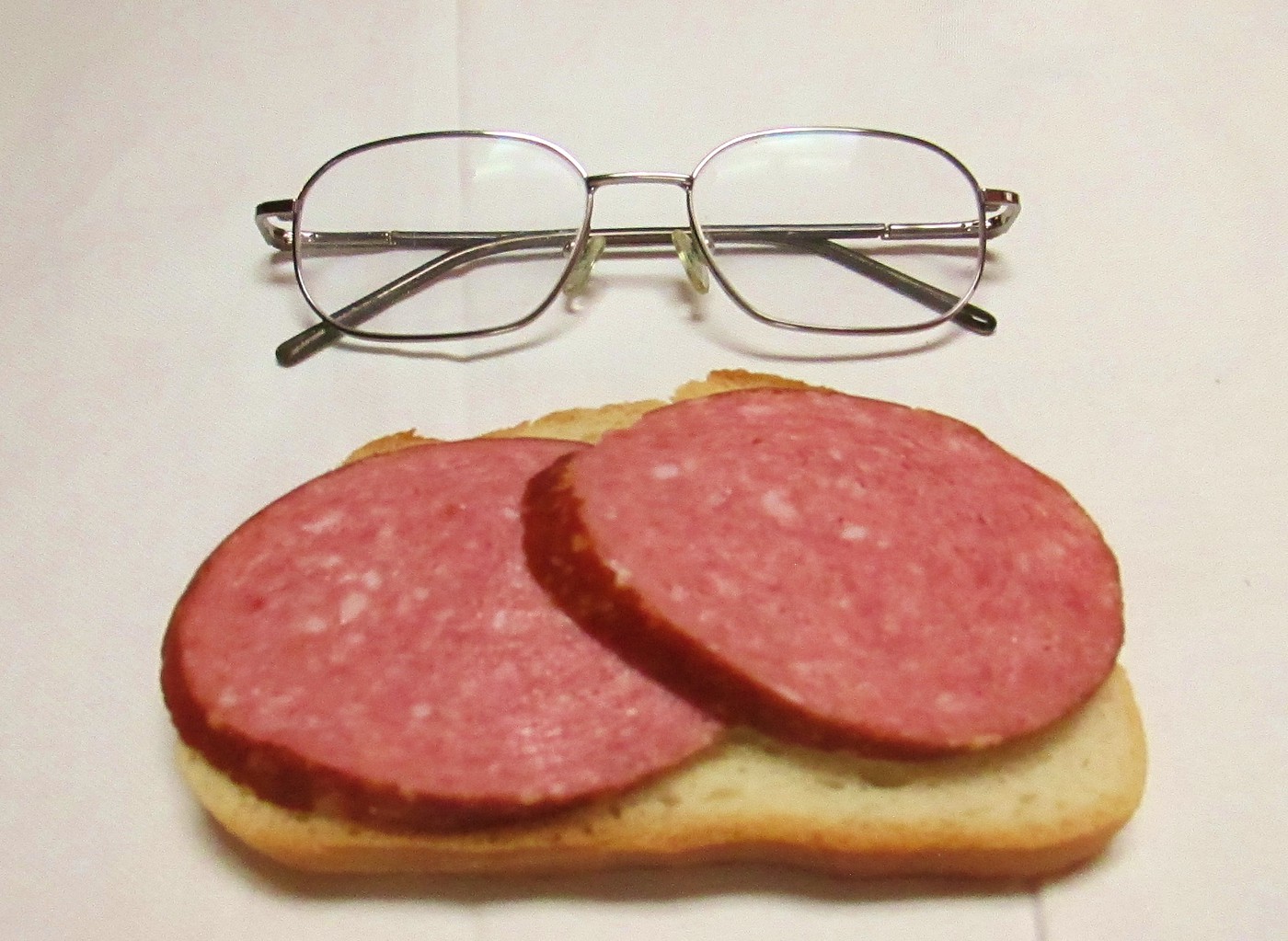 Sausage Sandwich Russian Diner Style
The glasses are placed to provide scale, but instead the make the bread look larger
Sausage Sandwich Russian Diner Style
The glasses are placed to provide scale, but instead the make the bread look larger
I stayed up quite late that first night, organizing items I’d brought along that would come in useful during the trip. We’re talking headlamp, books, magazines, mp3 players and headphones, food items such as coffee and creamer for the mornings and water bottles. There’s no really proper storage area for things like these but the empty upper bunk did the job nicely. I laid out three of the heavy wool blankets atop my “soft” mattress, but they did little to improve the softness of the sleeping surface. Oh well. I’m just going to have to live with it, I reckon.
One thing I really liked about my compartment was the ambient lighting at night. The large fluorescent light was available in two strengths. At its weaker setting, in combination with the smaller wall mounted reading lamps, the room took on a much warmer and cozier ambience. I read for an hour or so and then called it a night.
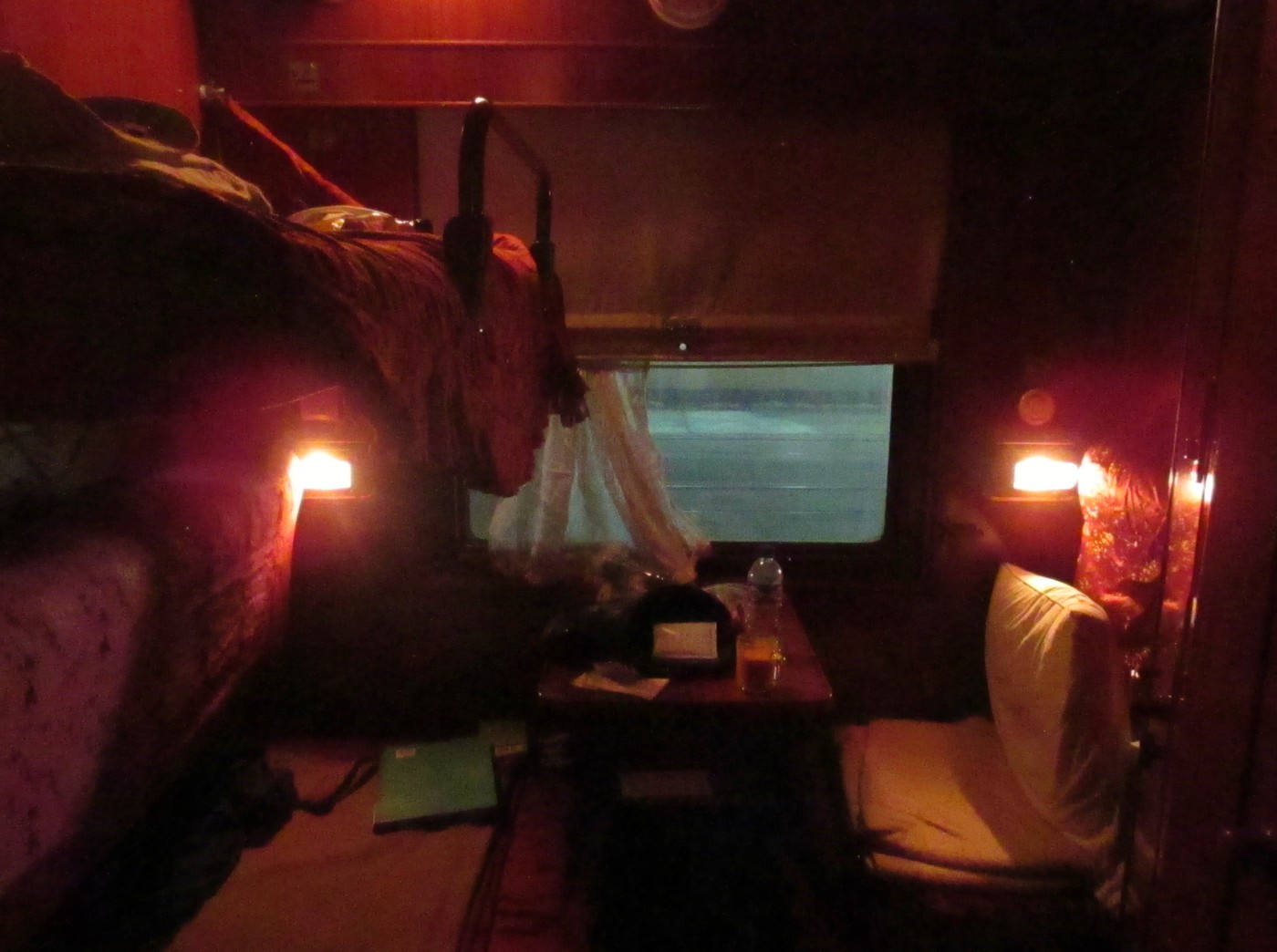 Evening lighting in my compartment