Originally Posted by
simonrp84
A few years ago I carrier a gamma ray spectrometer on every flight I took. The readings were fairly high - far higher than they are in my laboratory, even when I stood next to a radioactive source.
I find it very interesting that I'm classed as a radiation worker, yet flight crew are not despite their considerably higher annual dose.

I should probably start this post with a geek warning and an apology to the OP that this is very much OT but hopefully of interest; but if your interested read on. I write this as a previous Radiation Safety Officer (as a secondary role to be the doctor) on a nuclear submarine with nuclear weapons and you should speak to your Radiation Protection Supervisor for further information about your specific circumstances.
I don't know where you live/work but radiation limits vary around the world. Most places are in line with the UK, but in the US for example, the limit of radiation for a radiation worker is 2.5 times the maximum dose in the UK (they basically didn't implement a change from an international the IAEA consensus.
In the UK, a the maximum dose anyone is allowed to receive as an occupational exposure is 20mSv/yr. This is based on comparative increased acceptable risks of other occupations (for example, fishermen have an increased risk of drowning for example). Any worker who is expected to receive a dose of greater than 6mSV is classified as a radiation safety worker (or radiation worker) and require additional protection (such as an annual medical by a suitable qualified HSE approved doctor). Members of the public, as they have not opted for the occupation, and women who are pregnant have a much lower dose limit (1mSV). Medical exposure is also governed by IRR99, but is not limited by the same exposure limits (except for the healthcare workers administering it), where the balance of risk and benefit must be balanced.
These levels protect the individual from deterministic effects (on Ogive curve which essentially starts at much higher dose exposure), with the effect causing radiational exposure illness. Stochastic effects is the cancer risk and is a linear relationship, as the exposure goes up, so does the effect.
Pilots annual exposure is on average 2.19mSV, so they are not classified as a radiation worker, I am not sure what your annual exposure is, but it may be that your employer has classified you as a radiation worker even if you don't meet the threshold for litigation protection. They previously did this for submariners on UK submarines but the exposure we receive, even for those who work with the reactor, is less than a third of a pilot, so although we do wear dosimeters, there are no radiation workers within the Royal Navy. There are a handful within the wider MOD, mainly those who work with certain paints used by the RAF.
It is worth noting IRR99 ( the regulation that set the limits in the UK), the principle of ALARP (As Low As Reasonable Practicable) is used, so if a pilot is concerned about the amount of radiation in their cockpit environment, they could ask their employer to provide evidence of a radiation investigation. For example, it would reduce the risk if the cockpit didn't have windows and only cameras were used, but this isn't practicable, use of coated cockpit glass is a reasonable protective measure.
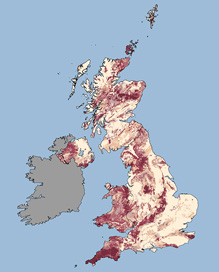
It is also worth noting that higher doses may be used in an emergency for the protection of life on a volunteer basis only (for example, going in to rescue workers from an area after a nuclear accident) And equally, for those who live in Cornwall for example, you are exposed to higher background radiation from Radon (see map below)
Originally Posted by
AllTheNines
IFor UV radiation experts - do the rays have to physically shine on your skin for it to be affected, or can the simple presence of rays bouncing around in your surroundings be just as bad? Likewise, presumably I should get out of the habit of leaving window blinds open with the sun shining through the cabin when I'm sat down the back?
Cosmic ionising radiation travels is linear, but it can be reflected. The highest level with be direct exposure. Where some is reflected, some also will be absorbed, so you don't get a full exposure. Generally speaking, if you are in shadow, the exposure will be lower. Clothing will limit the exposure, as will barrier creams (sun tan lotion) and glass that reflects a large proportion of the radiation.