Part 3 – Bârsana monastery, and crossing the border into Ukraine
The plan of today was simple: do a bit of sightseeing in the morning, have lunch in Sighet, cross the border over the river Tisza into Ukraine, and take the overnight train to Lviv. Romania and Ukraine share a long border, and have some historical links. The Ukrainian part of Bukovina (around Chernivtsi) and parts south of Odessa used to be Romanian territory. Even before that, when all belonged to the Austrian-Hungarian empire, the whole region was a big melting pot. But a world war and Stalin’s pen changed all this. When not driving, fixed transport links are non-existent between Romania and Ukraine. There are no direct flights, and only recently the Bucharest to Kyiv train was reinstated (crossing the border between Suceava and Chernivtsi), albeit its once-a-week frequency is a far cry from what used to be a daily Bucharest-Kyiv-Moscow service!
The connection I will make today, is the other direct passenger rail link between both countries. But as you have to cross the border between Sighetu Marmației and Solotvyna on the Ukrainian site on foot, it won’t show up if you try to look for train timetables online. But as the distance between the two border stations is just a short walk, it’s a great, easy connection if you know about it! (Because of this, online timetables like bahn.de will route you through either Hungary or Moldova instead, which not only takes longer but is far more expensive!)
But before crossing the border, there is still some sightseeing to do! My hotel had a tasty breakfast included in the café downstairs (choosing from different set menus), and soon I was ready to depart for nearby Bârsana. As I was travelling with a small duffel bag only, I checked out, took my bag, and walked to the main road to hitchhike again. While the ride yesterday to the Merry Cemetery was pretty straightforward (2 villages to the West on the main road), this destination required me to take a side road after a few kilometres south on the main road. Knowing that most cars would bypass this completely, I wrote my destination on an A4 page, and stood along the road with it for a few minutes until a car going in the same direction stopped. A middle aged couple took me into their car, apologising they had to stop for five minutes first at a supermarket on the outskirts of town. Of course, I didn’t mind at all, getting a ride this fast (again they refused any payment).
I was dropped off just outside the village of Bârsana at the local monastery complex. Besides the scenery, folk culture and the UNESCO-listed Merry Cemetery, Maramureş is famous for its wooden monasteries (also on the World Heritage list). Bârsana, located in a lush, verdant valley, is probably the most beautiful and well-known of those monasteries.

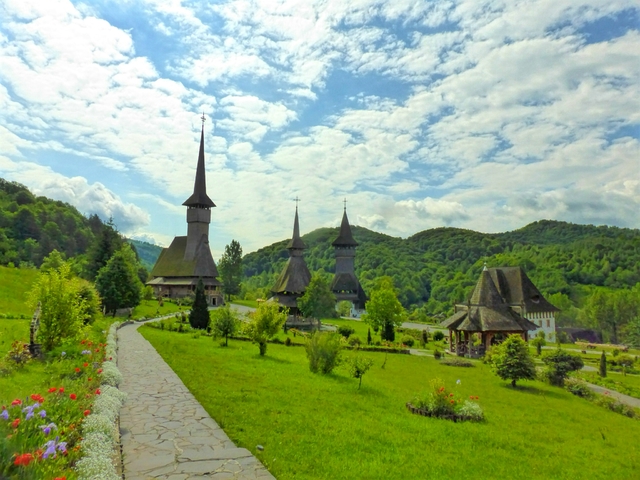

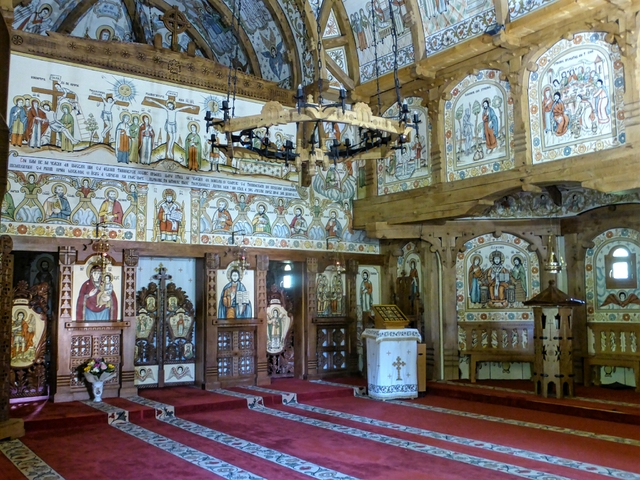

I walked around the complex at a leisurely pace, and relaxed for a while on this lovely day in the shade under the roof of the monastery well, drinking a few glasses of its “holy water”, which was refreshing at least on this warm day! The ride back to Sighet was much more straightforward, knowing that almost all traffic would be heading there. Again in a matter of minutes, I had a ride, this time by a construction worker in his white van.
Back in Sighet, I headed to a restaurant I walked by the day before which looked promising for lunch. Restaurant Rustic (Tineretului) has a traditional village-style interior, so I thought it might be a good place for hearty Romanian fare. Knowing that I wouldn’t have a real dinner being in an overnight train, I ordered both goulash (traditionally a rich, paprika-based soup full of potatoes, meat etc., and NOT a meal as you often see outside of Hungary!) and a tocăniță (a heavy Romanian stew, with paprika, garlic, a lot of different meats and of course polenta). I opted for an half-litre carafe of a very decent local red to wash it all away.
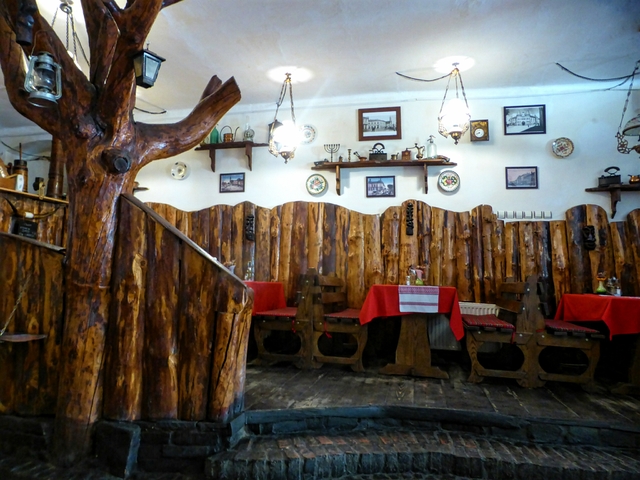
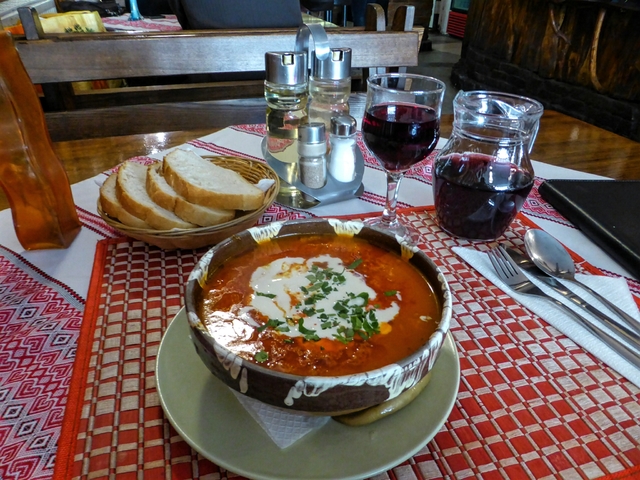

The goulash was phenomenal. Among the best I’ve tried! Perhaps it’s thanks to the sizeable Hungarian minority in this region. The tocăniță was very good as well, and I was more stuffed than a French foie gras goose when I walked away. The costs for the huge dinner including wine? Less than 7 euro. Maramureş is really good value! With a happy face after the dinner, I walked back towards the train station, crossed the railway track, and walked a few hundred metres more to the Romanian border post. I was across in just a few minutes, no questions asked or bags searched.


The Tisza river forms the border here between Romania and Ukraine. I secretly managed to snap a few shots in no-mans land of the bridge without getting noticed and thrown into the gulag. Just one or two cars and a handful of locals were trying to cross, it felt a bit like a backwater border that never gets busy at all.
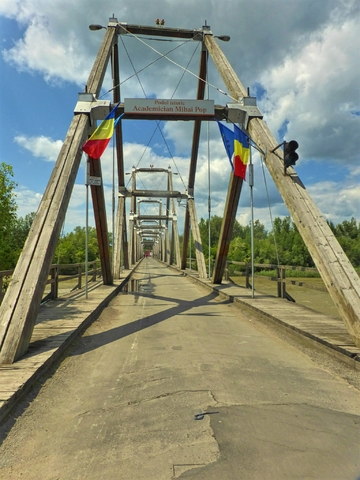

The Ukrainian side of the border had a more Soviet mentality towards hospitality than the friendly Romanian border guards. I was shouted at by an officer before I even arrived at passport control that I was walking on the wrong side of the road. Apparently crossing the road to the right was not satisfactory enough, no, I had to walk all the way back to the bridgehead and start my walk on Ukrainian soil again on the right side of the road. At least the lady who checked my passport was marginally nicer, only shouting out a few questions what I was going to do in Ukraine. But after about ten minutes, I managed to get across!
 Hello Transcarpathia! (Zakarpatia in Ukrainian)
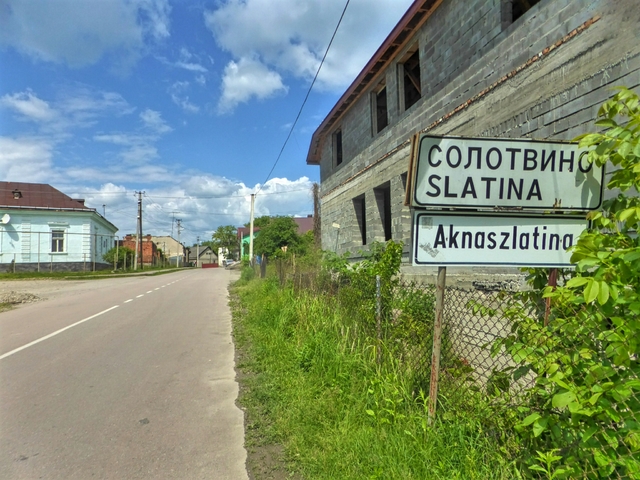 Town names in multiple languages? Very common in this multi-ethnic part of Europe! Although as I have written earlier, before the last world war and communism, it was a much bigger melting pot than it nowadays is.
I exchanged some Romanian lei to Ukrainian Hryvna for a good rate with a moneychanger hanging around the border, and bought a two litre plastic bottle of a very tasty homemade wine an old gypsy lady was selling for one euro. From the border at the banks of the river to the village centre, it was a leisurely ten minute walk uphill. Definitely this place feels like a calm little village compared to the already calm town of Sighet across the river! As I still had three hours before the departure of my train, I bought some supplies for the ride at a local supermarket, and sat down for a beer at what seemed to be the village square. Costs of a pint of beer? A measly thirty eurocents. Welcome to small-town Ukraine!


Solotvyna seemed like a town where nothing much happens. While the pub I sat down was completely full with locals inside, the few outdoor seats next to the dusty road were completely empty. At times an old Lada, or an expensive SUV with foreign license plates would drive by. In such corners, only the smugglers and those with a family abroad make any real money, I thought. To my surprise, a couple that sat down at the table next to me spoke English instead of Ukrainian, and I ended up drinking a few pints with a lovely Irish couple who just went across the border for a quick look at their Romanian holiday! I would never expect to meet any other traveller here, but ended up having a great little talk until the Irish couple had to go back downhill to Romania. It was a sign that also for me it was time to say goodbye to the cheap pints, and walk slowly towards the train station for my overnight train to Lviv.