Arriving from DUB - Connections and Arrivals
This post covers in detail all the possible connections you can do when arriving on a flight from DUB in to T5, and provides information on all the possible routes you can take to do those connections. The post also covers when you are simply arriving on a DUB flight and not connecting onwards. Please see the diagrams above which are referenced as well.
If you have a bag which is already checked through to your next flight you do not need to pick up your checked bag on any of the types of connections listed in this post. If you do have a checked bag but this is only checked to LHR you will have to exit via the DUB arrivals route (see ‘Arrivals from DUB’), collect your bag from the baggage hall, exit landside, and re-check your bag for your next flight. There is some more information on checked bags
in this post here.
- Arrivals from DUB
- DUB-UK connections
- DUB-INT connections
- DUB-T2/3/4 connections

As noted in an earlier post in the guide, arrivals from DUB use gates A23 and A22 which are on the southern end of T5A. For arrivals from DUB use the corridor which starts opposite A23. The corridor emerges past passport control (DUB arrivals do not have to cross the UK border) and you can proceed down to the baggage hall and out landside through customs.

The signed route for connections from DUB going on to a UK domestic flight involves exiting landside (i.e. follow the DUB arrivals corridor as noted in the above ‘Arrivals from DUB’ section), proceeding up to the departures floor, and going back airside by passing through the first wing or north/south security.
If using the exit near baggage carousel 9, when you exit the orange lift is in front of you - this is the best way to go for the first wing or south security. If heading for north security you need to exit by baggage carousel 5 instead and use the lifts near that exit. For the orange lifts you may need to push both call buttons since the two lifts aren't connected for some reason. Below is a graphic showing the route out landside to the orange lifts.
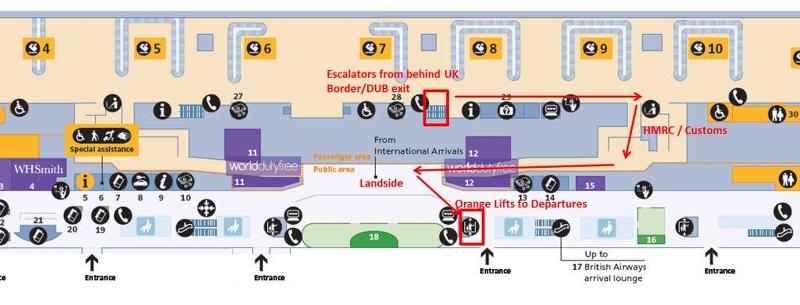
Graphic courtesy of
corporate-wage-slave
When you go through the gates just before the first wing security or north/security your photo will be taken and this will matched to you later on at the gate when you board to check the person who went through security is the same person boarding.

If you are connecting on to a T5 departing international flight there are two possible routes when you step off the jet bridge from either A23 or A22. You can either head landside, up to departures, and then come back airside through security, or you can stay airside and us the FCC. The signed route is the airside route via FCC and up to the connection security channels. However, FCC and the connection security channels can sometimes be very busy so you may well find it quicker to simply go via the landside route.
Of the two routes the landside route is recommended as it is usually quicker and is not much longer distance (if at all) than the airside route.
Landside Route
Head along the DUB arrivals corridor opposite A23, this takes you straight to the baggage hall where you can exit landside and then proceed up to the departures floor to go through security in order to go back airside. DUB arrivals do not go have to cross the UK border so there is no immigration when going landside.
See above in the 'DUB-UK connections' section for a description of the route from the baggage hall to the first wing or north/south security.
Airside Route
After exiting the jet bridge in to the main corridor turn right, show your onward boarding pass to the Heathrow staff member who will let you through the glass doors, then proceed along the corridor which runs on the east side of T5A to the FCC. You can then proceed through the INT connections channels in the FCC where you will have a boarding pass check by a BA member of staff and then head up to connections security in order to go airside.
Less than 45 Minutes between Flights?
The exception to the above advice to follow landside route is if you have 45 minutes or less to connect when stepping of the plane. T5 operates a system called conformance which means you need to be marked as ‘Ready to Fly’ at 35 minutes before your flight (this can occasionally be less for some connections but it is best to always work with 35 minutes). If you do not meet conformance you will very likely be denied to travel and have to be rebooked on a later flight. You are marked as ‘Ready to Fly’ and deemed to meet conformance when you first have your boarding pass checked at either FCC or at the entry gates for the first wing or south/north security. It can be slightly quicker to get to the boarding pass check at FCC than to get out landside and to the entry gates at the first wing or north/south security. Therefore if you are close to the conformance limit you will be better off going via the airside route to ensure you meet conformance, even though the landside route overall may have been quicker.

There are two possible routes you can take to do a DUB to T2/3/4 connection.
- Stay airside and use the airside transfer bus from T5 to T2/3/4.
- Go landside and take either the tube or Heathrow Express (HEX) to T2/3/4.
The airside route will almost always be faster than going landside. Taking the landside route is not recommended normally since the tube service interval is between 8-12 minutes and HEX is every 15 minutes (dropping to every 30 minutes late in the evening). Particularly when going to T4 the landside route is not quick and involves a connection as there is no direct tube/HEX. In comparison the airside buses are every 5 minutes and take 10-15 minutes to get to T2/3/4.
Airside Route
As noted, domestic arrivals come in to gates A22 or A23. Turn right, show your onward boarding pass to the Heathrow agent who will let you through the glass doors, then proceed along the corridor which runs on the east side of T5A to the FCC. If you do not have your bp yet you should mention this to the Heathrow staff member and show your itinerary, and they will let you proceed on to the airside buses - bps can be collected at the airline transfer desks in each of T2/3/4 when you get there. Also if connecting to an AA flight departing from T3 see the notes
in this post.
The airside transfer buses are accessed by going down the signed escalators to your right, or there are signed lifts to your left. Buses leave regularly for each of T2, T3, and T4, and the information boards at the doors should tell you when the next bus for your terminal is due. When you arrive at T2/3/4 you will have a bp check and go through.
Landside Route
An alternative route is go landside and take the tube or HEX to the other terminals. To do this follow the signs for DUB arrivals (see section above on ‘Arrivals from DUB’). Once landside just proceed to your choice of tube or HEX.
The tube trains are every 8-12 minutes. If going to T2/3 take the tube for one stop to the central tube station ‘Heathrow T123’. For T4 you will need to go two stops to Hatton Cross, cross to the opposite platform, and catch a T4 bound tube. The tube requires a card to check in and out and this can be either an oyster card or contactless credit/debit card. Should you need to buy an Oyster card for other travel in London they can be purchased from the tube ticket machines either on the ground floor of T5A or at platform level. Even though you check in and out for inter-terminal transfers you will not be charged as they are free. For T4 transfers (via Hatton Cross) as long as you remain tube side at Hatton Cross you will not be charged.
The HEX trains are every 15 minutes and it is one stop to T2/3. To get to T4 you need to change at the T2/3 station where you wait for a separate train to T4. As of May 2018 the HEX requires either an oyster/contactless cards to use (like the tube it is is also free between terminals), or you can get one of the free transfer tickets. See
this post 360 for more details.