The South American Altiplano - Strikes In Copacabana And Detour Through Peru - continued
As we exited the office, there was already a small group of backpackers gathered around looking for a way to get to Desaguadero. We joined in, and began asking some of the waiting taxi drivers how much it would cost. Just then, a minibus pulled up and dropped off a number of passengers. Our group negotiated a price with the driver to take all of us, although he told us if we waited for more people, the cost per person would go down.
While we debated, the nearby taxi drivers became increasingly hostile towards the minibus driver since he was essentially taking their business, and it was apparent to us that he was not a local. A couple of policemen from the station across the street were called over to calm things down as the taxi drivers began to shout obscenities and threatened to get physical. Legit or not, they accused the minibus driver of not having the proper permits to work in the area.
We tried to steer clear of the fracas, but at the same time, all of us wanted to get to Desaguadero as quickly and cheaply as possible. Finally, the policemen told the minibus driver to simply move down the street, where he was free to pick up passengers. We decided to follow him so we could leave immediately, but things got more tense as the taxi drivers proceeded to tail us. We quickly threw our gear into the back and climbed aboard as the police kept the taxi drivers at bay.
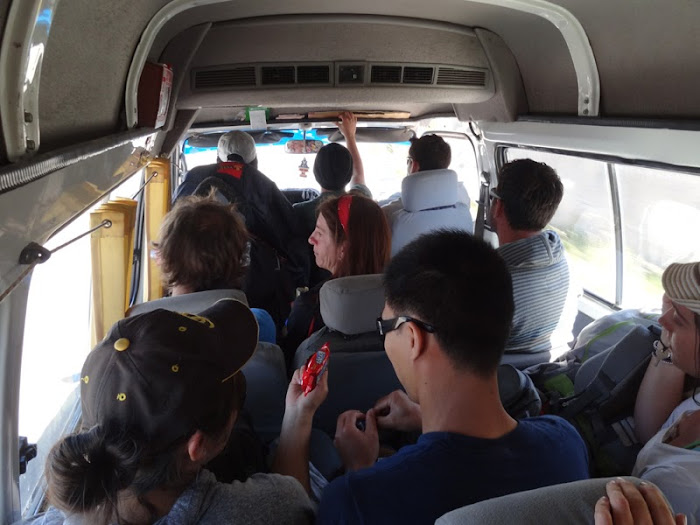 Minibus to Desaguadero
This was certainly one of the scarier situations I've encountered while traveling. Although at the time, I wasn't too concerned since the police were right there. Also, it wouldn't have made much sense for them to attack tourists. In the end, everything turned out fine, and each passenger paid six soles to get to Desaguadero. Once we arrived, it was the same immigration routine yet again. By then, it was beginning to feel like déjà vu.
Desaguadero is quite a bit more chaotic than Kasani, since locals use this border crossing as the main artery for commerce and trade. Still, after crossing the bridge into Bolivia, it wasn't too difficult to locate the Bolivian immigration office and get stamped in. Luckily, the $135 USD reciprocity fee is valid for five years, so we didn't need to pay it again.
 Desaguadero
 Leaving Peru... again
 Entering Bolivia... again
 Bolivian immigration office
After completing immigration, we asked one of the officers for directions to the La Paz-bound buses, and we were told to continue down the main street for about 500 meters. There, we were greeted with a line of dilapidated buses waiting to fill their seats with passengers. With the only option being local buses, we knew we would be arriving at the cemetery terminal, which I had really wanted to avoid. My main concern now was to minimize risk by getting into the city before sunset. Prices were set at 10 Bolivianos per person.
Unfortunately, there was not enough space for three more people in the first bus that was about to depart, so we boarded the next one in line, which was completely empty. We sat there for the next hour, not only waiting for more passengers, but also watching as they loaded cargo box after cargo box onto the roof. My stomach literally sank as I slowly realized we would not make it to La Paz before dark.
 Walking to the buses
Finally, at almost 5:00 pm, we pulled away from the stop and started on the four-hour journey. Saying the ride was uncomfortable would be an understatement, as I held onto all my belongings the entire way there. Every inch of floor space was taken up by boxes and bags, and the seat I shared barely had enough room for the larger-set woman next to me, let alone two people. But at this point, I was just glad we were on our way!
 Local bus to La Paz
As we approached El Alto just outside of La Paz proper, the bus began to make several stops, dropping passengers off and unloading cargo from the rooftop. This process took almost an hour, and by the time we continued on our way, it was well past 8:00 pm.
Descending into the giant bowl that La Paz sits in is quite a stunning sight, especially at night when all the buildings are lit up. It almost looks like you're standing on the rim of a massive crater with the dense city center located at the very bottom of the depression.
 Streets of El Alto
We wound our way down the steep slopes, and soon arrived at the cemetery bus terminal in total darkness. Feeling slightly anxious, we quickly gathered up our belongings and stepped onto the street, where we were immediately accosted by several questionable drivers asking us where we wanted to go. My instinct told me to leave the area and look for a more legitimate taxi on the main street, which is what we did. After walking about two blocks away from the terminal, we were able to hail down a radio cab that looked fairly new. We negotiated a price before getting in (18 Bolivianos), and thankfully, arrived at the Radisson Plaza Hotel in about fifteen minutes safe and sound.
It was a monster day of traveling... from hiking, to two border crossings, to minibuses and decrepit local buses, to taxis, but fortunately, things turned out alright in the end. Obstacles can arise at any time when navigating abroad, and it's important to be ready at a moment's notice for plans to change. Otherwise, you may end up stranded at a location and your itinerary completely halted. Stay alert in unfamiliar situations and always keep your wits about you!