October 5, 2012
Cumbres & Toltec Railway Antonito – Chama 1000a – 525p First Class
The Cumbres & Toltec Narrow Gauge Railway is the longest and highest narrow gauge railway in America. It runs 64 miles from the southern Colorado town of Antonito up and across the eastern flanks of the San Juan Mountains into New Mexico, terminating in the little town of Chama. As I type this, I’m hard pressed to think of any North American railroads – regardless of gauge – that operate higher than 10, 015 feet, which the C&T crosses at Cumbres Pass. I went to college just 120 miles west over in Durango, Colorado and over the years I had ridden the more famous narrow gauge train between Durango and Silverton on many occasions, especially when backpacking through the Weminuche Wilderness Area of the San Juan Mountains. Although I’d long been aware of Colorado’s “other” narrow gauge train, my normal peregrinations about the state rarely took me over to Alamosa and Antonito. A ride on this train has been long overdue, and so here I am at 9:30am on a beautiful Friday morning, well rested and ready for a full day’s adventure aboard this historic old train.
While we’re waiting to board, let’s start with a bit of the railroad’s history. The Cumbres & Toltec line was originally constructed in 1880 as part of the Rio Grande’s San Juan extension, which served the silver mining district of the San Juan Mountains in southwestern Colorado. Sheep, cattle and timber were also hauled to Alamosa where they made the connection up to Denver. Like all of the Rio Grande at the time, the tracks were built to a gauge of 3 feet between the rails, instead of the more common 4 feet, 8-1/2 inches that became standard in the United States. At the time, narrow gauge tracks made sense so that the railroad could make tighter turns in the mountains and thereby reduce construction costs. Eventually, the inability to interchange cars with other railroads led the Rio Grande to begin converting most of its tracks to standard gauge in 1890.
The repeal of the Sherman Act in 1893 (The U.S. government effectively stopped buying silver as a result) had a devastating effect on the silver mining industry and, by extension, the railroads that hauled it. The paucity of traffic over the San Juan Extension was simply not enough to warrant conversion to standard gauge and so, over the next forty years the San Juan Extension became an isolated anachronism, receiving its last major upgrades in equipment and infrastructure in the 1920s. A post-World War II natural gas boom brought a brief period of prosperity to the line, but operations dwindled to a trickle in the 1960s. Finally, in 1969 the Interstate Commerce Commission granted the Rio Grande’s request to abandon its remaining narrow gauge main line trackage, thereby ending the last use of steam locomotives in general freight service in the United States.
Most of the abandoned track was dismantled soon after the ICC’s decision, but thanks to the concerted efforts of a passionate group of railway preservationists and local civic interests, the most scenic portion of the line was saved. In 1970, the states of Colorado and New Mexico jointly purchased the track and railway related structures from Antonito to Chama along with nine steam locomotives, over 130 freight and work cars, and the Chama yard and maintenance facility. The total cost was about $550,000 or about 2.5 million in today’s dollars. The railroad was renamed the Cumbres & Toltec Scenic Railway and began hauling tourists the next year.
Today, the Cumbres & Toltec is designated a National Registered Historic Site as well as a National Civil Engineering Landmark. The railroad operates from May through October with trains departing from both Chama and Antonito each morning. Passengers have the option of traveling all the way through to the far end of the line and then returning via charter bus or going just to the halfway point of Osier where the two trains meet and luncheon is served during a one hour stop. From there they can ride the other train back to whatever town they started from.
I booked the train all the way from Antonito to Chama because I wanted to see the entire line and its scenery. The total cost for the entire journey in coach was $101.75 First Class seating is also available but it didn’t look all that much more comfortable relative to its extra cost of about $70.00. A chartered bus that would take me back to Antonito later that afternoon was included in the fare.
Boarding for our 10:00am departure was called at 9:45am. Although I was assigned to a car, seating was open and we were free to relocate to any other coach car once the trip was underway. Following four short toots of the whistle, the “All Aboard!” call was made, the gates were closed and off we went. Here’s
a map to follow along.
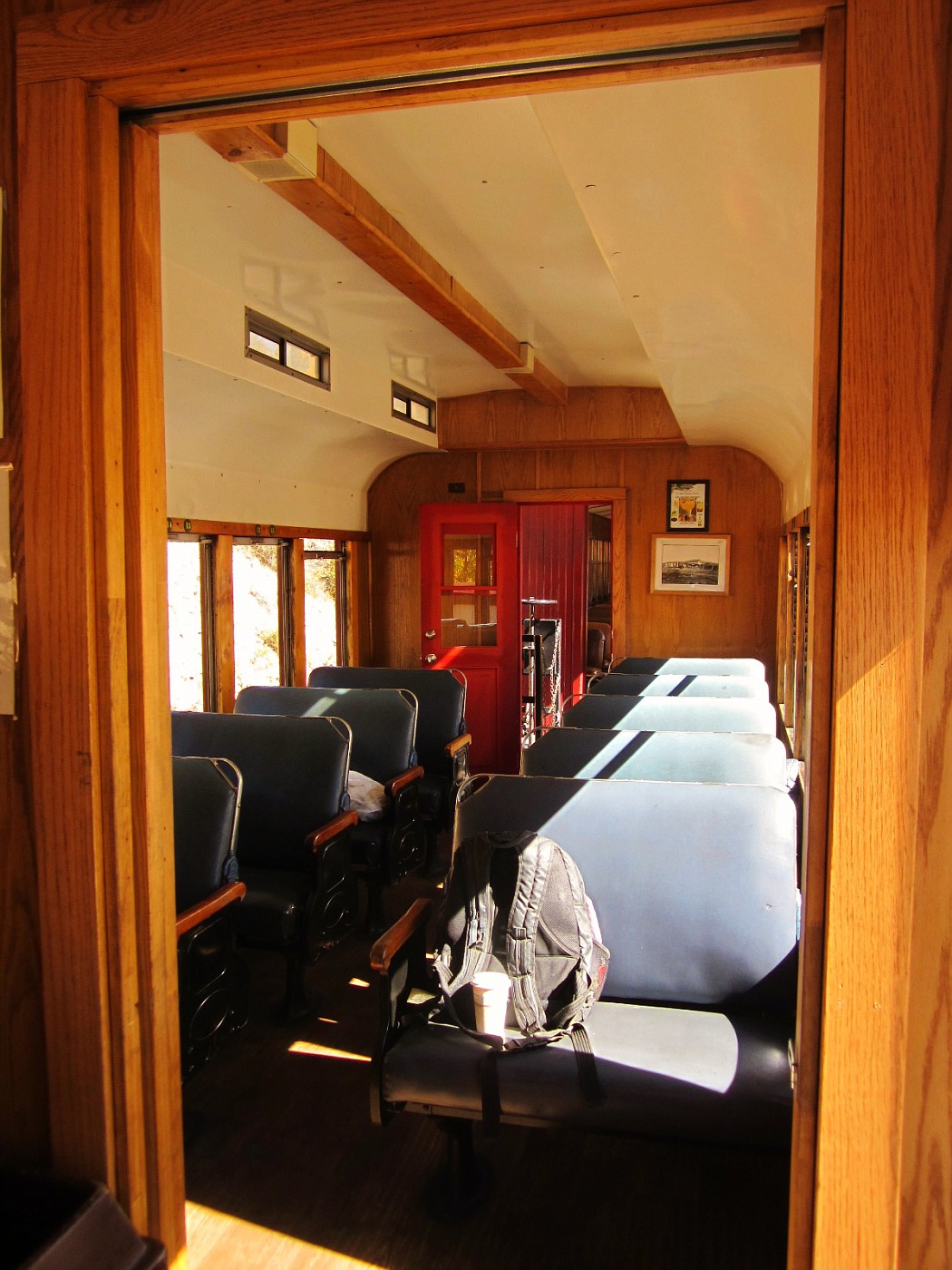 Coach seating on the C&T
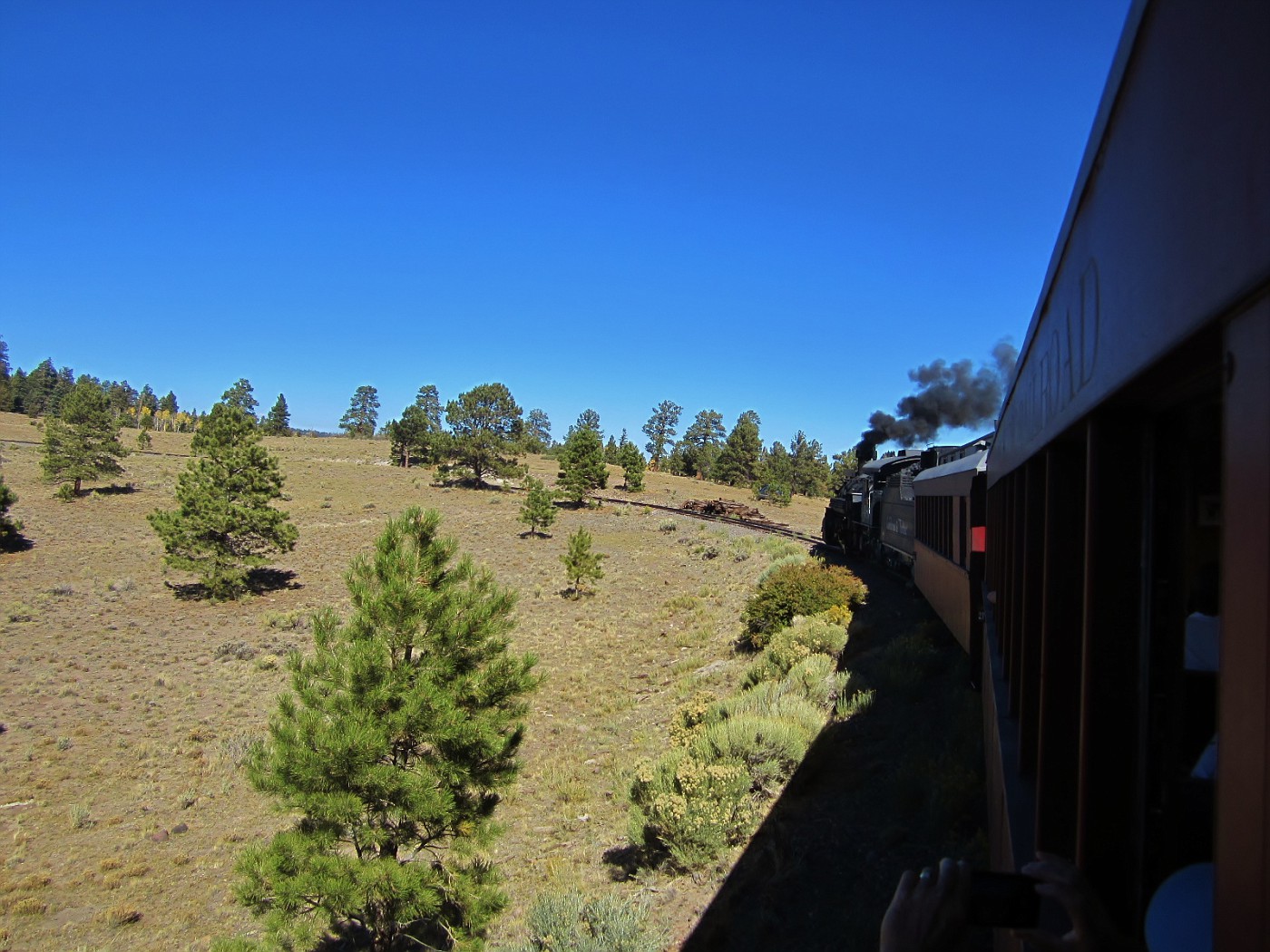 Climbing out of Antonito
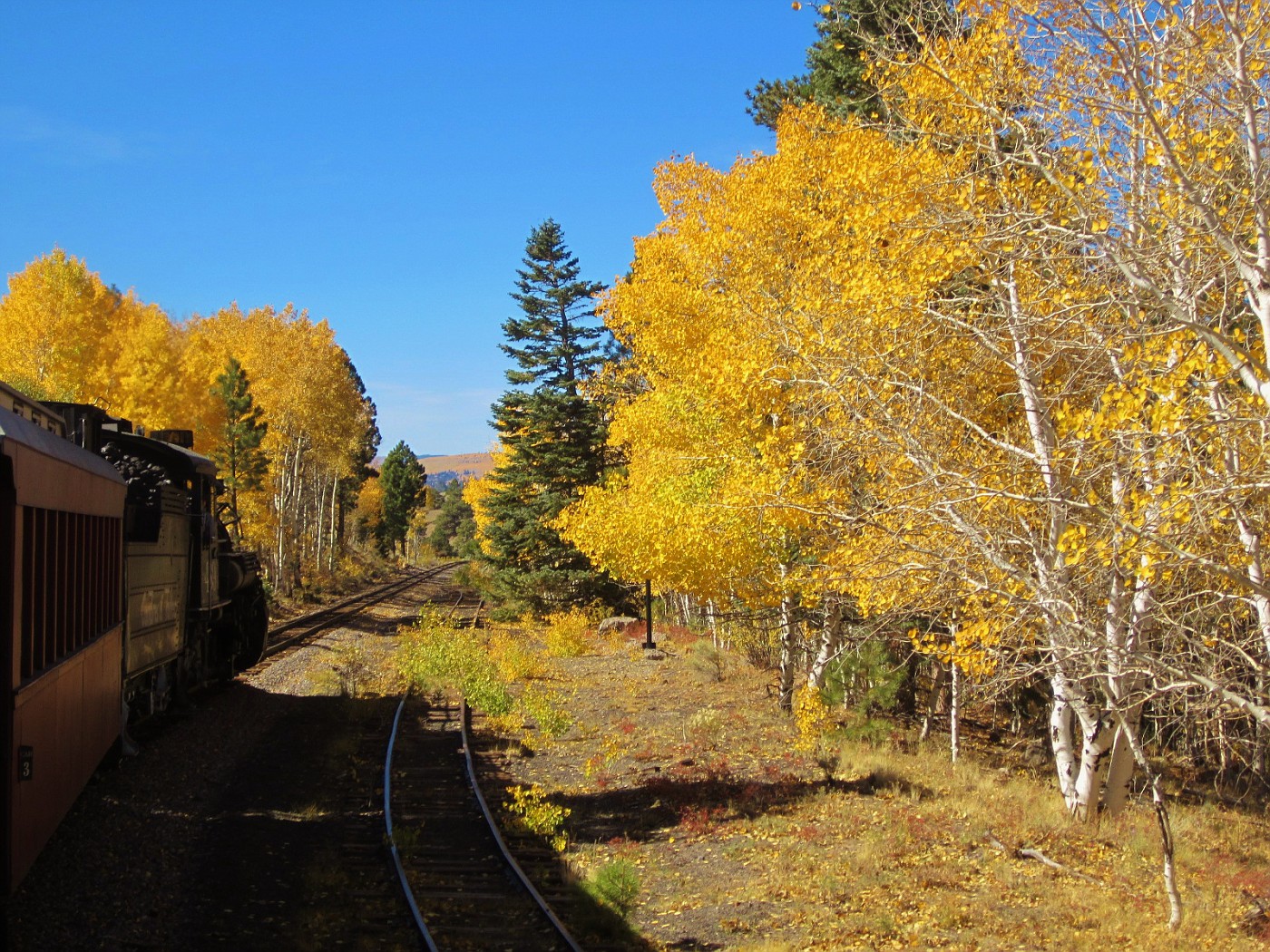 Climbing out of Antonito
From Antonito the train began a gradual climb into some barren or grassy hills. Shortly thereafter, the train crossed Ferguson's Trestle, named for a man who was hung from a locomotive there. This was explained by an onboard docent or guide from Friends of the Cumbres & Toltec Scenic Railroad, a non-profit, member-based organization whose mission is to preserve and interpret the railroad as a living history museum. Our guide's name was Fred and he did a great job throughout the journey. Fred pointed out that the original trestle was featured in a movie called “Where The Hell's That Gold?” starring Willie Nelson and Delta Burke. During filming, a planned explosion ended up getting out of hand and the trestle was burned down. Traffic was halted for a week while a temporary bridge was built, and over the next year a new trestle was built to match the original.
The proximity of the New Mexican border had us making eleven crossings into and out of New Mexico during the day. We continued to climb around a succession of horseshoe curves that took us ever higher into aspen and then pine forests. About an hour and a half in we reached our first water stop at Sublette, an abandoned railroad camp made up of a few old buildings and a siding. After filling the tender with water, we continued on. Perhaps a few photographs might best describe the journey at this point…
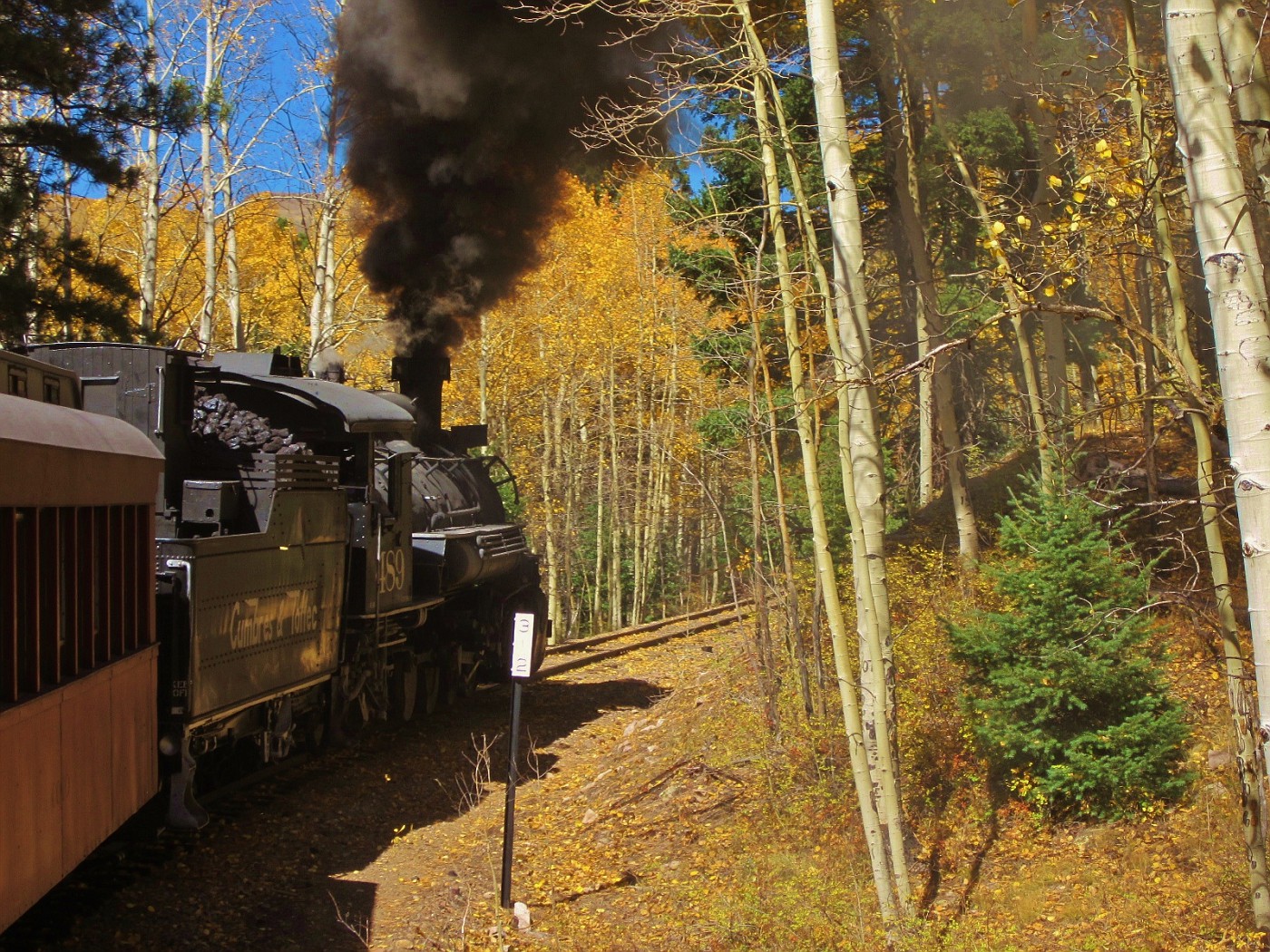 Chugging through the aspen forests
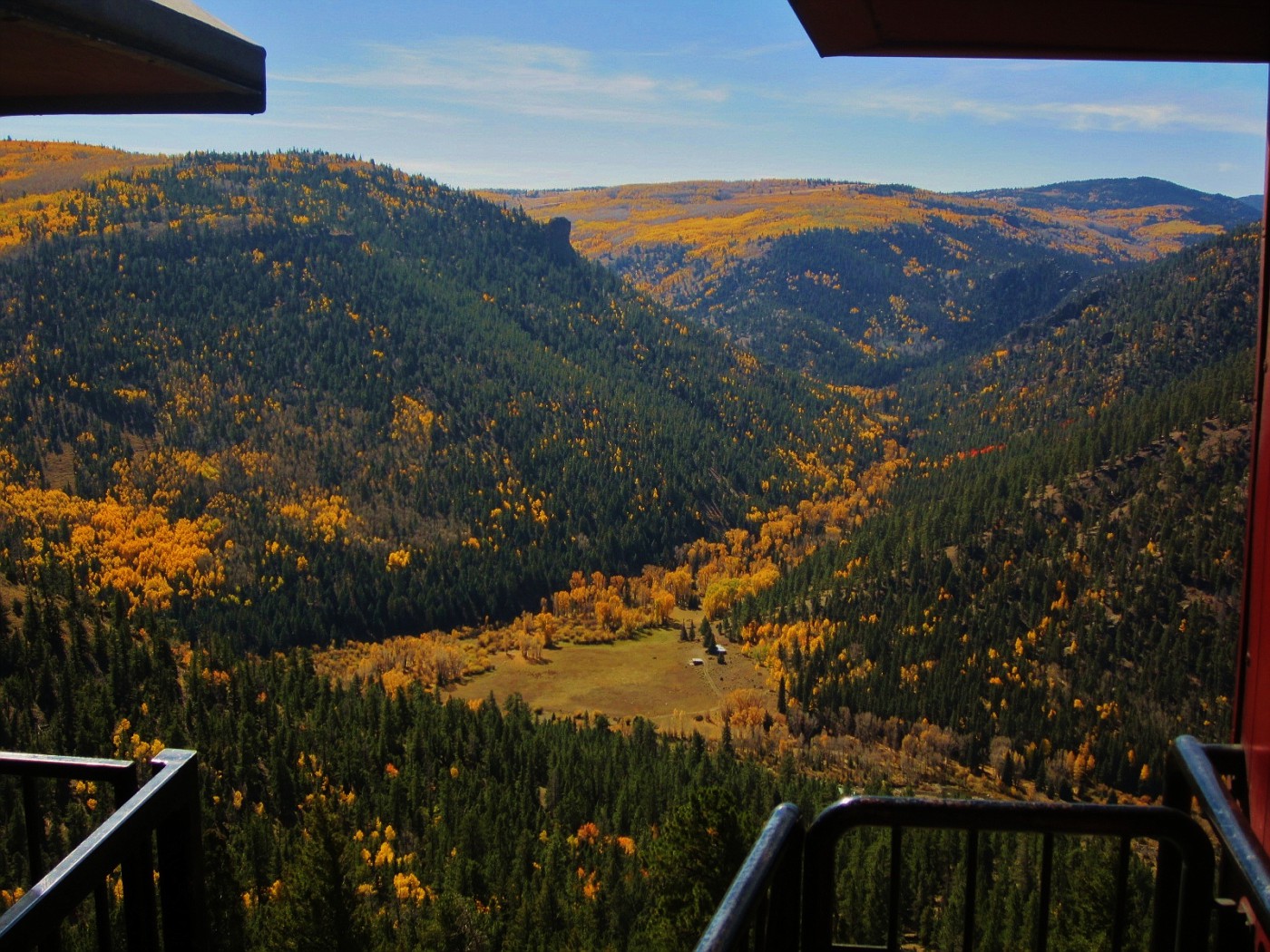 High above a local ranch
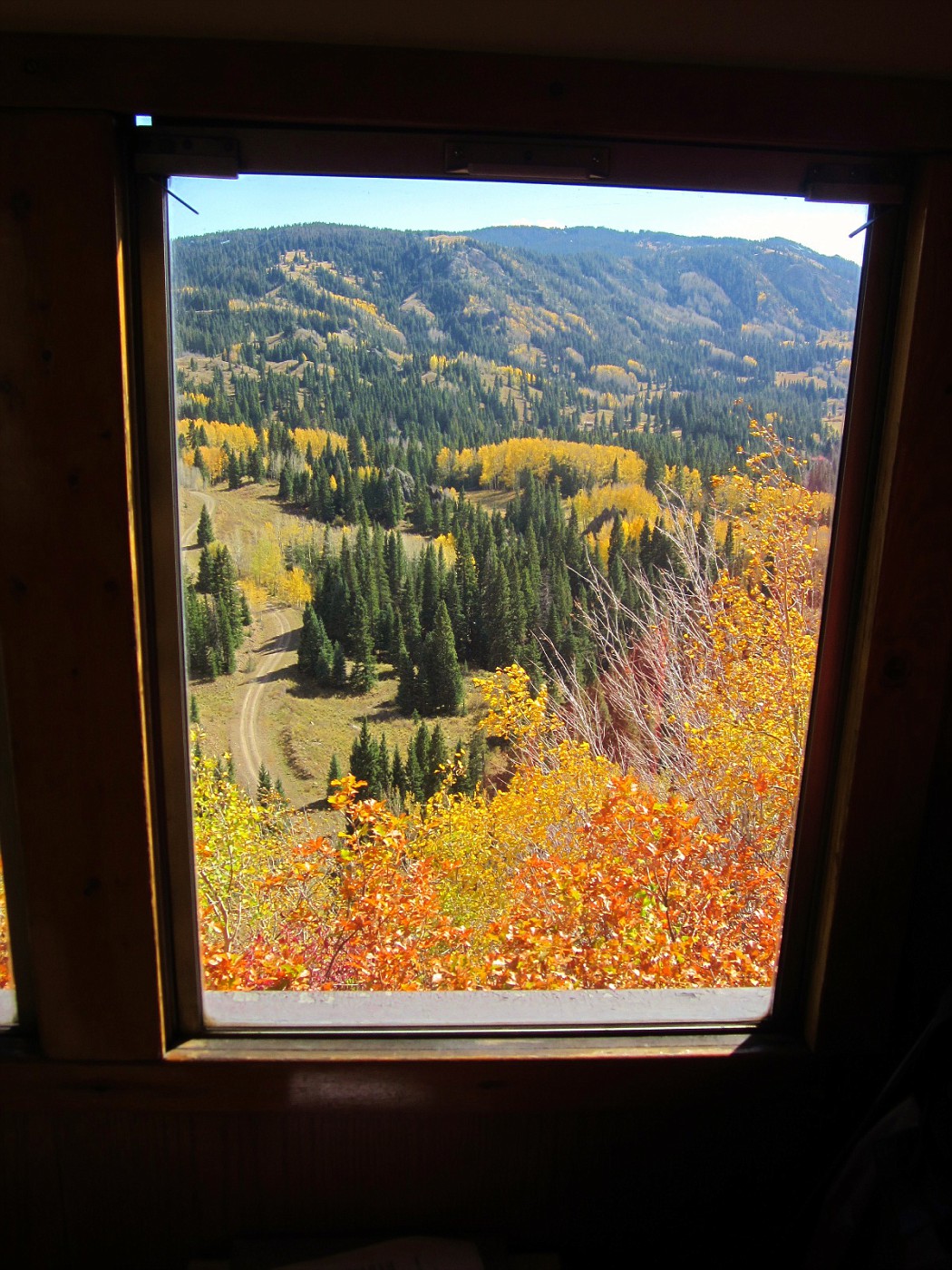 Looking out my window
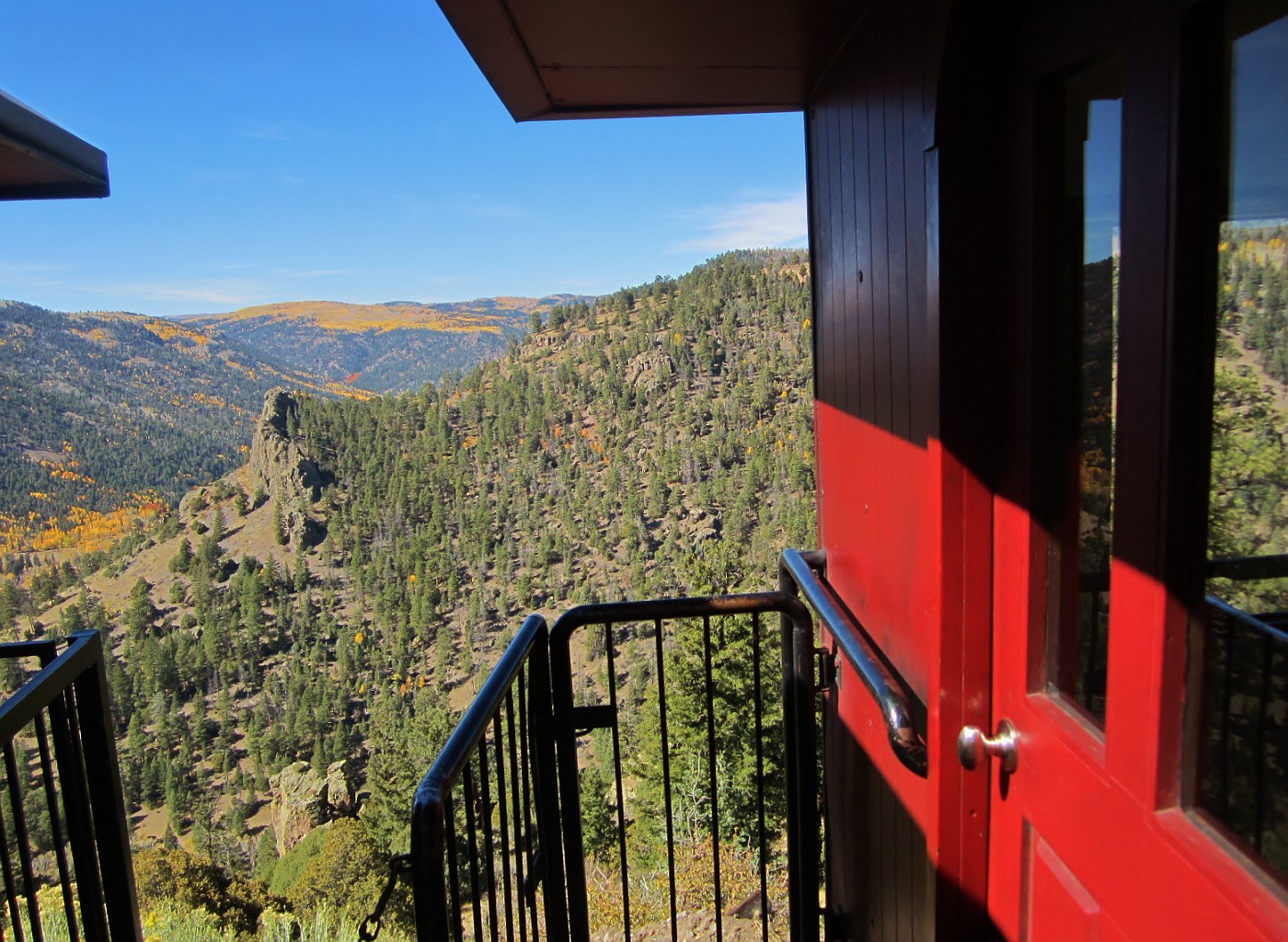 The view between cars
It was about 1:30pm when we arrived at the halfway point of Osier, Colorado. Osier sits at 9,637 feet and before the railroad built its tracks through here, a toll road connecting the Chama Valley with the San Luis Valley ran through this area. Today, Osier consists of a large dining hall for the train passengers (built in 1989) along with several out buildings and a water tank. It was explained that in the early days of steam, when locomotives were smaller, water tanks had to be located every 7-10 miles. Larger engines have larger tenders and with the current 1920s built locomotives, water tanks can be placed much farther apart.
The main attraction in Osier was an excellent all-you-can-eat luncheon featuring either hot turkey or meatloaf with all the usual accoutrements such as mashed potatoes, peas and corn, a complete salad bar and a wide selection of desserts. This was included in the fare and the one hour stop and family style seating allowed plenty of time to eat and chat with fellow passengers. Of course a gift shop was situated just off the dining room and, after a thorough perusal of all the usual schlock I just couldn’t resist plunking down 70¢ for a pair of colorful postcards.
Once again, four short whistles signaled that departure was imminent. We had a new crew out of Osier as our Antonito crew would be returning home with the other train. I missed the pretty little concessions attendant with the nice laugh who’d worked the trip into Osier, but the older lady who replaced her was a lot of fun with a great sense of humor.
From Osier the train continued its gradual climb around horseshoe curves, over a couple of trestles and along steep mountain slopes to its highpoint atop Cumbres Pass, elevation 10,015 feet. The paved highway between Chama and Antonito also crosses here, and several cars were parked off road waiting to photograph the train as it passed by.
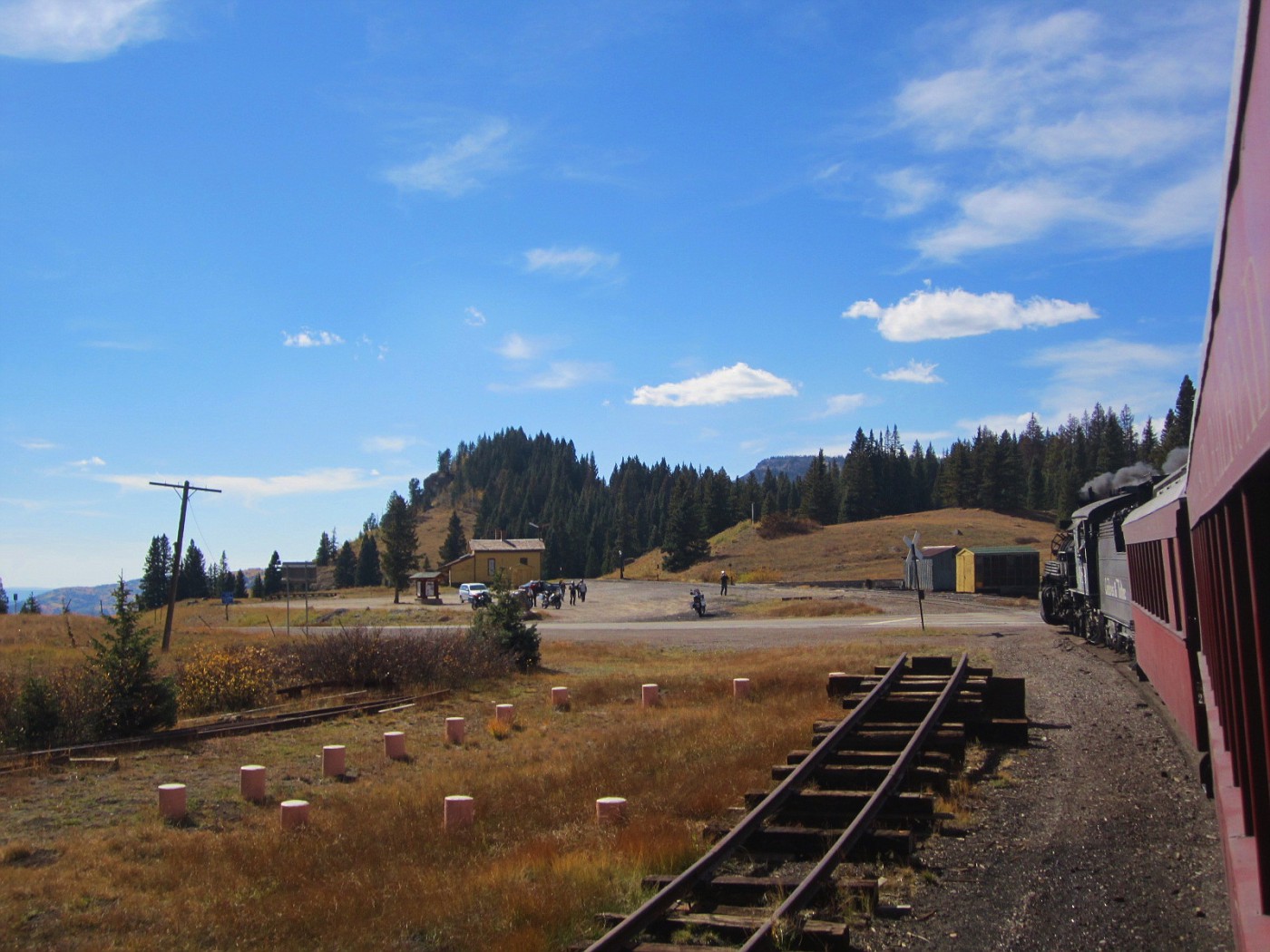 Cumbres Pass & Highway
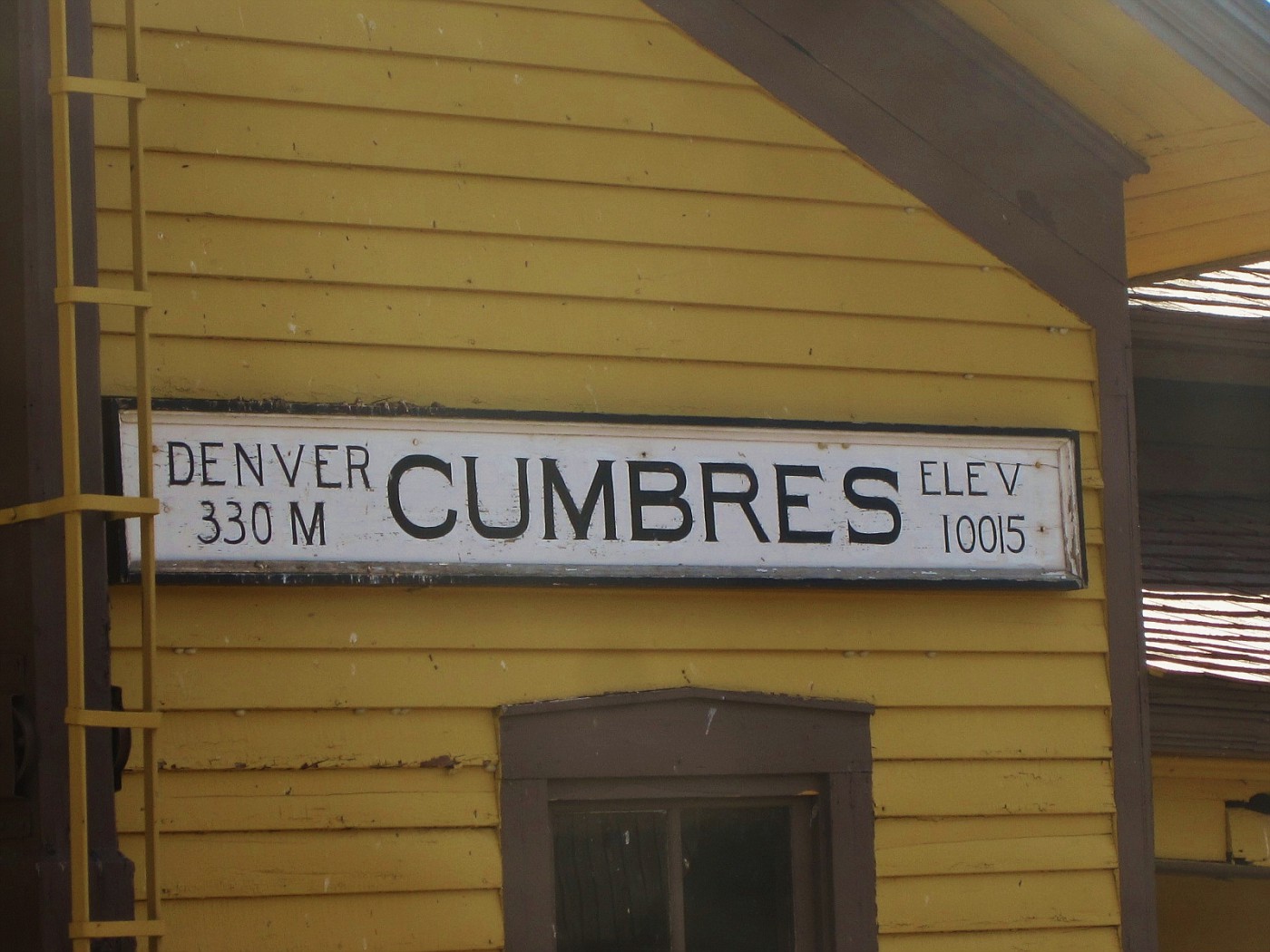 Cumbres Pass Station sign
After having travelled 50 miles uphill to reach the summit of Cumbres Pass, Chama was now only 14 miles away; all of it downhill, and much of that down a surprisingly steep 4% grade. After rolling along the rocky face of Windy Point, we descended down along the Wolf Creek drainage and into the Rio Chama Valley. Again, I’ll let my photographs tell the story…
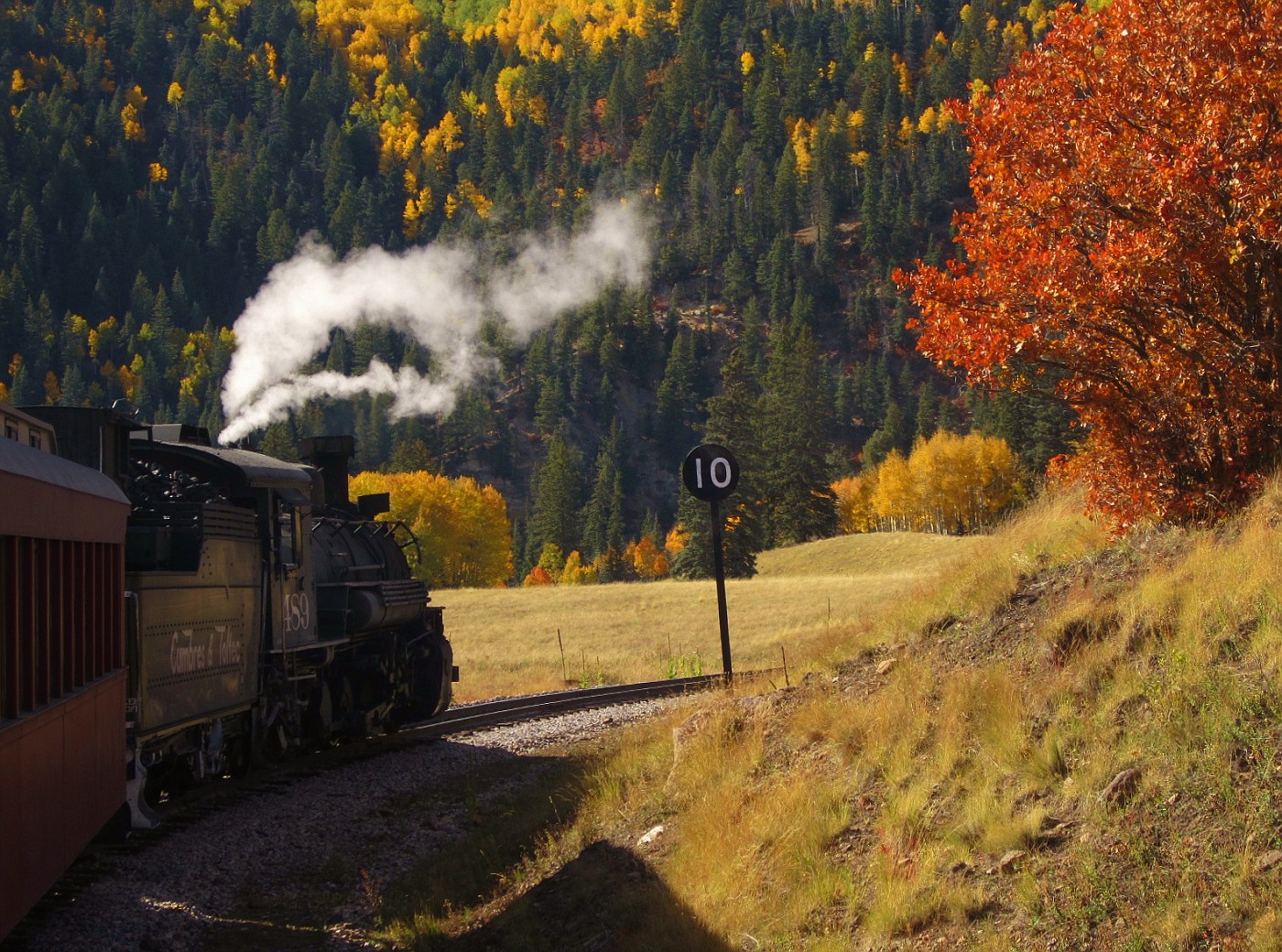 Rolling down Cumbres Pass
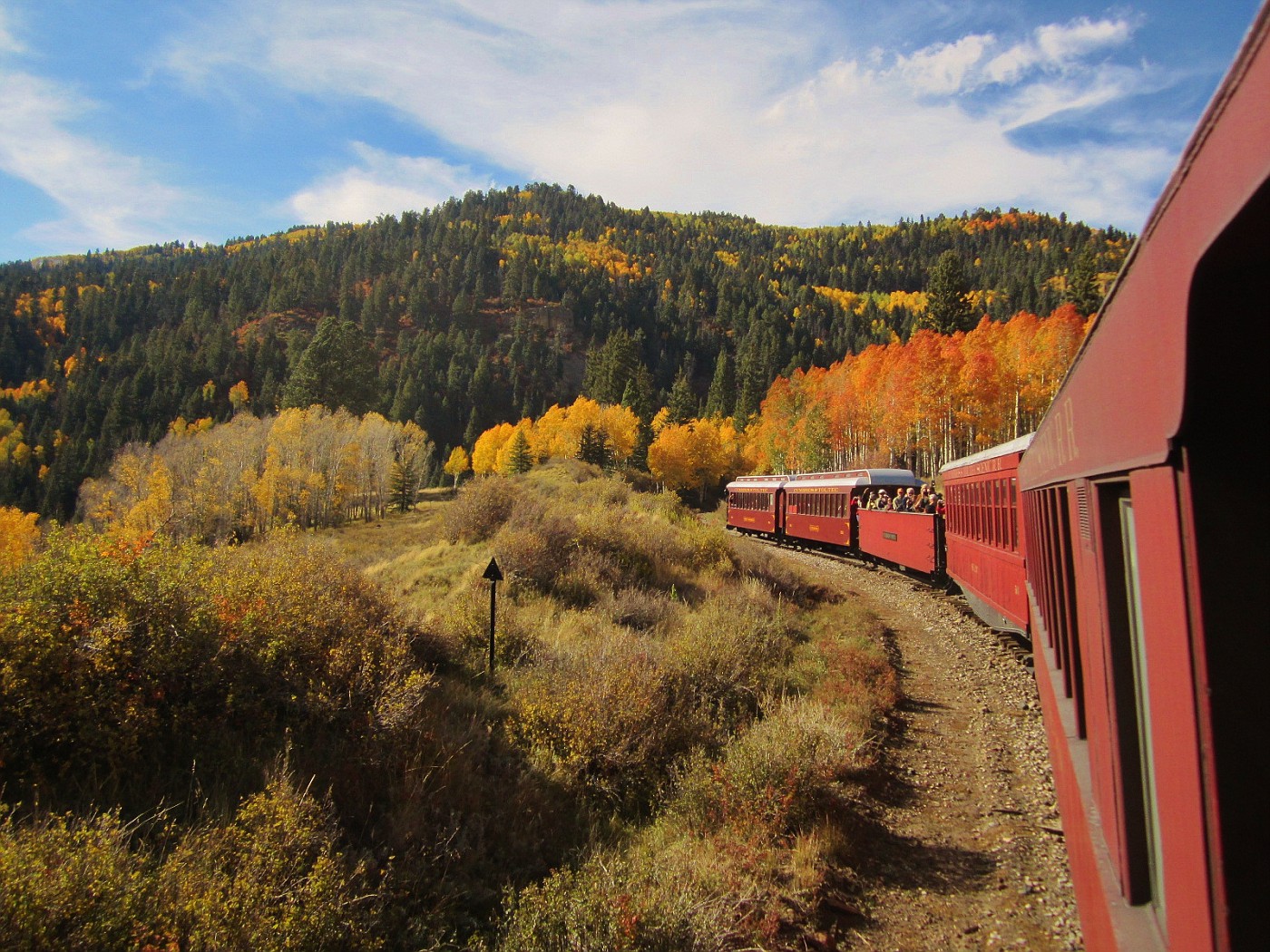 The rest of the train rolling down Cumbres Pass
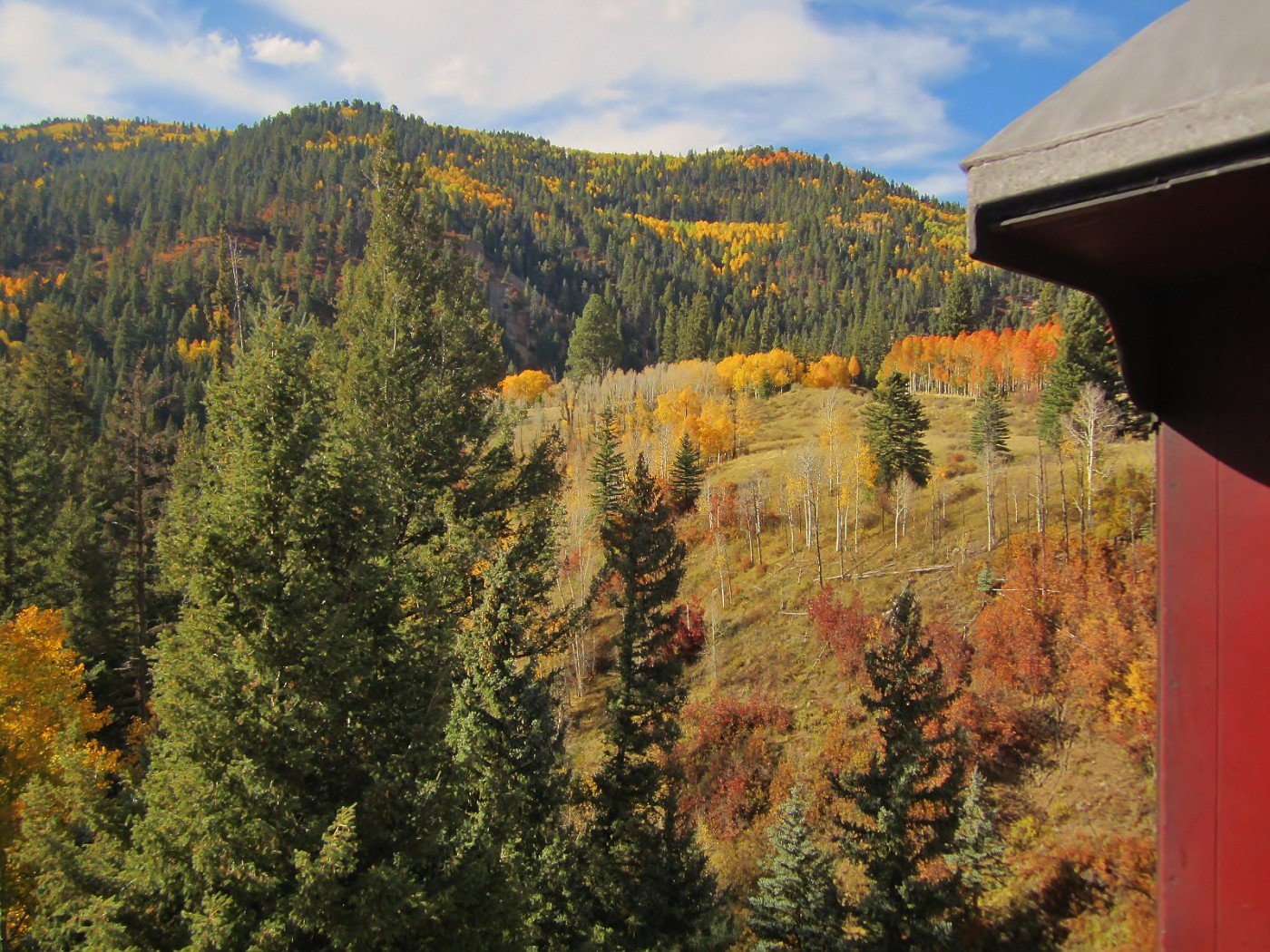 New Mexico mountain scenery
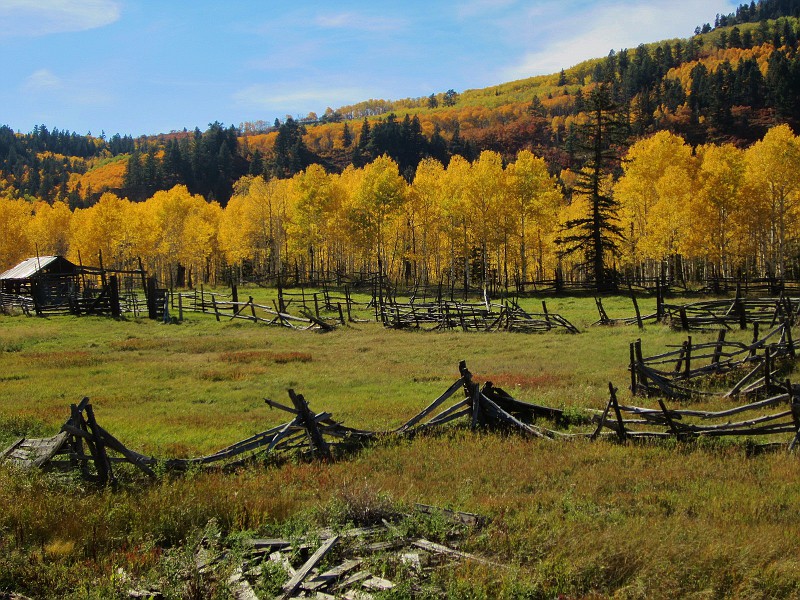 Rio Chama valley ranch
Our arrival in the beautiful town of Chama was right on time. Amongst narrow gauge rail aficionados, Chama is considered hallowed ground because it houses one of the most physically complete railroad yards from the steam era. An abundance of original issue rolling stock from the Denver and Rio Grande is parked throughout the yard and although portions of the roundhouse and warehouses have been changed, the yard and station still maintain a 1950s era ambience. A couple more photos…
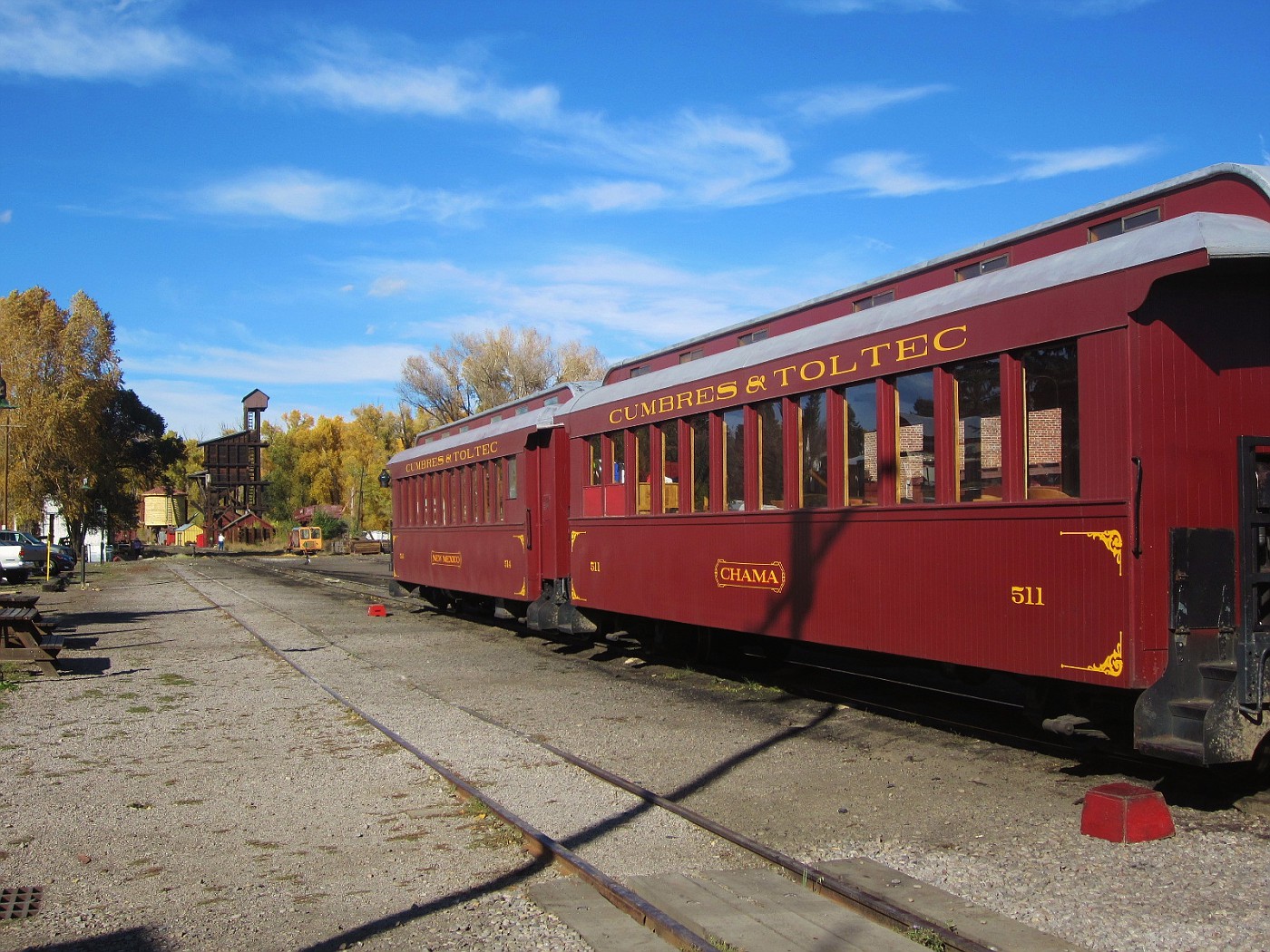 First Class cars in the Chama yard
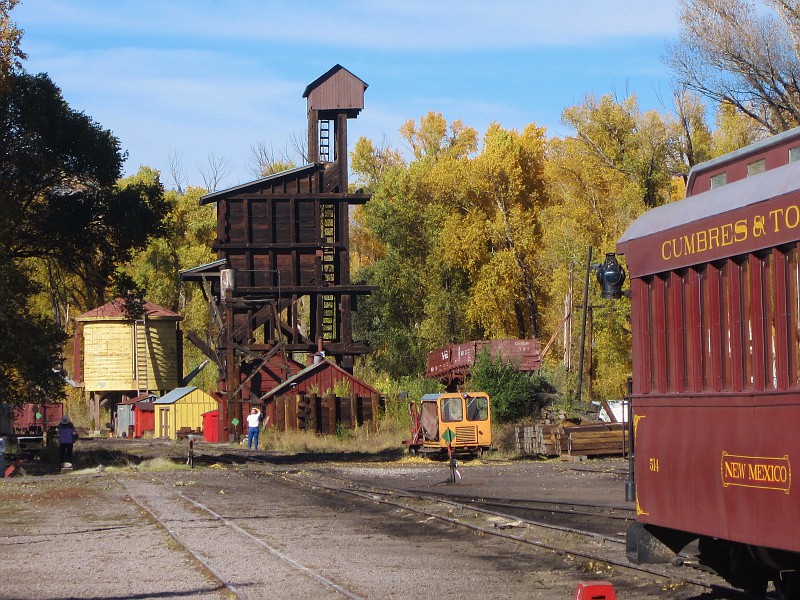 The old water tank and tower
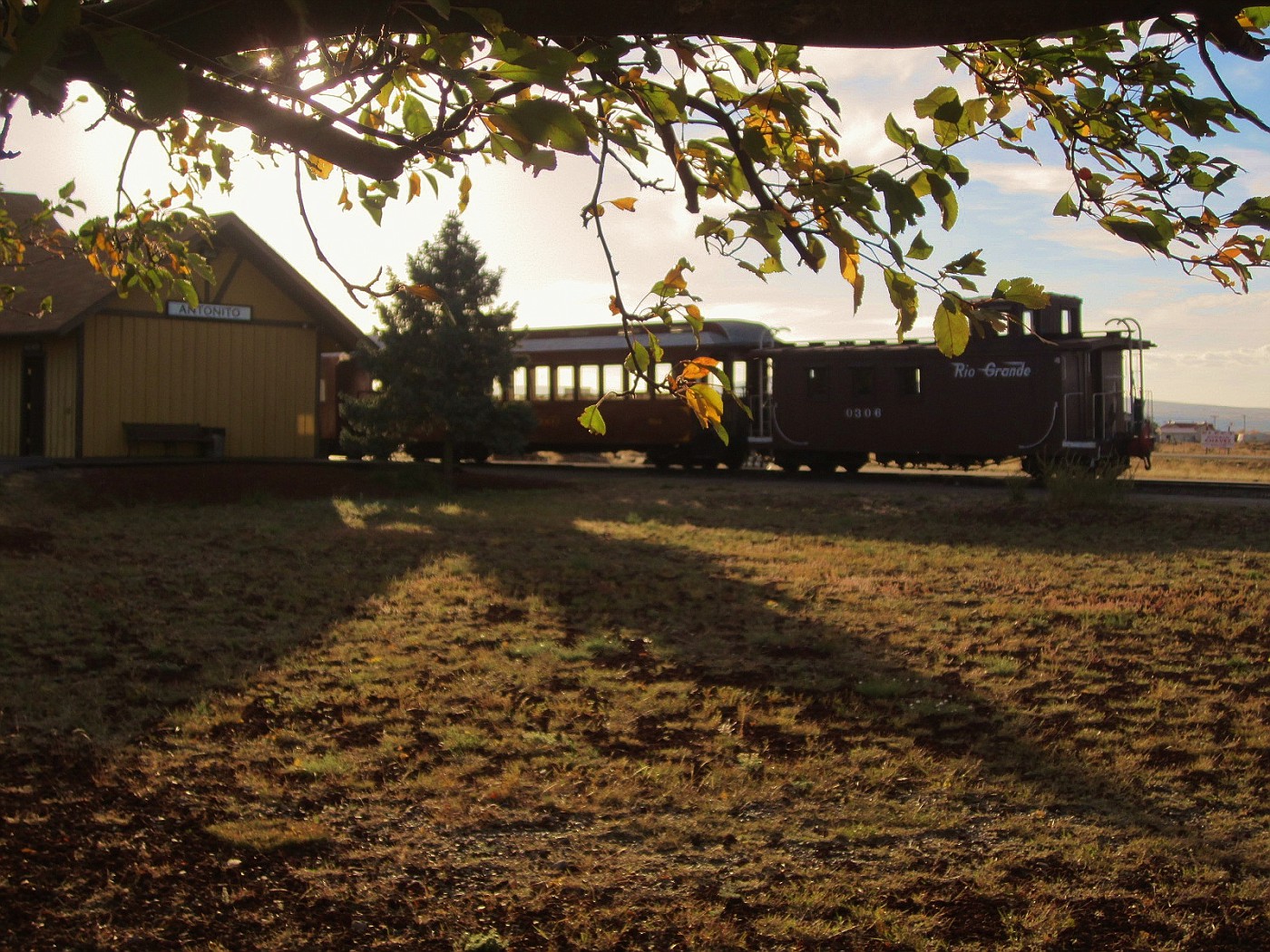 Late afternoon at the Antonito Station
We had about fifteen minutes to look around Chama – a town that in my estimation warrants at least a night’s stay – before boarding a chartered coach that delivered us back to the Antonito station. The coach ride accomplished in a mere one hour and ten minutes what took us five hours to do by train, but it offered nowhere near the excitement and beauty of the train ride. For many people however, spending five hours on a train is the deal breaker. They simply feel that they have better things to do with their time and have little interest in enjoying scenery purely for entertainment value. For those people there are plenty of interstate highways, cities, museums and other man-made attractions to go with the view from their $300.00/night resort room balcony.
For those willing to take the time to ride a train or take a road trip or even stay and eat in local establishments rather than the shinier corporate entities, the reward is a closer relationship with nature and a chance to experience downhome culture sorely lacking in the homogenized world of major airline and hotel chains.
I like the way Chinese poet Li Bai puts it:
QUESTION AND ANSWER
You ask me:
Why do I live
On this green mountain?
I smile
No answer
My heart serene
On flowing water
Peachblow
Quietly going
Far away
This is another earth
Another sky
No likeness
To that human world below
Now after all that, what am I going to be doing tomorrow? Getting on a plane to speed me across the country to Milwaukee where I’ve got a car rented for a week of travel that will take me first to Rochester, Minnesota for three days followed by a 1400 mile road trip through northern Wisconsin and Michigan’s Upper Peninsula. There’s a chance to catch some fall colors up in the UP and I will get to stand on the shores of Lake Superior for the first time. I’m looking forward all of this and more but first I’ve got to get 250 miles up the road to Denver in time for tomorrow afternoon’s flight.
I spent the night in Colorado Springs, located about 60 miles south of Denver. A nice collection of fine old 1950s era motels can be found along U.S. highway 24 as it runs through town. One of my favorites is the Stagecoach Motel. The rooms are spacious and include refrigerator, microwave and satellite TV all for just $40.00 per night.
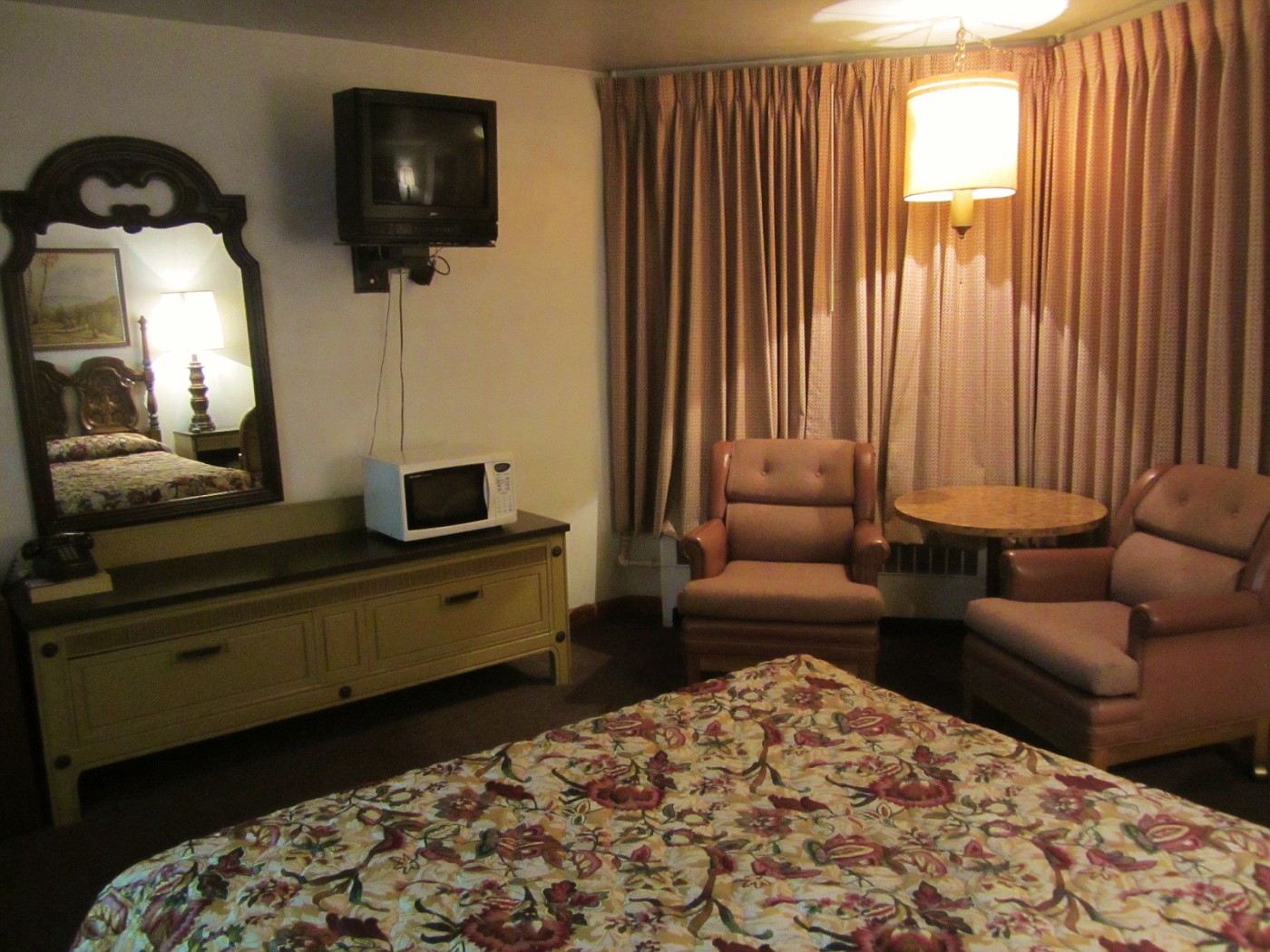 My room at the Stagecoach Motel
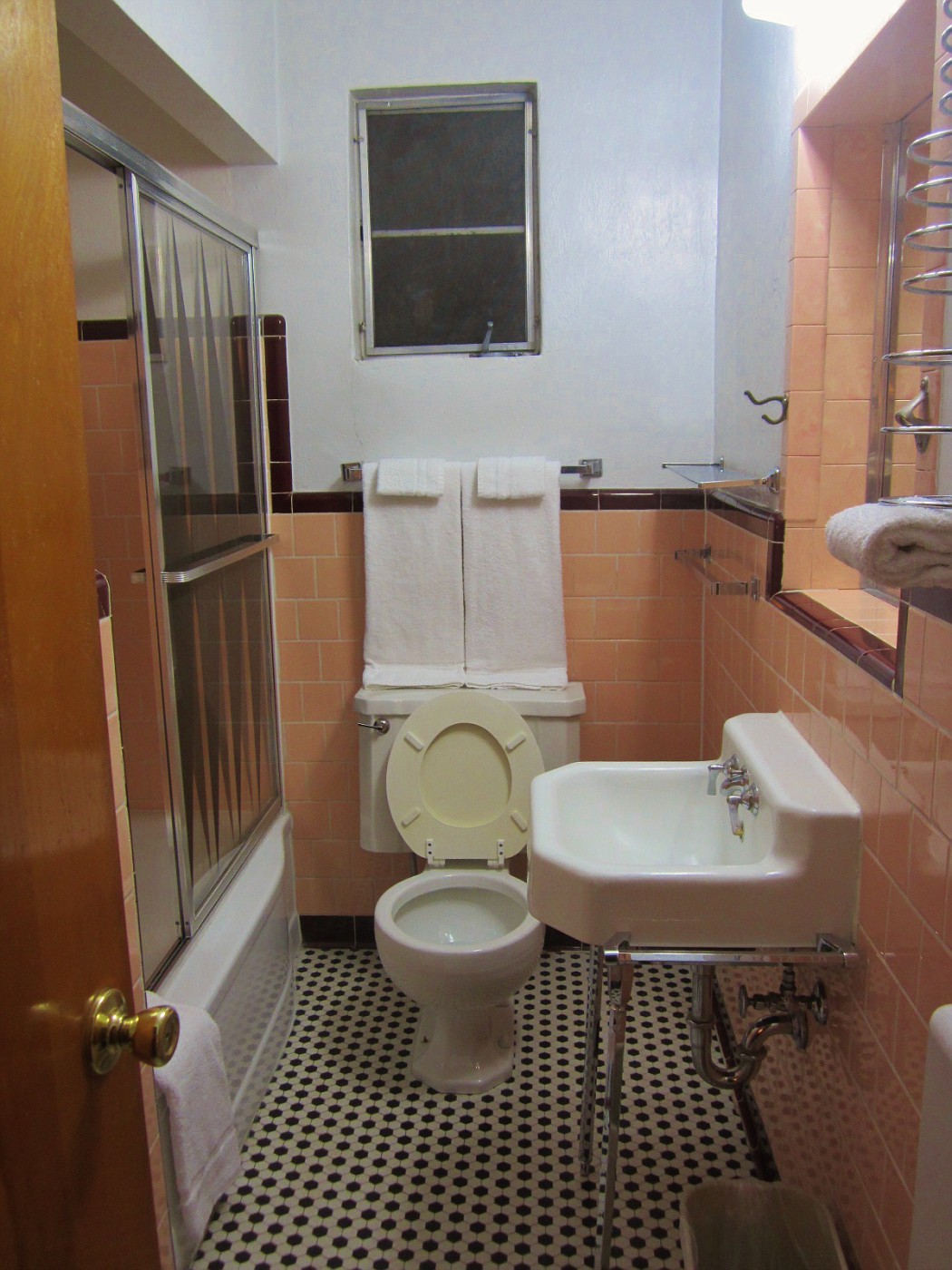 Check out the cool tiled floor!
October 6, 2012
Check out the cool tiled floor!
October 6, 2012
Delta Airlines Denver – Detroit 210p – 658p A320-200 Coach Class
Delta Airlines Detroit – Milwaukee 737p – 750p A319-100 Coach Class
As an elite level flyer with Alaska Airlines, I’m eligible for complimentary upgrades on Delta flights. While this sounds nice in theory, the reality is that I’m not eligible for those upgrades until all Delta elites of any ilk have been upgraded first. This is only fair as it is their airline, after all. Still, the reality is that more often than not I’ll find myself way down the upgrade list, like number 34 of 37. As a result my excitement over this benefit has waned considerably since it was first introduced. I don’t even bother to check the upgrade list before the flight any more, though checking the monitor at the gate is good for the occasional laugh. I have actually been upgraded on three of about fifty occasions, usually on short flights departing on Saturdays but once on an Atlanta to Portland flight. Today flying to Detroit, a Delta hub, I had no chance – Saturday or not.
A more realistic and cherished benefit for Alaska elites flying with Delta is the ability to pre-reserve some premium quality seating including exit rows at the time of booking. As a result I had a pair of spacious exit row seats awaiting me on today’s flights. I used the Sky Priority lane at check-in and avoided the fairly long line at security via the Premium lane, both of which allowed me that much more time in the Red Carpet Club.
Delta used to operate a small Crown Room here in Denver, and it is my fervent hope that they consider opening another one someday soon. That would seem unlikely however, so for now my only option is the United Club. I’m a lifetime member of Continental’s Presidents Club and not so long ago Continental operated a very attractive facility on the A Concourse here at DIA. However, the merger with United resulted in the consolidation of all operations on the B Concourse, so it no longer made sense to operate the much nicer Presidents Club on the A. That facility has now become an Admirals Club, but where once I enjoyed unfettered access, now I can enter only when flying Alaska out of Denver.
United operates two large lounges in Denver, one on each side of the B Concourse. They are pleasant and functional but somewhat less classy than the old Presidents Club. Still, they provided a quiet space to put in some work on this report which I’ve severely neglected over the past week. Today I wrote about the flight from Portland to Las Vegas.
As for two flights in Coach on a nice Saturday afternoon, there ain’t much to write home about. Delta’s smaller Airbuses are not equipped with the excellent “Delta on Demand” inflight entertainment system, and the inflight snack offerings on this two hour and ten minute flight were not particularly inspiring. Thankfully I’d stopped by the Schlotsky’s Deli over on the A Concourse and now enjoyed a delicious Schlotsky’s Original while folks around me salivated in envy.
Arrival in Milwaukee was fifteen minutes early. With no checked baggage, I headed straight across to the car rental counters where I upgraded my car to a spacious Ford Edge and then headed to nearby Brookfield for a night with friends and a good bottle of bourbon.