October 14, 2011
Delta Air Lines Denver – Atlanta 1035a – 339p 757-200 Economy Class
Delta Air Lines Atlanta – Kansas City 545p – 657p MD-90 Economy Class
By now some of you are probably wondering when I’m going to start riding some of those trains that I said would be part of this trip. Well wonder no more. The first ride comes tomorrow, in Business Class aboard Amtrak’s Missouri River Runner between Kansas City and St. Louis. First however, I need to get to Kansas City.
Kansas City sits 590 air miles east of Denver, and is often the beneficiary of some very low airfares offered by any one or all of the three airlines that offer nonstop service on the DEN-MCI route. Although Delta does not fly nonstop between Denver and Kansas City, it nonetheless offers a very attractive base fare of just $59.00 one way allowing for a connection in cities as far flung as Atlanta for a total mileage flown of 1,890 miles. To an old mileage runner like me, a routing like this is just plain irresistible.
Coffee and a sweet roll in United’s Red Carpet Club preceded my departure from Delta’s gate over on the C Concourse. Once onboard the 20 year old 757-200, I slowly reclined fully into the man behind me. Unfortunately, my exit row aisle seat was broken to the extent that it would not maintain its full upright and locked position. The flight was totally full and moving was not an option for either of us. Thankfully the guy behind me was not a large person and claimed not to be overly bothered by the situation.
Two hours and sixteen minutes later we landed in Atlanta on a warm and hazy afternoon. Amazingly, my connecting flight to Kansas City was scheduled to depart from the same gate that I’d just arrived at. I took this bit of good fortune with a grain of salt as Delta’s operation at ATL is notorious for last minute gate changes. Thankfully the A Concourse Sky Club was conveniently located right in the middle of the concourse, just above the inter-concourse train station.
The other reason I booked this connection via ATL was because the aircraft operating the ATL-MCI leg was an MD-90. Delta was the launch customer for the MD-90 back in 1995. Only 116 were built and Delta is one of only seven airlines worldwide still operating the plane.
The MD-90 was developed from the MD-80 series and people often confuse it with the older MD-80.
The two airplanes appear very similar but the -90 is 5 feet longer and is powered by the much more fuel efficient IAE V2500 series engines. Delta currently operates a fleet of seventeen MD-90s and is planning to add more. It recently acquired nine MD-90s from China Eastern Airlines and will soon add a few more from Japan Airlines and SAS.
Buying these older MD-90s makes great sense, economically. Depending upon their age, used MD-90s have appraised values of $5 million to $9 million. Assuming Delta is buying these used MD-90-30s in that price range, they’re getting quite a bargain considering that new Boeing 737-800s generally sell for over 60 million apiece. Sure, the 737-800s are newer, but the fuel economies of the MD-90s are very similar to the 737, especially given their similar capacity and efficient engines.
I recently read an interview Delta’s CEO Richard Anderson in which he stated that Delta’s monthly payments on each “new” 737-800 averaged about $350,000. By contrast, Delta’s MD-88s are paid for. So the MD-88s, despite their comparatively uneconomical JT8D engines, start out each month $350,000 less expensive to operate than the economical 737-800s. I wonder how it all tallies up at the end of each month? Either way, Delta doesn’t appear to be in any hurry to get rid of its MD-88s.
This was only my fourteenth flight aboard an MD-90. Although I was unable to discern any operational advantages such as fuel savings during the flight, I very much appreciated the spacious bulkhead aisle seat along with complimentary soda and peanuts bestowed upon me by the friendly flight attendants.
October 15, 2011
Amtrak Kansas City – St. Louis 400p – 950p Missouri River Runner Business Class
Amtrak celebrates its 40th anniversary of operation this year. Trains are a wonderful way to travel across this big beautiful continent of ours and thanks to Amtrak (and a lot of state and federal subsidies), we still can. I can think of no better way to celebrate Amtrak’s milestone than to buy a few tickets and hit the rails!
Back in the early 1980s, Amtrak took delivery of double decker Superliner equipment for use on its long distance trains between Chicago and the West Coast. The new Superliners replaced aging cars from the 1940s and 50s and represented a huge improvement in the onboard experience for passengers. To further spur ridership, Amtrak also introduced very attractively priced All Aboard America fares. America was divided into three sections and these fares allowed practically unlimited travel through any one or two sections or all of the country. Each section cost $125.00 and the only restriction was that you could not travel over any section of track more than twice, i.e. going and coming. During 1983 and 1984, I rode fifty-six trains over 50000 miles of American tracks, in the process riding every route longer than 400 miles in the Amtrak system.
Over the ensuing years I’ve knocked off a few more new routes and re-ridden many already travelled routes. The focus on this trip is to ride aboard trains I haven’t yet ridden upon. First up is the 280 mile run between Kansas City and St. Louis.
My train, the
Missouri River Runner, wasn’t scheduled to depart until 4:00pm. This left me plenty of time to sleep in, take a leisurely morning at the hotel, and then head into downtown Kansas City for a plate of ribs at one of the many barbecue establishments for which Kansas City is justifiably renowned.
In the month leading up to this trip, I’d asked anyone I encountered from Kansas City about their thoughts on the best barbecue in town. There are many fine barbecue restaurants in Kansas City but the one name that came up the most often was
Gates & Sons Barbecue. So that’s where I went, to the location on 32nd and Main, and enjoyed as good a plate of beef ribs as I’ve ever had. I look forward to a return visit to check out the burnt ends sandwich.
By the way, my mode of transport from the airport into and around town was the city bus. Whereas many reporters in this forum might have utilized airport limos or shuttles into the city, I can’t afford such extravagance even if I could afford it, i.e. I’ll never pay $28.00 for the convenience of a van straight to my destination when I can get within a couple of blocks for just $1.50 and twenty or thirty minutes more of my time. After lunch I walked a block down Main and caught the #57 bus. Minutes later I was let off directly across the street from Kansas City’s Union Station.
*** *** *** *** *** *** *** *** ***
One hundred years ago, airlines and modern paved highways didn’t exist. Ocean liners transported people between continents and trains moved them over land. The world was a lot bigger place back then and travelling anywhere was considered a grand adventure. Big city train stations of that era reflected the grandeur and excitement of long distance travel with monumental architecture that included cavernous grand halls, high sculpted ceilings, polished stone floors and church-pew like seats.
Kansas City’s Union Station is a magnificent example of this reverential style of architecture. Built in the Beaux-Arts style commonly seen in European architecture, the station opened in 1914 as the second-largest train station in the country.
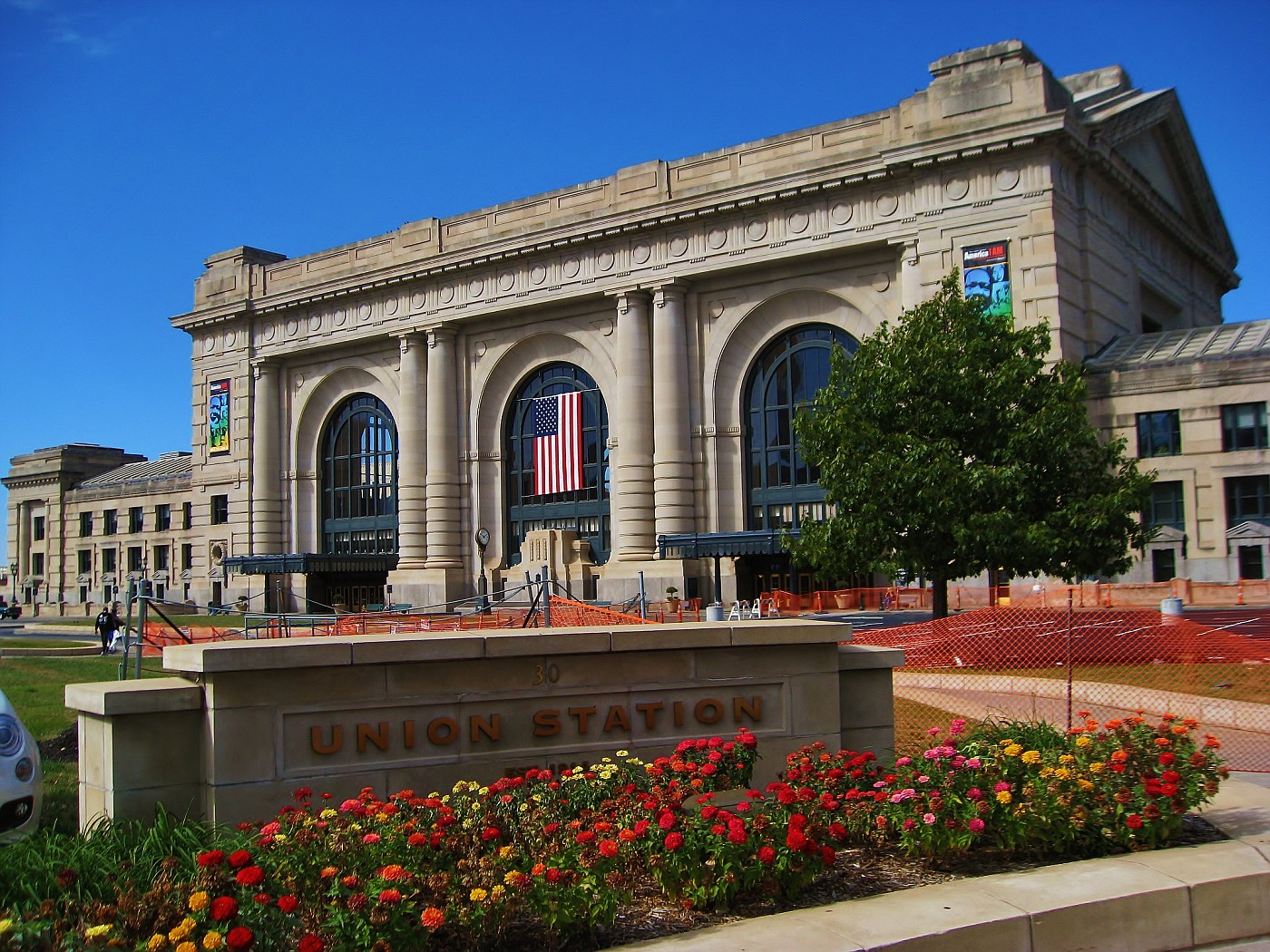 Kansas City Union Station
The entire station complex encompasses over 850,000 square feet. The ceiling in the Grand Hall is 95 feet high and is distinguished by beautifully restored plastered frescoes and three huge chandeliers weighing 3,500 pounds each.
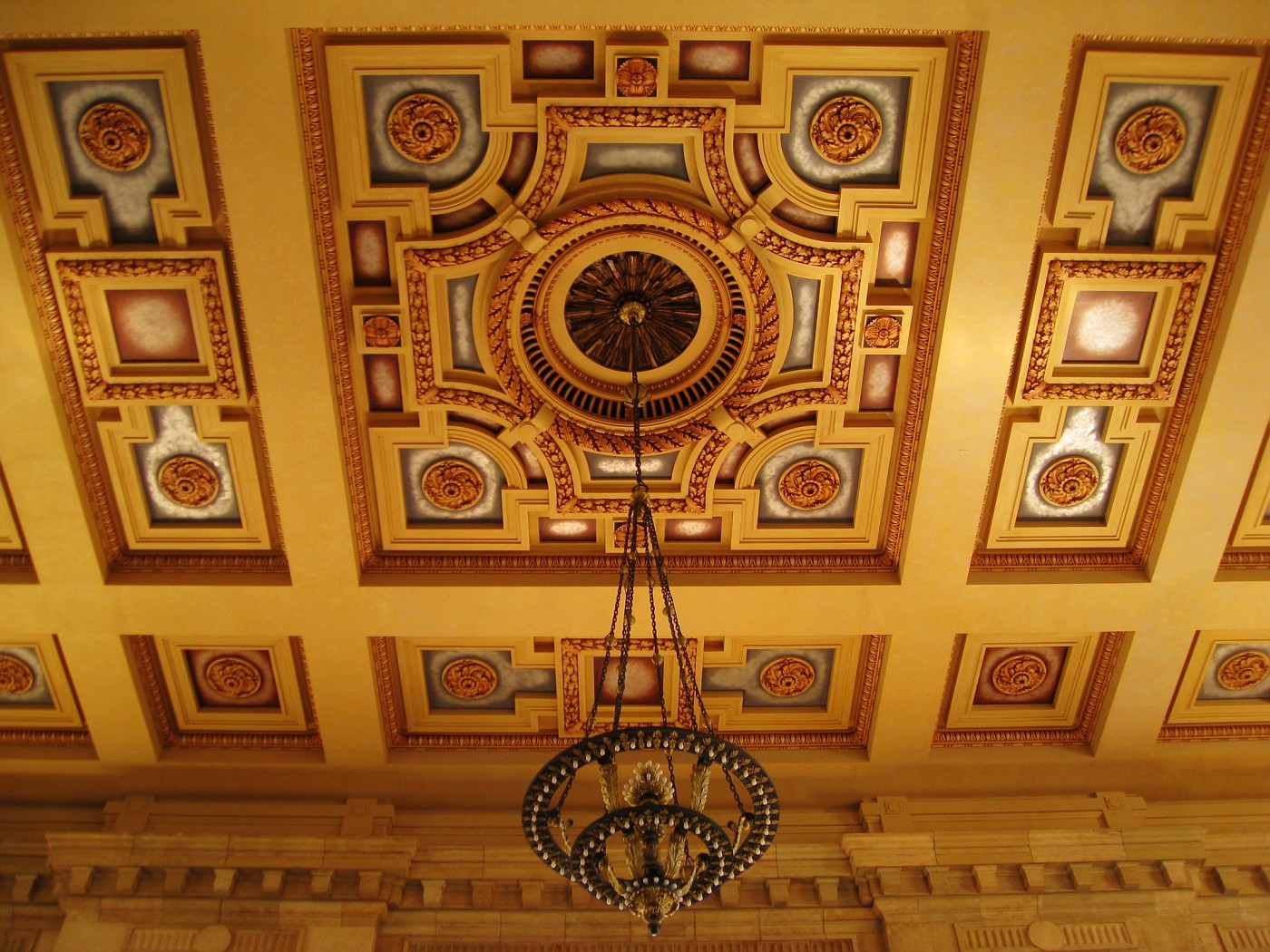 Kansas City Union Station Ceiling and Chandelier
Enormous, deep-set arched windows face the front of the station. The sunshine they allow in casts a warm glow on the rose-brown marble floors and light stone walls. The overall ambience of the station is surprisingly light and airy for such a large building.
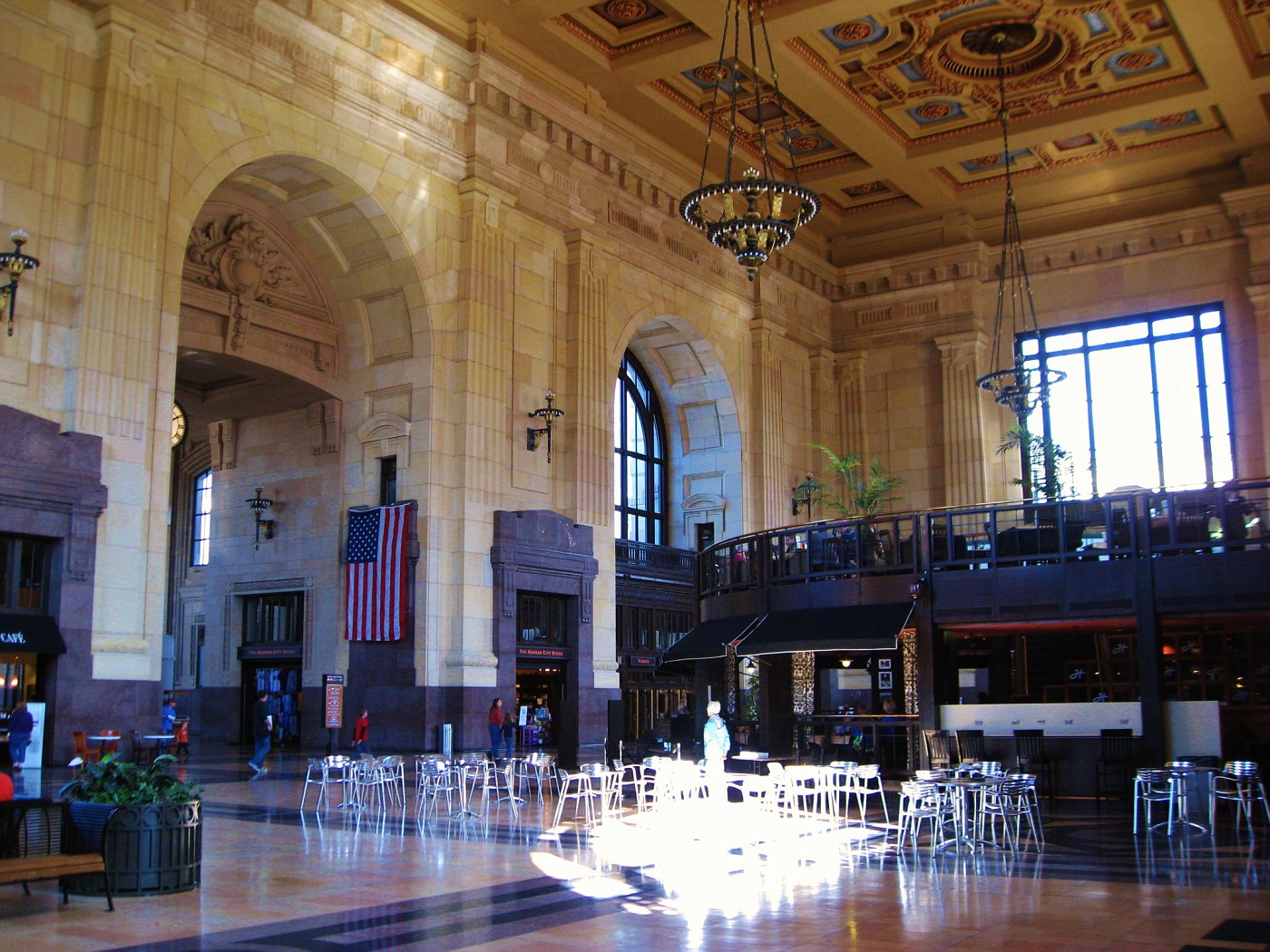 Kansas City Union Station Great Hall
At its peak during World War II, an estimated one million travelers passed through this station. Like any large city terminal, the station included restaurants, a cigar store, and a barber shop. Additionally, it was the corporate headquarters for Fred Harvey, the company that famously catered the Santa Fe railroad and operated a string of hotels throughout the Southwest.
Since its renovation and reopening in 1999, Union Station is now home to the H&R Block City Stage Theater, an Imax theater, the Gottlieb Planetarium and a public science center with over 50 interactive exhibits called Science City. The station also hosts two upscale restaurants, a post office and numerous smaller shops. I was here on a Saturday afternoon and there were clearly many more people who’d come to Union Station to eat and/or visit one of its many attractions than to depart on a train.
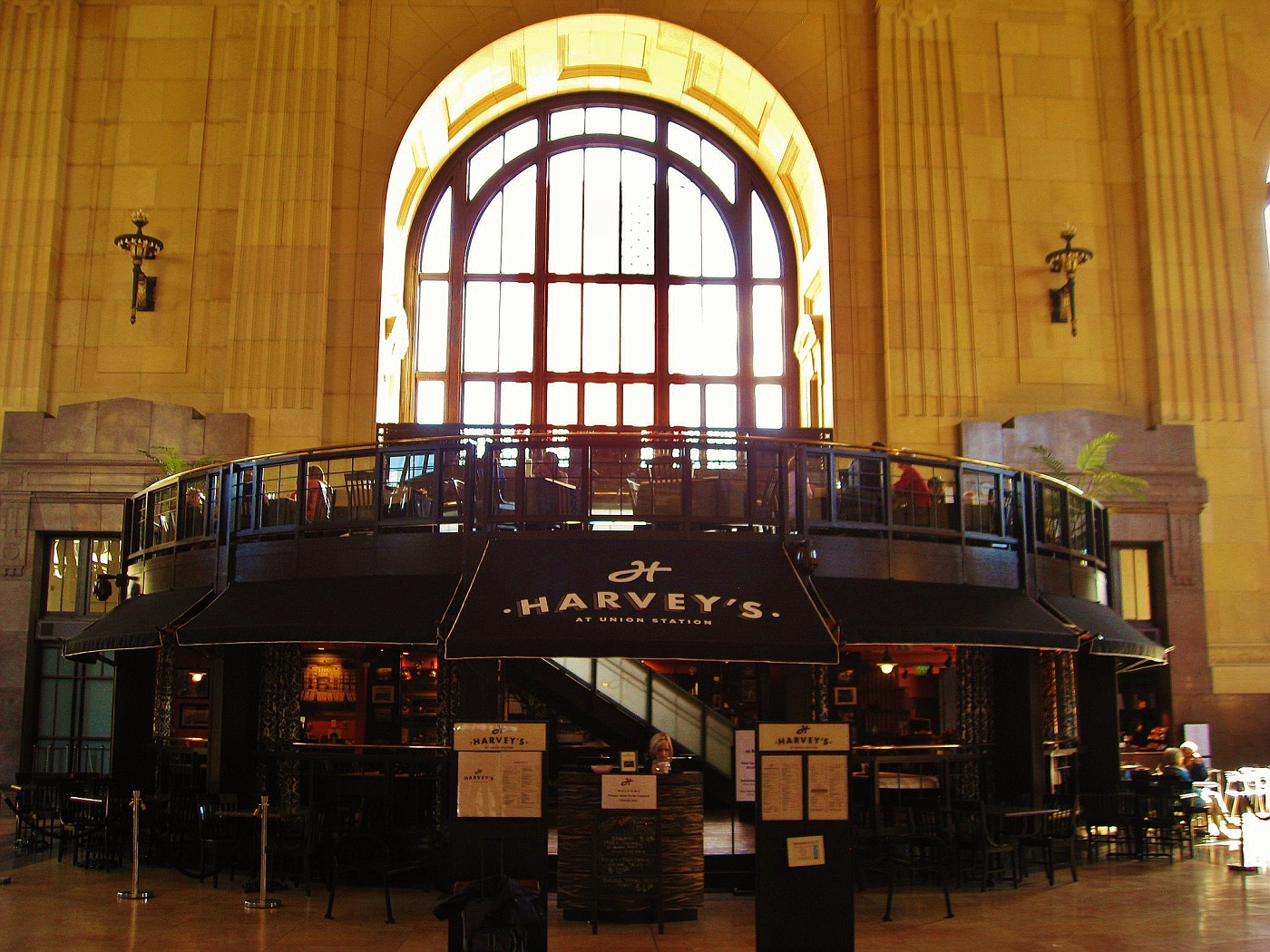 Harvey’s Restaurant at Union Station
Boarding for the
Missouri River Runner was announced at 3:45pm. There were perhaps forty of us who commenced the long walk out along the outside of the station to an elevated walkway over the tracks where an elevator took us down to trackside. In the old days, when there were over 100 trains per day through here, we’d have accessed our train directly through one of the many track entrances in the North Hall.
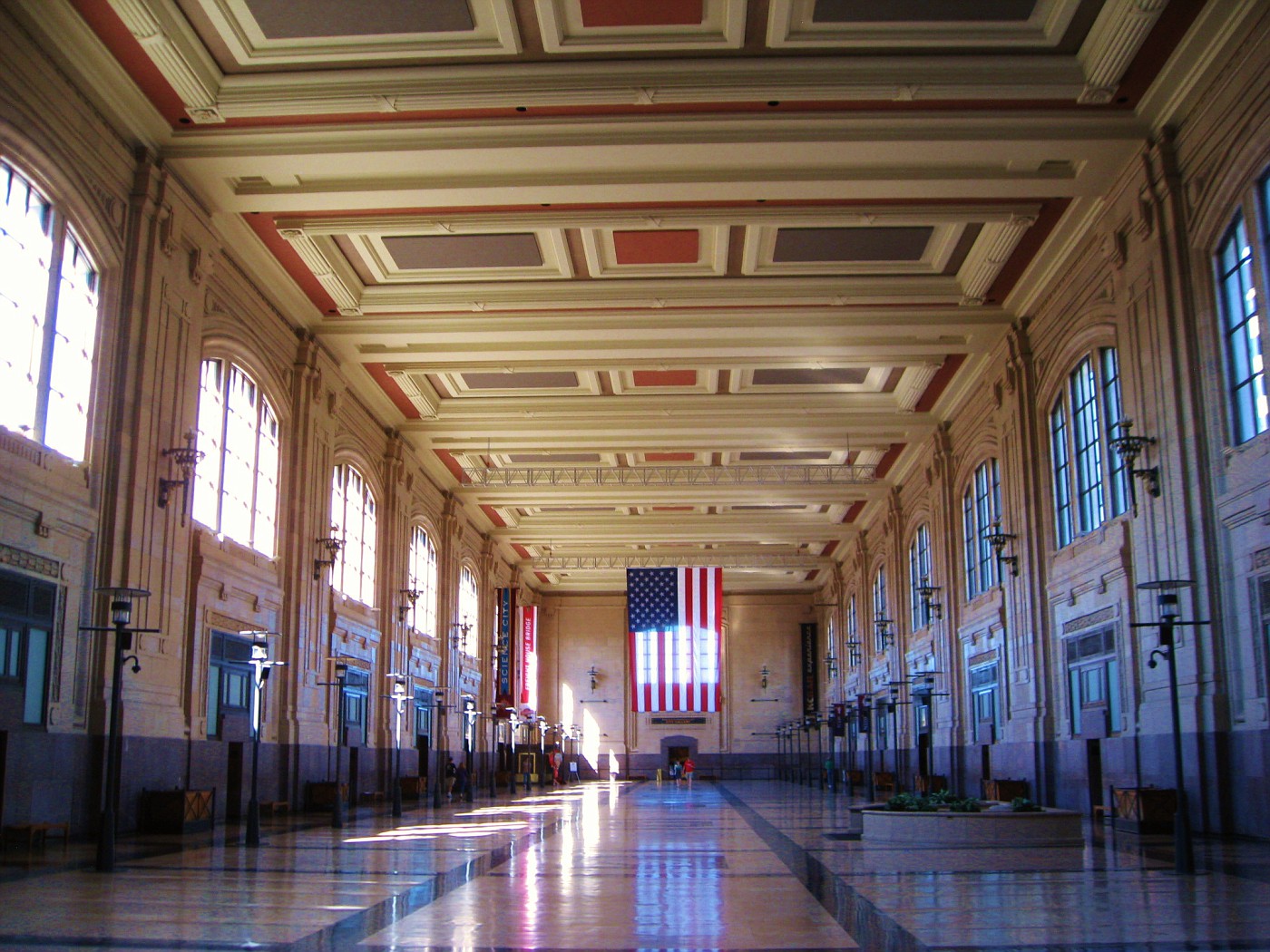 Kansas City Union Station North Hall
Amtrak offers Coach and Business Class seating aboard most of its short to medium distance trains. Coach accommodations are in surprisingly wide and comfortable seats arranged in a 2-2 configuration throughout the car. Business Class offers wider leather covered seats configured 1-2 and includes a free soft drink and a newspaper. 120v outlets are available at each seat in both classes.
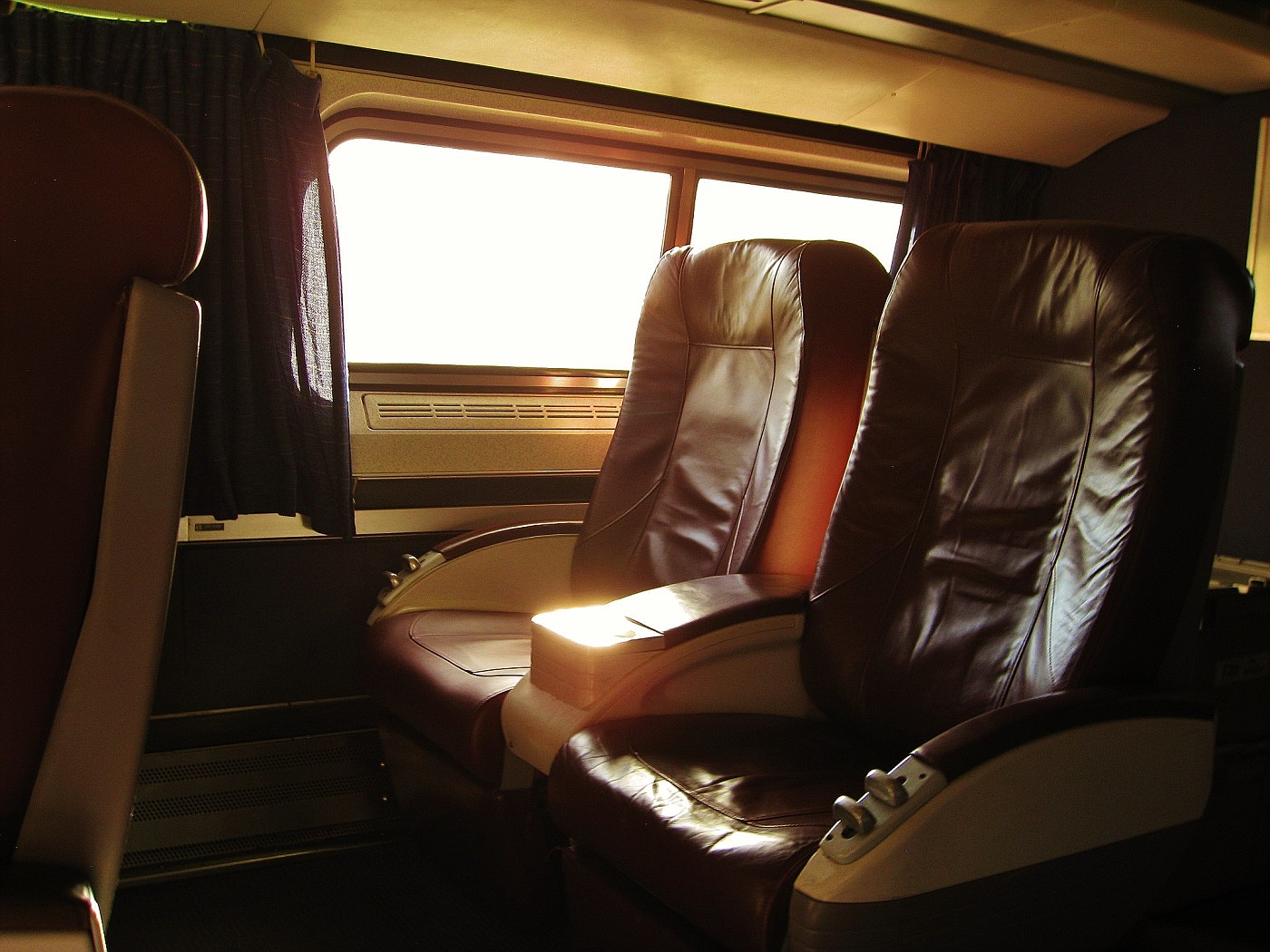 Amtrak Business Class Seats
Today’s consist was headed up by a single P42DC locomotive followed by four coach cars and a Café/Business Class car at the rear of the train. This car featured a small lounge/dining area in the front of the car, a café service area in the middle and five rows of Business Class seating in the rear of the car. Myself and two ladies were the only passengers back there. Shortly after we’d boarded, the train supervisor stopped by to welcome us aboard, explain a bit about the four and a half hour journey and offer us a copy of that morning’s St. Louis Post Dispatch.
The scenery between Kansas City and St. Louis defines bucolic. For 283 miles, we rolled past low rolling hills and fields dotted by pretty farm houses, multiple silos, quaint back roads and the occasional cow. Promotional brochures about the train indicate the eastern half of the route features frequent views of the Missouri River, but by the time we’d travelled that far it was dark.
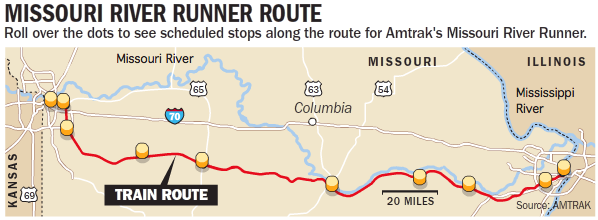 Route of Amtrak’s Missouri River Runner
Amtrak’s
Cafe Car Menus vary depending upon the region. Here in the Midwest, it seemed quite fitting that White Castle cheeseburgers were on the menu in addition to the usual sandwiches and snacks. Also available were Starbucks bottled Frappuccinos and a decent variety of beer and liquor. Beer prices ranged from $5.00 for domestic beers like Bud or Miller to $6.50 for a premium brew which today was Leinenkugel Amber. I paid $10.00 for a White Castle burger and a bottle of Jack Daniels on the rocks, which I enjoyed with my own supply of Blue Diamond smoked almonds.
Aside from the pretty scenery, the highlight of this trip came at Herman, Missouri where we boarded 200 passengers who’d spent the day participating in that town’s Oktoberfest celebrations. Prior to our arrival in Herman, the crew made an announcement essentially warning us of what to expect ~ a bunch of rowdy, beer soaked folks who’d likely be looking to continue their revelry onboard. Five Amtrak police armed with guns and tasers also boarded at Herman to keep the peace but with the exception of the occasional rebel yell, this group was lively but otherwise fine.
At St. Louis Union Station I boarded the Metro train directly from the station to the airport. An hour later I was camped out for the night in my favorite corner of the terminal building.
October 16, 2011
Delta Air Lines St. Louis – Minneapolis 800a – 930a A319-100 First Class
Delta Air Lines Minneapolis – Baltimore 1030a – 130p A319-100 Economy Class
Amtrak Baltimore – Washington DC 255p – 330p Northeast Regional Economy Class
Amtrak Washington DC – New Orleans 630p – 730p The Crescent First Class
Although St. Louis’ Lambert Field is undergoing a renovation, the main terminal building appears to have changed little since I first flew out of here on an Allegheny Airlines BAC-111 on a bitterly cold January morning back in 1977. Gone are names like TWA, Eastern and Ozark that were commonplace in the 1970s, and the old full service coffee shop located at one end of the terminal building has also disappeared but otherwise the ticket counters look exactly the same. Amidst the construction areas are a multitude of signs asking passengers to help the city “See it through”.
Down at gate A-2 awaited a shiny 8 year old A319 along with an upgrade to seat 1A for the short one hour and ten minute flight to Minneapolis. I was amongst the first to board and happily accepted a hot cup of coffee from the flight attendant. Later in the flight, a pass with the snack basket yielded a package of Biscoff cookies. Breakfast over America in the twenty-first century…
I have flown over
1400 unique routes, acquiring over 900000 miles of unduplicated route mileage. Today’s flights between St. Louis, Minneapolis and Baltimore represent two more new routes. I’ve talked with the folks over at flightmemory.com about purchasing a map of my flights but they say that with their style of map at least, I have so many different routes that the end result would not look very good.
The last time I flew into Baltimore was in April of 1988 aboard a United Airlines DC-10, the very same airplane (N1819U) that crashed and burned while attempting an emergency landing at Sioux City, Iowa on July 19, 1989. I’d begun that trip by driving from Colorado to Virginia and had just come from three nights with the Grateful Dead down at Hampton Roads Coliseum. The Dead had released their In The Dark album the year before and the band’s popularity – after having played together for twenty-three years – had suddenly grown to include mainstream America. The result was 20000 people showing up for 12000 seat venues and overflowing parking lots filled with a whole new group of tie-dye clad inebriates, many of whom were more into the party scene than they were the music.
The Dead’s founding member Jerry Garcia put it most correctly when he advised “
If you get confused, listen to the music play.” Many of the newcomers not only had no clue, they didn’t care if they got into the shows or not. There was always a party in the parking lot, much like tailgating before and during a football game. As a veteran of the Dead’s much mellower concert scene through the seventies and early eighties, the big crowds at Hampton were a sudden and unwelcome surprise. It would only get worse at the Spectrum in Philly, a city I’ve never found anything likeable about. I didn’t much care for New York’s Nassau Coliseum either, so I sold my tickets for those shows and drove up to Baltimore’s Friendship Airport. There I utilized a free ticket I’d been awarded in a promotion the summer before and flew straight to Honolulu where I spent three days in tropical bliss at a cheap hotel on Lewers Street drinking Mai Tais and smoking Marlboros at the poolside bar with the hard cores. I also took a bus to the North Shore, went swimming and acquired a sunburn. Then I flew up to Anchorage for two days of spring breakup before flying back to Baltimore where I picked up my truck and sped on up to Hartford for that night’s show.
Getting back to the present, I was most thankful for the presence of an Amtrak station just one mile from the airport terminal. A free shuttle bus runs every 12 minutes between the airport and the station, so I had plenty of time for coffee and some internet time before heading over to the station for my 2:55pm train down to Washington.
Washington D.C.’s Union Station. Oh. My. God. What a magnificent edifice! It’s everything I just wrote about Kansas City’s Union Station but bigger. Here – check out
This Site for an excellent description with photographs of the station and its history.
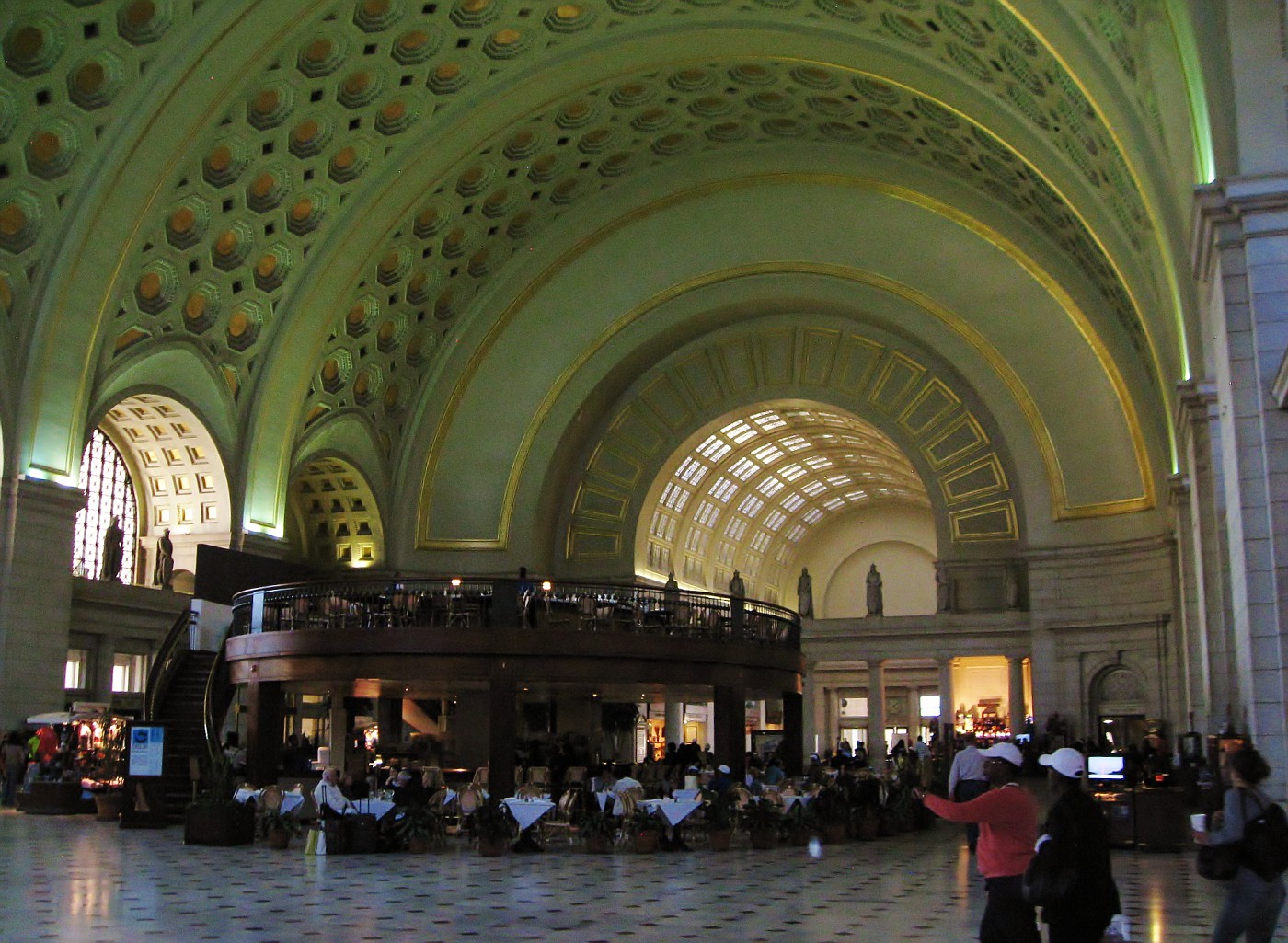 Washington DC Union Station Great Hall
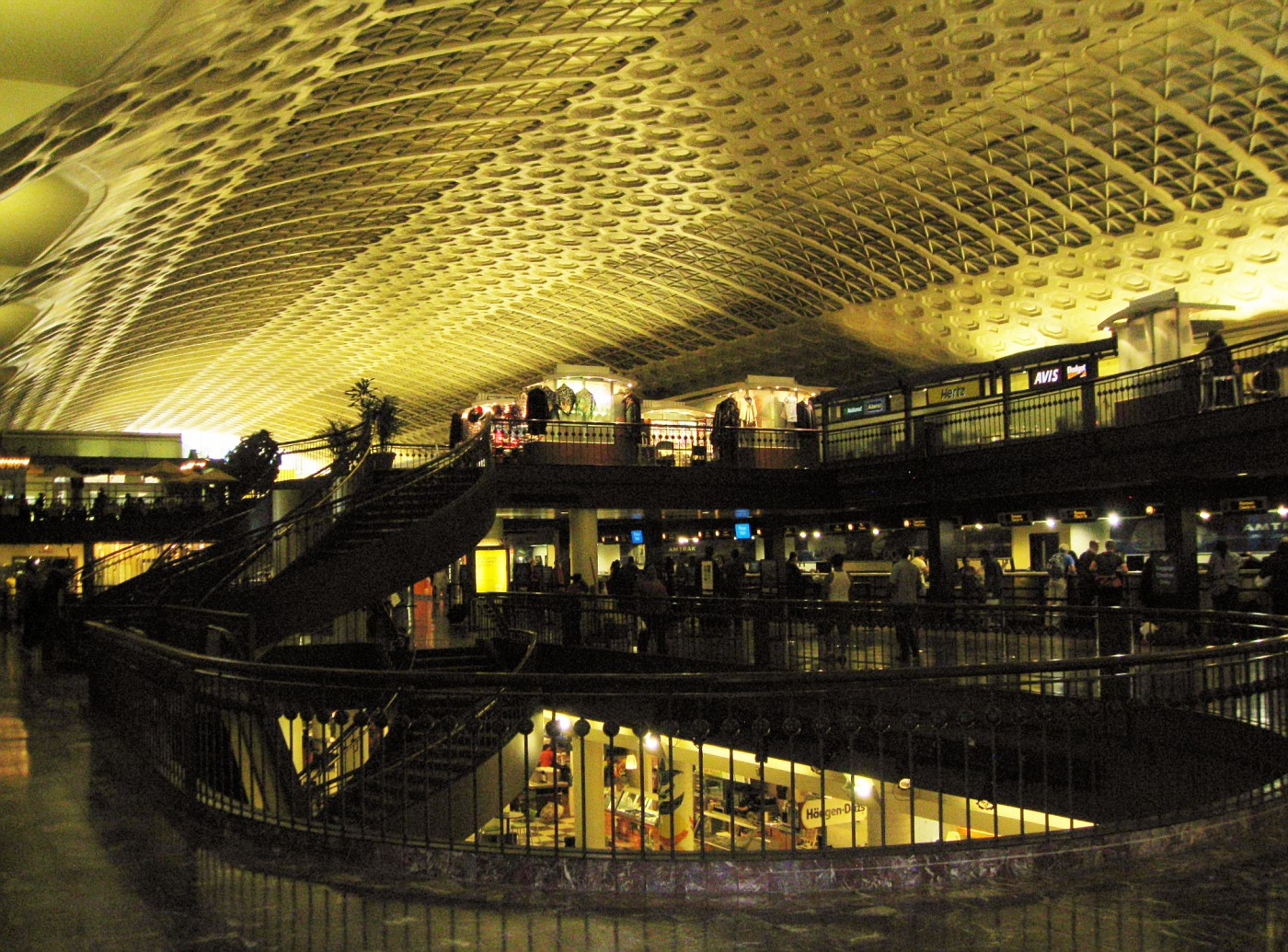 Washington DC Union Station Ticket Counters
With two and a half hours to wait until my next train,
The Crescent, was scheduled to board for New Orleans, I headed over to Amtrak’s Club Acela lounge to drop off my luggage. Reserved exclusively for First Class passengers and those traveling aboard Amtrak’s Acela trains between Washington and New York or Boston, the Club Acela is an attractive lounge befitting the station it serves. Floors of polished marble are offset by stone planters, glass partitions and brass railing. Artistic posters of historic railroad advertising adorn the walls. The seating is comfortable and overall this lounge is a pleasant place to await your train. The only shortcoming worthy of note were the refreshments which, in the afternoon at least, are limited to coffee, tea, pretzels and Goldfish crackers.
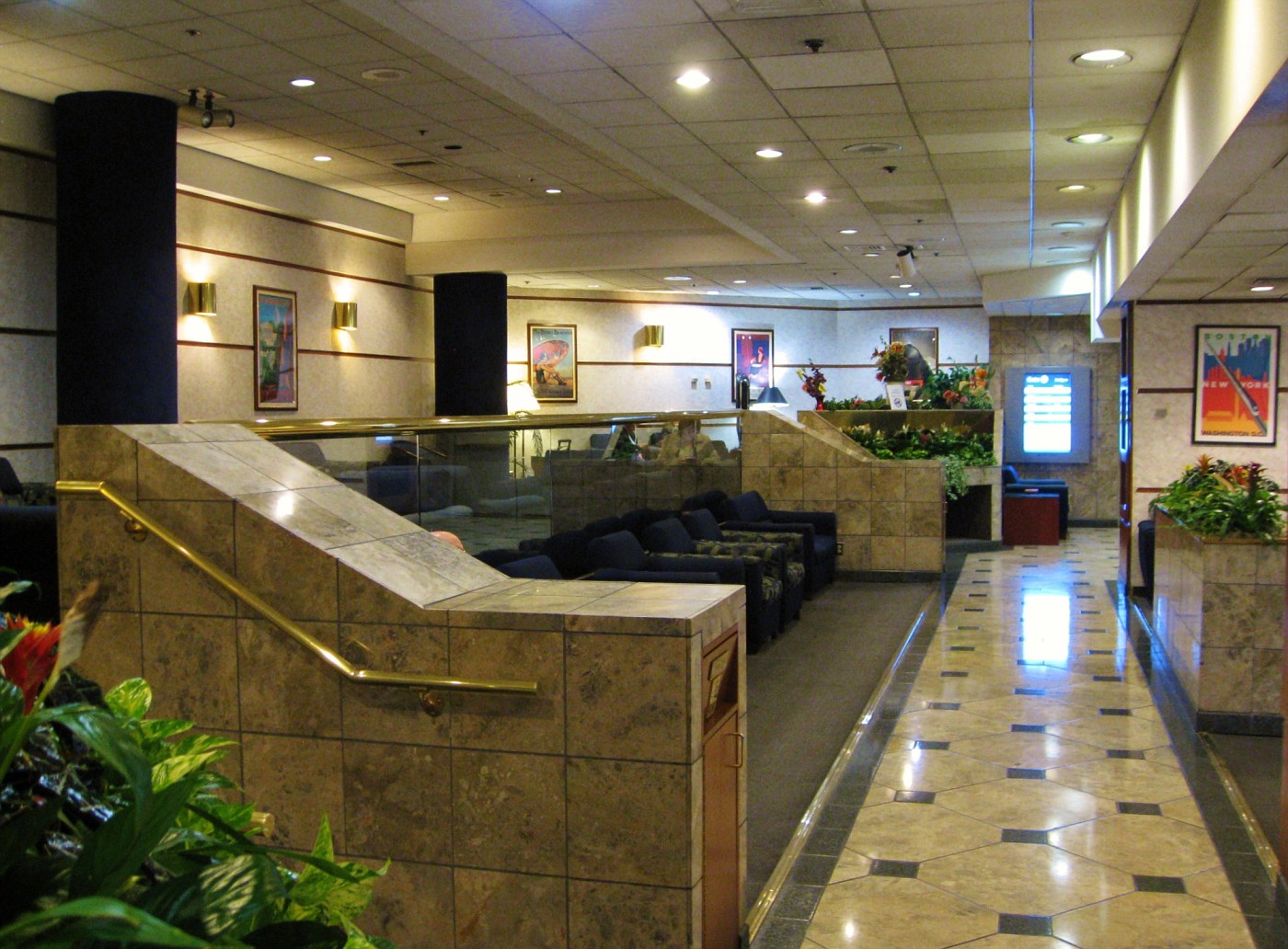 Washington DC Club Acela Lounge
Over in one corner of the lounge, a lively group of football fans was watching the televised Eagles-Redskins game. The score was close and with Philadelphia and Washington being so nearby each other geographically, the support for each team was fairly even amongst those watching the game. As a lifelong fan of the Denver Broncos, I had little interest in this NFC East battle. As a true fan of the game of football however, it was a great contest with an enthusiastic audience to boot. What better way to spend a Sunday afternoon while awaiting your train? All that was missing was good cold beer.
After the game (won by the Eagles), I headed out to have a look around the station. What a marvelous place! There were a nice variety of upscale shops along with a couple of nice looking restaurants on the upper level. Taking the escalator down to the lower level, I discovered one of the finest food courts I’ve ever seen – certainly the nicest I’d seen in an airport or train station. There must’ve been over twenty concessions down there, serving everything from Jamaican to Indian to Italian to Cajun. Further exploration revealed a liquor store that looked to be quite well stocked. As it was Sunday however, it was closed and I was unable to buy any beer for the long ride down to New Orleans.
Back in the Club Acela, boarding for the southbound
Crescent was announced at 6:10pm. Passengers were instructed to gather at the east exit from the lounge where an Amtrak porter then led us out to the waiting train. An electric cart was available for those passengers requiring assistance.
The
Crescent begins its journey at New York’s Penn Station, so there were already a fair number of passengers already onboard the train by the time we arrived. The consist this evening included one baggage car, two Viewliner sleepers, a dining car, a café/lounge car and four Amfleet coaches. My sleeper was named “Winter View” and was located directly behind the baggage car. As I approached the steps up into the car, I was greeted and welcomed aboard by my car attendant, Henry, who relieved me of my bag and showed me to my accommodations, roomette #2.
Although I have ridden Amtrak’s
Crescenton two prior occasions, I booked it for this trip because I’d yet to ride in First Class sleeper accommodations aboard Amtrak’s View-Liner equipment which is used only on eastern routes. Bi-Level Superliner equipment is used aboard all long distance trains operating west and south of Chicago. Superliner equipment is not used back east because the overpasses and tunnels are not high enough to accommodate the cars. The one exception to that is the Capitol Limited which runs on the old B&O line between Chicago and Washington DC,
I booked my accommodations back in August and purchased a roomette down to New Orleans for just $265.00 all in. Roomettes are perfect for one person and, because they have a drop down upper bunk, suitable for two. Amtrak has an excellent page describing their Viewliner Roomette right
HERE. Check it out!
Once everyone had boarded, Henry stopped by each room to take dinner reservations. Because this evening’s train was heavily booked, he recommended eating sooner rather than later as some of the more popular entrée items, such as the New York Steak, tend to sell out later in the evening. I took Henry’s advice and made a 7:15pm dinner reservation. I was handed a small card indicating the reservation time, and then settled into the large padded seat in my roomette and watched as we rolled out of the station and glided south through Washington’s suburbs and into Virginia.
It’s a twenty-six hour, 1,150 mile journey from Washington DC down to New Orleans. If you’re in a hurry, take a plane. Traveling by train, especially if you’ve purchased sleeper accommodations, is a great way to enjoy seeing the country you’re traveling through rather than over while enjoying a comfortable seat in spacious accommodations. The pace is relaxed and there’ll be plenty of opportunity to share the excitement of it all with your fellow travelers while sitting down over a nice meal in the diner or enjoying drinks and conversation in the lounge car.
My reverie was interrupted by the call to dinner for those with 7:15pm dinner reservations. Sleeping car passengers are never more than a car or two away from the diner, so moments later I presented myself to the dining car steward who assigned me to a table for four. Soon I was joined by Eddie and Fiona, a middle aged couple from England who’d spent the past week in New England enjoying the fall foliage. Now they were headed south to visit friends in Birmingham, Alabama before continuing on to New Orleans later in the week.
Menus had already been placed at each table and so we took a moment to consider the choices. Soon our waiter stopped by, noted our room and car numbers, and then asked if we’d care for anything to drink with dinner. Red and white wine for my dinner companions and a Jack Daniels on the rocks for me please. As for dinner, let’s check out
the menu. (Be sure to click on
Crescent Dining Car Menu)
Eddie and I opted for the New York steak with baked potato while Fiona chose the half roasted chicken. Salad and rolls were delivered first. The salads were nothing special, just some salad greens and a couple of cherry tomatoes. A wicker basket in the center of the table held a variety of Paul Newman brand salad dressings and I would have to say my Balsamic Vinaigrette was the highlight of the salad. C’mon, Amtrak ~ at least throw in some shredded carrots and cabbage!
The steaks were actually pretty good – mine was perfectly medium rare and the baked potato was hot and tender. Fiona’s chicken was on the small side but otherwise looked quite nice. She liked it just fine and I decided I would order it tomorrow night. Although there was a choice of two or three desserts, we all chose the apple pie a la mode. The pie was nicely warmed and the ice cream was soft but cold. Delicious!
Afterwards, we retired to the lounge car for another round of drinks and a bit of train talk. Fiona commuted to work each day on a train but this was her first long distance trip. Both her and Eddie were impressed with their accommodations as well as the fare, which was a far sight lower than the price they’d have paid for a trip of similar distance and accommodations in Europe.
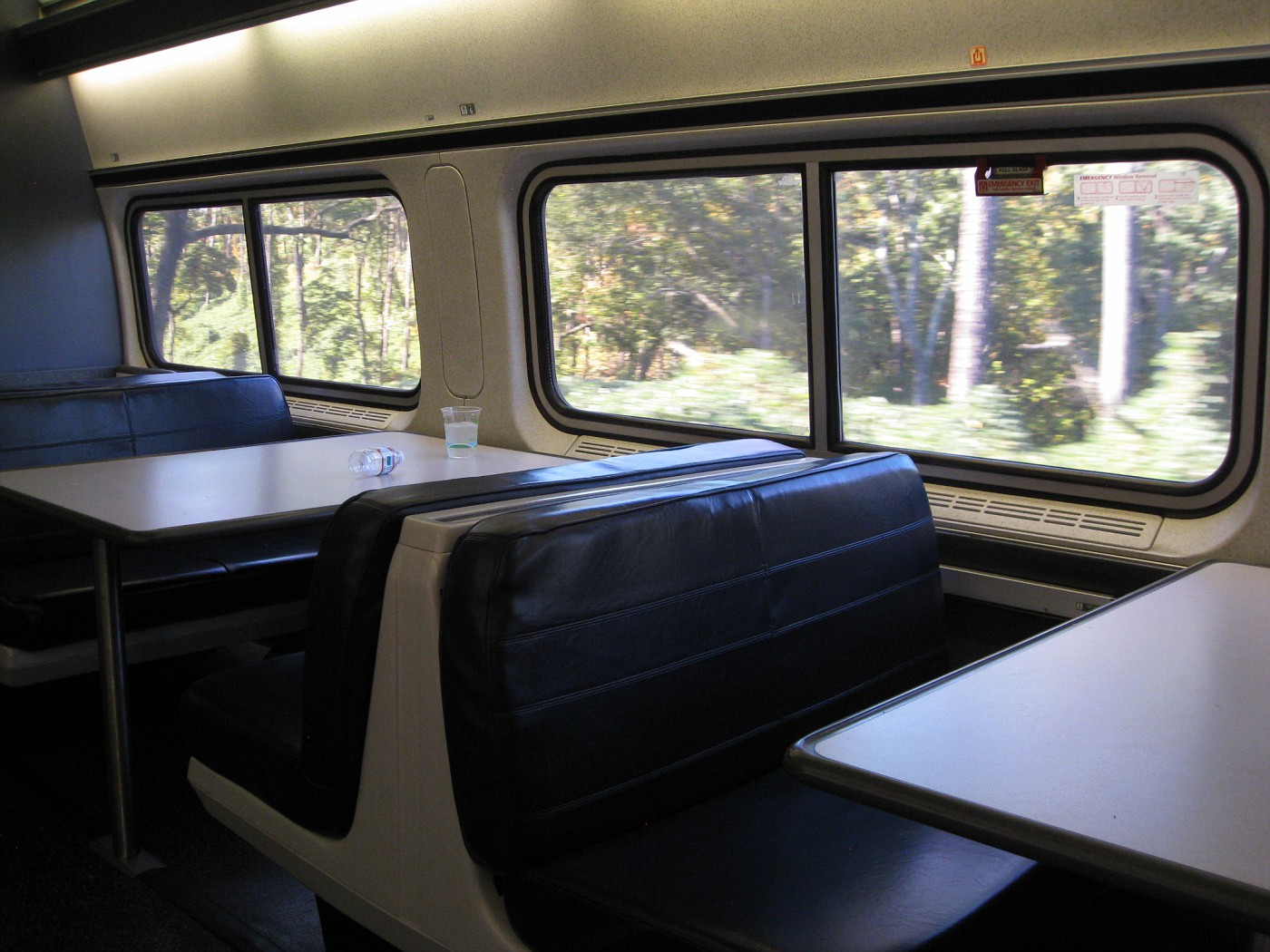 Crescent Lounge Car Seating
How true! Amtrak is one of the best travel bargains in the western world for long distance First Class train travel. A trip of this length in Australia would cost you close to $1000.00, and probably not too far off that in Europe, especially if you had private accommodations.
It was about 10:30pm when we called it a night and returned to our sleepers. I was pleasantly surprised to find that Henry had already converted my roomette into nighttime mode, with the bed made up, the night light on and a little square of Amtrak chocolate on my pillow. I read for about an hour before finally succumbing to the gentle rhythm of the rails.
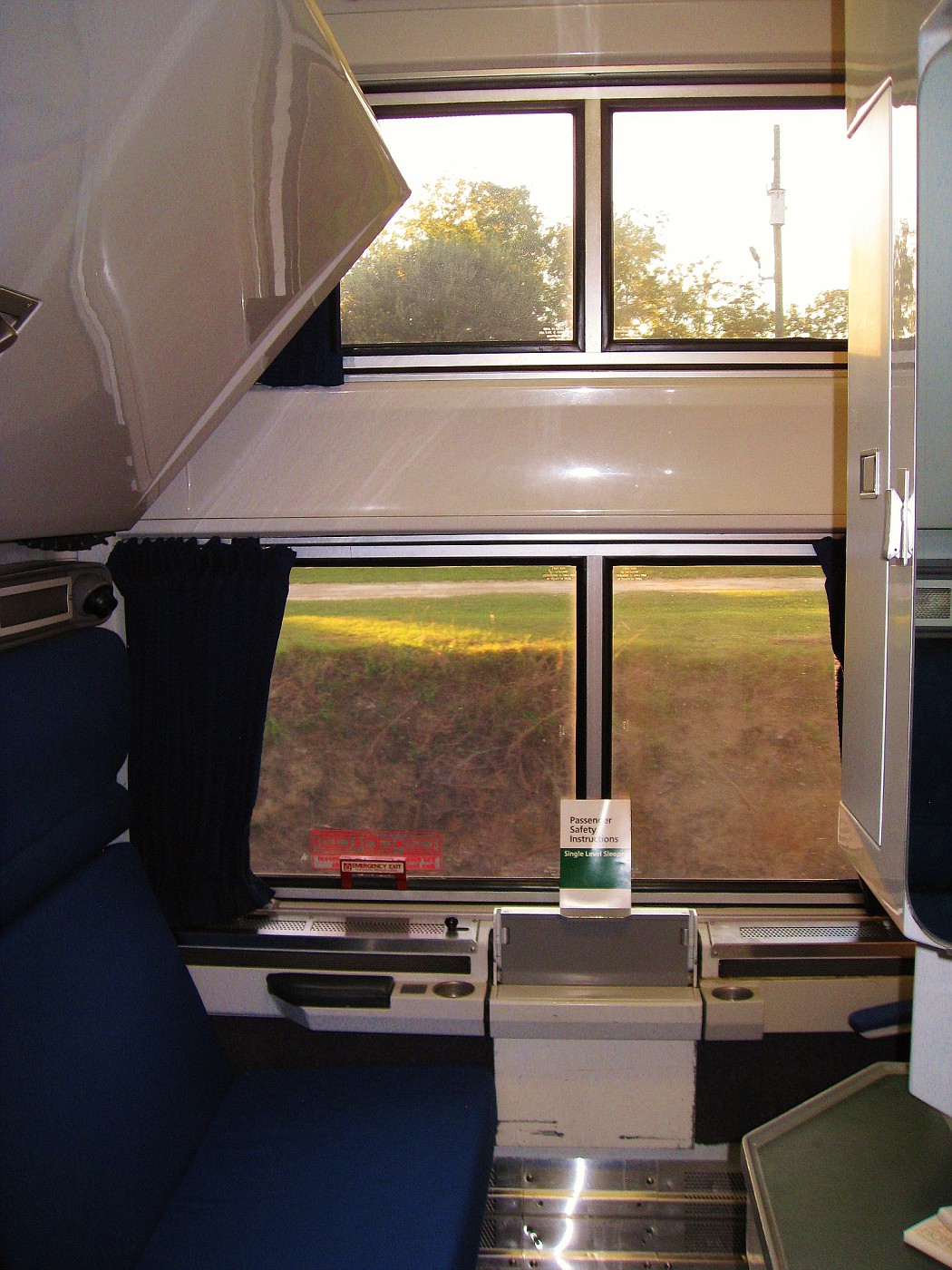 Crescent ViewLiner Bedroom
When I awoke, we were just departing from Atlanta’s Peachtree Station. It was almost 9:00am local time! Worried that I might have slept through breakfast, I quickly threw on some clothes, drug a brush through my hair and a razor over my face and then hurried up to the diner, pausing only to grab that morning’s copy of USA Today that had been placed under my door during the stop in Atlanta.
“Yes, sir!” said the dining car steward. There was still time to enjoy a full breakfast. And so I did, ordering the vegetable omelet with a side of chicken apple-maple sausage. Being as we were traveling through the Deep South, I reckoned I’d better accompany that omelet with grits and a biscuit. Since most of the passengers had already eaten, I had a table completely to myself. Coffee and orange juice were delivered in abundance and I dined like Southern gentry while perusing the news of the nation as only USA Today can present it.
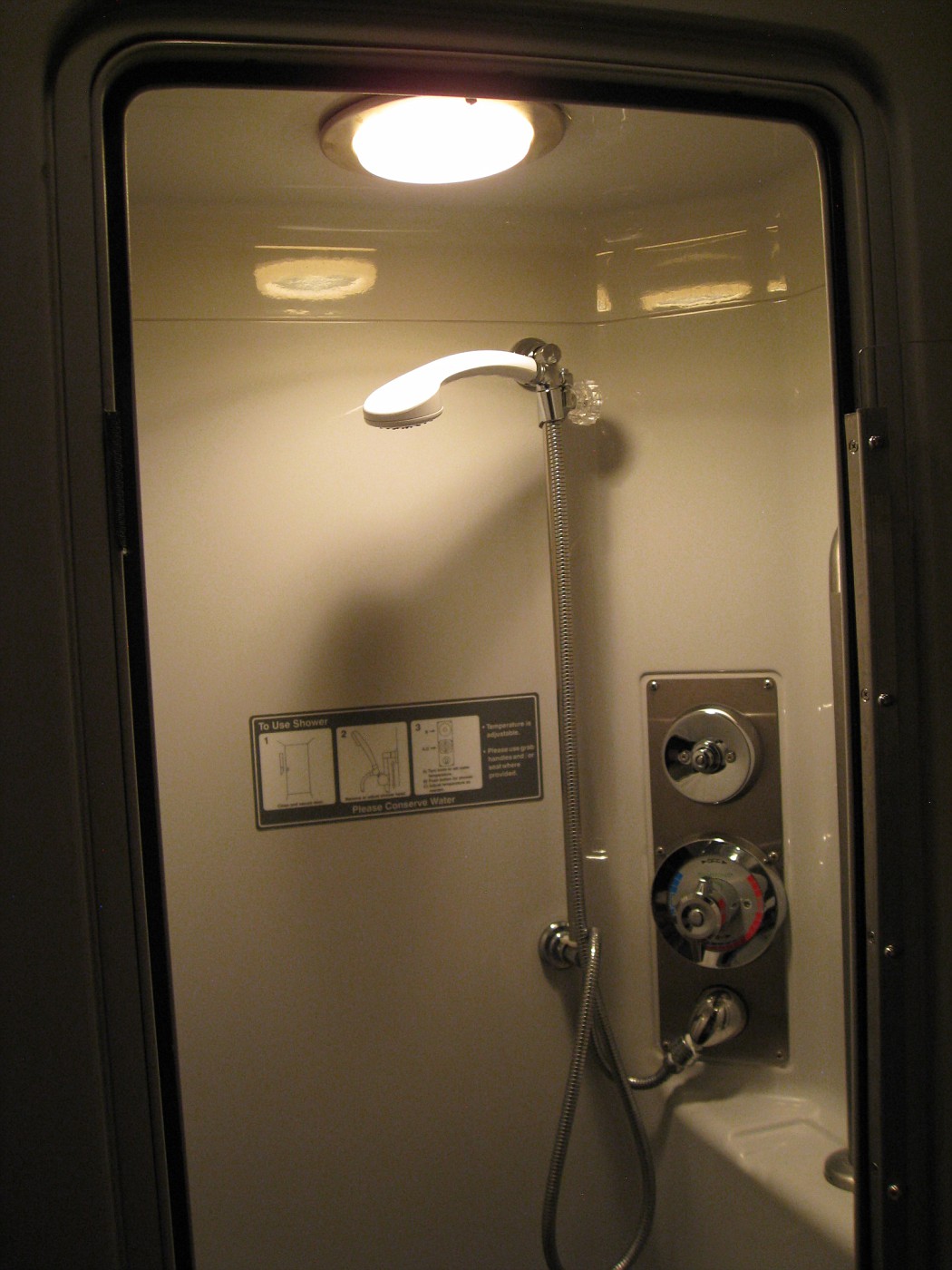 Crescent Shower
After showering, I spent the remainder of the morning catching up on this trip report, pausing occasionally to watch as Georgia and Alabama sped by. The twelve hour ride between Atlanta and New Orleans is pretty though hardly scenic. For the most part the landscape consisted of heavily forested low rolling hills, their monotony broken up by the occasional road or small town. During a break for lunch, I discovered that the diner upon which we were riding was built in 1950 and once served the Southern Pacific Railroad. One of my tablemates, Steve, was what railroad folks like to call a “Foamer”, as in one who’s so excited about railroadiana that they practically foam at the mouth. I’ve met a few foamers in my time and Steve was a bit more laid back than most though he did have an Amtrak equipment roster with him which enabled him to discern the heritage of our 61 year old diner.
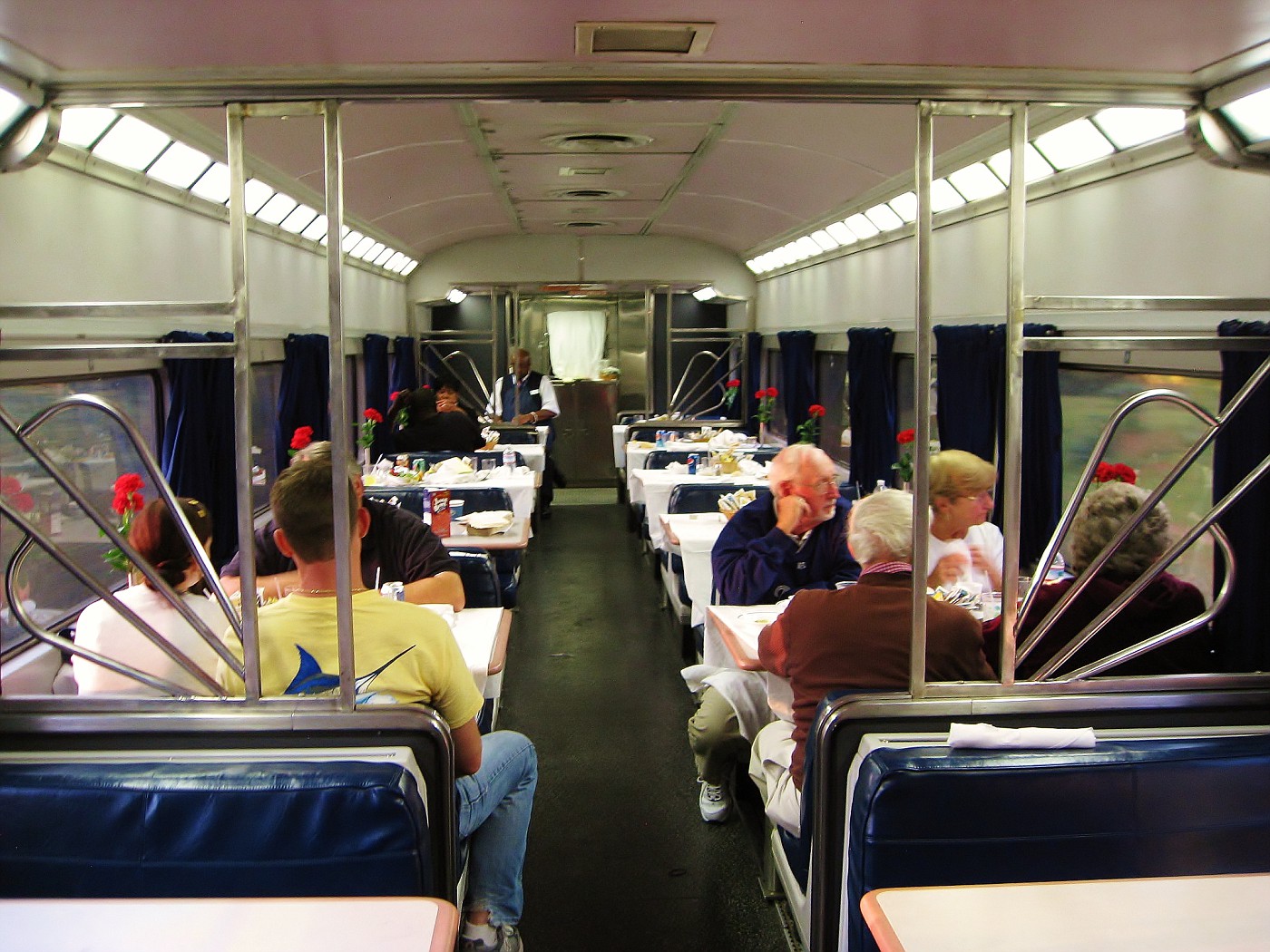 Crescent Dining Car
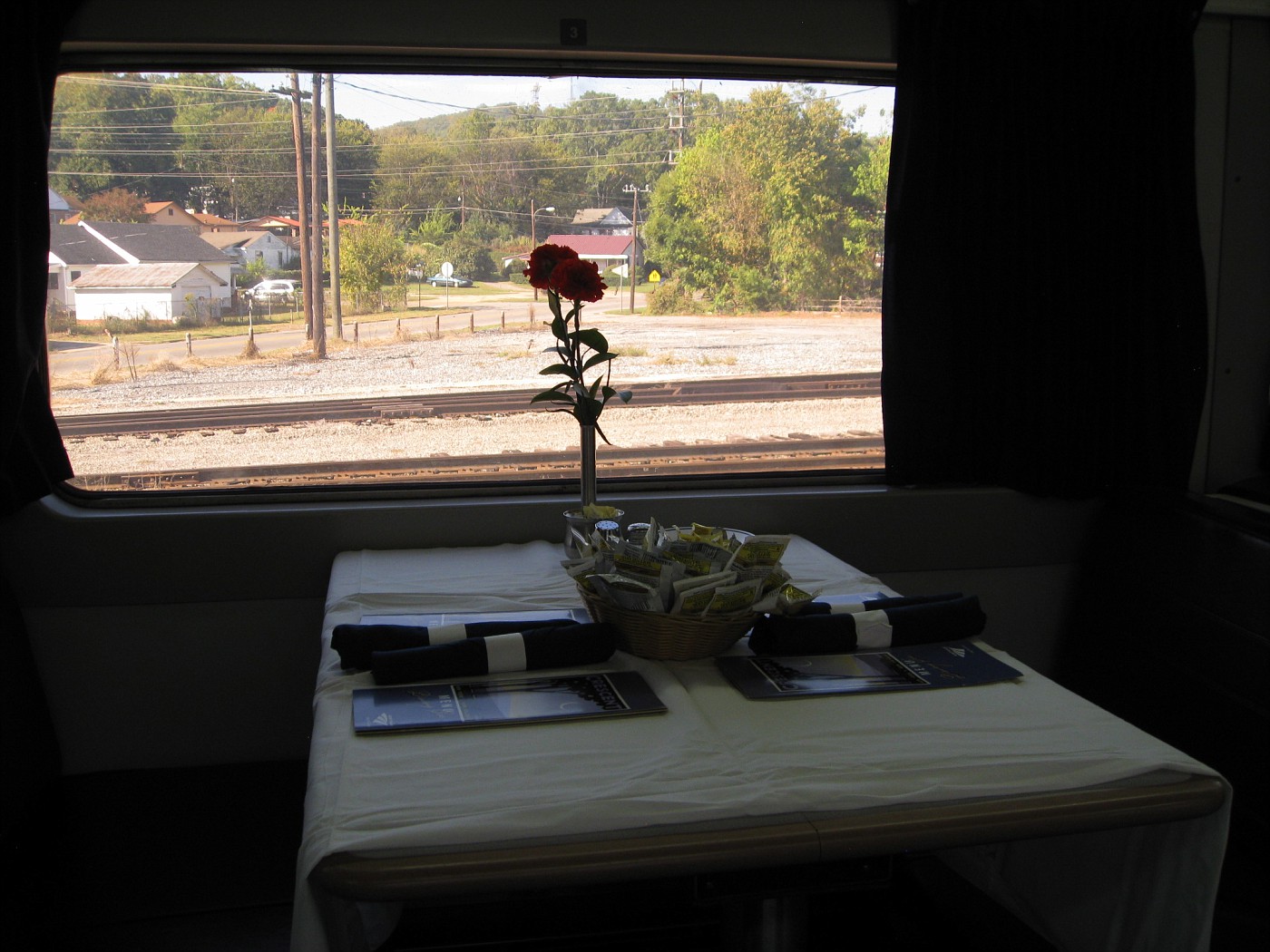 Crescent Dining Table
Time flew by quickly as we sped through rural Mississippi at speeds approaching 70 mph. In Meridian, Mississippi was a beautifully restored train depot, one of several that we’d stopped at since departing Washington. The sun was just setting by the time we rolled through Slidell, Louisiana and onto the 7-mile trestle over Lake Pontchartrain. The trestle is quite narrow and has no railing, so looking out the window it was impossible to see any part of the track or bridge, only water.
The train slowed considerably as we entered the suburbs of New Orleans. Eventually we came to a stop and then slowly backed into the New Orleans terminal, just as they do in Chicago. A glance at my watch indicated that we were only five minutes late by them time we’d finally reached the station platform. Alighting from the train into the muggy New Orleans night, I thanked Henry with a ten spot for a job well done and hurried into the blissfully air-conditioned station.
The New Orleans Union Passenger Terminal serves both Amtrak and Greyhound. While nicely functional, it would hardly be considered an architectural marvel. Inside there is a gift shop, a food court area featuring a Subway sandwich concession and a few electronic games like Pac Man for those so inclined. Once, after eating a few shrooms, I blew up a Pac Man machine with over 700000 points and counting. I was in a serious groove with a couple men to spare when the electronic screen on the board just exploded on me! Bummer... I have no doubt I’d have cleared one million. Interestingly, uniformed NOPD officers were posted at both entrances to the station, probably a good idea given the seediness of the area and the behavioral shortcomings occasionally exhibited amongst those who ride Greyhound.
I was surprised to find that it was not possible to travel between the station and the airport via city bus. Indeed, the cop I spoke with laughed at the very notion of such silliness. Taxi was the only option, he said. The cost would be about $35.00. The Amtrak agent on duty reiterated this, but I asked to see the phone book anyway. In the yellow pages, under Airport Transportation, was a business called Airport Shuttle Co. I called them and was quoted a one way rate of $20.00. Book it, Dano! I was informed that it would be about an hour before they could pick me up at the station, but the Monday Night Football game between the Jets and Dolphins proved sufficiently entertaining as to render the long wait quite bearable.
After a bit of reconnaissance at the airport, I discovered that the A Concourse had been closed for renovation, so I found a nice dark hollow nearby where I spent a comfortable night atop my Thermarest pad. Airport sleeping doesn’t get much better.