3 May Back in the Pays Basque
Driving around Bearn and the Pays Basque, we noticed a lot of light cream-coloured and somewhat small cows. It didn't take us long to find marketing information for the Blonde d'Aquitaines (which appear to have a following in N. America) which is protected by AOC like the Bresse Chicken.

A blonde of Aquitaine
The weather had been overcast but as we climbed the valley towards Larrau, the weather cleared with bright blue skies so we could see the rugged peaks of the Pyrenees. I had to stop for lunch again at Etchemaite so we made reservations while we went up a bit further to explore.
Settling in for lunch, I ordered a make-your-own prix fixe menu while the PoA chose a 2 courser. Recoqnizing us from our Friday visit (the restaurant gets a lot of repeat customers), we were waiting for my first course when the maitresse brought us 2 plates with a rather large slab of cold meat loaf/terrine arranged with some vegetables. We alerted them that we did not order them but we were told it was a comp amuse guele. It certainly just wasn't a mouthful and would be considered a light meal by many). I ordered the beef which I was assured was from a Blonde d'Aquitaine. I will say that the meat was very tender and delicate, and non-fibrous, but there wasn't much flavour. If you ever wanted to make a beef schnitzel, this would be the beef to use.
The first time I ate at Etchemaite, they were serving whole trout sautéed in olive oil, garlic and jambon de Bayonne. Wonderfully delicious. After lunch, I talked to the chef de cuisine and asked him why this wonderful dish isn’t on the menu (there are certainly enough trout farms to supply him). I makes whatever I feel like, he said.
While the Pyrenees aren't any more or less rugged than mountains in western N. America, what makes them different is how accessible they are. You find paved roads (perhaps small, steep and very narrow) everywhere. I could imagine designing torturous race courses for road bikers here.
It was apparently already vacation time here so we couldn’t find any accommodation in our Routard guide unless we went to Tosse in Landes. Landes is part of that low sandy land SW of Bordeaux. It was essentially a sand wasteland most unsuitable for agriculture but Napoleon had the idea of planting most of the entire area with pine and he did it. From that start, the region now produces over 1/3 of France’s wood. Any wooden case that holds your Bordeaux wine was probably from Landes timber.
Tosse and the coastal stretch of Landes has become a French retirement haven with lots of relatively newly-built developments which would make one think they were in suburban Australia. The food in these tourist-oriented towns is often disappointing and we were disappointed that we did find disappointing food.
Regional food and specialties
I’m not sure if it’s my lack of fluency in Spanish but I get the impression the French side has many more food specialties in a much smaller area. Not just the Blonde d’Aquitaine (not uniquely Basque), but also piment peppers from Ezpeleta (Espelette), Jambon de Bayonne – Baiona (from a unique breed of Basque pig), dark cherries from Itsasu (Itxassou). The region even has its own AOC wine Irulegi (Irouleguy). Gateau Basque, an almond tart filled with either cream or Itsasu cherries, seems to be made only on this side of the Pyrenees. The Basque also used to go after baby eels that came in from the Sargasso sea but they’ve been almost fished out. The small Atlantic mussels here are a specialty. They are small and delicious – something the PoA who doesn’t like shelled mollusc in general actually relishes. Some Basque dishes include piperade which is an omelette featuring piment and sweet peppers, Marmitako – a tune stew, Poulet basqueais – a self-descriptive stew, and Ttoro – a really flavourful fish/seafood stew (served with lots of garlic toast). Before I forget, there’s the sheep cheese / fromage de brebi often sold as Ossau Iraty AC (as well as some trade name). The milk has to be from the black-faced sheep.
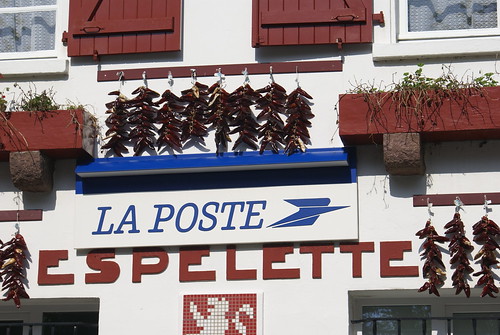
One of the prettiest post office in France?
Experience with the French Medical system
A clogged eustachion tube led to an ear infection. Pharmacies were unable to offer anything other than a saline nasal spray (the French seem to be really into this, and it does work) but I needed real medical attention. Driving to Baiona, I found a pharmacy who referred me to a Medicin up the road. It wasn’t a long wait fortunately and most surprisingly, the consultation and prescription costed a mere €22 which the medicin collected in cash.
Armed with my prescription (saline nasal spray, oral antibiotics and a liquid antibiotic administered directly into the ear), we went off to explore Baiona which is said to be where the bayonet was invented. The town is divided in Bayonne and Petit Bayonne depending on which side of the Errobi (Nive) river you’re on. Petit Bayonne is a charming example of a high density Basque town. One highlight of Bayonne is the cathedral. A feature common to most Basque churches is that they have galleries above the main floor, often at least two levels, to fit in more parishioners.

Petit Bayonne
We decided to stay in the town of Azkaine (Ascain) for the next 3 nights in a typical Basque farmhouse. This particular property had been in the same family for hundreds of years (some old farms are said to be occupied by the same family for millennia). There aren’t too many old houses though as the Basque are fastidious and will rebuilt their farmhouses and churches every few centuries. This particular family built a new house in the 19th century but did not demolish the old house (which was either 16th or 14th century). The old house had been used as a barn was in the process of being renovated for occupation by the daughter and her young family.

Older Basque farmhouse (either 400 or 600 years old) typical throughout most of Euskadi

The immediately adjacent newer (18th century) farmhouse. One's Labourd and one's Navarra style. I forget which is which.
Our excursions included the formerly-glamorous resort of Miarritze (Biarritz) which still has wonderful old hotels and promenades, as well as the old town. It’s certainly worth walking around the beach front old quarter if you have the time. Donibane Lohizune (St. Jean de Luz – it means mud and not light) also has a promenade and an old harbour still used by fisherman.

How the beach at Biarritz is groomed

Biarritz from a promenade viewpoint
There are said to be some wonderful seafood restaurants along the coastal road between Ziburu (Cibourre) and the frontier town of Hendaia (Hendaye). We settled for a seafood restaurant – popular with the locals – in some residential street in Ziburu where the Ttoro is one of the specialties.
For one of our lunches, we stopped in at
Les tables de les Freres Ibarboure, one of the local destination restaurants. The family has run this one Michelin star restaurant (and also a hotel). On my first visit here a decade ago, I was looking for the restaurant when I found very helpful white on brown road sign (the French do have their priorities right here) with the restaurant’s name on it, which took me down some country road, under a one-lane tunnel under a railway track with a blind corner, over a highway and then some obscure and winding country lane to the restaurant. I also learnt that I should know more menu terms. Ordering ris d’agneau, I was expecting something lamby. It certainly was, and delicious, but took a bit of getting used to this delicacy.
The wait staff here are wonderful and friendly. One specialty of the restaurant is the chocolate degustation for dessert (highly recommended). At €15, it’s almost half the small prix fixe menu price and only available on the a la carte menu but the staff made a substitution (has to be ordered when they take your lunch order) for us, at a very small supplement. We did notice that those who ordered an aperitif received a small plate of canapés while those who had a dessert drink got petit fours. The amuse guele here was an assortment of molluscs on a foamy savoury bed. Lunch for two with a bottle of wine, the supplement and coffee was surprisingly affordable – not much more than a good dinner for two in YVR. The menu I’ll have in the future would be the degustation though. For those considering staying at the hotel, it would appear that guests who have board get to choose from an apparently small and possibly limited menu.
The PoA had Gateau Basque 3x in less than 6 days. The best was at some restaurant in Donibane Lohizune where she had the paella with the (for her) wonderful small mussels. Somewhere in the middle and nowhere near as good was at the bakery featured in Kurlansky’s book in Senpere (St. Pee du Nivelle) and the worse being the pastry offered at breakfast at our chambers d’hote one morning. I’ve noticed that bakery standards have been slipping in France and going to an artisanal patisserie or boulangerie does not guarantee you’ll get a real croissant and not just some bready semblance instead. Same with the Gateau Basque that had a very hard an inedible crust.
Other than berets and espadrilles (the former is made in Bearn and the latter – well it’s hard to find authentic ones with rope soles these days), the fashion every Basque man needs is a makhila. It’s a short walking stick or baton – said to have originated as a shepherd’s staff that every old man needs. It’s short but heavy enough to take someone down, and also has a nice point to it, on both ends. One family, the
Anciart-Bergaras in Larresoco has been making them for 6 generations, and a frequent patron is the French government which buys them as gifts for foreign dignitaries.

Monsieur Gracy and his and his father's makhilas in his left hand. His father was given the silver one by the local government in 1955. M. Gracy received his in the early '90s. That kid isn't one of the progeny, but could well have been that of
this woman.
One thing I've noticed that's new in France is the preponderance of RVs. I recall hardly seeing any 10 years ago but there seems to have been a boom in their numbers. Though smaller in size than their N. American counterparts, they still take up a lot of room on small French roads, are slow and their drivers are no less inconsiderate and clueless than some or many of the morons you see driving them in N. America.
Between Ascain and Sare is Le Petit Train de La Rhune, a cog railway that takes you up the the northwesternmost peak of the Pyrenees at some 700m. We had passed it earlier in the week but saw a warning light stating that it was cloudy with no visibility up top. Seeing that it was clear the previous night and gloriously sunny that morning, we headed to the station
where a sizable crowd was already there. Getting our tickets, we rushed the train, only to find ourselves on the second train. On a single track up to 3 trains are operated at one time with a switch at the middle for opposing direction trains to pas each other. Following the 1st train by some 90 seconds, we appreciated the steepness of the climb, which some hikers were
walking. Passing many pottoks along the way, we got to the top where there was a sizeable crowd. The peak straddled the French-Spanish border with the cafe (and road down) being on the Spanish side. Hiking down is an option and a downhill mountain biker would be spoilt for choice of downhill single track.

At the summit of La Rhune
Our friend who was starting his pilgrimage that day was scheduled to depart Donibane Garuzi. Taking a small back road, we drove along where the pilgrimage trail (some 8km straight up) and road met. He wasn't there and we later learnt that we were on the 2nd day trail for many (it's that steep). When we crossed from Spain into France, we passed a site called Urkulu. It's high up on a peak and is a circular tower base built of well-cut stone. No one knows who built it but they must have spent a lot of time and effort. It is said to resemble a Roman victory tower but there's no record of the Romans ever building it there. The Basque have no legends about it and the name isn't a Basque one. It's also a steep rugged trail up unless you chose to follow the zigzagging livestock trail.

Gate of Spain at Donibane Garuzi - passed through by hundreds of thousands, if not millions, of pilgrims.

Urkulu is up there. You can see the stone ring on the peak crest.

Cave used as a paddock on the crest of the Pyrenees