Hey, everyone.
I have observed different airport layouts and passenger flows in the past years and noticed a few differences between airports in North America and Brazil. As I have been only to Canada, the US and Brazil, I'm curious to learn how it works in other countries. First I will state my perceptions, then I will post some pictures to illustrate what I mean and lastly I will put some questions. Please note that these are general perceptions and there may be actual variation from one airport to another.
United States (most airports):
Arrivals: DOMESTIC passengers walk out the aircraft through a jetway, which leads straight to the concourse. Connecting passengers go from gate to gate and don't have to go through sterile corridors. Passengers who have arrived in their final destination follow the signs to baggage claim/ground transportation and can access retail stores available in the concourse. Baggage claim area is usually open to non-passengers, so they can meet up with arriving passengers.
INTERNATIONAL arriving passengers walk out through the jetway, which leads to a small room with an elevator and escalators. All passengers have to go up one level and walk through a secure sterile section of corridors, which leads to the immigration booths. After that, passengers go down two levels, claim their luggage and clear customs. Connecting passengers leave their luggage on the baggage recheck desk, which is located near the custom desks.
Departures: BOARDING passengers access the jetway straight from the concourse and international and domestic passengers mingle, since there's no passport control for departing passengers.
Canada (major aiports only)
Works pretty much like US airports, but they do have passport control for international departures. There are also US pre-clearance facilities, which means that US-bound passengers clear immigration and customs before leaving Canada.
Brazil (major aiports only)
Arrivals: DOMESTIC passengers walk out the airplane through jetways, which lead to a main sterile corridor, located between the gates and the jetways. All passengers have to walk all the way to the end of that corridor, where they can choose to go down one level to baggage claim or re-enter the gate area through the transfers desk, for connecting flights. Passengers who have arrived in their final destination cannot buy anything from the concourse merchants, since retail stores are not accessible from the sterile corridor. Baggage claim area is restricted to passengers and is not open for non-passengers.
INTERNATIONAL passengers walk out the plane to the same sterile corridor located between the jetways and the gates and have to walk all the way to the other end of the terminal, where international connecting passengers have to
clear security to access the gates and passengers whose final destination is Brazil have to
go down one level and clear immigration. After that, they claim their bags and clear customs, which is located on the same level as immigration. Connecting passengers have to walk out the baggage claim area and find the airlines desks to recheck their luggage.
Departures: boarding passengers have to walk across the sterile corridor to access the jetways and eventually boarding passengers will interrupt the flow of arriving passengers or vice-versa. INTERNATIONAL passengers departing have to go through passport control booths and don't mingle with domestic departing passengers.
PICTURES
Gate G12 in MSP (United States). Note (on the left) how the jetway ends directly in the concourse and it is not separated from the gate.
 © StreetView 2009
Sterile corridor in CNF (Brazil). Note the gates on the left and the jetways on the right.
© StreetView 2009
Sterile corridor in CNF (Brazil). Note the gates on the left and the jetways on the right.
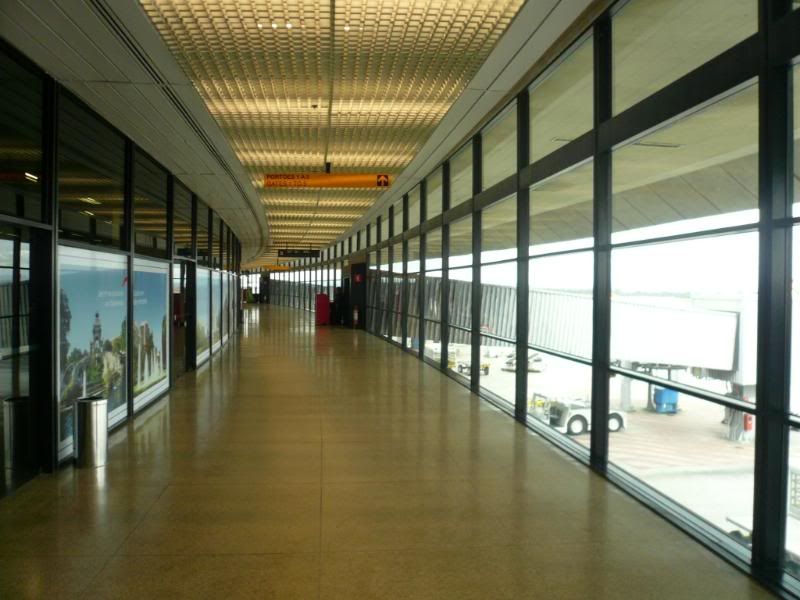 © docpepz http://www.airliners.net/aviation-fo...d.main/154634/
Gates 24 and 24A in GRU (Brazil). Note how the gate is not directly connected to the jetways and there is a glass separation between them.
 © StreetView 2009
QUESTIONS
How is it in your country, guys? Is it more like it works in the US or it looks more like Brazil? Pictures are very much appreciated.
For those who travel the most, which model do you think works best and which one is more common?
By the way, before anyone suggests that the model used in Brazil is this way because of the time when those terminals were built, I did some research and it turns out that most of the terminals in which that model has been adopted were built (or remodeled) less than 15 years ago.