Day Twenty-Five
Alaska Marine Highway First Class ~ M.V. Columbia ~ Ketchikan, AK to Juneau, AK ~ 200p – 915a +1
After a good night’s sleep, I awoke to considerably better conditions than the night before. A mixture of sun and clouds brightened the day outside and I was thankful that I had not completely closed my curtains the night before. I’d slept in until almost 10:00am local time and so had only about an hour to enjoy a shower and a cup of in-room coffee before checking out and catching the local city transit bus downtown.
One of Ketchikan’s more noted attractions is the famous Creek Street. The street is actually a boardwalk mounted on stilts set on a high slope along the east side of Ketchikan Creek. Built in 1903, Creek Street was originally home to Ketchikan’s Red Light District. That activity was banned in 1954 and Creek Street is now home to a number of quaint shops and restaurants. I paused on a bridge over the creek to take a picture, and then continued on to the entrance to the funicular that ascends 130 feet up the mountain to the Cape Fox Lodge.
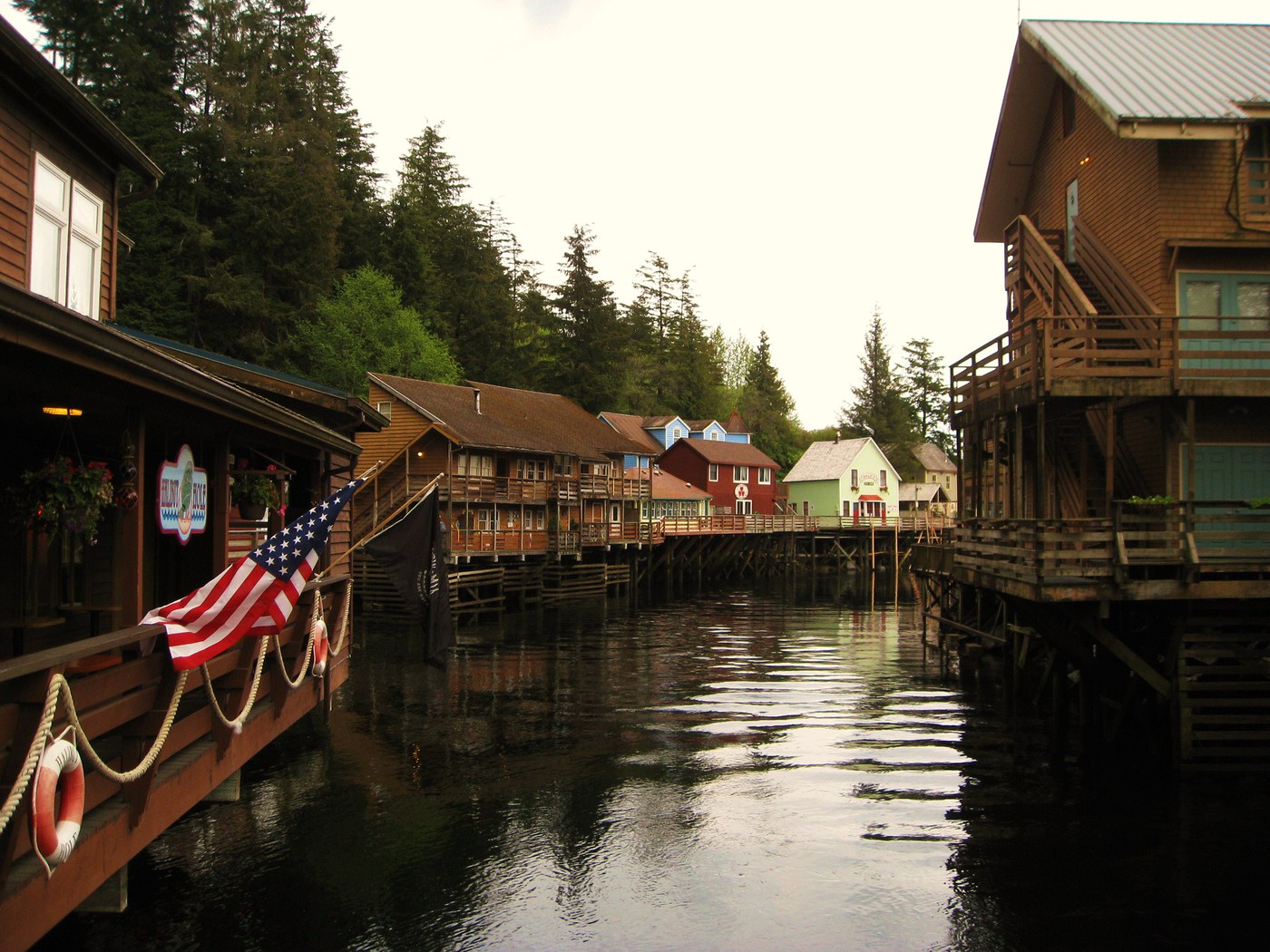 Ketchikan’s famous Creek Street
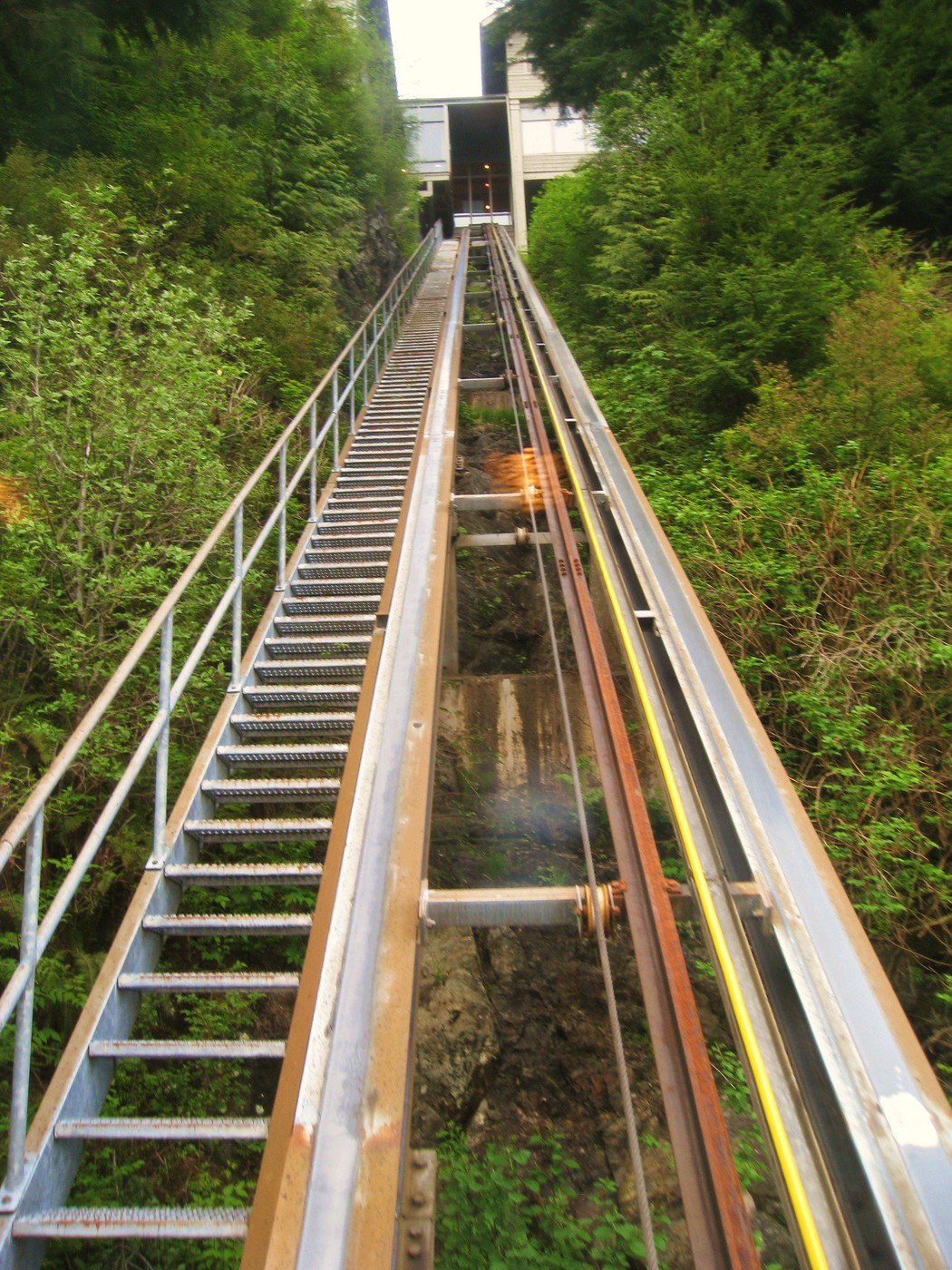 The funicular up to Cape Fox Lodge
I don’t recall exactly when I first discovered the Cape Fox Lodge but I’m thankful I did. The Heen Kahidi Restaurant offers a rustic Pacific Northwest ambience with large picture windows providing a spectacular view of Ketchikan and the Tongass Narrows below. The menu is affordably priced and fond memories of the Halibut & Pesto Flatbread Sandwich linger with me to this day.
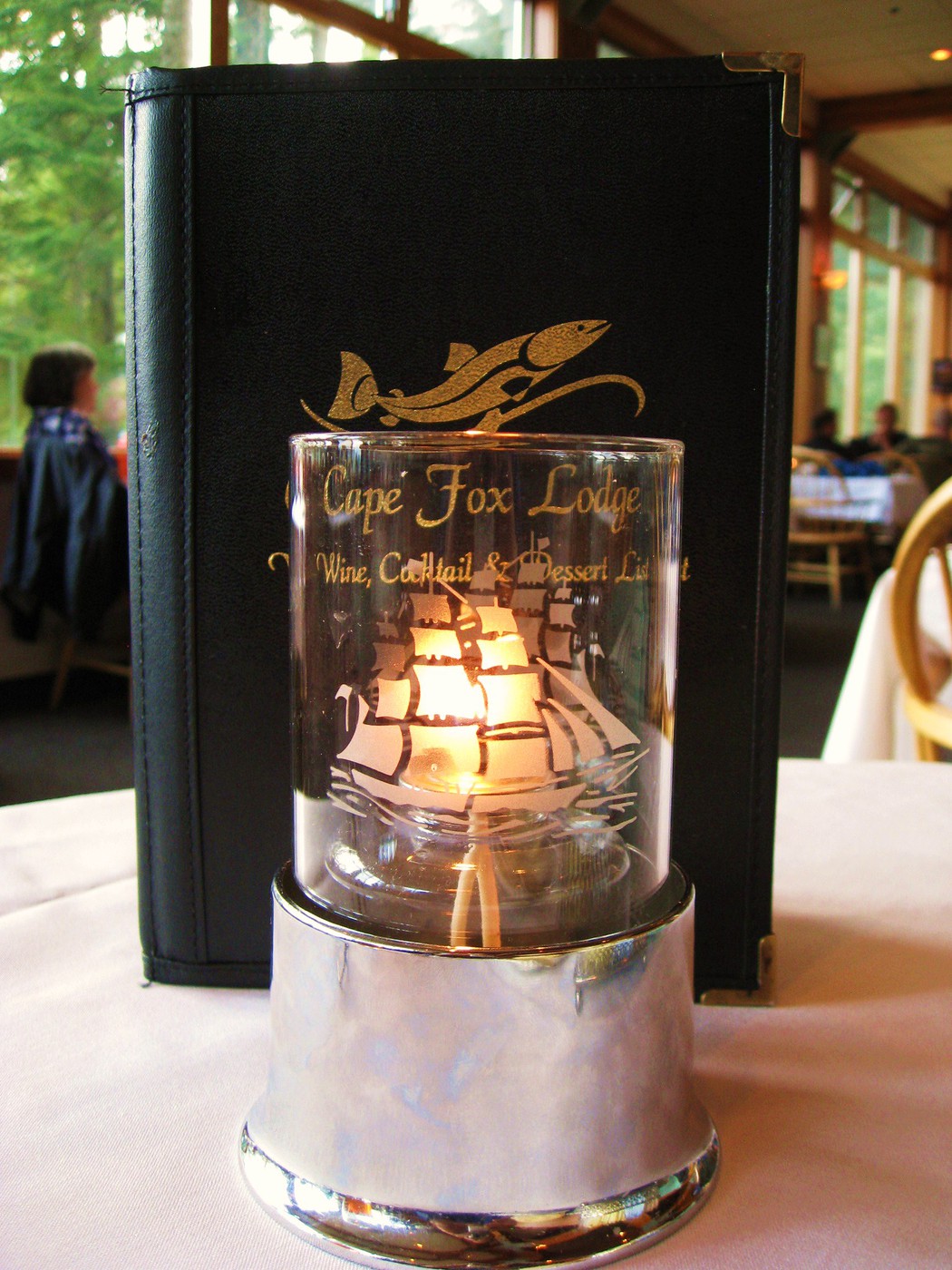 Heen Kahidi Restaurant Ambience
It was about 12:30pm when I caught the city bus over to the Ketchikan Ferry Terminal. The bus stopped conveniently just across the street and I wheeled my roll-a-bord across the parking lot and into the terminal where I collected my boarding pass for the nineteen hour sailing up to Juneau.
By the way, the “
Alaska Marine Highway” is not a beautiful Alaskan coastal road. The name can be a bit confusing to some since there are no roads to or between the communities of Southeastern Alaska. Once known as the Alaska Ferry System, the name was changed to the Alaska Marine Highway shortly after Alaska gained its statehood in 1959. One story has it that the new State of Alaska had requested federal funding for the Alaska Ferry System fleet but their request was denied by the Federal government on the grounds that only highway systems are eligible for Federal transportation funds. The State of Alaska then renamed the Alaska Ferry System to the Alaska Marine Highway and lo and behold, the federal funds began to flow. Funny how government works sometimes, isn’t it?
To this day, the communities throughout Alaska’s southeastern panhandle remain accessible only by air and sea, so the ferries of the Alaska Marine Highway continue to play a vital role in the transport of people, freight and vehicles. There are currently eleven ferries in the fleet, some of them fairly small. The route system stretches as far south as Bellingham, Washington and as far west as Dutch Harbor in the Aleutian Islands.
I took my first ride along the Alaska Marine Highway back in 1985. Myself and a bunch of friends from Denali rode the M.V. Malaspina on the four day, three night run from Haines, Alaska all the way down to Seattle. We were blessed with excellent autumn weather along with one of the finest displays of northern lights I’ve ever witnessed. Rather than book cabins or sit in the passenger lounges inside the ship, we all just set up tents on the top deck or slept on chaise loungers under the solarium. There were quite a few other folks up there doing the same thing. Hacky sacks were boppin’, beer was discreetly flowing and a couple of guitars made their presence known over the course of the journey. It was a memorable experience, one that I’ve managed to repeat eight or nine times since.
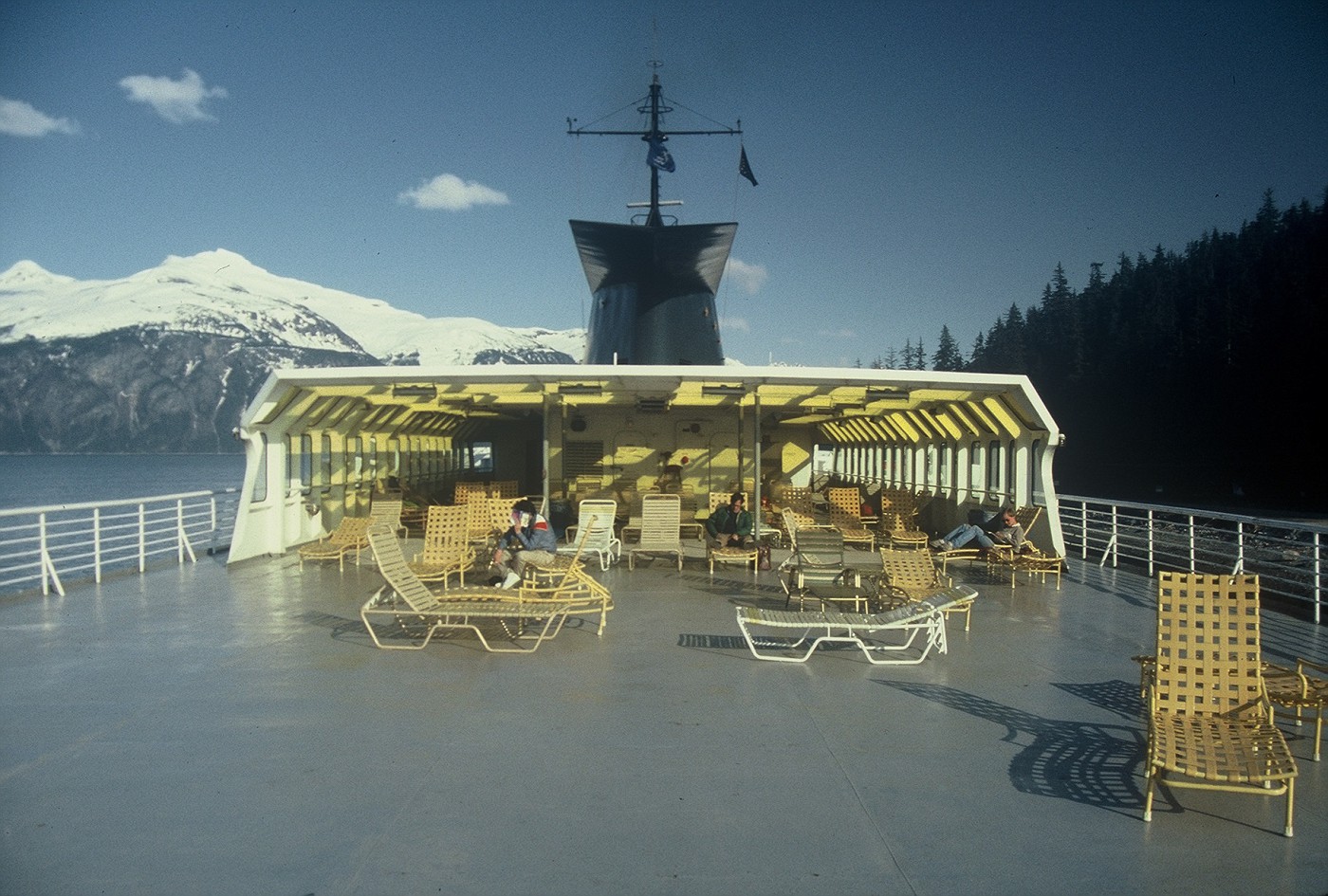
Life on the Alaska Marine Highway - 1985
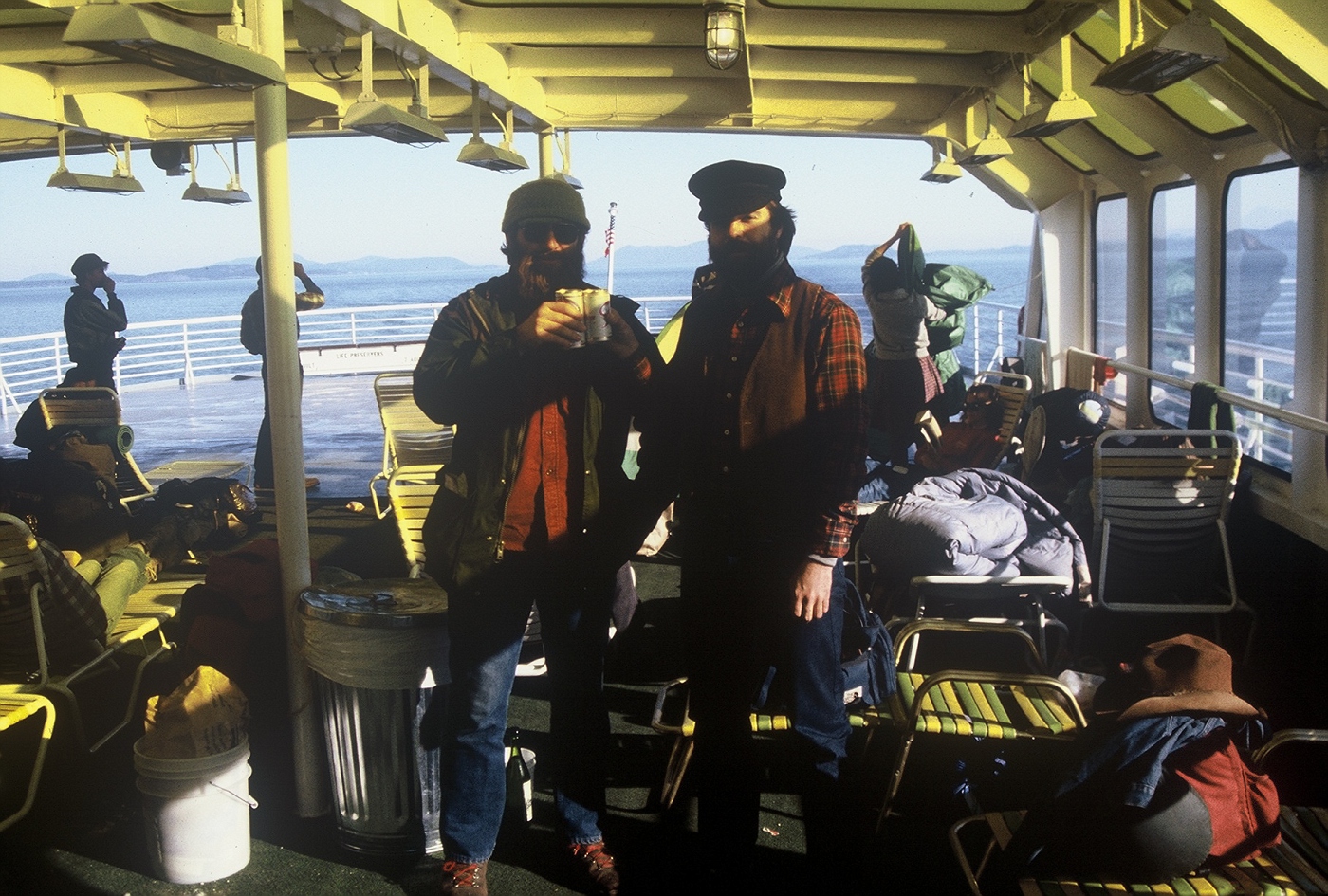
Your trip reporter toasts his good fortune with a travel companion - 1985
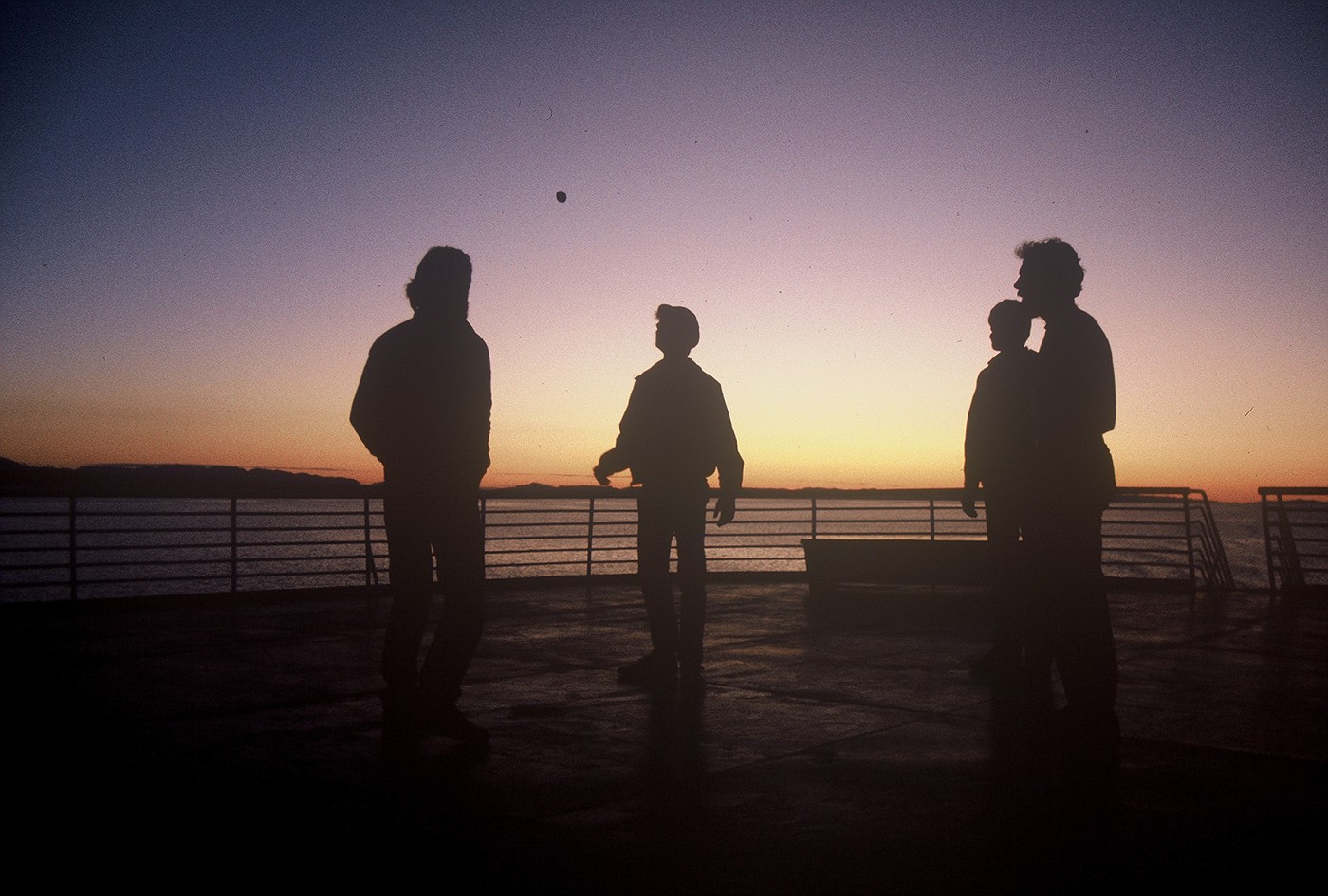
Hacky-Sack on the deck at twilight - 1985
This afternoon’s departure will be aboard the M/V Columbia – the largest ship in the Alaska Marine Highway fleet. I first rode this ship back in 1990, but then for only a short journey up the Lynn Canal between Juneau and Haines. This afternoon’s trip would be considerably longer – long enough to thoroughly enjoy all of the ship’s many amenities including a first for me: a stateroom. That’s right – after years of sleeping on chaise lounges under the solarium or on the floor atop my Thermarest pad in one of the many lounges, this time I would be splurging and shelling out an additional $126.00 for a 2-berth stateroom. As such, I consider this trip to be a “First Class” passage and so was anxious to board and check out my new quarters.
* * * _ _ * * *
Constructed in 1974 by Lockheed Shipbuilding in Seattle, Washington, the M/V Columbia has been the flagship vessel for the Alaska ferry system for 44 years. It normally serves the major inside passage communities between Bellingham, Washington and Skagway, Alaska. The ship is named after the Columbia Glacier which itself was named after Columbia University. It is one of several glaciers in the Prince William Sound area that were named for elite US colleges by the Harriman Alaska Expedition in 1899.
Per the Alaska Marine Highway website, the M/V Columbia is designed to carry 499 passengers and has a vehicle capacity of 2,660 linear feet, which is equal to approximately 133 twenty-foot vehicles. There are 45 four-berth and 56 two-berth cabins. Additional onboard amenities include a full service dining room as well as a cafeteria-style restaurant, a pair of observation lounges with comfortable chairs, a covered heated solarium, a movie lounge, showers, a coin-operated laundry and lockers, writing and quiet lounges, and a children's play area.
Here’s a schematic of the ship’s interior:
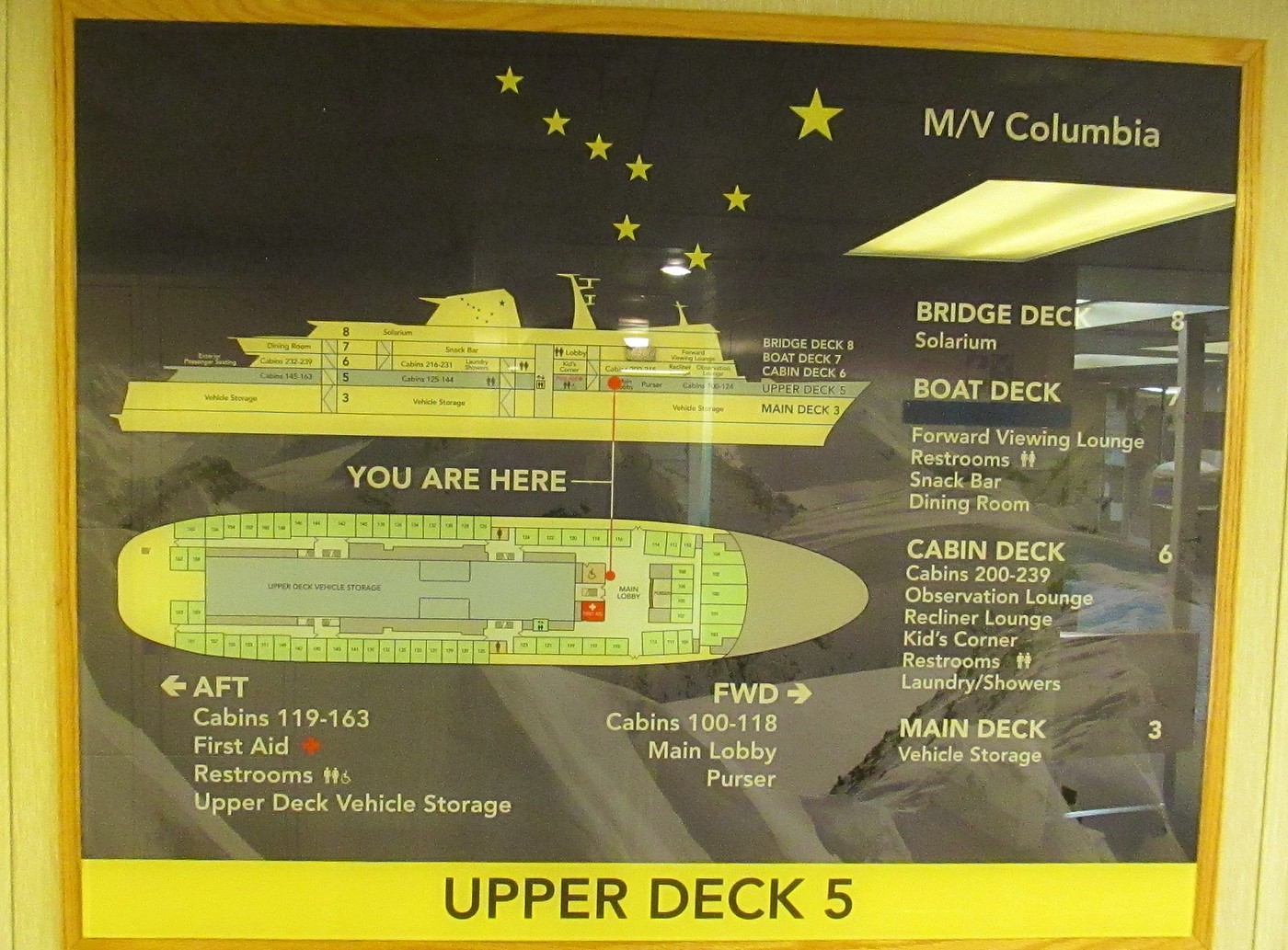
M/V Columbia Deck Guide
A light rain had begun to fall as I began the long walk down the automobile gangplank onto the ship. It’s an inauspicious entrance as you enter through the cavernous vehicle storage deck. The ceilings are almost 20 feet high to accommodate the occasional tractor-trailer and today there were three on board. Only a handful of cars were in evidence, but then this is still the off-season. A month from now this hold will be packed!
A uniformed deck hand got my attention with a wave and directed me to an elevator that would take me to the upper decks. My cabin was located on Upper Deck 5, as was the Purser’s Station where I would need to check in and receive the keys to my room.
I haven’t ridden a lot of ships, so I’m always amazed at how big they are. The Columbia, at 418 feet long and 85 feet wide, feels like a big ship to me. Compared to the huge cruise ships that ply these waters during the summer months though, the Columbia’s practically a tug boat. Even so, I was still impressed by the spaciousness of the Purser’s Station and lounge.
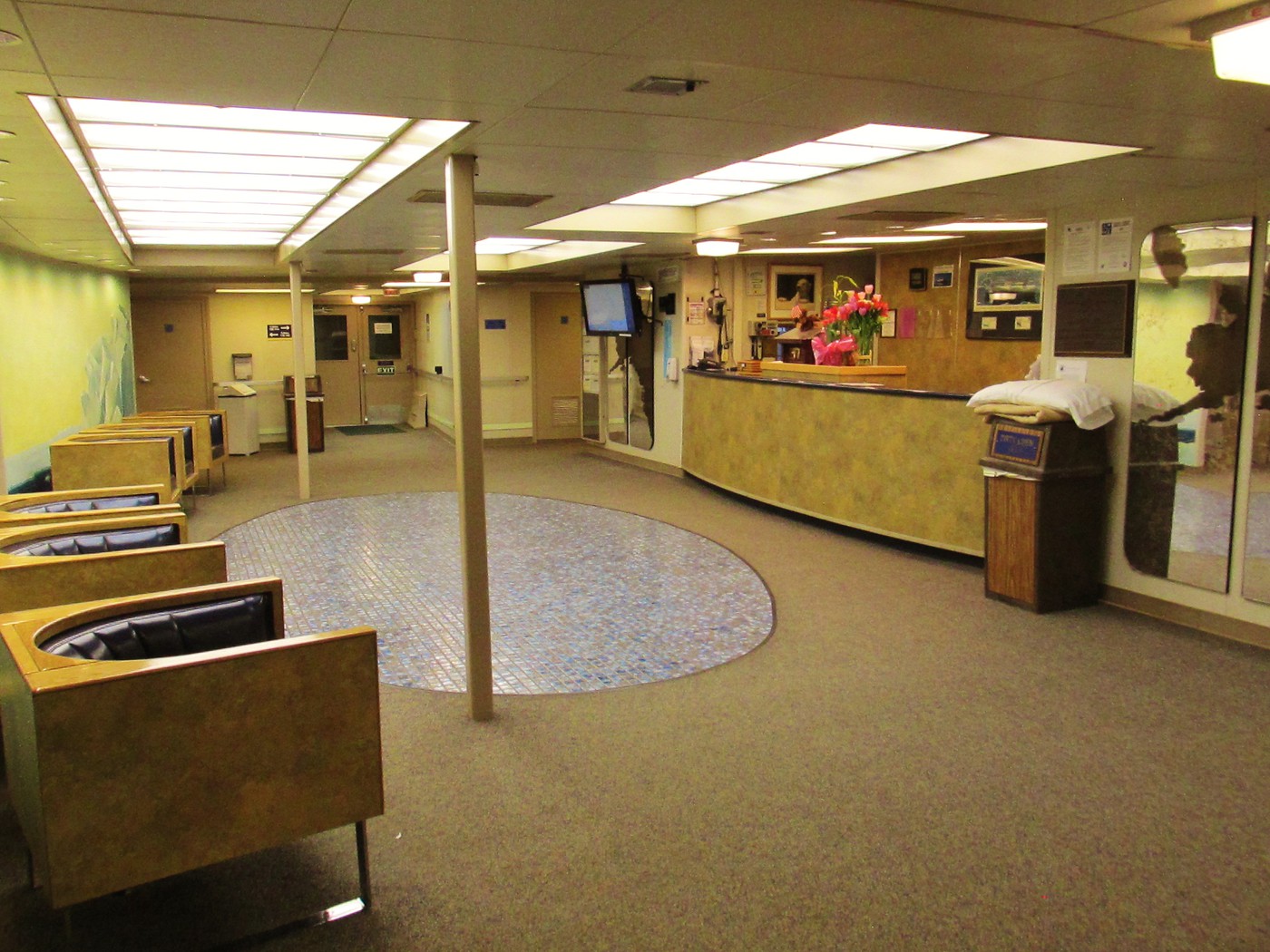
M/V Columbia Purser’s Station
The purser, a friendly middle-aged lady named Marcy, welcomed me aboard with a smile. After collecting my boarding pass, she provided me with keys to my cabin and an extra blanket. I was assigned cabin 139, located just down the hallway behind me and to my left.
Many of my trips aboard the Alaska Marine Highway have come during the off season when ridership is low – sometimes exceptionally so. On a couple of occasions during the winter months, I’ve been one of less than a dozen passengers aboard a 300+ passenger ferry. According to the purser, we had only about 50 passengers onboard today.
This would be my first time having private enclosed accommodations aboard an Alaska Marine Highway ship. On all of my previous trips, I’d always been very comfortable setting up camp in a remote corner of one of the lounges. For me that meant a Thermarest Pad and a pillow. While others might shy away from such open accommodations, I grew up traveling this way. There was once a time that I really had no other choice. For many years I hitch hiked back and forth across the American West, sleeping wherever I could find a quiet out of the way place. Under a tree, behind some bushes – wherever so long as it was reasonably safe and out of the public eye. Throughout it all I never felt put out or down on my luck. For me the greatest thrill was in just being out there on the road. It was all part of the great adventure that was my early traveling life, an adventure made all the more exciting for the sheer unpredictability and unknown aspects of it all. I never worried about where I’d sleep for the night. I’d work that out when the time came. Somehow I can’t help but feel that life would have been a lot less entertaining back then had I been staying in hotels each night.
Now, forty years later, times have changed a bit. Though mentally I still have no compunctions about sleeping on airport floors or in ferry lounges, physically I feel a lot more comfortable having a bed to sleep on. Thankfully, I’m also now in a position where I can afford to pay for hotel rooms as needed. That wasn’t always the case in years past. Where once I would have scoffed at the notion of paying an additional $126.00 for a cabin on this 19 hour ferry trip, for this trip at least I consider it money well spent and am definitely looking forward to the comfort and privacy that my cabin will provide.
So then, let’s have a look at my accommodations…
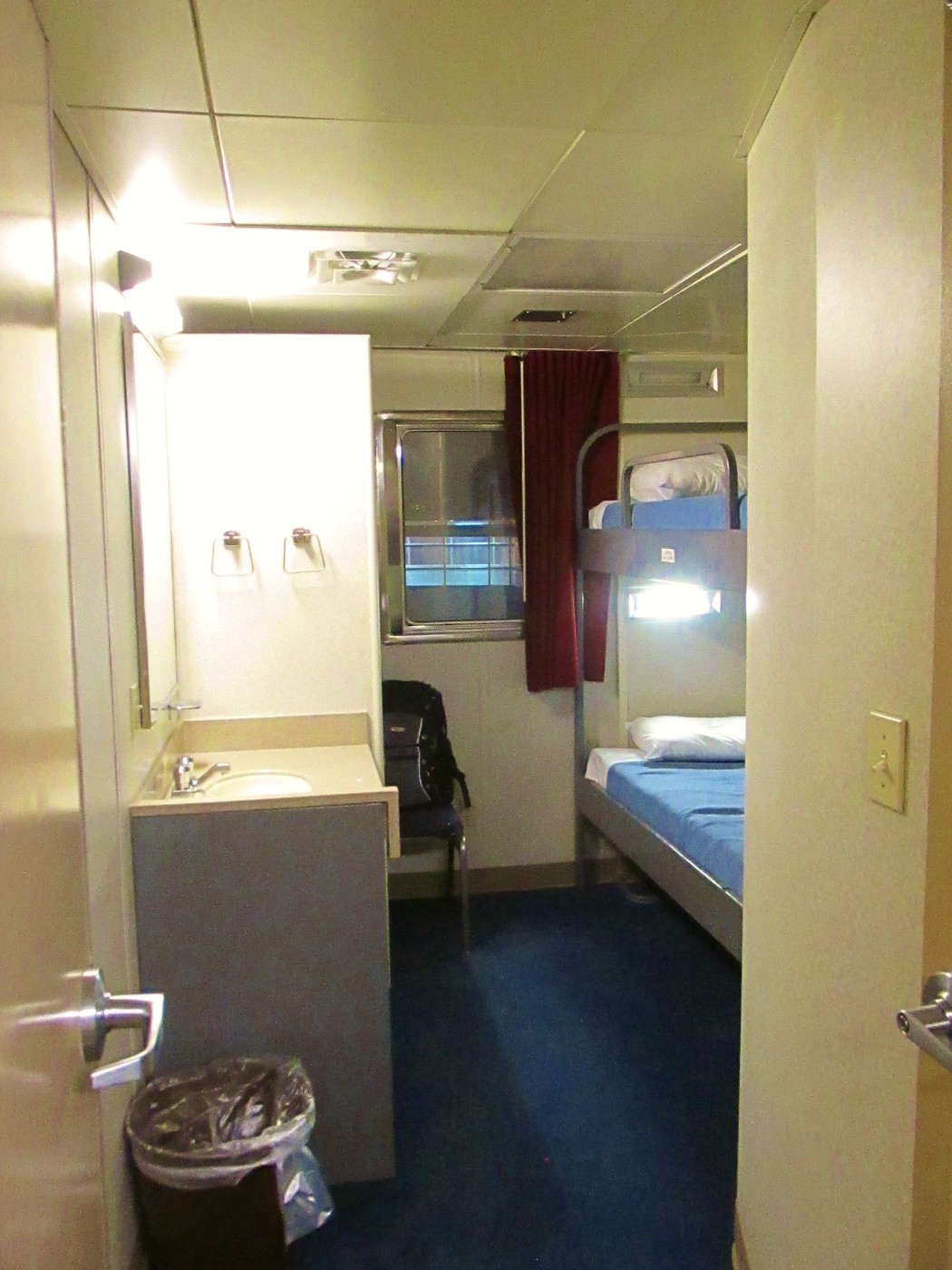
Opening the door to my 2 bed cabin
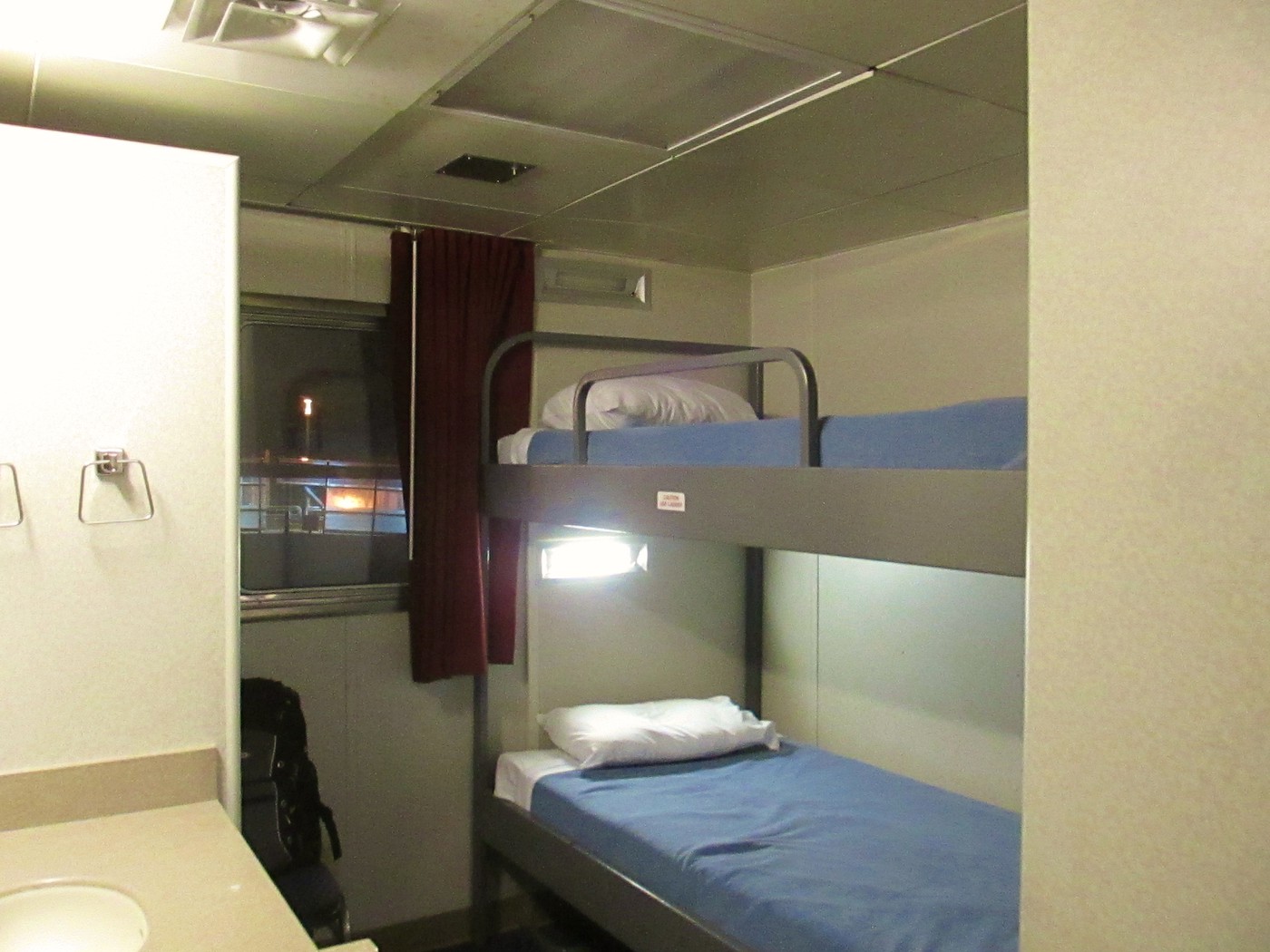
Comfortable yet spartan
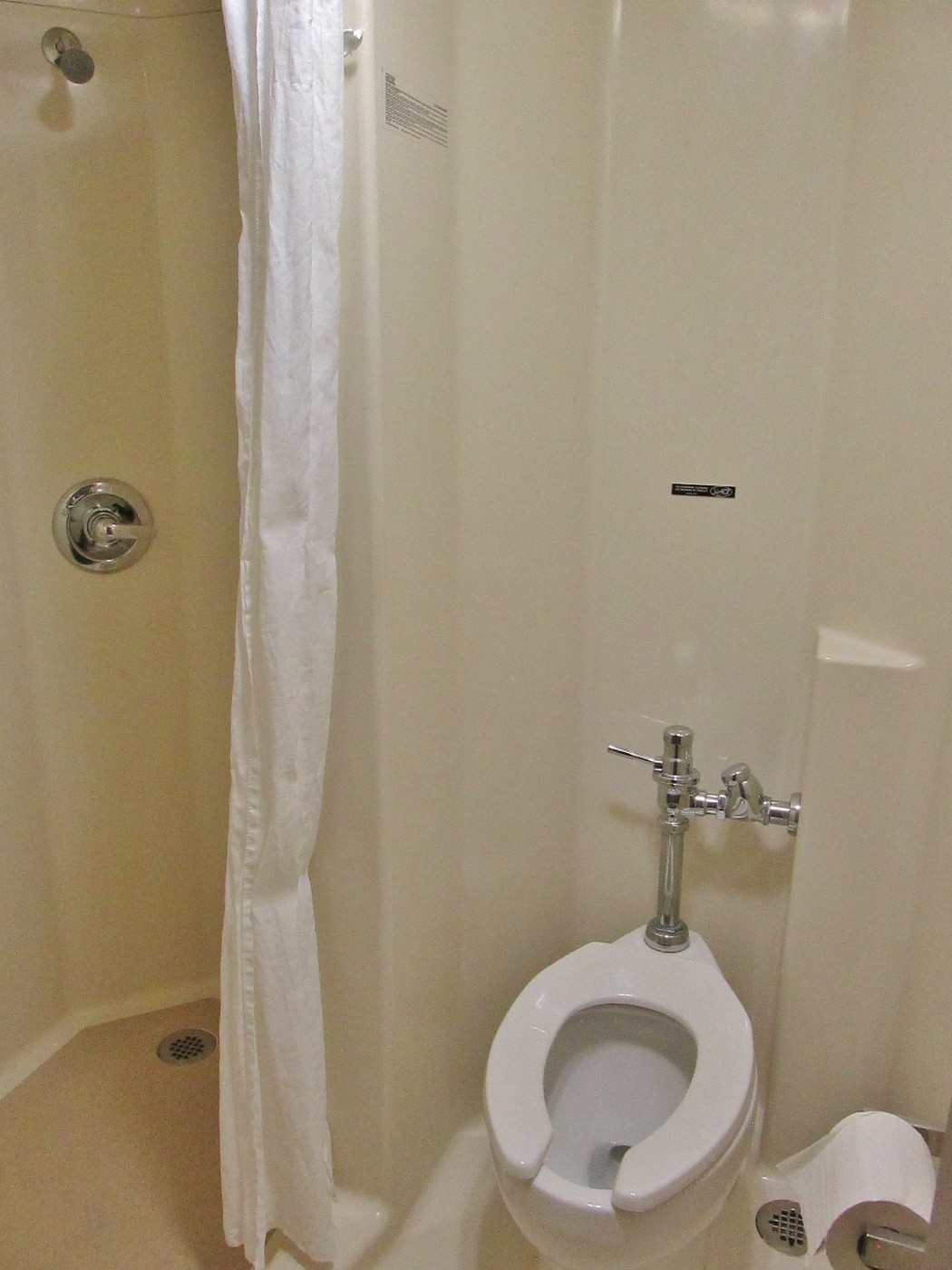
Modular Water Closet
Cabins aboard the M/V Columbia will never be confused with those aboard a proper cruise ship. I would describe mine as comfortable yet spartan. A bunk bed was mounted along one wall. Across from it were a small desk and a small closet with a single padded chair facing them. A wash basin and mirror completed the amenities. At the entrance to my cabin was a door leading to the bathroom – a well-organized molded plastic room that included a spacious walk-in shower.
Tossing my daypack on the chair, I took a seat on the bed and then took a moment to stretch out. Oh yeah – this’ll do just fine. The mattress was pretty cheap but the overall space and lighting was excellent. I switched pillows with the bunk above and then spent the remaining time until departure comfortably stretched out while catching up on the day’s news via that morning’s edition of the Juneau Empire.
A blast from the ship’s horn signaled departure was imminent. A barely perceptible shudder then indicted we were powering away from the dock. Just down the hall from my cabin was a doorway leading outside onto the passageway that ran along the forward part of our deck. I headed outside and watched as the Ketchikan waterfront receded into the distance. As we cruised past Gravina Island upon which the airport sits, I could clearly make out the ramp that led from the terminal apron up to the runway.
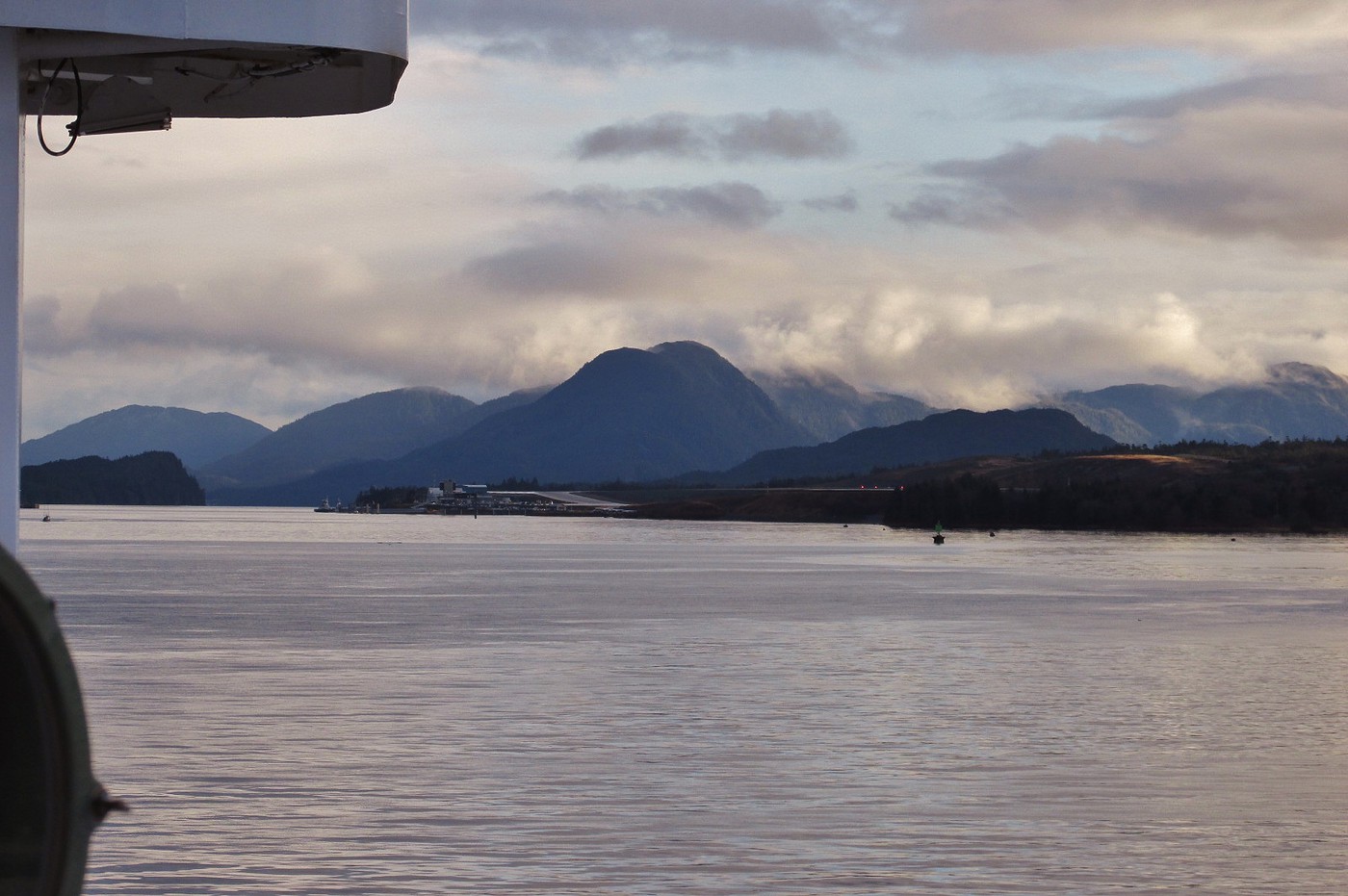
Ketchikan Airport as seen from the ferry
It wasn’t long before a brief squall forced me back inside. It was time to head upstairs and check out the rest of the ship. With nineteen hours of sailing ahead of us until our arrival in Juneau, some people might be easily overcome by the tedium of long distance travel. In the fast paced, instant gratification world we live in today, most travel has been reduced to a few hours in a sterile grey or dark blue upholstered tube of an airplane where window shades shut out the outside world and attention is focused on the artificial entertainment provided through the airline’s IFE or our personal tablets or laptops. Those in need of such diversions will be happy to know that there is no shortage of electrical outlets in either the cabins or the public areas of the ship.
On the other hand, there’s a lot to be said for sailing through some of the prettiest landscape on the planet, landscape that is best enjoyed through open eyes supporting a mindset appreciative of this planet’s natural wonders, especially when they’re right there in front of you as opposed to on a computer screen via a BBC documentary. While for many stuff like this is enjoyable but boring after a short while, I actually rather enjoy relaxing in a comfy chair while watching the world go by and so it was that I headed up to the sparsely populated forward viewing lounge where I found a great seat to enjoy the scenery (including keeping a keen eye out for the occasional breaching whale) for a couple of hours.
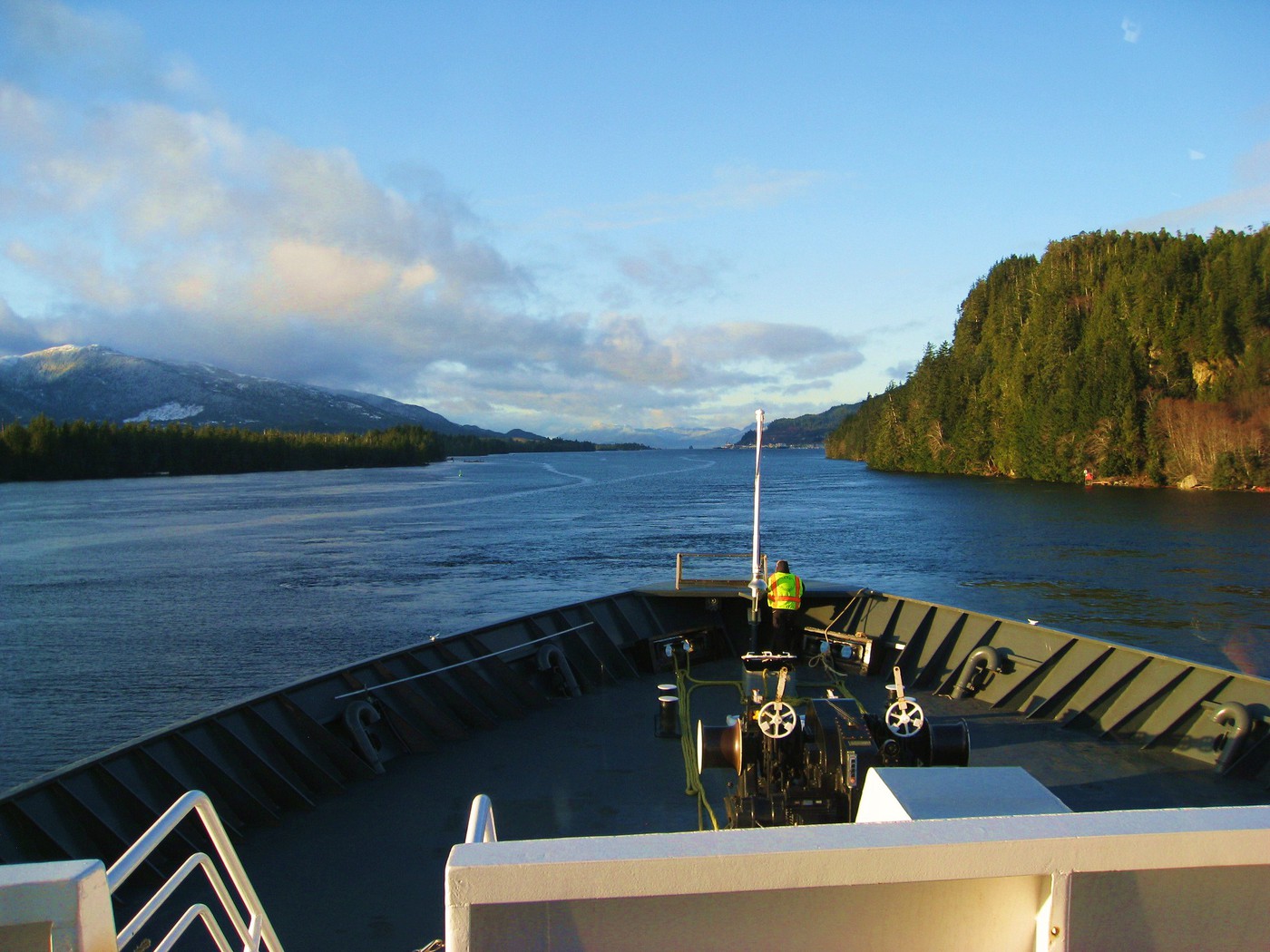
Northbound through Alaska’s Inside Passage
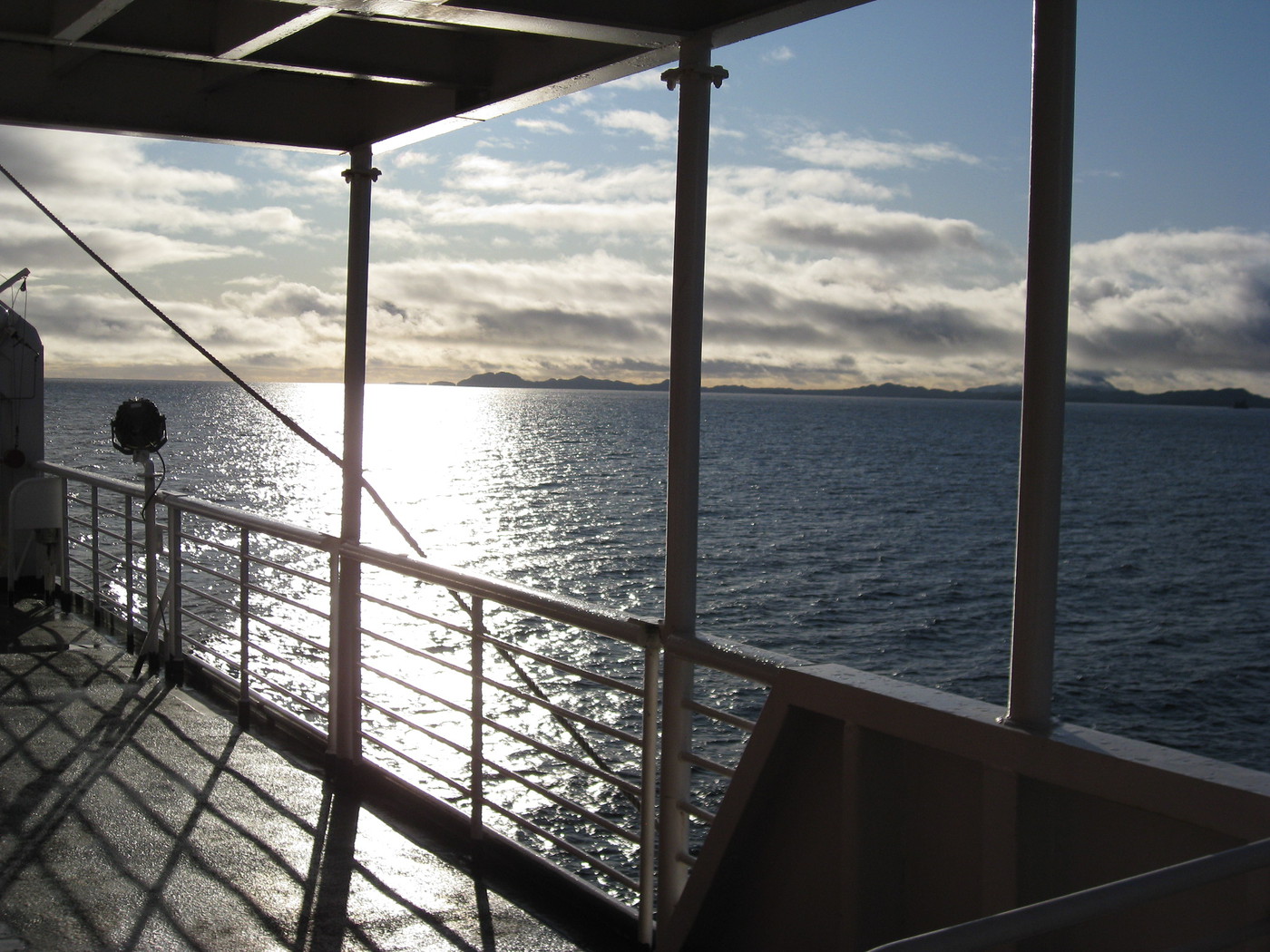
Sunny day cruising along Alaska’s coast
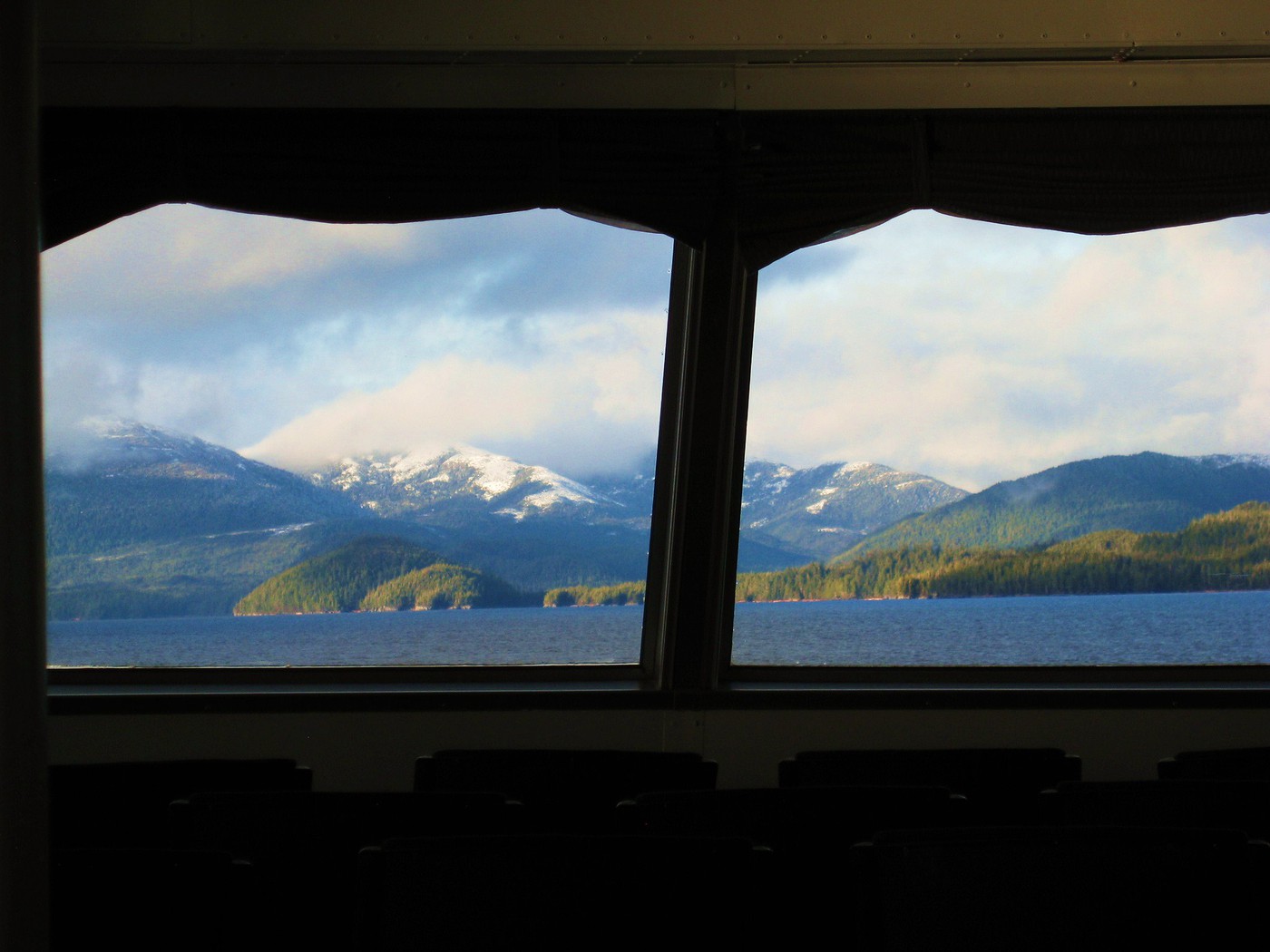
The view from the lounge
Comfortable seating and large windows allowed for a nice view as we steamed north through the narrow channel between Prince of Wales Island and the mainland. The warmth of the spring season had still not been sufficient to completely melt the snow on the surrounding mountains. The white snow contrasted nicely with the green spruce forests and dark blue waters of the Inside Passage.
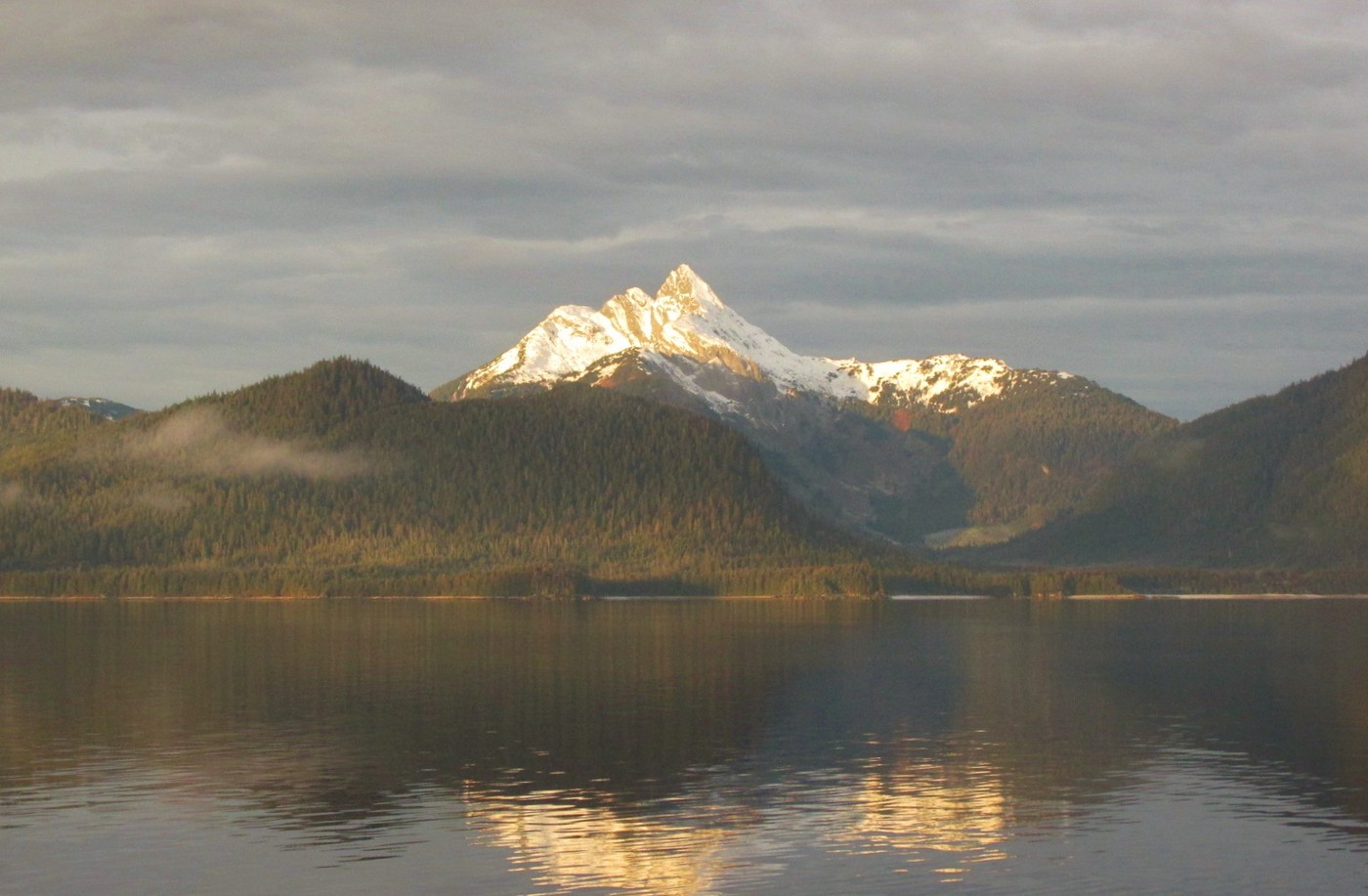
Afternoon Delight
After a couple of hours, I headed back to my cabin for a short nap. It was so nice to be able to stretch out comfortably on the spacious lower bunk. I read for about half an hour before lapsing off into a contented slumber for the next hour or so.
It was about 6PM when I made my way upstairs to the ship’s dining room. Located on the Boat Deck (Level 7) at the rear of the ship, its large windows and spacious ambience made for a really nice dining atmosphere. I took a seat near a window and took in the view.
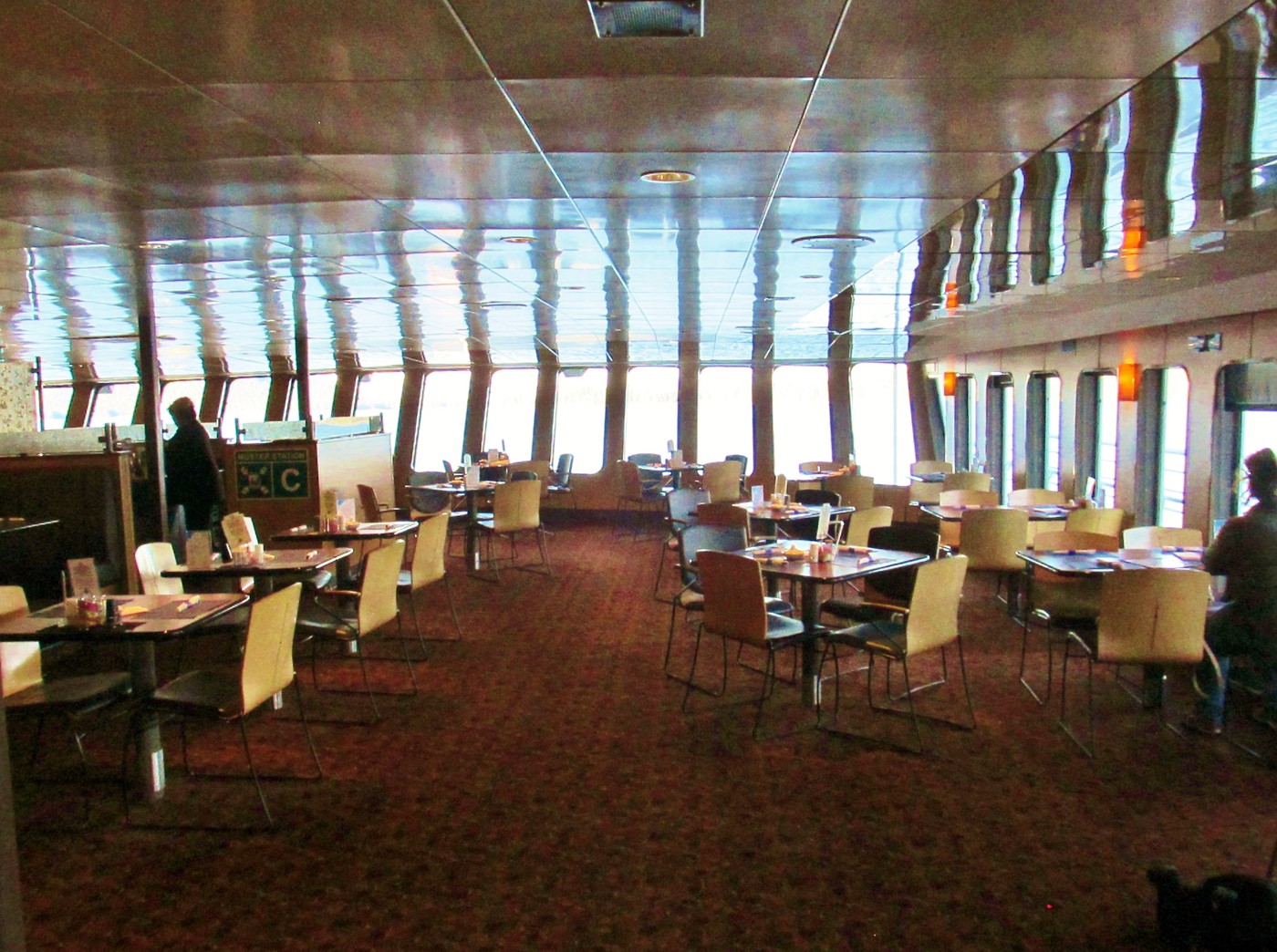
MV Columbia Dining Room
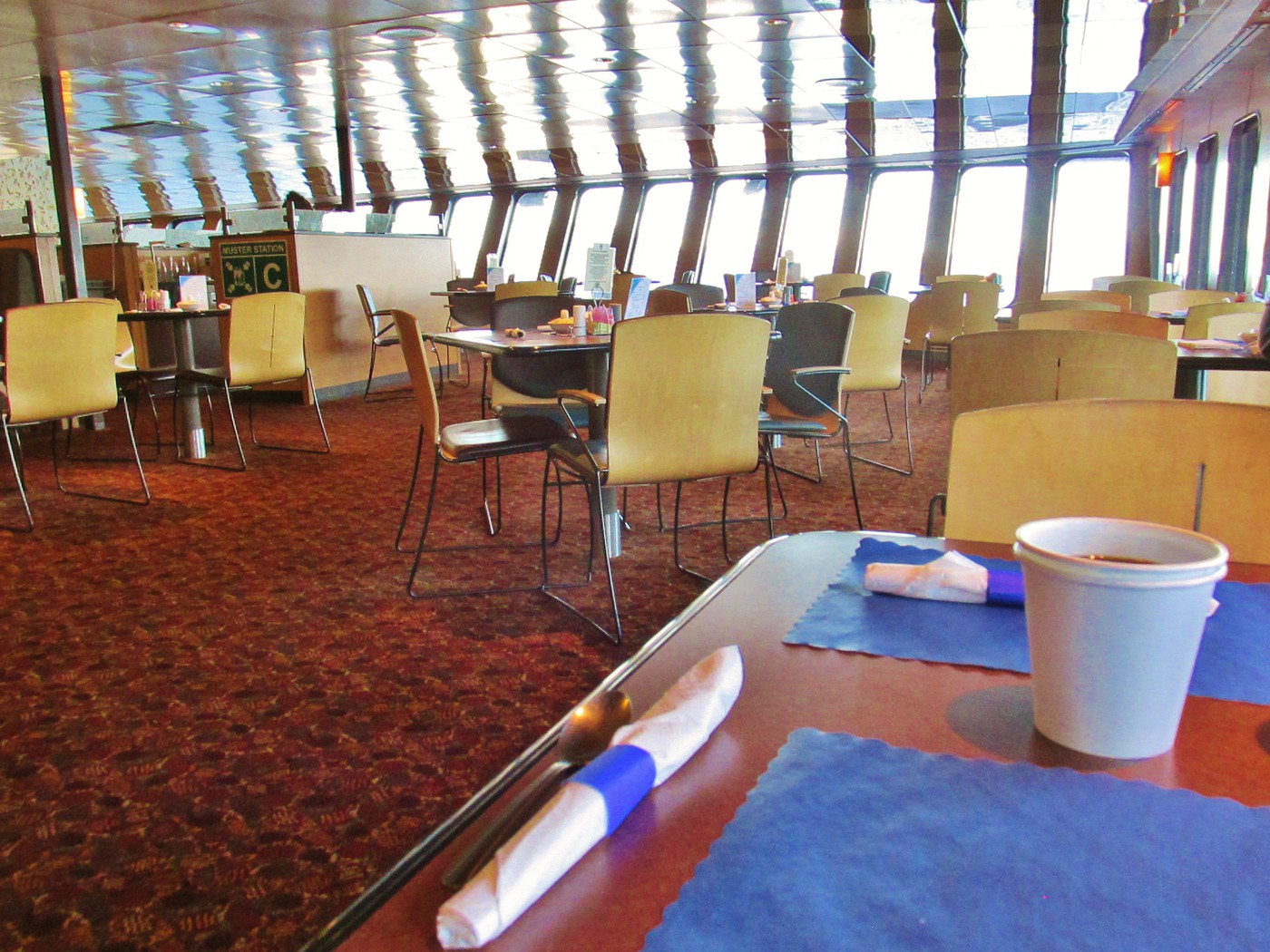
Table View
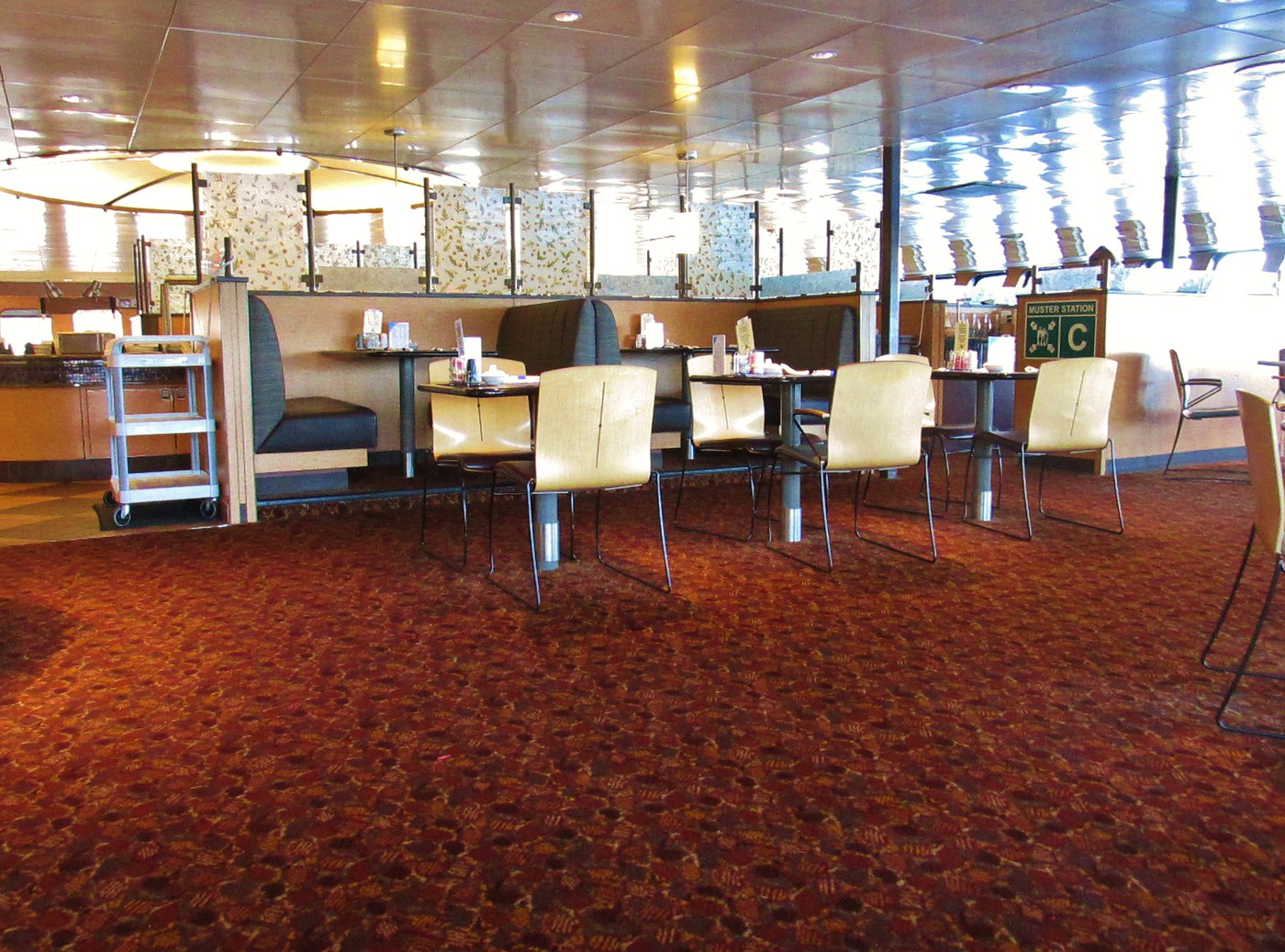
There’s lots of space between tables
The last time I rode the Columbia was nearly 28 years ago in November of 1990. Back in those days this dining room featured linen table cloths, a full menu including bar service and a bevy of nicely uniformed servers. Alas, times have changed – and not for the better.
The Alaska Marine Highway is operated by the Alaska State Department of Transportation. The state budget is predicated upon projected oil revenue and with the significant drop in oil prices two years ago, the state has been hustling to make ends meet ever since. The Alaska Marine Highway retired two vessels, one of them my favorite – the M/V Taku – and has made considerable cutbacks to the onboard service. The bars on all boats are now closed and alcohol is available only in the dining rooms during meal times. The menu, which once boasted a wide variety of appetizers, entrees and lighter meals now lists just a couple of main dishes in addition to a daily special and a couple of sandwiches. It’s now posted on a little 5x7” piece of poster board, mounted in a clear plastic stand-up display - much like an advertisement for the daily special.
It’s possible that this stripped down menu is an off season aberration and the overall service and options will improve once the high season kicks in. I asked my server about it but she claimed to have no idea. What a sorry state of affairs. Still, here I am and I’m hungry so let’s go with… the Daily Special – Chicken Parmigiana.
I’ve been served Chicken Parmigiana a few times, enough times to know that it’s usually one or more breaded chicken cutlets topped with marinara sauce and either mozzarella, parmesan or provolone cheese. What I was served tonight was two little cutlets – each of them smaller than a typical chicken leg – accompanied by a scoop of rice and some carrots. There was no sauce. There was no cheese. It was more like Chicken Padukah.
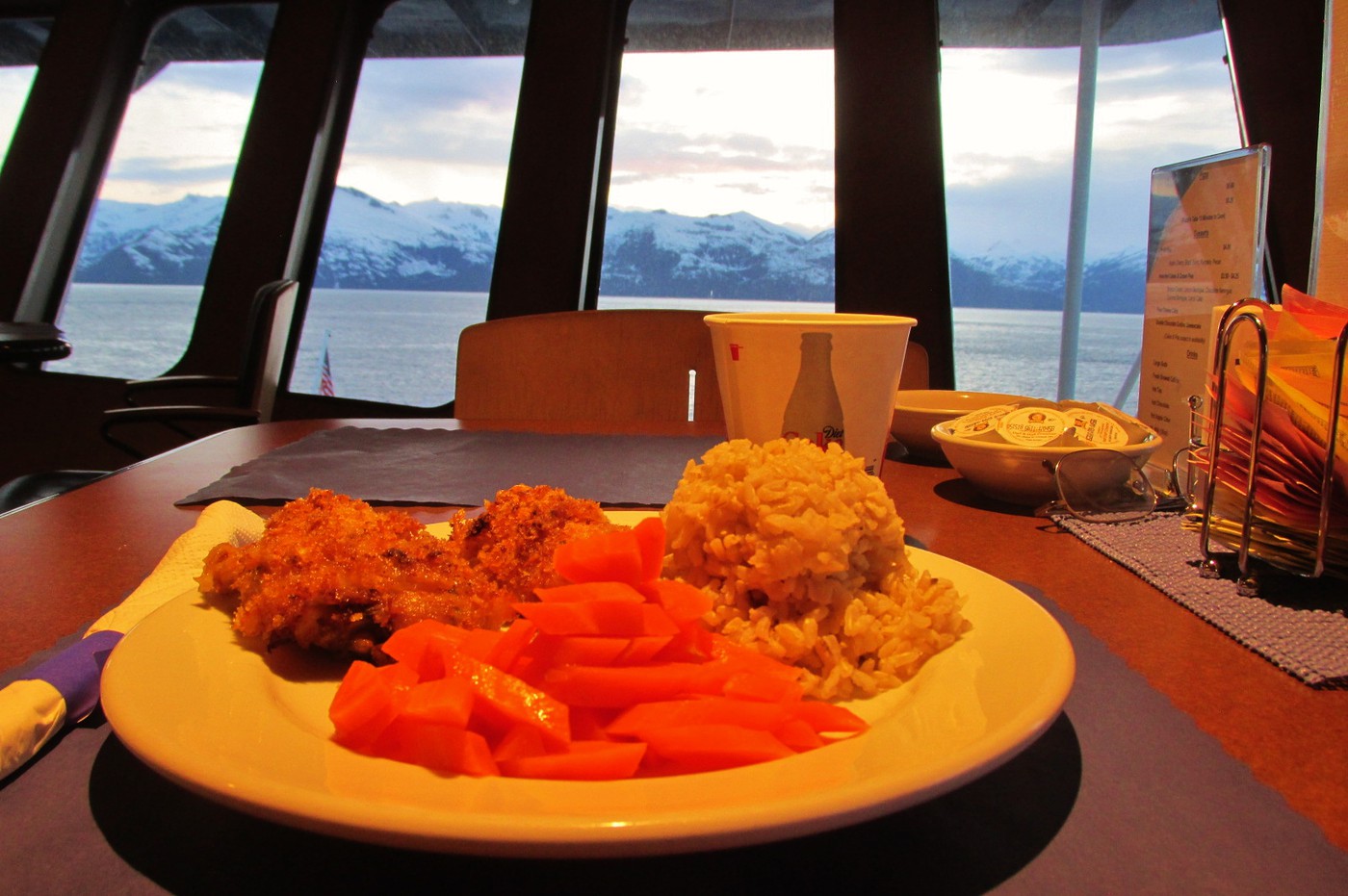
AMH Chicken Whatever
That said, this meal still tasted pretty good. At the same time, if only based on portion size I don’t think it lived up to the $16.00 price tag on the menu. Again, while it could be that tonight’s stripped down meal – budget shortfall notwithstanding – was a temporary aberration resulting from the off-season blues, next time I ride the ferry I think I’ll do a bit of pre-trip investigation as to the food service and – if need be - consider self-catering.
After dinner, I stepped outside to take a couple of pictures…
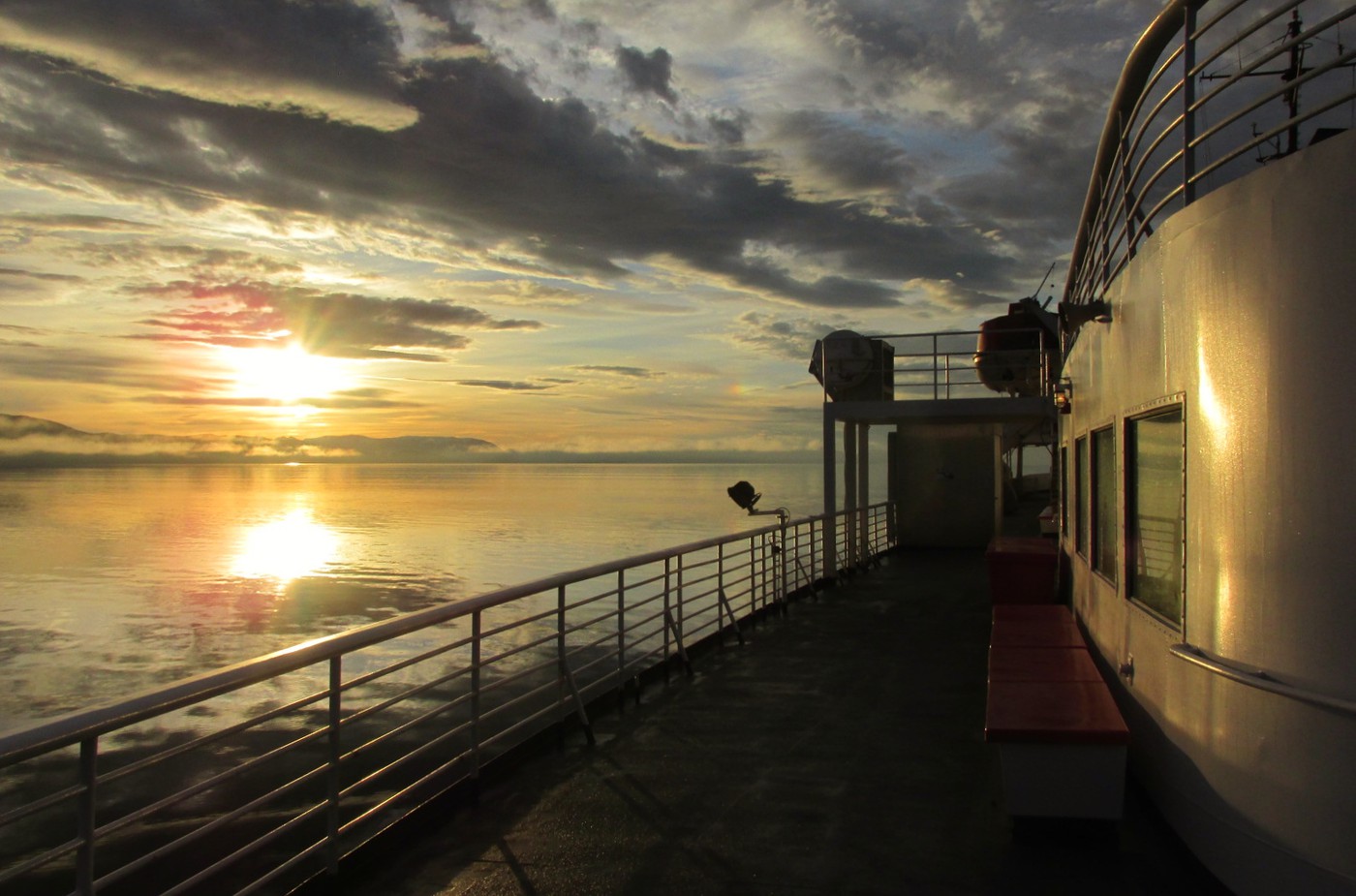
Sunset on the Inside Passage
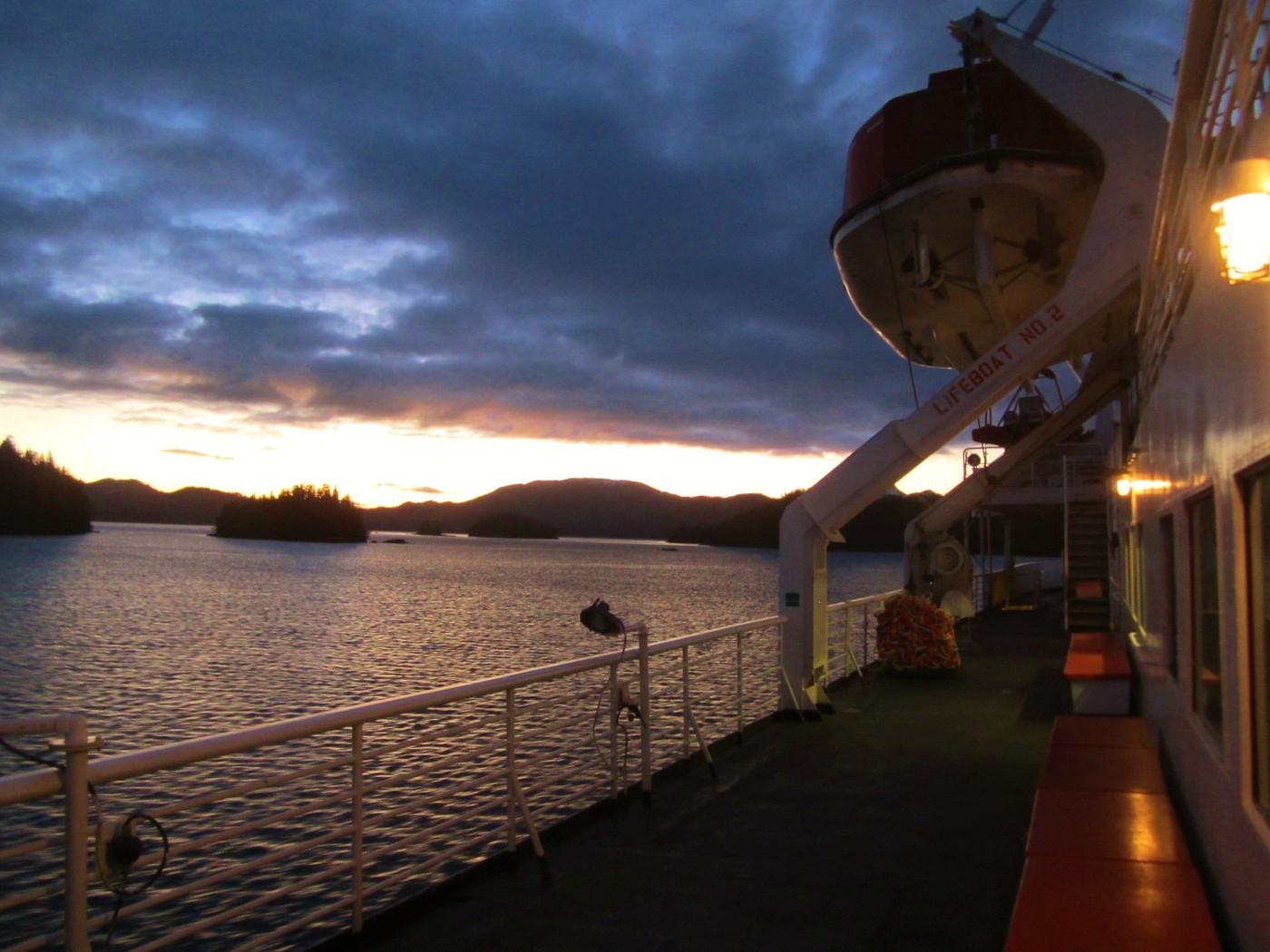
Evening Shadows
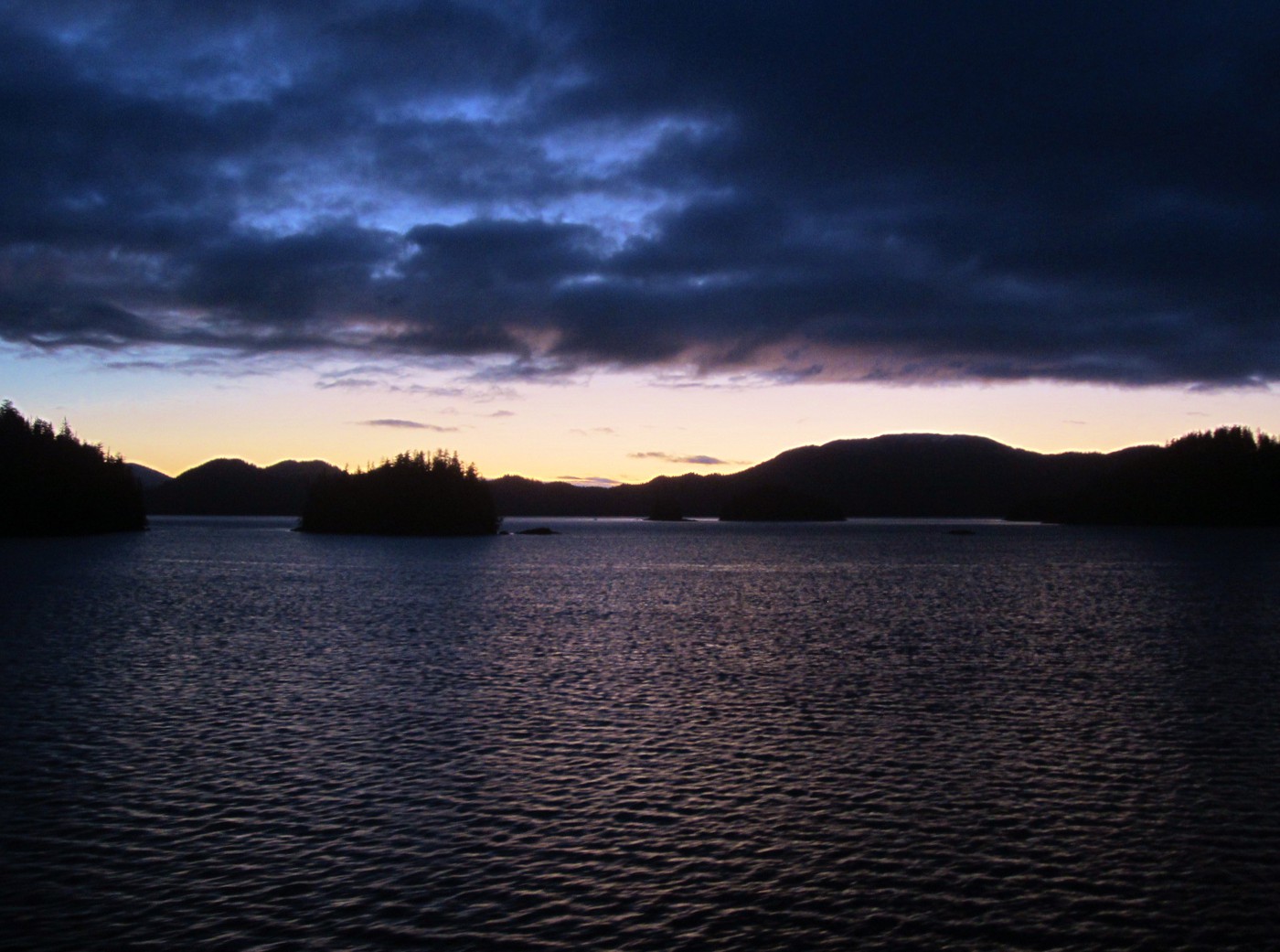
Last light of day
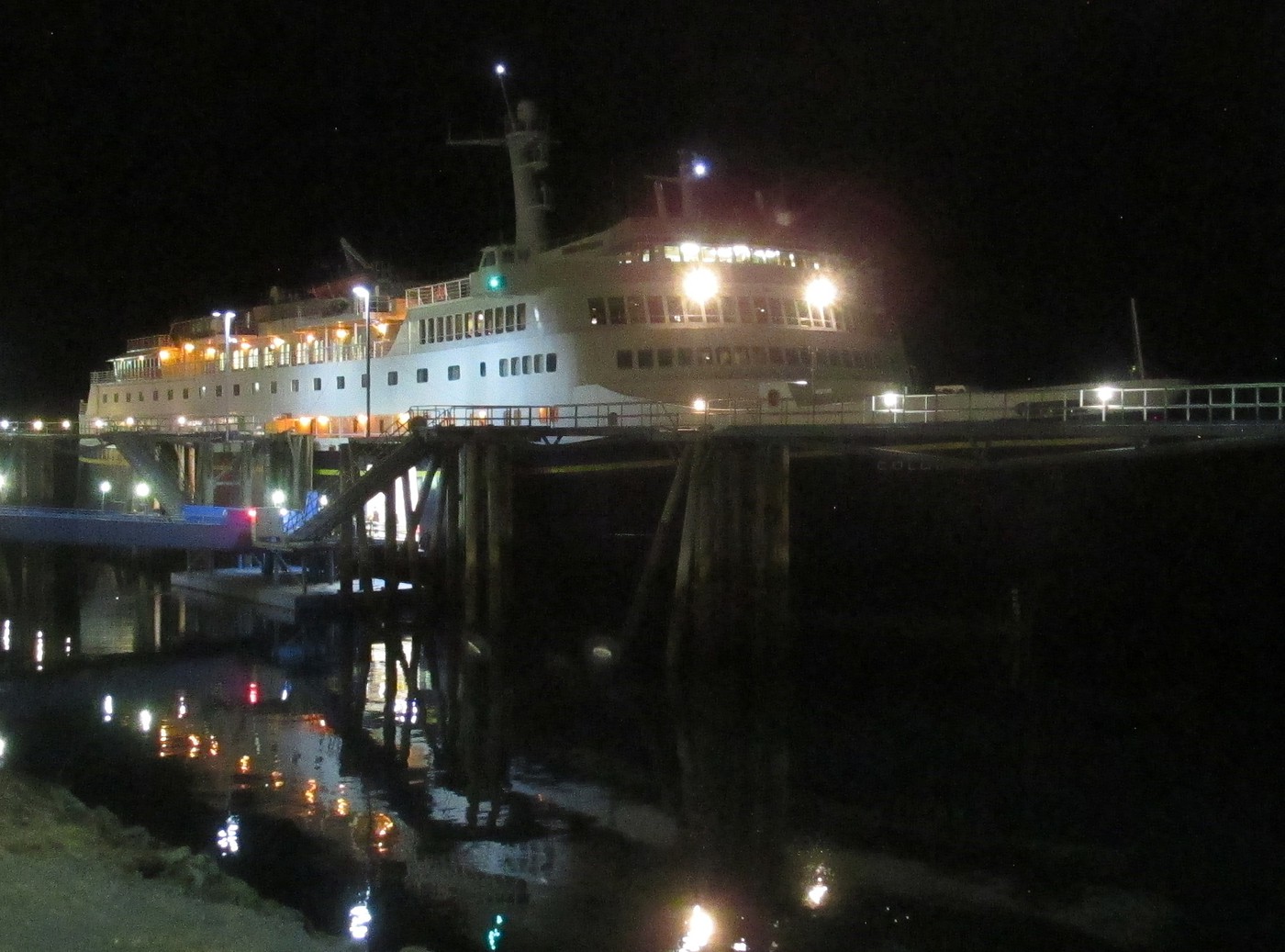
M/V Columbia at Wrangell
For me at least, time passes rather quickly on long trips like this. If I’m not taking in the scenery or chatting with fellow passengers, I’ve always got a book or magazine to read as well as my laptop on which to occasionally put in some work on this report. It should be noted here that wireless internet service is not provided by the Alaska Marine Highway although one can occasionally pick up internet service while in certain ports.
Prior to departure from Ketchikan I’d purchased a 375 ml bottle of Jack Daniels and joined a couple from Boise, Idaho who were heading up to Skagway, Alaska for summer tourism jobs. Outside of Denali, I can’t imagine a nicer place to spend a summer working in Alaska than Skagway (although there are likely many equals). Located at the top of the Chilkoot Inlet, Skagway is surrounded by rugged mountains and lush forests. The town is home to gold-rush-era buildings, now preserved as part of the Klondike Gold Rush National Historical Park. The White Pass & Yukon Route Railroad offers spectacular scenery while climbing 3000 feet up White Pass to the Canadian border and beyond. I visited there three years ago and rode the White Pass railroad on a beautiful sunny day. You can read about that trip right https://www.flyertalk.com/forum/25917164-post19.html]HERE
It was about 10:00pm when I returned to my cabin, took a quick shower and then stretched out on my bunk and read myself to sleep. It had been another great day of scenery and relaxation while cruising Alaska’s Inside Passage. Honestly, short of a First Class suite aboard the likes of Emirates or The Orient Express, this for me is travel at its finest. Spectacular scenery, comfortable accommodations, a tasty meal (I’m a reasonably forgiving guy) and some enjoyable social interaction – it’s been a good ride.
Day Twenty-Six
Alaska Marine Highway First Class ~ M.V. Columbia ~ Arrival in Juneau, AK ~ 915a
Alaska Airlines First Class ~ 737-700 ~ Juneau, AK to Anchorage, AK ~ 104p – 241p
Alaska Airlines First Class ~ 737-800 ~ Anchorage, AK to Fairbanks, AK ~ 743p – 839p
I carry a cheap travel alarm clock that I purchased for about $6.00 nearly eight years ago. It’s small and sufficiently noisy to wake me up easily. Best of all, it’s reliable and runs forever on a pair of AAA batteries. I set it to go off at 6:30am. The Columbia would be terminating its trip at Juneau and we’d been informed the night before that breakfast would only be available until 7:30am so that both the crew and the passengers would have time to get ready for our arrival into Juneau.
Out on the deck, sunshine and shadows combined to create some spectacular vistas…
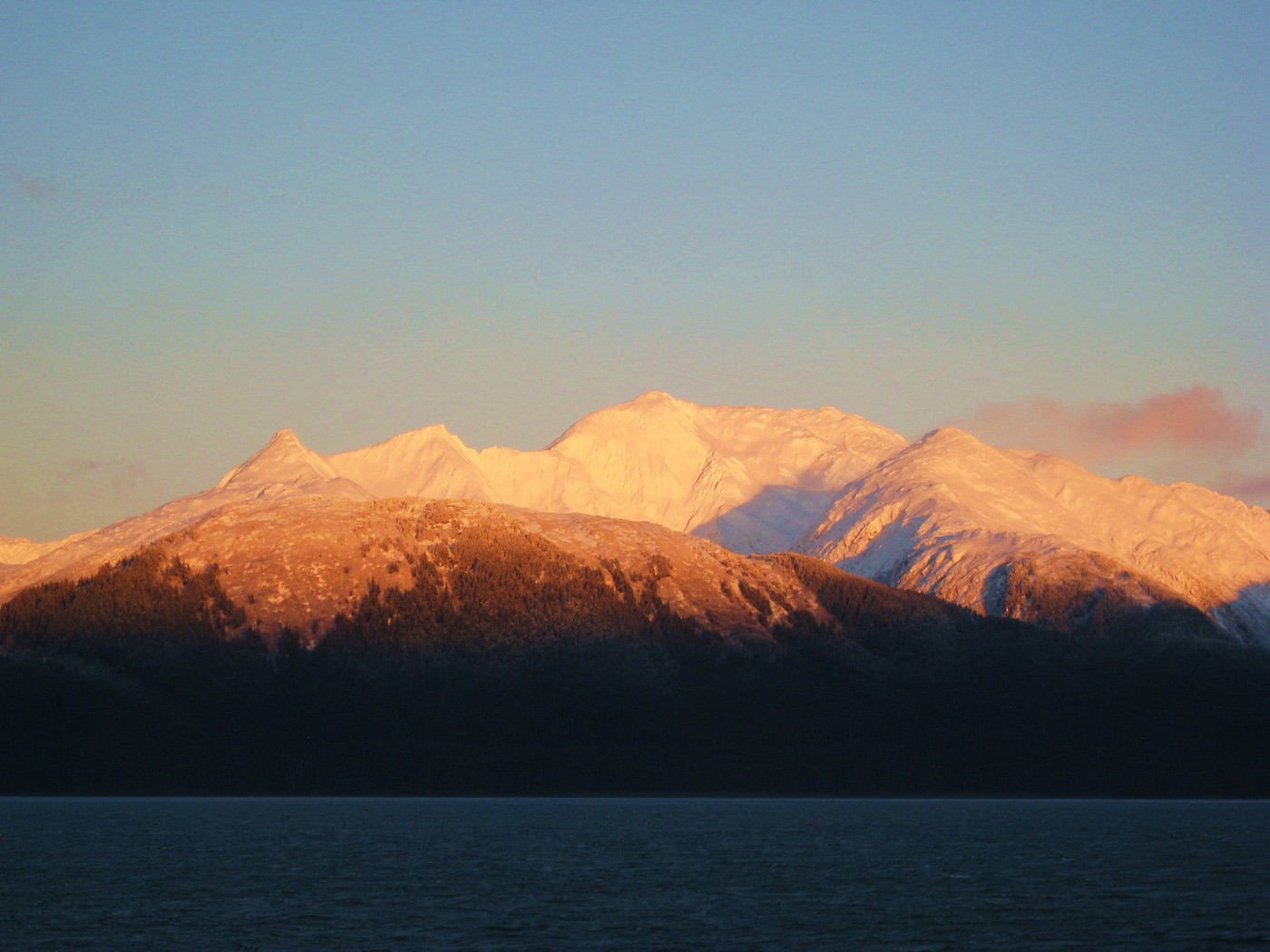
Sunrise on the Inside Passage
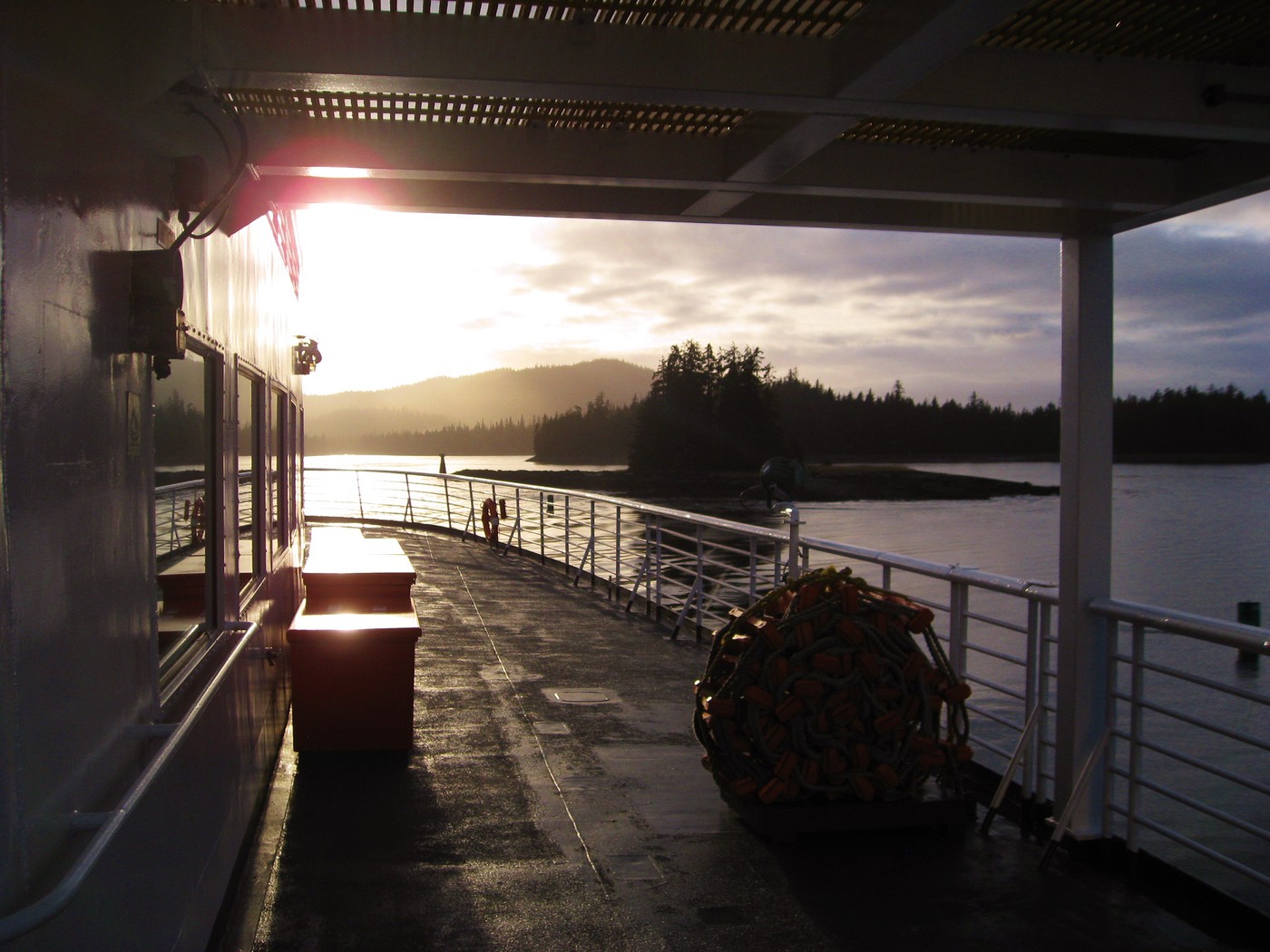
Morning Shadows
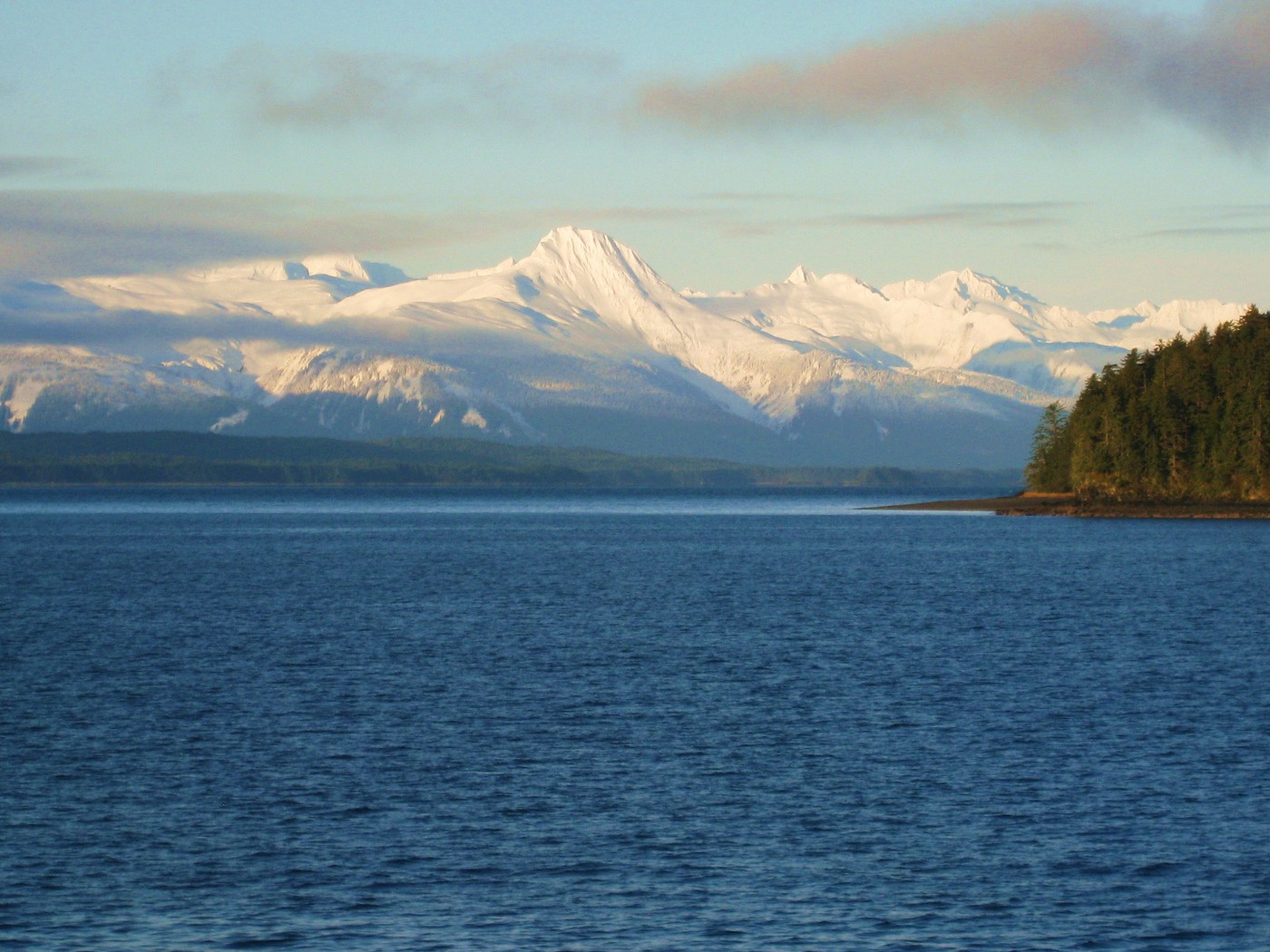
A fine spring day along Alaska’s coast
Hot coffee and orange juice awaited me in the bright and sunny dining room. I love all the windows in this place! The menu, though limited, offered a good looking Denver Omelet so that’s what I ordered – sourdough toast with butter, please.
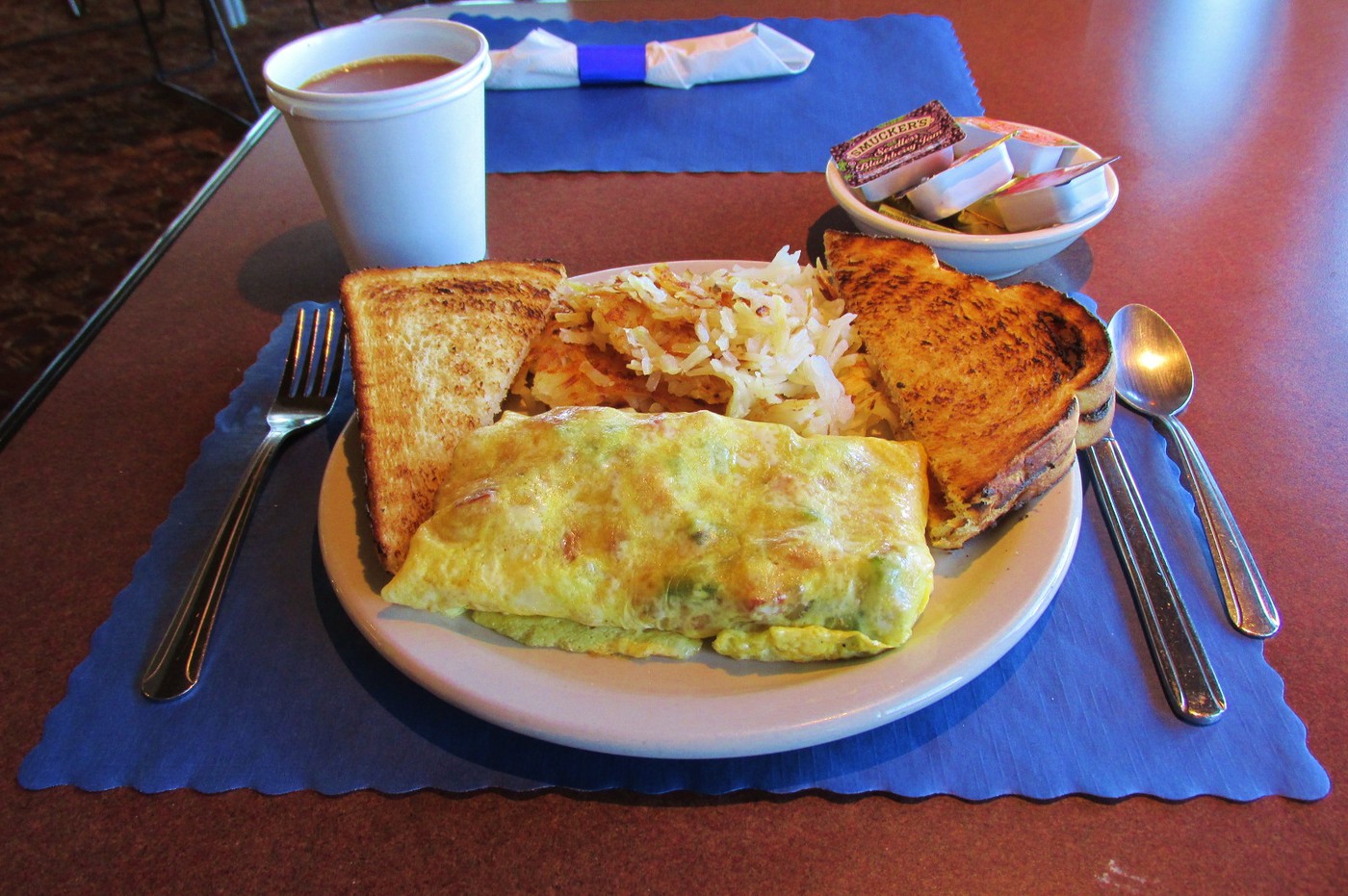
First Class Breakfast Omelet
Now that was an excellent omelet! Add to that the ambience of sitting at a table alongside one of the big picture windows looking out on the coastal splendor of Alaska on this beautiful spring morning and, well, this day was off to a great start.
After breakfast, I headed out on to the deck for another quick photo as we made our initial approach to Juneau’s Auke Bay Ferry Terminal. The early morning air still held considerable chill so I didn’t tarry long out there. Back in my cabin, I collected my gear and awaited the call to disembark.
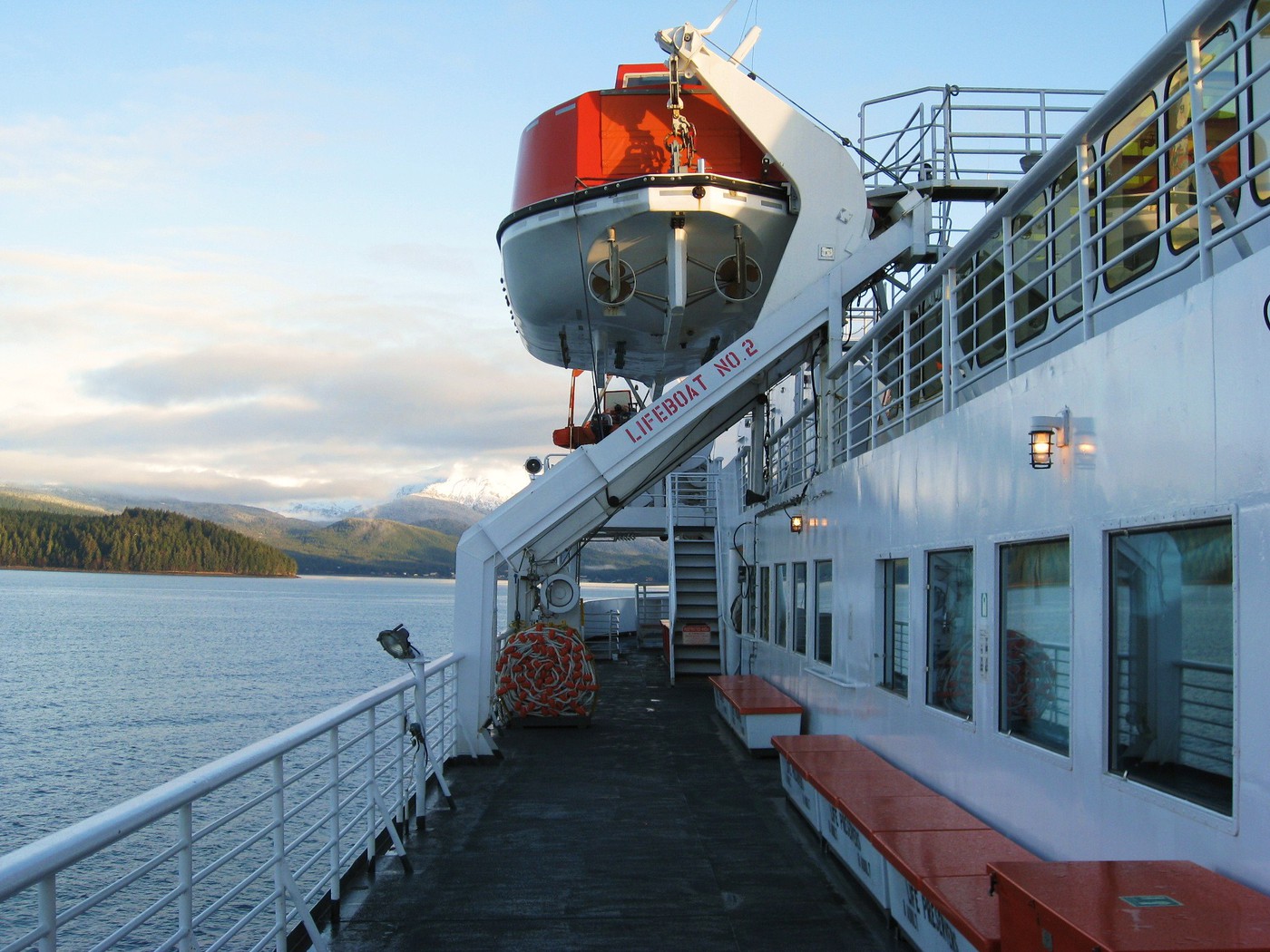
Approaching Juneau
Riding the ferry for this part of my trip home was a good call. I was fortunate to have such nice weather through a part of the world where the conditions are often less than ideal. Even had it been cloudy however, I really just enjoy the pace of travel like this. Despite having logged almost five and a half million miles of air travel, my preference for continental travel is land based travel, i.e. road, rail or sea provided the latter is coastal in nature. I don’t think I’d enjoy cruising out in the middle of the open ocean nearly so much. I love the scenery and the ambience of travel aboard a conveyance large enough to be comfortable yet small enough to still provide a sense of intimacy. My ride aboard the M/V Columbia ticked off all the boxes in that regard.
After docking in Juneau, I turned in my room key to the purser and made my way down to the car deck and then outside up the auto ramp and into the terminal. The Alaska Marine Highway ferry terminal is located 13 miles out of Juneau along the Glacier Highway. Short of taxis, there is no public transport available into Juneau. Given the daylight hour however, and the heavily traveled Glacier Highway, hitchhiking into town is a breeze. I walked across the large vehicle assembly area and up on to the highway where I caught a ride straight to the airport within 10 minutes.
Upon checking in for my Alaska flights up to Anchorage and beyond to Fairbanks, I was happy to discover I’d been upgraded on AS 65, the 100pm departure to Anchorage – this despite traveling on an award ticket between Juneau and Fairbanks. I honestly don’t know how many other airlines – if any – upgrade non-revenue award travel ticket holders, but I must say I am extremely thankful that Alaska does. Indeed, it’s hard – for me at least – to imagine any airline that takes better care if its top tier elite passengers than Alaska.
With two and a half hours until flight time, I found there wasn’t a lot to do in Juneau’s small airport. Aside from a fairly good sized gift shop on the lower level, it used to have a very nice full service restaurant upstairs but that closed about five years ago and now all that’s available landside is a full service bar offering a few pre-packaged items like sweet rolls and a sandwich or two. On the other side of security is a small café selling overpriced sandwiches, snacks and drinks. There is an attached bar in a back room but I believe it’s only open in the afternoon. I ordered a coffee in the landside bar and sat down at a table to watch the ESPN sports report on a nearby television.
Boarding for flight 65 to Anchorage was called at 12:30pm. Our aircraft was a 737-700, an aircraft which has become fairly ubiquitous throughout Alaska’s southeast coastal communities since the retirement of the 737-400 combis. Alaska originally purchased twenty-two of the smaller -700s - at the time Boeing’s longest range member of the 737 family - but then sold off about half the fleet as new longer range 737-800s and 900s joined the fleet. I understand Alaska’s plan is to convert some of its remaining -700s into combis (They’ve already converted one into the world’s first 737-700 freighter) but the aircraft operating today’s flight was in the standard two-class configuration.
Flight time for this 570 mile trip up the coast to Anchorage was one hour and twenty-eight minutes. With no competition on the route, Alaska had no real incentive to offer much in the way of a meal and so it was that the food offered on this luncheon hour flight was the dreaded hummus and pita plate – an offering better suited as an appetizer than a snack or luncheon. Consisting of a small ramekin of hummus accompanied by three miniature pita rounds and a couple sticks of cucumber, the entire portion was so small that all of it was able to fit into 3”x5” dish from Alaska’s short-lived tapas style food service experiment of two years ago.
Unfortunately, a fair amount of cloud cover obscured most of the rugged coastline between Juneau and Anchorage but the flight was otherwise smooth and the service good. I washed down my hummus with a glass of Jack Daniels accompanied by the last of a sleeve of Blue Diamond smoked almonds that I discovered in the bottom of my daypack. Who knows how long they’d been down there, but the almonds were still crunchy and proved a tasty complement to the bland hummus and the fiery Jack Daniels.
In Anchorage I made my way to the Alaska Lounge located at the top of the C Concourse. I have been a member in good standing of the Alaska Lounge (ex-Alaska Boardroom) since the late 1980s when I relocated permanently from Colorado to Alaska. Joining the Boardroom also replaced my longstanding membership in Western Airlines’ Horizon Club which was merged into Delta’s Crown Room (now Sky Club) as a result of the 1986 merger between Delta and Western. These days the Alaska Lounge is the only airline club available in Anchorage and although I miss the spaciousness of the Horizon Club as well as the big bowls of premium mixed nuts it always had available, Alaska’s smaller lounge provides a nice variety of drinks, soups, salads and other snack items. It also provides an excellent Wi-Fi connection which helped pass the time during my three hour layover in Anchorage.
I was extremely fortunate to get upgraded on the final leg up to Fairbanks, something I wasn’t aware of until I presented my boarding pass at the entrance to the Jetway. I hadn’t even bothered to check beforehand primarily because Alaska does a brisk business between its two largest cities and I should imagine the 7:43pm departure is a popular one for business travelers. Perhaps a meeting or a dinner engagement ran a bit longer than planned for someone this evening. Whatever the reason, I was now seated in 1A.
I saluted my good fortune with a glass of Woodford Reserve on the rocks, and then watched with anticipation as we descended over the Tanana basin, made a wide turn over the north side of town and lined up for final on runway 20R. It was a beautiful evening of the type only Alaska can offer at this time of day during this time of year, and I was fortunate to have my camera ready.
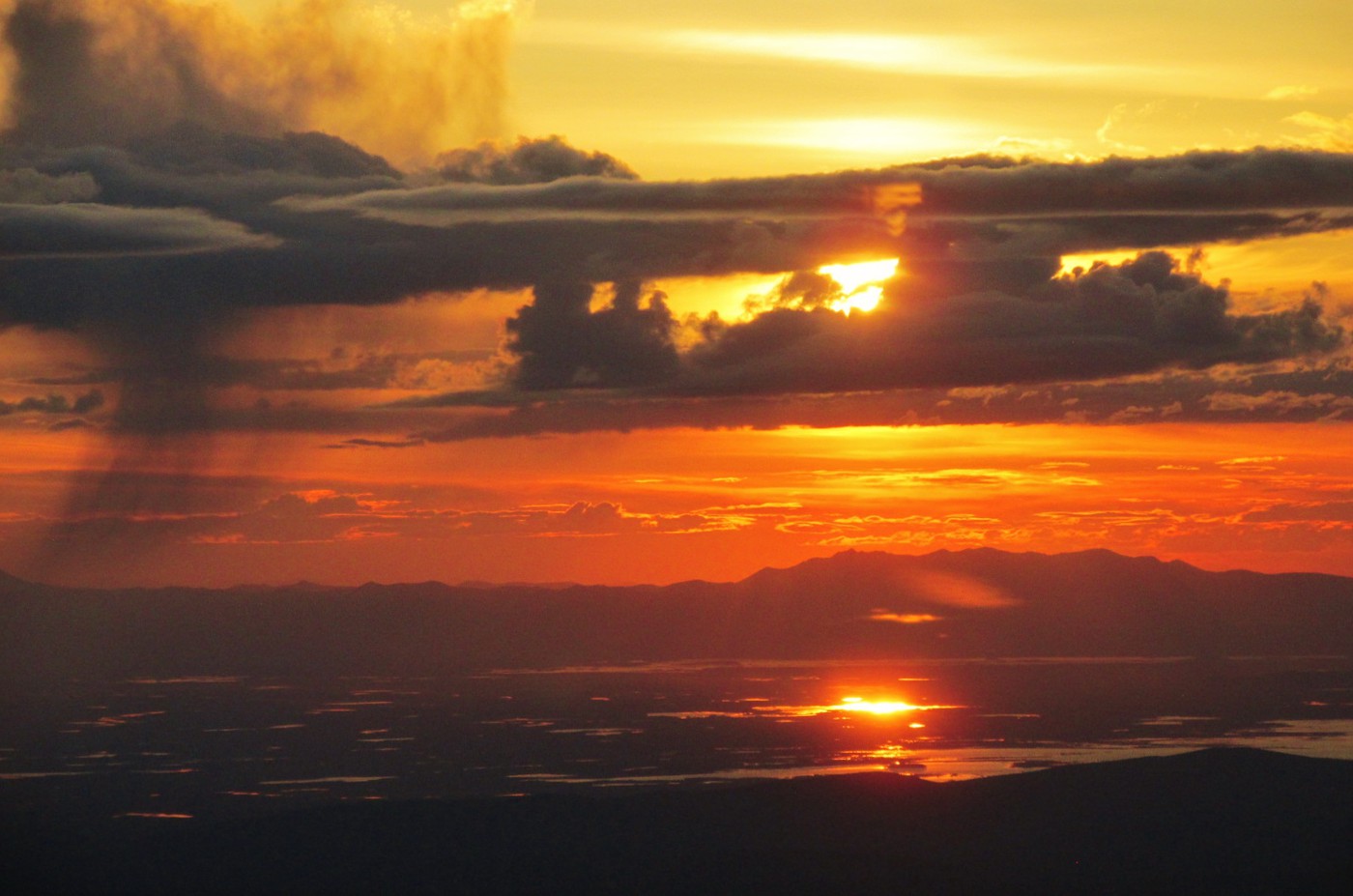
A pretty evening descent into Fairbanks
Touchdown was light as a feather and, following a loud and lengthy deployment of the thrust reversers, we taxied briskly into gate 1 and parked alongside an attractive red and black DHC-8-100 belonging to Ravn, Alaska’s largest intra-state carrier.
My neighbor Steve met me at the airport and we drove out to Ester for cold beers and cook-it-yourself burgers at the Golden Eagle Saloon. After 35000 miles of quality travel experience via road, rail, air and sea, it sure was good to be home.
* * * _ _ * * *
After having submitted more than seventy of these reports over the past seventeen years, I must admit that they’re becoming a bit more difficult to write in a timely fashion being as I’ve done it all so many times before. I don’t know how many more trip reports of this breadth and scope I have left in me but I do know that were it not for your continuing readership and enthusiastic endorsement of my past reports I probably wouldn’t have written more than a handful of them in the first place.
As such, I’d like to offer a multitude of thanks to all of you who’ve ever taken the time to read one of my trip reports and special thanks to all of you who’ve taken the time to read this report, be it in part or in full. I recognize that it takes a fair investment in time to read through 55000+ words of text as opposed to flipping through most photo reports, so to all of you who felt this report worthy of your time invested, I offer my heartfelt thanks for your readership.
As ever, I’m always happy to entertain any questions, comments or catcalls - though given my convoluted schedule in the coming weeks, response time may not always be as expeditious as I’d like.
Cheers from my desk here on a beautiful evening at Latitude 65°N.
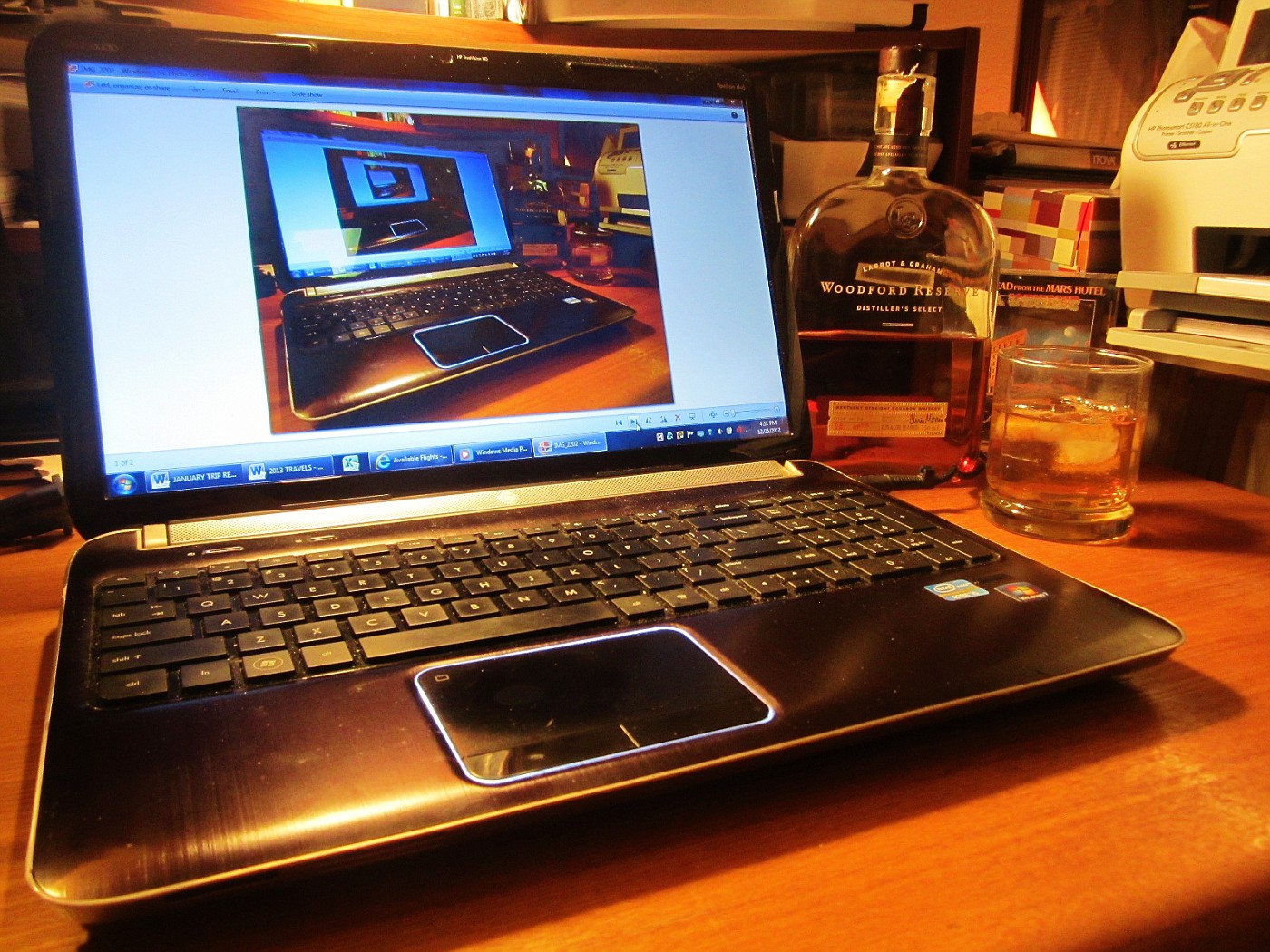
Cheers from a beautiful evening at Latitude 65°N