























Of the Original 1,050 Boeing 757, Can You Guess How Many Are Still in Service Today? — #TBT Week of February 15
 Joe Cortez February 19, 2015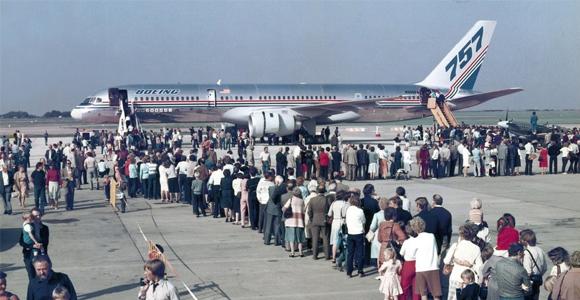

In the spirit of #TBT (“Throwback Thursday,” not Brazil’s Tabatinga Airport) FlyerTalk takes a look back at the events that helped shape modern aviation. Here are just a few moments from history that changed the face of the industry during the week of February 15.
February 15, 1946
Engineers and builders of the Douglas DC-6, touted as the upgrade of the DC-4, celebrated the first flight of the new aircraft. The new four-engine propeller aircraft boasted many technological upgrades, including a pressurized cabin and greater accommodations.
The DC-6 had a range of nearly 3,000 miles and was capable of transporting up to 102 passengers. Because of this longer range, the DC-6 would become one of the first aircraft regularly scheduled for around-the-world service.
February 16, 2013
After 22 years of being suspended from Kuwait, Iraqi Airlines flew its first flight from Baghdad International Airport (BGW) into the neighboring nation. The troubled airline was barred from flying direct from Baghdad as a result of the invasion of Kuwait in 1991.
Flights resumed after a set of repatriations were settled between Iraq and Kuwait, including a $300 million cash settlement to Kuwait and a $200 million investment in a joint airline project.
February 17, 1988
With increased interest in forming another airline in South Korea, the Kumho Group founded the basis of Seoul Air International — the airline that would ultimately become Asiana Airlines. With investment from Kumho, Korea Development Bank and other domestic companies, the new airline would fly its first scheduled service by the end of the year.
Within 10 years, the new airline would operate the South Korean presidential aircraft before going on to join Star Alliance in 2003.
February 18, 1956
Despite the building tension of the Cold War, Finnair would be the first western carrier to break through the Iron Curtain. The flag carrier of Finland flew the first regularly scheduled flight from Western Europe (Helsinki) to Moscow after World War II, operating two flights per week.
In nearly 60 years of flying the historic route, which it now operated daily, Finnair has shuttled upwards of 1.8 million passengers to Moscow.
February 19, 1982
The Boeing 757 — the aircraft that solidified hub-and-spoke planning as a medium-range workhorse — celebrated its first flight from Boeing’s headquarters. In a storied 23-year history, Boeing delivered 1,050 of the 757s to airlines around the world.
According to Boeing statistics, the 757 has transported more than 1.3 billion passengers since the first one was delivered to Eastern Airlines in 1982. Today, more than 1,030 of the delivered 757 aircraft remain in service.
February 20, 1965
Piedmont Airlines, one of the predecessors to US Airways and “The New American,” retired its final Douglas DC-3 exactly 15 years after it first entered passenger service. Credited as one of the airplanes that gave birth to modern commercial aviation, the DC-3 could be configured for either regular service or outfitted with the first lie-flat seats in sleeper service.
Today, that retired Piedmont DC-3 is on display at the North Carolina Transportation Museum.
February 21, 1971
Nearly 20 years after its formation as a helicopter service, All Nippon Airways operated its first international flight from Tokyo to Hong Kong with a Boeing 727. The route was recognized as ANA’s debut as an international player in the Asian marketplace.
Just over four months after ANA’s competitive debut, tragedy struck when one of the airline’s Boeing 727 collided mid-air with a Japanese Air Self-Defense Force F-86F fighter jet.
[Photo: East Midlands Airport via BBC]
You’re Reading



In July 2012, 860 of the narrow-body twinjets were in airline service, and Delta Air Lines was the largest operator with 169 aircraft.