






MORNING OF THE SUPPRESSION OF TERRORIST BANDS IN MOUNTAIN AREAS AND VILLAGERS AND SCHOOL CHILDREN SHOUTING IN DELIGHT
Bright if not so early the next morning I set off towards the village of Mae Salong, about 50 klicks northwest of Chiang Rai near the Burmese border. This pipsqueak of a village has a more interesting story than most: after the Commies under Mao established their rule over the whole country in the 1950s, one fragment of the Nationalist (Kuomintang/KMT) army made its way over to exile in Thailand. There the KMT trained its army for the day of return that was one day to come, and financed itself by growing opium and dealing in heroin, with notorious warlord Khun Sa living just around the corner.
The Thais weren't entirely happy about this state of affairs, and the KMT head honchos started to have their own doubts about the probability of imminent return, so the two struck a deal: the battle-hardened KMT would help the Thais squelch their own Communist insurgency, and they'd get Thai citizenship and help for crop substitution. Somewhat surprisingly, the plan worked -- the Reds got squished, the renegade Chinese became upstanding Thai citizens, and instead of opium fields, it's now tea plantations growing Taiwanese High Mountain Oolong that dot the hills of Mae Salong.
And that's where I found myself standing on a broiling hot April noon. It soon became clear that this was well off-season: the peak here is the winter, when the plums and cherries blossom and visitors come not just from Thailand but KMT's main territory of Taiwan as well. My only consolation was that April is tea harvest time, so leaves were drying out next to tea factories and the smell of roasting tea filled the air.
Guidebooks try to paint Mae Salong as a little Yunnanese Shangri-La, where KMT cadres with wispy Ho Chi Minh beards smoke suspiciously opium-y long pipes, but no, appearancewise it's pretty much a Thai town these days, complete with the obligatory Seven-Eleven in the little town square. I trekked up to the hilltop to see the Thai stupa and temple, detoured via the Mae Salong Resort (formerly a KMT training camp and still looking about as comfy as an army barracks), had a bowl of not very noteworthy noodles at the Yunnanist Noodle Shop and tried my hand at Chinese tea ceremony with an obliging if English-challenged tea shop hostess. And with the heat and the haze beating down, I felt I'd seen enough and took my leave. Maybe again someday in winter...
DAY OF THE YELLOW SURPRISE (A SPECIAL BRAND OF SIAMESE DRINKING WATER) EXPLOITED AT MAE SAI BY TUPTIMKUNA ICE FACTORY
I had toyed with the idea of dropping across the border into Tachileik for the day, but somehow the appeal of passing through four more convoluted immigration arrivals and exits had decreased in appeal after doing just that between Thailand and Laos, and anyway, did I really want to get my first taste of Myanmar by visiting what is, by all accounts, a dusty border town with little to see? So I contented myself with attempting to peek across the border from Mae Sai, where the Thais have tactfully erected a series of monuments commemorating King Naresuan, who beat back several Burmese invasions and personally dispatched their crown prince in a sword duel. The most memorable of these monuments is a giant scorpion, angrily brandishing its huge claws in the general direction of any Maew hordes who might dare come this way. The peek didn't amount to much (darn haze again), but hey, this was along the way anyway for my main destination of the day -- the Hall of Opium. I grabbed a bottle of Yellow Surprise (A SPECIAL BRAND OF SIAMESE DRINKING WATER EXPLOITED AT MAE SAI) and hopped aboard a tuk-tuk to the Golden Triangle.
My hopes were not very high, since every museum I've been to in Thailand -- and, for that matter, every museum I've been to in any South-East Asian country outside Singapore -- has sucked. But once I hopped off the songthaew and strolled through the landscaped grounds of the Hall, it became clear that this was no ordinary municipal dust-collector, and I bit the 500 baht bullet for an entry ticket and ventured inside.
The first section of the Hall of Opium is also the strangest: a dimly lit and weirdly colored twisty tunnel, with (you realize with a start) outlines of wraithlike, tortured figures embedded in the walls amid admonitions to pay attention and learn what opium does to you. After a brief breather in a large open-air hall complete with a little field of poppy, opium latex oozing out a few sliced-open pods (was it for real?), you're escorted in to watch a brief movie about the history of opium in the area and endless benevolence of their Majesties in putting a stop to it... and then the museum starts. And this was, perhaps, the most amazing part: hall after hall of pictures, objects and explanations, with life-size replicas, videos, headphones where appropriate. For most part, it was remarkably true to the facts even when those facts were inconvenient, with eg. thorough coverage of the Thai kingdom's former opium excise tax system, the political motivations behind the original ban and the CIA's dope-dealing through Air America. Only the very last sections on the unrequired evils of all drugs started to go a little overboard.
Somewhat dazed but quite thoroughly satisfied, I munched on some tasty poppy seed cookies at the gift shop and trekked the three km down to the Golden Triangle itself. This term has now been appropriated to describe the point when Myanmar, Laos and Thailand intersect, and since this isn't really very much to look at, the Thais have gone out of their way to dress it up into an absolutely ridiculous tourist trap. The once modest temple has sprouted a giant sitting Buddha perched upon an even more giant ship-shaped buildings and there are elephant statues topped with palanquins where you can clamber and have your photo taken (in exchange for a donation, of course). Every inch of the riverside is taken up with hawkers pushing cruises on the Mekong and every inch of the roadside opposite is taken up with souvenir stalls pushing junk.
I shoveled down some rather tasty fried kuey teow phat siiu noodles and made my escape, first snagging the songthaew down to Chiang Saen. This is the place where I was originally supposed to stay, and which turned out to be low-key but fairly nice, with some intriguing, half-overgrown ruins along the road out -- it was a shame that I had no time to explore. Another hour and a half by rattletrap local bus to Chiang Rai, and I was back in Wangcomeland.
Like most Thai provincial towns, Chiang Rai doesn't look like much at first sight, but once I'd ventured out of the night bazaar and my Wangcomely confines to the local restaurants and markets I'd started to appreciate it a little more. With my flight at midday, I had a few hours to kill in the morning, so I decided to skip the execrable hotel buffet and head out on a walking tour.
First stop was Po Sai, apparently one of Chiang Rai's best-known khao soi noodle joints and conveniently located right next to the Wang Come. A dish rarely seen outside northern Thailand, khao soi consists of noodles in thin chicken curry, topped with lime, shallots and pickled cabbage -- and while this may not sound like a recipe for culinary nirvana, when done right it's absolutely fantastic, and Po Sai's is the best I've tried yet.
And then I set off on my temple tour. Wat Klang Wiang is your standard-issue northern Thai temple, deserted early in the morning, with some gorgeous statuary and a handy "No Killing Area" sign. Wat Ming Meuang impressed with a squat but stately wiharn and an intricately carved sign written in the ancient (and long-dead) Lanna script. But Chiang Rai's top attraction is Wat Phra Singha ("Temple of the Holy Lion"). According to legend, this was just a fairly ordinary temple until one day in 1434, a bolt of lighting struck one of the chedis (stupas), splitting it open and revealing the Emerald Buddha, said by legend to date back to 43 BC in India (although archaeologists note that it looks suspiciously like 15th-century Lanna style). Adventures worthy of a comic book followed, with the statue moving to Lampang, Chiang Mai, captured by a Lao prince and taken to Luang Prabang and then Vientiane. Vientiane was sacked by the Thais in 1779, who brought it back. King Rama I finally built Bangkok's famous Temple of the Emerald Buddha in 1784, and that's where it's stayed ever since.
Today's Wat Phra Singha is royally supported and thus well funded temple overflowing with well-tended greenery and an excellent if compact two-story airconditioned museum, where a bored but amiable old monk likes to quiz visitors about Thailand. The museum contains a near-exact replica of the Emerald Buddha, although it was intentionally made 0.1 cm shorter than the real thing! The once-cracked (but long since repaired) chedi is in the middle and tucked away towards the back is the hall where real Emerald Buddha was once kept.
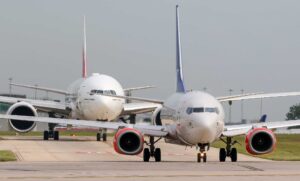
FLIGHT OF THE THAI AIR ASIA FD3255 B737-300 SEAT 19E
Like most Thai airports bearing the tag, Chiang Rai's "international" airport does not actually serve any international flights, and it feels rather too large for its modest volume of flights to Bangkok, Bangkok and more Bangkok (plus a daily hop to Chiang Mai).
As for Air Asia, it does what it says on the box. They've got a winning formula and they stick to it, so see this old trip report for the full scoop on the FD experience. Today's flight was on one of the slowly-being-phased-out 737s, but still in perfectly serviceable condition with leather seats and tolerable pitch, and our flight departed and arrived precisely on time and in one piece.
DAYS OF THE OK FAMILY HERE WE GO! LET'S ENJOY SHOPPING FOR YOUR EXCITING LIFE
With a little planned buffer time to kill, I headed down to the Magic Food Court down in Suvarnabhumi's basement and had a perfectly acceptable (if hardly magical) meal of rice with pork leg stew -- one of those ubiquitous Thai dishes that no tourist restaurant ever stocks, because the economics require a huge pot and dedication to serving this one dish alone. It's fatty, it's greasy, it melts in your mouth and it's aroy maak maak. (And you don't have to order the pig skin and intestines unless you want to.)
A good half hour ahead of time Z, having unintentionally abused her freshly minted Star Gold to go through Fast Track immigration, appeared fresh off her flight from Tokyo and we headed to the taxi queue. Our cabbie, smiling a little too toothily for comfort as we chattered away in the back seat, figured he could pull a fast one on us and he turned right (that is, to the east, towards Pattaya) at the junction from the airport to the Bang Na-Trat highway and then did a great big loop around the airport that padded the bill by a good 100 baht and added 30 min to our travel time. Not being too sure of the geography, I thought he was heading for some alternate route to the south (I usually stay around Sukhumvit, but this time we'd opted for the Hilton in Thonburi), but the penny dropped once the loop ended and we reached precisely the same highway -- and he didn't even drive onto it, just under.
On arrival at the hotel, the meter was showing ~450 and he cheekily told us it would be 600 with the surcharge and tolls (which in reality totaled 95 baht). I called him on the right turn after the airport, to which he tittered and made up some lame excuse about avoiding an accident... and then snatched the 500 baht we grudgingly gave him and skittered off. Welcome back to the big city!
But we didn't have much time to mope, as we'd booked two nights at the Millennium Hilton. Back when I first lived in Thailand around 2003, the building was still a skeleton left rotting after the 1999 financial crisis (remember that one?), and it was a real pleasure to find out what they'd done to it. I'm not much of a Hilton man, and I was staying here primarily to dispose of some points I'd had sitting around, but this is one excellent hotel -- even without any elite status at Hilton. Our room (and, as I understand it, all rooms) had great river views and the pool area downstairs had a little fake beach (less fun than you'd think) and recliners placed inside the pool itself (more fun than you'd think). Add in a large local market right next door, with an excellent array of Thai eats especially at dinnertime, and who needs executive lounges anyway?
Speaking of markets, though, Z had been converted to the religion of Chatuchak on her last visit to the Big Mango and the next morning I was somewhat reluctantly dragged along. Fortuitously, the March morning dawned unseasonally cool, and coupled with kinda-sorta-early morning start spending 3 hours poking around (me) and buying tons of stuff (her) at the Weekend Market was far less painful than usual. To counterbalance this surfeit of capitalism, we popped into the recently opened Bangkok Art and Culture Center just across from MBK, which even had a free coat check service where we could deposit our Chatuchak loot. If arriving by Skytrain, visitors are first greeted by Wit Pimkanchanapong's brilliant If There Is No Corruption -- unfortunately, it was pretty much downhill from there, with a mishmash of generic (read: largely incomprehensible) modern art that could have been from anywhere. Bah humbug, but points for trying anyway. (And it was, after all, free.)
The next morning, we decided to do something even more touristy, and visit the Grand Palace. We'd both been here once before, but ages ago, and I figured on getting a few new snaps since the last round didn't turn out too good. What I didn't figure on, though, was the crowd and (this time) the all too seasonal heat: the place was jampacked, with tourist buses disgorging their loads non-stop and slowly shuffling queues to get into the shrine of the Emerald Buddha. We took a breather by the Ramakiet murals, another in the blissful air-conditioned comfort of the Royal Regalia pavilion (top pick: the three clothing sets of the Buddha), and then escaped back to our hotel pool.
When in Chaing Rai, I always stay at the Dusit Island Resort. It used to be $US40 when I first started going there about 6 years ago. It presently is about 3200baht, but stay 3 nights and you get a suite, dinner, breakfast and sheets without wangcome for the same price. Become a free Dusit Gold and get it for much less if you can get there web-site to work. Book in Thailand and get if for even less.
The pool is very nice, but at the cheap rate, they do not heat it.
I've seen buses that will get you from the border without the long loop to Chang Rai plying the main road to Chiang Saen.
Sorry to see that you missed standing at the northernmost point in Thailand. If the crossing is open it is easy to get into Myanmar for a few hours. Just like Thailand but $5 more for the cost of the visa.
Hilton is very nice especially on the executive floor. It is probably the best SE Asian Hilton property about on a par with the KL Hilton. Yes, the Conrad Singapore is nicer but it is branded Conrad not Hilton. Next time splurge and put Z on the executive floor.
Enjoyed your report. Perhaps, I will fly into Luang Namtha on my next visit to Laos since you make it sound worthwhile.